Transmission Operator
VAR focus
Voltage schedules, reactive scheduling, exemptions and GOP communications under VAR-001
How Keentel helps
Voltage schedule and reactive studies, documented basis for schedules and bandwidths

Your Trusted Partner in Electrical Engineering and Power Systems
At Keentel Engineering, we deliver electrical power engineering services built on 30 years of experience and a commitment to excellence. Our clients include utilities, developers, EPCs, and public agencies across the U.S.
Unlike firms that sacrifice technical depth to chase billable hours, we prioritize precision, compliance, and value engineering. From transmission services and relay modeling to winterization and SCADA planning, we never compromise on quality.

At Keentel Engineering, we take pride in being the go-to electrical power engineering firm for power and utility system planning, substation design, protection, control, and power system analysis. The following attributes distinguish our team in utility-grade substation engineering and compliance-driven project delivery.
With three decades of hands-on project delivery, we bring unmatched expertise in substation layout design, substation electrical and civil engineering, relay protection, and grid-tie solutions. Our experience includes projects in complex terrain, urban retrofit environments, and utility-scale renewable integrations.
Our engineering process applies AutoCAD 3D, BIM modeling, and system-level substation design practices to ensure accurate planning, reduced errors, and efficient coordination across all project stakeholders.
Our workflow includes 3D substation design, enabling clash-free coordination between structural, electrical, and civil disciplines.
From grounding grid studies to relay protection settings, we engineer every detail to improve system reliability, performance, and operational safety. Our rigorous QA/QC process ensures compliance with IEEE, NFPA, and ISO/TSO interconnection standards.
Among leading electrical substation design companies, Keentel Engineering stands out for 30+ years of proven high-voltage and utility-grade project delivery.




First name, email and what you're interested in are all we need to get moving. Everything else, including drawings or an RFP, is optional.
Under VAR-001, the Transmission Operator is responsible for voltage and reactive control in its area: specifying voltage schedules, scheduling reactive resources and operating to keep voltages within limits. Under VAR-002, the Generator Operator operates each unit with its automatic voltage regulator in voltage control mode unless the TOP has exempted it, maintains the schedule it has been given and notifies the TOP of status and capability changes. The Generator Owner supplies step-up transformer tap information and changes. In the WECC region, VAR-501-WECC adds a regional requirement for power system stabilizers on applicable synchronous units.
The common thread is verifiable data. A voltage schedule is only achievable if the reactive capability behind it is real, and an AVR is only in voltage control mode if its settings and limiters say so.
IDs are shown without version suffixes. Confirm the version in effect for your facility and audit period and check Section 4 (Applicability) for unit and facility criteria.
| Standard (Keentel page) | Title | Applicable functions | Typical evidence |
|---|---|---|---|
| VAR-001 | Voltage and Reactive Control | TOP | Voltage schedules and their basis, reactive resource scheduling, system voltage limits, exemption decisions and communications to GOPs |
| VAR-002 | Generator Operation for Maintaining Network Voltage Schedules | GO, GOP | AVR operating-mode logs, voltage schedule adherence records, TOP notifications, GSU tap information and change notices |
| VAR-501-WECC | Power System Stabilizer | GO, GOP (WECC region) | PSS in-service records, tuning and test documentation, outage notifications, applicability determinations |
| MOD-025 (Page 48) | Verification and Data Reporting of Generator Real and Reactive Power Capability and Synchronous Condenser Reactive Power Capability | GO, TO | Capability test or verification data and reported capability |
| MOD-026 (Page 49) | Verification of Models and Data for Generator Excitation Control System or Plant Volt/Var Control Functions | GO, TP | Verified excitation or plant volt/var control models and supporting test data |
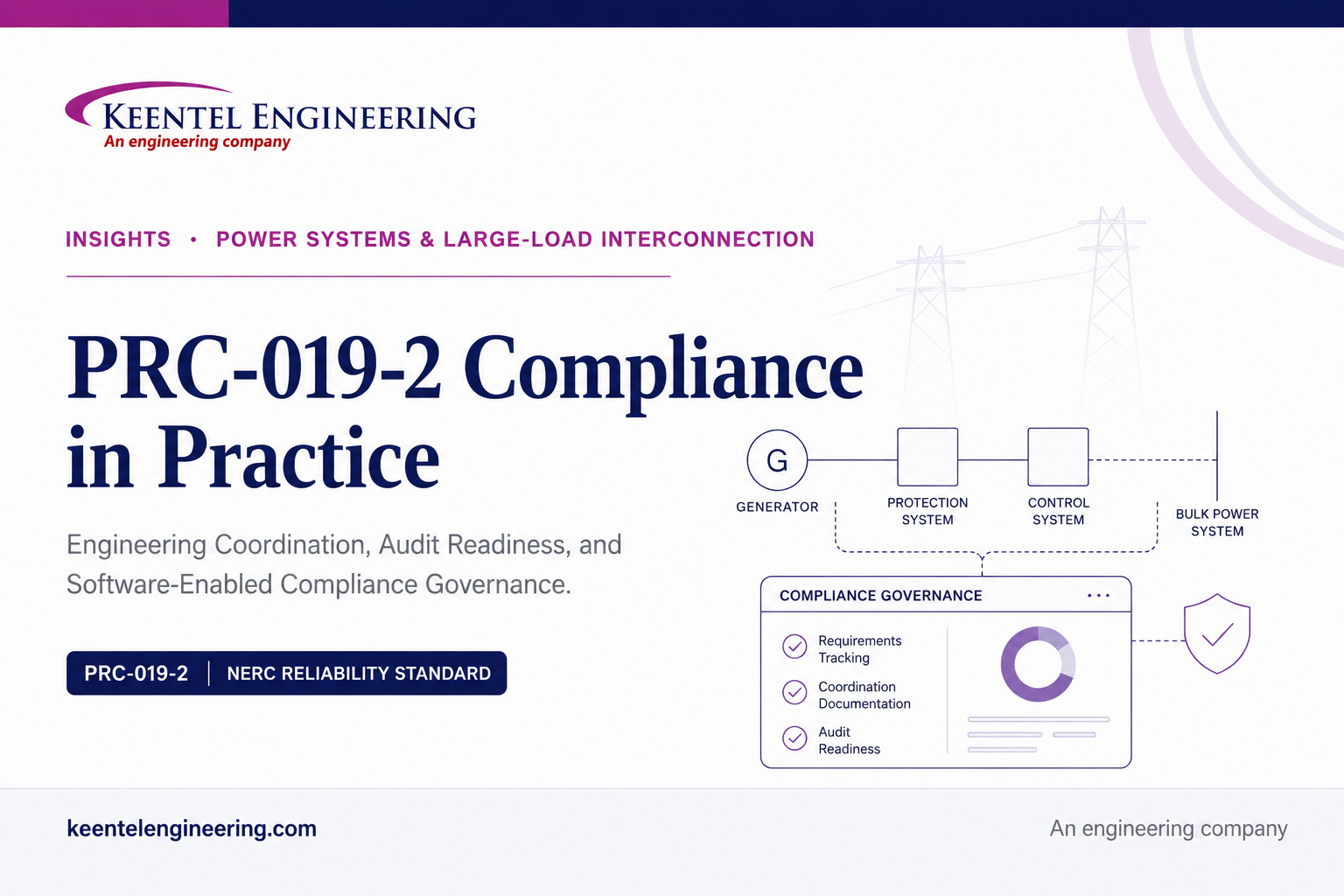
| PRC-019 (Page 40) | Coordination of Generating Unit or Plant Voltage Regulating Controls, Limiters, Equipment Capabilities and Protection | GO; TO with synchronous condensers | Coordination of voltage regulating controls and limiters with equipment capability and protection |
Function abbreviations: TOP Transmission Operator · GO Generator Owner · GOP Generator Operator · TO Transmission Owner · TP Transmission Planner.
Voltage schedules, reactive scheduling, exemptions and GOP communications under VAR-001
Voltage schedule and reactive studies, documented basis for schedules and bandwidths
Operating in automatic voltage control mode, meeting the schedule, timely notifications under VAR-002
Procedure review, notification workflow, operator guidance and evidence mapping
GSU tap information and change notices under VAR-002; PSS under VAR-501-WECC where applicable
GSU tap documentation, AVR and PSS settings review, capability verification
AVR mode and limiters, PSS in WECC, reactive capability curve
AVR/PSS model and settings review, MOD-025 capability, PRC-019 coordination
Plant-level voltage control through the power plant controller and inverters
Plant voltage controller review, reactive capability at the point of interconnection, PSCAD™ or PSS®E verification
For IBRs, “automatic voltage control mode” lives in the power plant controller. Mode selection, droop, deadband and reactive limits are configured there and in inverter settings — evidence depends on retrieving and documenting them.
For synchronous units, AVR mode, excitation limiters and PSS status are the core records, supported by verified models and capability data.

As IBRs make up more of the generation fleet, TOPs rely on plant controllers for voltage support, and the evidence for VAR-002 increasingly comes from controller configurations rather than exciter panels.
Newly registered GO/GOP IBR owners take on VAR-002 obligations for their plants as registration and applicable implementation plans take effect.
FERC Order No. 901 directs NERC to address IBR model validation and data sharing in phases, which is expected to raise expectations for the plant controller models and capability data that underpin voltage schedules.
Reactive capability reported under MOD-025, models verified under MOD-026 and limiter coordination under PRC-019 are increasingly reviewed together with VAR evidence.
confirm the notification process works on nights and weekends and that every AVR or PSS status change is logged with time and recipient.
confirm the TOP has current GSU tap information and that tap changes trigger a notice.
document the plant controller’s voltage control mode, setpoints and reactive limits, and confirm they match what the TOP expects.
make sure each voltage schedule has a documented basis and has been communicated to the right GOP.
reconcile reported reactive capability with MOD-025 results so the numbers used in operations are the verified ones.
Many VAR obligations are event-driven. Exact notification timelines and review periods come from the standard version in effect and your TOP’s instructions.
| Activity | Typical cadence | Standards |
|---|---|---|
| Operation in automatic voltage control mode and schedule adherence | Continuous | VAR-002 |
| Notification of AVR, PSS or capability status changes | Event-driven, within the timelines in the standard | VAR-002, VAR-501-WECC |
| Voltage schedule issue and revision | When the TOP issues or revises a schedule | VAR-001, VAR-002 |
| GSU tap information and change notices | On request and after tap changes, per the standard | VAR-002 |
| Reactive capability verification | Periodic, on the cycle in the standard, and after relevant equipment changes | MOD-025 |
| Excitation or plant volt/var model verification | Periodic and after relevant changes, per the standard | MOD-026 |
| PSS tuning and in-service verification | Per the regional standard and unit commissioning or modification | VAR-501-WECC |

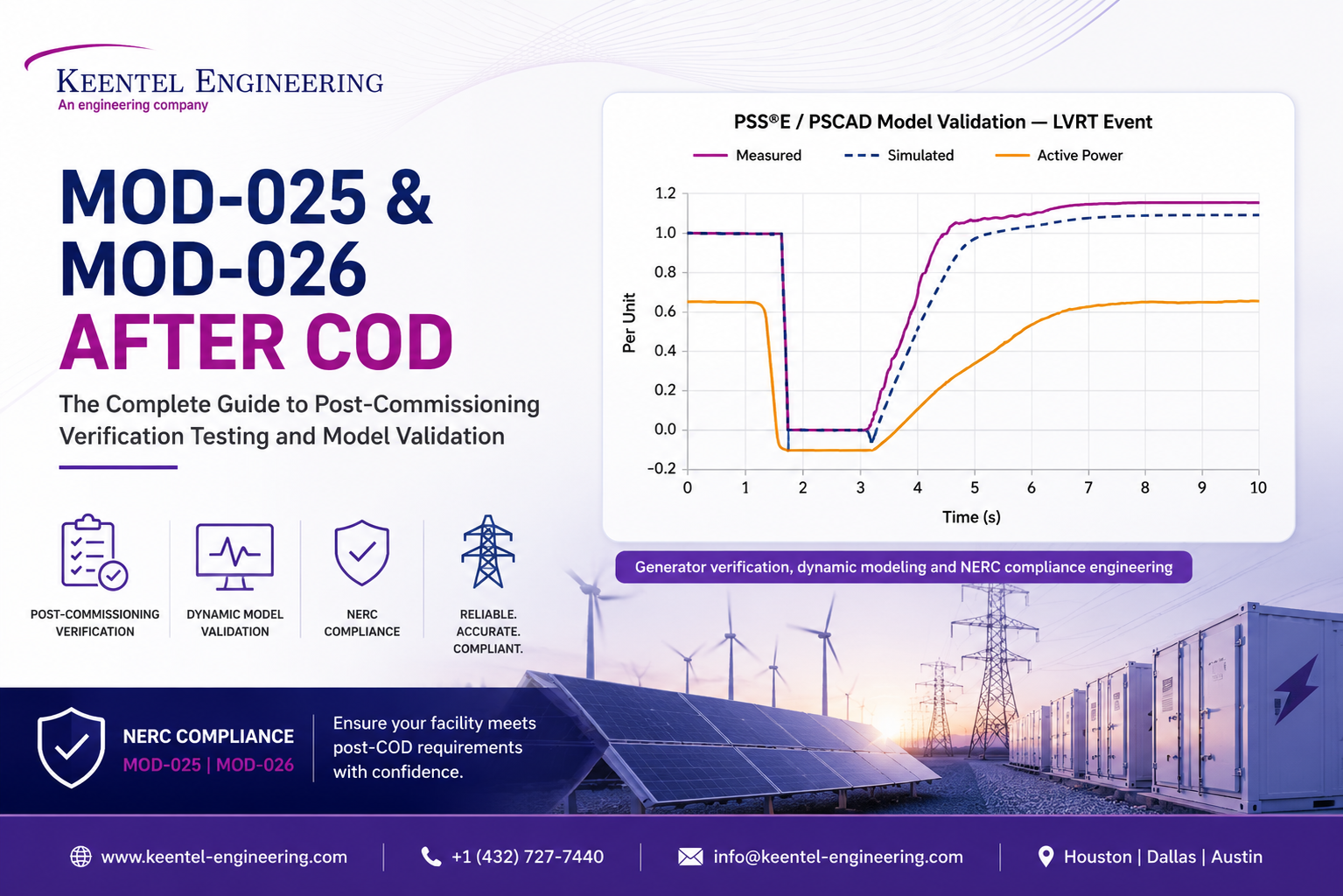
MOD-025 test planning, data review and capability reporting that give VAR-002 schedules a verified foundation (Inner Page 48).
For TOPs and plants: studies of achievable voltage schedules and bandwidths given capability, GSU taps and system conditions.
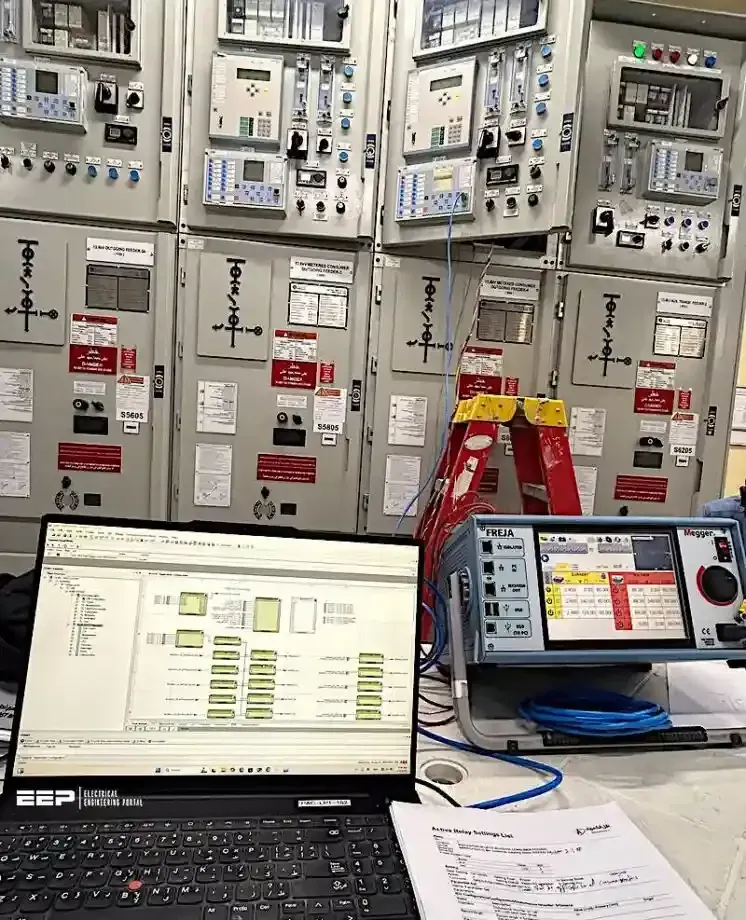
Review of excitation, limiter and stabilizer settings and models, including IEEE 421.5 model representation and MOD-026 alignment.
Power plant controller mode, droop, deadband and reactive limit review, with simulation in PSS®E or PSCAD™ where needed.
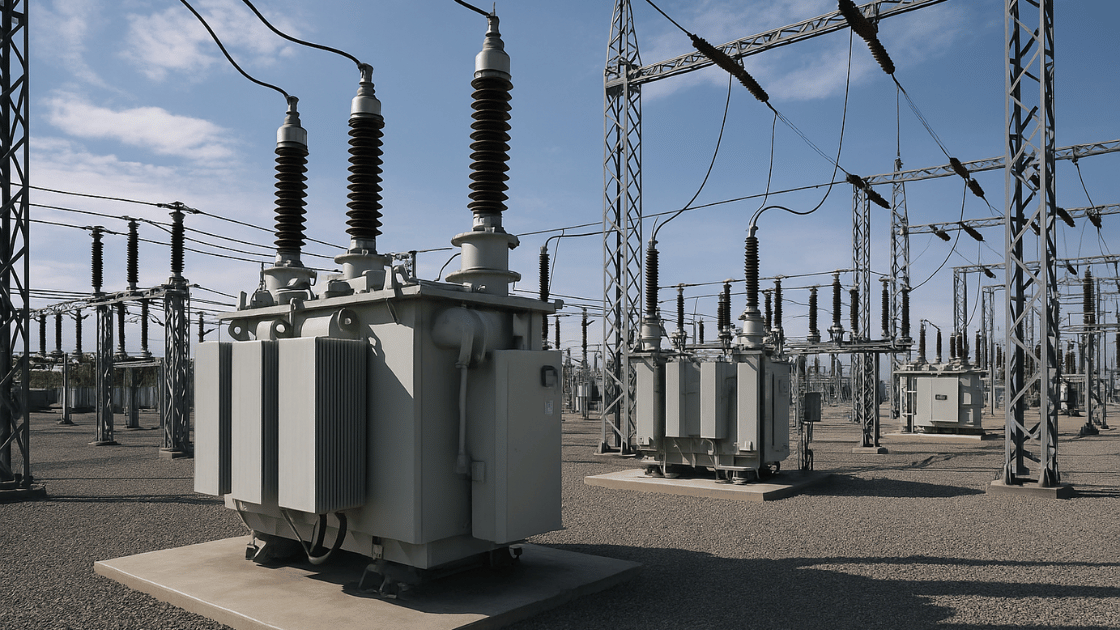
Tap position, range and impedance records assembled for VAR-002 requests and change notices.
GOP notification procedures, logs and requirement-mapped evidence for audit.
Identify which VAR requirements apply to each unit or plant, including any regional requirements.
Voltage schedules, AVR and PSS settings, plant controller configuration, GSU data, capability tests and logs.
Check reactive capability, control settings, models and limiter coordination against each other.
Walk through the notification and logging workflow with the GOP to confirm it produces evidence.
Recommend setting, study, procedure or data corrections and verify them.
Issue the evidence package and keep it current as equipment or schedules change.
| Deliverable | What it gives you |
|---|---|
| VAR applicability summary | Each unit or plant mapped to the VAR requirements that apply |
| Reactive capability report | Verified capability at the terminals and point of interconnection, reconciled with MOD-025 |
| Voltage schedule study | Achievable schedule and bandwidth with documented assumptions |
| AVR / PSS / plant controller review | Settings, modes and models checked against expectations and standards |
| GSU tap data sheet | Tap information ready for TOP requests and change notices |
| Notification procedure and evidence index | A workable GOP process and a requirement-mapped record of compliance |

| Gap | Consequence |
|---|---|
| AVR or PSS status changes not logged | The unit may have been compliant, but the entity cannot demonstrate it. |
| Notifications made but not recorded | No evidence of who was told, or when. |
| Reported reactive capability differs from verified capability | Schedules and operating studies rely on numbers the unit cannot deliver. |
| IBR voltage control mode undocumented | The owner cannot show the plant was regulating voltage as required. |
| GSU tap information out of date | The TOP’s schedule assumptions no longer match the installed transformer. |
| Limiter settings not coordinated | VAR operation and PRC-019 coordination evidence conflict with each other. |
MOD-025 reactive capability and MOD-026 excitation or plant volt/var models are the technical backbone of VAR evidence.
PRC-019 requires voltage regulating controls and limiters to coordinate with equipment capability and protection.
TOP-003 data specifications often request AVR, PSS and reactive capability data used in voltage control.
Planning models and voltage-based SOLs depend on accurate reactive capability and control models.
Plant controller and inverter settings that govern voltage control also shape ride-through behavior.
GO and GOP registration, including Category 2 IBRs, determines who holds VAR-002 obligations.
Send us your voltage schedule, capability data and AVR or plant controller settings. Keentel will verify they agree, close the gaps and organize the VAR evidence for audit.
Serving utilities, EPCs, developers, and infrastructure organizations supporting critical power systems nationwide.