

A Coordinated Electric System Interconnection Review—the utility’s deep-dive on technical and cost impacts of your project.

Challenge: Frequent false tripping using conventional electromechanical relays
Solution: SEL-487E integration with multi-terminal differential protection and dynamic inrush restraint
Result: 90% reduction in false trips, saving over $250,000 in downtime

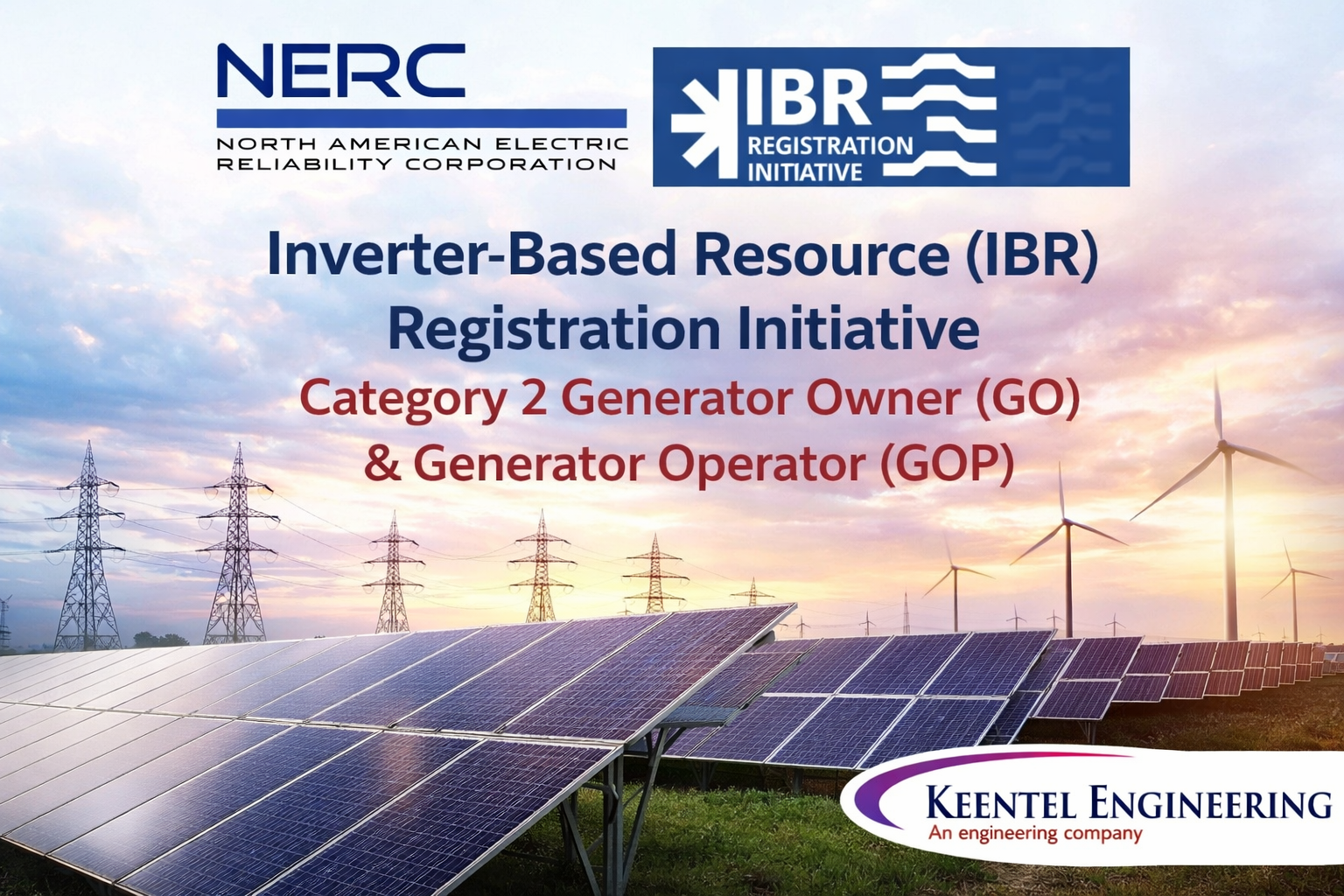
Inverter-Based Resource (IBR) Registration Initiative: What Category 2 Generator Owners and Operators Need to Know

IBR Registration Initiative for Category 2 Generator Owners and Operators
Calendar icon. D

january 30, 2026 | Blog

Introduction

The rapid growth of inverter-based resources (IBRs) including solar PV, wind, battery energy storage systems (BESS), and hybrid facilities has fundamentally changed how the Bulk Power System (BPS) operates. While these resources bring flexibility and decarbonization benefits, they also introduce new reliability risks if not properly modeled, operated, and governed.

To address these challenges, the North American Electric Reliability Corporation (NERC) launched the IBR Registration Initiative, a multi-year effort to bring previously unregistered BPS-connected IBR owners and operators under the NERC compliance framework. As of May 2025, the initiative has entered its third and final phase: registration with a firm compliance effective date of May 15, 2026 for newly registered Category 2 entities 


This article explains:

  • What Category 2 Generator Owner (GO) and Generator Operator (GOP) registration means
  • Who must register and why
  • Key timelines, documentation, and risks
  • How Keentel Engineering supports IBR owners through registration and ongoing NERC compliance

Understanding Category 2 GO and GOP Registration

What Is Category 2?

NERC revised its Rules of Procedure (ROP) to formally define Category 1 and Category 2 Generator Owners and Operators. Category 2 primarily captures IBR facilities that were historically outside the NERC compliance registry but now meet revised Bulk Electric System (BES) and aggregation criteria 


In practical terms, Category 2 typically includes:

  • Solar, wind, BESS, and hybrid facilities
  • Aggregated resources ≥ 20 MVA
  • Facilities interconnected at ≥ 60 kV
  • Assets connected to the BPS, even if individually smaller

If a facility aggregates with others to exceed the threshold at a common point of connection, all participating facilities become Category 2 assets, triggering registration obligations 


Why This Registration Matters

Many IBR owners are encountering NERC registration for the first time. This is not a paperwork exercise it is a fundamental shift in regulatory exposure.


Once registered, Category 2 GO/GOPs become subject to:

  • Mandatory NERC Reliability Standards
  • Audit readiness expectations
  • Model validation, protection, and performance requirements
  • Event reporting, disturbance analysis, and coordination obligations


Failing to engage early increases the risk of:

  • Incomplete or incorrect registration
  • Delayed approvals
  • Compliance gaps at the May 2026 enforceability date

NERC and the Regional Entities have been clear: timely cooperation is mandatory, not optional 


Registration Timeline and Key Milestones

According to NERC, Category 2 registrations are being processed in batches between August 2025 and April 2026, with a universal effective registration date of May 15, 2026 


Key takeaway:

Even though compliance enforcement begins in May 2026, registration activities are happening now, and Regional Entities are operating on different schedules.

Keentel strongly recommends initiating internal readiness at least 9–12 months before the effective date.


Required Documentation for Category 2 Registration

Entities must submit detailed technical and contractual information through CORES or a Regional Entity secure portal, including 

:

  • Completed GO/GOP Asset Verification Form
  • Interconnection Agreement (and amendments)
  • Operating and third-party O&M agreements
  • Electrical one-line diagrams (from resource to POI)
  • Inverter or turbine nameplate data

This documentation is not just administrative—it becomes the foundation for:

  • BES applicability determination
  • Compliance scope
  • Future audits and enforcement actions

Confidentiality and Data Protection

Some asset owners hesitate to share technical data without an NDA. NERC explicitly states that NDAs are not required. Instead, all submitted data is protected under ROP Section 1500 (Confidential Information), which legally binds Regional Entities to safeguard sensitive information 


Multi-Regional Entities and Phased Projects

Facilities in Multiple Regional Entities

If your organization owns or operates Category 2 facilities across multiple Regional Entity footprints:

  • You must comply with each Regional Entity’s timeline
  • Registrations may not be synchronized
  • Separate approval letters may be issued

Phased Commercial Operation

Projects coming online in phases must register early, even if initial phases only meet Category 2 thresholds and later phases may elevate the facility to Category 1 status 


Life After Registration: What Changes?

Once registered, Category 2 entities must prepare for:

  • Applicable NERC Reliability Standards (per the quarterly compliance dates matrix)
  • Future transition to GADS reporting (effective May 15, 2026)
  • CMEP oversight and possible inclusion in the Coordinated Oversight Program
  • Cyber and physical security participation via E-ISAC membership (a free benefit of registration) 

How Keentel Engineering Supports Category 2 IBR Owners

Keentel Engineering specializes in bridging the gap between registration and real-world compliance. Our services include:

Registration & Applicability Support

  • Category 2 GO/GOP determination
  • BES and aggregation analysis
  • Registration strategy across multiple Regional Entities

Technical Documentation & Engineering

  • One-line diagram development and validation
  • Inverter and BESS nameplate verification
  • Interconnection and operating agreement reviews

NERC Compliance Readiness

Long-Term Compliance Support

  • Ongoing advisory services
  • Model validation updates
  • Event response and disturbance analysis support

Expanded FAQ – Practical Answers for Asset Owners

  • Do I still need to submit documentation if I believe my asset does not meet Category 2 criteria?

    Yes. Self-determinations do not replace Regional Entity evaluations. All requested documentation must be submitted before a formal decision is issued 


  • What if I don’t yet know who my GOP will be?

    Register as both GO and GOP. The registration can be revised later once a formal GOP is designated 


  • When do GADS requirements begin?

    GADS reporting is not required until May 15, 2026, but early confirmation submissions are recommended 


  • Can Category 2 entities join the Coordinated Oversight Program?

    Yes, provided the organization operates in two or more Regional Entities. Any changes will be formally processed after the registration effective date 

  • What is E-ISAC and why does it matter?

    E-ISAC provides threat intelligence for cyber and physical security risks and is a free benefit of NERC registration, offering significant operational value to new registrants 


Final Thoughts

The IBR Registration Initiative is not just a regulatory formality—it represents a structural shift in how inverter-based resources are governed within the North American grid. For Category 2 Generator Owners and Operators, early action, strong engineering support, and compliance-focused planning are essential.

Keentel Engineering stands ready to guide IBR owners through every phase—from registration to full NERC compliance—so there are no surprises when May 2026 arrives.


A smiling man with glasses and a beard wearing a blue blazer stands in front of server racks in a data center.

About the Author:

Sonny Patel P.E. EC

IEEE Senior Member

In 1995, Sandip (Sonny) R. Patel earned his Electrical Engineering degree from the University of Illinois, specializing in Electrical Engineering . But degrees don’t build legacies—action does. For three decades, he’s been shaping the future of engineering, not just as a licensed Professional Engineer across multiple states (Florida, California, New York, West Virginia, and Minnesota), but as a doer. A builder. A leader. Not just an engineer. A Licensed Electrical Contractor in Florida with an Unlimited EC license. Not just an executive. The founder and CEO of KEENTEL LLC—where expertise meets execution. Three decades. Multiple states. Endless impact.

Four workers in safety vests and helmets stand with arms crossed near wind turbines.

Let's Discuss Your Project

Let's book a call to discuss your electrical engineering project that we can help you with.

Man in a blazer and open shirt, looking at the camera, against a blurred background.

About the Author:

Sonny Patel P.E. EC

IEEE Senior Member

In 1995, Sandip (Sonny) R. Patel earned his Electrical Engineering degree from the University of Illinois, specializing in Electrical Engineering . But degrees don’t build legacies—action does. For three decades, he’s been shaping the future of engineering, not just as a licensed Professional Engineer across multiple states (Florida, California, New York, West Virginia, and Minnesota), but as a doer. A builder. A leader. Not just an engineer. A Licensed Electrical Contractor in Florida with an Unlimited EC license. Not just an executive. The founder and CEO of KEENTEL LLC—where expertise meets execution. Three decades. Multiple states. Endless impact.

Leave a Comment

Related Posts

FERC Order 2023 interconnection process diagram showing power generation
By SANDIP R PATEL May 1, 2026
FERC Order 2023: interconnection reforms, cluster studies & grid impact. Learn key changes fast.
Transmission line design infographic with BIM and power engineering solutions
By SANDIP R PATEL April 27, 2026
Explore advanced transmission line design services with BIM modeling, automated calculations, digital twins, and power engineering solutions by Keentel.
PJM Dynamic Model Guidelines 2026 infographic for utility-scale interconnection,
By SANDIP R PATEL April 27, 2026
Learn PJM dynamic model development, PSS®E model validation, and interconnection compliance requirements. Discover expert strategies for approval.
PJM NextGen application guide for utility-scale energy projects with solar, wind and battery storage
By SANDIP R PATEL April 25, 2026
Master the PJM NextGen application guide for utility-scale projects. Learn interconnection steps, technical data, and avoid delays. Get started today.
DC supply selection schemes improving reliability in HV, MV and LV protection systems
By SANDIP R PATEL April 24, 2026
Learn how DC supply selection schemes improve protection system reliability with dual DC architecture, redundancy, and anti-pumping solutions. Discover more.
Generator protection and control engineering solutions for power system stability
By SANDIP R PATEL April 24, 2026
Learn generator protection control engineering, ANSI 25 synchronization, relay schemes, and power system protection best practices. Discover expert solutions.
Solar capacity and availability testing for utility-scale power systems
By SANDIP R PATEL April 22, 2026
Utility-scale solar capacity testing, solar availability testing, and ASTM E2848 support for bankable performance. Learn more with Keentel.
PSCAD EMT vs RMS simulation infographic for power system stability, load flow, short circuit,
By SANDIP R PATEL April 22, 2026
Compare RMS vs EMT simulation using PSCAD. Learn when to use each for power system studies, inverter modeling, and grid stability. Discover more.
PSCAD power system modeling and simulation services for EMT studies.
By SANDIP R PATEL April 22, 2026
Explore PSCAD modeling, EMT simulation, and grid interconnection studies with expert insights. Learn advanced power system analysis techniques today.