

A Coordinated Electric System Interconnection Review—the utility’s deep-dive on technical and cost impacts of your project.

Challenge: Frequent false tripping using conventional electromechanical relays
Solution: SEL-487E integration with multi-terminal differential protection and dynamic inrush restraint
Result: 90% reduction in false trips, saving over $250,000 in downtime

Navigating PRC-029-1- Enhancing Grid Reliability Through Inverter-Based Ride-Through Requirements

Calendar icon. D

July 31, 2025 | Blog

Overhead power lines with connected icons: factory, house, phone, solar panel, and truck, over city at dusk.

Introduction

As inverter-based resources (IBRs) increasingly dominate the power generation landscape, North American Electric Reliability Corporation (NERC) has taken a critical step with PRC-029-1—a standard developed to bridge the performance gap between IBRs and synchronous generators during system disturbances. PRC-029-1, titled “Frequency and Voltage Ride-Through Requirements for Inverter-Based Generating Resources,” outlines how IBRs must behave during frequency and voltage excursions, ensuring they contribute to, rather than destabilize, grid reliability.


The Driving Force: Why PRC-029-1 Was Developed

Historically, PRC-024 addressed ride-through requirements but was found inadequate for managing IBR behavior during system events. The unique nature of IBRs—fast-switching, electronically interfaced resources—requires specialized performance criteria. Their control systems are programmable but constrained by equipment limits. As a result, inconsistent ride-through performance led to widespread reliability concerns, especially during major disturbance events.

PRC-029-1 not only aligns partially with IEEE 2800-2022, but also responds directly to mandates issued by the Federal Energy Regulatory Commission (FERC) in Order No. 901. It defines event-based criteria that reflect real-world IBR behavior during system faults, frequency dips, and voltage excursions.


Key Features of PRC-029-1

1. Event-Based Compliance

Unlike conventional modeling-only standards, PRC-029-1 is primarily performance-based. It mandates field-verified ride-through behavior while also requiring simulation evidence.

2. Defined Frequency and Voltage Zones

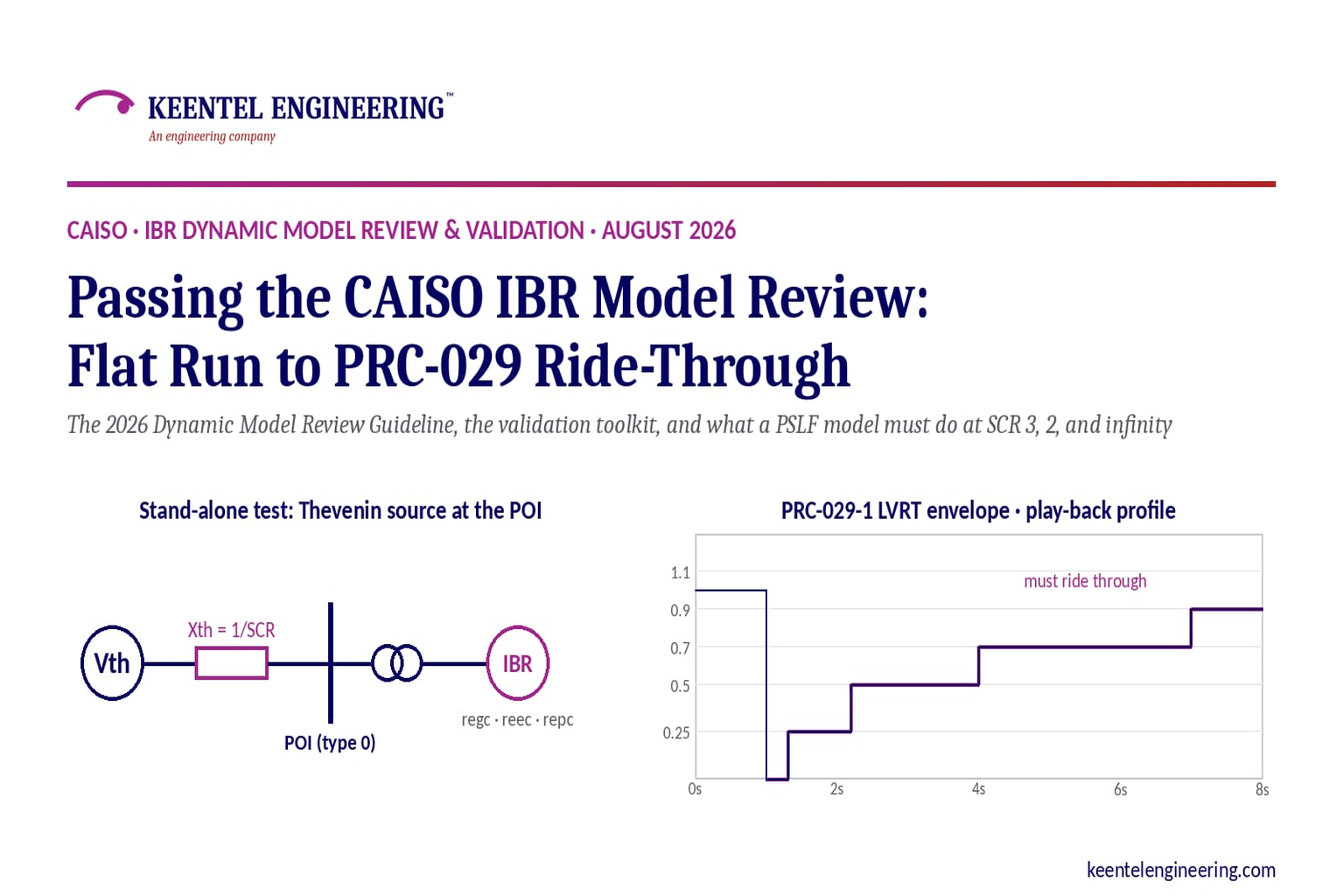
Using Attachment 1, PRC-029-1 introduces clearly defined voltage and frequency ride-through zones. These reflect more tolerant thresholds than synchronous generator standards, given IBRs’ lower sensitivity to such deviations.

3. FERC-Directed Enhancements

From requiring continuous current injection during faults to prohibiting momentary cessation in the ride-through zone, FERC Order No. 901 played a pivotal role in shaping PRC-029-1's provisions.


Detailed Requirements Breakdown

Requirement R1: Voltage Ride-Through Capability

R1 mandates that IBRs must not trip or cease current exchange within defined ride-through zones. It standardizes voltage thresholds at the high-side of the main power transformer and expects IBRs to manage phase angle jumps up to 25 electrical degrees. Loss-of-synchronism protection must be configured conservatively or disabled to prevent premature tripping.

Requirement R2: Voltage Performance During Disturbances

R2 sets operational expectations across three regions:

  • Continuous Operation Region: Return to pre-disturbance power.
  • Mandatory Operation Region: Inject reactive current proportionally to voltage deviation.
  • Permissive Region: Allow limited current blocking but re-engage within 5 cycles.

Subparts R2.1 through R2.5 further detail AVR behavior, reactive power prioritization, and safe recovery protocols post-fault.

Requirement R3: Frequency Ride-Through

Recognizing that IBRs lack inertia, R3 mandates a broader 6-second ride-through window (56–57 Hz and 61.8–64 Hz). It introduces rate-of-change-of-frequency (ROCOF) limits, requiring IBRs to tolerate ROCOFs up to 5 Hz/sec. Only in extreme ROCOF cases may tripping be permissible.

Requirement R4: Exemptions for Legacy Equipment

To accommodate existing non-compliant IBRs, R4 allows documented exemptions—but only for specific voltage durations and conditions. These exemptions must be shared with system planners and must be voided if limitations are rectified.


Implications for Developers, Owners, and Grid Operators

  • Developers must ensure new IBR designs support wide frequency and voltage ride-through.
  • Owners must update protection settings and verify real-time performance.
  • Operators and Planners will rely on improved IBR performance data for grid modeling and contingency planning.

Integration with IEEE 2800-2022 and PRC-024

PRC-029-1 enhances and partially replaces PRC-024 for IBRs, aligning with IEEE 2800-2022 thresholds but enforcing additional field-verified compliance. Unlike IEEE 2800, PRC-029-1 includes event-specific criteria and exemption mechanisms tailored to North American bulk power system reliability.


Conclusion

PRC-029-1 represents a transformative shift in how NERC approaches IBR integration. It ensures these modern assets do not compromise system reliability but instead act as dynamic, dependable grid contributors. For Keentel Engineering clients and partners, understanding and implementing PRC-029-1 is critical for interconnection success and regulatory compliance.


Technical FAQs on PRC-029-1

  • What is the main goal of PRC-029-1?

    To ensure IBRs remain connected and exchange current during defined frequency and voltage excursions.

  • How does PRC-029-1 differ from PRC-024?

    It is performance-based, tailored to IBR characteristics, and includes ROCOF considerations.

  • What voltage thresholds are used?

    Thresholds are measured at the high-side of the main power transformer, aligning with IEEE 2800-2022.

  • What defines compliance under PRC-029-1?

    Field event performance is primary; models and simulations are supporting evidence.

  • What is momentary cessation?

    A condition where IBRs stop injecting current—prohibited in the must ride-through zone.

  • What frequency ranges are covered in R3?

    56–57 Hz and 61.8–64 Hz must be tolerated for at least 6 seconds.

  • Are exemptions allowed?

    Only for legacy equipment under R4, with strict documentation and planner communication.

  • What is ROCOF and how is it treated?

    Rate of Change of Frequency. Ride-through is mandatory for ROCOF ≤ 5 Hz/sec.

  • Is IEEE 2800 compliance sufficient?

    No. PRC-029-1 may exceed IEEE 2800 requirements in some areas.

  • What is the Continuous Operation Region?

    The voltage range where IBRs must fully return to pre-disturbance power.

  • Can IBRs prioritize reactive current?

    Yes, by default. But transmission operators may require active power prioritization.

  • What is PLL loss-of-synchronism protection?

    A trip mechanism when phase angle shifts exceed thresholds; should be disabled for BPS IBRs.

  • What’s the purpose of Attachment 1?

    It defines ride-through voltage zones and durations.

  • How fast must current resume in permissive zones?

    Within 5 cycles once voltage recovers.

  • Can IBRs block current in low voltage conditions?

    Yes, temporarily in the permissive zone.

  • How should AVR be tuned?

    To avoid overshoot or undershoot and enable stable voltage recovery.

  • What happens if AVR causes overshoot?

    The overshoot must remain within Attachment 1’s limits.

  • Are frequency protection settings prescribed?

    No. They must protect equipment but not interfere with R3 compliance.

  • Can ROCOF trip during faults?

    No. ROCOF protection must be disabled during faults and fault clearance.

  • When is exemption communication required?

    Upon documentation or removal of limitations.

  • Can IBRs with legacy controls be exempt from R3?

    No. Exemptions apply only to voltage ride-through under R4.

  • How is ride-through evaluated?

    Through field data from disturbance events and simulation studies.

  • Is modeling still required?

    Yes, but as supplementary evidence to field behavior.

  • Can inverter units be individually exempt?

    No. PRC-029-1 applies to the IBR plant as a whole.

  • Why is PRC-029-1 critical now?

    With growing IBR penetration, system inertia is declining, increasing the risk of instability during disturbances


Related Blogs


Man in a blazer and open shirt, looking at the camera, against a blurred background.

About the Author:

Sonny Patel P.E. EC

IEEE Senior Member

In 1995, Sandip (Sonny) R. Patel earned his Electrical Engineering degree from the University of Illinois, specializing in Electrical Engineering . But degrees don’t build legacies—action does. For three decades, he’s been shaping the future of engineering, not just as a licensed Professional Engineer across multiple states (Florida, California, New York, West Virginia, and Minnesota), but as a doer. A builder. A leader. Not just an engineer. A Licensed Electrical Contractor in Florida with an Unlimited EC license. Not just an executive. The founder and CEO of KEENTEL LLC—where expertise meets execution. Three decades. Multiple states. Endless impact.

Four workers in safety vests and helmets stand with arms crossed near wind turbines.

Let's Discuss Your Project

Let's book a call to discuss your electrical engineering project that we can help you with.

Man in a blazer and open shirt, looking at the camera, against a blurred background.

About the Author:

Sonny Patel P.E. EC

IEEE Senior Member

In 1995, Sandip (Sonny) R. Patel earned his Electrical Engineering degree from the University of Illinois, specializing in Electrical Engineering . But degrees don’t build legacies—action does. For three decades, he’s been shaping the future of engineering, not just as a licensed Professional Engineer across multiple states (Florida, California, New York, West Virginia, and Minnesota), but as a doer. A builder. A leader. Not just an engineer. A Licensed Electrical Contractor in Florida with an Unlimited EC license. Not just an executive. The founder and CEO of KEENTEL LLC—where expertise meets execution. Three decades. Multiple states. Endless impact.

Leave a Comment

Related Posts

Keentel Engineering transmission infrastructure project with utility truck, construction loader.
By SANDIP R PATEL March 13, 2026
FERC Order 1920-B introduces long-term regional transmission planning reforms in the U.S. Learn how the rule affects utilities, renewable integration, and grid infrastructure development.
High voltage electrical substation construction with transmission equipment and switchgear infrastru
By SANDIP R PATEL March 11, 2026
Discover best practices for high-voltage substation construction, including engineering planning, labor productivity benchmarking, equipment installation, and project control strategies.
Large baseload power plant cooling towers connected to high-voltage transmission grid infrastructure
By SANDIP R PATEL March 11, 2026
Engineering guide to grid integration of large baseload power plants covering system stability, substation design, transformer configuration, and reliability requirements.
IEC 61439 low oltage switchgear and controlgear assembly panel
By SANDIP R PATEL March 11, 2026
Learn how IEC 61439 governs low-voltage switchgear assemblies, including design verification, safety requirements, temperature rise limits, and engineering practices for compliant power distribution systems.
Protection relay testing equipment (Omicron CMC 356) used in power plant commissioning and electrica
By SANDIP R PATEL March 11, 2026
Learn the hidden problems in power plant commissioning and how engineering testing, relay verification, and system validation prevent failures.
High-voltage electrical substation with transmission towers, power lines, and switching equipment il
By SANDIP R PATEL March 8, 2026
Explore advanced power system protection and relaying used in modern substations, including SCADA integration, relay coordination, fault detection, and digital protection technologies.
NERC PRC-012-2 compliance for solar, wind, and battery energy storage systems.
By SANDIP R PATEL March 7, 2026
Guide to NERC PRC-012-2 compliance for solar plants, wind farms, and BESS. Understand RAS requirements, generator owner obligations, and testing rules.
NERC TPL-008-1 Extreme Temperature Planning Standard infographic explaining technical requirements
By SANDIP R PATEL March 7, 2026
Understand TPL-008-1 transmission planning requirements, extreme temperature assessments, compliance timeline, and grid reliability planning strategies.
Engineer monitoring SCADA system displays in a control room illustrating modern
By SANDIP R PATEL March 7, 2026
High-voltage electrical substation with transmission towers, power lines, and switching equipment illustrating advanced power system protection and relaying in modern substation design.