

Distribution vs Sub-Transmission vs Bulk Electric System: An Interconnection Guide

Calendar icon.

May 1, 2025 | Blog

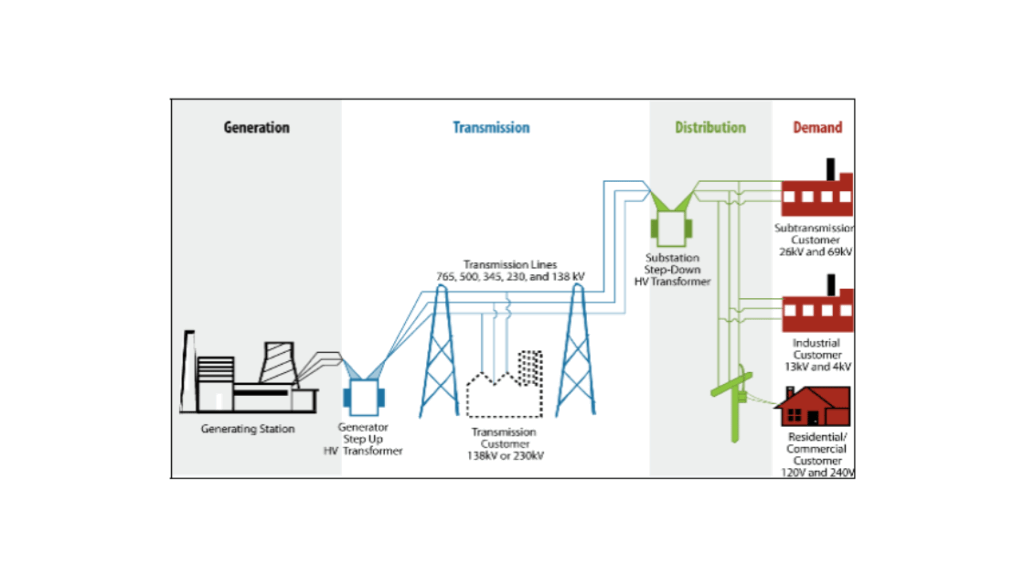
Diagram of the electrical power grid, from generation to consumer. Includes substations, transmission lines, and transformers.

At Keentel Engineering, we track every update to U.S. interconnection policy so clean-energy projects can connect quickly and safely—whether they land on distribution, sub-transmission, or Bulk Electric System (BES) circuits. Grid-modernization programs, led by the U.S. DOE’s Interconnection Innovation e-Xchange (i2X) plus new NERC “bright-line” rules and IEEE 1547/2800 standards, are sharpening—but still shifting—the boundaries that decide which requirements a project must meet.


This guide distills the latest definitions, regulatory triggers, and compliance checkpoints you need to know—and shows how Keentel Engineering steers developers, utilities, and financiers through each interconnection path with confidence.


Understanding Each Grid Segment

1. Distribution System (< 46 kV)

Often called the “last mile,” the distribution network moves power from local substations to homes and businesses. Common voltages—34.5 kV, 23 kV, 12.47 kV—flow through feeders, transformers and protective devices situated between the high-voltage transmission grid and the customer meter.

2. Sub-Transmission System (46 – 138 kV)

Sitting between transmission and distribution, sub-transmission lines back-feed multiple distribution substations. IEEE 2800 notes that these voltages can overlap upper-end distribution levels, creating grey areas for DER interconnection and compliance.

3. Bulk Electric System (BES) (≥ 100 kV)

NERC’s “bright-line” definition captures facilities operating at 100 kV and above, single generators > 20 MVA, or aggregated plants > 75 MVA—unless they are used solely for local distribution. FERC Order 888’s seven-factor test further determines whether assets above 100 kV remain classified as distribution rather than BES.

Need a turnkey plan for your point of interconnection? Explore our Substation Design Services to see how Keentel delivers PE-sealed layouts, relay settings, and grounding designs that sail through utility review.


Why the Right Classification Matters

  • Interconnection requirements – Each segment triggers a different rulebook: IEEE 1547 for most distribution DERs, IEEE 2800 for large inverter-based resources on sub-transmission, and full NERC registration for Bulk Electric System assets.
  • DER sizing implications – Installations < 20 MVA often pass through streamlined screens, while larger plants face bulk-power-system (BPS) studies and protection upgrades.
  • Hosting-capacity limits – Mislabeling a feeder or bus can slash the megawatts the circuit can safely absorb, delaying or downsizing projects.
  • Compliance & risk – An incorrect tag can suddenly pull the owner into NERC CIP, PRC and MOD mandates—adding costly audits and penalties.

Keentel Engineering maps each project to the correct segment, designs to the applicable standard, and shepherds the filing—so your solar, wind, storage or T&D upgrade interconnects smoothly at distribution, sub-transmission or BES level.


Frequently Asked Questions

Q1 What voltage marks the beginning of the Bulk Electric System (BES)?

Transmission elements operating at 100 kV and above are normally classified as BES.

Q2 How is a distribution system defined?

It carries power from the transmission system to end-users and typically operates below 46 kV.

Q3 What is sub-transmission?

The intermediate network—46 kV to 138 kV—that links transmission and distribution substations.

Q4 Where does IEEE 1547 apply?

It sets interconnection requirements for DERs on distribution voltages.

Q5 What changed in IEEE 1547-2018?

Voltage and size limits were removed, making the standard more flexible but less explicit.

Q6 When does IEEE 2800 supersede IEEE 1547?

For large inverter-based resources (IBRs) connected at sub-transmission levels.

Q7 How does NERC define the BES?

A “bright-line” test: assets ≥ 100 kV—with listed exceptions—plus generators > 20 MVA or aggregated > 75 MVA.

Q8 What does FERC Order 888 add?

Facilities > 100 kV are not automatically BES; the 7-factor test determines if they’re still distribution.

Q9 What is hosting capacity?

The DER megawatts a circuit can absorb without compromising reliability or safety.

Q10 Why is accurate DER classification critical?

It dictates study scope, compliance obligations and grid-reliability risk.

Q11 What is a Point of Common Coupling (PCC)?

The grid interface where a DER interconnects.

Q12 How does aggregate capacity affect standards?

Multiple small units can exceed thresholds, triggering BES or IEEE 2800 rules.

Q13 What is NERC’s SPIDER Working Group?

A committee developing DER-related grid-reliability functions and standards.

Q14 How does the DOE i2X program influence interconnection?

i2X drives research and best practices to simplify, speed and standardise clean-energy interconnections.

Q15 What are i2X’s primary goals?

Fairness, simplicity and faster timelines through collaborative innovation.

Q16 Does hosting-capacity analysis cover sub-transmission?

Mostly distribution, but sub-transmission is included when DERs impact it.

Q17 What is the DOE’s broader role in grid definitions?

Facilitating nationwide dialogue and research to refine distribution, sub-transmission and BES boundaries.

HQ18 Are behind-the-meter resources DERs?

Yes—if they can export energy to the grid.

Q19 How are local networks treated under BES rules?

Radial or networked systems < 300 kV that aren’t critical for transfers are generally excluded.

Q20 What if a DER threatens transmission reliability?

Even a distribution-level DER may trigger NERC compliance and mitigation studies.


Keentel Engineering in Action — Interconnection Case Studies

Case 1 | 20 MW Solar + Storage at 34.5 kV

  • Challenge: Confirm eligibility for a streamlined distribution interconnection.
  • Solution: Applied IEEE 1547 mapping to prove the project was below Bulk-Power thresholds; no BES studies required.
  • Result: Utility approval five months faster than standard—avoided extra BPS compliance costs.

Case 2 | 25 MW Wind Farm on 69 kV Sub-Transmission

  • Challenge: Determine whether IEEE 1547 or the new IEEE 2800 rules governed the IBR interconnection.
  • Solution: Coordinated with the local balancing authority; adopted IEEE 2800 settings and protection tweaks without redesign.
  • Result: First project in the region to interconnect under IEEE 2800—on schedule and fully compliant.

Case 3 | 115 kV Radial Line—BES vs. Local Distribution

  • Challenge: Financing stalled after regulators hinted the line might be classified as Bulk Electric System.
  • Solution: Performed a FERC Order 888 seven-factor test; demonstrated the facility’s local-distribution function.
  • Result: Project was exempted from NERC BES registration, cutting regulatory costs by >$500 k and clearing the path to financial close.

Conclusion

In today’s fast-moving clean-energy market, correctly classifying your project—distribution, sub-transmission, or Bulk Electric System—is the difference between a smooth interconnection and months of costly rework. Keentel Engineering couples decades of grid-integration experience with up-to-the-minute knowledge of IEEE 1547, IEEE 2800, NERC “bright-line” rules, and the DOE i2X roadmap. The result: faster approvals, bulletproof compliance, and maximum project value.

Ready to take the guesswork out of interconnection?
Let Keentel Engineering turn complex standards into a clear, cost-effective path to energization.


A smiling man with glasses and a beard wearing a blue blazer stands in front of server racks in a data center.

About the Author:

Sandip "Sonny" R. Patel, P.E.

IEEE Senior Member · Founder & CEO, Keentel Engineering

In 1995, Sonny Patel earned his Electrical Engineering degree from the University of Illinois. But degrees don't build legacies — action does.

For three decades, he has worked the power industry from every side of the table: 16 years as a utility engineer at Exelon/Commonwealth Edison; generation leadership across hydroelectric, industrial steam turbine, and a 9 GW renewable fleet; NERC Regional Entity Senior Compliance Engineer and Audit Team Lead, auditing some of the nation's largest utilities; and testing and commissioning lead on equipment up to 765 kV — the very top of the North American grid.

Utility. Generator. Regulator. Consultant. Few engineers have seen all four seats. Fewer still have sat in them.His experience spans nuclear, hydro, conventional generation, renewables, oil and gas, mining — and today's data centers, where he is authoring a three-book series on data center design. He is a Licensed Professional Engineer in six states and a Licensed Electrical Contractor in Florida (Unlimited EC) — he doesn't just design the work; he's qualified to stand behind its execution.Today, as Founder and CEO of Keentel Engineering, Sonny leads 51 engineers delivering substation design, power system studies, NERC compliance, and commissioning — done right, coast to coast.Three decades. Every side of the table. One standard: accountable engineering

Four workers in safety vests and helmets stand with arms crossed near wind turbines.

Let's Discuss Your Project

Let's book a call to discuss your electrical engineering project that we can help you with.

Man in a blazer and open shirt, looking at the camera, against a blurred background.

About the Author:

Sandip "Sonny" R. Patel, P.E.

IEEE Senior Member · Founder & CEO, Keentel Engineering

In 1995, Sonny Patel earned his Electrical Engineering degree from the University of Illinois. But degrees don't build legacies — action does.

For three decades, he has worked the power industry from every side of the table: 16 years as a utility engineer at Exelon/Commonwealth Edison; generation leadership across hydroelectric, industrial steam turbine, and a 9 GW renewable fleet; NERC Regional Entity Senior Compliance Engineer and Audit Team Lead, auditing some of the nation's largest utilities; and testing and commissioning lead on equipment up to 765 kV — the very top of the North American grid.Utility. Generator. Regulator. Consultant. Few engineers have seen all four seats. Fewer still have sat in them.His experience spans nuclear, hydro, conventional generation, renewables, oil and gas, mining — and today's data centers, where he is authoring a three-book series on data center design. He is a Licensed Professional Engineer in six states and a Licensed Electrical Contractor in Florida (Unlimited EC) — he doesn't just design the work; he's qualified to stand behind its execution.Today, as Founder and CEO of Keentel Engineering, Sonny leads 51 engineers delivering substation design, power system studies, NERC compliance, and commissioning — done right, coast to coast.Three decades. Every side of the table. One standard: accountable engineering

Leave a Comment

Related Posts

Structure height and voltage in transmission line design guide by Keentel Engineering with power tow
By SANDIP R PATEL August 22, 2026
Learn how transmission structure height is calculated using NESC clearance rules, sag-tension analysis, voltage classes, terrain, span length, and IEEE standards.
Gas-insulated substation design and engineering diagram.
By SANDIP R PATEL August 22, 2026
Explore gas-insulated substations (GIS), including design, GIS vs AIS, SF₆ alternatives, grounding, VFTO, safety, and key IEEE and IEC standards.
Sizing AC cables in a utility-scale solar PV plant technical guide by Keentel Engineering, showing N
By SANDIP R PATEL August 22, 2026
Learn NEC-based AC cable sizing for utility-scale solar PV plants, including ampacity, voltage drop, derating factors, short-circuit checks, and inverter examples.
By SANDIP R PATEL August 22, 2026
Learn how NERC's new data center rules affect registration, modeling, protection, compliance, and what computational load operators should do now.
POI interconnection engineering for large loads and data centers.
By SANDIP R PATEL August 20, 2026
2026 guide to POI interconnection for data centers and large loads. Explore ISO/RTO requirements, grid studies, PSCAD modeling, costs, timelines and NERC rules.
Solar and battery storage shared bus resonance diagram
By SANDIP R PATEL August 20, 2026
Learn how shared 480 V solar and BESS buses create resonance, harmonic, grounding, and transformer issues—and how proper engineering prevents failures.
12.47 kV pole-mounted distribution transformer assembly designed for U.S. IEEE and NESC utility stan
By SANDIP R PATEL August 20, 2026
Learn U.S. pole-mounted transformer design requirements, including IEEE, ANSI, and NESC standards, voltage classes, grounding, protection, and DER considerations.
Neutral grounding resistor sizing guide for HRG and LRG power system grounding applications
By SANDIP R PATEL August 20, 2026
Learn how to size neutral grounding resistors using IEEE and NEC practices, including HRG/LRG selection, fault current calculations, duty ratings, and examples.
PRC-023-6 BESS relay loadability compliance guide
By SANDIP R PATEL August 19, 2026
Understand PRC-023-6 for utility-scale BESS: applicability, the 39-month rule, relay loadability, setting criteria, Category 2 IBRs, and audit evidence.