

A Coordinated Electric System Interconnection Review—the utility’s deep-dive on technical and cost impacts of your project.

NERC Compliance Service – Empowering Grid Reliability with FERC Order 901 & Latest NERC Standards

Calendar icon. D

May 9, 2025 | Blog

Engineer in a safety vest and hard hat working on a laptop at an electrical substation at dusk.

Overview: Why NERC Compliance Matters

In the ever-evolving landscape of power system management, maintaining compliance with NERC standards is not optional—it’s essential. The emergence of renewable energy resources and inverter-based technologies has dramatically transformed the operational dynamics of the Bulk Power System (BPS). To support this transformation, Keentel Engineering offers advanced NERC compliance services tailored to help Generator Owners (GOs), Transmission Owners (TOs), and other regulated entities navigate complex requirements under FERC Order 901, MOD-032-2 modeling, and MOD-026-2 compliance standards.


Our NERC Compliance Services

Keentel Engineering provides specialized services across three core NERC MOD standards initiatives:

Model Verification and Validation – MOD-026-2

  • Merging MOD-026 and MOD-027 requirements into a uniform framework
  • Defining "Model Verification" vs. "Model Validation" per IEEE P2800.2
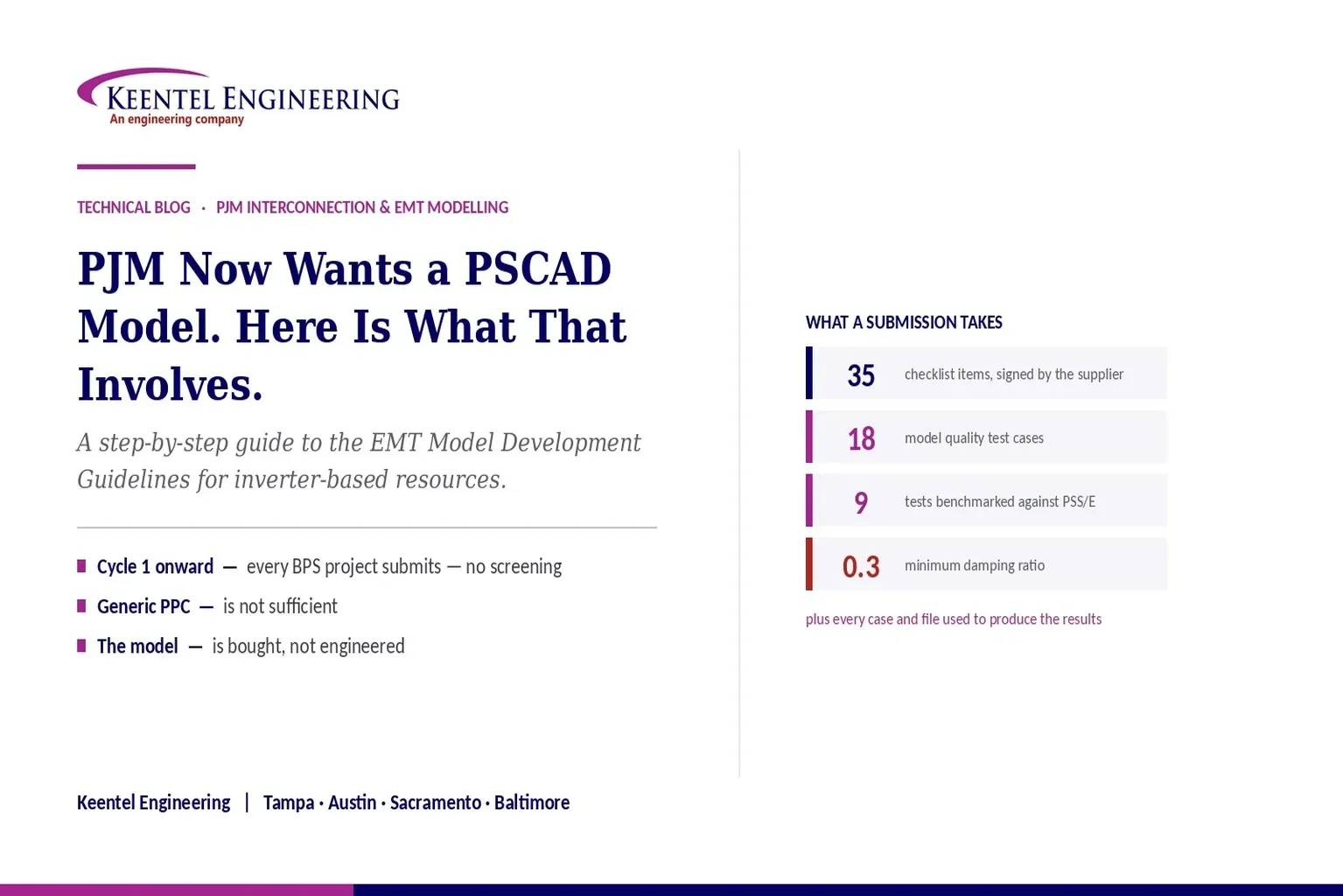
  • Assisting with EMT model validation services for Inverter-Based Resources (IBRs)
  • Improving model fidelity using disturbance data from PRC-002-5 and PRC-028-1 compliance
  • Supporting audit readiness with mod-026-2 compliance documentation

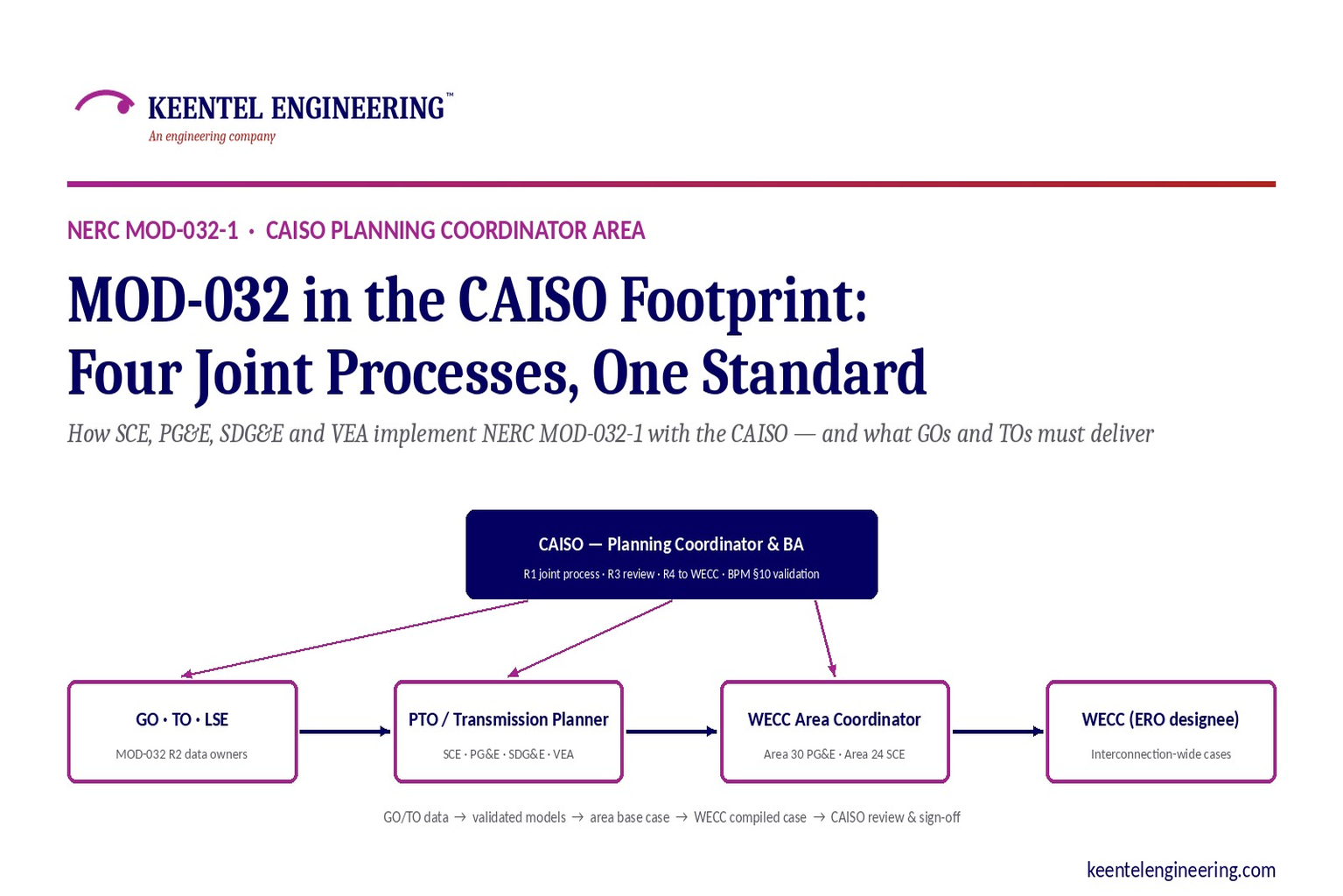
Uniform Framework for IBR Modeling – MOD-032-2

  • Preparing compliant datasets for both registered and unregistered IBRs
  • Conforming to ERO’s “Criteria for Acceptable Models”
  • Addressing DER integration, demand aggregation (Attachment 1), and mod-032 model validation
  • Managing phased-in compliance timelines (24–36 months for R2–R4)
  • Supporting mod-032-2 modeling strategies aligned with FERC/NERC requirements

System Model Validation – MOD-033

  • Validating planning and operational models against field behavior
  • Meeting Order 901 directives for interconnection-wide consistency
  • Ensuring component models comply with MOD-032 and MOD-026-2
  • Collaborating with model owners for mod-033 validation and continuous improvement

Benefits of Keentel’s NERC Compliance Services

  • End-to-End Support: From data collection through NERC audit readiness
  • Custom Solutions: IBRs, DERs, and legacy asset strategies
  • Technical Expertise: Deep knowledge of FERC Order 901, IEEE standards, and MOD-033-2 validation protocols
  • Time-Sensitive Guidance: Navigate deadlines and avoid penalties
  • Ongoing Monitoring: Stay aligned with evolving FERC and NERC compliance rules

NERC Modeling Support Aligned with FERC & IEEE Standards

Keentel Engineering’s NERC compliance modeling services address key standards such as MOD-032-2, MOD-026-2, and MOD-033, helping Generator and Transmission Owners implement FERC Order 901 requirements effectively. Whether you need IBR compliance modeling, assistance with PRC-002-5 disturbance data, or MOD-032-2 model validation, we provide tailored solutions. Our engineers support clients with FERC 901 ibr standards, mod-026-2 compliance, and mod-032-2 modeling for real-world accuracy. Even complex needs like EMT model validation services or mod-033 audit readiness are handled with precision.

To meet FERC Order 901’s modeling mandates, explore our PRC-029-1 and PRC-024-4 compliance services.


FAQ on NERC Compliance Services

  • What is a NERC compliance service?

    A NERC compliance service is a suite of engineering consulting and modeling solutions that ensure utilities, GOs, TOs, and other entities meet mandatory reliability standards set by NERC.

  • Why is NERC compliance important?

    NERC compliance guarantees the reliable operation of the Bulk Power System (BPS), prevents grid disturbances, and helps stakeholders avoid significant financial penalties.

  • What is FERC Order 901?

    FERC Order 901 is a federal directive mandating updated modeling and validation practices—particularly for Inverter-Based Resources (IBRs)—to enhance grid reliability.

  • What is the difference between model verification and validation?

    • Model Verification confirms that the model’s design aligns with NERC and IEEE requirements.
    • Model Validation compares simulation outputs against real disturbance data (e.g., from PRC-002 and PRC-028) to ensure accuracy.
  • Which entities need to comply with MOD-026-2?

    Generator Owners with new or existing IBRs commissioned after the effective date must comply with MOD-026-2 for model verification and validation.

  • What does MOD-032-2 address?

    MOD-032-2 defines a uniform framework for collecting model data for IBRs and DERs across all planning regions, including the new Attachment 1 requirements.

  • How does MOD-033 ensure system reliability?

    MOD-033 mandates end-to-end system model validation, comparing dynamic and steady-state simulations against actual performance data to guarantee planning models reflect real behavior.

  • What are Inverter-Based Resources (IBRs)?

    IBRs are energy assets—such as solar PV, wind turbines, and BESS—that interface with the grid via power electronics, requiring specialized modeling and compliance under PRC-029, MOD-032, and related standards.

  • Who benefits from Keentel’s NERC compliance services?

    Utilities, GOs, TOs, Distribution Providers, and any NERC-registered entities gain from our turnkey compliance solutions, ensuring audit readiness and operational resilience.

  • What is EMT modeling and who needs it?

    EMT modeling (Electromagnetic Transient) involves high-fidelity PSCAD or similar simulations for IBRs to assess transient behavior during faults and system events.

  • Are legacy systems covered under the new NERC modeling rules?

    Yes. Even legacy assets lacking OEM support must be modeled or justified for exemption under MOD-026-2 and MOD-032-2 guidelines.

  • What is Attachment 1 in MOD-032?

    Attachment 1 is the detailed data sheet specifying required information—such as control parameters and protection settings—for all DER, demand, and IBR models.

  • What are “Acceptable Models” under ERO criteria?

    “Acceptable Models” meet the ERO’s performance and usability benchmarks, ensuring consistency and comparability across interconnection-wide studies.

  • How is model performance evaluated?

    Performance is validated by comparing simulation outputs against recorded disturbance data from PRC-002-5 and PRC-028-1 monitoring equipment.

  • How long do I have to comply with new MOD-032-2 changes?

    Compliance timelines extend up to 36 months post-effective date, depending on FERC approval and the specific implementation phase (R2–R4).

  • Do unregistered IBRs need to be modeled?

    Yes. MOD-032-2 requires modeling for all IBRs above threshold capacities, regardless of formal NERC registration.

  • What’s Keentel’s approach to phased compliance?

    We develop customized roadmaps aligned with FERC milestones and COD (Commercial Operation Date) requirements for each standard’s phase-in.

  • What if I lack disturbance data for model validation?

    Keentel assists in acquiring and interpreting disturbance recordings from PRC-002 and PRC-028 monitoring equipment.

  • Can Keentel support me during a NERC audit?

    Absolutely. We deliver comprehensive compliance documentation, technical reports, and expert defense during NERC audits.

  • How are system models validated interconnection-wide?

    Validation is performed collaboratively across all Planning Coordinators’ footprints to ensure regional consistency under MOD-033.

  • Does MOD-033 apply to real-time operations?

    No—MOD-033 applies to offline models used by planners, not to real-time operational systems.

  • What if my model is deemed unacceptable?

    We reconfigure, retest, and resubmit your models for ERO approval, ensuring full compliance.

  • What tools does Keentel use for modeling and validation?

    Industry-approved platforms such as Siemens PSS®E, PSCAD, and other benchmarking software ensure model accuracy and compliance.

  • What happens after model validation?

    Validated models are updated, resubmitted, archived, and integrated into ongoing grid operations and future audits.

  • How do I start with Keentel’s NERC compliance service?

    Contact us for a no-obligation compliance assessment and roadmap tailored to your MOD-026, MOD-032, and MOD-033 needs.


Partner with Keentel Engineering

The future of Bulk Power System reliability depends on robust, compliant, and future-ready modeling. With Keentel Engineering as your NERC compliance modeling partner, your organization will meet evolving FERC and NERC compliance demands and enhance operational resilience.

Start your journey toward MOD-032 compliance support, MOD-026-2 modeling, and audit readiness today.


Man in a blazer and open shirt, looking at the camera, against a blurred background.

About the Author:

Sonny Patel P.E. EC

IEEE Senior Member

In 1995, Sandip (Sonny) R. Patel earned his Electrical Engineering degree from the University of Illinois, specializing in Electrical Engineering . But degrees don’t build legacies—action does. For three decades, he’s been shaping the future of engineering, not just as a licensed Professional Engineer across multiple states (Florida, California, New York, West Virginia, and Minnesota), but as a doer. A builder. A leader. Not just an engineer. A Licensed Electrical Contractor in Florida with an Unlimited EC license. Not just an executive. The founder and CEO of KEENTEL LLC—where expertise meets execution. Three decades. Multiple states. Endless impact.

Four workers in safety vests and helmets stand with arms crossed near wind turbines.

Let's Discuss Your Project

Let's book a call to discuss your electrical engineering project that we can help you with.

Man in a blazer and open shirt, looking at the camera, against a blurred background.

About the Author:

Sonny Patel P.E. EC

IEEE Senior Member

In 1995, Sandip (Sonny) R. Patel earned his Electrical Engineering degree from the University of Illinois, specializing in Electrical Engineering . But degrees don’t build legacies—action does. For three decades, he’s been shaping the future of engineering, not just as a licensed Professional Engineer across multiple states (Florida, California, New York, West Virginia, and Minnesota), but as a doer. A builder. A leader. Not just an engineer. A Licensed Electrical Contractor in Florida with an Unlimited EC license. Not just an executive. The founder and CEO of KEENTEL LLC—where expertise meets execution. Three decades. Multiple states. Endless impact.

Leave a Comment

Related Posts

Power system engineering services for data centers and industrial large load integration
By SANDIP R PATEL March 19, 2026
Large load integration solutions for grid reliability, data centers, and industrial power systems with advanced engineering and compliance support.
Large load grid reliability solutions for AI data centers and industrial power systems
By SANDIP R PATEL March 19, 2026
Large loads are reshaping grid behavior. Discover risks, interconnection challenges, and engineering solutions for reliable power system integration.
Keentel Engineering transmission infrastructure project with utility truck, construction loader.
By SANDIP R PATEL March 13, 2026
FERC Order 1920-B introduces long-term regional transmission planning reforms in the U.S. Learn how the rule affects utilities, renewable integration, and grid infrastructure development.
High voltage electrical substation construction with transmission equipment and switchgear infrastru
By SANDIP R PATEL March 11, 2026
Discover best practices for high-voltage substation construction, including engineering planning, labor productivity benchmarking, equipment installation, and project control strategies.
Large baseload power plant cooling towers connected to high-voltage transmission grid infrastructure
By SANDIP R PATEL March 11, 2026
Engineering guide to grid integration of large baseload power plants covering system stability, substation design, transformer configuration, and reliability requirements.
IEC 61439 low oltage switchgear and controlgear assembly panel
By SANDIP R PATEL March 11, 2026
Learn how IEC 61439 governs low-voltage switchgear assemblies, including design verification, safety requirements, temperature rise limits, and engineering practices for compliant power distribution systems.
Protection relay testing equipment (Omicron CMC 356) used in power plant commissioning and electrica
By SANDIP R PATEL March 11, 2026
Learn the hidden problems in power plant commissioning and how engineering testing, relay verification, and system validation prevent failures.
High-voltage electrical substation with transmission towers, power lines, and switching equipment il
By SANDIP R PATEL March 8, 2026
Explore advanced power system protection and relaying used in modern substations, including SCADA integration, relay coordination, fault detection, and digital protection technologies.
NERC PRC-012-2 compliance for solar, wind, and battery energy storage systems.
By SANDIP R PATEL March 7, 2026
Guide to NERC PRC-012-2 compliance for solar plants, wind farms, and BESS. Understand RAS requirements, generator owner obligations, and testing rules.