Generator Owners
Capability verification, dynamic model verification and model data submissions — the heaviest MOD workload for most plants, including solar, wind, BESS and hybrid facilities.

Your Trusted Partner in Electrical Engineering and Power Systems
At Keentel Engineering, we deliver electrical power engineering services built on 30 years of experience and a commitment to excellence. Our clients include utilities, developers, EPCs, and public agencies across the U.S.
Unlike firms that sacrifice technical depth to chase billable hours, we prioritize precision, compliance, and value engineering. From transmission services and relay modeling to winterization and SCADA planning, we never compromise on quality.

At Keentel Engineering, we take pride in being the go-to electrical power engineering firm for power and utility system planning, substation design, protection, control, and power system analysis. The following attributes distinguish our team in utility-grade substation engineering and compliance-driven project delivery.
With three decades of hands-on project delivery, we bring unmatched expertise in substation layout design, substation electrical and civil engineering, relay protection, and grid-tie solutions. Our experience includes projects in complex terrain, urban retrofit environments, and utility-scale renewable integrations.
Our engineering process applies AutoCAD 3D, BIM modeling, and system-level substation design practices to ensure accurate planning, reduced errors, and efficient coordination across all project stakeholders.
Our workflow includes 3D substation design, enabling clash-free coordination between structural, electrical, and civil disciplines.
From grounding grid studies to relay protection settings, we engineer every detail to improve system reliability, performance, and operational safety. Our rigorous QA/QC process ensures compliance with IEEE, NFPA, and ISO/TSO interconnection standards.
Among leading electrical substation design companies, Keentel Engineering stands out for 30+ years of proven high-voltage and utility-grade project delivery.




First name, email and what you're interested in are all we need to get moving. Everything else, including drawings or an RFP, is optional.
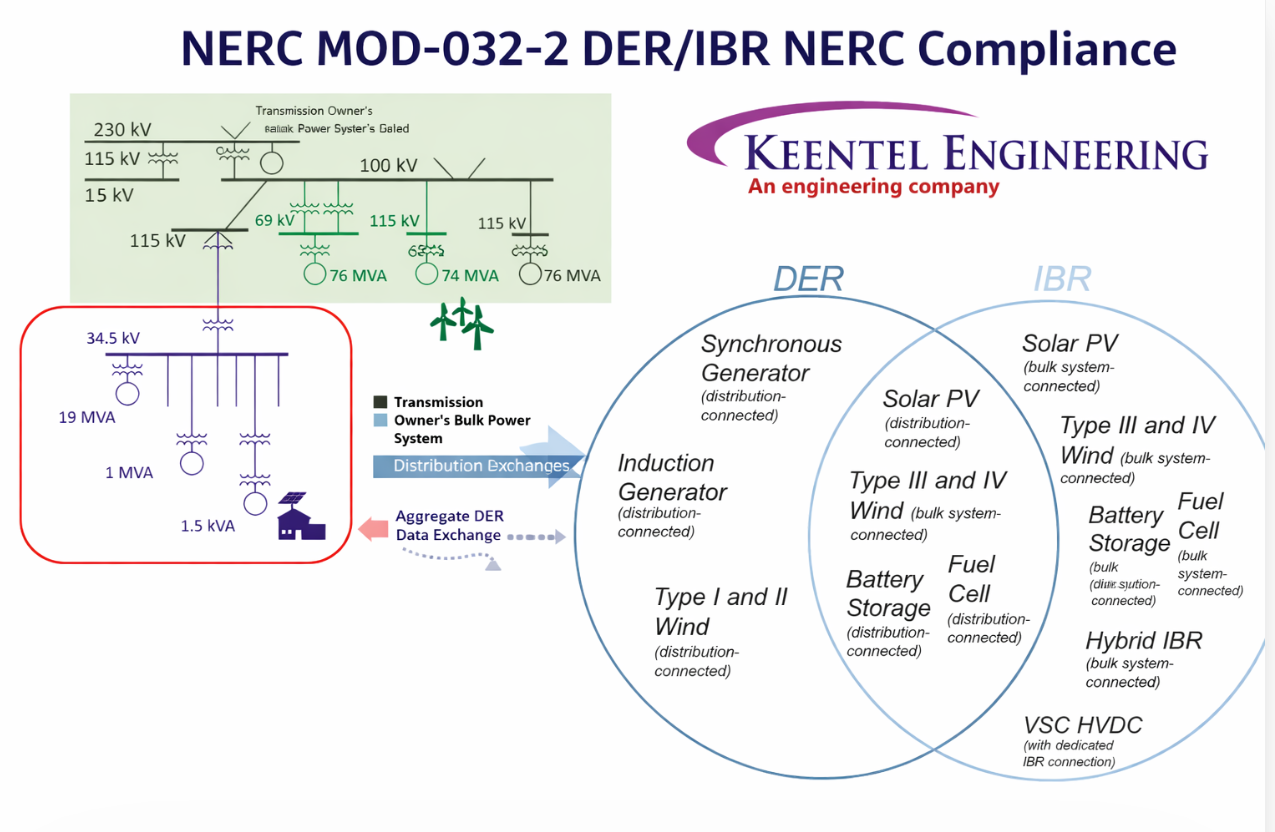
Interconnection studies, transmission planning assessments, operating limits and Real-time Assessments are only as good as the models and data behind them. The MOD standards make the owners of that information responsible for its accuracy: Generator Owners verify how their plants actually behave, and entities across the planning community submit data to the specifications their Planning Coordinators and Transmission Planners publish.
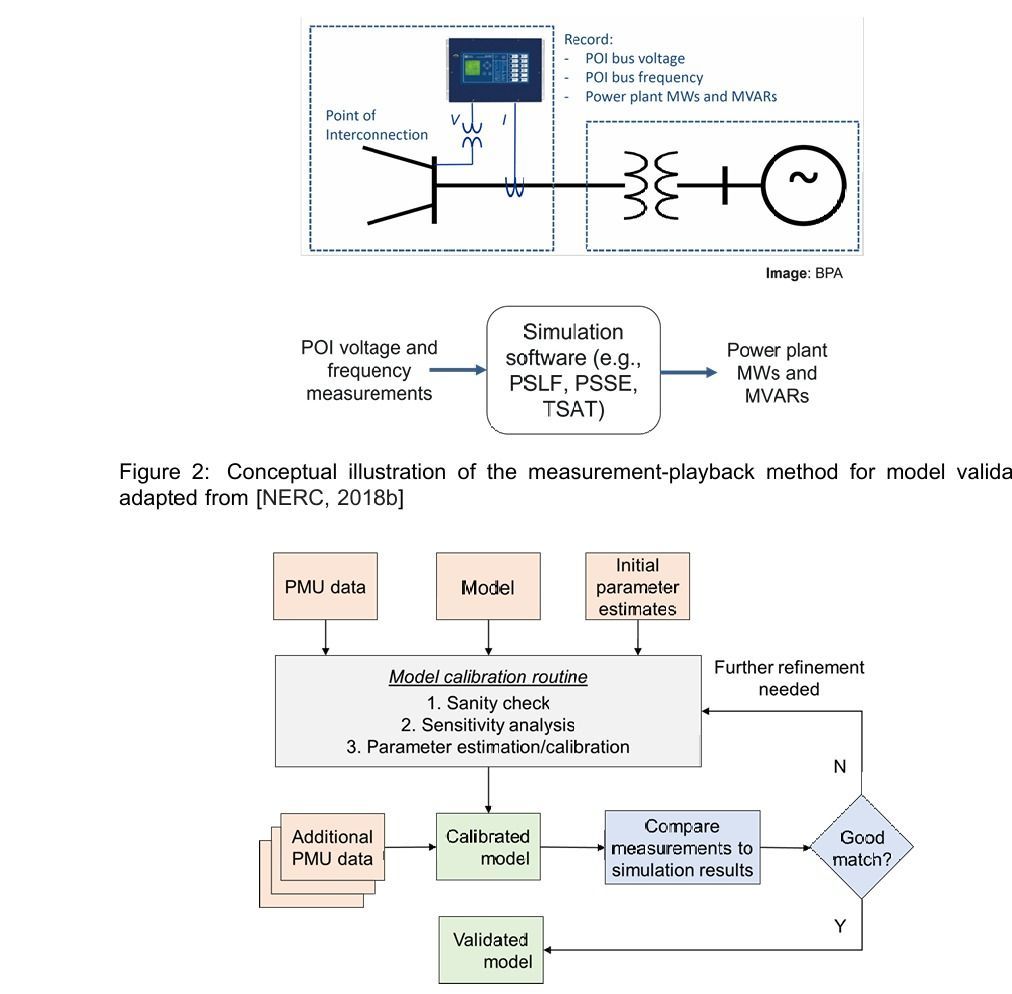
The ERO has repeatedly identified model quality — especially for inverter-based resources — as a reliability risk. Disturbance reviews have documented IBR plants that did not respond the way their submitted models predicted. That is why MOD compliance is increasingly about demonstrating that models reproduce measured behavior, not simply filing parameters on time.

Standard IDs are shown without version suffixes. Confirm the version in effect for your facility and audit period — several MOD standards are being revised under FERC Order No. 901, and older ATC/TTC-related MOD standards have been retired.
| Standard | Title / subject | Applicable functions | Typical evidence |
|---|---|---|---|
| MOD-025 | Verification and Data Reporting of Generator Real and Reactive Power Capability and Synchronous Condenser Reactive Power Capability | GO; TO (synchronous condensers) | Test plans, staged test or operational data, capability curves, dated submissions to the Transmission Planner |
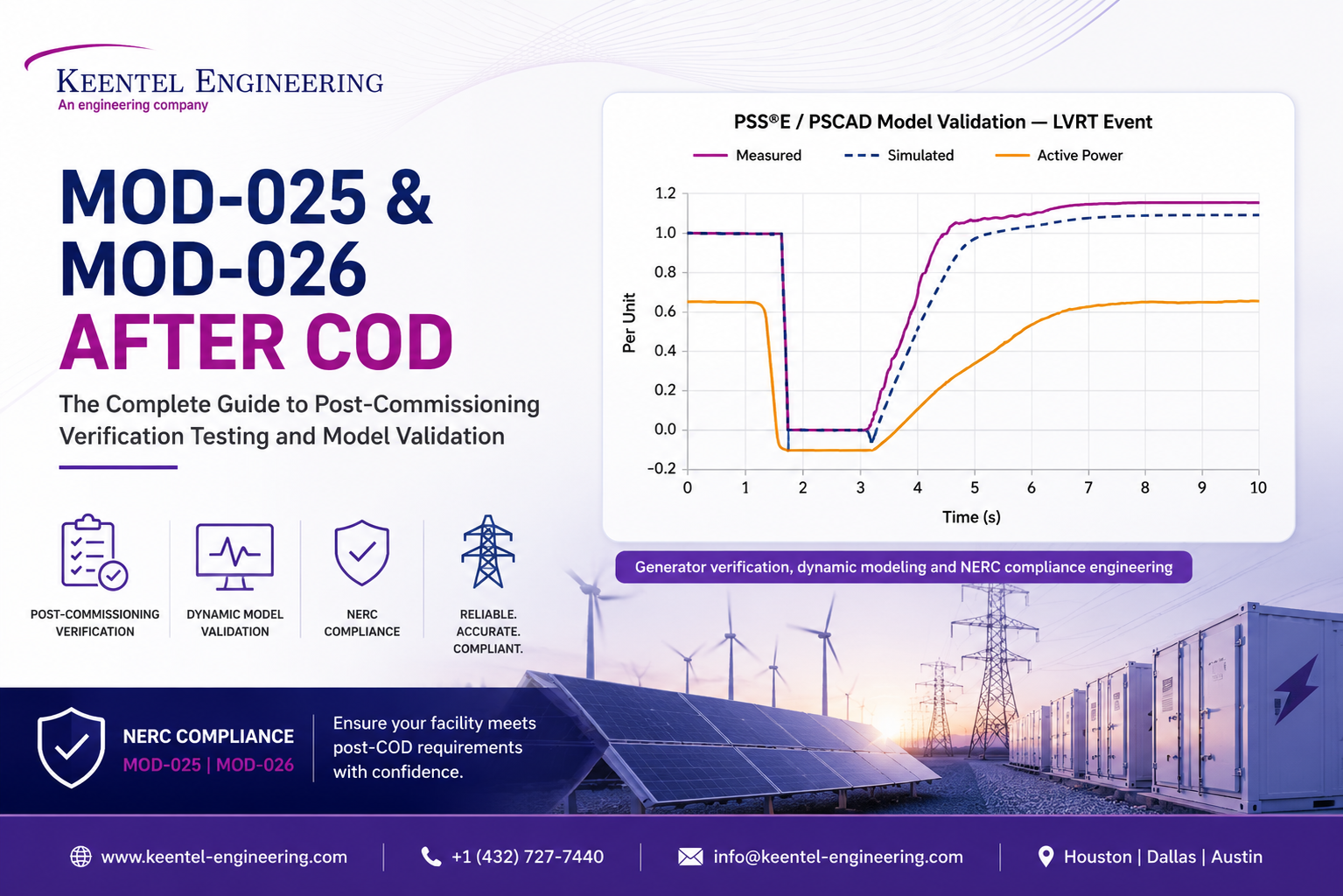
| MOD-026 | Verification of Models and Data for Generator Excitation Control System or Plant Volt/Var Control Functions | GO, TP | Model parameter review, measured response, simulated vs measured comparison, verification report, TP model requirements and responses |
| MOD-027 | Verification of Models and Data for Turbine/Governor and Load Control or Active Power/Frequency Control Functions | GO, TP | Frequency-response test or event data, tuned model, verification report, TP correspondence |
| MOD-031 | Demand and Energy Data | PC, TP, BA, RP, DP (per requirement) | Data request, compiled demand and energy data, dated submissions |
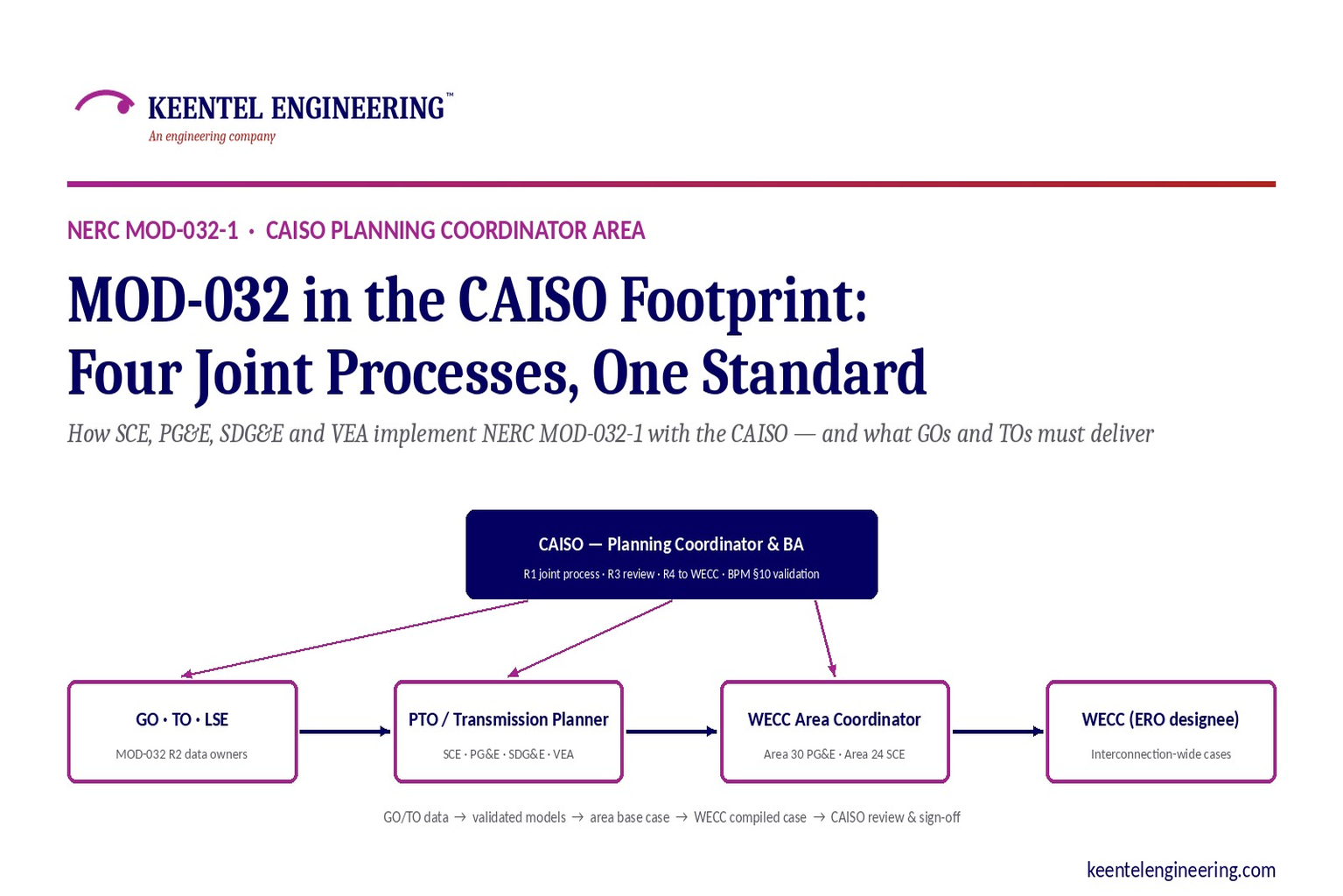
| MOD-032 | Data for Power System Modeling and Analysis | PC, TP, BA, GO, RP, TO, TSP | PC/TP data requirements and reporting procedures, steady-state, dynamic and short-circuit data, submission and response records |
| MOD-033 | Steady-State and Dynamic System Model Validation | PC, RC, TOP | Documented validation process, event comparisons, data provided to the PC |
Capability verification, dynamic model verification and model data submissions — the heaviest MOD workload for most plants, including solar, wind, BESS and hybrid facilities.
MOD-025 for synchronous condensers and MOD-032 data for transmission facilities.
Publishing data requirements, reviewing submitted models, compiling demand data and validating system models.
Demand, energy and resource data under MOD-031 and MOD-032.
Providing actual system behavior data to support MOD-033 model validation.
Newly registered inverter-based resources taking on MOD verification and data obligations for the first time.
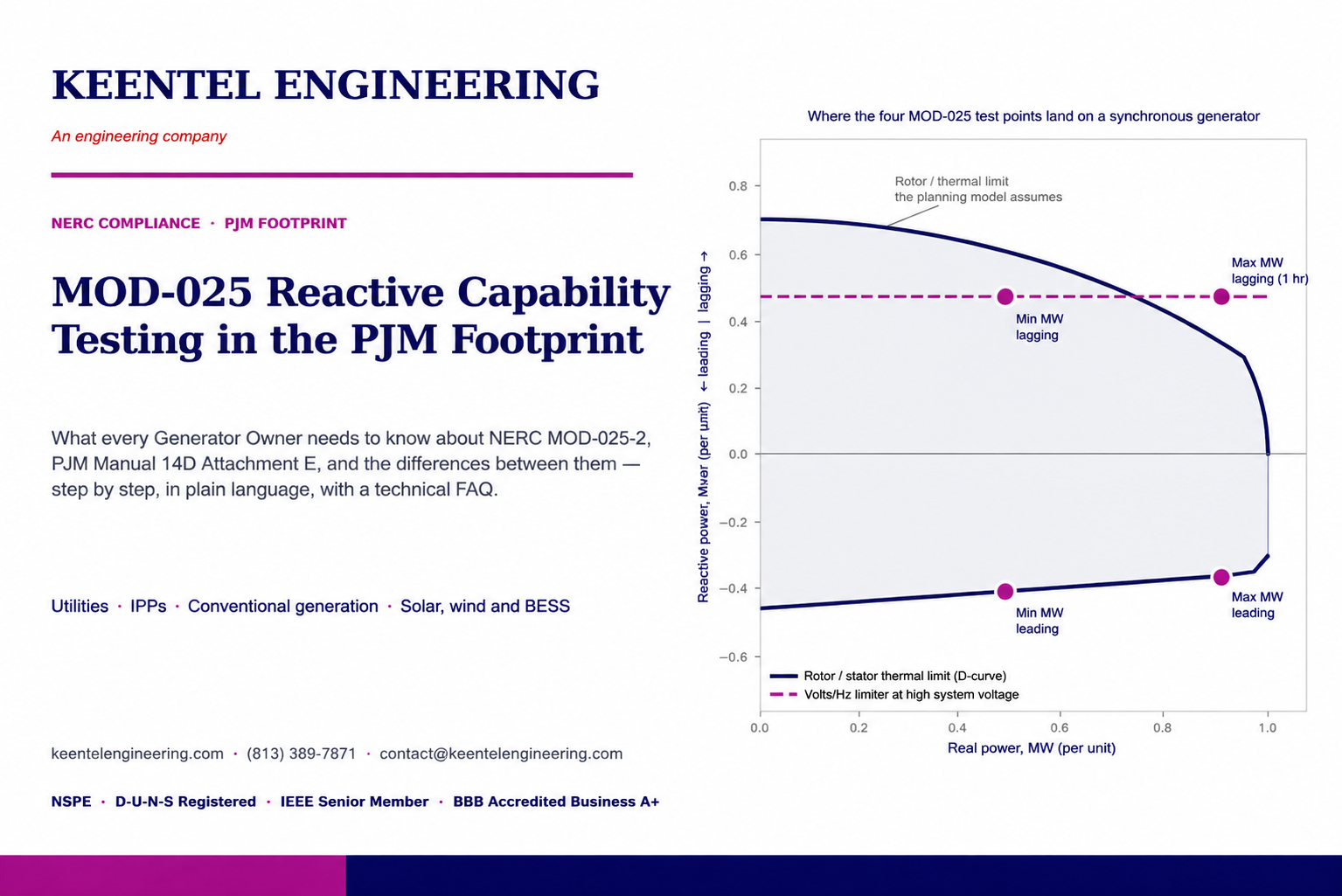
Test planning, witness support, data analysis and capability-curve reporting for synchronous and inverter-based plants.
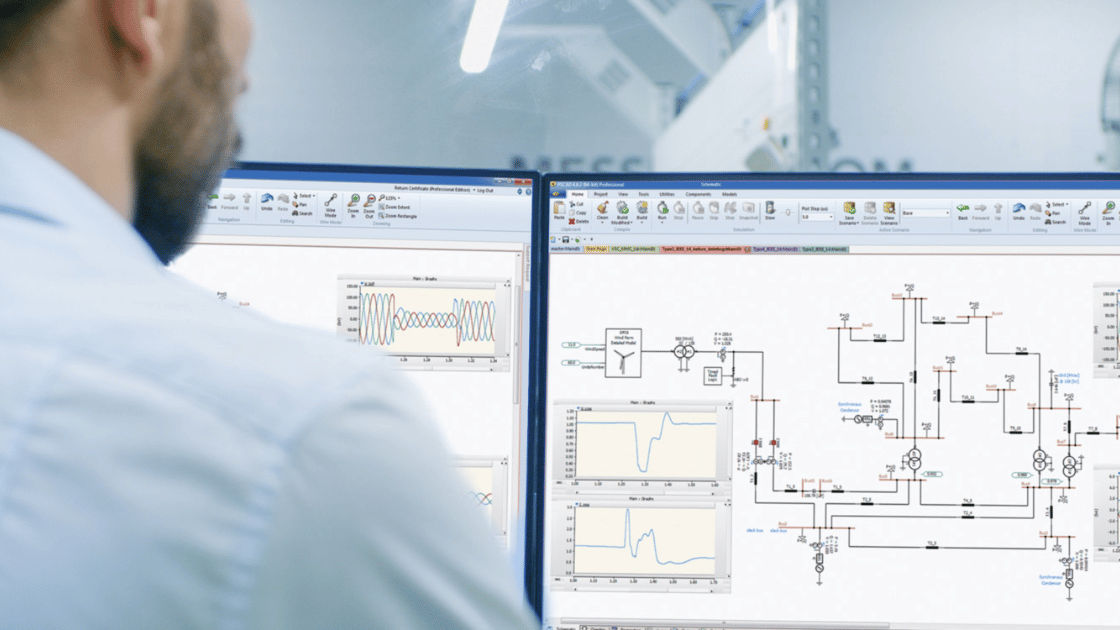
Model parameterization, benchmarking against measured response and verification reports in PSS®E and PSLF.
Data prepared to each PC and TP’s requirements — PJM, CAISO, ERCOT, MISO, SPP, WECC and others — including DER representation where required.
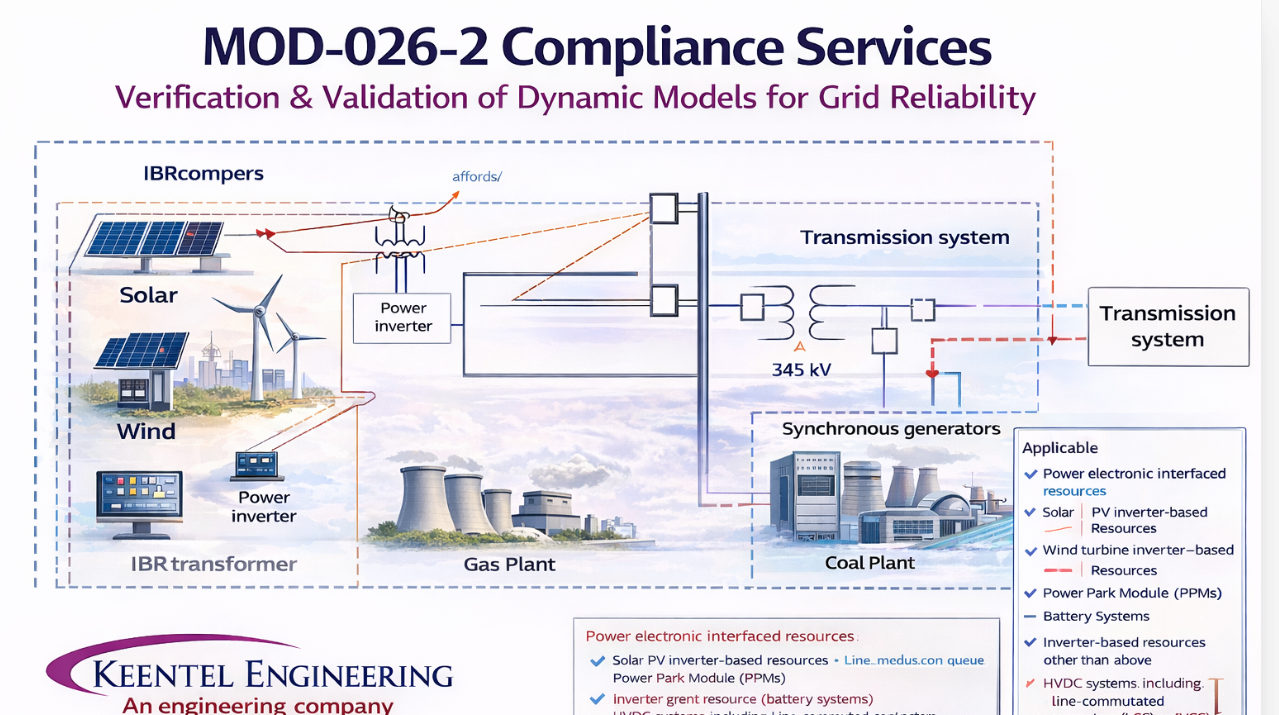
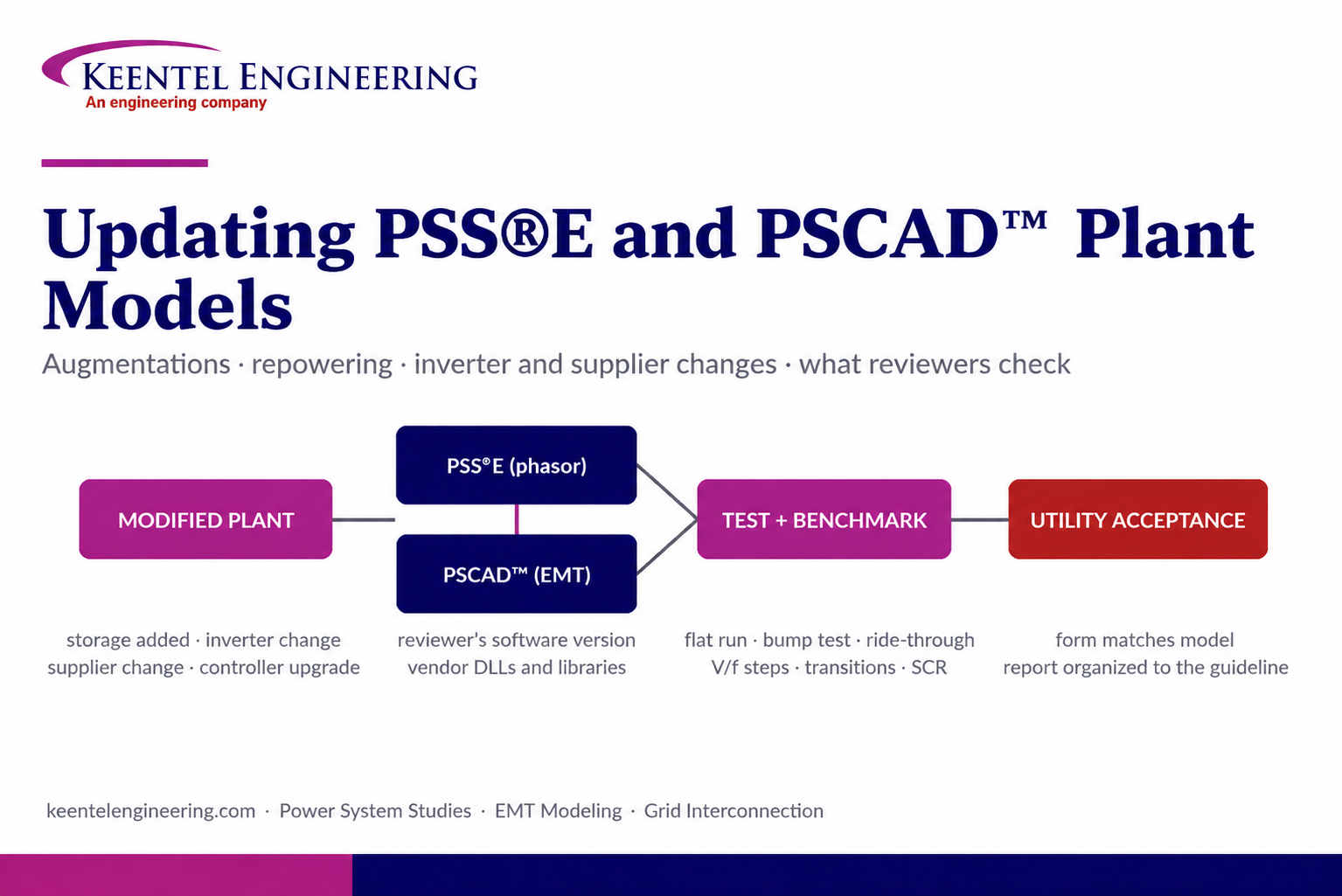
PSCAD™ plant models built from OEM inverter models, collector systems and plant controllers, benchmarked to the positive-sequence model.
Event-based comparison of simulated and actual system response for Planning Coordinators and data support from RCs and TOPs.
Compilation and documentation of demand and energy data in response to PC and BA requests.

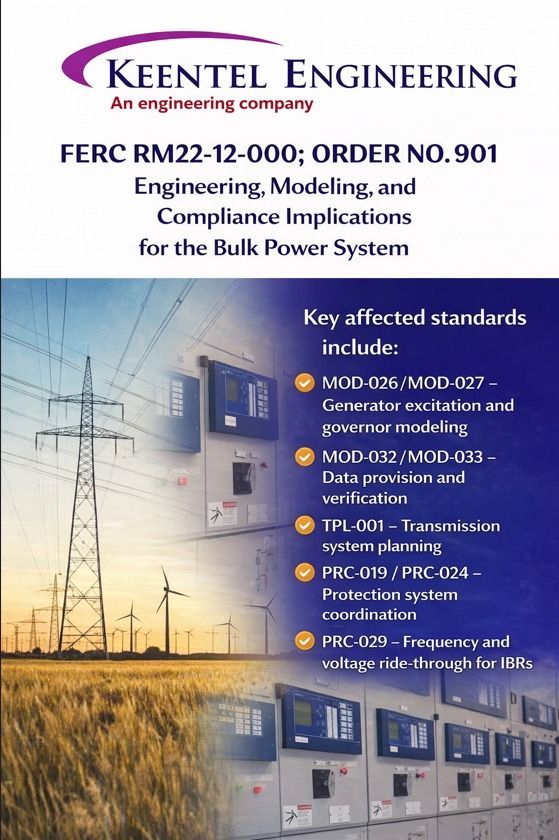
FERC Order No. 901 directed NERC to develop new or revised Reliability Standards for inverter-based resources, including requirements on data sharing, model validation and model verification. NERC has been developing those standards in milestones, and the resulting revisions affect several MOD standards and related planning requirements.
The practical direction is clear even while specific versions and effective dates are confirmed: planners expect IBR models that reflect the installed inverter firmware and plant controller settings, EMT models alongside positive-sequence models, and verification against measured performance. Keentel tracks these revisions and helps owners plan model work so a single test or model update supports both current and upcoming requirements.
Identify which MOD requirements and versions apply to each facility and where each is in its periodic cycle.
Nameplates, OEM models, settings, prior test reports and the PC/TP data requirements that apply to you.
Confirm model inputs reflect installed equipment, firmware and in-service settings.
Plan staged tests or use disturbance and operational data for capability and model verification.
Benchmark model response against measured behavior and tune within physically justified bounds.
Deliver verification reports and data packages in the format each recipient requires, with dated transmittal records.
| Deliverable | Purpose |
|---|---|
| MOD applicability and cycle tracker | Which MOD requirements apply to each facility, and when each verification is next due |
| MOD-025 capability verification report | Test data, capability curves and data reported to the Transmission Planner |
| MOD-026 / MOD-027 verification reports | Model parameters, simulated vs measured comparison and conclusions |
| Positive-sequence and EMT model packages | PSS®E, PSLF and PSCAD™ models with documentation and benchmarking |
| MOD-032 data submission package | Data prepared to PC and TP requirements with transmittal records |
| MOD-033 validation documentation | Event comparisons and documented validation process support |
| Gap | Why it matters |
|---|---|
| Models built from design data and never updated | Commissioning changes, firmware updates and tuning leave the submitted model behind the plant. |
| Verification without measured data | A parameter check alone does not show the model reproduces actual plant response. |
| Generic IBR models in submissions | Planners increasingly reject generic or library models that do not reflect the installed equipment. |
| EMT and positive-sequence models disagree | Inconsistent models undermine confidence in both and often trigger rework. |
| Missed periodic verification cycles | Verification intervals run per unit; without a tracker, dates slip unnoticed. |
| No transmittal evidence | Data sent informally by email is hard to prove against a PC or TP deadline. |

Send us your current models, test reports and PC/TP data requirements. Keentel will show you where your MOD evidence is strong, where it is stale, and what it will take to verify it against measured behavior.
Serving utilities, EPCs, developers, and infrastructure organizations supporting critical power systems nationwide.