

A Coordinated Electric System Interconnection Review—the utility’s deep-dive on technical and cost impacts of your project.

Challenge: Frequent false tripping using conventional electromechanical relays
Solution: SEL-487E integration with multi-terminal differential protection and dynamic inrush restraint
Result: 90% reduction in false trips, saving over $250,000 in downtime

How to Safely Overload Transformers Using IEEE C57.91-2011 Guidelines

A minimalist icon of a calendar page with a grid of dots representing dates. D

April 22, 2025 | Blog

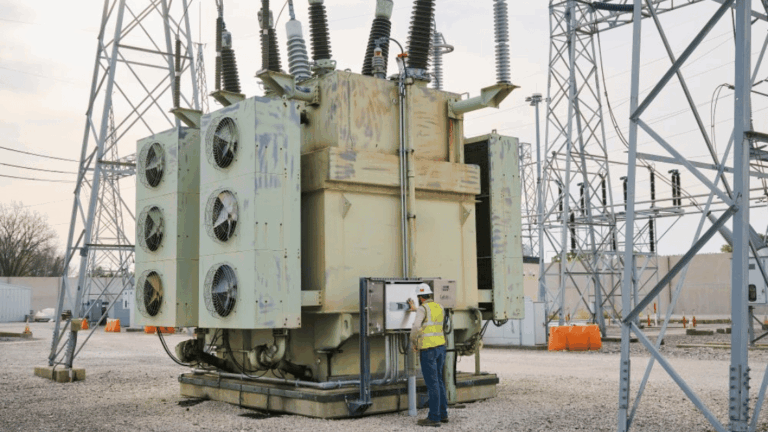
A worker in a safety vest inspects a large industrial electrical transformer at a power substation.

At Keentel Engineering, our commitment to power system reliability and regulatory compliance is backed by decades of transformer analysis expertise. One of the most valuable tools in our transformer engineering arsenal is IEEE Std C57.91-2011, which outlines guidelines for loading mineral-oil-immersed power transformers and step-voltage regulators beyond their nameplate ratings without compromising safety or lifespan.

IEEE C57.91 provides detailed guidance on safe transformer overloading by evaluating thermal limits and insulation aging.


What Is IEEE C57.91-2011?

IEEE C57.91-2011 is a technical standard published by the Institute of Electrical and Electronics Engineers. It provides detailed thermal performance models and guidelines for planned, emergency, and seasonal overloading of mineral-oil-immersed transformers. The guide explains how transformers rated for 65 °C (and legacy 55 °C systems) can be safely loaded beyond their rated capacity using:

  • Hotspot and top-oil temperature rise assessments
  • Insulation aging estimation (per-unit life, FAA)
  • Risk-based short-term and long-term emergency loading
  • Ambient temperature compensation
  • Computer-aided loading calculations


The IEEE C57.91-2011 standard helps engineers determine safe loading limits under varying operating conditions.


Why This Guide Matters

Transformers often experience variable load conditions, especially in renewable integration and substation interconnection projects. Overloading—if executed improperly—can shorten insulation life, create gas evolution from insulating materials, and trigger dielectric breakdowns. IEEE C57.91 provides utilities and engineers with a standardized way to mitigate these risks and maximize transformer usage without compromising safety.

Transformer overloading must be carefully managed to avoid accelerated insulation degradation and reduced equipment life.

Learn more about system reliability in our guide on importance of power system studies for substations.


Key Benefits for Utilities and Project Developers

  • Quantifiable Risk Management: Through per-unit life and aging acceleration factors, operators can predict insulation aging under elevated temperatures.
  • Guided Emergency Planning: The guide supports short-time emergency loading to maintain power during outages or grid instability.
  • Customizable Overload Calculations: Adjust loading strategies based on exact transformer parameters (e.g., cooling type, oil volume, top-oil rise, etc.).
  • Enhanced Transformer Life Cycle Costing: Balance short-term performance demands with long-term asset health.

Keentel Engineering’s Expertise with IEEE Transformer Loading Guidelines

As industry leaders in Power System Studies and Substation Design, Keentel Engineering integrates IEEE C57.91 into all transformer loading assessments. Our transformer engineering services include:

  • Thermal modeling of ONAN and ONAF transformers
  • Emergency loading calculations and seasonal strategies
  • Life expectancy modeling and insulation degradation curves
  • Application of aging acceleration factors (FAA)
  • Compliance support for NERC PRC-005 and PRC-019

Whether your project involves a 20 MVA substation bank or small distribution regulators, we apply these guidelines for safe, cost-effective transformer operation—especially during variable or peak load conditions.


Top Questions Answered

  • What does IEEE C57.91-2011 cover?

    It provides loading recommendations for mineral-oil-immersed transformers and step-voltage regulators, including risk assessment during overload conditions.

  • What is the significance of 65 °C winding rise?

    This is the standard temperature rating for modern transformer insulation systems, determining the basis for thermal aging and loading capacity.

  • Can I load my transformer above its nameplate?

    Yes, under the guidelines, controlled overloading is permissible with consideration for insulation aging, ambient temperature, and cooling design.

  • What are aging acceleration factors (FAA)?

    These indicate how much faster insulation ages at various hotspot temperatures compared to the baseline 110 °C.

  • What is per-unit insulation life?

    It’s the ratio of expected insulation life at a given temperature to that at the standard 110 °C, allowing lifespan estimates.

  • How is top-oil rise calculated?

    It uses exponential models considering oil cooling time constants and initial vs. ultimate oil temperatures.

  • What’s the role of ambient temperature?

    Ambient conditions significantly influence allowable overload limits and insulation degradation rates.

  • Can this guide be applied to step-voltage regulators?

    Yes, dedicated sections and formulas are provided for assessing regulator loading.

  • How does overload impact transformer bushings and tap changers?

    Excessive currents can increase thermal stress and gas evolution, risking mechanical failure.

  • What are short-time and long-time emergency loading?

    Short-time refers to overloads lasting minutes to hours; long-time spans several hours to days. Each has defined thermal and insulation impacts.

  • Is this guide applicable to 55 °C systems?

    Yes, it includes recommendations for legacy systems with 55 °C average winding temperature rise.

  • What data is needed for accurate calculations?

    Load losses, oil weights, insulation details, temperature rise tests, and oil flow type (directed vs. non-directed).

  • Can I use this guide without a computer?

    Basic loading approximations are possible manually, but detailed evaluation is best done with modeling software.

  • What is cold-load pickup (CLPU)?

    It’s the sudden, high inrush current when loads are restored after an outage, covered in Annex F.

  • How does insulation aging relate to transformer life?

    While insulation life is a key factor, transformer life may exceed it depending on mechanical wear and maintenance.

  • Are there differences in loading power vs. distribution transformers?

    Yes, the guide provides specific limits and risk factors based on transformer size and voltage class.

  • What is the loss of life percentage?

    It quantifies the insulation lifespan used during a given overload cycle—important for asset management.

  • How does altitude or temperature affect transformer loading?

    High altitudes and extreme ambient temperatures reduce cooling efficiency and loading capacity.

  • What’s the difference between ONAN and ONAF cooling?

    ONAN is natural air cooling; ONAF adds forced air (fans), increasing load capability.

  • How can Keentel Engineering help?

    We offer complete transformer study packages, integrating IEEE C57.91 into practical solutions aligned with utility needs and grid codes.


Related Services You Might Need

Explore our full range of engineering services that complement transformer performance planning:


Final Takeaway

Transformer overloading isn’t just about pushing limits—it’s about understanding them. At Keentel Engineering, we help utilities, IPPs, and project developers implement the IEEE C57.91-2011 guide into practical, reliable, and risk-adjusted transformer operations. Whether you’re managing 24/7 industrial loads or dynamic solar interconnections, we deliver customized insights backed by standards-based modeling.

The IEEE C57.91 guide for loading mineral-oil-immersed transformers provides a structured approach to balancing performance and reliability.


Ready to Optimize Transformer Reliability?

Contact Keentel Engineering today to explore how IEEE C57.91-2011 transformer loading guidance can reduce your O&M risk and maximize performance across utility and industrial power systems.


A smiling man with glasses and a beard wearing a blue blazer stands in front of server racks in a data center.

About the Author:

Sandip "Sonny" R. Patel, P.E.

IEEE Senior Member · Founder & CEO, Keentel Engineering

In 1995, Sonny Patel earned his Electrical Engineering degree from the University of Illinois. But degrees don't build legacies — action does.

For three decades, he has worked the power industry from every side of the table: 16 years as a utility engineer at Exelon/Commonwealth Edison; generation leadership across hydroelectric, industrial steam turbine, and a 9 GW renewable fleet; NERC Regional Entity Senior Compliance Engineer and Audit Team Lead, auditing some of the nation's largest utilities; and testing and commissioning lead on equipment up to 765 kV — the very top of the North American grid.

Utility. Generator. Regulator. Consultant. Few engineers have seen all four seats. Fewer still have sat in them.His experience spans nuclear, hydro, conventional generation, renewables, oil and gas, mining — and today's data centers, where he is authoring a three-book series on data center design. He is a Licensed Professional Engineer in six states and a Licensed Electrical Contractor in Florida (Unlimited EC) — he doesn't just design the work; he's qualified to stand behind its execution.Today, as Founder and CEO of Keentel Engineering, Sonny leads 51 engineers delivering substation design, power system studies, NERC compliance, and commissioning — done right, coast to coast.Three decades. Every side of the table. One standard: accountable engineering

Four workers in safety vests and helmets stand with arms crossed near wind turbines.

Let's Discuss Your Project

Let's book a call to discuss your electrical engineering project that we can help you with.

Man in a blazer and open shirt, looking at the camera, against a blurred background.

About the Author:

Sandip "Sonny" R. Patel, P.E.

IEEE Senior Member · Founder & CEO, Keentel Engineering

In 1995, Sonny Patel earned his Electrical Engineering degree from the University of Illinois. But degrees don't build legacies — action does.

For three decades, he has worked the power industry from every side of the table: 16 years as a utility engineer at Exelon/Commonwealth Edison; generation leadership across hydroelectric, industrial steam turbine, and a 9 GW renewable fleet; NERC Regional Entity Senior Compliance Engineer and Audit Team Lead, auditing some of the nation's largest utilities; and testing and commissioning lead on equipment up to 765 kV — the very top of the North American grid.Utility. Generator. Regulator. Consultant. Few engineers have seen all four seats. Fewer still have sat in them.His experience spans nuclear, hydro, conventional generation, renewables, oil and gas, mining — and today's data centers, where he is authoring a three-book series on data center design. He is a Licensed Professional Engineer in six states and a Licensed Electrical Contractor in Florida (Unlimited EC) — he doesn't just design the work; he's qualified to stand behind its execution.Today, as Founder and CEO of Keentel Engineering, Sonny leads 51 engineers delivering substation design, power system studies, NERC compliance, and commissioning — done right, coast to coast.Three decades. Every side of the table. One standard: accountable engineering

Leave a Comment

Related Posts

By SANDIP R PATEL August 22, 2026
Learn how NERC's new data center rules affect registration, modeling, protection, compliance, and what computational load operators should do now.
Solar and battery storage shared bus resonance diagram
By SANDIP R PATEL August 20, 2026
Learn how shared 480 V solar and BESS buses create resonance, harmonic, grounding, and transformer issues—and how proper engineering prevents failures.
12.47 kV pole-mounted distribution transformer assembly designed for U.S. IEEE and NESC utility stan
By SANDIP R PATEL August 20, 2026
Learn U.S. pole-mounted transformer design requirements, including IEEE, ANSI, and NESC standards, voltage classes, grounding, protection, and DER considerations.
Neutral grounding resistor sizing guide for HRG and LRG power system grounding applications
By SANDIP R PATEL August 20, 2026
Learn how to size neutral grounding resistors using IEEE and NEC practices, including HRG/LRG selection, fault current calculations, duty ratings, and examples.
PRC-023-6 BESS relay loadability compliance guide
By SANDIP R PATEL August 19, 2026
Understand PRC-023-6 for utility-scale BESS: applicability, the 39-month rule, relay loadability, setting criteria, Category 2 IBRs, and audit evidence.
PRC-029-1 voltage ride-through envelope for inverter-based resources.
By SANDIP R PATEL August 18, 2026
Learn PRC-029-1 compliance requirements for inverter-based resources, including voltage and frequency ride-through, EMT studies, protection settings, and testing.
Solar plant electrical testing and commissioning for utility-scale PV systems
By SANDIP R PATEL August 17, 2026
A technical guide to solar plant electrical testing, commissioning, I-V curves, thermography, insulation testing, cable tests and performance acceptance.
Alt Text: Gas-insulated substation engineering guide covering GIS safety, reliability, VFTO, partial
By SANDIP R PATEL August 16, 2026
Explore GIS substation engineering, including design, SF6 safety, VFTO, grounding, commissioning, testing, GIS vs AIS, and IEEE/IEC standards.
Cable testing before energization engineering guide
By SANDIP R PATEL August 16, 2026
Learn the correct cable testing sequence before energization, including VLF, AC/DC withstand, sheath testing, partial discharge, tan delta, and standards.