A Coordinated Electric System Interconnection Review—the utility’s deep-dive on technical and cost impacts of your project.
Challenge: Frequent false tripping using conventional electromechanical relays
Solution: SEL-487E integration with multi-terminal differential protection and dynamic inrush restraint
Result: 90% reduction in false trips, saving over $250,000 in downtime
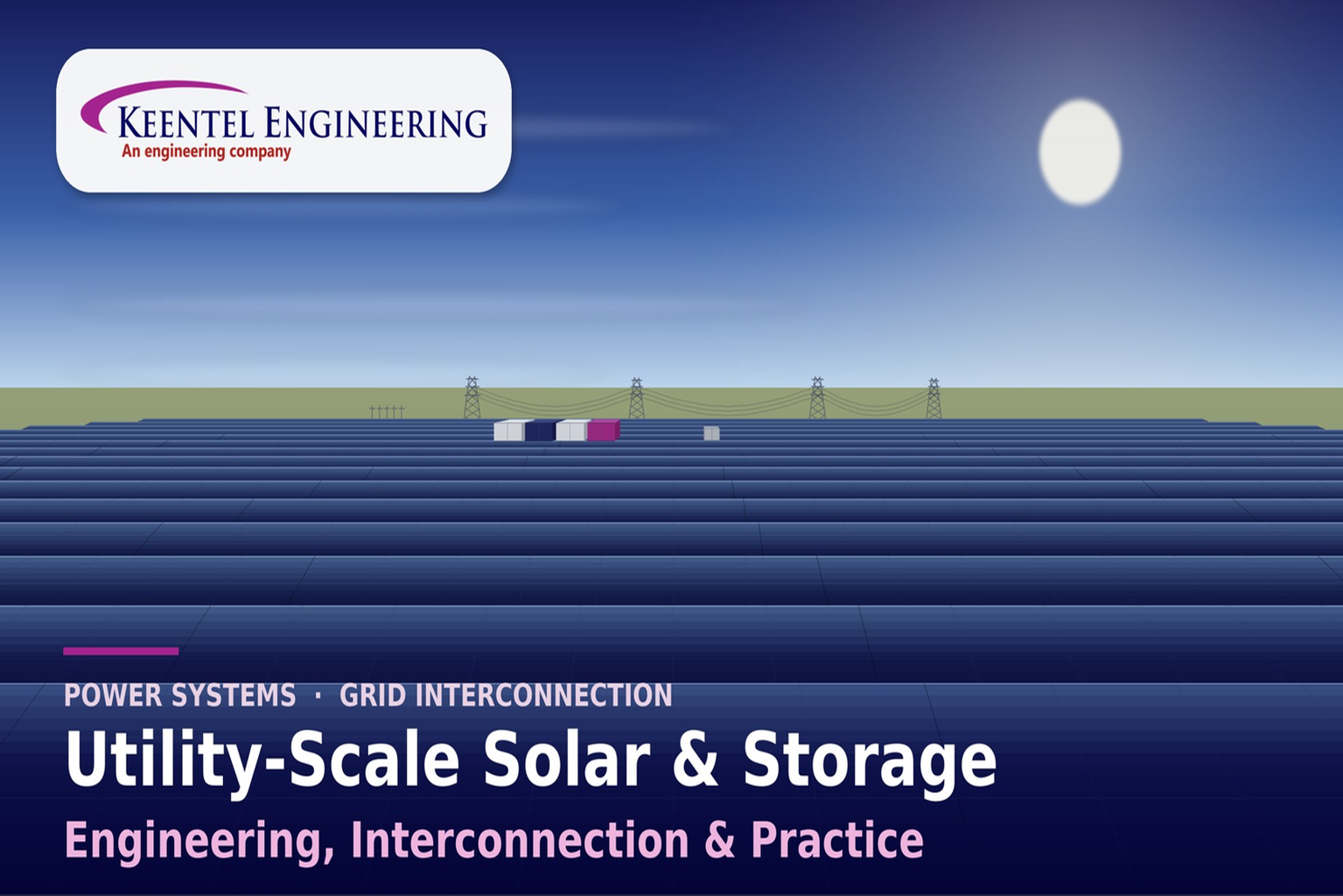
Utility-Scale Solar & Storage: Engineering, Interconnection & Practice
Jun 30, 2026 | Blog
A combined technical article, FAQ, and case-study collection from Keentel Engineering
PART I
From PV Fundamentals to Utility-Scale Interconnection
How module-level physics scales into a transmission-connected power plant
Why utility-scale PV is its own engineering discipline
A rooftop array and a 150-megawatt solar power plant share the same underlying physics: silicon cells convert irradiance into direct current, modules are wired in series to build voltage, and an inverter converts that DC into grid-compliant AC. But the moment a project crosses from “behind-the-meter generation” into “a power plant that exports to the transmission system,” the engineering problem changes character. The questions stop being only about modules, conductors, and a service panel, and start being about how a multi-megawatt inverter-based resource behaves on the grid during faults, how it holds voltage at the point of interconnection, and whether the surrounding network can absorb its output.
At Keentel Engineering, our interconnection and power-systems work begins where the PV body of knowledge ends. This article walks the full arc from the module-level design fundamentals that every solar engineer must master, up through the collector system, the substation, and the studies that decide whether a plant can connect at all. The fundamentals never stop mattering; they simply become the foundation that the grid-facing engineering is built on.
The threshold that defines “utility-scale”
The National Electrical Code® recognizes large PV plants as a distinct class. NEC® Article 691 (Large-Scale Photovoltaic Electric Power Production Facility) may be applied to facilities of roughly 5 MW (5,000 kW) of generating capacity and larger that meet specific criteria the facility is not mounted on or in a building, public access is restricted, the plant is operated as a power-generation station, and the engineering is documented and stamped by a licensed professional engineer.
The practical takeaway: above this threshold, a PV plant is treated like a conventional generating station, not a building electrical system. That single distinction reshapes design, protection, commissioning, and above all interconnection.
The building blocks, scaled up
Every PV plant is assembled from the same hierarchy of components, but at utility scale each layer grows into infrastructure of its own.
From cell to source circuit
Modules are connected in series into strings (source circuits) to build DC voltage. Modern utility-scale plants are almost universally built around a 1500 V DC architecture rather than the 600 V or 1000 V systems common in distributed PV. The reason is purely economic: higher string voltage means lower current for the same power, which means fewer, longer strings, smaller DC conductors per watt delivered, and fewer combiner terminations across hundreds of acres.
From source circuit to inverter
How those source circuits reach the inverter divides utility-scale design into two dominant topologies:
- Central-inverter (DC-combined) plants. Source circuits land in DC combiner boxes out in the array, the combined PV output circuits run to large central inverters (often 2–5 MW each), and the inverters feed a medium-voltage transformer. This topology minimizes the number of inverters and is well suited to large, uniform sites.
- String-inverter (decentralized) plants. Many smaller three-phase string inverters are distributed throughout the field, each serving a handful of source circuits and feeding the medium-voltage collection system directly through skid-mounted transformers. This topology improves granular MPPT, simplifies replacement, and reduces single-point exposure, at the cost of more devices to monitor.
A protection nuance that matters at scale
DC arc-fault detection is straightforward on individual source circuits at a combiner, but it becomes technically impractical on large combined PV output circuits feeding a central inverter — the fault signature is swamped by the aggregate current. This is one of several reasons large-scale facilities lean on restricted access, qualified-person operation, and the alternative provisions of NEC® 691 rather than the prescriptive arc-fault rules written for accessible rooftop arrays.
From inverter to the point of interconnection
Above the inverter, the plant becomes a substation. Inverter AC output is stepped up by pad-mounted transformers to a medium-voltage
Designing the array voltage window
The single most consequential electrical calculation in PV design is the array voltage window — and it is driven by temperature, not by nameplate power. A string that looks correct at 25°C can over-voltage an inverter on the coldest morning of the year or fall out of the MPPT window on the hottest afternoon. Getting this wrong at utility scale multiplies the same error across millions of modules.
The cold-end limit: maximum open-circuit voltage
Module open-circuit voltage rises as temperature falls. To protect the inverter and stay within the system DC rating, the maximum string voltage must be evaluated at the coldest expected cell temperature — conventionally the ASHRAE extreme-minimum (2%) design temperature for the site. The corrected voltage uses the module’s VOC temperature coefficient (β):
VMAX = VOC × [ 1 + β × (TMIN − 25°C) ]
A worked example
| Parameter | Value | Basis |
|---|---|---|
| Open-circuit voltage, V₀ᴄ (STC) | Combined wind + ice + temperature with overload factors | Module datasheet @ 25°C |
| V₀ᴄ temperature coefficient, β | −0.27 %/°C | Module datasheet |
| Site coldest cell temp (ASHRAE 2% min) | −12°C | Representative site |
| Inverter maximum DC input | 1500 V | Inverter datasheet |
| Inverter MPPT lower limit | 875 V | Inverter datasheet |
Temperature-corrected per-module maximum: VMAX = 49.6 × [1 + (−0.0027)(−12 − 25)] = 49.6 × 1.100 ≈ 54.6 V. Dividing the 1500 V ceiling by 54.6 V yields 27.5, so the design is capped at 27 modules in series. That string reaches 27 × 54.6 ≈ 1473 V on the coldest morning safely under 1500 V.
The hot-end limit: minimum operating voltage
At the other extreme, maximum-power voltage (VMP) falls as cells heat. The string must stay above the inverter’s minimum MPPT voltage at the hottest expected operating temperature, or the plant sheds energy by tracking off its true maximum-power point. Checking the same 27-module string with a −0.35 %/°C VMP coefficient at a 70°C cell temperature gives roughly 27 × 35.2 ≈ 951 V — comfortably above the 875 V floor. The string design therefore survives both temperature extremes, which is the entire objective. We also subtract a small annual voltage-degradation allowance (about 0.5–1%/year) so the window remains valid across the 30-plus-year life of the plant.
Why this scales into real money
A one-module error in string length, applied across a 150 MW plant, can shift hundreds of thousands of strings. Choosing 27 versus 26 modules changes conductor counts, combiner loading, inverter utilization, and land use simultaneously. The voltage-window calculation is where module physics, inverter specifications, and site climate meet and it is the foundation every downstream system depends on.
Conductors, current, and the economics of voltage drop
PV is a current-limited source, and the Code sizes conductors with that in mind. Under NEC® 690.8, the maximum source-circuit current is the module short-circuit current multiplied by 1.25 (to account for irradiance above 1000 W/m²), and conductor ampacity is then sized with a further 1.25 continuous-duty factor before temperature and conduit-fill derating. Over hundreds of acres, these factors interact with two competing costs: copper/aluminum tonnage and lifetime energy lost to voltage drop.
At utility scale, voltage-drop budgeting stops being a code-minimum check and becomes a lifecycle optimization. A conductor sized to the bare ampacity minimum may pass inspection yet bleed energy for thirty years; an oversized run wastes capital up front. The right answer balances the present value of lost production against incremental conductor cost a calculation repeated across DC homeruns, the medium-voltage collector feeders, and the GSU connection. This is why collector-system design is treated as an engineering optimization, not a lookup.
| Circuit segment | Typical voltage | Primary design driver |
|---|---|---|
| Source circuit (string) | Up to 1500 V DC | Temperature voltage window; series fusing |
| PV output circuit (combined DC) | Up to 1500 V DC | Ampacity (690.8), arc-fault practicality |
| Inverter AC output | Low-voltage AC | Inverter OCPD; conductor ampacity |
| MV collector system | ~34.5 kV | Feeder loading; losses; cable ampacity |
| GSU / POI | 69–230+ kV | Interconnection requirements; protection |
The layer the PV body of knowledge doesn’t cover: interconnection
Everything above produces a plant that works as a self-contained generator. Whether it is allowed to connect and how it must behave once connected is a separate engineering domain, and it is the core of Keentel’s practice. Three things distinguish a transmission-connected inverter-based resource from a building PV system:
1. It must ride through grid disturbances
A rooftop inverter is required to disconnect during a utility disturbance for safety. A utility-scale plant is required to do the opposite: ride through voltage and frequency excursions and keep supporting the grid, because a fleet of large resources tripping offline during a fault would itself become a reliability event. Ride-through and grid-support behavior are governed by standards such as IEEE 1547 for distribution-connected resources and IEEE 2800 for transmission-connected inverter-based resources, layered with NERC reliability requirements. Demonstrating compliance is an analysis problem, not a nameplate claim.
2. Its grid behavior must be modeled and proven
Interconnection studies require validated models of how the plant responds to the network. Keentel develops both positive-sequence dynamic models (PSS®/E) for system-wide stability and power-flow studies and electromagnetic-transient models (PSCAD™/EMTDC™) for the fast, fault-driven behavior of inverter controls that positive-sequence tools cannot capture. These models feed the feasibility, system-impact, and facilities studies that an ISO/RTO or utility runs before assigning an interconnection agreement and cost responsibility.
3. It must hold voltage and supply reactive power
Beyond real-power export, a utility-scale plant is expected to manage voltage at the POI and provide a specified reactive-power (VAR) capability across its operating range, coordinated by a plant controller. Reactive capability, voltage set-point control, and the protection scheme that isolates the plant for genuine faults while riding through transient events are all engineered, modeled, and field-verified.
Where the fundamentals and the grid meet
The string voltage window, conductor sizing, and combiner architecture decide what the plant can produce. The interconnection engineering ride-through, dynamic modeling, reactive capability, and protection decides whether and how that production is allowed onto the grid. A successful project needs both, and a defect in either layer can stall a project in the interconnection queue or in commissioning.
Commissioning a power plant
The commissioning principles taught for any PV system scale directly into utility practice; what changes is the rigor, the documentation, and the fact that the tests are performed by qualified personnel under restricted access. The pre-energization electrical sequence still rests on a handful of fundamental tests:
- Continuity of grounding and bonding. A low-impedance fault path is verified throughout the racking, equipment grounding, and grounding-electrode system. A useful field benchmark: the bonding resistance on a circuit should stay below 50 V divided by the circuit’s overcurrent rating (for example, under ~1.67 Ω on a 30 A circuit), keeping touch potentials below the hazardous threshold before a fault clears.
- AC voltage and phasing. Inverter AC connections are verified for correct voltage and phase rotation before energization — a phase-rotation error at a multi-megawatt skid is not a tolerable surprise.
- Insulation resistance. A megohmmeter verifies insulation integrity from ungrounded conductors to ground. At scale this is performed efficiently at the DC combiners — source circuits are isolated and tested, and combiner-to-combiner results are compared to flag the outlier that signals damaged wiring or a degrading module string.
- Open-circuit voltage and polarity. Each source circuit’s V₀ᴄ and polarity are confirmed against the temperature-corrected design value the field check on the voltage-window calculation above.
- Short-circuit current. Source-circuit Iₛᴄ is verified under controlled conditions to confirm string health and current balance across the array.
Beyond the pre-energization checks, I–V curve tracing characterizes representative strings against their expected curves to catch soiling, mismatch, shading, or connection problems early, and a performance-ratio test confirms the plant delivers its modeled energy. A first-order annual energy check peak-sun-hours × installed DC kW × system factor anchors expectations before detailed production modeling refines them.
Operations, maintenance, and long-term performance
A utility-scale plant is a 30-plus-year asset, and its economics live or die on availability and performance retention. Module degradation (typically a fraction of a percent per year), inverter availability, soiling losses, vegetation and tracker maintenance, and connection integrity all compound over the asset life. A disciplined O&M program grounded in the same commissioning tests used as periodic diagnostics protects the production assumptions that the project was financed against. The insulation-resistance trend that looked like a
commissioning formality becomes, years later, the early-warning system for a degrading array.
Where Keentel fits
Keentel Engineering works across the full lifecycle of utility-scale solar and storage from interconnection feasibility through detailed design, modeling, and owner’s-engineer support:
Talk to Keentel
Planning a utility-scale PV or PV-plus-storage project — or stuck on an interconnection study, a ride-through requirement, or a model-validation issue? contact@keentelengineering.com · 813-389-7871 · keentel.com · Tampa, FL & Austin, TX.
Case Study 1 — 150 MW Single-Axis-Tracker PV Plant: Clearing the Interconnection Queue
Project snapshot
| Project parameter | Representative value |
|---|---|
| Type | Greenfield utility-scale PV (export to transmission) |
| Capacity | 150 MW AC / ~195 MW DC (DC:AC ≈ 1.30) |
| Array | Bifacial modules on single-axis trackers, 1500 V DC architecture |
| Inverters | Central inverters (multi-MW), DC-combined topology |
| Collection | 34.5 kV medium-voltage collector system |
| Interconnection | 138 kV point of interconnection via dedicated GSU substation |
| Keentel scope | POI / interconnection engineering, PSS®/E and PSCAD™ modeling, owner’s engineer review |
The challenge
The project had a viable site and a signed module supply agreement, but its interconnection request had stalled. The ISO’s system-impact study flagged two concerns: the plant’s low-voltage ride-through behavior during nearby transmission faults could not be confirmed from the manufacturer’s generic models, and a weak-grid stability question at the POI required electromagnetic-transient analysis that the developer’s original consultant had not provided. Without validated models, the project risked falling to the back of the queue and absorbing avoidable network-upgrade cost allocations.
Keentel’s approach
- Built and validated dual models. Keentel developed a positive-sequence dynamic model (PSS®/E) for power-flow and stability studies and an electromagnetic-transient model (PSCAD™/EMTDC™) tuned to the actual inverter control parameters, so the plant’s sub-cycle fault response could be demonstrated rather than assumed.
- Demonstrated ride-through compliance. Fault scenarios at and near the POI were simulated to confirm the plant remained connected and provided grid support through the required voltage and frequency envelopes, consistent with IEEE 2800 and the applicable NERC requirements.
- Resolved the weak-grid question. The EMT study characterized controller interaction with the local network at low short-circuit strength, and informed plant-controller tuning and reactive-capability settings that kept the plant stable across the studied operating range.
- Reviewed the interconnection package as owner’s engineer. Keentel independently checked the collector-system design, GSU and POI protection coordination, and reactive-capability commitments before they were locked into the interconnection agreement.
Engineering highlights
- Voltage-window discipline. The 1500 V string design was confirmed at the site’s ASHRAE extreme-minimum temperature for the cold-end limit and at peak cell temperature for the MPPT floor, with annual voltage degradation included — protecting both the inverter rating and lifetime energy capture.
- Protection that rides through real events. The POI protection scheme was coordinated to isolate the plant for genuine faults while honoring the ride-through requirement for transient disturbances.
Outcome
With validated PSS®/E and PSCAD™ models and a defensible ride-through demonstration, the project cleared the study concerns and retained its queue position. The independent owner’s-engineer review caught two collector-protection coordination items before construction — far cheaper to fix on paper than in the field.
Case Study 2 — 100 MW PV + 50 MW / 200 MWh Storage: Engineering a Dispatchable Hybrid
Project snapshot
| Project parameter | Representative value |
|---|---|
| Type | Utility-scale PV-plus-storage hybrid (solar + BESS) |
| Solar capacity | 100 MW AC PV |
| Storage capacity | 50 MW / 200 MWh battery energy storage (4-hour) |
| Coupling | AC-coupled at the medium-voltage collector bus |
| POI export limit | 100 MW at the point of interconnection |
| Interconnection | 230 kV point of interconnection |
| Keentel scope | Hybrid plant design integration, bidirectional modeling, protection, owner’s engineer |
The challenge
The owner wanted to add four-hour storage to a PV project to firm output and capture energy-arbitrage value — without increasing the export limit at the POI. That created three coupled engineering problems: the plant now had to manage bidirectional power flow (charging from the array and the grid, discharging on dispatch); the interconnection models had to represent the resource’s behavior in both directions; and the export had to be held to 100 MW even when the PV and battery could momentarily deliver more, which is a controls and protection problem, not just a nameplate one.
Keentel’s approach
- Selected and engineered the coupling architecture. An AC-coupled configuration at the collector bus was adopted to keep the PV and storage blocks independently serviceable and to simplify export-limit enforcement, with the trade-offs against a DC-coupled alternative documented for the owner.
- Modeled the resource in both power-flow directions.
PSS®/E and EMT models represented charging and discharging behavior, ride-through in both modes, and the plant controller’s response — because an interconnection study for a hybrid cannot assume a one-way generator.
- Engineered the export-limit and reactive-support controls. The plant controller logic was designed to cap net export at the POI across all PV/BESS operating combinations while still meeting the reactive-capability and voltage set-point requirements at 230 kV.
- Addressed storage-specific design. Bidirectional protection, state-of-charge-aware operation, and storage code provisions (e.g., NEC® Article 706 framework) were integrated into the overall plant design and reviewed independently as owner’s engineer.
Engineering highlights
- One POI, two resources. The interconnection agreement was supported with models proving the combined plant respected the 100 MW export limit and ride-through requirements regardless of dispatch state.
- Firming without a bigger interconnection. By holding the export limit and adding storage behind it, the project improved its capacity value and dispatchability without triggering the larger network upgrades a higher export request would have required.
Outcome
The hybrid was engineered to deliver firmer, more dispatchable output and arbitrage value while staying within its existing 100 MW interconnection envelope. Bidirectional modeling and controller logic that enforced the export cap let the project add four-hour storage without re-opening the interconnection capacity — the most expensive door to reopen on a utility-scale project.
Case Study 3 — 80 MW String-Inverter Plant: Commissioning and Performance Verification at Scaleph
Project snapshot
| Project parameter | Representative value |
|---|---|
| Type | Utility-scale PV (decentralized string-inverter topology) |
| Capacity | 80 MW AC / ~104 MW DC |
| Array | 1500 V DC strings on fixed-tilt structures |
| Inverters | Distributed three-phase string inverters with skid transformers |
| Collection | 34.5 kV collector system |
| Interconnection | 69 kV point of interconnection |
| Keentel scope | Commissioning oversight, performance verification, owner’s engineer |
The challenge
Construction was complete and the owner needed confidence that the plant would meet its financed production target before final acceptance from the EPC. Early energization data showed two combiner zones underperforming their neighbors, and a handful of string inverters were reporting intermittent ground-related alarms. The owner engaged Keentel to run a disciplined commissioning and performance-verification program and to determine whether the issues were construction defects to be corrected before acceptance — or noise.
Keentel’s approach
- Ran the pre-acceptance electrical test sequence. Continuity of grounding and bonding, AC voltage and phasing, insulation resistance, open-circuit voltage/polarity, and short-circuit current were verified and documented across the plant by qualified personnel under restricted access.
- Isolated the underperformance with insulation-resistance comparison. Insulation resistance was measured at the DC combiners and compared zone-to-zone. The two outlier zones returned readings well below their peers — a clear, repeatable signature pointing to damaged conductor insulation rather than soiling or shading.
- Confirmed the diagnosis with I–V curve tracing. Representative strings in the suspect zones were curve-traced against expected I–V characteristics, separating mechanical/wiring faults from module mismatch and confirming the specific strings needing rework.
- Verified plant performance against the model. After corrections, a performance-ratio test confirmed the plant delivered its modeled energy, anchored by a first-order peak-sun-hours energy check and refined with detailed production modeling.
Engineering highlights
- Comparison testing beats absolute thresholds. At scale, the fastest way to find the defect is to test identical sub-systems and flag the outlier — combiner-to-combiner insulation-resistance comparison turned a vague “two zones look low” into a precise rework list.
- Acceptance backed by data. Documented test records gave the owner a defensible basis to require EPC corrections before final acceptance, protecting the production warranty and the financing assumptions.
Outcome
The underperforming zones were traced to a small number of insulation faults, corrected by the EPC before acceptance, and re-verified. The plant passed its performance-ratio test, and the owner accepted the asset with a complete commissioning record — turning an ambiguous early-data concern into a closed, documented item.
How Keentel supports utility-scale projects
Across these problem classes — interconnection, hybrid integration, and commissioning — Keentel Engineering works the full lifecycle of utility-scale solar and storage:
- POI / interconnection engineering — feasibility, system-impact, and facilities study support and interconnection-agreement review.
- EMT and positive-sequence modeling — PSCAD™/EMTDC™ and PSS®/E for ride-through, stability, and protection.
- Substation & transmission-line design — collector systems, GSU and POI substations, protection coordination.
- Utility-scale renewables & BESS engineering — PV, storage, and hybrid plant design and integration.
- Owner’s engineer & NERC O&P compliance — independent review, commissioning oversight, and reliability support.
Start a conversation
Have a project facing one of these challenges? contact@keentelengineering.com · 813-389-7871 · keentel.com · Tampa, FL & Austin, TX.
Part II
Utility-Scale Solar & Interconnection FAQ
Plain-language answers to the questions asked most about large PV and storage projects
This FAQ collects the questions Keentel Engineering hears most often from developers, asset owners, EPC partners, and AHJs working on
utility-scale solar and solar-plus-storage projects. Answers are general engineering information; project-specific, PE-stamped engineering and the governing code edition always control.
Defining the project
Q. What makes a solar project “utility-scale”?
There is no single legal line, but a practical one comes from NEC® Article 691, which can apply to PV facilities of roughly 5 MW (5,000 kW) and larger that are not building-mounted, have restricted public access, are operated as generating stations, and are engineered under a licensed PE. Above that threshold a plant is treated like a conventional power station rather than a building electrical system — which changes how it is designed, protected, commissioned, and interconnected.
Q. How is a utility-scale plant different from a large commercial rooftop system?
The physics are the same; the grid relationship is not. A commercial system is sized to offset on-site load and must disconnect during a grid disturbance. A utility-scale plant exists to export power to the transmission or distribution system, must ride through disturbances, and must hold voltage and supply reactive power on command. It also adds infrastructure a building never has: a medium-voltage collector system, a project substation, a generator step-up transformer, plant-level protection, SCADA, and a power plant controller.
Q. What is the difference between AC and DC capacity, and why are both quoted?
The DC capacity is the installed module nameplate; the AC capacity is the inverters’ grid-side rating. Plants are deliberately built with a DC-to-AC ratio above 1.0 (commonly 1.2–1.4) so the inverters run near full output for more hours and the plant captures more energy from the same interconnection. A “150 MW” plant may mean 150 MW AC at the POI with roughly 180–210 MW DC of modules behind it.
Electrical design
Q. Why is temperature — not power rating — the critical input to string design?
Module voltage changes with temperature. Open-circuit voltage rises as it gets colder, so the maximum string voltage is checked at the coldest expected cell temperature (the ASHRAE extreme-minimum design temperature) to avoid exceeding the inverter and system DC rating. Maximum-power voltage falls as it gets hotter, so the string must stay above the inverter’s minimum MPPT voltage at the hottest expected temperature. Get either end wrong and you over-voltage the inverter or shed energy — multiplied across millions of modules.
Q. Why are most new utility-scale plants built at 1500 V DC?
Higher string voltage means lower current for the same power. Lower current means smaller DC conductors per watt, longer strings, fewer combiner terminations, and lower resistive losses across a site that can span hundreds of acres. The move from 1000 V to 1500 V DC was one of the larger step-changes in utility-scale cost reduction.
Q. Central inverters or string inverters — which is better?
Neither is universally better; it is a project trade-off:
Central inverters (multi-MW units fed by DC combiners) minimize device count and suit large, uniform sites with centralized maintenance.
String inverters (many smaller distributed units) improve granular MPPT, simplify field replacement, and reduce single-point exposure, at the cost of more devices to monitor.
Site uniformity, O&M strategy, terrain, and availability targets usually decide it.
Q. Central inverters or string inverters — which is better?
Under NEC® 690.8, maximum source-circuit current is short-circuit current × 1.25 (for irradiance above 1000 W/m²), and conductor ampacity then carries a further 1.25 continuous-duty factor before temperature and conduit-fill derating. At utility scale we go beyond the code minimum and optimize each run — weighing conductor cost against thirty years of voltage-drop losses, because the minimum-ampacity conductor can quietly bleed energy for the life of the plant.
Interconnection
Q. What actually happens in an interconnection study?
When a project requests to connect, the ISO/RTO or utility evaluates its impact through a staged process — typically a feasibility study, a system-impact study, and a facilities study. These determine whether the network can host the plant, what upgrades are needed, and who pays for them. The output is an interconnection agreement with technical requirements and cost responsibility. Keentel supports developers through this process with the models and analysis the studies depend on.
Q. What is “ride-through,” and why must a plant stay connected during a fault?
Ride-through is the requirement that a generator remain connected and keep supporting the grid through voltage and frequency excursions, rather than tripping off. If a large fleet of inverter-based resources all disconnected during a single fault, that mass trip would itself become a reliability event. Ride-through and grid-support behavior are governed by IEEE 1547 (distribution) and IEEE 2800 (transmission-connected inverter-based resources), layered with NERC reliability requirements.
Q. Why do projects need both PSS®/E and PSCAD™ models?
They answer different questions. Positive-sequence models (PSS®/E) evaluate system-wide power flow and dynamic stability across the network. Electromagnetic-transient models (PSCAD™/EMTDC™) capture the fast, fault-driven behavior of inverter controls — sub-cycle dynamics that positive-sequence tools cannot represent. Modern interconnection processes increasingly require EMT studies for inverter-based resources, so most utility-scale projects need both.
Q. Does a solar plant provide reactive power and voltage control?
Yes. Beyond exporting real power, a utility-scale plant is expected to manage voltage at the POI and provide a specified reactive-power (VAR) capability across its operating range, coordinated by a plant controller. Reactive capability and voltage set-point control are engineered, modeled, and verified during commissioning — they are interconnection requirements, not optional features.
Storage & hybrids
Q. How does adding a battery (BESS) change the engineering?
A battery turns a variable generator into a more dispatchable, controllable resource, but it adds layers: bidirectional power flow, state-of-charge management, a more complex plant controller, additional protection and thermal/fire-safety design, and storage-specific code provisions (for example, NEC® Article 706). The interconnection picture also changes — charge/discharge behavior, ride-through, and reactive support all have to be modeled for both directions of power flow.
Q. Can a battery be added to an existing solar plant without re-studying interconnection?
Usually not without analysis. Adding storage changes the plant’s behavior at the POI — its power profile, its controllability, and often its requested capacity — so the interconnection impact typically must be re-evaluated. Whether it triggers a new study or a modification depends on the configuration (AC- vs DC-coupled), the export limit, and the ISO/utility rules. This is exactly the kind of question to model before committing.
Commissioning & operations
Q. What pre-energization tests confirm a plant is ready?
The core sequence, performed by qualified personnel under restricted access, is: continuity of grounding and bonding; AC voltage and phasing; insulation resistance (efficiently done at the DC combiners with a megohmmeter); open-circuit voltage and polarity per source circuit; and short-circuit current verification. I–V curve tracing and a performance-ratio test then confirm the plant produces its modeled energy.
Q. How is long-term performance protected over a 30-year asset life?
Through a disciplined O&M program that treats the commissioning tests as periodic diagnostics. Tracking insulation-resistance trends, inverter availability, soiling losses, connection integrity, tracker and vegetation maintenance, and module degradation protects the production assumptions the project was financed against. The combiner test that felt like a formality at commissioning becomes the early-warning system years later.
Q. What is an owner’s engineer, and when is one worth engaging?
An owner’s engineer (OE) is an independent technical advisor representing the project owner’s interests — reviewing design, modeling, interconnection, and EPC work, and overseeing commissioning. An OE is most valuable on capital-intensive, schedule-sensitive projects where an independent check on the interconnection package, the dynamic models, and the commissioning results materially reduces risk. Keentel provides owner’s-engineer services across utility-scale solar and storage.

About the Author:
Sonny Patel P.E. EC
IEEE Senior Member
In 1995, Sandip (Sonny) R. Patel earned his Electrical Engineering degree from the University of Illinois, specializing in Electrical Engineering . But degrees don’t build legacies—action does. For three decades, he’s been shaping the future of engineering, not just as a licensed Professional Engineer across multiple states (Florida, California, New York, West Virginia, and Minnesota), but as a doer. A builder. A leader. Not just an engineer. A Licensed Electrical Contractor in Florida with an Unlimited EC license. Not just an executive. The founder and CEO of KEENTEL LLC—where expertise meets execution. Three decades. Multiple states. Endless impact.
Services

Let's Discuss Your Project
Let's book a call to discuss your electrical engineering project that we can help you with.
About the Author:
Sonny Patel P.E. EC
IEEE Senior Member
In 1995, Sandip (Sonny) R. Patel earned his Electrical Engineering degree from the University of Illinois, specializing in Electrical Engineering . But degrees don’t build legacies—action does. For three decades, he’s been shaping the future of engineering, not just as a licensed Professional Engineer across multiple states (Florida, California, New York, West Virginia, and Minnesota), but as a doer. A builder. A leader. Not just an engineer. A Licensed Electrical Contractor in Florida with an Unlimited EC license. Not just an executive. The founder and CEO of KEENTEL LLC—where expertise meets execution. Three decades. Multiple states. Endless impact.
Leave a Comment
We will get back to you as soon as possible.
Please try again later.
Related Posts