A Coordinated Electric System Interconnection Review—the utility’s deep-dive on technical and cost impacts of your project.
Challenge: Frequent false tripping using conventional electromechanical relays
Solution: SEL-487E integration with multi-terminal differential protection and dynamic inrush restraint
Result: 90% reduction in false trips, saving over $250,000 in downtime
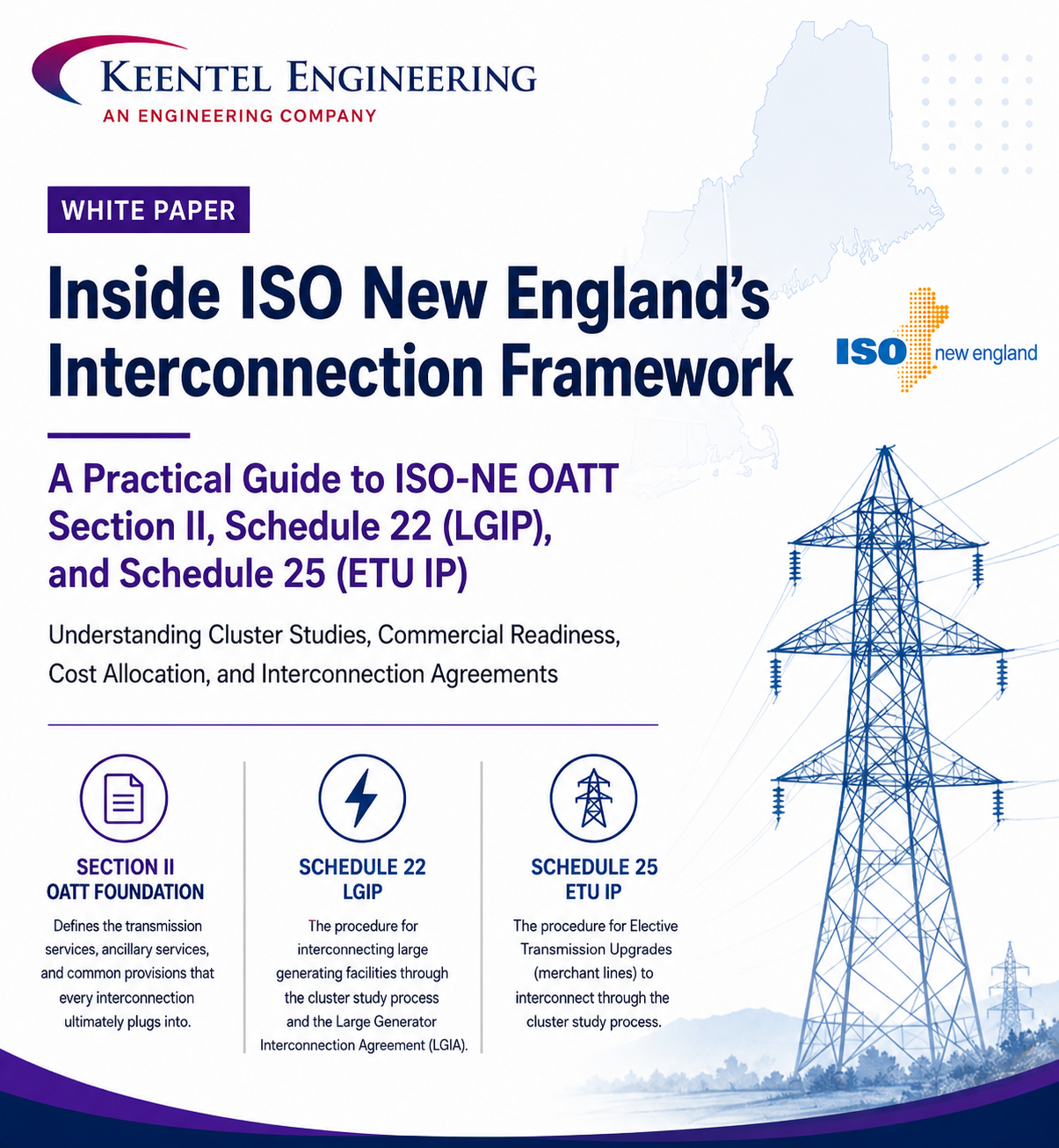
Inside ISO New England's Interconnection Framework
jun 6, 2026 | Blog
A Keentel Engineering White Paper — Transmission & Interconnection
1. Executive Summary
Connecting a power plant or a merchant transmission line to the New England bulk system is governed not by a single rulebook but by three interlocking instruments within ISO New England's Open Access Transmission Tariff (OATT). Understanding how they fit together is the difference between a project that moves through the queue and one that stalls.
This white paper distills the three controlling documents — Section II (the OATT's common service provisions), Schedule 22 (the Large Generator Interconnection Procedures, or "LGIP"), and Schedule 25 (the Elective Transmission Upgrade Interconnection Procedures, or "ETU IP") — into a working reference for developers, asset owners, and the engineers who study and build interconnections.
All three reflect ISO-NE's transition to a cluster study model, the reform mandated by FERC Order No. 2023 to replace the legacy first-come, first-served serial queue. They share an effective date of May 3, 2025 under FERC docket ER25-2149-000. Because they were revised in lockstep, they now use a common vocabulary, a common study sequence, and a common set of commercial-readiness and withdrawal-penalty mechanics.
The three documents at a glance:
- Section II — ISO-NE OATT (~617 pp.): Defines the transmission services, ancillary services, and common provisions that every interconnection ultimately plugs into. The tariff "operating system."
- Schedule 22 — LGIP (~402 pp.): The end-to-end procedure for interconnecting large generating facilities, from request through cluster study, facilities study, affected-system study, and the Large Generator Interconnection Agreement (LGIA).
- Schedule 25 — ETU IP (~370 pp.): The parallel procedure for Elective (merchant) Transmission Upgrades — controllable ties, HVDC links, and other non-tariff-funded transmission that elects to interconnect.
2. Regulatory Context — Why the rules changed
For two decades, interconnection in New England — as across most of the United States — ran on a serial, first-come/first-served queue. Each request was studied largely on its own, on top of the projects ahead of it. As renewable and storage development surged, that model collapsed under its own weight: queues ballooned, studies were endlessly restudied as speculative projects dropped out, and developers waited years for certainty.
FERC's Order No. 2023 directed transmission providers and grid operators to move to a cluster study framework — studying batches of requests together at fixed intervals — and to raise the commercial-readiness bar so that only serious projects occupy queue capacity. ISO New England implemented these reforms across its tariff, and the three documents in this paper are the result.
Two structural ideas run through all of them:
- Study the cluster, not the individual. Requests submitted within a defined window are evaluated as a group, so network upgrades and their costs are identified and allocated across the projects that actually drive them.
- Make readiness cost money. Commercial Readiness Deposits and Withdrawal Penalties replace the old, near-free option to sit in the queue indefinitely, discouraging speculative placeholders.
3. Document 1 — Section II: The OATT foundation every project plugs into
Section II is the largest of the three documents because it is the substrate: it defines what services exist on the ISO-NE system before any single project is studied. Interconnection procedures in Schedules 22 and 25 repeatedly cross-reference Section II for definitions, standards, and the underlying services a resource is ultimately enabling.
Common Service Provisions (Section II.A) carries the tariff's master Definitions, its statement of purpose, the linkage to Market Rule 1 (the market design), and the catalogue of Ancillary Services that keep the system stable and reliable: Scheduling, System Control and Dispatch; Reactive Supply and Voltage Control; Regulation and Frequency Response; Energy Imbalance; Ten-Minute Spinning and Non-Spinning Reserve; Thirty-Minute Operating Reserve; Blackstart; Generator Imbalance; and Special Constraint Resource Service.
For an interconnecting generator, these definitions matter because the resource's design — its reactive capability, ramp rate, ability to provide reserves — determines which of these services it can supply and how it will be settled.
Regional Network Service (Section II.B) establishes the network transmission service that moves energy across the pooled New England system, together with the responsibilities of the ISO and the Participating Transmission Owners (PTOs) and the treatment of real-power losses. Regional Network Service is the service framework a Network Resource is built to support.
A useful mental model: Section II is the grid's terms of service. Schedules 22 and 25 are the procedures for getting
onto that grid; Section II describes what you are getting onto.
4. Document 2 — Schedule 22: The Large Generator Interconnection Procedures
Schedule 22 is the procedural heart of generator interconnection. It governs any request to interconnect a new large generating facility, materially modify an existing one, increase a facility's energy or capacity capability, begin participating in the wholesale markets, or convert between interconnection-service types. Its thirteen sections walk a project from first request to executed agreement:
- §1–2 Definitions, scope and timing — the shared vocabulary and the master clock.
- §3 Interconnection Requests — what makes a request valid, OASIS posting, coordination with internal affected systems, and withdrawal.
- §4 Evaluation process — queue position, the general study process, transferability, and modifications.
- §5 Transition — how legacy serial-queue projects move into the cluster process, including the one-time Transitional Cluster Study.
- §6 Information access — publicly posted interconnection data.
- §7 Cluster Study — the central group study.
- §8 Interconnection Facilities Study — detailed engineering and cost estimate for the customer's facilities and assigned upgrades.
- §9 Affected System Study — coordination where neighboring systems outside the New England Control Area may be impacted.
- §10 Optional Interconnection Study — a customer-requested sensitivity analysis.
- §11 The LGIA — tender, negotiation, execution and filing of the Large Generator Interconnection Agreement.
- §12 Construction — scheduling and construction sequencing of facilities and network upgrades.
- §13 Miscellaneous — confidentiality, study-cost obligations, disputes, and the Engineering & Procurement (E&P) Agreement.
A series of appendices supplies the operative forms: the Interconnection Request, the Cluster Study Agreement, the Interconnection Facilities Study Agreement, the Affected System study agreements, and the Transitional Cluster Study Agreement, among others.
5. The fork in the road — CNR vs. NR Interconnection Service
Early in the process a developer must choose the type of interconnection service. This single choice shapes how the project is studied, what upgrades it triggers, and what it is allowed to do in the capacity market.
| Attribute | Network Resource (NR) Service | Capacity Network Resource (CNR) Service |
|---|---|---|
| Standard applied | Network Capability Interconnection Standard | Capacity Capability Interconnection Standard (higher, deliverability-tested) |
| What it secures | Ability to inject energy into the network | Deliverability of capacity without relying on redispatch of other capacity resources |
| Capacity market | Does not by itself qualify the resource to clear capacity | Establishes CNR Capability (MW) needed to participate in the Forward Capacity Auction |
| Typical upgrades | Generally lighter — energy injection only | Generally heavier — must survive deliverability testing |
| Convertible? | Yes — can later request to move from NR to CNR for all or part of capability | The deliverability commitment a capacity seller needs |
the capacity market.In plain engineering terms: NR service answers "can the grid absorb my energy?", while CNR service answers the harder question "can the grid count on my capacity being deliverable when the system is stressed?" The latter requires the resource to survive a deliverability analysis, which usually means more — and more expensive — network upgrades.
6. The engine — the Cluster Study process, step by step
The cluster study is the procedural innovation at the center of the reform. Rather than studying projects one at a time, ISO-NE collects requests during a defined window and studies them together as a Cluster.
- Cluster Request Window opens. Requests may only be submitted during a defined window; those submitted outside it are not considered. Subsequent windows open on a fixed cadence, giving a predictable calendar instead of a perpetual queue.
- Validation & queue assignment. Shortly after the window closes, the System Operator validates requests and assigns Queue Positions. A subsequent customer-engagement period lets parties confirm scope, deposits, and contingent facilities.
- Cluster Study. The group is studied together — combining system-impact and facilities analyses — to identify needed Network Upgrades and Interconnection Facilities. Results are issued in a Cluster Study Report and reviewed at a Cluster Study Report Meeting.
- Cluster Restudy (if triggered). If higher-queued projects withdraw or material assumptions change, a Restudy reallocates upgrades and costs across surviving cluster members.
- Interconnection Facilities Study (§8). A project-specific, detailed engineering study refines the design and cost estimate for the customer's interconnection facilities and its assigned share of network upgrades.
- Affected System & Optional studies (§9–10). Where neighboring systems outside the New England Control Area may be impacted, an Affected System Study coordinates and allocates those costs. A customer may also commission an Optional Interconnection Study for sensitivity scenarios.
- LGIA — tender, negotiate, execute (§11). The System Operator tenders the LGIA; the parties negotiate, and the customer executes and files it with FERC, locking in costs, milestones, and obligations before construction.
- Construction & energization (§12). The Interconnecting Transmission Owner builds its facilities and network upgrades on an agreed schedule, with construction sequencing across cluster members.
Note: Exact day-count deadlines for each milestone are specified in the tariff and on the System Operator's OASIS; missing a study deadline can carry penalties under §3.9. Treat the sequence above as the skeleton and the tariff as the authority.
7. The money — deposits, commercial readiness, and the cost of leaving
The reform's second pillar is financial. To occupy queue capacity, a project must put real money behind its intent — and pay if it leaves and strands costs for others.
Commercial Readiness Deposits
are posted at defined points in the process (and escalate as the project advances) to demonstrate that a developer is serious. They may be satisfied by cash, an eligible letter of credit, or a surety bond from an approved issuer. Failure to cure a deposit deficiency within the prescribed period results in withdrawal of the request.
Withdrawal Penalties:
A customer who withdraws — or is deemed withdrawn — may be assessed a Withdrawal Penalty calculated under the tariff's formulas. A distinct Transitional Withdrawal Penalty applies to projects moving through the one-time Transitional Cluster Study used to migrate the legacy queue. These penalties internalize the cost a dropout imposes on the rest of the cluster by forcing restudies and reallocations.
Surplus Interconnection Service:
Where an existing interconnection has headroom, a customer may add a resource (often storage) behind an existing point of interconnection through a streamlined study — avoiding re-triggering the full process.
8. Document 3 — Schedule 25: The merchant transmission track
Schedule 25 mirrors Schedule 22 almost section-for-section, but its subject is different: the Elective Transmission Upgrade (ETU) — transmission that a developer elects to build and fund itself (controllable interties, HVDC links, and similar facilities) rather than transmission funded through the regional tariff. Because such a project interconnects to the grid much like a generator does, it needs an analogous procedure.
The parallels are deliberate:
- The same Cluster Study (§7), Interconnection Facilities Study (§8), Affected System Study (§9), and Optional Study (§10).
- The same CNR / NR service-type choice, applied to the ETU rather than to a generating facility.
- The same commercial-readiness mechanics — including a CETU Participation Deposit, which functions as a Commercial Readiness Deposit for the elective-transmission context.
- A capstone agreement analogous to the LGIA: the Elective Transmission Upgrade Interconnection Agreement (§11).
By co-locating
merchant transmission and generation in the same cluster machinery, ISO-NE can study the two together and allocate shared network upgrades coherently — important as interregional ties and offshore-wind delivery infrastructure grow.
9. How the three documents interlock
Read individually, each document is hundreds of pages of regulatory prose. Read together, they form a clean three-layer system:
| Layer | Document | Answers the question |
|---|---|---|
| Foundation | Foundation | What services and standards exist on the ISO-NE system? |
| Generator procedure | Schedule 22 (LGIP) | How does a power plant get connected and into the markets? |
| Transmission procedure | Schedule 25 (ETU IP) | How does merchant transmission get connected on comparable terms? |
Schedules 22 and 25 are procedural siblings sharing one vocabulary and one study engine; Section II is the parent tariff both reach back into for definitions, ancillary services, and the network service their projects ultimately enable. A change in one ripples through the others — which is precisely why all three carry the same May 3, 2025 effective date and FERC docket.
10. Practical takeaways for developers and engineers
- Calendar discipline beats speed. With fixed Cluster Request Windows, the old "submit early to grab queue position" instinct is gone. Plan to be ready for a window, with site control, deposits, and design maturity in hand.
- Pick the service type early and deliberately. NR vs. CNR drives study scope, upgrade cost, and capacity-market eligibility. Choosing CNR for a resource that will never bid capacity wastes money; choosing NR for a capacity-seeking resource invites a painful conversion later.
- Model your cluster neighbors. Because upgrades and costs are allocated across the cluster, the other projects in your window are part of your risk profile. Restudies triggered by their withdrawals can change your assigned upgrades.
- Budget for readiness, not just construction. Commercial Readiness Deposits and potential Withdrawal Penalties are real, escalating capital commitments that belong in the pro forma from day one.
- Watch the affected-system seam. Projects near the New England border can trigger Affected System Studies with neighboring operators — a coordination path that adds time and cost outside ISO-NE's direct control.
- Treat Surplus Interconnection Service as a tool. For storage additions behind an existing interconnection, it can be dramatically faster than a fresh request.
11. Twenty Frequently Asked Questions
Q1. What are the three documents and how do they relate?
Section II is the ISO-NE OATT's common service provisions — the foundation defining services and standards. Schedule 22 (the LGIP) is the procedure for interconnecting large generators. Schedule 25 (the ETU IP) is the parallel procedure for Elective Transmission Upgrades. Section II is the parent tariff; Schedules 22 and 25 are procedural siblings that both reference it.Section II is the ISO-NE OATT's common service provisions — the foundation defining services and standards. Schedule 22 (the LGIP) is the procedure for interconnecting large generators. Schedule 25 (the ETU IP) is the parallel procedure for Elective Transmission Upgrades. Section II is the parent tariff; Schedules 22 and 25 are procedural siblings that both reference it.
Q2. What is a cluster study and why did ISO-NE adopt it?
A cluster study evaluates a group of interconnection requests together rather than one at a time. ISO-NE adopted it to implement FERC Order No. 2023, which sought to clear backlogged serial queues, reduce endless restudies, and allocate network-upgrade costs across the projects that actually drive them.
Q3. When did these rules take effect
All three documents share an effective date of May 3, 2025, under FERC Docket No. ER25-2149-000.
Q4. What is the difference between NR and CNR interconnection service?
NR service is granted under the Network Capability Interconnection Standard and secures the ability to inject energy. CNR service is granted under the higher Capacity Capability Interconnection Standard, establishes deliverable capacity (CNR Capability in MW), and is what a resource needs to participate in the Forward Capacity Auction. CNR generally triggers heavier network upgrades.
Q5. Can I change from NR to CNR later?
Yes. The tariff treats a request to change from NR to CNR service for all or part of a facility's capability as a form of Interconnection Request, which is then studied accordingly. It is not free or automatic — it re-enters the study process — so the service type should be chosen deliberately at the outset.
Q6. What is a Cluster Request Window?
It is the defined period during which Interconnection Requests may be submitted to be studied together in a cluster. Requests submitted outside the window are not considered. Subsequent windows open on a fixed cadence, so developers plan around a predictable calendar rather than racing to claim queue position.
Q7. What is a Commercial Readiness Deposit?Q7. What is a Commercial Readiness Deposit?
A deposit a customer must post at defined points to demonstrate the project is real and to hold queue capacity. It can be satisfied with cash, an eligible letter of credit, or an approved surety bond. Failing to cure a deposit deficiency in time results in withdrawal of the request.
Q8. What happens if I withdraw from the queue?
A customer who withdraws, or is deemed withdrawn, may be assessed a Withdrawal Penalty calculated under the tariff. The penalty exists because a dropout can force restudies and reallocate upgrade costs onto the remaining cluster members; the penalty internalizes that cost.
Q9. What is the Transitional Cluster Study?
A one-time study used to migrate projects from the legacy serial queue into the new cluster framework. It has its own agreement and its own Transitional Withdrawal Penalty for customers who leave during the transition.
Q10. What is an Affected System Study?
When an interconnection may impact an electric system outside the New England Control Area, that neighboring system is an "Affected System." Schedule 22 §9 provides procedures to notify it, study the impact, and allocate any Affected System Network Upgrade costs — often coordinated through a multiparty agreement.
Q11. What is the difference between Interconnection Facilities and Network Upgrades?
Interconnection Facilities are the equipment needed to physically connect the customer at the point of interconnection — split into the customer's facilities and the Interconnecting Transmission Owner's facilities. Network Upgrades are additions or modifications to the broader transmission system required to accommodate the new injection. The studies identify and cost both.
Q12. What is an Optional Interconnection Study?
A study a customer can request (Schedule 22 §10) to evaluate scenarios or sensitivities beyond the standard cluster analysis — for example, alternative configurations or assumptions. It is at the customer's option and expense and does not replace the required studies.
Q13. What is the LGIA?
The Large Generator Interconnection Agreement is the binding contract that concludes the procedure. It is tendered by the System Operator, negotiated by the parties, then executed by the customer and filed with FERC. It fixes the scope of facilities and upgrades, cost responsibility, construction milestones, and operating obligations.
Q14. What is an Elective Transmission Upgrade (ETU)?
Transmission a developer elects to build and fund itself — such as a controllable intertie or HVDC link — rather than transmission funded through the regional tariff. Because it interconnects to the grid much like a generator, Schedule 25 gives it an analogous, cluster-based procedure.
Q15. How does Schedule 25 differ from Schedule 22?
They are structurally parallel — same cluster study, facilities study, affected-system study, optional study, and service-type choice. The difference is the subject: Schedule 22 connects generating facilities and ends in an LGIA; Schedule 25 connects elective transmission and ends in an Elective Transmission Upgrade Interconnection Agreement, with a CETU Participation Deposit serving as its Have a project in the BPA queue or a model that needs validation? Contact Keentel Engineering's interconnection modeling team.
Q16. What is Surplus Interconnection Service?
A streamlined path that lets a customer use unused capability at an existing point of interconnection to add a resource — frequently storage — without re-running the full interconnection process. It is studied through a Surplus Interconnection Service Study.
Q17. What ancillary services does Section II define, and why do they matter to a generator?
Section II catalogues services such as scheduling/dispatch, reactive supply and voltage control, regulation and frequency response, energy imbalance, ten-minute spinning and non-spinning reserves, thirty-minute operating reserve, blackstart, and generator imbalance. They matter because a resource's physical design determines which it can provide and how it is settled — design and revenue strategy are linked.
Q18. What is a Material Modification?
A change to a proposed or existing facility (or its interconnection facilities) significant enough to require re-evaluation. The tariff treats such modifications as triggering an Interconnection Request or assessment, because they can alter study results and the upgrades a project drives.
Q19. Are there penalties for missing study deadlines?
Yes. Both Schedule 22 and Schedule 25 include provisions (e.g., §3.9) for penalties when a customer fails to meet study deadlines. These reinforce the discipline the cluster process depends on, since one party's delay affects the whole cluster.
Q20. Where do I go for the authoritative answer?
The governing text is the filed ISO-NE OATT — Section II, Schedule 22, and Schedule 25 — as accepted by FERC under ER25-2149-000, together with the System Operator's OASIS postings for current windows, deadlines, and deposit requirements. This white paper is an orientation guide; the tariff controls in any conflict. For project-specific analysis, engage qualified interconnection engineering and regulatory counsel

About the Author:
Sandip "Sonny" R. Patel, P.E.
IEEE Senior Member · Founder & CEO, Keentel Engineering
In 1995, Sonny Patel earned his Electrical Engineering degree from the University of Illinois. But degrees don't build legacies — action does.
For three decades, he has worked the power industry from every side of the table: 16 years as a utility engineer at Exelon/Commonwealth Edison; generation leadership across hydroelectric, industrial steam turbine, and a 9 GW renewable fleet; NERC Regional Entity Senior Compliance Engineer and Audit Team Lead, auditing some of the nation's largest utilities; and testing and commissioning lead on equipment up to 765 kV — the very top of the North American grid.Utility. Generator. Regulator. Consultant. Few engineers have seen all four seats. Fewer still have sat in them.
His experience spans nuclear, hydro, conventional generation, renewables, oil and gas, mining — and today's data centers, where he is authoring a three-book series on data center design. He is a Licensed Professional Engineer in six states and a Licensed Electrical Contractor in Florida (Unlimited EC) — he doesn't just design the work; he's qualified to stand behind its execution.Today, as Founder and CEO of Keentel Engineering, Sonny leads a nationwide team of engineers delivering substation design, power system studies, NERC compliance, and commissioning — done right, coast to coast.Three decades. Every side of the table. One standard: accountable engineering.
Services

Let's Discuss Your Project
Let's book a call to discuss your electrical engineering project that we can help you with.
About the Author:
Sandip "Sonny" R. Patel, P.E.
IEEE Senior Member · Founder & CEO, Keentel Engineering
In 1995, Sonny Patel earned his Electrical Engineering degree from the University of Illinois. But degrees don't build legacies — action does.
For three decades, he has worked the power industry from every side of the table: 16 years as a utility engineer at Exelon/Commonwealth Edison; generation leadership across hydroelectric, industrial steam turbine, and a 9 GW renewable fleet; NERC Regional Entity Senior Compliance Engineer and Audit Team Lead, auditing some of the nation's largest utilities; and testing and commissioning lead on equipment up to 765 kV — the very top of the North American grid.
Utility. Generator. Regulator. Consultant. Few engineers have seen all four seats. Fewer still have sat in them.
His experience spans nuclear, hydro, conventional generation, renewables, oil and gas, mining — and today's data centers, where he is authoring a three-book series on data center design. He is a Licensed Professional Engineer in six states and a Licensed Electrical Contractor in Florida (Unlimited EC) — he doesn't just design the work; he's qualified to stand behind its execution.
Today, as Founder and CEO of Keentel Engineering, Sonny leads a nationwide team of engineers delivering substation design, power system studies, NERC compliance, and commissioning — done right, coast to coast.Three decades. Every side of the table. One standard: accountable engineering.
Leave a Comment
Thank you for contacting us.
We will get back to you as soon as possible.
We will get back to you as soon as possible.
Oops, there was an error sending your message.
Please try again later.
Please try again later.
Related Posts
By Team 2 Dexora
•
October 20, 2026
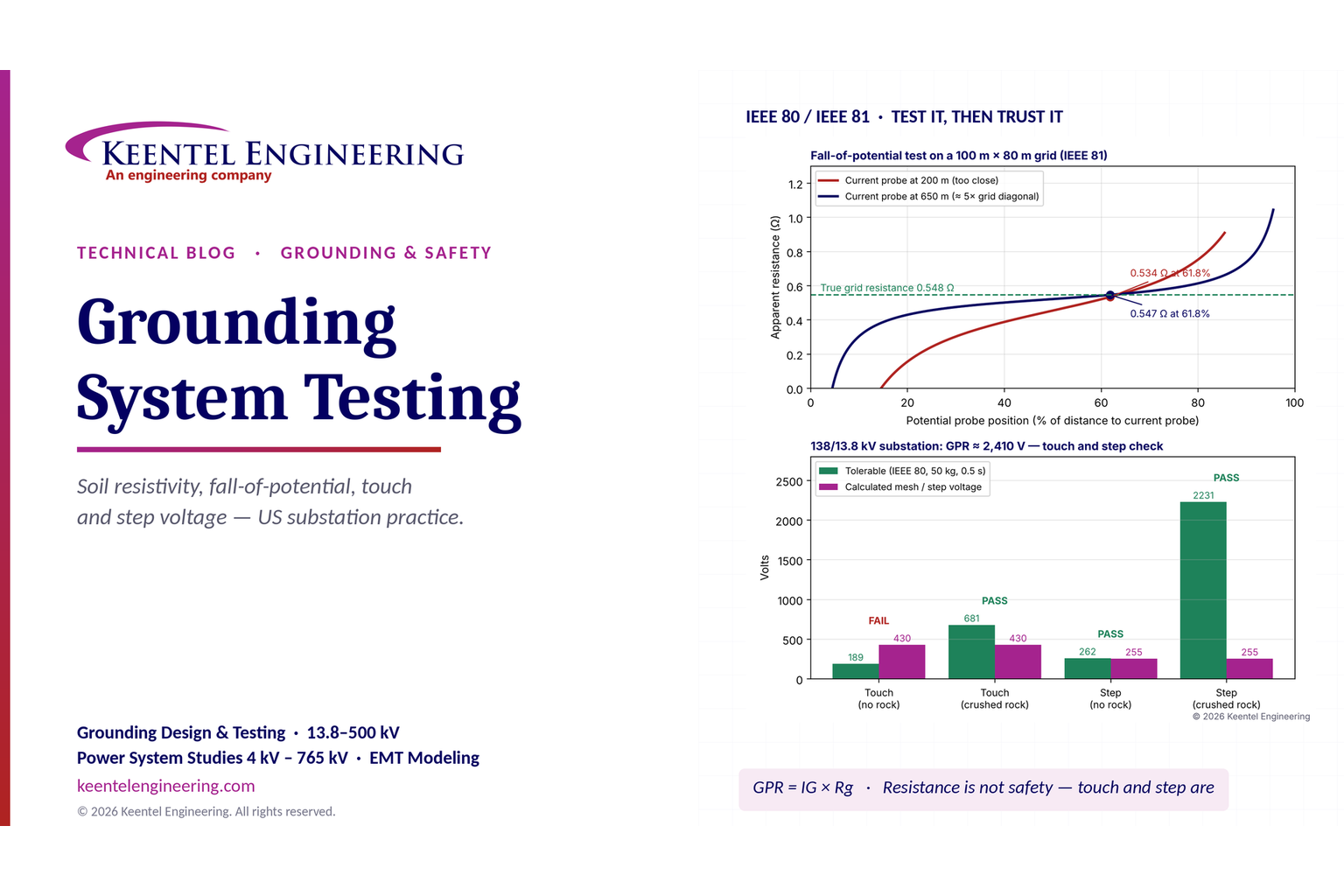
Explore grounding system testing with Keentel Engineering. Learn IEEE 80/81 methods, soil resistivity, ground resistance, and touch and step voltage safety.
By SANDIP R PATEL
•
October 13, 2026
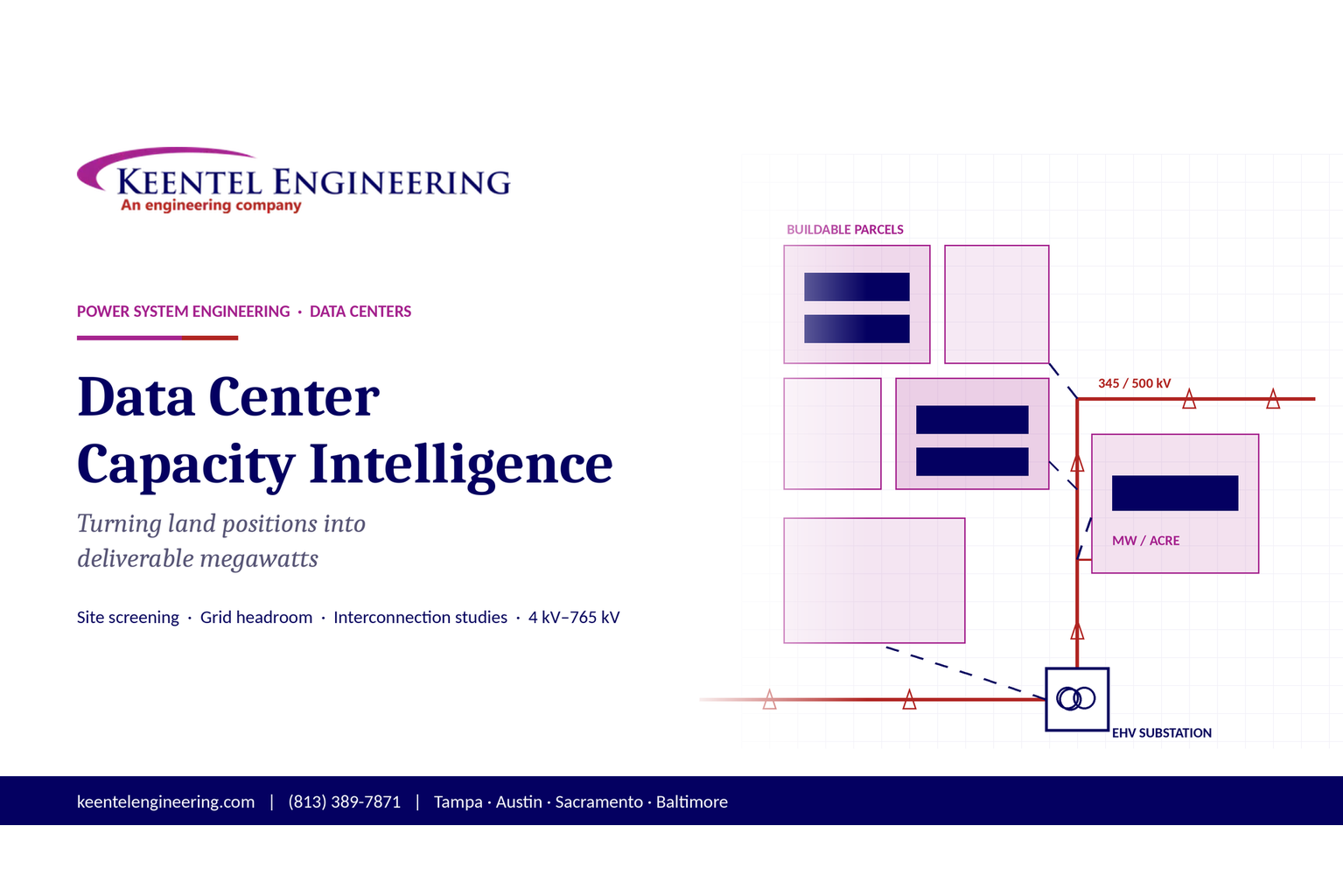
Plan data center capacity with land screening, MW-per-acre estimates, grid power availability and interconnection feasibility studies from Keentel Engineering.
By SANDIP R PATEL
•
October 11, 2026
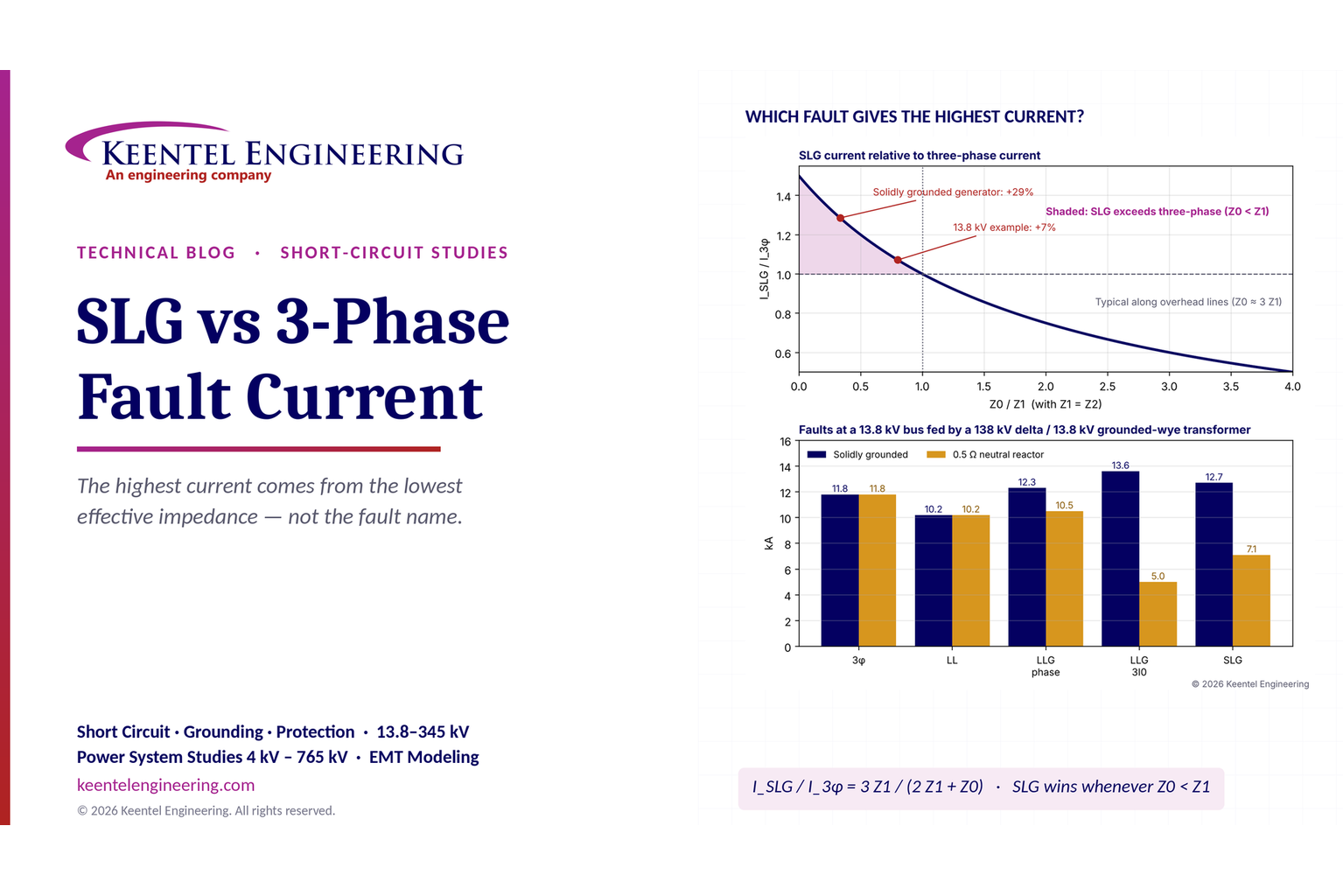
Learn which fault produces the highest current at a bus, why SLG faults can exceed three-phase faults, and how symmetrical components determine fault duty.
By SANDIP R PATEL
•
October 11, 2026
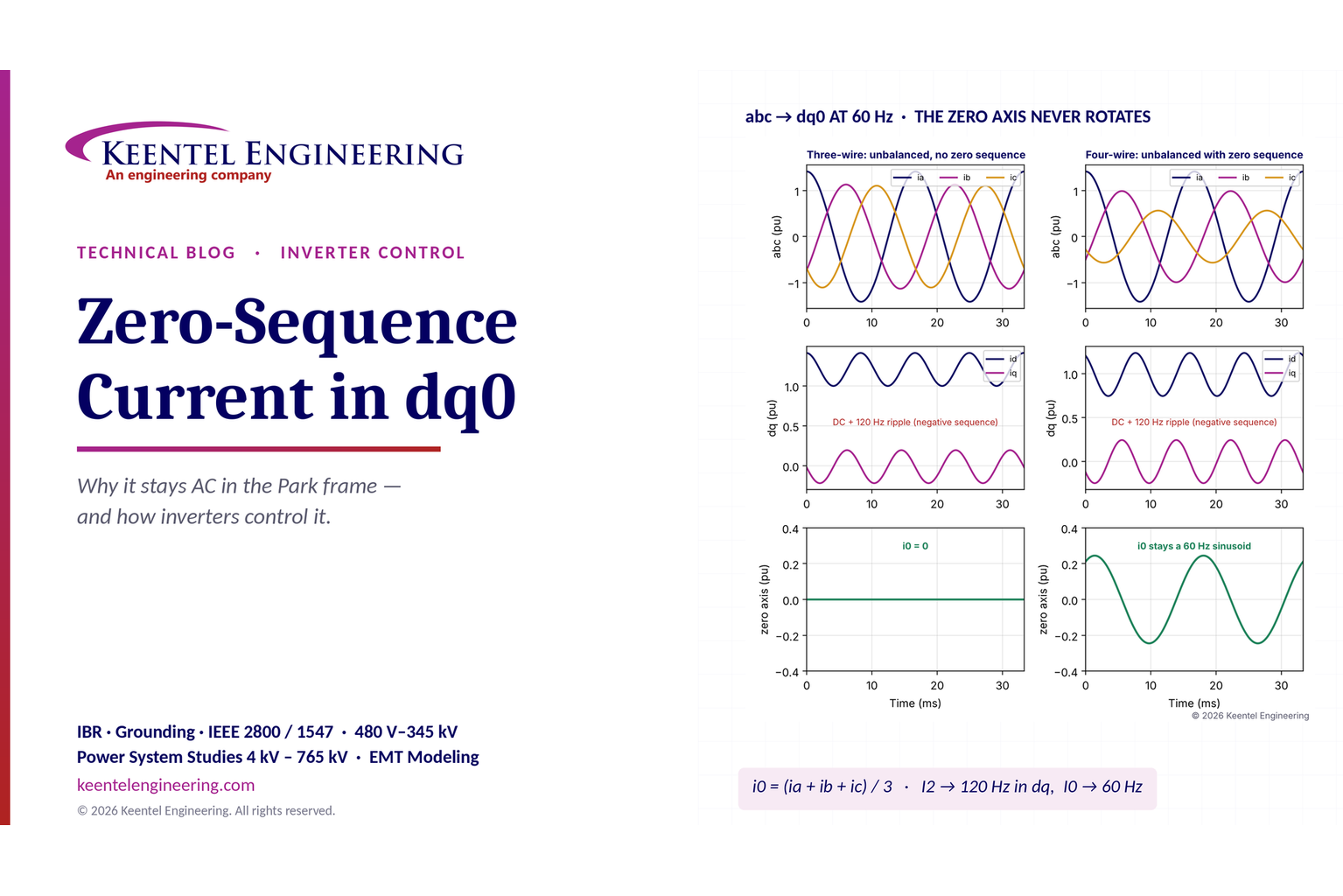
Learn why zero-sequence current pulsates in the dq0 frame, how Park's transformation works, and how inverter controls handle unbalance and ground faults.
By SANDIP R PATEL
•
October 11, 2026
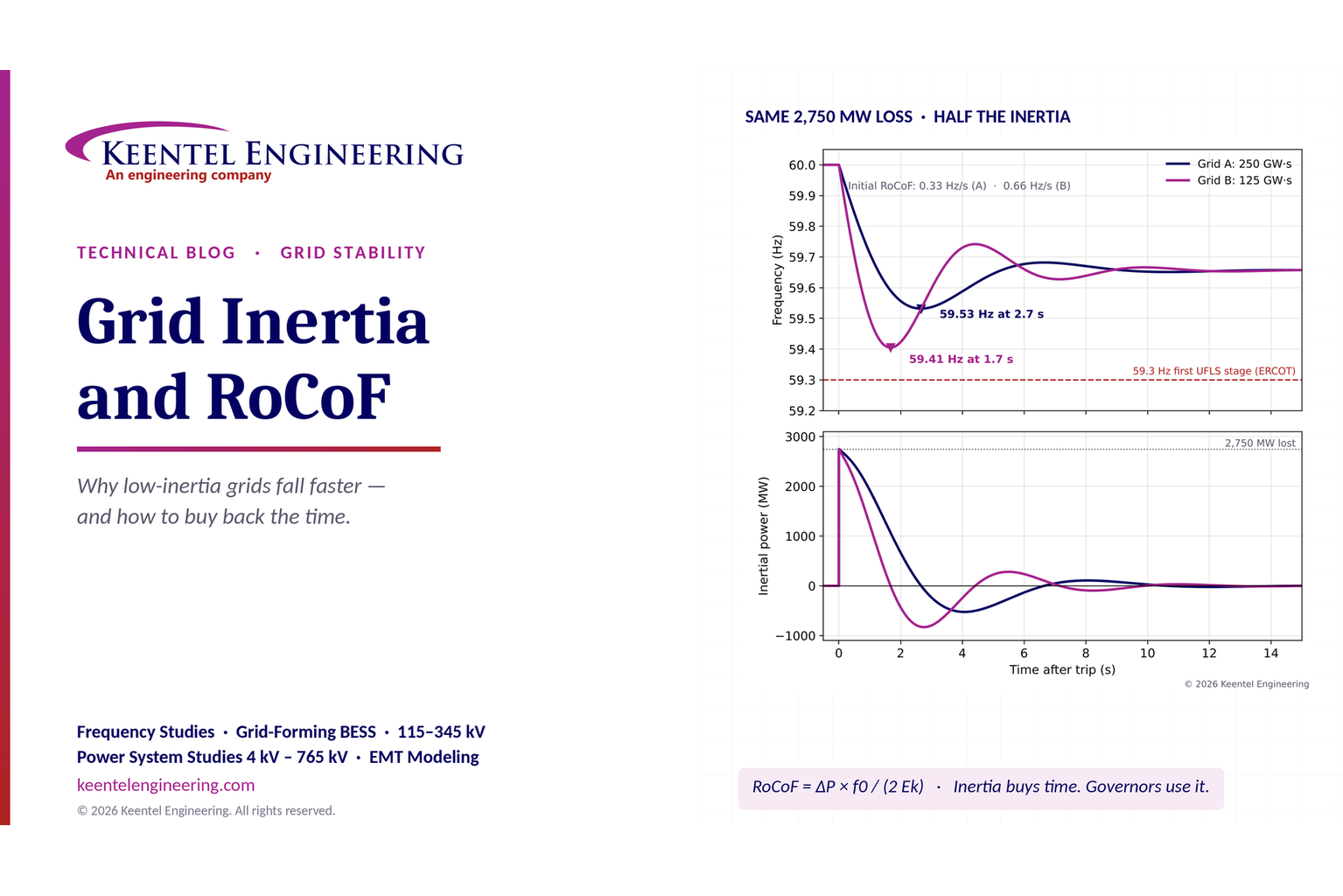
Explore grid inertia, RoCoF and frequency response, with swing equation calculations, frequency nadir analysis and US power system simulation examples.
By SANDIP R PATEL
•
October 11, 2026
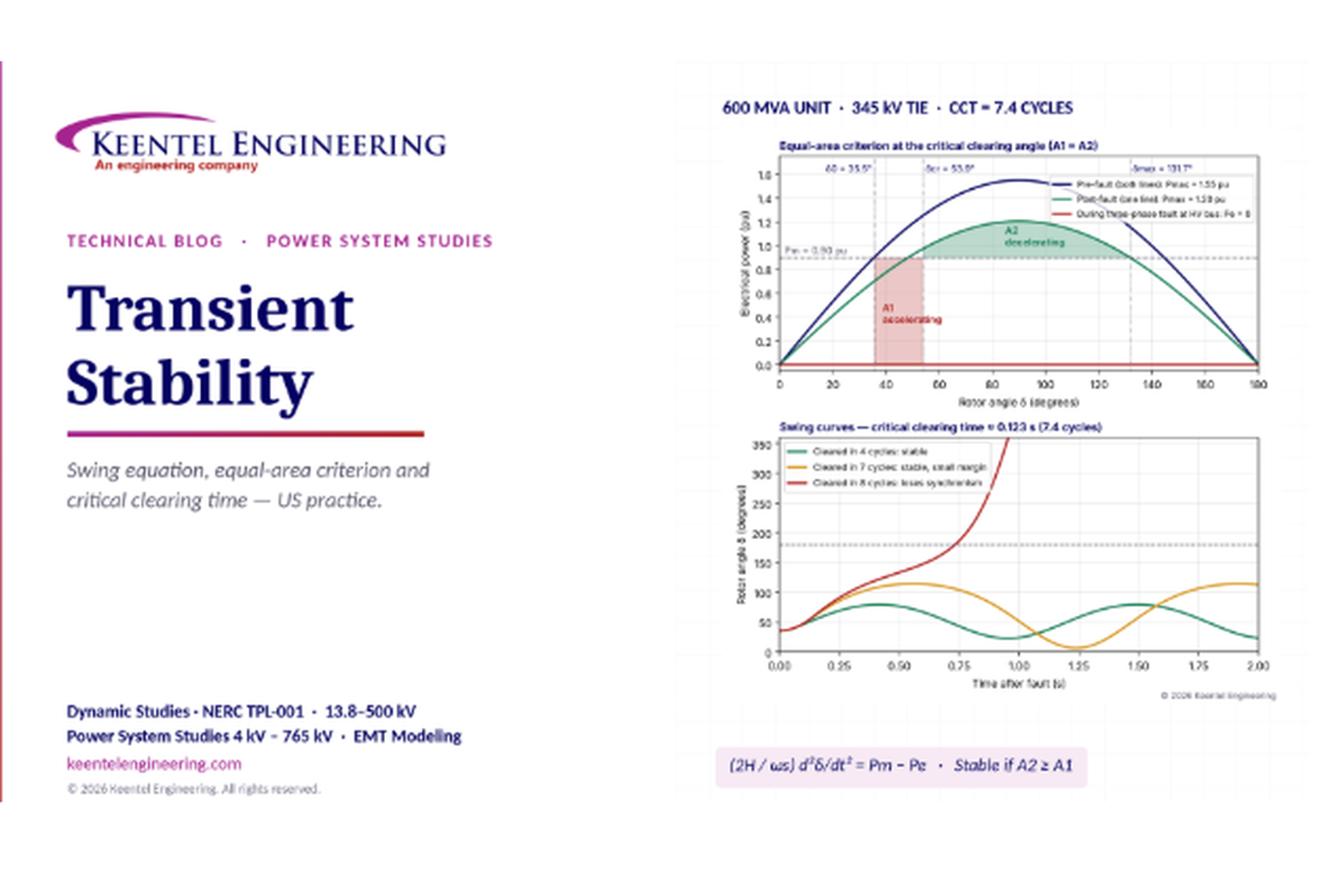
Learn transient stability analysis, swing equation, equal-area criterion and critical clearing time with a 345 kV worked example and NERC TPL-001 guidance.
By SANDIP R PATEL
•
October 11, 2026
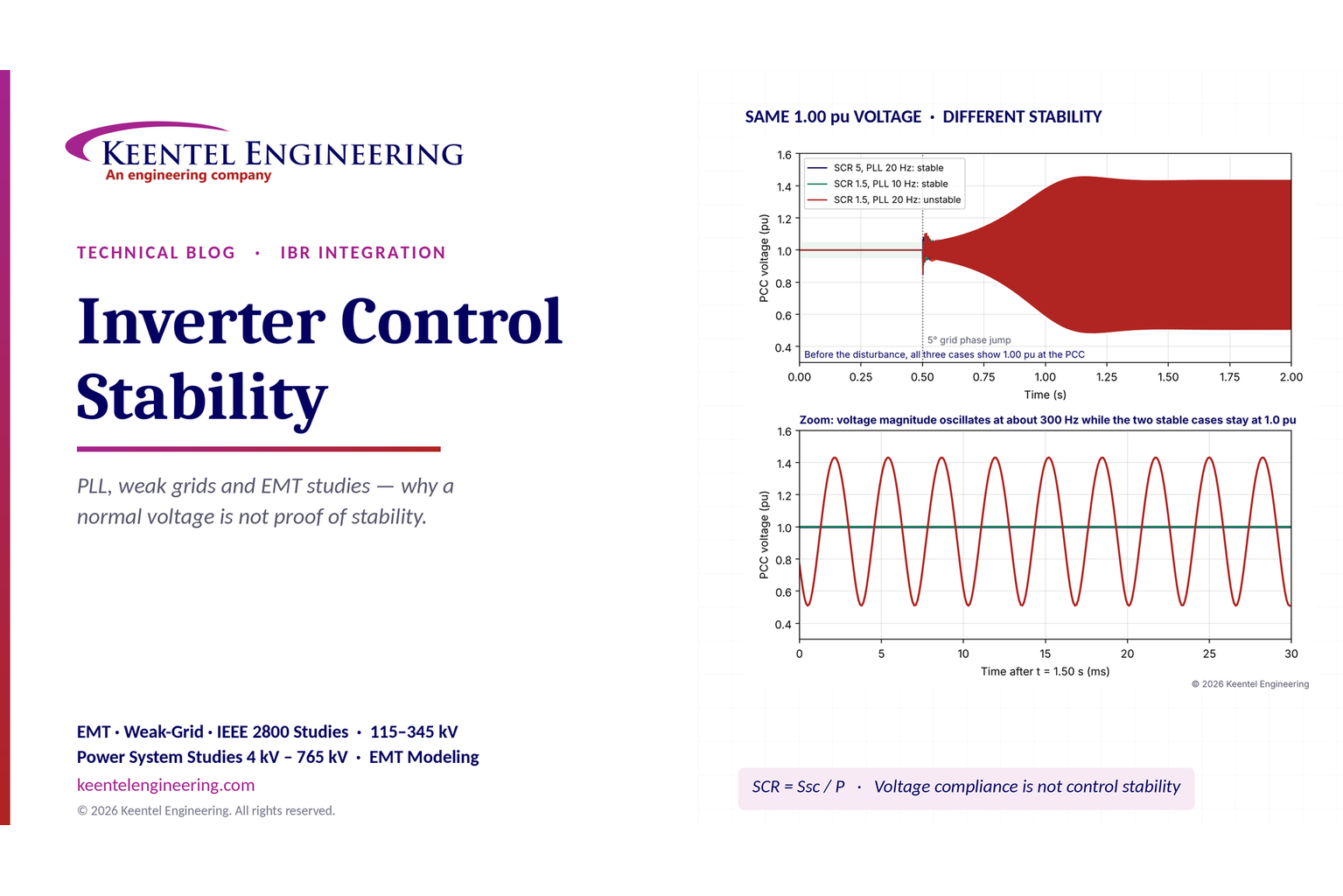
Learn why inverter controls become unstable in weak grids, how PLL bandwidth and SCR affect stability, and how PSCAD EMT studies identify and mitigate oscillations.
By SANDIP R PATEL
•
October 11, 2026
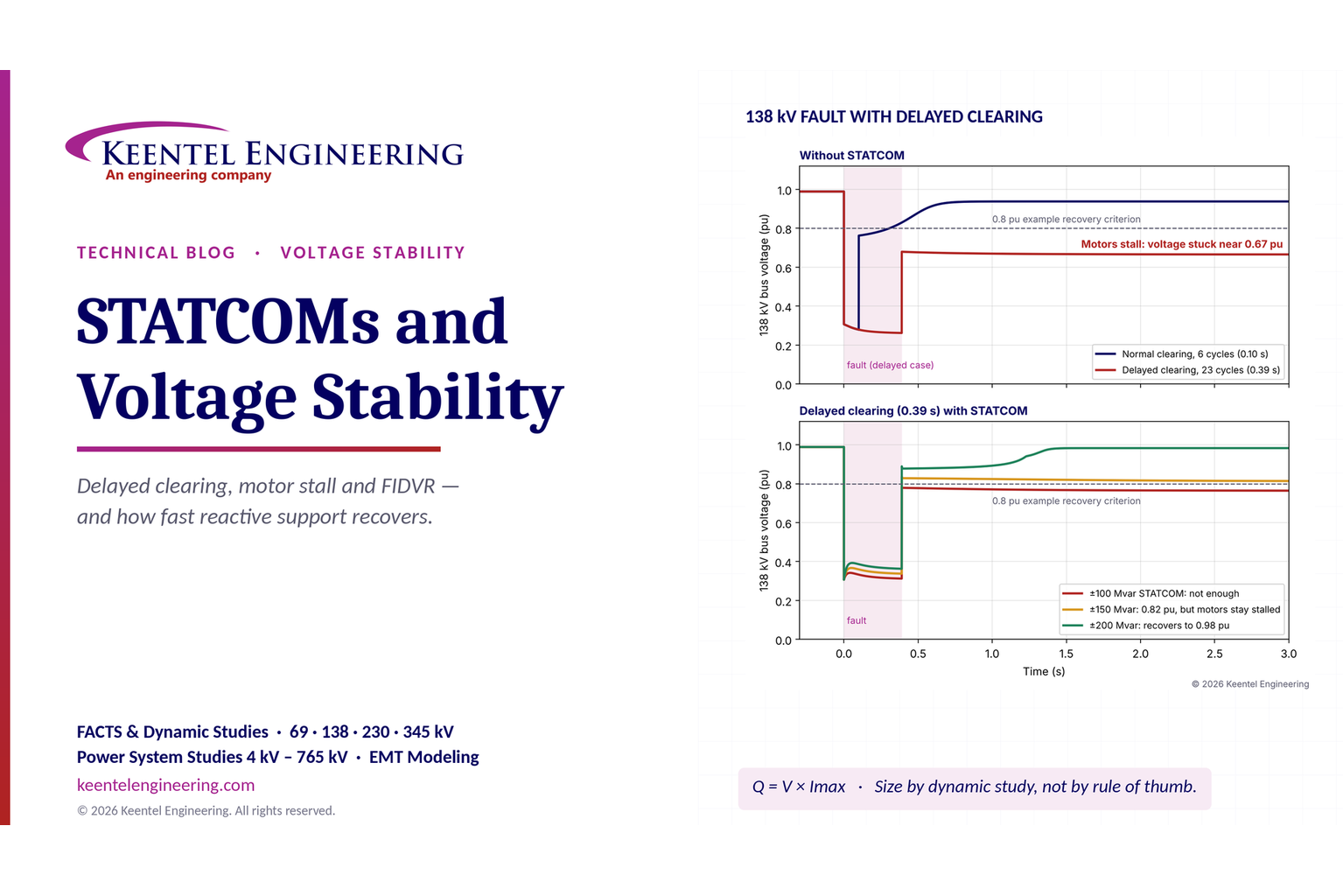
Learn how STATCOMs improve voltage stability and prevent FIDVR. Explore reactive power sizing, delayed fault clearing, NERC criteria and 138 kV simulation results.
By SANDIP R PATEL
•
October 10, 2026
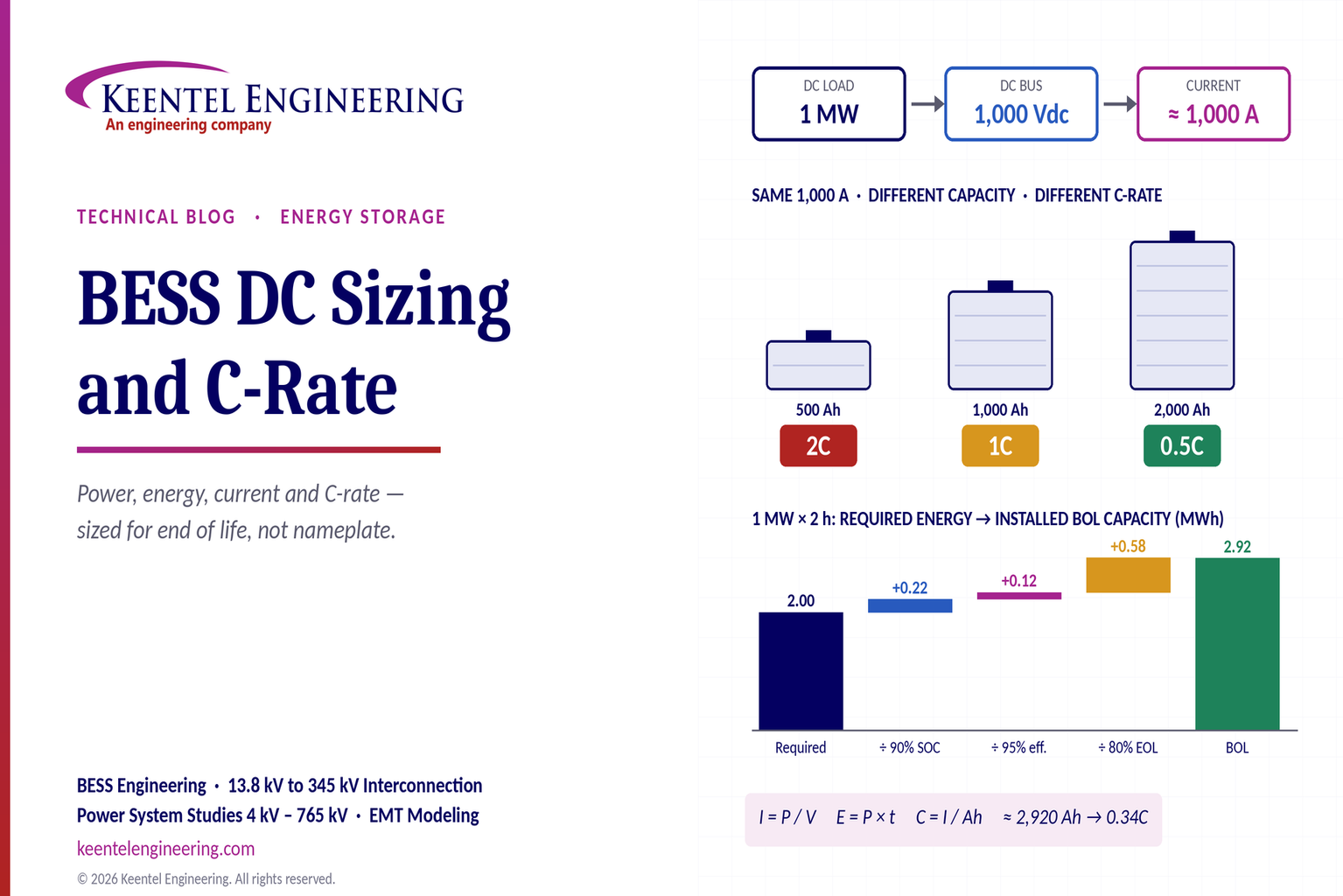
Learn BESS DC sizing with power, energy, current and C-rate calculations, battery losses, degradation and a 100 MW/400 MWh utility-scale example.