
A Coordinated Electric System Interconnection Review—the utility’s deep-dive on technical and cost impacts of your project.
Challenge: Frequent false tripping using conventional electromechanical relays
Solution: SEL-487E integration with multi-terminal differential protection and dynamic inrush restraint
Result: 90% reduction in false trips, saving over $250,000 in downtime
| Category | Metric |
|---|---|
| VPP capacity (Lunar Energy) | 650 MW |
| Lunar funding raised | US$232 million |
| Data center BESS example | 31 MW / 62 MWh |
| ERCOT grid-scale batteries | 15+ GW |
| LDES tenders (H1 2026) | Up to 9.3 GW |
| Lithium-ion share of LDES by 2030 | 77% |
| FEOC initial threshold | 55% |
| BESS tariff rate (2026) | ~55% |
| Capacity gain from analytics | 5–15% |
What is T&D Co-Simulation?
Confusing Physical Connections with Logical Nodes in IEC 61850
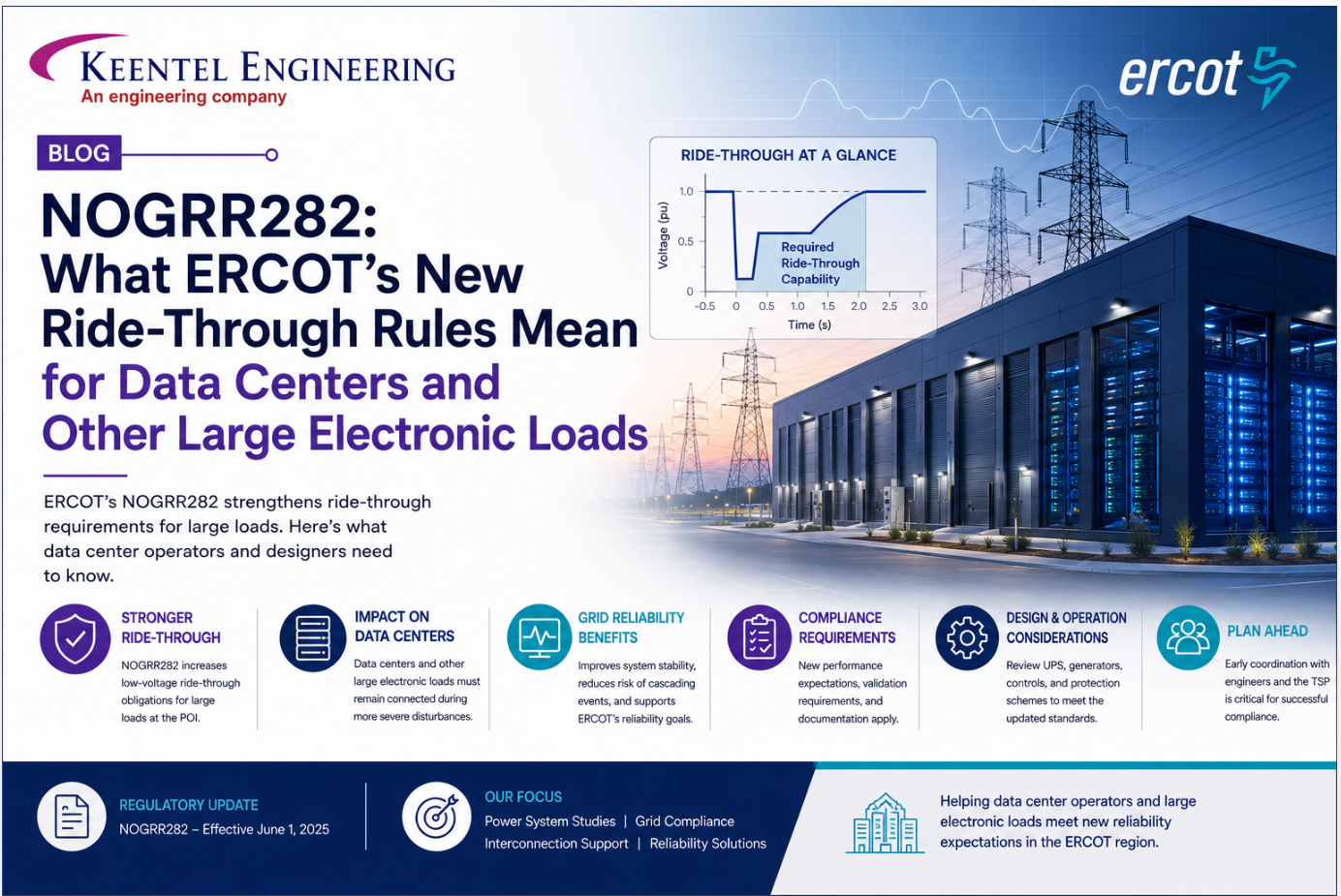
NOGRR282: What ERCOT's New Ride-Through Rules Mean for Data Centers and Other Large Electronic Loads
Jun 9, 2026 | blog
For most of the grid's history, "ride-through" was a generator problem. Synchronous machines and, more recently, inverter-based resources have long been held to defined voltage and frequency envelopes — PRC-024 for generators, IEEE 2800 for new IBRs — so that a routine fault somewhere on the transmission system doesn't cascade into a chain of unit trips. Loads were assumed to be passive: they drew power, and if a disturbance knocked some of them offline, that was generally a stabilizing event, not a destabilizing one.
That assumption no longer holds in ERCOT. With NOGRR282, posted November 14, 2025, ERCOT extends formal ride-through obligations to the demand side for the first time — specifically to Large Electronic Loads. If you are developing, financing, or engineering a data center, AI training campus, or cryptocurrency facility in Texas, this is the rule that now governs how your site is allowed to behave during a grid disturbance.
Why a load became a reliability problem
A traditional industrial load is dominated by motors and resistive heating. When voltage sags during a fault, that load tends to keep drawing power and even helps damp the disturbance. A modern computational load behaves nothing like that. Behind the service transformer sits a wall of power electronics — rectifier front ends, switch-mode supplies, UPS systems, and fast digital controls — engineered to protect extremely sensitive and expensive equipment. When those controls see a voltage dip, their instinct is to disconnect or enter momentary cessation in milliseconds, well before a human or even most relays would react.
Individually, that's good engineering for the asset owner. In aggregate, at the scale these facilities now reach, it's a system-level hazard. A single transmission fault can be cleared in three to six cycles and is, by design, a survivable event for the grid. But if several hundred — or several thousand — megawatts of computational load all detect the same sag and drop simultaneously, the grid experiences a sudden, large loss of demand. Because load and generation must balance instantaneously, a large block of vanishing load behaves like a large block of injected generation: voltage spikes upward and frequency rises. ERCOT has documented load-loss events of this character repeatedly since late 2022, and its own studies have flagged clusters capable of shedding thousands of megawatts in a single event — comparable to the entire demand of a mid-sized city — in response to a disturbance that the rest of the grid was built to absorb without incident.
That is the gap NOGRR282 closes. The premise is simple: if a power-electronic load is large enough to threaten system stability when it trips, it should be required to stay connected through the same range of conditions a generator is required to survive.
What counts as a Large Electronic Load
The applicability hinges on a definition that lives in the companion rule, NPRR1308. A Large Load is any facility, or group of facilities at a single site behind one or more meters, with an aggregate peak demand of 75 MW or more. A Large Electronic Load is the subset of those where 50% or more of the site demand is computational, power-electronic-based load — the data center and crypto-mining profile. The threshold is deliberately drawn around the technology, not the business model, because it's the power-electronic interface, not the kilowatt-hours, that creates the trip risk.
The two new operating-guide sections
NOGRR282 inserts two new sections into the Nodal Operating Guides: Section 2.6.4 for frequency ride-through and Section 2.14 for voltage ride-through. Both apply at the same compliance point and both carry the same enforcement teeth, but they govern different physical phenomena, so it's worth taking them in turn.
A threshold question for any operator is whether the rule even reaches an existing project. NOGRR282 grandfathers a facility out of the requirements if either of two conditions was satisfied on or before November 14, 2025: the LEL had already received ERCOT approval to energize, or it had completed its
Large Load
Interconnection Study (LLIS) with results communicated per Planning Guide Section 9.4
and had received the interconnection confirmation letter from its TDSP under Planning Guide Section 9.5. Miss both gates by a day and the full performance regime applies.
Where performance is judged
Both envelopes are evaluated at the LEL's Service Delivery Point. If the load is co-located with a Generation Resource or Energy Storage Resource, the measurement point shifts to the Point of Interconnection Bus of that resource. This matters for co-located "bring-your-own-generation"
data center designs, because it defines the electrical boundary at which your control and protection scheme has to demonstrate compliance — not at the server rack, but at the grid interface.
Frequency ride-through (Section 2.6.4)
The frequency envelope is a familiar shape to anyone who has worked with generator ride-through. It defines, for a given frequency band, the minimum time the load must remain connected and consuming.
| Frequency f (Hz) | Minimum ride-through time |
|---|---|
| f > 61.8 | May ride through or trip |
| 61.2 < f ≤ 61.8 | 299 seconds |
| 58.8 ≤ f ≤ 61.2 | Continuous |
| 57.0 ≤ f < 58.8 | 299 seconds |
| f < 57.0 | May ride through or trip |
The continuous band around nominal 60 Hz is the normal operating range. The 299-second shoulders are the survivability requirement: for a moderate excursion, the load has to hold on for nearly five minutes rather than tripping in the first cycle. Only at the extreme tails — above 61.8 Hz or below 57.0 Hz — does the rule release the load to trip at its discretion, recognizing that those conditions are themselves symptomatic of a grid already in serious trouble.
Two performance conditions ride alongside the envelope. First, if the LEL is drawing current at the moment the disturbance begins, it must keep drawing current through any condition requiring ride-through — it cannot simply zero out and wait. Second, it should hold active power within 10% of the pre-disturbance level throughout. The intent is to prevent a load from technically "staying connected" while functionally dropping its demand to near zero, which would defeat the purpose.
There are two carve-outs. A load is not required to ride through if it is acting under its TDSP's Under-Frequency Load Shed program, or if it is delivering an Ancillary Service that obligates it to trip or curtail in response to frequency. In both cases the load is doing exactly what the grid wants it to do.
Voltage ride-through (Section 2.14)
The
voltage envelope is built on RMS positive-sequence voltage in per-unit of nominal, again measured at the SDP or POIB.
| RMS positive-sequence voltage (p.u.) | Minimum ride-through time |
|---|---|
| V > 1.20 | May ride through or trip |
| 1.10 < V ≤ 1.20 | 2.0 seconds |
| 0.90 ≤ V ≤ 1.10 | Continuous |
| 0.80 ≤ V < 0.90 | 2.0 seconds |
| 0.50 ≤ V < 0.80 | 0.5 seconds |
| 0.20 ≤ V < 0.50 | 0.25 seconds |
| V < 0.20 | 0.15 seconds |
The structure mirrors the low-voltage ride-through curves generators already live with: the deeper the sag, the shorter the time the load must endure it, because deep, sustained sags are physically rare and usually mean a nearby unfaulted condition. A bolted three-phase fault driving voltage below 0.20 p.u. only has to be tolerated for 150 milliseconds — roughly the time a transmission protection scheme needs to clear it — whereas a shallow 0.85 p.u. dip has to be ridden through for a full two seconds.
The recovery behavior is where the engineering gets specific. Inside the continuous band, or for a brief overvoltage between 1.10 and 1.20 p.u. lasting under two seconds, the load simply maintains pre-disturbance active power. For a sag into the 0.80–0.90 p.u. band that recovers within two seconds, the load may reduce consumption in proportion to the voltage drop but must return to at least 90% of its pre-disturbance level within one second of voltage climbing back above 0.90 p.u. For any deeper sag the load is required to survive, the same one-second, 90%-recovery obligation applies once voltage clears 0.90 p.u.
NOGRR282 then splits the deep-sag behavior by date, which is one of the most important — and most overlooked — features of the rule. For an LEL that qualifies under the interconnection-milestone path after November 14, 2025 but on or before January 1, 2028, the reduction in active power between 0.80 and 0.50 p.u. must be proportional to the voltage drop if the equipment is capable; below 0.50 p.u. it may curtail as needed; and if it genuinely isn't capable of proportional behavior, it may reduce as much as necessary to stay connected, provided it restores afterward. For an LEL qualifying after January 1, 2028, the standard hardens: the load must keep consuming between 0.80 and 0.50 p.u. (with only a temporary, proportional reduction permitted), and only below 0.50 p.u. may it curtail freely to ride through. In practice, projects energizing later are expected to deploy more capable, grid-friendly power-electronic designs, and the rule writes that expectation into a date.
One more constraint applies across the board: whenever voltage falls outside the continuous range, the LEL must not draw current exceeding 125% of its maximum normal operating current. This caps the inrush a recovering load can slam back onto the system, so that ride-through compliance doesn't simply trade a load-loss problem for a recovery-overcurrent problem. (This 125% figure is among the items ERCOT has revisited in later redlines, so confirm the controlling number against the current posting before you design to it.)
The protection philosophy is the hard part
For most developers, the ride-through tables aren't the difficult engineering. The difficult engineering is making the protection scheme compatible with them, because NOGRR282 directly constrains how site protection is allowed to operate.
Protection systems that are installed and active to trip the load must be set to allow ride-through beyond the mandated envelope, all the way to the maximum the equipment can tolerate — unless the trip is serving a UFLS event or an Ancillary Service obligation. Frequency protection must use filtered quantities or sufficient time delays to avoid misoperation, and tripping on an instantaneous frequency measurement is prohibited outright. On the voltage side, instantaneous over-current and over-voltage protection likewise has to use filtered quantities or time delays, and any AC instantaneous over-voltage element that could interrupt consumption must use a measurement window of at least one full cycle of the fundamental. Finally, the rule bars any scheme that disconnects or transfers load to backup generation purely because a certain number of sags or swells occurred within a window, where the load was obligated to ride through each one individually.
Taken together, these provisions are aimed squarely at the nuisance-trip behavior that started the whole problem: sub-cycle, instantaneous, "protect the asset first" logic that fires before the disturbance has even resolved. The standard forces a deliberate design philosophy in which protection distinguishes a genuine internal fault from a transient external disturbance the facility is supposed to survive.
What happens when you fail
NOGRR282 builds in a structured non-compliance process rather than an immediate penalty. If ERCOT determines an LEL failed to ride through a qualifying event, the interconnecting TDSP supplies available data for ERCOT's event analysis, and the Customer representing the LEL is on the clock: investigate and report the root cause within 90 days of ERCOT's request, develop a corrective plan within 90 days of completing that investigation, and implement the approved plan within 180 days unless ERCOT grants more time. Overriding all of that, if ERCOT judges that continued operation poses an imminent risk to local or system reliability, it can order the LEL disconnected — and keep it disconnected — until the Customer demonstrates compliance to ERCOT's satisfaction. For a facility whose entire business case depends on uptime, that disconnection authority is the provision that should command management attention.
How to get ahead of it
The practical takeaway is that ride-through is no longer something to retrofit after energization. Under the broader NPRR1308 framework, ERCOT is aligning operating expectations with the interconnection study and energization workflow, which means performance has to be demonstrable through dynamic modeling well before the meter spins. Equipment selection, UPS and rectifier control settings, protection coordination, and the dynamic model you submit all have to tell a consistent story: this load will hold through the envelope.
This is the work Keentel Engineering does. We assess LEL applicability and grandfathering status, perform the dynamic modeling and ride-through studies ERCOT now expects, and coordinate protection settings — relay logic, measurement windows, filtering, and time delays — so a site meets the Section 2.6.4 and 2.14 envelopes without sacrificing legitimate equipment protection. If you're moving a large computational load through the ERCOT queue, the time to
engineer compliance is before the LLIS, not after the first event report lands on your desk.
Frequently Asked Questions
1. What is NOGRR282?
It's a Nodal Operating Guide Revision Request that ERCOT submitted on November 14, 2025, establishing — for the first time — formal frequency and voltage ride-through requirements for Large Electronic Loads. It adds two sections to ERCOT's Nodal Operating Guides and is paired with a companion protocol change, NPRR1308.
2. What is a Large Electronic Load (LEL)?
Under NPRR1308, an LEL is a Large Load (a site of 75 MW or more aggregate peak demand) where at least 50% of that demand is computational, power-electronic-based load — the profile of data centers and cryptocurrency mining facilities. The definition targets the technology that causes trip risk, not the type of business.
3. How is an LEL different from a Large Load?
Every LEL is a Large Load, but not every Large Load is an LEL. A 100 MW manufacturing plant dominated by motors is a Large Load but not an LEL. A 100 MW data center is both, because the majority of its demand runs through power electronics. ERCOT has signaled it may develop separate ride-through rules for non-electronic Large Loads later, with potentially different thresholds
4. Why is ERCOT regulating how loads behave during disturbances?
Because large power-electronic loads trip or rapidly curtail during routine voltage sags, and when many do so at once, the grid sees a sudden, large loss of demand that behaves like a surge of generation — pushing voltage and frequency upward. ERCOT has recorded these events repeatedly since October 2022 and has identified clusters capable of dropping thousands of megawatts from a single ordinary fault.
5. Which Operating Guide sections does NOGRR282 create?
Section 2.6.4, Frequency Ride-Through Requirements for Large Electronic Loads, and Section 2.14, Voltage Ride-Through Requirements for Large Electronic Loads. Both are new.
6. Does NOGRR282 apply to my existing facility?
Only if you miss both grandfathering gates. A facility is exempt if, on or before November 14, 2025, it either received ERCOT approval to energize, or completed its Large Load Interconnection Study (with results communicated under Planning Guide 9.4) and received its TDSP interconnection confirmation letter under Planning Guide 9.5. Projects that hadn't reached one of those milestones by that date are subject to the full requirements.
7. Where is ride-through performance measured?
At the LEL's Service Delivery Point. If the load is co-located with a Generation Resource or Energy Storage Resource, the compliance point moves to that resource's Point of Interconnection Bus. This is the electrical boundary your protection and controls must satisfy.
8. What does the frequency ride-through envelope require?
Continuous operation between 58.8 and 61.2 Hz; at least 299 seconds of ride-through in the 61.2–61.8 Hz and 57.0–58.8 Hz bands; and discretion to ride through or trip above 61.8 Hz or below 57.0 Hz. If the load is consuming when the event starts, it must keep consuming through any band requiring ride-through.
9. What does the voltage ride-through envelope require?
Using RMS positive-sequence voltage in per-unit: continuous between 0.90 and 1.10; 2.0 seconds in the 0.80–0.90 and 1.10–1.20 bands; 0.5 seconds for 0.50–0.80; 0.25 seconds for 0.20–0.50; and 0.15 seconds below 0.20. Above 1.20 p.u. the load may trip. The deeper the sag, the shorter the required endurance, because deep sags clear quickly.
10. Does "ride-through" mean the load just has to stay connected, or keep consuming?
Both, in most cases. Staying physically connected isn't enough — within the continuous range the load must maintain pre-disturbance active power, and during frequency events it should hold within 10% of the pre-disturbance level. The rule explicitly prevents a load from staying nominally connected while dropping its demand to near zero.
11. What is the 10% active power tolerance?
During a frequency disturbance requiring ride-through, a consuming LEL should keep its active power within 10% of the level it was drawing just before the event. It's a guardrail that defines what "continuing to consume" actually means in measurable terms.
12. How much can I reduce load during a deep voltage sag?
For sags the load must survive, you may reduce consumption — proportionally to the voltage drop in the moderate bands — but you must return to at least 90% of pre-disturbance consumption within one second of voltage recovering above 0.90 p.u. The specific allowance below 0.50 p.u. depends on when your project qualifies (see next question).
13. What changes on January 1, 2028?
The voltage performance standard tiers by qualification date. LELs qualifying after November 14, 2025 but on or before January 1, 2028 must reduce proportionally between 0.80 and 0.50 p.u. only if capable, with fallback flexibility if not. LELs qualifying after January 1, 2028 must keep consuming between 0.80 and 0.50 p.u. (only temporary proportional reduction allowed) and may curtail freely only below 0.50 p.u. Later projects face the stricter standard, reflecting an expectation of more capable equipment.
14. What is the 125% overcurrent limitation?
Whenever voltage moves outside the continuous range, the LEL must not draw current exceeding 125% of its maximum normal operating current. This prevents a recovering load from slamming excessive inrush onto the system during voltage recovery. Note this value is among the items ERCOT has revisited in later redlines — confirm against the current posting.
15. How does NOGRR282 constrain my protection settings?
Substantially. Trip-capable protection must be set to allow ride-through to the maximum the equipment tolerates (except for UFLS or Ancillary Service obligations). Frequency protection must use filtered quantities or time delays, and tripping on an instantaneous frequency measurement is prohibited. Voltage-side instantaneous over-current and over-voltage protection must likewise use filtered quantities or time delays.
16. What is the one-cycle measurement window requirement?
Any AC instantaneous over-voltage protection element that could interrupt the load's consumption must use a measurement window of at least one full cycle of the fundamental frequency. This blocks sub-cycle nuisance tripping on transients the facility is supposed to ride through.
17. Are there exemptions to ride-through?
Yes. A load is not required to ride through when it is operating under its TDSP's Under-Frequency Load Shed program, or when it is providing an Ancillary Service that requires it to trip or curtail in response to the disturbance. In those cases, disconnecting or reducing is the desired grid behavior.
18. What happens if my LEL fails to ride through an event?
ERCOT initiates a corrective process: the TDSP supplies event data, and the Customer must investigate and report the root cause within 90 days of ERCOT's request, develop a corrective plan within 90 days of completing the investigation, and implement the approved plan within 180 days. If ERCOT judges continued operation an imminent reliability risk, it can order the facility disconnected until compliance is demonstrated.
19. How does NOGRR282 relate to NPRR1308 and the interconnection study process?
NPRR1308 supplies the definitions and protocol framework; NOGRR282 supplies the operating performance requirements. ERCOT is increasingly aligning these operating expectations with the interconnection study and energization workflow, so ride-through capability now needs to be demonstrated through dynamic modeling as part of getting a project approved — not proven after the fact.
20. Is NOGRR282 final, and how should developers prepare now?
It is progressing through ERCOT's stakeholder process and remains subject to change — ERCOT has already proposed redlines since the November 2025 posting, including adjustments to high-frequency thresholds and the overcurrent allowance. Developers shouldn't wait for finalization. The right move now is to confirm applicability and grandfathering status, select capable power-electronic equipment, build a compliant dynamic model, and coordinate protection settings against the envelopes early. Keentel Engineering can run the ride-through studies, dynamic modeling, and protection coordination needed to get a Large Electronic Load through the ERCOT queue compliant from day one

About the Author:
Sandip "Sonny" R. Patel, P.E.
IEEE Senior Member · Founder & CEO, Keentel Engineering
In 1995, Sonny Patel earned his Electrical Engineering degree from the University of Illinois. But degrees don't build legacies — action does.
For three decades, he has worked the power industry from every side of the table: 16 years as a utility engineer at Exelon/Commonwealth Edison; generation leadership across hydroelectric, industrial steam turbine, and a 9 GW renewable fleet; NERC Regional Entity Senior Compliance Engineer and Audit Team Lead, auditing some of the nation's largest utilities; and testing and commissioning lead on equipment up to 765 kV — the very top of the North American grid.Utility. Generator. Regulator. Consultant. Few engineers have seen all four seats. Fewer still have sat in them.
His experience spans nuclear, hydro, conventional generation, renewables, oil and gas, mining — and today's data centers, where he is authoring a three-book series on data center design. He is a Licensed Professional Engineer in six states and a Licensed Electrical Contractor in Florida (Unlimited EC) — he doesn't just design the work; he's qualified to stand behind its execution.Today, as Founder and CEO of Keentel Engineering, Sonny leads a nationwide team of engineers delivering substation design, power system studies, NERC compliance, and commissioning — done right, coast to coast.Three decades. Every side of the table. One standard: accountable engineering.
Services

Let's Discuss Your Project
Let's book a call to discuss your electrical engineering project that we can help you with.
About the Author:
Sandip "Sonny" R. Patel, P.E.
IEEE Senior Member · Founder & CEO, Keentel Engineering
In 1995, Sonny Patel earned his Electrical Engineering degree from the University of Illinois. But degrees don't build legacies — action does.
For three decades, he has worked the power industry from every side of the table: 16 years as a utility engineer at Exelon/Commonwealth Edison; generation leadership across hydroelectric, industrial steam turbine, and a 9 GW renewable fleet; NERC Regional Entity Senior Compliance Engineer and Audit Team Lead, auditing some of the nation's largest utilities; and testing and commissioning lead on equipment up to 765 kV — the very top of the North American grid.
Utility. Generator. Regulator. Consultant. Few engineers have seen all four seats. Fewer still have sat in them.
His experience spans nuclear, hydro, conventional generation, renewables, oil and gas, mining — and today's data centers, where he is authoring a three-book series on data center design. He is a Licensed Professional Engineer in six states and a Licensed Electrical Contractor in Florida (Unlimited EC) — he doesn't just design the work; he's qualified to stand behind its execution.
Today, as Founder and CEO of Keentel Engineering, Sonny leads a nationwide team of engineers delivering substation design, power system studies, NERC compliance, and commissioning — done right, coast to coast.Three decades. Every side of the table. One standard: accountable engineering.
Leave a Comment
Thank you for contacting us.
We will get back to you as soon as possible.
We will get back to you as soon as possible.
Oops, there was an error sending your message.
Please try again later.
Please try again later.
Related Posts
By SANDIP R PATEL
•
October 23, 2026
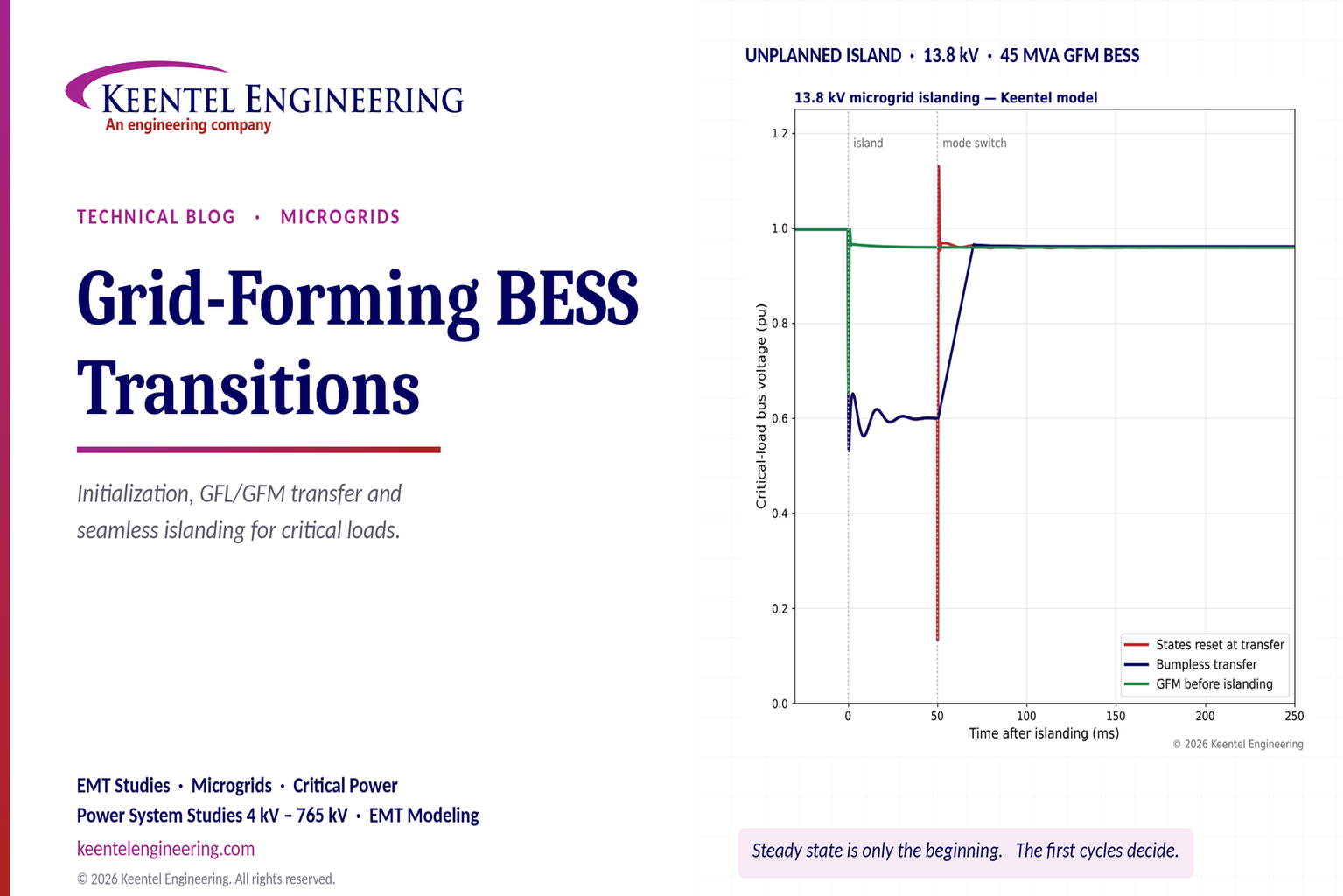
Explore grid-forming BESS initialization, GFL-to-GFM transitions, seamless islanding, EMT simulations, current limiting and microgrid protection.
By SANDIP R PATEL
•
October 23, 2026
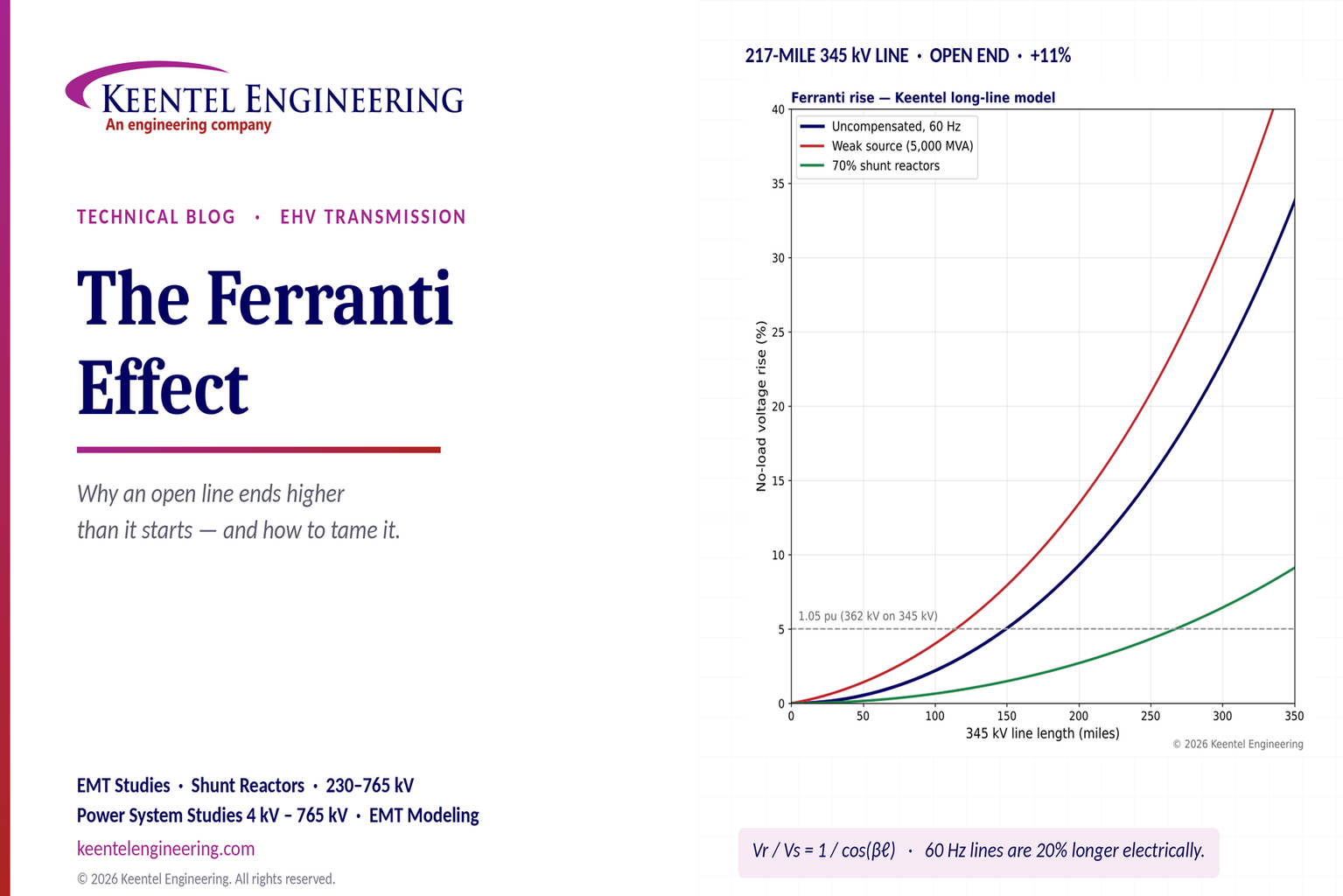
Explore the Ferranti effect in EHV transmission lines: voltage rise, 345 kV examples, switching overvoltages, shunt reactor sizing and mitigation.
By SANDIP R PATEL
•
October 23, 2026
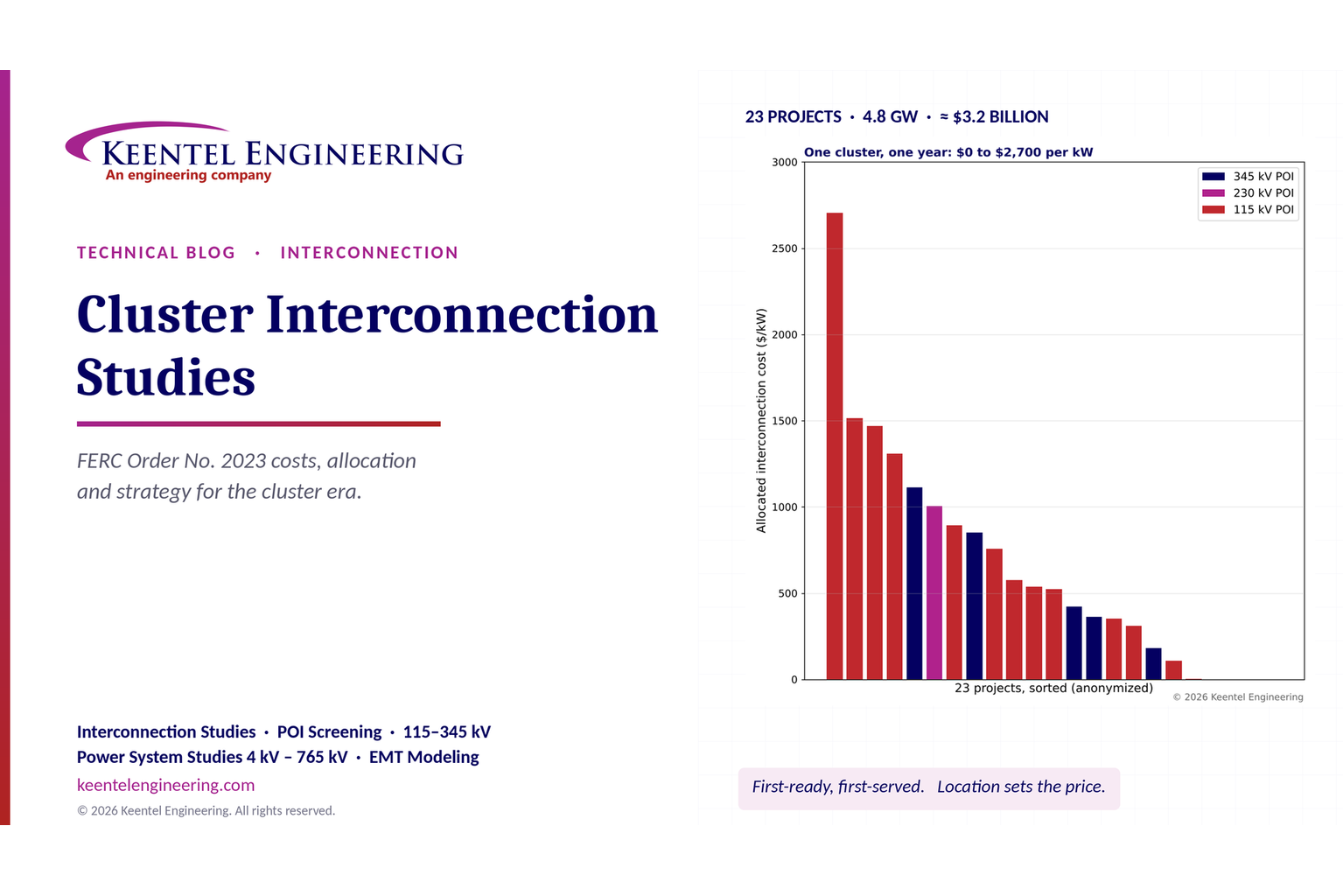
Explore cluster interconnection studies under FERC Order 2023, including network upgrades, cost allocation, withdrawal penalties and developer strategy.
By SANDIP R PATEL
•
October 21, 2026
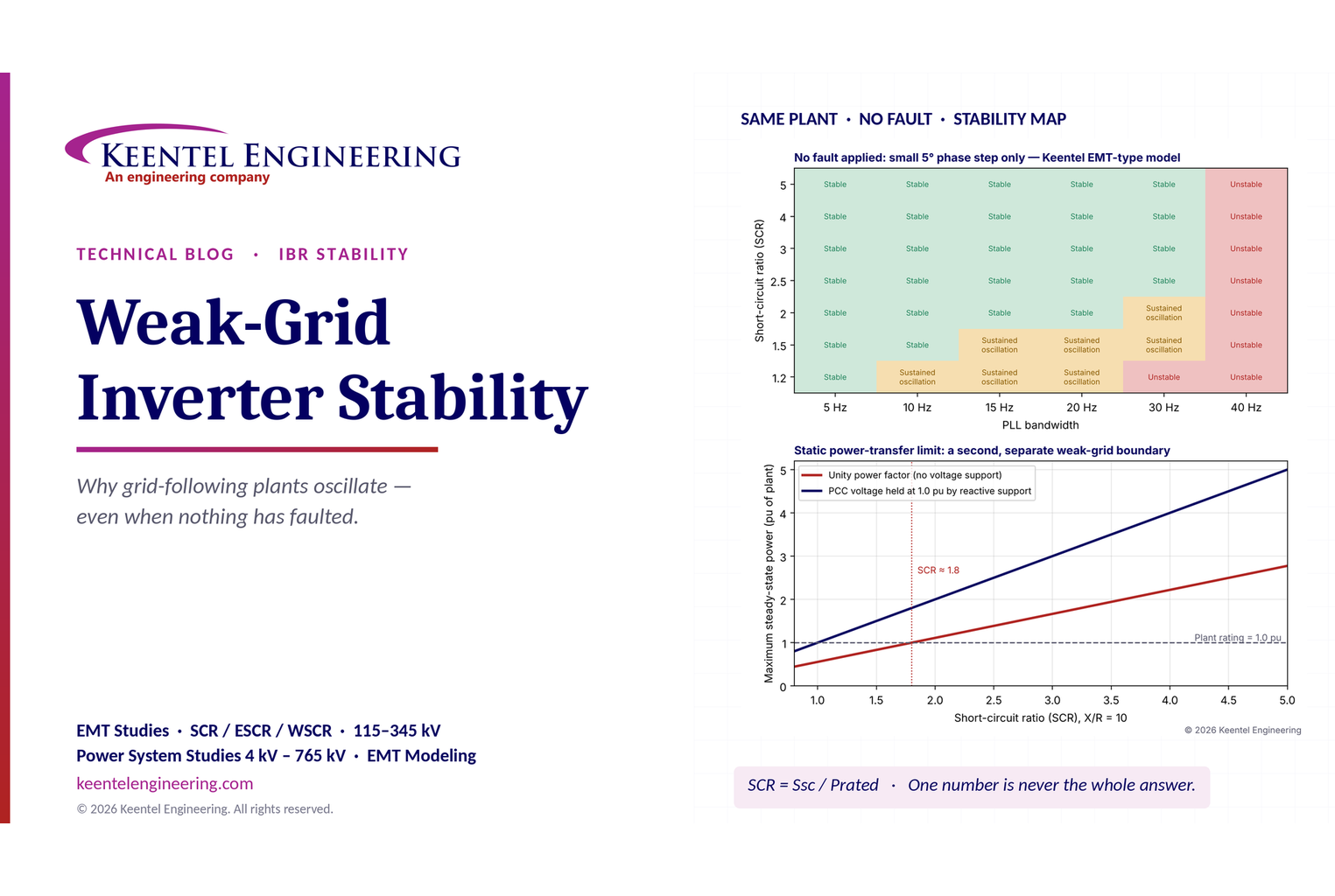
Learn why grid-following inverters become unstable without grid faults. Explore SCR, PLL interactions, EMT studies, grid strength, and mitigation.
By SANDIP R PATEL
•
October 21, 2026
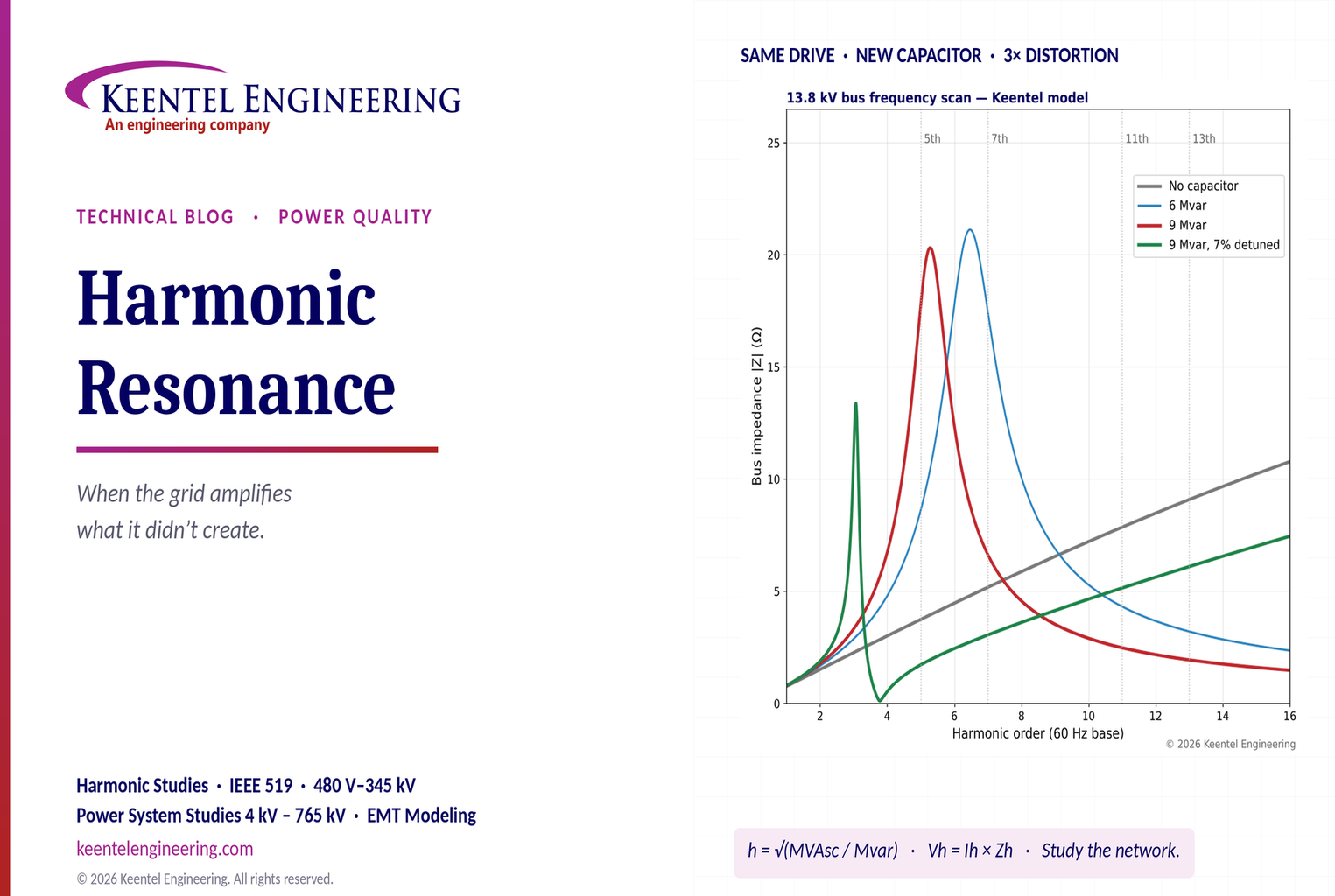
Learn how harmonic resonance amplifies distortion in power systems. Explore capacitor banks, detuned reactors, frequency scans, and IEEE 519 solutions.
By SANDIP R PATEL
•
October 20, 2026
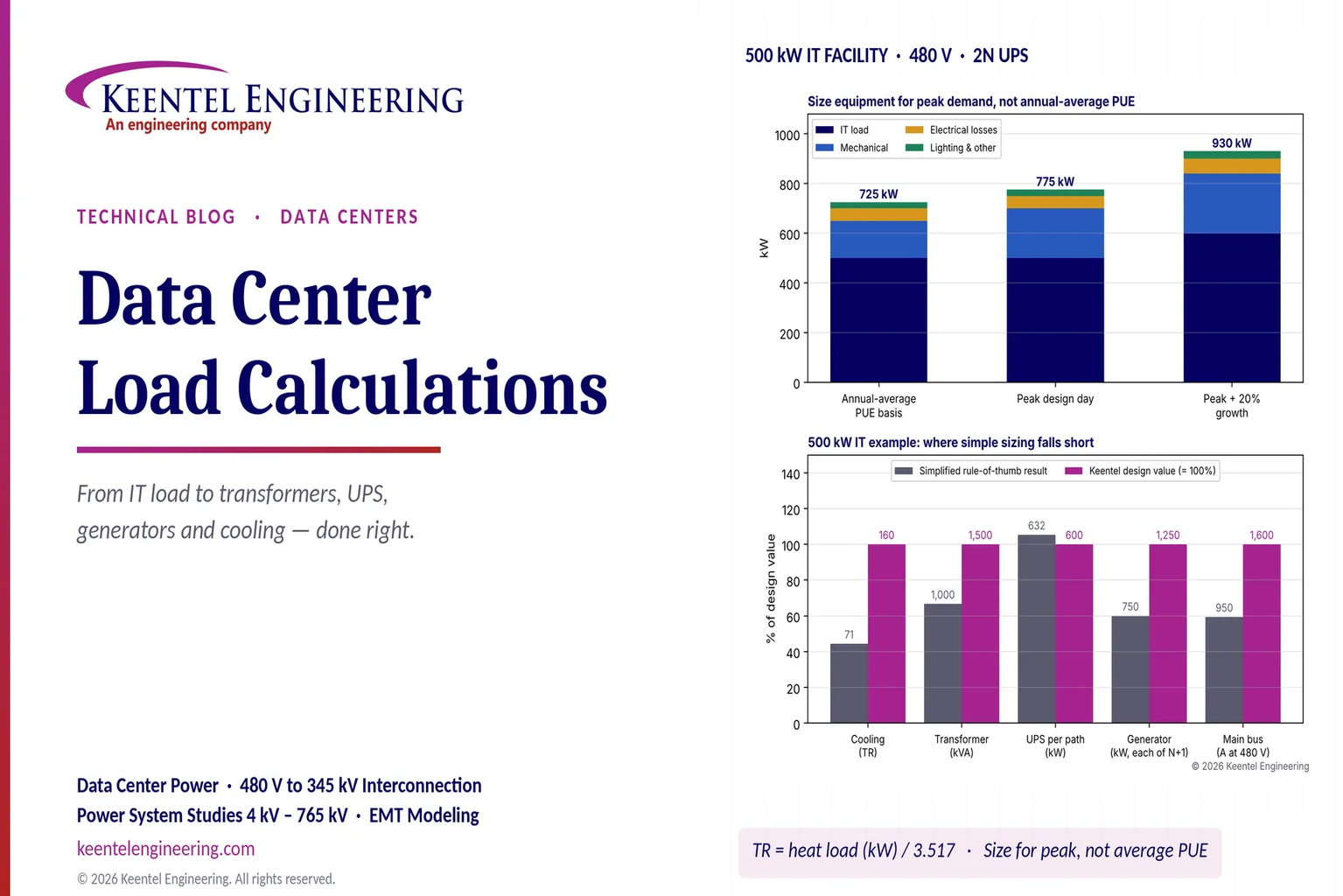
Learn data center electrical load calculations, including IT demand, PUE, UPS and generator sizing, cooling loads, redundancy, and worked US examples.
By SANDIP R PATEL
•
October 20, 2026
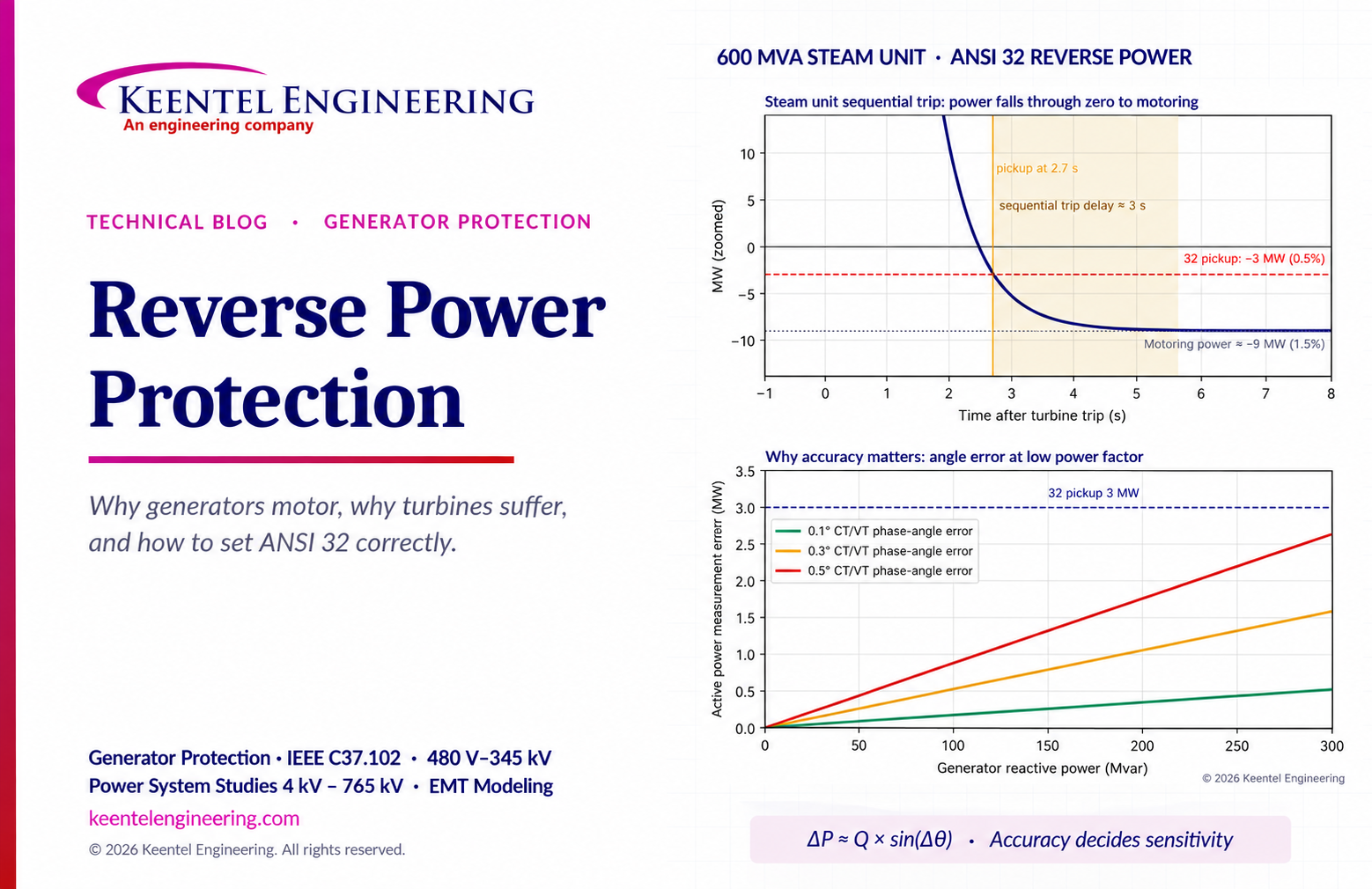
Learn reverse power protection (ANSI 32), generator motoring, relay pickup settings, time delays, sequential tripping and testing for US power plants.
By Team 2 Dexora
•
October 20, 2026
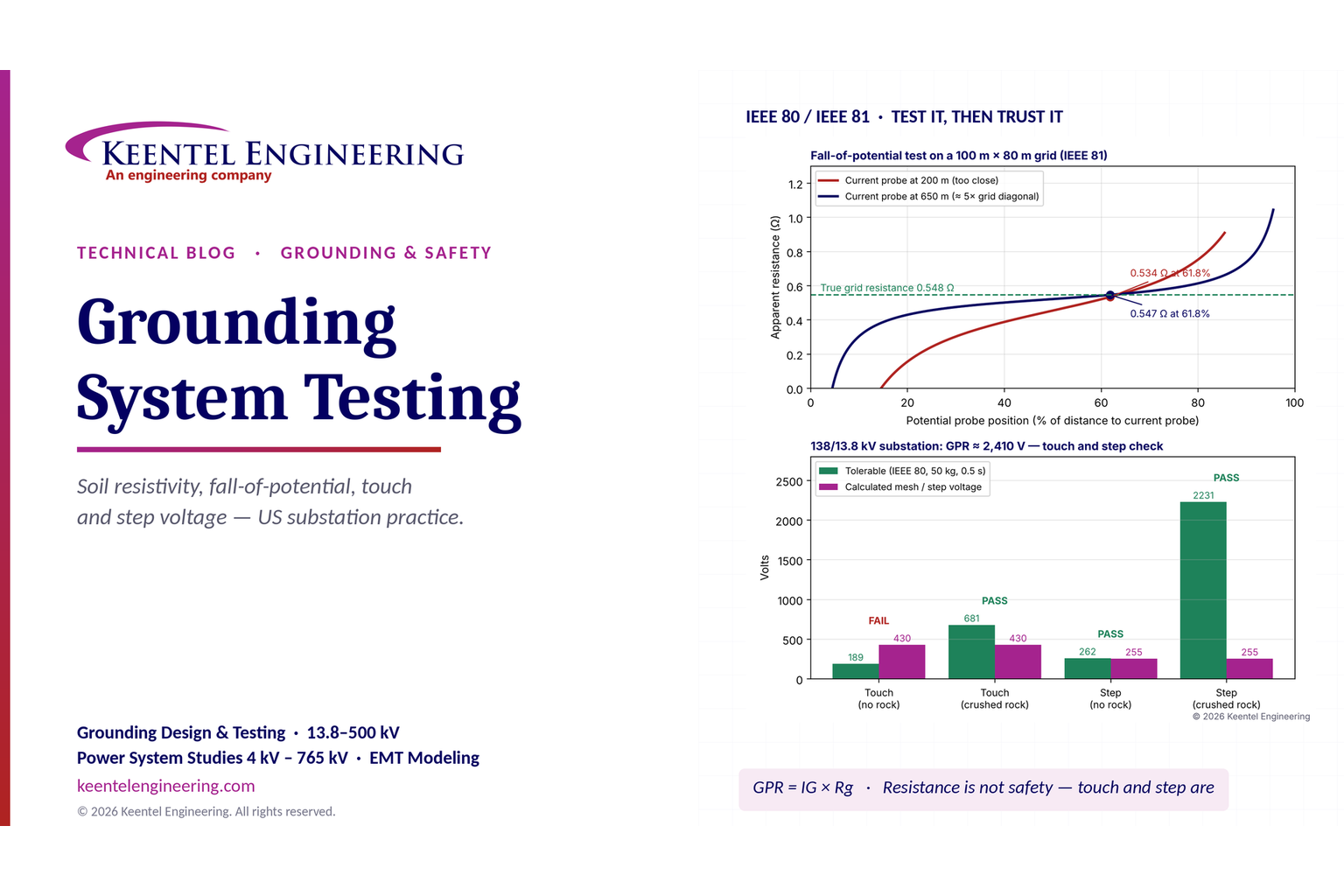
Explore grounding system testing with Keentel Engineering. Learn IEEE 80/81 methods, soil resistivity, ground resistance, and touch and step voltage safety.
By SANDIP R PATEL
•
October 13, 2026
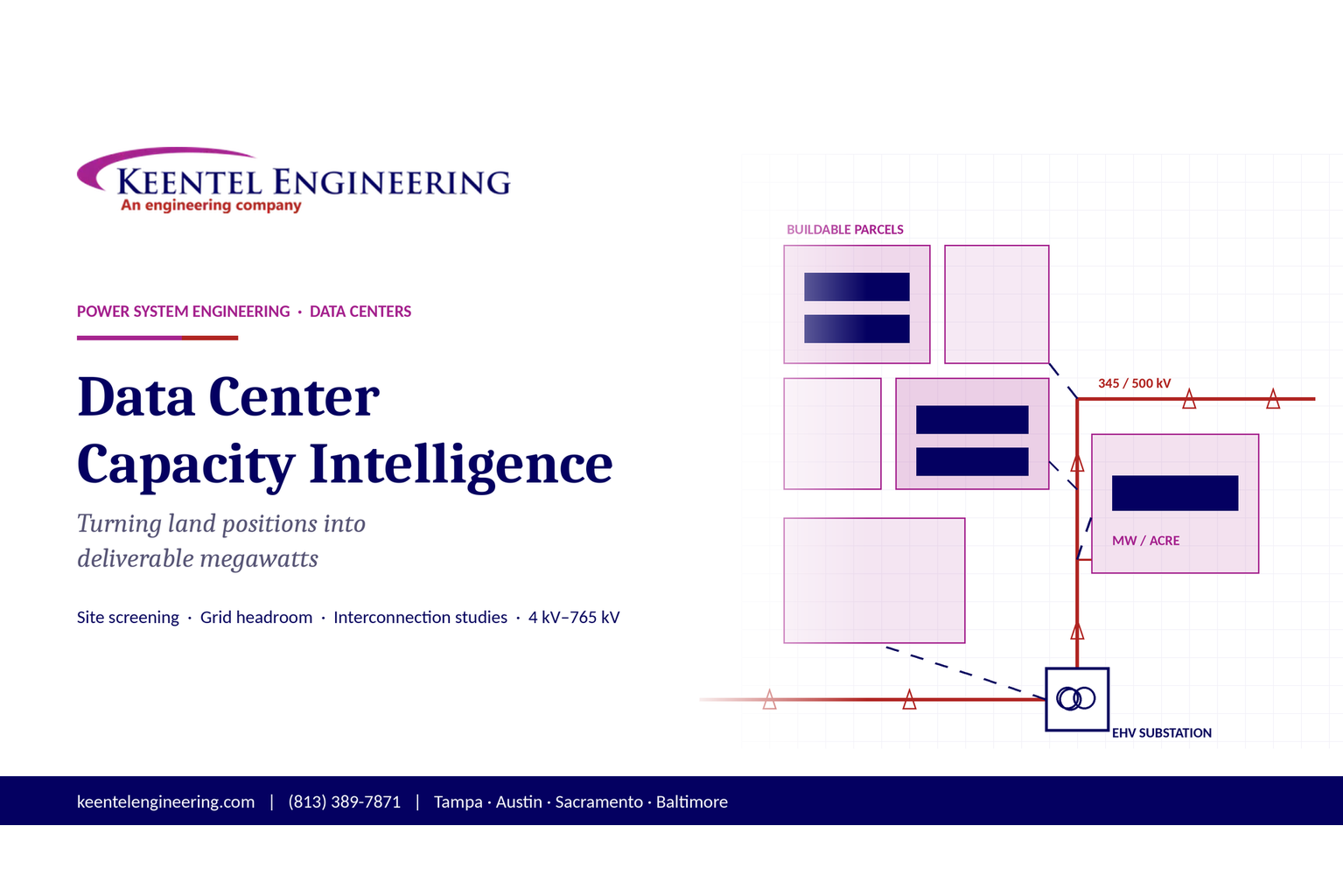
Plan data center capacity with land screening, MW-per-acre estimates, grid power availability and interconnection feasibility studies from Keentel Engineering.





