
A Coordinated Electric System Interconnection Review—the utility’s deep-dive on technical and cost impacts of your project.

Challenge: Frequent false tripping using conventional electromechanical relays
Solution: SEL-487E integration with multi-terminal differential protection and dynamic inrush restraint
Result: 90% reduction in false trips, saving over $250,000 in downtime

Category Metric
VPP capacity (Lunar Energy) 650 MW
Lunar funding raised US$232 million
Data center BESS example 31 MW / 62 MWh
ERCOT grid-scale batteries 15+ GW
LDES tenders (H1 2026) Up to 9.3 GW
Lithium-ion share of LDES by 2030 77%
FEOC initial threshold 55%
BESS tariff rate (2026) ~55%
Capacity gain from analytics 5–15%

What is T&D Co-Simulation?

Confusing Physical Connections with Logical Nodes in IEC 61850

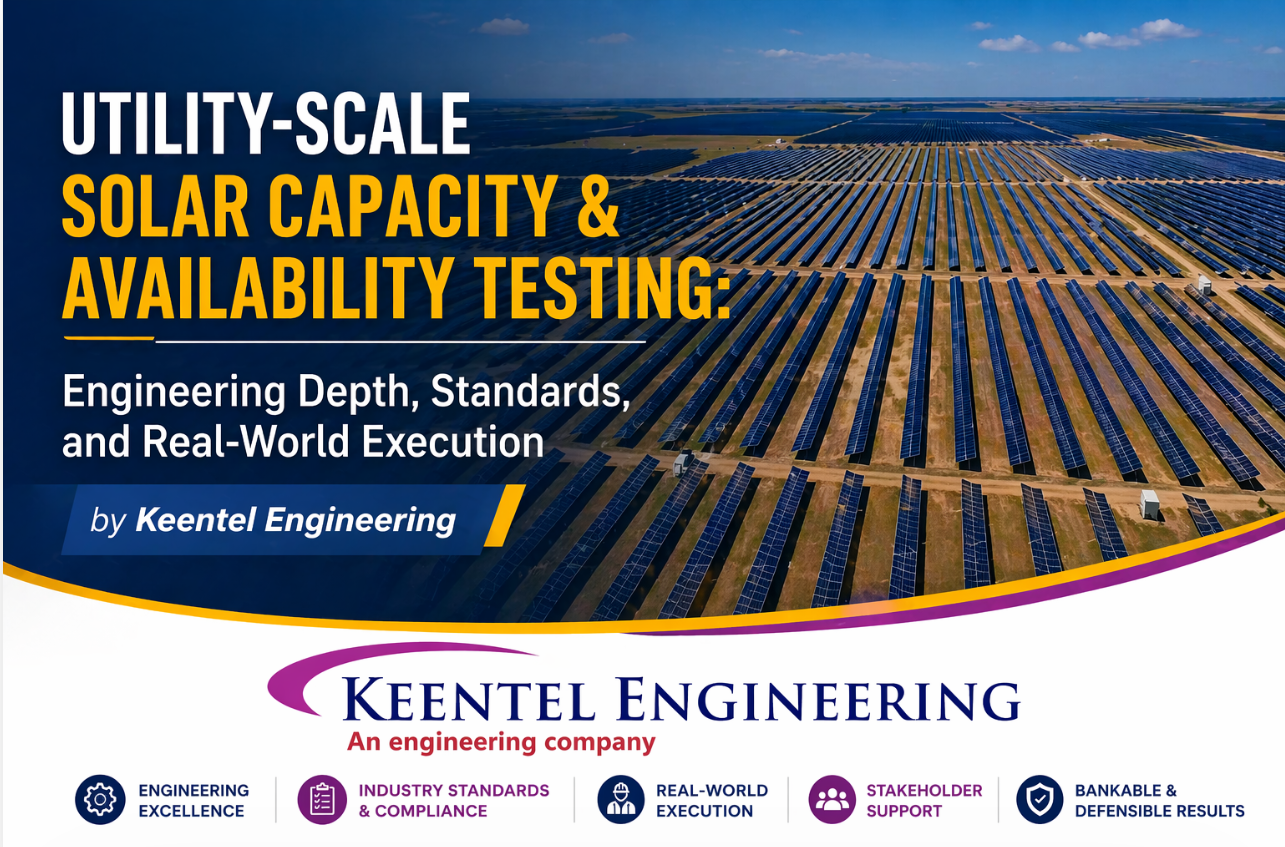
Utility-Scale Solar Capacity & Availability Testing: Engineering Depth Standards and Real World Execution by Keentel Engineering

Solar capacity and availability testing for utility-scale power systems
Calendar icon. D

 Apr 22, 2022  | blog

Introduction

In today’s utility-scale solar industry, successful project delivery is no longer defined by installation alone—it is defined by verified, bankable performance. Capacity and availability testing have become critical contractual milestones, often tied directly to financial closeout, performance guarantees, and final acceptance.


While many stakeholders reference ASTM E2848 as the governing methodology, real-world execution—especially under EPC agreements—requires far more than simply applying a standard. It demands advanced engineering, high-precision instrumentation, rigorous data validation, and coordinated stakeholder management.


At Keentel Engineering, we bring over three decades of combined expertise in power systems, renewable integration, and NERC-compliant engineering services, delivering fully defensible, contract-compliant solar capacity testing solutions for developers, EPC contractors, and asset owners across North America.


Industry Standards and Engineering Framework

ASTM E2848 – Core Capacity Verification Standard

ASTM E2848 provides the foundation for:

  • Measuring photovoltaic system output under real conditions 
  • Applying statistical regression models 
  • Normalizing performance to defined reporting conditions 


However, Keentel Engineering goes beyond standard compliance by ensuring:


  • Strict adherence to data validity criteria 
  • Custom regression modeling for bifacial and tracker systems 
  • Audit-ready documentation aligned with lender and IE expectations

ASTM E2939 – Reporting Conditions & Expected Capacity

This standard defines how reference conditions are established, including:


  • Irradiance levels 
  • Ambient and module temperatures 
  • Environmental baselines 


Keentel Engineering enhances this process by:


  • Integrating site-specific meteorological data 
  • Validating PVsyst models against field conditions 
  • Ensuring alignment between modeled and measured performance 

IEC 61724-2 – Performance Monitoring

While ASTM governs capacity testing, IEC standards provide:


  • Long-term performance monitoring frameworks 
  • Performance ratio (PR) evaluation 
  • Operational benchmarking 


Keentel integrates both ASTM and IEC methodologies to deliver holistic system performance validation.

EPC-Specific Contractual Requirements

Most utility-scale projects include enhanced contractual specifications, such as:


  • Bifacial irradiance modeling 
  • Albedo measurement requirements 
  • Strict data filtering rules 
  • Pass/fail thresholds (typically ≥95%) 
  • Availability guarantees (often 100%) 


Keentel Engineering specializes in navigating these contract-driven complexities, ensuring results are both technically accurate and legally defensible.


Capacity Test Plan Development Keentel’s Engineering Approach

A well-developed Capacity Test Plan is the cornerstone of successful execution.


Keentel Engineering delivers:


1. Detailed Project Characterization


  • System configuration (AC/DC ratings) 
  • Module technology (monofacial/bifacial) 
  • Tracker geometry and orientation 
  • Site-specific conditions 

2. Advanced Instrumentation Strategy


  • Sensor selection (Class A pyranometers) 
  • Redundancy planning 
  • Sensor placement optimization 
  • Calibration verification and traceability 

3. Data Acquisition Architecture


  • SCADA integration and validation 
  • High-resolution data logging (1-minute or better) 
  • Time synchronization across all channels 

4. Data Quality & Filtering Protocols


  • Primary and secondary exclusion criteria 
  • Shading and clipping detection 
  • Stability analysis (irradiance variability) 
  • QC disposition tracking for each dataset 

5. PV Modeling & Simulation Integration


  • Full PVsyst model validation 
  • Albedo correction for bifacial systems 
  • Removal of non-representative losses (soiling, downtime)

6. Reporting Condition Determination


  • Statistical derivation from test data 
  • Alignment with contractual definitions 
  • Ensuring minimal extrapolation error 

Field Execution Excellence

At Keentel Engineering, field execution is where engineering rigor meets real-world conditions.


1. Precision Instrument Deployment


  • Coplanar alignment of pyranometers (±1° tolerance) 
  • Strategic placement of rear irradiance sensors 
  • Albedometer installation for accurate ground reflectivity measurement 
  • Distributed module temperature sensing

2. Daily QA/QC Operations


  • Sensor cleaning and inspection 
  • Real-time data validation 
  • Identification of anomalies (clipping, shading, sensor drift) 
  • Immediate corrective action 

3. Real-Time Engineering Oversight


Keentel engineers actively monitor:


  • Irradiance stability 
  • Inverter performance 
  • Tracker alignment 
  • Data completeness 


This ensures that:


  • Invalid data is minimized
  • Test duration is optimized
  • Results remain defensible

4. Bifacial & Tracker System Expertise


Modern solar plants require advanced handling of:


  • Rear-side irradiance measurement 
  • Ground albedo variability 
  • Tracker angle validation 
  • Back-of-module temperature modeling 


Keentel Engineering applies industry-leading methodologies to accurately capture these variables.


Data Analysis & Capacity Determination

Advanced Regression Modeling


Keentel performs multi-variable regression analysis using:


  • Front irradiance 
  • Rear irradiance (bifacial contribution) 
  • Module temperature 


This allows accurate prediction of system output under Reporting Conditions.

Capacity Metrics Delivered


  • Measured Capacity (MC) 
  • Target Capacity (TC) 
  • Measured Capacity Ratio (MCR) 


Typical acceptance threshold:


  • ≥95%

Uncertainty Analysis


Keentel provides:


  • Statistical confidence intervals 
  • Sensor uncertainty evaluation 
  • Regression error analysis 


Ensuring results meet bankability and audit standards.


Equipment Expertise & Cost Optimization

Equipment Used by Keentel Engineering


  • Class A pyranometers (front and rear POA) 
  • Albedometer systems 
  • Back-of-module temperature sensors 
  • Ambient meteorological sensors 
  • High-resolution data acquisition systems 
  • Custom mounting and alignment hardware 

Cost Insight


  • Purchase cost: $28,000 – $38,000 
  • Rental cost: $6,000 – $12,000 


However  Keentel Engineering delivers value beyond equipment by providing:


  • Engineering integration 
  • Data validation 
  • Risk mitigation 
  • Contract compliance 

Stakeholder Coordination & Support


Capacity testing involves multiple stakeholders:


  • Developers and asset owners 
  • EPC contractors 
  • Independent engineers (IE) 
  • Lenders and financial institutions 
  • O&M teams 

Keentel Engineering’s Role

1. Technical Leadership


  • Translating standards into actionable execution plans 
  • Aligning expectations across all parties 


2. Risk Management


  • Identifying potential failure points early 
  • Reducing likelihood of test repetition 
  • Ensuring compliance with contractual obligations 


3. Transparent Communication


  • Real-time updates during testing 
  • Clear documentation of assumptions and results 
  • Support during review and acceptance process 


4. Dispute Resolution Support


  • Providing defensible methodologies 
  • Supporting technical discussions between parties 
  • Ensuring audit-ready documentation 


A smiling man with glasses and a beard wearing a blue blazer stands in front of server racks in a data center.

About the Author:

Sandip "Sonny" R. Patel, P.E.

IEEE Senior Member · Founder & CEO, Keentel Engineering

In 1995, Sonny Patel earned his Electrical Engineering degree from the University of Illinois. But degrees don't build legacies — action does.

For three decades, he has worked the power industry from every side of the table: 16 years as a utility engineer at Exelon/Commonwealth Edison; generation leadership across hydroelectric, industrial steam turbine, and a 9 GW renewable fleet; NERC Regional Entity Senior Compliance Engineer and Audit Team Lead, auditing some of the nation's largest utilities; and testing and commissioning lead on equipment up to 765 kV — the very top of the North American grid.

Utility. Generator. Regulator. Consultant. Few engineers have seen all four seats. Fewer still have sat in them.His experience spans nuclear, hydro, conventional generation, renewables, oil and gas, mining — and today's data centers, where he is authoring a three-book series on data center design. He is a Licensed Professional Engineer in six states and a Licensed Electrical Contractor in Florida (Unlimited EC) — he doesn't just design the work; he's qualified to stand behind its execution.Today, as Founder and CEO of Keentel Engineering, Sonny leads 51 engineers delivering substation design, power system studies, NERC compliance, and commissioning — done right, coast to coast.Three decades. Every side of the table. One standard: accountable engineering

Four workers in safety vests and helmets stand with arms crossed near wind turbines.

Let's Discuss Your Project

Let's book a call to discuss your electrical engineering project that we can help you with.

Man in a blazer and open shirt, looking at the camera, against a blurred background.

About the Author:

Sandip "Sonny" R. Patel, P.E.

IEEE Senior Member · Founder & CEO, Keentel Engineering

In 1995, Sonny Patel earned his Electrical Engineering degree from the University of Illinois. But degrees don't build legacies — action does.

For three decades, he has worked the power industry from every side of the table: 16 years as a utility engineer at Exelon/Commonwealth Edison; generation leadership across hydroelectric, industrial steam turbine, and a 9 GW renewable fleet; NERC Regional Entity Senior Compliance Engineer and Audit Team Lead, auditing some of the nation's largest utilities; and testing and commissioning lead on equipment up to 765 kV — the very top of the North American grid.Utility. Generator. Regulator. Consultant. Few engineers have seen all four seats. Fewer still have sat in them.His experience spans nuclear, hydro, conventional generation, renewables, oil and gas, mining — and today's data centers, where he is authoring a three-book series on data center design. He is a Licensed Professional Engineer in six states and a Licensed Electrical Contractor in Florida (Unlimited EC) — he doesn't just design the work; he's qualified to stand behind its execution.Today, as Founder and CEO of Keentel Engineering, Sonny leads 51 engineers delivering substation design, power system studies, NERC compliance, and commissioning — done right, coast to coast.Three decades. Every side of the table. One standard: accountable engineering

Leave a Comment

Related Posts

Station battery sizing design for substation DC auxiliary power system
By SANDIP R PATEL September 5, 2026
Understand ERCOT BESS interconnection requirements, including model packages, EMT studies, ride-through compliance, telemetry, and real-time co-optimization.
Transformer vector groups showing 30-degree HV and LV phase displacement at clock positions 11 and 1
By SANDIP R PATEL September 3, 2026
Learn transformer vector groups, clock notation, 30° phase shift, IEC vs ANSI conventions, grounding, differential protection and paralleling.
Station battery sizing design for substation DC auxiliary power system
By SANDIP R PATEL September 3, 2026
Learn how station battery sizing works, including duty cycles, ampere-hour calculations, voltage checks, chargers, DC systems, and substation reliability.
Transmission structure design showing angle classes and line support requirements.
By SANDIP R PATEL September 3, 2026
Learn how transmission structure design works, including structure types, loading cases, materials, foundations, right of way, and selection factors.
BESS energy capacity comparison showing installed, usable, guaranteed, POI and net delivered megawat
By SANDIP R PATEL September 3, 2026
Learn the difference between BESS nameplate, usable, guaranteed and delivered energy, including degradation, round-trip efficiency, auxiliary loads and testing.
ERCOT frequency response testing for generator compliance
By SANDIP R PATEL September 3, 2026
Understand ERCOT frequency response testing, from droop and deadband requirements to staged test procedures, data analysis, and compliance reporting.
STATCOM reactive power support improving voltage stability in modern power systems.
By SANDIP R PATEL September 3, 2026
Learn what a STATCOM does, how it supports voltage stability, reactive power control, weak grids, and why dynamic studies are essential for proper sizing.
Power system protection schemes from generator to load showing overlapping protection zones
By SANDIP R PATEL September 1, 2026
Learn power system protection schemes from generator to load, including protection zones, relay coordination, device numbers, backup protection, and settings.
PRC-029-1 compliance deadlines and enforcement discretion for inverter-based resources
By SANDIP R PATEL September 1, 2026
Understand PRC-029-1 compliance deadlines, IBR ride-through requirements, R1–R4, enforcement discretion, notification rules, and owner action steps.