A Coordinated Electric System Interconnection Review—the utility’s deep-dive on technical and cost impacts of your project.
Challenge: Frequent false tripping using conventional electromechanical relays
Solution: SEL-487E integration with multi-terminal differential protection and dynamic inrush restraint
Result: 90% reduction in false trips, saving over $250,000 in downtime
| Category | Metric |
|---|---|
| VPP capacity (Lunar Energy) | 650 MW |
| Lunar funding raised | US$232 million |
| Data center BESS example | 31 MW / 62 MWh |
| ERCOT grid-scale batteries | 15+ GW |
| LDES tenders (H1 2026) | Up to 9.3 GW |
| Lithium-ion share of LDES by 2030 | 77% |
| FEOC initial threshold | 55% |
| BESS tariff rate (2026) | ~55% |
| Capacity gain from analytics | 5–15% |
What is T&D Co-Simulation?
Confusing Physical Connections with Logical Nodes in IEC 61850
MISO PLANNING MODELING MANUAL A Complete Technical Guide for Power System Engineers

Apr 17, 2022 | blog
Reliability Data Requirements, Reporting Procedures & 20 Expert FAQs Published by KEENTEL
Introduction: Understanding MISO's Planning Modeling Framework
The Midcontinent Independent System Operator (MISO) serves as the NERC Planning Coordinator (PC) for one of North America's largest power grids spanning 15 U.S. states and the Canadian province of Manitoba. At the heart of MISO's reliability mission is a rigorous, standards-driven modeling process that ensures every megawatt, every transformer, and every distribution boundary is accurately represented in planning studies.
The MISO Planning Modeling Manual (Version 4.5) establishes the technical framework governing how data owners — Transmission Owners (TO), Generator Owners (GO), Load Serving Entities (LSE), and Resource Planners (RP) — submit the data that feeds MISO's annual planning model cycles. These models underpin TPL compliance, ERAG interconnection-wide submissions, economic studies, and long-term transmission expansion planning (MTEP).
For engineers at Keentle Engineering and across the power industry, understanding this framework is essential whether you are interconnecting a new generation facility, verifying compliance for an existing asset, submitting dynamics data for a renewable project, or reviewing short circuit contributions for a GIC study. This technical brief distills the manual into its critical concepts and answers the 20 most pressing engineering questions we hear from practitioners in the field.
Section 1: The MISO Modeling Process From Data to Grid-Wide Cases
MISO's annual planning model development follows a structured, multi-pass process. Each year, MISO issues a data request to all registered entities, collects submissions through the Model On Demand (MOD) platform, performs quality checks, posts cases for stakeholder review, incorporates corrections, and ultimately delivers finalized models to the NERC ERO/designee for Interconnection-wide case assembly.
The cycle targets are approximately: data request issued in August, Pass 1 models posted in August, initial data due in September, Pass 2 in October, Pass 3 in December, final model in March, and ERO submission in June. This means data owners have approximately one month between each pass to review outputs and submit corrections.
Responsible Entities & Core Data Obligations
| Transmission Owner (TO) | System topology, buses, lines, transformers, HVDC, voltage limits, reactive compensation, GIC/sequence data, area interchange |
|---|---|
| Generator Owner (GO) | Generator parameters, GSU transformer, seasonal capabilities, station service load, IBR collector system, dynamics, GIC, sequence data |
| Load Serving Entity (LSE) | Aggregate demand by bus, load composition for dynamics, sequence network data |
| Resource Planner (RP) | Same as GO obligations for future planned resources with executed interconnection agreements |
| Transmission Service Provider (TSP) | Long-term firm OASIS information for area interchange schedules |
The Model On Demand (MOD) tool is MISO's centralized data submission platform. All steady-state power flow data, project files, BLG/DEV profiles, and dynamics data flow through MOD. The tool enforces a hierarchical data order: Base Case information forms the foundation, overlaid by Project files, then Seasonal Ratings, then BLG/DEV profiles. Understanding this hierarchy is critical — higher-layer data overwrites lower-layer entries.
Section 2: Power Flow Model Development Scenarios, Scheduling, and Topology
Power flow models are developed using Siemens PTI PSS(R)E. MISO develops models for years 0, 1, 2, 5, and 10 relative to the current planning cycle. For example, the 2026 series covers planning years 2026 through 2036. Each model year includes a defined set of seasonal scenarios depending on the planning horizon:
Scenario Matrix by Model Year
| Year 0 | Summer Peak, Fall Peak, Winter Peak |
|---|---|
| Year 1 | Spring Light Load, Spring Peak, Summer Peak, Winter Peak |
| Year 2 | Spring Light Load, Summer Peak, Winter Peak |
| Year 5 | Spring Light Load, Spring Minimum Load, Summer Shoulder, Summer Peak, Winter Peak |
| Year 10 | Summer Peak, Winter Peak |
Each scenario represents a specific operating condition: Summer Peak is the maximum summer demand; Summer Shoulder is 70-80% of summer peak; Winter Peak is maximum winter demand; Spring Light Load is near-minimum load early morning conditions; and Spring Minimum Load is the lowest expected net load during spring, which is critical for studying overgeneration and voltage rise on increasingly renewable-heavy grids.
Generator outputs in each scenario are set using Bus/Load/Generation (BLG) profiles. Renewable dispatch percentages are prescribed: wind in Summer Peak scenarios uses the assigned Capacity Credit; wind in Winter Peak runs at 67%; light load average wind is 40%; Summer Shoulder average wind is 27%. Solar output follows similarly prescribed percentages 0% in Winter Peak and light load conditions, approximately 48% in Summer Shoulder average wind scenarios.
Section 3: Generator Modeling Synchronous, Wind, Solar, Storage, and Hybrids
MISO's modeling requirements distinguish among generator technology types, with specific topology conventions and data requirements for each. A universal threshold applies: all generators with a nameplate greater than 20 MVA, or facilities with aggregated nameplate greater than 75 MVA, must be modeled in explicit detail (unless they meet NERC BES exclusion criteria). Blackstart Resources must always be modeled in detail regardless of size.
Synchronous Generators
Traditional synchronous generators must include the point-of-interconnection (POI) transformer and transmission line, the generator step-up transformer (GSU), reactive compensation, station service loads (if >1 MW), and correctly synchronized Machine IDs. Bus names must incorporate the MISO interconnection queue designation (e.g., JXXXX Gen, limited to 12 characters).
Wind Farms
Wind farms are represented as single equivalent machines (or multiple equivalents for geographic diversity, turbine type differences, or development phases). The topology includes a wind turbine generator at low voltage (typically 690 V), an equivalent GSU transformer, a collector system equivalent, a POI transformer, and reactive compensation. Machine ID uses 'W'. WMOD and WPF fields must be populated with non-zero values.
A critical wind farm modeling requirement is the wind-free reactive status: when PGEN=0 and the unit is online, updated MVAR limits must be submitted. Additionally, a fixed shunt (recommended ID 'NP') must be modeled at the low side of the POI transformer, sized to negate collector system charging when the wind turbine is offline.
Solar Farms
Solar farms follow nearly identical topology requirements to wind farms, with machine IDs using 'PV' or 'S' characters. The same sun-free reactive status requirement applies: when the solar farm is at PGEN=0 online, reactive limits must be updated, and a fixed shunt ('NP') handles collector charging. Solar output in Summer/Spring/Fall Peak scenarios equals the annual assigned Capacity Credit; all light load and winter peak scenarios carry 0% output.
Energy Storage
Energy storage systems use machine IDs 'ES' or 'E'. A key distinction: Pmin must reflect maximum charge rate (not storage capacity), and Pmax must reflect maximum discharge rate. WMOD should be set to 1 or 2. Storage dispatch requires two Economic Tier Orders — one for standby and one for discharging. Storage As Transmission Only Asset (SATOA) resources operate at 0% MW output with full load MVAR range across all scenarios.
Hybrid Generation
For plants with shared interconnections comprising multiple fuel types (e.g., solar+storage, wind+storage), each fuel type must be modeled as an explicit separate machine, whether AC or DC coupled. No aggregation of different fuel types into a single machine record is permitted.
Section 4: Dynamics Model Development
Dynamics models simulate the transient response of the power system over a 0-20 second window following a disturbance, using a typical time step of one quarter cycle. MISO develops dynamics models in PSS(R)E Dyre (.dyr) format, with simulations also run in DSA Tools TSAT for cross-platform validation.
Dynamics scenarios are a subset of the power flow scenarios. For Year 1, only Summer Peak dynamics are built. Year 5 includes Light Load, Summer Peak, and Summer Shoulder. Year 10 Summer Peak dynamics are built only if material generation additions or changes occur between Years 5 and 10; otherwise MISO submits the Year 5 Summer Peak dynamics to the ERO.
At a minimum, generators with nameplate >20 MVA or aggregated nameplate >75 MVA require detailed dynamic models including: Generator Model, Excitation System Model, Turbine-Governor Model, Power System Stabilizer Model, Reactive Line Drop Compensation Model, and a Frequency Response classification (Responsive, Squelched, or Non-Responsive). The excitation system and power system stabilizer may be omitted if not installed or active.
MISO enforces its own Standard Generator Component Model List, which references the NERC Acceptable Model List but with important additions: governor models that cannot represent deadband are not accepted by MISO even if NERC-acceptable (e.g., TGOV1). User-defined models (UDMs) are only permitted when standard PSS(R)E models cannot adequately represent the device's performance characteristics. All UDMs must be table-driven, include block diagrams and documentation, and be accompanied by a compatible DSA Tools TSAT version.
Section 5: Short Circuit and GIC Model Development
In support of TPL-007 harmonic analysis requirements, TOs and GOs must provide positive, negative (automatically the negative of positive sequence in PSS(R)E), and zero sequence network data. Required data includes: generators, loads, non-transformer branches, mutual branches, transformers, switched shunts, fixed shunts, and induction machines. Submissions must use 6-digit bus numbers consistent with the power flow model.
Geomagnetic Induced Current (GIC) models supplement the AC power flow model to simulate DC current paths through the network during geomagnetic disturbance events, per TPL-007 R2. GIC data requirements are extensive and encompass substation/bus data (including geographic coordinates and ground resistance), transmission line data (underground lines require 0.0 entries for Vp/Vq), detailed transformer data (winding resistances, vector group, core construction, K-factor), fixed and switched shunt DC resistances, and load/DC line/VSC transformer data. GIC harmonic analysis by MISO is performed on 5-year Summer Peak and 5-year Summer Shoulder Average Wind models.
20 Technical FAQs: MISO Planning Modelinga
The following expert Q&A covers the most technically demanding aspects of the MISO Planning Modeling Manual v4.5, drawn from common engineering challenges in generator interconnection, transmission planning, and compliance modeling.
FAQ 1: What is the MOD data hierarchy and why does submission order matter?
The MOD platform processes data in a strict hierarchical stack. At the base is the MOD Base Case, which contains the current system topology and equipment records approved through prior cycles.
Above that sit Project files (MTEP Appendix A/B, Non-MTEP, Generator, Base Case Change), which modify topology by adding, removing, or changing equipment. Above projects sit Seasonal Ratings Profiles, and at the top are BLG (Bus/Load/Generation) and DEV (Device Control) Profiles.
Each layer can overwrite data from the layer below it — but not vice versa. This means if you submit incorrect topology data in a BLG profile (which is above projects), it will overwrite correctly approved project data. Specifically: Bus information such as voltage magnitude and angle should not be included in BLG profiles because it would overwrite topology established by Projects. The practical implication for engineers: only put load forecast data and generation output data in BLG profiles; use properly typed MOD projects for any topology changes; use DEV profiles only for seasonal tap and setting changes that genuinely vary by season.
FAQ 2: When does a Generator Owner need to submit data vs. relying on their interconnecting Transmission Owner?
By default, Generator Owners are expected to submit their data directly to MOD/MISO. The delegation option — where the interconnecting Transmission Owner submits on the GO's behalf — requires a formal MOD-032 Letter of Notice of Data Submittal Duty submitted to PlanningModeling@misoenergy.org. Until that letter is on file, the GO is solely responsible.
Even when delegation is in place, coordination with the TO is still required to ensure bus number assignments (from the TO's MMWG-allocated bus ranges) and topology are consistent. The delegation letter remains effective until MISO receives written notification to suspend it. For engineers managing multiple generator projects across different TOs, it is critical to verify delegation status for each project independently — a common source of compliance gaps is assuming delegation automatically carries over from prior projects or when a project transfers between developers.
FAQ 3: What are the minimum modeling requirements for a large wind farm interconnection under MISO's modeling rules?
A wind farm must be modeled as at least a single equivalent machine using a topology that explicitly includes: (1) a wind turbine generator at low voltage (typically 690 V) with machine ID using 'W'; (2) an equivalent GSU transformer stepping low voltage to medium voltage (e.g., 34.5 kV); (3) a collector system equivalent represented as transmission lines with the equivalent impedance of the actual collector; (4) a POI transformer stepping medium to high voltage; (5) an interconnection transmission line; and (6) both generator-level and plant-level reactive compensation.
Beyond the physical topology, wind-specific requirements include: WMOD and WPF must be set to non-zero values (if WMOD 2 or 3 is used and the plant has different leading/lagging power factors, submit the more conservative value); a wind-free reactive status must be established (unit online, PGEN=0, updated MVAR limits); and a fixed shunt with ID 'NP' must be placed at the low side of the POI transformer to negate collector system charging when the turbine is offline. This fixed shunt is online only when the machine is offline (Status=0), and is sized with susceptance B to cancel the charging MVars of the collector system. Failure to model this shunt results in voltage calculation errors in light load scenarios.
FAQ 4: How are wind output levels determined for each planning scenario, and who sets them?
MISO prescribes specific wind output percentages for each scenario through Table 4-4 of the Planning Modeling Manual. These are applied as a percentage of the unit's Pmax in the BLG profile. The percentages reflect expected operating conditions in each scenario: Summer Peak, Fall, and Spring scenarios use the wind Capacity Credit as assigned in the annual MISO Wind and Solar Capacity Credit Report; Winter Peak uses 67% (average wind); Light Load and Minimum Load use 40% (average wind); Summer Shoulder uses 27% (average wind).
Additional sensitivity scenarios extend this further: Summer Shoulder High Wind uses 76%; Light Load High Wind uses 84%; Light Load No Wind uses 0%. These percentages are reviewed and updated periodically by MISO (with changes requiring approval from MISO's Planning Steering Committee and Policy Advisory Committee). The Generator Owner is responsible for ensuring their BLG profile submissions reflect these prescribed output levels for each scenario. Submitting a uniform output level across all scenarios — a common error — violates the scenario definitions and will be flagged during MISO's data quality review.
FAQ 5: What is the correct modeling approach for a battery energy storage system (BESS) that operates both as a market participant and as a transmission-only asset?
A BESS has two operating modes in MISO planning models, each with distinct dispatch treatment. When operating as a Storage As Transmission Only Asset (SATOA), the unit is set to 0% MW output (PGEN=0) with WMOD=1 and full load MVAR range (QT and QB at full capacity limits) across all scenarios. When operating as a market participant, dispatch is set via Economic Tier Order, also with WMOD=1 and full MVAR range.
Critically, storage requires two separate Economic Tier Orders to be submitted in the Non-Tier Order workbook — one for standby mode and one for discharging mode. This is because the dispatch algorithm needs to distinguish between a storage unit at rest versus actively discharging. Regarding Pmin and Pmax: Pmin must be set equal to the maximum charge rate of the inverter (typically negative, representing consumption), NOT the total energy storage capacity. Pmax must equal the maximum discharge rate, NOT the storage capacity. A common error is setting Pmax to the energy capacity (e.g., 100 MWh on a 50 MW/4hr system) instead of the power rating (50 MW). The MOD project name must include the MISO interconnection queue number, and the generator bus name should follow the convention of JXXX_ENSTOR1.
FAQ 6: What dynamics data is mandatory for IBR (inverter-based resources), and how does MISO's UDM policy apply?
For inverter-based resources (wind, solar, storage), dynamics data must be submitted as part of the annual planning cycle alongside the power flow data. MISO requires that standard PSS(R)E library models be used wherever possible. For wind turbine generators and solar PV systems, this typically means using NERC/WECC-endorsed generic renewable energy system models (e.g., REGCA1, REECAD, REPCAD for type 3/4 wind turbines and PV systems in newer PSS(R)E versions, or the appropriate manufacturer-specific models from the NERC Acceptable Model List).
MISO's UDM policy is restrictive: a user-defined model is only accepted when (a) the specific performance features are necessary for proper representation and cannot be approximated by standard PSS(R)E models, and (b) the model is table-driven (not CONET or CONEC based). Every UDM submitted for MMWG use must include written documentation with block diagrams, ICON/CON/variable definitions, and be accompanied by source code or .dll files. Additionally, a compatible DSA Tools TSAT version of the UDM must also be created and maintained — MISO runs simulations in both PSS(R)E and TSAT, and a PSS(R)E-only UDM is not sufficient for full acceptance. DER dynamics data should also be provided for any DER explicitly represented in the power flow models.
FAQ 7: How does the composite load model (CMLD) work, and what data does MISO need from LSEs to build it?
The Composite Load Model (CMLD) is a dynamic load representation developed by the NERC Load Modeling Working Group that models six load components: Motor A (small 3-phase compressor motors, e.g., large air conditioners), Motor B (large 3-phase fan motors), Motor C (medium 3-phase pump motors), Motor D (single-phase air conditioner compressor motors), Electronic Load (voltage-dependent), and Static Load (frequency and voltage dependent). The model topology includes a distribution transformer equivalent, distribution feeder equivalent, and connects to the high-voltage transmission system bus.
MISO builds CMLD parameters using load composition data submitted by LSEs, categorized as Residential, Commercial, Industrial, and Agricultural fractions. These fractions are converted into motor component percentages using MISO's prescribed matrices (Tables 7-1-1 through 7-1-5 in the manual, which differ by season — Summer Peak, Shoulder, Light Load, Minimum Load, Winter Peak). The mathematical derivation multiplies the R/C/I/A fraction vector by the component percentage matrix to yield fractions Fma, Fmb, Fmc, Fmd, and Fel. If an LSE does not provide a specific dynamic load characteristic model, MISO derives CMLD parameters from the R/C/I/A composition data. Submission of accurate load composition is therefore directly tied to the quality of the dynamics model in the LSE's service territory.
FAQ 8: What are MOD 'Project Statuses' and which statuses result in projects being included in base models?
MOD projects carry a status that determines whether they are incorporated into planning models. The inclusion logic is defined in Table 4-3 of the manual. Planned status projects are included for MTEP Appendix A, Non-MTEP MISO, Non-MISO Network, and Generator project types. MTEP Appendix B projects are only included when they are in Target MTEP A status (i.e., the project is proposed to be approved by the MISO Board of Directors in the current cycle). Generator projects in 'In Service' status are included in models. Conceptual and Alternative statuses for Appendix B projects are NOT included in models.
For Generator project types specifically: Planned status generators are included; Conceptual status generators are explicitly excluded. In Service generators are included. This matters practically because a generator that has received Board approval (Appendix A) and is in Planned status will appear in planning models and influence system studies, while a generator in Conceptual status will not — even if it has a signed interconnection agreement. Engineers advising clients on timeline visibility in MISO models should ensure interconnection projects reach 'Planned' status through the proper MOD process.
FAQ 9: What is the correct bus naming convention for generator projects, and how are bus numbers allocated?
Generator bus names must incorporate the MISO interconnection queue designation. For standard interconnection projects, this follows the format 'JXXXX Gen' for synchronous generators, 'JXXXX Wind' for wind projects, 'JXXXX Solar' for solar, and 'JXXX_ENSTOR1' for storage (all limited to 12 characters for PSS(R)E compatibility). For generator replacement projects, the new bus is named using the replacement project number: 'RXXXX'. MOD Project file names for generators must include the DPP Study Project ID (formatted as GXXX, JXXX, or RXXX), the company name acronym, and the project name — for example: ITC-JXXX-PROJECT_NAME.prj.
Bus numbers must be allocated from the interconnecting Transmission Owner's MMWG-assigned bus number ranges — the GO may not choose arbitrary bus numbers. This coordination with the TO is mandatory and must occur before MOD submission. In practice, the TO maintains a bus number registry aligned with the MMWG Multi-Regional Modeling Working Group allocations, and the GO must formally request bus numbers as part of the pre-modeling coordination. For facilities spanning multiple voltage levels (generator bus, collector bus, POI bus), each bus needs a separately allocated number from the TO's range.
FAQ 10: How should station service loads be modeled, and what are the representation thresholds?
Station service loads at BES generators are required to be explicitly modeled when the station service load exceeds 1 MW. The load must use Load ID 'SS' (for a single generator at the bus). If multiple generators share a bus, station service loads for each unit must use IDs 'S1', 'S2', 'S3', etc., correlated to the correct generator ID. Legacy station service load IDs different from this convention must be communicated to MISO at PlanningModeling@misoenergy.
Station service loads must be represented as positive values (generator consumption) and must be enabled or disabled consistent with the generator's in-service status for each year/case/sensitivity in the BLG profile. If a generator is offline in a given scenario, its station service load must also be disabled. Notable exceptions: nuclear generation station service loads are not required to follow the SS naming recommendation, and station service loads not directly connected to the generation bus are exempt from the SS naming convention. The GO bears responsibility for informing MISO of the generator-to-station service association as part of the data submittal package. This association is needed for MISO to correctly toggle loads during model post-processing.
FAQ 11: What are the GIC data requirements for a substation with 345 kV wye-grounded transformers, and how is the data submitted?
For a substation with 345 kV wye-grounded transformers, comprehensive GIC data submission is required under TPL-007. The substation entry must include: a substation number (defined as the lowest bus number of the highest voltage present in the substation, selected from the utility's MMWG-allocated bus ranges), the substation summer ground resistance in ohms, geographic latitude and longitude, and the applicable earth model designation (either a USGS Earth model acronym or detailed parameters).
For the transformers themselves, the required data fields are extensive: DC winding resistances (ohms/phase) for each winding, presence and location of any DC blocking devices, transformer vector group (can be submitted through MOD's AC power flow model data instead), transformer core construction type and number of phases (or K-factor if known), size and location of any grounding resistors, and special consideration for phase-shifting transformers. All line data at >200 kV must include underground line designations (with 0.0 Vp/Vq entries) and any ground-path shunts. Data is submitted via Excel spreadsheet attached to a GIC Model Data Request — not through the standard MOD project file process. GIC model data submissions are typically requested annually in June, following completion of the dynamics model cycle.
FAQ 12: How does MISO handle area interchange modeling, and what data must TOs provide?
Area interchange represents firm and expected inter- and intra-MISO transactions. MISO uses an Area Interchange Transaction workbook that TOs complete in collaboration with their Balancing Authority. The required data fields for each transaction include: source and sink areas, transaction MW amount, applicable model scenarios (since not all transactions apply to all seasonal models), start and end dates, and either an OASIS Transmission Service Reservation (TSR) number or a Grandfathered Agreement (GFA) number. Expected transfers without an OASIS or GFA reference are also accepted and documented.
All transactions must be confirmed by both transacting parties. MISO posts the workbook to the MISO MTEP Sharefile for review, additions, edits, and deletions before finalizing. The final cases are solved using PSS(R)E's 'ties + loads' interchange function. The Local Balancing Authority (LBA) may submit this data instead of the control area Transmission Owner, provided MISO is notified in writing by both parties. Engineers managing complex multi-area transactions should pay particular attention to the scenario applicability column — a transaction that exists in Summer Peak but not in Spring Light Load must be correctly flagged, otherwise the model will have incorrect inter-area flows for those light load studies.
FAQ 13: What sequence network data is required for short circuit modeling, and which facilities must be covered?
Short circuit sequence network data (positive, zero, and derivatively negative sequence) must be submitted for all facilities meeting any of the following criteria: NERC BES-defined elements (excluding Blackstart resources with POI below 200 kV); 200 kV and higher MISO transferred transmission facilities; and transformers interconnecting to the above at 100 kV or higher via at least two terminals. The data must cover eight element types: generators, loads, non-transformer branches, mutual branches, transformers, switched shunts, fixed shunts, and induction machines.
Note that PSS(R)E automatically treats negative sequence data as the negative of the positive sequence data — you do not need to enter separate negative sequence records for standard elements. All formatting must follow the PSS(R)E version currently specified by MISO, and topology must be consistent with the power flow model (same 6-digit bus numbers, same transformer winding configurations). MOD project file names for sequence network submissions should contain the company name acronym followed by 'SEQNET' and identifying information (e.g., ATC-SEQNET-345kV system). Crucially, equivalized representations of neighboring networks within a TO or GO model must NOT be submitted — only actual system elements within the submitter's responsibility boundary.
FAQ 14: What data checks does MISO perform on submitted power flow data, and how should engineers prepare?
MISO runs an automated suite of power flow data checks after each model pass and includes the results in the model posting package. Key checks include: bus voltage against TO planning criteria; machines on Type 1 (load) buses (flags generators incorrectly connected to load buses); online machines on Type 4 (isolated) buses; unrealistic PMAX/PMIN (PMAX>2000, PMIN<-1000, or PMAX
Engineers should perform pre-submission self-checks using PSS(R)E's built-in data validation routines against this checklist. Particular attention should be paid to: verifying GTAP values are within the 0.9-1.1 range for all generators (GTAP is the generator step-up transformer turns ratio, and defaults far outside this range indicate untouched placeholder data); ensuring RMPCT is positive for all voltage-controlling generators; and confirming that wind machines are modeled at their low-voltage bus (not the POI bus). Additionally, MISO performs a sample N-1 DC contingency screen — engineers should run a similar pre-check to identify any immediately overloaded facilities that would be flagged in this screen.
FAQ 15: What is the difference between MTEP Appendix A and Appendix B projects, and how does this affect their inclusion in planning models?
MTEP Appendix B projects are those that have been demonstrated to be a potential solution to an identified reliability, economic, or policy need, but have not yet been formally approved. They are in a study or evaluation phase. Appendix B projects in 'Planned' or 'Proposed' status are NOT included in MISO planning models — only Appendix B projects that have achieved 'Target MTEP A' (i.e., they are proposed to be approved by the MISO Board in the current cycle) are included, and only in the Target MTEP A model variant.
MTEP Appendix A projects are those that have been justified as the preferred solution, reviewed by the MISO Board of Directors, and formally approved. Appendix A projects in 'Planned' status are included in all standard planning models. This distinction has significant practical implications: a transmission project that is under study in Appendix B will not be modeled in the standard TPL studies — meaning any reliability violations it is intended to address will show up as violations in the study results. Only after Board approval and Appendix A designation does the project formally enter the planning model. Engineers advising transmission developers on MISO's project pipeline should align development milestones accordingly.
FAQ 16: How should DER (Distributed Energy Resources) be represented in MISO power flow models?
MISO recommends that existing inverter-based DER (such as solar gardens and battery storage) be explicitly represented in power flow models when they have significant aggregate impact at individual T-D interface buses. Non-inverter-based DER are not required to be explicitly represented. DER representation takes one of two forms: as a Machine Record (recommended for non-aggregate, non-zero marginal cost generation such as distributed thermal), or as a Distributed Resource on a Distinct Load (recommended for aggregate zero marginal cost resources such as distributed wind/solar/geothermal).
When using the Distributed Resource on a Distinct Load approach, the load ID must be 'DR', and no more than one DER record should exist at a single bus (multiple DER must be aggregated). Critically, reported load values must NOT net out the DER: Reported Load = Forecasted Load + Reported DER. This prevents double-counting in the power flow solution. No additional T-D transformers should be added to the model; existing load bus locations are used with the T-D transformer impact folded into the machine or load representation. The Non-Tier Order Workbook distributed by MISO tracks DER dispatch treatment and must be completed for all non-tier-order resources, including DER machines, BTMG, and negative loads.
FAQ 17: What protection relay modeling is required in dynamics submissions, and what are the generic relay settings MISO applies?
MISO applies three generic protection relay models universally during dynamics simulations: a Generic Transient Voltage Monitor (flags bus voltages outside 0.7-1.2 pu during 12 cycles post-disturbance), a Generic Out-of-Step Monitor (flags apparent impedance exceeding line impedance), and a Generic Distance Relay with three zones (Circle A = 1.0x line impedance, Circle B = 1.25x, Circle C = 1.5x). These generic relays monitor conditions but do not represent specific physical equipment.
Equipment-specific relay models must be submitted for BES resources that meet the PRC-006-5 frequency trip criteria. This includes underfrequency and overfrequency trip settings for: individual generating units >20 MVA directly connected to BES that trip above/below the Generator Under/Overfrequency Trip Modeling curves; facilities >75 MVA aggregate nameplate that exceed those curves; and any facility at a common bus with total generation >75 MVA nameplate. For underfrequency, the settings must be submitted when the unit trips above the Generator Underfrequency Trip Modeling curve in PRC-006-5 Attachment 1. For overfrequency, submissions are required when the unit trips below the Generator Overfrequency Trip Modeling curve. Special Protection Schemes (SPS) with automatic actions must also be modeled explicitly, as they can have significant grid-wide impact in contingency scenarios.
FAQ 18: How should a Generator Replacement Project be modeled, and what happens during the transition period?c
A Generator Replacement Project involves interconnecting a new generator at the same site as an existing generator, typically as an upgrade or technology replacement. The modeling approach requires the replacement generator to be placed on a new bus with a new bus number — this new bus should be named using the replacement project number in the format 'RXXXX'. The new bus must share a common transmission interconnection topology with the bus(es) of the unit(s) being replaced.
During the transition period — from when the replacement generator enters service until the old unit is physically retired — both generators must be simultaneously represented in the planning models. The dispatch of the legacy and replacement generator is governed by the anticipated replacement date established in the Generator Interconnection Agreement (GIA). This means the BLG profiles for model years spanning this transition period must correctly reflect which unit is dispatched and at what level. Engineers must carefully track the GIA replacement date against each model year scenario to correctly populate generation output. Failing to model both units during the overlap period underestimates short circuit contribution and reactive support capability, which can affect contingency study results.
FAQ 19: What are the load forecast quality checks MISO applies, and what variance thresholds trigger a justification request?
MISO performs three automated year-over-year (YoY) variance checks on submitted load profiles: (1) comparison of the current year load to the previous year load, flagging variances greater than 10%; (2) comparison of the current year load to the previous year Module E (load forecast) value, flagging YoY variances greater than 10%; and (3) comparison of the current year load to the previous year real-time peak load, flagging variances greater than 10%. Any profile triggering these flags requires a written justification from the submitting entity explaining the variance (e.g., large industrial load addition, change in DER representation, inclusion of new acquisition loads).
MISO also applies reasonability ratio checks across the entire MISO footprint for submitted load profiles by scenario. The expected ratios relative to Summer Peak are: Summer Peak = 100%, Summer Shoulder = 70-80%, Fall = 75-90%, Spring = 75-90%, Light Load = 45-65%, Minimum Load = 30-50%, Winter Peak = 100% of Winter Peak. Individual TOs may fall outside these ranges due to geographic diversity (e.g., a winter-peaking TO in the north will naturally show a different summer/winter ratio), and MISO acknowledges this. However, deviations require explanation. These checks exclude non-firm loads such as station service, Qualifying Facilities, and similar. If a TO's load forecasting methodology changes year-over-year, MISO must be proactively notified to provide context for the automated variance checks.
FAQ 20: How does MISO's approach to interruptible load modeling work, and what PSS(R)E flag controls it?
Interruptible loads must be flagged in the power flow model using the INTRPT field (set to 1 in MOD, which maps to the 'Interruptible' field in PSS(R)E). The full MW value that is interruptible must be modeled at that load record. When only a portion of a bus's total load is interruptible — which is common for industrial customers with partial interruptibility agreements — the load must be split into two separate load records on the same bus: one record for the non-interruptible portion with INTRPT set to 0 (or left blank), and a separate record for the interruptible portion with INTRPT set to 1.
This distinction matters because MISO's TPL and economic studies treat interruptible load differently from firm load — in certain contingency analyses, interruptible load can be removed from service as a mitigation option, whereas firm load cannot. Incorrectly lumping interruptible and non-interruptible loads into a single record with INTRPT=0 overstates firm load, leading to conservative violations, while setting INTRPT=1 on the entire load understates firm load and potentially masks real reliability issues. LSEs and TOs coordinating on load modeling should ensure that tariff-based interruptibility agreements at specific buses are reflected in this field, with load split according to the contracted MW interruptibility quantities for each customer.
Conclusion: Engineering Excellence in MISO Compliance
The MISO Planning Modeling Manual v4.5 represents the culmination of NERC, MISO, and industry collaboration to ensure grid reliability studies reflect real-world system behavior. For engineering organizations working across generator interconnection, transmission planning, renewable integration, and compliance, mastering these requirements is not optional — it directly affects interconnection timelines, study accuracy, and NERC compliance standing.
Key engineering takeaways from this review: the MOD data hierarchy must be understood before any submission; generator technology type determines topology requirements in detail; dynamics models must match PSS(R)E library requirements or face strict UDM scrutiny; GIC and short circuit data obligations are extensive for high-voltage assets; and load modeling accuracy directly feeds composite load model quality for dynamics studies.
Keentle Engineering brings deep expertise in MISO planning compliance, MOD submissions, power flow and dynamics modeling, and interconnection support. Whether you need pre-submission data validation, dynamics model development for renewable projects, GIC study support, or expert representation in MISO stakeholder processes, our engineering team is equipped to deliver results.
Contact Keentle Engineering: For MISO planning modeling support, interconnection engineering, and compliance consulting, visit www.keentle.com or contact our technical team directly. We support GO, TO, and LSE obligations across the MISO footprint.

About the Author:
Sandip "Sonny" R. Patel, P.E.
IEEE Senior Member · Founder & CEO, Keentel Engineering
In 1995, Sonny Patel earned his Electrical Engineering degree from the University of Illinois. But degrees don't build legacies — action does.
For three decades, he has worked the power industry from every side of the table: 16 years as a utility engineer at Exelon/Commonwealth Edison; generation leadership across hydroelectric, industrial steam turbine, and a 9 GW renewable fleet; NERC Regional Entity Senior Compliance Engineer and Audit Team Lead, auditing some of the nation's largest utilities; and testing and commissioning lead on equipment up to 765 kV — the very top of the North American grid.Utility. Generator. Regulator. Consultant. Few engineers have seen all four seats. Fewer still have sat in them.
His experience spans nuclear, hydro, conventional generation, renewables, oil and gas, mining — and today's data centers, where he is authoring a three-book series on data center design. He is a Licensed Professional Engineer in six states and a Licensed Electrical Contractor in Florida (Unlimited EC) — he doesn't just design the work; he's qualified to stand behind its execution.Today, as Founder and CEO of Keentel Engineering, Sonny leads a nationwide team of engineers delivering substation design, power system studies, NERC compliance, and commissioning — done right, coast to coast.Three decades. Every side of the table. One standard: accountable engineering.
Services

Let's Discuss Your Project
Let's book a call to discuss your electrical engineering project that we can help you with.
About the Author:
Sandip "Sonny" R. Patel, P.E.
IEEE Senior Member · Founder & CEO, Keentel Engineering
In 1995, Sonny Patel earned his Electrical Engineering degree from the University of Illinois. But degrees don't build legacies — action does.
For three decades, he has worked the power industry from every side of the table: 16 years as a utility engineer at Exelon/Commonwealth Edison; generation leadership across hydroelectric, industrial steam turbine, and a 9 GW renewable fleet; NERC Regional Entity Senior Compliance Engineer and Audit Team Lead, auditing some of the nation's largest utilities; and testing and commissioning lead on equipment up to 765 kV — the very top of the North American grid.
Utility. Generator. Regulator. Consultant. Few engineers have seen all four seats. Fewer still have sat in them.
His experience spans nuclear, hydro, conventional generation, renewables, oil and gas, mining — and today's data centers, where he is authoring a three-book series on data center design. He is a Licensed Professional Engineer in six states and a Licensed Electrical Contractor in Florida (Unlimited EC) — he doesn't just design the work; he's qualified to stand behind its execution.
Today, as Founder and CEO of Keentel Engineering, Sonny leads a nationwide team of engineers delivering substation design, power system studies, NERC compliance, and commissioning — done right, coast to coast.Three decades. Every side of the table. One standard: accountable engineering.
Leave a Comment
Thank you for contacting us.
We will get back to you as soon as possible.
We will get back to you as soon as possible.
Oops, there was an error sending your message.
Please try again later.
Please try again later.
Related Posts
By SANDIP R PATEL
•
October 13, 2026
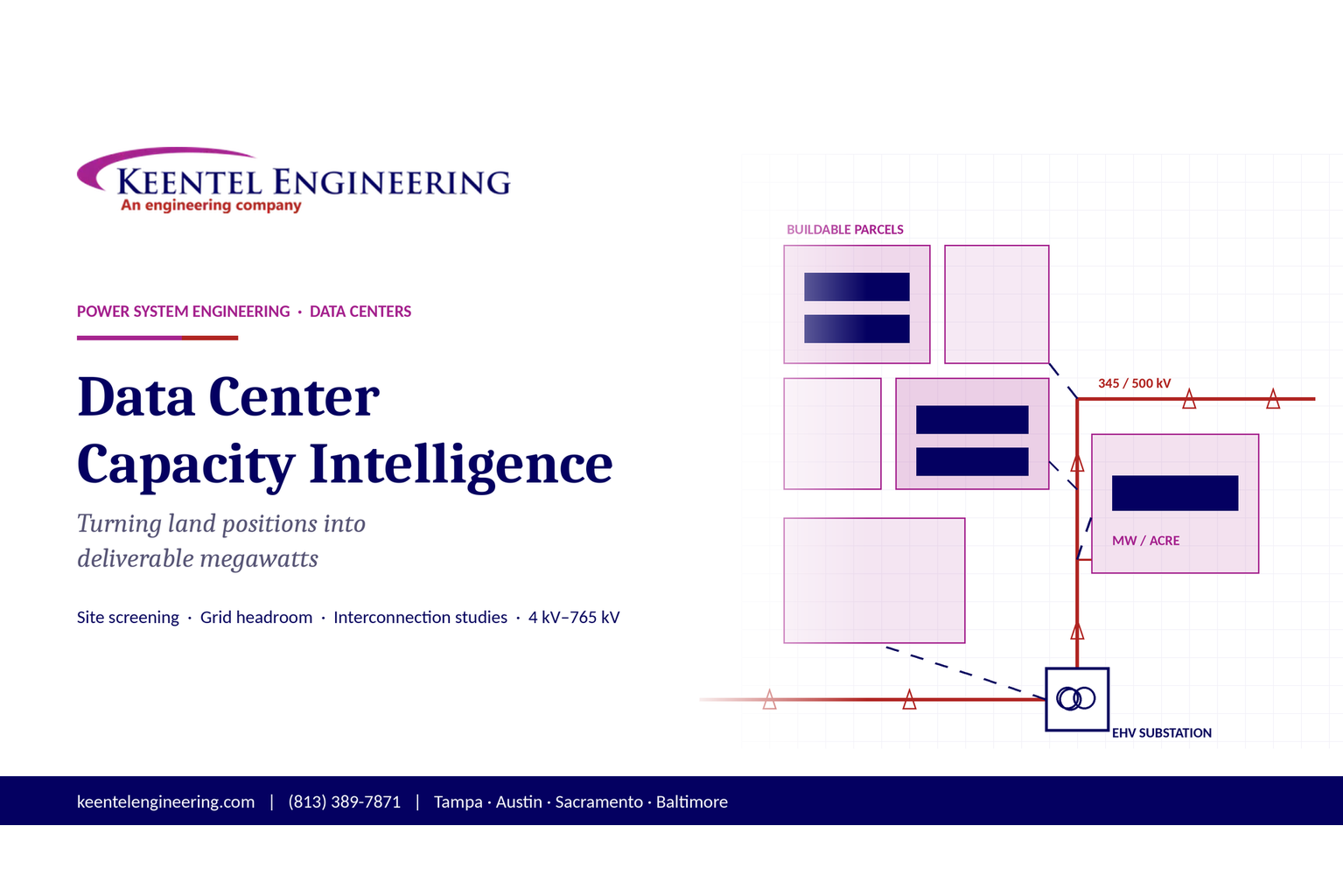
Plan data center capacity with land screening, MW-per-acre estimates, grid power availability and interconnection feasibility studies from Keentel Engineering.
By SANDIP R PATEL
•
October 11, 2026
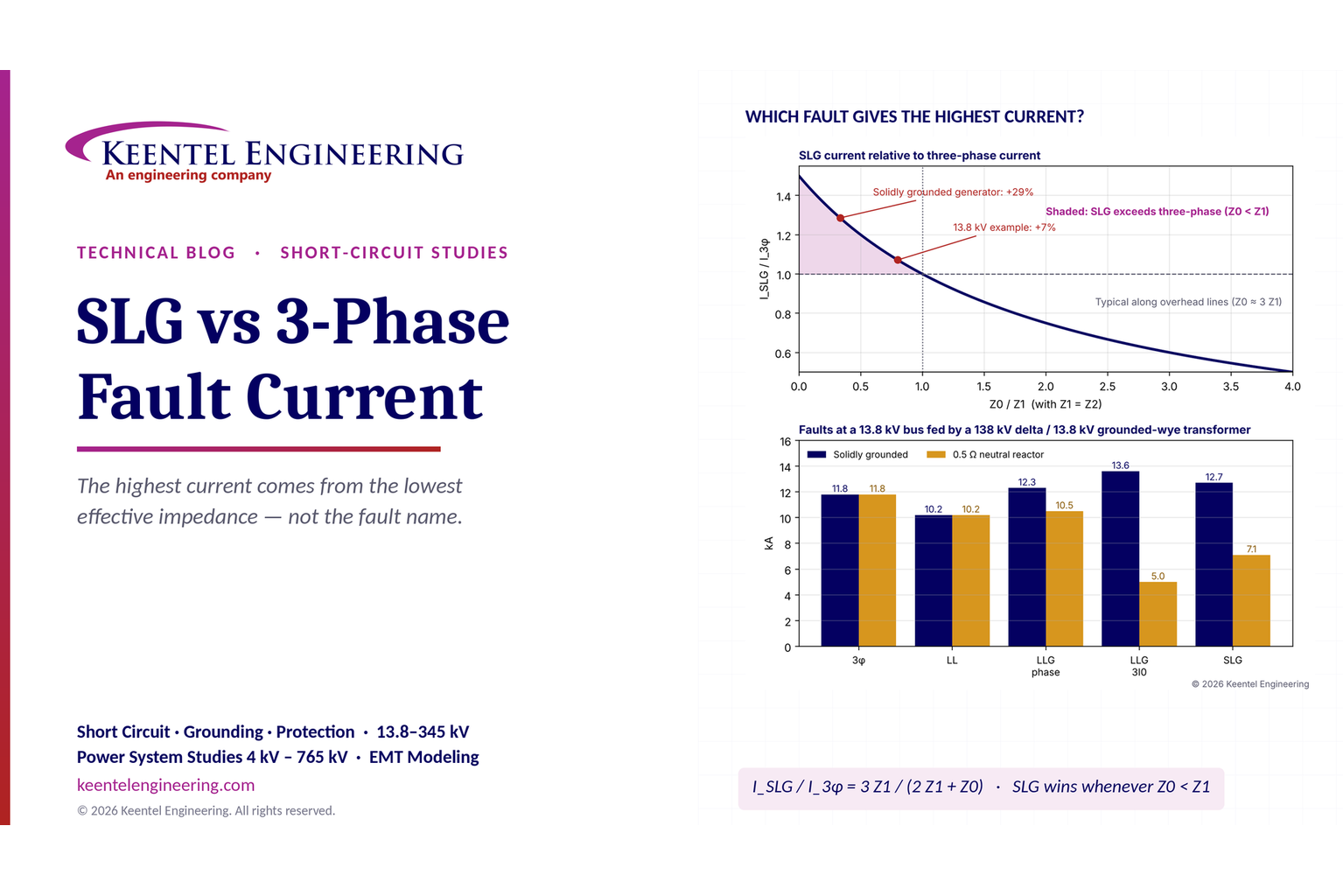
Learn which fault produces the highest current at a bus, why SLG faults can exceed three-phase faults, and how symmetrical components determine fault duty.
By SANDIP R PATEL
•
October 11, 2026
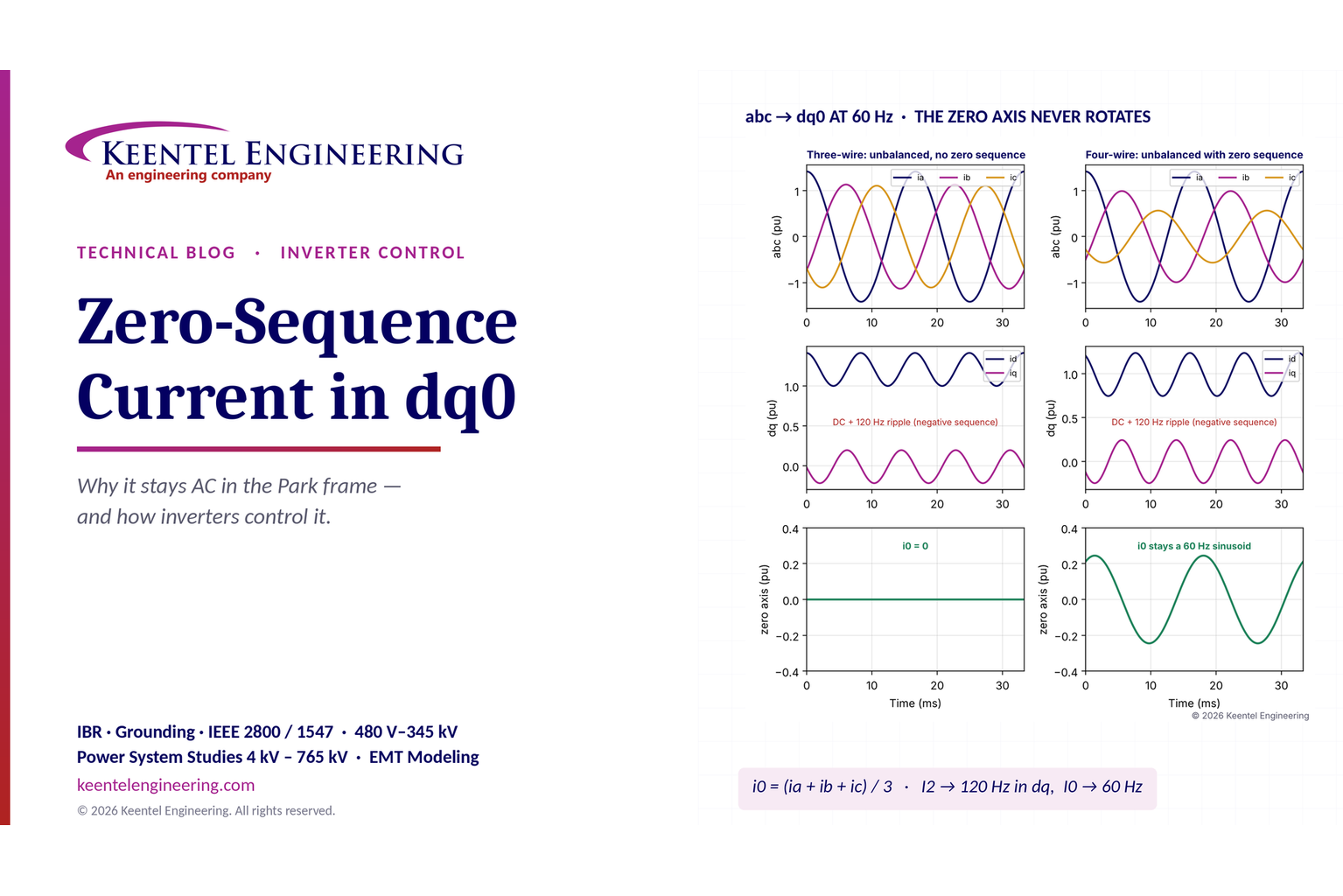
Learn why zero-sequence current pulsates in the dq0 frame, how Park's transformation works, and how inverter controls handle unbalance and ground faults.
By SANDIP R PATEL
•
October 11, 2026
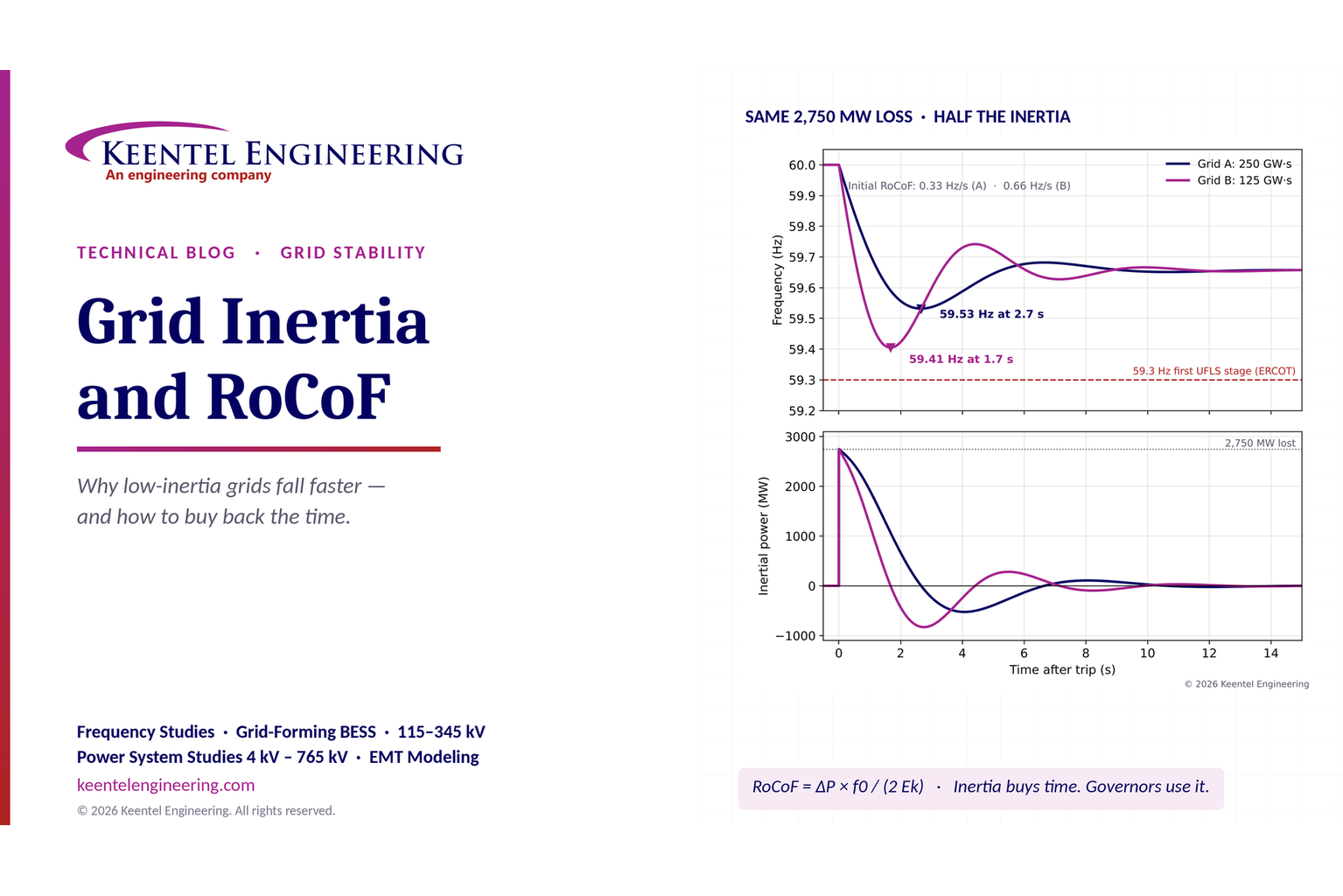
Explore grid inertia, RoCoF and frequency response, with swing equation calculations, frequency nadir analysis and US power system simulation examples.
By SANDIP R PATEL
•
October 11, 2026
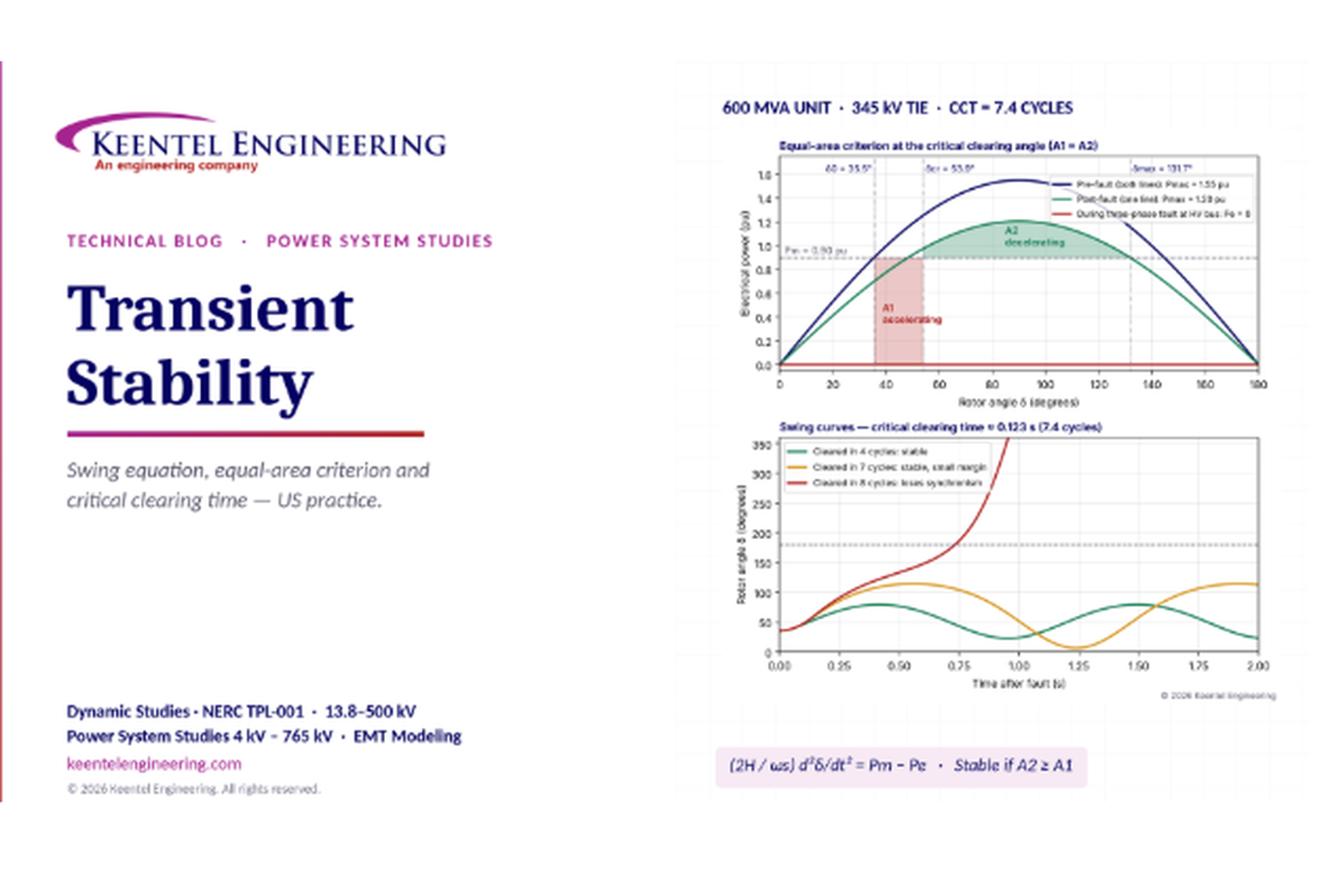
Learn transient stability analysis, swing equation, equal-area criterion and critical clearing time with a 345 kV worked example and NERC TPL-001 guidance.
By SANDIP R PATEL
•
October 11, 2026
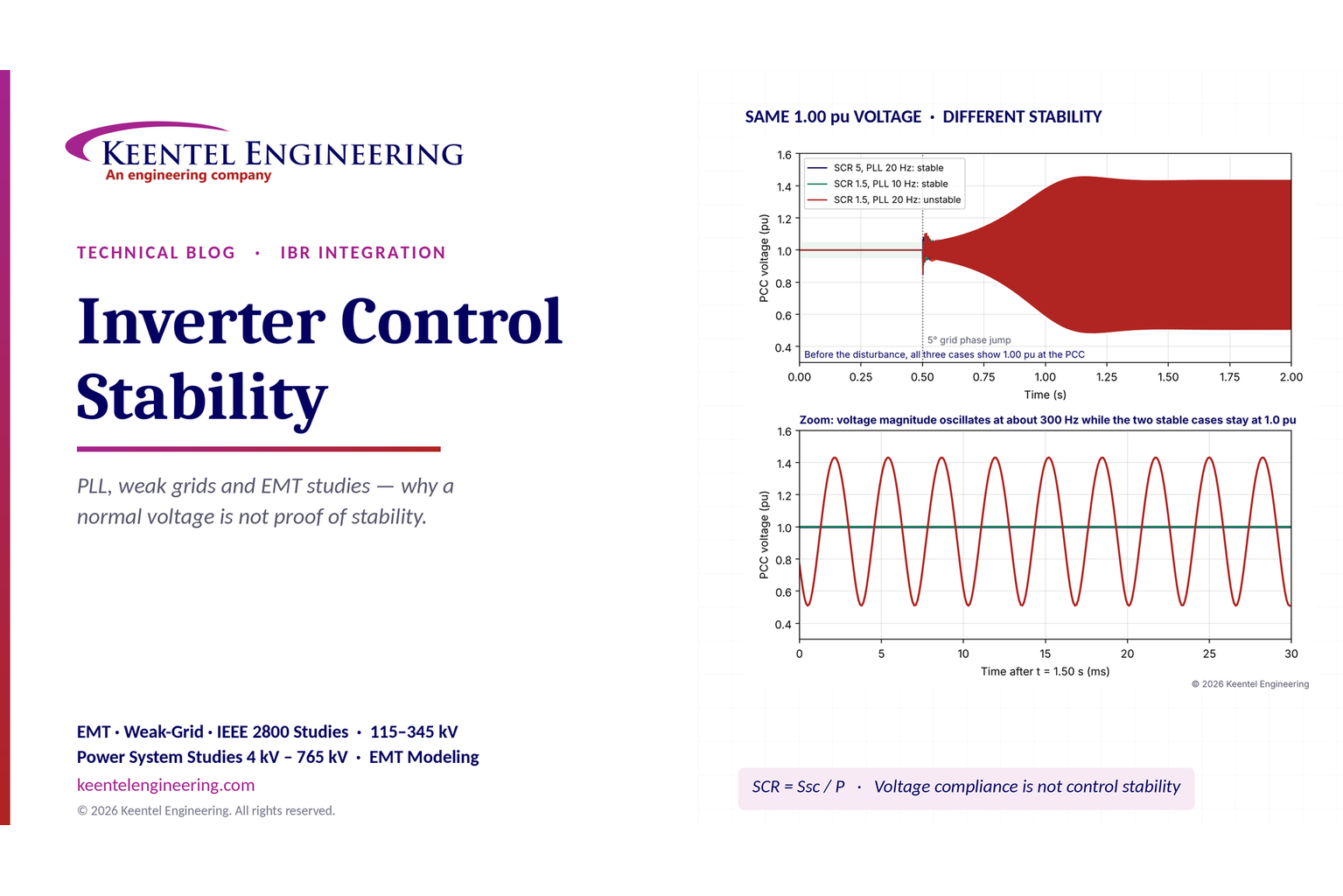
Learn why inverter controls become unstable in weak grids, how PLL bandwidth and SCR affect stability, and how PSCAD EMT studies identify and mitigate oscillations.
By SANDIP R PATEL
•
October 11, 2026
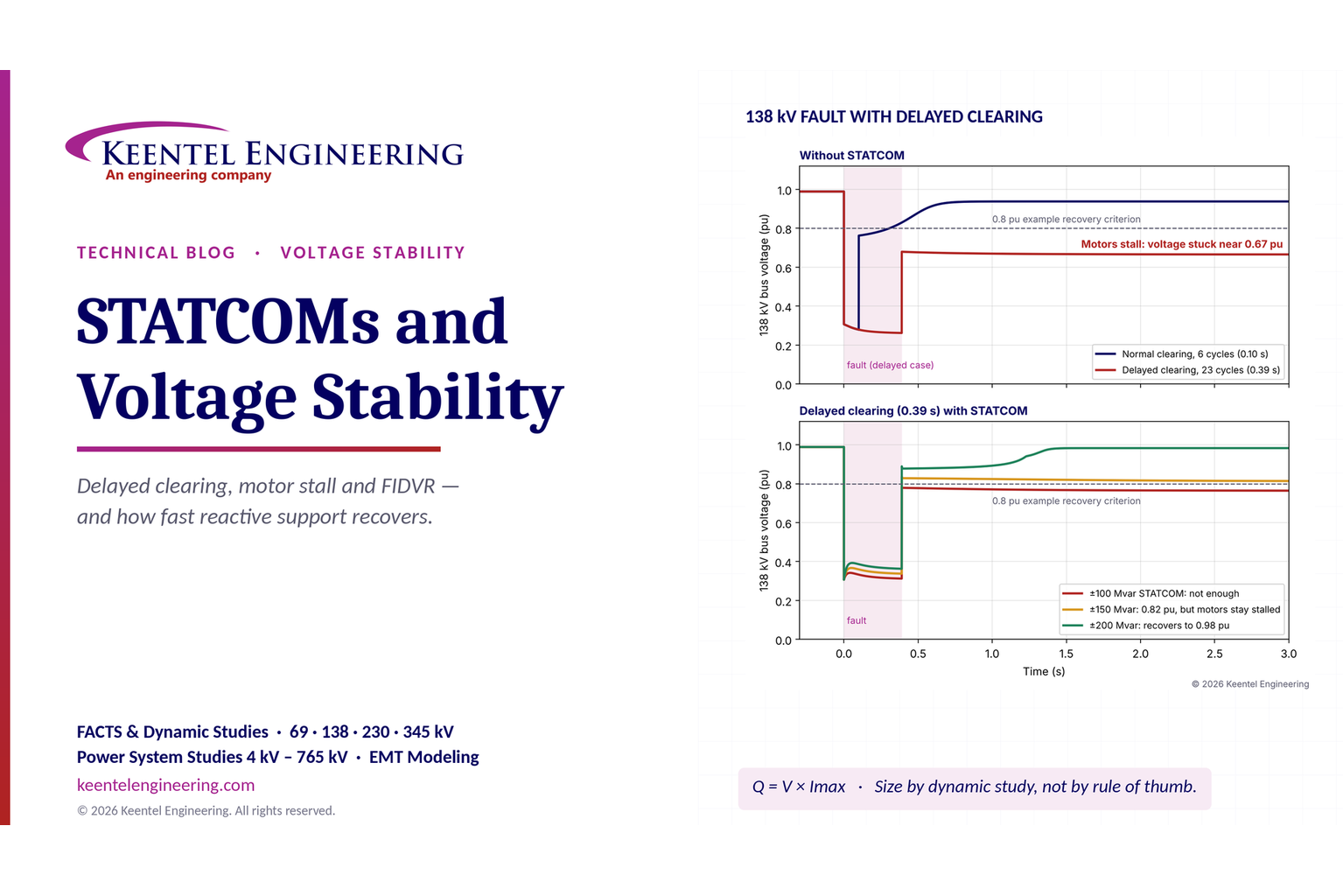
Learn how STATCOMs improve voltage stability and prevent FIDVR. Explore reactive power sizing, delayed fault clearing, NERC criteria and 138 kV simulation results.
By SANDIP R PATEL
•
October 10, 2026
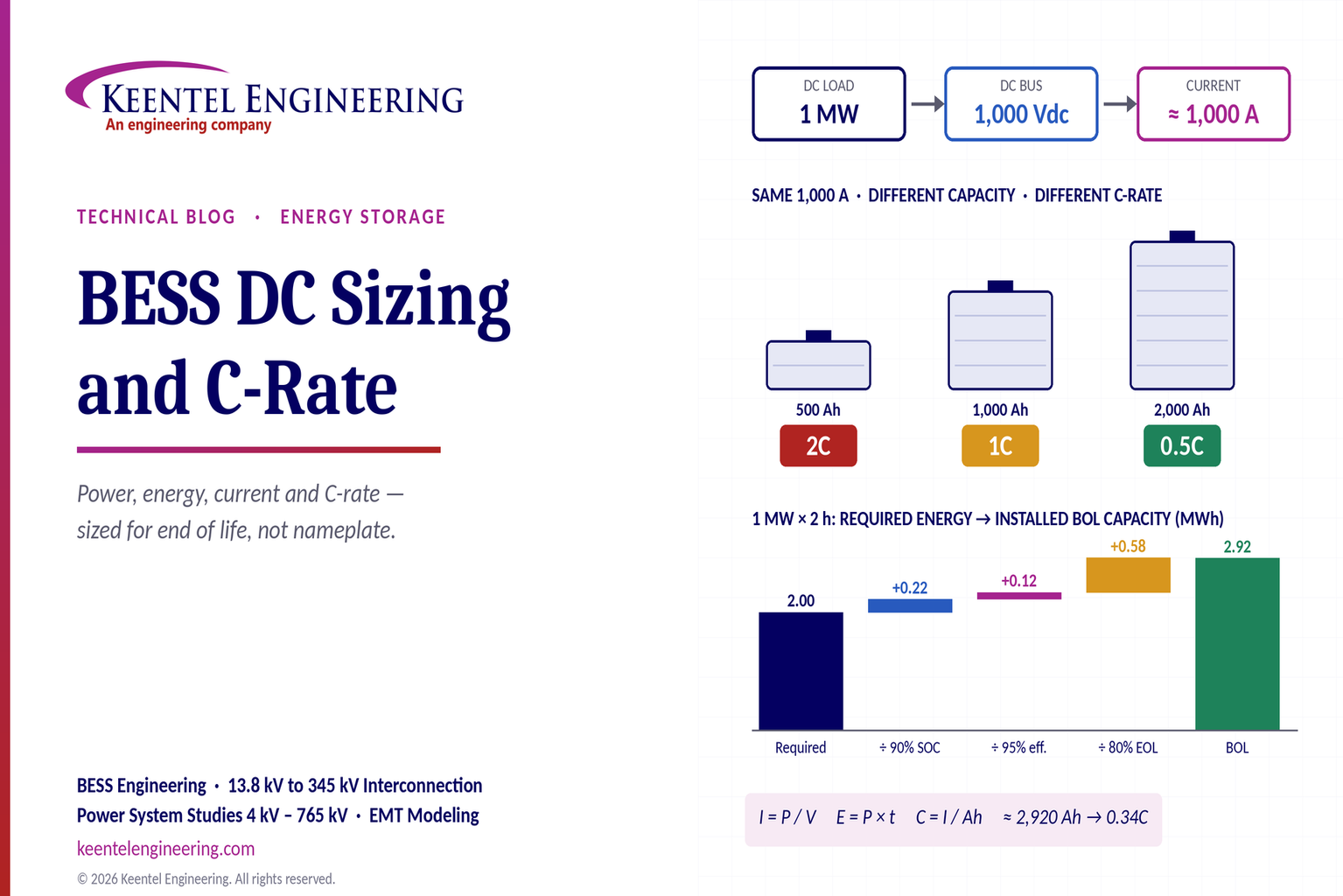
Learn BESS DC sizing with power, energy, current and C-rate calculations, battery losses, degradation and a 100 MW/400 MWh utility-scale example.
By SANDIP R PATEL
•
October 10, 2026
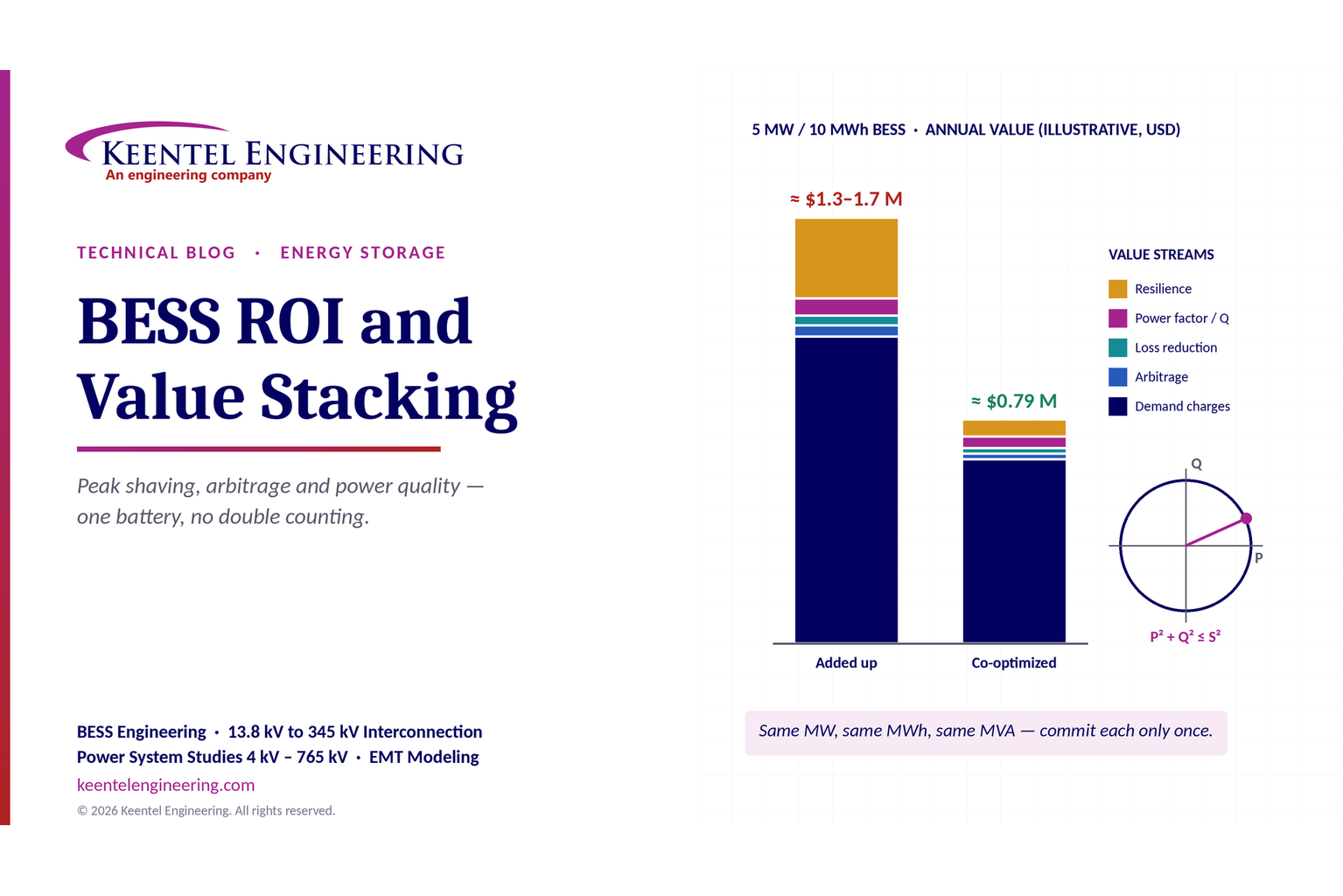
Learn how BESS ROI is calculated using peak shaving, energy arbitrage, power quality and battery storage economics, with a practical 5 MW/10 MWh example.