

A Coordinated Electric System Interconnection Review—the utility’s deep-dive on technical and cost impacts of your project.
Challenge: Frequent false tripping using conventional electromechanical relays
Solution: SEL-487E integration with multi-terminal differential protection and dynamic inrush restraint
Result: 90% reduction in false trips, saving over $250,000 in downtime
| Category | Metric |
|---|---|
| VPP capacity (Lunar Energy) | 650 MW |
| Lunar funding raised | US$232 million |
| Data center BESS example | 31 MW / 62 MWh |
| ERCOT grid-scale batteries | 15+ GW |
| LDES tenders (H1 2026) | Up to 9.3 GW |
| Lithium-ion share of LDES by 2030 | 77% |
| FEOC initial threshold | 55% |
| BESS tariff rate (2026) | ~55% |
| Capacity gain from analytics | 5–15% |
What is T&D Co-Simulation?
Confusing Physical Connections with Logical Nodes in IEC 61850
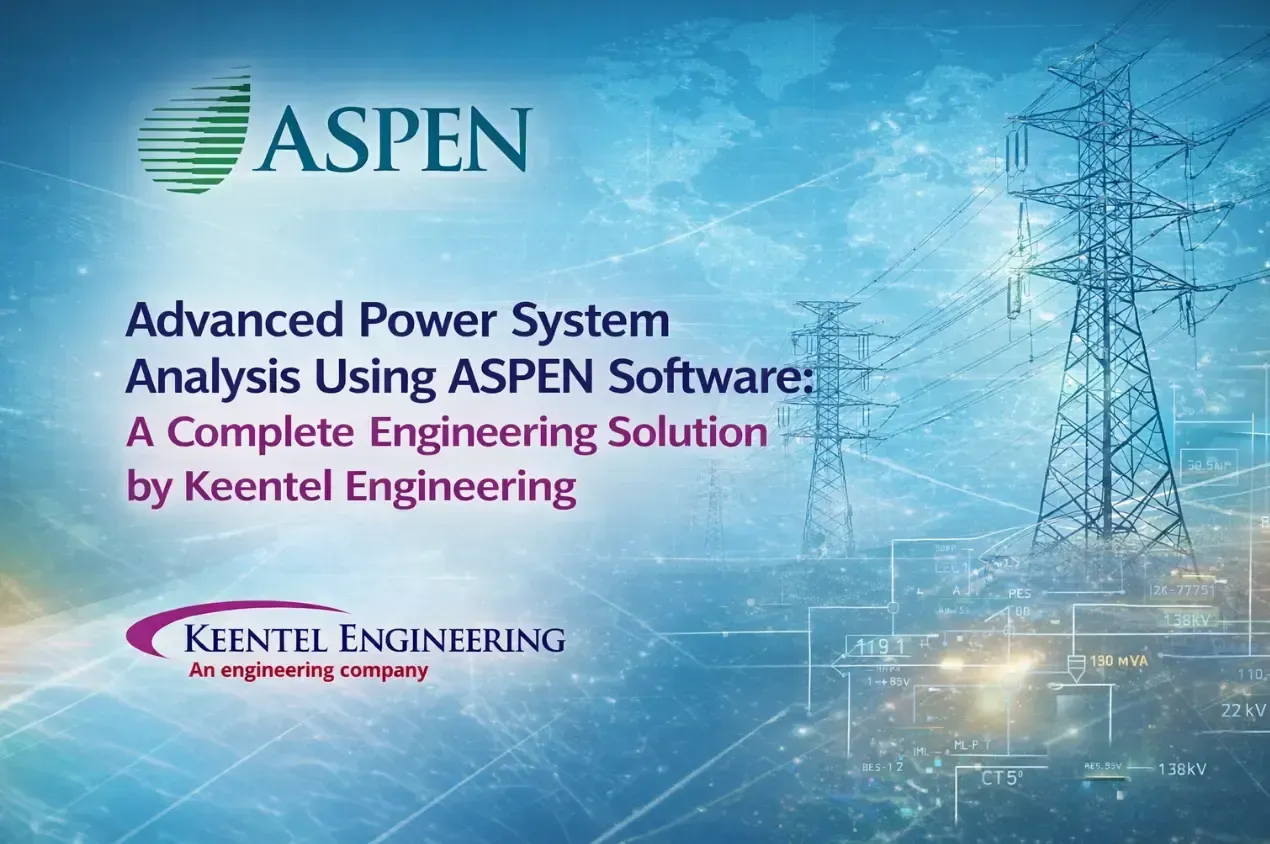
Advanced Power System Analysis Using ASPEN Software: A Complete Engineering Solution by Keentel Engineering
Apr 17, 2022 | blog
Introduction
Modern power systems are rapidly evolving due to the integration of renewable energy, increased grid complexity, and stricter compliance requirements such as NERC PRC standards. Utilities, developers, and industrial facilities now require high-fidelity modeling, accurate fault analysis, robust protection coordination, and enterprise-level data management.
At Keentel Engineering, we leverage the full suite of ASPEN Power System Software to deliver industry-leading solutions in:
- Protection system design and coordination
- Power system planning and studies
- Distribution system analysis
- NERC compliance services
- Data integration and automation
ASPEN’s ecosystem comprising OneLiner, Power Flow, DistriView, Breaker Rating Module, CIM Module, Line Database, and Relay Database—provides a comprehensive, end-to-end engineering platform.
1. Transmission System Protection with ASPEN OneLiner
ASPEN OneLiner is the industry-leading tool for short circuit analysis and relay coordination widely used by utilities worldwide.
Key Capabilities:
- ANSI/IEEE and IEC short circuit calculations
- Detailed relay modeling (overcurrent, distance, differential)
- Simulation of multiple fault types
- Automatic relay coordination validation
- NERC PRC compliance support (PRC-023, PRC-025, PRC-026, PRC-027)
Engineering Value:
At Keentel Engineering, we use OneLiner to:
- Perform fault duty analysis
- Validate protection schemes
- Optimize relay settings for reliability and selectivity
2. Power System Planning with ASPEN Power Flow
ASPEN Power Flow enables steady-state analysis of transmission and sub-transmission systems .
Key Capabilities:
- Load flow analysis
- Voltage profile assessment
- N-1 contingency analysis
- System losses and overload detection
- Generator and transformer control modeling
Engineering Applications:
- Interconnection studies
- Transfer capability analysis
- System expansion planning
3. Distribution System Analysis with ASPEN DistriView
Distribution systems are inherently unbalanced and require
phase-domain modeling, which DistriView provides.
Key Capabilities:
- Unbalanced 3-phase, 2-phase, and single-phase modeling
- Voltage drop and load flow analysis
- Short circuit and motor starting studies
- Harmonic analysis
- Reliability assessment
- Arc flash analysis (IEEE 1584)
Engineering Value:
Keentel Engineering uses DistriView for:
- Utility distribution planning
- Renewable integration studies
- Industrial system analysis
4. Breaker Duty Evaluation with ASPEN Breaker Rating Module
Protection studies are incomplete without verifying equipment capability.
Key Capabilities:
- ANSI/IEEE and IEC breaker rating checks
- X/R ratio-based current adjustments
- Fault simulations with network contingencies
- Identification of overstressed breakers
Engineering Importance:
- Prevent equipment failure
- Ensure system safety
- Maintain regulatory compliance
5. Accurate Modeling with ASPEN Line Database
Accurate studies depend on accurate input data.
Key Features:
- Advanced modeling of overhead lines and underground cables
- Use of Carson’s and Amatani’s methods
- Mutual coupling and zero-sequence modeling
- Phase-domain and sequence-domain parameters
Engineering Impact:
- Improves fault current accuracy
- Enhances relay coordination results
- Supports reliable system design
6. Enterprise Data Integration with ASPEN CIM Module
Utilities today require seamless data exchange across platforms
Key Features:
- CIM-compliant data exchange
- Conversion between ASPEN and industry formats
- Python-based automation (ACTool)
- Model synchronization across systems
Engineering Value:
- Eliminates data silos
- Enables automation
- Improves model consistency
7. Protection Asset Management with ASPEN Relay Database
Managing protection assets is as critical as designing them.
Key Capabilities:
- Centralized relay settings management
- Tracking of test results and maintenance
- Integration with OneLiner
- PRC-005 compliance support
Engineering Benefits:
- Reduces human error
- Improves audit readiness
- Supports lifecycle management
Why Choose Keentel Engineering?
Keentel Engineering brings:
- 30+ years of power system expertise
- Deep knowledge of NERC compliance and grid codes
- Experience with renewable integration and utility-scale systems
- Advanced capabilities in:
- PSSE, TSAT, PSCAD, ASPEN
- Protection and control design
- Power system studies
Conclusion
ASPEN software provides a comprehensive, scalable, and accurate platform for modern power system analysis. When combined with Keentel Engineering’s expertise, it delivers:
- Reliable system design
- Accurate protection coordination
- Regulatory compliance
- Efficient project execution
20 Advanced Technical FAQs (Detailed Answers)
1. What makes ASPEN OneLiner essential for protection engineers?
ASPEN OneLiner provides advanced short circuit analysis and relay coordination capabilities, enabling engineers to simulate faults, validate protection schemes, and ensure compliance with ANSI, IEC, and NERC standards.
2. How does ASPEN Power Flow support transmission planning?
It allows engineers to analyze voltage profiles, system losses, and contingency conditions, helping utilities plan system expansions and ensure operational reliability.
3. Why is phase-domain modeling important in DistriView?
Phase-domain modeling captures unbalanced conditions in distribution systems, providing more accurate results compared to traditional sequence-based methods.
4. How does the Breaker Rating Module ensure equipment safety?
It simulates worst-case faults, calculates adjusted currents using X/R ratios, and compares them against breaker ratings per ANSI/IEC standards.
5. What role does the Line Database play in system studies?
It provides highly accurate impedance and capacitance parameters, which are critical inputs for fault and load flow calculations.
6. How does ASPEN support NERC PRC compliance?
ASPEN tools provide analysis and documentation capabilities required for PRC standards, including relay loadability, coordination, and maintenance tracking.
7. What is the benefit of integrating Relay Database with OneLiner?
It ensures consistency between field settings and study models, eliminating manual data entry errors.
8. How does ASPEN CIM Module improve workflow efficiency?
It enables automated data exchange between systems using CIM standards, reducing manual intervention.
9. Can ASPEN handle large-scale power systems?
Yes, ASPEN software can model networks with over 100,000 buses efficiently.
10. What types of faults can be simulated in OneLiner?
Bus faults, line-end faults, intermediate faults, open-phase faults, and bus-to-bus faults.
11. How does Power Flow handle voltage control?
It uses automatic algorithms for generators, LTC transformers, shunts, and phase shifters.
12. What is the importance of X/R ratio in breaker studies?
It affects the asymmetrical current and determines the actual interrupting duty on breakers.
13. How does DistriView perform harmonic analysis?
It includes frequency scan and harmonic load flow capabilities to evaluate system distortion.
14. What is the advantage of ASPEN’s relay modeling?
It supports detailed manufacturer-specific relay logic, improving study accuracy.
15. How does ASPEN support renewable integration?
It models inverter-based resources such as solar, wind, and BESS systems.
16. What is N-1 contingency analysis?
It evaluates system performance when one component fails, ensuring system reliability.
17. How does ASPEN improve engineering productivity?
It provides fast computation, graphical visualization, and automation tools.
18. What data formats does ASPEN support?
CIM, PSS/E, PSLF, GE, ANAFAS, and more.
19. How does Relay Database support maintenance programs?
It tracks relay tests, schedules maintenance, and supports compliance reporting.
20. Why is ASPEN preferred by utilities worldwide?
Due to its accuracy, speed, scalability, and comprehensive feature set across all power system domains.

About the Author:
Sonny Patel P.E. EC
IEEE Senior Member
In 1995, Sandip (Sonny) R. Patel earned his Electrical Engineering degree from the University of Illinois, specializing in Electrical Engineering . But degrees don’t build legacies—action does. For three decades, he’s been shaping the future of engineering, not just as a licensed Professional Engineer across multiple states (Florida, California, New York, West Virginia, and Minnesota), but as a doer. A builder. A leader. Not just an engineer. A Licensed Electrical Contractor in Florida with an Unlimited EC license. Not just an executive. The founder and CEO of KEENTEL LLC—where expertise meets execution. Three decades. Multiple states. Endless impact.
Services

Let's Discuss Your Project
Let's book a call to discuss your electrical engineering project that we can help you with.

About the Author:
Sonny Patel P.E. EC
IEEE Senior Member
In 1995, Sandip (Sonny) R. Patel earned his Electrical Engineering degree from the University of Illinois, specializing in Electrical Engineering . But degrees don’t build legacies—action does. For three decades, he’s been shaping the future of engineering, not just as a licensed Professional Engineer across multiple states (Florida, California, New York, West Virginia, and Minnesota), but as a doer. A builder. A leader. Not just an engineer. A Licensed Electrical Contractor in Florida with an Unlimited EC license. Not just an executive. The founder and CEO of KEENTEL LLC—where expertise meets execution. Three decades. Multiple states. Endless impact.
Leave a Comment
We will get back to you as soon as possible.
Please try again later.