
A Coordinated Electric System Interconnection Review—the utility’s deep-dive on technical and cost impacts of your project.

Challenge: Frequent false tripping using conventional electromechanical relays
Solution: SEL-487E integration with multi-terminal differential protection and dynamic inrush restraint
Result: 90% reduction in false trips, saving over $250,000 in downtime

Category Metric
VPP capacity (Lunar Energy) 650 MW
Lunar funding raised US$232 million
Data center BESS example 31 MW / 62 MWh
ERCOT grid-scale batteries 15+ GW
LDES tenders (H1 2026) Up to 9.3 GW
Lithium-ion share of LDES by 2030 77%
FEOC initial threshold 55%
BESS tariff rate (2026) ~55%
Capacity gain from analytics 5–15%

What is T&D Co-Simulation?

Confusing Physical Connections with Logical Nodes in IEC 61850

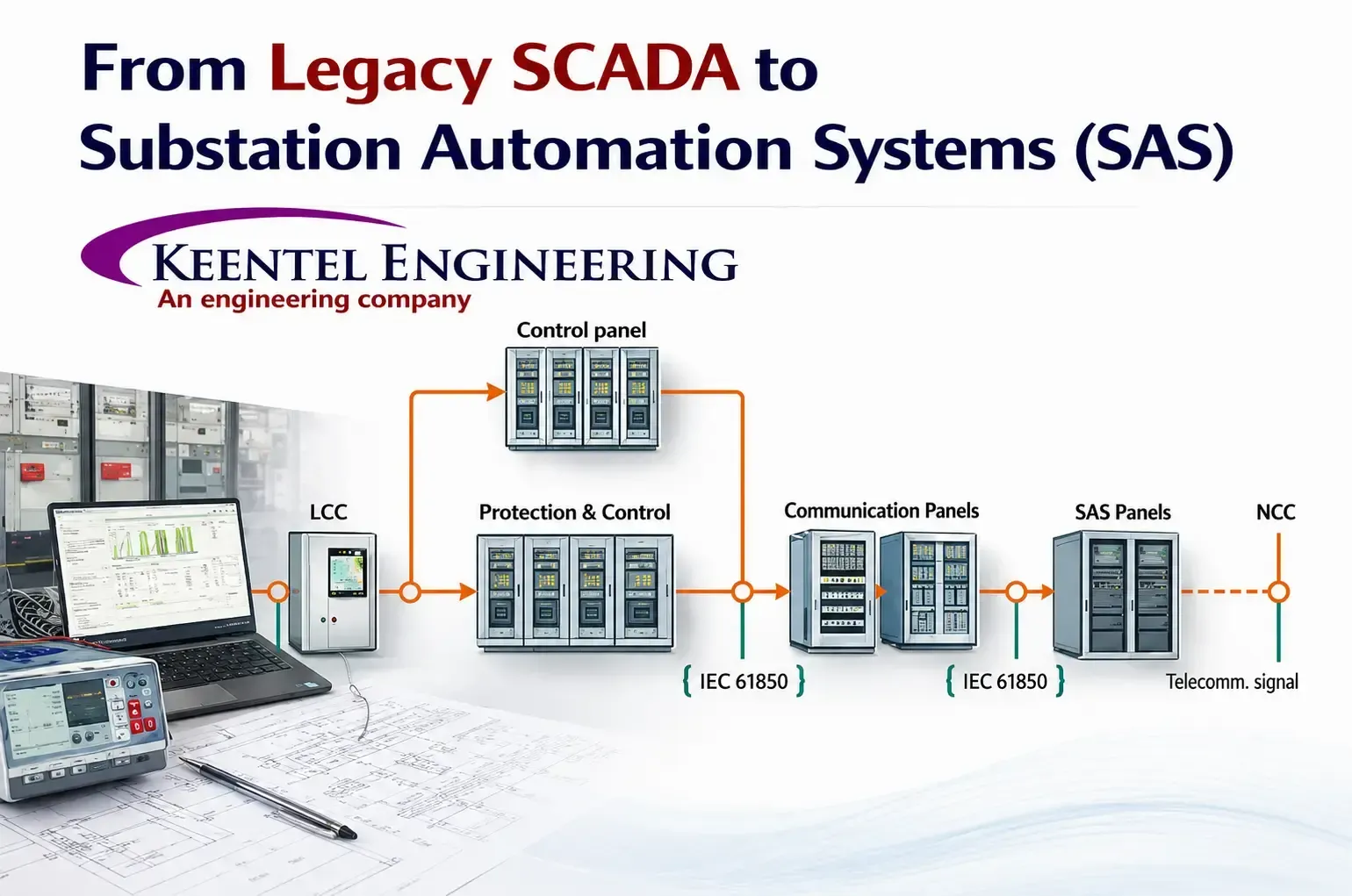
From Legacy SCADA to Smart Substations: The Future of Substation Automation Systems (SAS) By Keentel Engineering Powering the Next Generation Grid

Keentel Engineering: Upgrading from Legacy SCADA to IEC 61850 Compliant Substation Automation System
Calendar icon. D

 Apr 18, 2022  | blog

Introduction

The power industry is undergoing a massive digital transformation, and substations are at the center of this evolution. Traditional SCADA-based substations—once the backbone of grid control—are now being replaced by modern Substation Automation Systems (SAS) that offer intelligent, scalable, and highly efficient operations.


This transition is not just an upgrade—it’s a complete paradigm shift from hardwired, panel-centric systems to communication-driven, digital architectures. 

At Keentel Engineering, we specialize in helping utilities, developers, and industrial clients design, upgrade, and implement advanced SAS solutions aligned with IEC 61850 and global best practices.


What is a Substation Automation System (SAS)?

A Substation Automation System (SAS) is an integrated framework that enables:


  • Monitoring 
  • Protection 
  • Control 
  • Data acquisition 
  • Communication 


all through digital technologies and intelligent electronic devices (IEDs). 


Unlike traditional systems that rely heavily on copper wiring, SAS leverages:


  • High-speed communication networks 
  • Centralized software platforms 
  • Real-time data analytics 


Result: Smarter, faster, and more reliable substations


Limitations of Conventional SCADA Systems

Traditional SCADA systems were:


  • Hardwired and inflexible 
  • Dependent on massive copper cabling 
  • Limited in scalability and integration 
  • Costly to modify or expand 


For example, each signal required dedicated wiring, leading to bulky panels and complex installations. 


Key Challenges:


  • High installation and maintenance costs 
  • Risk of wiring errors 
  • Limited remote access 
  • Slow fault response 

Why Utilities Are Moving to SAS

Modern substations must operate in:


  • Remote locations 
  • Unmanned environments 
  • Highly interconnected grids 


SAS enables:


  • Remote monitoring and control 
  • Real-time fault detection 
  • Data-driven decision making 

Key Features of Modern SAS

1. Intelligent Electronic Devices (IEDs)

  • Perform protection, control, and monitoring 
  • Store disturbance and fault records 


2. Communication-Based Architecture


  • Replaces copper wiring with Ethernet/fiber networks 
  • Enables fast and reliable data exchange 


3. Remote Engineering Access


Engineers can:


  • Retrieve fault data 
  • Modify relay settings 
  • Diagnose issues remotely 


No need for site visits, saving time and cost. 


SAS Functional Architecture

Modern SAS operates on a three-level hierarchy:


Process Level


  • Collects data from field equipment (CTs, VTs, breakers) 
  • Converts electrical signals into digital data


Bay Level


  • Uses Bay Control Units (BCUs) and protection relays 
  • Executes control commands and interlocking logic 


Station Level


  • Centralized monitoring via HMI and SCADA gateway 
  • Manages alarms, events, and system-wide control 

The Shift: From Copper to Communication

One of the most significant transformations:

Traditional SCADA Modern SAS
Copper wiring Ethernet/Fiber
Hardware-based Software-defined
Panel-centric System-centric
Limited signals Dave

 A single communication cable can replace hundreds of wires. 


IEC 61850: The Game Changer

IEC 61850 standard enables:

  • Multi-vendor interoperability 
  • Standardized communication 
  • Scalable system integration 


This allows different manufacturers’ equipment to communicate seamlessly, accelerating SAS adoption worldwide. 


Advanced Capabilities of SAS

Disturbance Monitoring


  • Detect voltage dips, frequency deviations, harmonics 
  • Analyze faults remotely 


Remote Control & Flexibility


  • Adjust protection settings without site visits 
  • Restore system stability faster 


Time Synchronization


  • GPS-based timing ensures accurate fault analysis 
  • Critical for event sequencing and protection coordination 


Role of Bay Control Units (BCUs)


BCUs are the heart of modern substations:


  • Interface between field devices and control system 
  • Execute control and interlocking logic 
  • Provide local and remote operation 


Modern BCUs:


  • Replace multiple legacy devices 
  • Offer programmable logic and diagnostics 
  • Improve system reliability and flexibility

How Keentel Engineering Can Help

At Keentel Engineering we provide end-to-end SAS solutions, including:


Engineering & Design


  • IEC 61850-based SAS architecture 
  • Protection & control design 
  • Communication network design 


Retrofit & Upgrades


  • SCADA to SAS migration 
  • Brownfield automation projects 
  • Digital substation transformation 


Studies & Compliance


  • Protection coordination 
  • NERC compliance support 
  • Dynamic modeling (PSSE, PSCAD, TSAT) 


Testing & Commissioning


  • Factory Acceptance Testing (FAT) 
  • Site Acceptance Testing (SAT) 
  • Relay settings and validation 


With 30+ years of experience, Keentel ensures reliable, scalable, and future-ready substations.


Frequently Asked Questions (FAQs)

  • 1. What is the difference between SCADA and SAS?

    SCADA is a monitoring system, while SAS is a fully integrated system that includes protection, control, communication, and automation.

  • 2. Why is SAS important for modern power systems?

    It enables remote operation, real-time monitoring, and improved reliability, which are critical for today’s complex grids.


  • 3. What is IEC 61850?

    A global standard for substation communication, enabling interoperability between devices from different manufacturers.


  • 4. What are IEDs in SAS?

    Intelligent Electronic Devices that perform protection, control, monitoring, and data recording.

  • 5. What is a Bay Control Unit (BCU)?

    A device responsible for bay-level control, monitoring, and communication within a substation.

  • 6. Can existing substations be upgraded to SAS?

    Yes. Keentel specializes in brownfield upgrades, converting legacy SCADA systems into modern SAS.


  • 7. What are the benefits of SAS over traditional systems?

    • Reduced wiring 
    • Faster fault response 
    • Remote operation 
    • Lower maintenance costs 

  • 8. How does SAS improve reliability?

    By enabling real-time monitoring, automated protection, and faster fault resolution.


  • 9. What role does communication play in SAS?

    Communication networks replace wiring, allowing high-speed data exchange and scalability.


  • 10. Is SAS suitable for renewable energy integration?

    Yes. SAS is essential for managing solar, wind, and BESS systems.


  • 11. What is the process level in SAS?

    The level where data is collected from field equipment like CTs, VTs, and breakers.


  • 12. What is the station level?

    The top layer where operators monitor and control the entire substation.


  • 13. How does SAS support remote engineering?

    Engineers can analyze faults, retrieve data, and update settings remotely.


  • 14. What is disturbance monitoring?

    Tracking system events like voltage dips and frequency changes to analyze grid behavior.


  • 15. How does SAS reduce operational costs?

    By minimizing site visits, wiring, and maintenance requirements.


  • 16. What industries benefit from SAS?

    • Utilities 
    • Renewable energy 
    • Industrial plants 
    • Data centers 

  • 17. What is time synchronization in SAS?

    Ensures all devices have accurate timestamps for fault analysis.


  • 18. What is the role of HMI in SAS?

    Provides a visual interface for operators to monitor and control systems.


  • 19. Can SAS support multi-vendor systems?

    Yes, especially with IEC 61850 compliance.


  • 20. Why choose Keentel Engineering for SAS projects?

    Because we offer:

    • Proven expertise 
    • End-to-end solutions 
    • Compliance-driven engineering 
    • Advanced modeling & studies 


Final Thoughts

The transition from SCADA to SAS is no longer optional it’s essential for grid modernization.


Organizations that adopt SAS today will benefit from:


  • Higher reliability 
  • Lower costs 
  • Better system visibility 
  • Future-ready infrastructure 


Partner with Keentel Engineering to lead this transformation with confidence.


A smiling man with glasses and a beard wearing a blue blazer stands in front of server racks in a data center.

About the Author:

Sonny Patel P.E. EC

IEEE Senior Member

In 1995, Sandip (Sonny) R. Patel earned his Electrical Engineering degree from the University of Illinois, specializing in Electrical Engineering . But degrees don’t build legacies—action does. For three decades, he’s been shaping the future of engineering, not just as a licensed Professional Engineer across multiple states (Florida, California, New York, West Virginia, and Minnesota), but as a doer. A builder. A leader. Not just an engineer. A Licensed Electrical Contractor in Florida with an Unlimited EC license. Not just an executive. The founder and CEO of KEENTEL LLC—where expertise meets execution. Three decades. Multiple states. Endless impact.

Four workers in safety vests and helmets stand with arms crossed near wind turbines.

Let's Discuss Your Project

Let's book a call to discuss your electrical engineering project that we can help you with.

Man in a blazer and open shirt, looking at the camera, against a blurred background.

About the Author:

Sonny Patel P.E. EC

IEEE Senior Member

In 1995, Sandip (Sonny) R. Patel earned his Electrical Engineering degree from the University of Illinois, specializing in Electrical Engineering . But degrees don’t build legacies—action does. For three decades, he’s been shaping the future of engineering, not just as a licensed Professional Engineer across multiple states (Florida, California, New York, West Virginia, and Minnesota), but as a doer. A builder. A leader. Not just an engineer. A Licensed Electrical Contractor in Florida with an Unlimited EC license. Not just an executive. The founder and CEO of KEENTEL LLC—where expertise meets execution. Three decades. Multiple states. Endless impact.

Leave a Comment

Related Posts

Primary injection testing setup with engineers inspecting current transformer commissioning in power
By SANDIP R PATEL April 17, 2026
Learn primary injection testing, CT commissioning, and current transformer validation. Ensure reliable substation protection systems discover best practices.
ASPEN power system analysis by Keentel Engineering for efficient electrical grid optimization.
By SANDIP R PATEL April 17, 2026
Optimize grids with ASPEN Power System Analysis, OneLiner & planning tools. Improve protection coordination and compliance. Discover solutions today.
MISO Planning Modeling Technical Guide banner with Keentel Engineering branding
By SANDIP R PATEL April 17, 2026
Master the MISO Planning Modeling Manual with expert insights on power system modeling, compliance, and generator requirements. Learn more today.
The image shows a map of Texas, highlighting regions associated with ERCOT
By SANDIP R PATEL April 16, 2026
Master ERCOT 2026 data and modeling requirements. Learn steady state, dynamic modeling, validation, and compliance strategies to avoid delays and rejections.
Power grid towers with digital network illustration and engineering article title.
By SANDIP R PATEL April 15, 2026
A detailed overview of PJM interconnection reforms, including the shift to a Cycle-based model, reduced queue delays, and the impact on grid reliability, project development, and engineering services.
Biggest Mistakes in Analyzing Modern Substation Schematics
By SANDIP R PATEL April 11, 2026
Discover 15 critical mistakes in modern substation schematic analysis, including IEC 61850, protection zones, GOOSE, CT/VT issues, and grid reliability risks.
Advanced large load modeling for grid reliability with data center power systems.
By SANDIP R PATEL April 10, 2026
Learn how large load modeling improves grid reliability for data centers and modern power systems using advanced EMT, dynamic studies, and compliance strategies.
ERCOT large load interconnection surge with data centers, renewable energy, and grid reliability
By SANDIP R PATEL April 10, 2026
ERCOT faces a surge in large load interconnections driven by AI data centers. Explore grid challenges, batch studies, and developer strategies
Data center power diagram with MVDC, UPS, transformers, generators, and IT load.
By SANDIP R PATEL April 10, 2026
Learn how EMT modeling improves data center grid stability, AI load integration, and power quality. Expert insights by Keentel Engineering.