

A Coordinated Electric System Interconnection Review—the utility’s deep-dive on technical and cost impacts of your project.

Challenge: Frequent false tripping using conventional electromechanical relays
Solution: SEL-487E integration with multi-terminal differential protection and dynamic inrush restraint
Result: 90% reduction in false trips, saving over $250,000 in downtime

Category Metric
VPP capacity (Lunar Energy) 650 MW
Lunar funding raised US$232 million
Data center BESS example 31 MW / 62 MWh
ERCOT grid-scale batteries 15+ GW
LDES tenders (H1 2026) Up to 9.3 GW
Lithium-ion share of LDES by 2030 77%
FEOC initial threshold 55%
BESS tariff rate (2026) ~55%
Capacity gain from analytics 5–15%

What is T&D Co-Simulation?

Confusing Physical Connections with Logical Nodes in IEC 61850

ERCOT Parameter Verification Reports (PVR): The Ultimate Guide for IBR Compliance

By Keentel Engineering

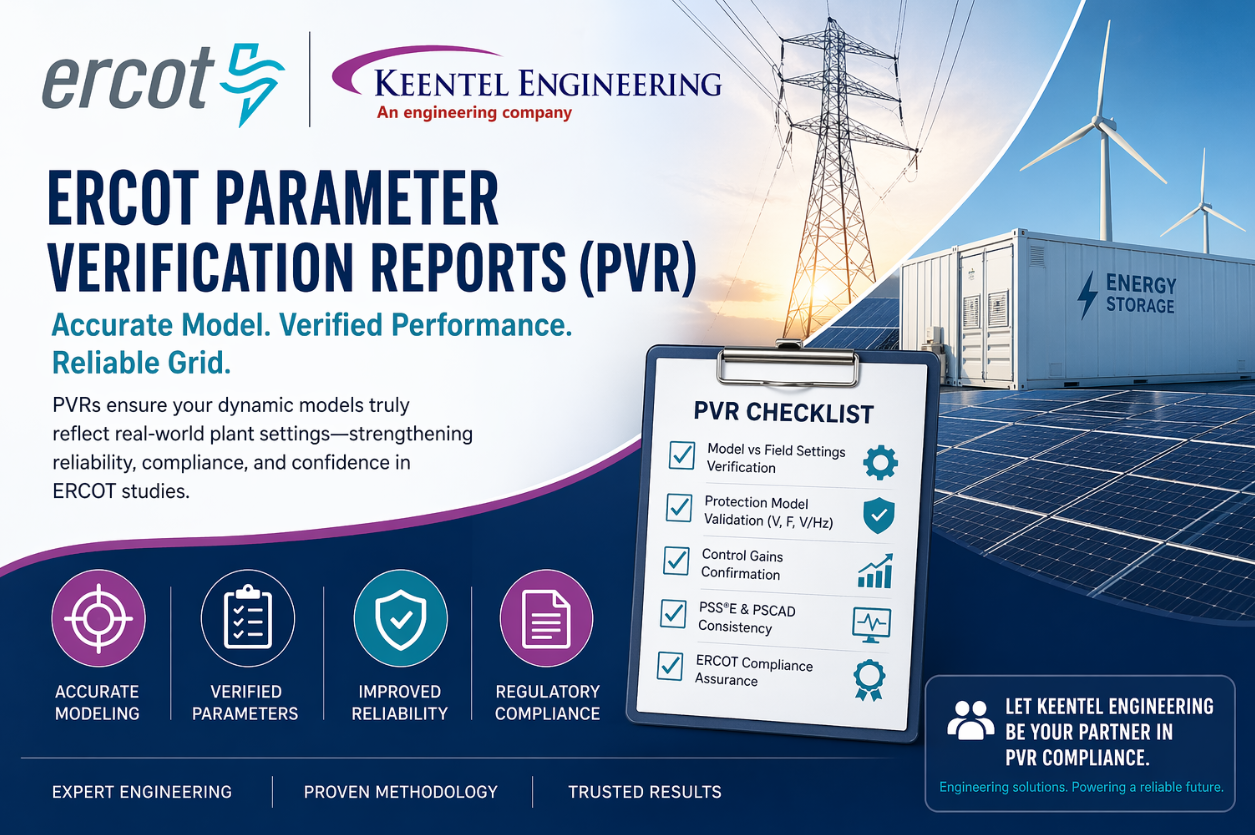
ERCOT PVR promo with grid, solar, and checklist.
Calendar icon. D

 Apr 21, 2022  | blog

The rapid growth of inverter-based resources (IBRs) solar, wind, and battery energy storage systems has fundamentally changed how power systems behave during disturbances. While dynamic models have long been used to simulate system performance, recent events have made one thing clear:


  • If your model doesn’t match your plant, your compliance doesn’t matter.


This is exactly why ERCOT introduced Parameter Verification Reports (PVRs) as part of its Model Quality initiative to ensure that simulation models accurately represent real-world plant behavior.

In this article, we break down everything you need to know about PVRs, including requirements, technical expectations, industry challenges, and how Keentel Engineering supports clients in achieving compliance.


What is a Parameter Verification Report (PVR)?

A Parameter Verification Report (PVR) is a formal engineering document that confirms:


  • The dynamic model parameters (PSS®E / PSCAD) 
  • Match the actual field-installed settings 
  • Including controls and protection systems 

ERCOT’s objective is simple but critical:

  • Ensure that grid simulations reflect real plant behavior during disturbances 

Why PVRs Matter: Lessons from Real Grid Events

One of the most important drivers behind PVR implementation was the Odessa disturbance event.

What happened?


  • Multiple plants failed to ride through disturbances 
  • But their models indicated they should have stayed online 


Root Cause:


  • Mismatch between model parameters and field settings 


As highlighted in the presentation (Page 6):


  • Many discrepancies were due to incorrect or outdated model settings 
  • Verification processes were missing or incomplete 


This created a major reliability risk for ERCOT.


ERCOT PVR Requirements and Compliance Timeline

PVR requirements were implemented under:


  • PGRR-085 (Effective March 1, 2021) 
  • ERCOT Planning Guide Sections 5.5 and 6.2 


PVR Submission Requirements:


According to the presentation (Page 2):


  • Within 30 days after Part 3 approval 
  • Again 1–2 years after approval 
  • Within 30 days after any setting change 
  • Every 10 years thereafter 
  • Mandatory for existing plants (as of March 2023

What Does a PVR Actually Verify?

A proper PVR goes far beyond a simple model review.

1. Control System Verification


  • AVR (Automatic Voltage Regulator) gains 
  • Plant controller parameters 
  • Active/reactive power control settings 
  • Governor droop


2. Protection System Verification


ERCOT explicitly requires validation of:


  • Voltage protection 
  • Frequency protection 
  • V/Hz protection 


These are critical trip mechanisms that directly impact ride-through performance 


3. Dynamic Model Alignment


  • PSS®E model parameters 
  • PSCAD model (for IBRs) 
  • Model consistency across platforms 

Why MOD-026/027 is NOT Enough (Especially for IBRs)

Many developers assume that NERC MOD studies are sufficient. That’s not true—especially for renewable plants.

According to the presentation (Page 4):


For Conventional Plants:


  • MOD-026/027 can verify: 


  • Exciter models 
  • Governor models 


  • But still require additional checks (PSS, protection, inertia) 


For IBR Plants:


MOD studies are limited and insufficient because they:


  • Cannot verify protection settings 
  • Cannot capture fast dynamic response 
  • Cannot validate voltage ride-through behavior 


Best practice:


  • OEM must confirm settings against PSCAD models (preferred) 

The Role of PSCAD in PVR for IBRs

For inverter-based resources, PSCAD plays a critical role in validation:


  • Captures fast electromagnetic transients 
  • Validates fault ride-through performance 
  • Reflects actual inverter control behavior 


ERCOT may require:


  • PSCAD Model Quality Testing (MQT) 
  • Completion of Guideline Checksheet (OEM-driven) 

Common PVR Mistakes (and How to Avoid Them)

From Page 5 of the presentation, the most common issues include:


Missing Model Submission


  • Reports submitted without PSS®E/PSCAD models 


Poor Parameter Traceability


  • No mapping between report and model parameters 


No Field Verification Explanation


  • Missing documentation on: 


  • How settings were verified 
  • How many units were checked

Ignoring Protection Relays

  • Failure to model the most limiting relay conditions 

Model Mismatch Between Tools

  • Updating PSS®E but not PSCAD 


These mistakes are one of the top reasons for ERCOT review delays.


Best Practices for a High-Quality PVR

At Keentel Engineering, we follow a structured approach:


Verify at the Source


  • Confirm settings directly from: 


  • SCADA 
  • Relay settings 
  • OEM documentation 


Align All Models


  • Ensure: 


  • PSS®E = PSCAD = Field 


Document Everything


  • Include:


  • Parameter tables with index references 
  • Verification methodology 
  • OEM confirmations 


Focus on Protection


  • Always validate: 


  • Trip thresholds 
  • Ride-through limits 
  • Relay coordination 

Challenges in Real Projects

1. OEM Unavailability


  • Some OEMs refuse or delay support 
  • ERCOT allows “best effort” documentation in such cases 


2. Multi-OEM Plants


  • Solar + BESS + Wind = multiple control philosophies 
  • May require multiple verification reports 


3. Legacy Plants


  • Incomplete documentation 
  • Outdated models 

How Keentel Engineering Supports PVR Compliance

We provide end-to-end PVR support including:


  • Model-to-field parameter verification 
  • Protection system validation 
  • PSCAD & PSS®E alignment 
  • OEM coordination 
  • ERCOT-compliant reporting 


Our experience across ERCOT ensures:


  • Faster approvals
  • Reduced review comments
  • Accurate compliance

Conclusion

Parameter Verification Reports are not just a regulatory checkbox—they are a critical reliability tool.


As ERCOT continues integrating more inverter-based resources, the importance of accurate modeling and validation will only increase.


A compliant model is not enough.


A verified model is what ensures
grid reliability  .


Detailed FAQ – ERCOT Parameter Verification Reports (PVR)

  • 1. What is the main purpose of a PVR?

    The purpose is to confirm that dynamic simulation models accurately reflect actual plant field settings, ensuring reliable grid studies and compliance with ERCOT requirements 


  • 2. When is a PVR required?

    A PVR is required:

    • After project approval (within 30 days) 
    • After any setting change 
    • 1–2 years after approval 
    • Every 10 years thereafter 

  • 3. Are MOD-026/027 studies sufficient?

    No.

    They are:

    • Useful for conventional plants 
    • Limited for IBRs 

    They cannot verify protection systems or fast dynamic responses 


  • 4. Why are protection settings so important in PVR?

    Because protection systems:

    • Determine when the plant trips 
    • Directly impact ride-through capability

    Incorrect modeling can cause:

    • False compliance 
    • Unexpected plant disconnection 

  • 5. What happens if model parameters don’t match field settings?

    ERCOT may:

    • Reject the PVR 
    • Require corrections 
    • Request additional validation 

    More importantly:

    • It creates real grid reliability risk 

  • 6. Do I need PSCAD for PVR?

    For IBR plants:

    • Yes, strongly recommended

    PSCAD is required to:

    • Validate fast dynamics 
    • Confirm ride-through performance 

  • 7. Can I get an extension for PVR submission?

    No ERCOT does not typically grant extensions, but communication is encouraged 


  • 8. What if my OEM is not available?

    You must:

    • Document the issue 
    • Provide best-effort verification 

    ERCOT may:

    • Request alternative validation methods 

  • 9. Can I submit multiple PVRs for one plant?

    Yes.

    This is common for:

    • Multi-OEM plants 
    • Hybrid systems (solar + BESS + wind) 

  • 10. What are the biggest risks in PVR?

    • Model ≠ Field settings 
    • Missing protection modeling 
    • Incomplete documentation 
    • PSCAD mismatch 

  • 11. What is the biggest lesson learned from ERCOT?

    From the Odessa event:

    • “A model that is not verified can be dangerously misleading.”

  • 12. What tools are used in PVR?

    • PSS®E 
    • PSCAD 
    • Relay setting files 
    • OEM documentation

    ERCOT is also developing:

    • PSCAD testing tools for model validation 


A smiling man with glasses and a beard wearing a blue blazer stands in front of server racks in a data center.

About the Author:

Sonny Patel P.E. EC

IEEE Senior Member

In 1995, Sandip (Sonny) R. Patel earned his Electrical Engineering degree from the University of Illinois, specializing in Electrical Engineering . But degrees don’t build legacies—action does. For three decades, he’s been shaping the future of engineering, not just as a licensed Professional Engineer across multiple states (Florida, California, New York, West Virginia, and Minnesota), but as a doer. A builder. A leader. Not just an engineer. A Licensed Electrical Contractor in Florida with an Unlimited EC license. Not just an executive. The founder and CEO of KEENTEL LLC—where expertise meets execution. Three decades. Multiple states. Endless impact.

Four workers in safety vests and helmets stand with arms crossed near wind turbines.

Let's Discuss Your Project

Let's book a call to discuss your electrical engineering project that we can help you with.

Man in a blazer and open shirt, looking at the camera, against a blurred background.

About the Author:

Sonny Patel P.E. EC

IEEE Senior Member

In 1995, Sandip (Sonny) R. Patel earned his Electrical Engineering degree from the University of Illinois, specializing in Electrical Engineering . But degrees don’t build legacies—action does. For three decades, he’s been shaping the future of engineering, not just as a licensed Professional Engineer across multiple states (Florida, California, New York, West Virginia, and Minnesota), but as a doer. A builder. A leader. Not just an engineer. A Licensed Electrical Contractor in Florida with an Unlimited EC license. Not just an executive. The founder and CEO of KEENTEL LLC—where expertise meets execution. Three decades. Multiple states. Endless impact.

Leave a Comment

Related Posts

8760 withdrawal study showing hourly grid headroom, facility demand, deficit hours, and BESS sizing
By SANDIP R PATEL July 21, 2026
Learn how an 8760 withdrawal study models hourly grid headroom and uses SAM-based BESS sizing for large-load interconnection projects.
SPP HILLGA process diagram showing load withdrawal study, LLRIS workflow, and large load interconnec
By SANDIP R PATEL July 21, 2026
Learn how the SPP HILLGA process supports data center generation interconnection and why an 8760 withdrawal study can determine project success.
Electrical Protection & Relay Coordination for Hyperscale Data Centers
By SANDIP R PATEL July 19, 2026
Learn electrical protection and relay coordination for hyperscale data centers with IEEE standards, short-circuit studies, arc-flash analysis, and MV protection.
By SANDIP R PATEL July 18, 2026
Explore Battery Energy Storage System components, including cells, PCS, BMS, EMS, cooling, fire protection, sizing, safety, and grid codes.
By SANDIP R PATEL July 18, 2026
Explore how grid-forming inverters support BESS, synthetic inertia, grid-code compliance, plant sizing, testing, and project revenue.
Automating protection system monitoring and verification with the SEL RTAC for NERC PRC-005 complian
By SANDIP R PATEL July 18, 2026
Learn how SEL RTAC protection monitoring supports NERC PRC-005 compliance, predictive maintenance alarms, automated reporting, and relay verification.
By SANDIP R PATEL July 17, 2026
Explore utility-scale BESS design from the 10% package to IFC, NFPA 855 compliance, PSS®E/PSCAD models, and ERCOT interconnection.
electrical substation design
By SANDIP R PATEL July 17, 2026
Substation design guide, electrical substation design, substation equipment sizing, IEEE 80 grounding design, IEEE 998 lightning shielding, bus configuration design
Medium-voltage switchgear system for data center electrical infrastructure, protection, and operatio
By SANDIP R PATEL July 15, 2026
Learn how medium-voltage switchgear improves data center reliability with expert guidance on MV architecture, protection, redundancy, commissioning, and maintenance.