

A Coordinated Electric System Interconnection Review—the utility’s deep-dive on technical and cost impacts of your project.
Challenge: Frequent false tripping using conventional electromechanical relays
Solution: SEL-487E integration with multi-terminal differential protection and dynamic inrush restraint
Result: 90% reduction in false trips, saving over $250,000 in downtime
| Category | Metric |
|---|---|
| VPP capacity (Lunar Energy) | 650 MW |
| Lunar funding raised | US$232 million |
| Data center BESS example | 31 MW / 62 MWh |
| ERCOT grid-scale batteries | 15+ GW |
| LDES tenders (H1 2026) | Up to 9.3 GW |
| Lithium-ion share of LDES by 2030 | 77% |
| FEOC initial threshold | 55% |
| BESS tariff rate (2026) | ~55% |
| Capacity gain from analytics | 5–15% |
What is T&D Co-Simulation?
Confusing Physical Connections with Logical Nodes in IEC 61850
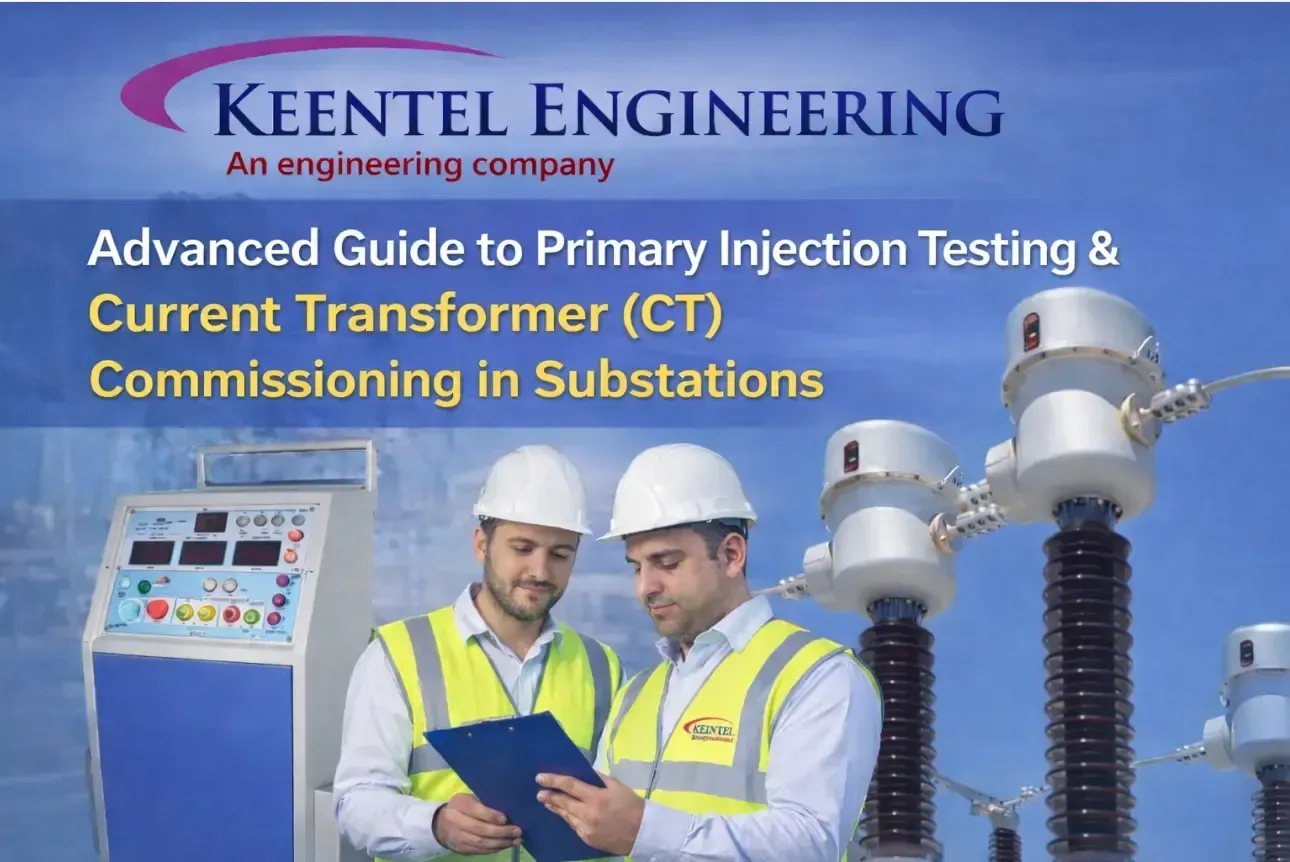
Advanced Guide to Primary Injection Testing & Current Transformer (CT) Commissioning in Substations By Keentel Engineering Power System Experts
Apr 17, 2022 | blog
Introduction
In modern power systems, accuracy, reliability, and protection coordination are non-negotiable. At the heart of these systems lies the Current Transformer (CT) a critical component enabling precise measurement and protection.
Primary injection testing and CT commissioning are essential processes that ensure protection systems operate correctly under real-world fault conditions. As substations become more complex—especially with renewable integration and grid modernization these testing procedures are no longer optional; they are foundational.
At Keentel Engineering, we specialize in HV, MV, and EHV substation testing, commissioning, and NERC-compliant engineering services, delivering high-fidelity validation of protection systems.
What is Primary Injection Testing?
Primary injection testing involves injecting a high current directly into the primary side of a CT or protection device to validate the entire protection circuit from CT to relay to breaker.
Unlike secondary injection, this method verifies the complete system under real operating conditions, ensuring:
- Correct CT ratio performance
- Proper wiring and polarity
- Relay operation and trip logic
- End-to-end protection system integrity
According to the uploaded document, this method is essential to validate current transformers, relays, and trip units by simulating actual current flow conditions.
Understanding Current Transformers (CTs)
Primary vs Secondary Side
- Primary Side: Connected to high-voltage system where actual current flows
- Secondary Side: Provides scaled-down current for relays/meters
For example, a 2000/1 CT ratio means 2000 A on primary results in 1 A on secondary .
This transformation enables safe measurement and protection without exposing equipment to
high voltage .
Key Components in CT Commissioning
1. CT Terminal Box
Acts as the starting point of CT secondary wiring and primary testing location .
2. Junction Boxes / CT Panels
Used in large substations to centralize CT connections, improving maintainability and reliability.
3. Local Control Cubicle (LCC)
Provides:
- SCADA interface
- Relay integration
- Centralized monitoring and control
4. CT Loop
The CT loop is the secondary circuit path from CT → LCC → protection panel, ensuring proper signal transmission .
CT Polarity A Critical Commissioning Step
Incorrect polarity is one of the most common causes of protection failure .
- Primary polarity: P1, P2 (or H1, H2)
- Secondary polarity: S1, S2 (or X1, X2)
Polarity ensures correct phase relationship between primary and secondary currents, which is crucial for:
- Differential protection
- Directional relays
- Fault detection
The document highlights the use of dot notation to represent polarity alignment .
Protection Core vs Metering Core
Protection Core
- Used for relays (overcurrent, differential, distance)
- Handles high fault currents without saturation
- Example: 5P20 class → up to 20× rated current within 5% error
Metering Core
- Used for billing and monitoring
- High accuracy under normal conditions
- Low saturation point (ISF 3–5) protects instruments during faults
Critical Rule:
Never interchange protection and metering cores—this can cause relay failure or inaccurate billing.
CT Ratio and Its Importance
CT Ratio = Primary Current / Secondary Current
Example:
- 300/5 → CTR = 60
- 300/1 → CTR = 300
Choosing the correct CT ratio ensures:
- Accurate relay settings
- Proper fault detection
- System stability
Primary Injection Testing Procedure (Keentel Approach)
At Keentel Engineering we follow a structured commissioning methodology:
Step 1: Pre-Check
- Verify drawings (SLD, schematics)
- Check CT nameplate data
- Inspect wiring and grounding
Step 2: CT Loop Verification
- Confirm continuity from CT to relay
- Validate phase identification (L1, L2, L3, Neutral)
Step 3: Polarity Testing
- Ensure correct orientation (P1 toward line or bus)
Step 4: Primary Current Injection
- Inject calibrated current
- Measure secondary response
- Validate CT ratio
Step 5: Relay Operation Check
- Confirm trip signals
- Verify coordination
Step 6: Safety Validation
- Confirm CT shorting links
- Ensure proper grounding
Safety Considerations in CT Testing
CT Shorting
Prevents dangerous voltages in secondary circuit when open
Grounding
- Prevents shock hazards
- Reduces electromagnetic interference
- Ensures accurate measurements
Why Primary Injection Testing is Critical
- Validates entire protection chain
- Detects wiring errors early
- Ensures relay coordination
- Prevents costly failures
- Supports NERC compliance (PRC standards)
Keentel Engineering Services
We provide end-to-end solutions including:
Substation Engineering & Commissioning
- AIS & GIS substations
- MV & HV switchgear systems
- CT/PT testing and validation
Protection & Control (P&C)
- Relay settings and coordination
- SCADA integration
- IEC 61850 implementation
Power System Studies
- Short circuit
- Load flow
- Dynamic and transient stability
NERC Compliance Services
- PRC, TPL, MOD standards
- Model validation (PSSE, PSCAD, TSAT)
Conclusion
Primary injection testing and CT commissioning are essential for ensuring grid reliability, safety, and compliance. As power systems evolve, these processes become even more critical.
With decades of expertise, Keentel Engineering delivers precision-driven testing, commissioning, and engineering solutions tailored to utilities, developers, and industrial clients.
Frequently Asked Questions (FAQs)
1. What is the difference between primary and secondary injection testing?
Primary injection tests the entire system including CTs, while secondary injection only tests relays.
2. Why is CT polarity important?
Incorrect polarity leads to relay misoperation and protection failure.
3. What happens if CT secondary is open?
Dangerous high voltage can develop, risking equipment damage and personnel safety.
4. What is CT saturation?
It is when the CT core cannot accurately reproduce current beyond a limit, causing measurement errors.
5. What is a CT loop?
The complete secondary wiring path from CT to protection devices.
6. Can metering and protection cores be interchanged?
No—this causes incorrect operation and potential system failure.
7. What is ISF in CTs?
Instrument Security Factor; defines saturation limit for metering cores.
8. Why is grounding required in CT circuits?
To ensure safety and measurement accuracy.
9. What standards govern CT commissioning?
- IEC 60044
- IEEE C57 series
- NERC PRC standards
10. What is a CT ratio?
The ratio of primary current to secondary current.
11. What is primary injection used for?
To validate real-world performance of protection systems.
12. What equipment is used for primary injection testing?
High-current injection test sets (e.g., Omicron CPC, Megger).
13. What is CT terminal box function?
Central connection point for CT secondary wiring.
14. What is LCC panel role?
Centralized control and monitoring of substation equipment.
15. How do you verify CT polarity?
Using polarity test kits or primary injection.
16. What is protection core class 5P20?
CT accuracy within 5% error up to 20× rated current.
17. Why is CT loop verification important?
Ensures correct wiring from CT to relay.
18. What industries need CT commissioning?
- Utilities
- Renewable energy (solar, wind, BESS)
- Industrial plants
19. How often should CT testing be performed?
During commissioning and periodic maintenance cycles.
20. Does Keentel provide on-site testing?
Yes—full field commissioning and validation services.

About the Author:
Sonny Patel P.E. EC
IEEE Senior Member
In 1995, Sandip (Sonny) R. Patel earned his Electrical Engineering degree from the University of Illinois, specializing in Electrical Engineering . But degrees don’t build legacies—action does. For three decades, he’s been shaping the future of engineering, not just as a licensed Professional Engineer across multiple states (Florida, California, New York, West Virginia, and Minnesota), but as a doer. A builder. A leader. Not just an engineer. A Licensed Electrical Contractor in Florida with an Unlimited EC license. Not just an executive. The founder and CEO of KEENTEL LLC—where expertise meets execution. Three decades. Multiple states. Endless impact.
Services

Let's Discuss Your Project
Let's book a call to discuss your electrical engineering project that we can help you with.

About the Author:
Sonny Patel P.E. EC
IEEE Senior Member
In 1995, Sandip (Sonny) R. Patel earned his Electrical Engineering degree from the University of Illinois, specializing in Electrical Engineering . But degrees don’t build legacies—action does. For three decades, he’s been shaping the future of engineering, not just as a licensed Professional Engineer across multiple states (Florida, California, New York, West Virginia, and Minnesota), but as a doer. A builder. A leader. Not just an engineer. A Licensed Electrical Contractor in Florida with an Unlimited EC license. Not just an executive. The founder and CEO of KEENTEL LLC—where expertise meets execution. Three decades. Multiple states. Endless impact.
Leave a Comment
We will get back to you as soon as possible.
Please try again later.