

A Coordinated Electric System Interconnection Review—the utility’s deep-dive on technical and cost impacts of your project.

Challenge: Frequent false tripping using conventional electromechanical relays
Solution: SEL-487E integration with multi-terminal differential protection and dynamic inrush restraint
Result: 90% reduction in false trips, saving over $250,000 in downtime

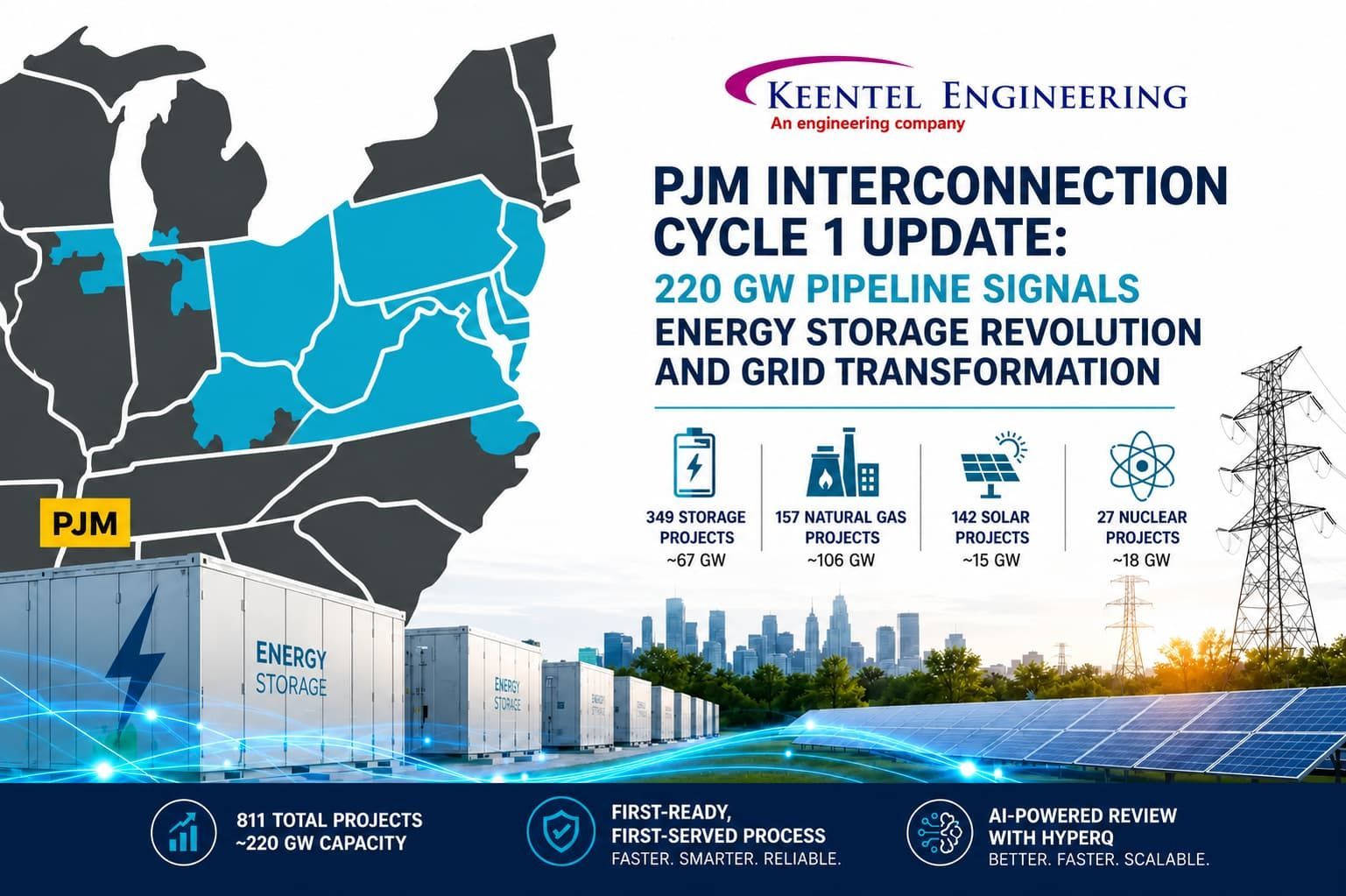
PJM Interconnection Cycle 1 Update: 220 GW Pipeline Signals Energy Storage Revolution and Grid Transformation

PJM Cycle 1 Interconnection Infographic: 220 GW Storage & Grid Update
Calendar icon. D

May 2, 2026 | Blog

Introduction: A Defining Moment for the U.S. Power Grid

PJM Interconnection’s first cycle under its reformed “first-ready, first-served” process marks one of the most significant structural shifts in U.S. grid history. With 811 generation projects totaling over 220 GW of capacity, the interconnection queue is no longer just a backlog—it is now a filtered, execution-focused pipeline of future generation.


What stands out most is not just the scale—but the composition.


Energy storage has emerged as the dominant technology by project count, signaling a fundamental transition in how grid reliability, flexibility, and economics will be managed across the Mid-Atlantic and Midwest.


For utilities, developers, regulators, and engineering firms like Keentel Engineering, this is not just an update—it is a turning point in grid planning, modeling, and compliance.


Cycle 1 Snapshot: What the Data Really Tells Us

The Cycle 1 submissions provide a clear, data-driven view of the future grid:


  • 811 total projects 
  • ~220 GW total capacity 
  • 349 energy storage projects (~67 GW) 
  • 157 natural gas projects (~105 GW) 
  • Diverse mix including nuclear, solar, wind, and emerging technologies 


Key Insight:


  • Energy storage leads in number of projects 
  • Natural gas leads in total capacity 


This reveals a hybrid grid model emerging:


  • Gas and nuclear → bulk capacity 
  • Storage → flexibility and reliability layer 
  • Renewables → variable generation 

From First-Come to First-Ready: Why the Reform Matters

PJM’s shift from first-come, first-served to first-ready, first-served is arguably the most important structural change.


Key Requirements for Entry:


  • Demonstrated site control 
  • Financial commitment 
  • Technical readiness 


Why This Matters:


  • Eliminates speculative projects 
  • Improves study efficiency 
  • Enables faster project execution 
  • Removes legacy backlog entirely 


Engineering Impact:


For firms like Keentel:


  • Higher-quality project pipeline 
  • Increased demand for accurate upfront studies 
  • Reduced tolerance for incomplete modeling 

Energy Storage: The Dominant Force in the Queue

Energy storage accounts for:


  • ~43% of total projects 
  • ~30%+ of total capacity 


This is not accidental—it reflects a deep alignment between technical capability and market need.


Why Storage Is Leading (Technical Perspective)

1. Fast Dynamic Response


  • Millisecond response for:


  • Frequency regulation 
  • Grid stability 
  • Contingency support 


2. Peak Load Management


  • Reduces stress during peak demand 
  • Defers transmission upgrades 


3. Renewable Integration


  • Smooths solar/wind variability 
  • Enables higher renewable penetration 


4. Transmission Congestion Relief


  • Strategically located BESS can: 


  • Reduce LMP spikes 
  • Improve system efficiency 

Reliability Crisis Without Storage

According to the Brattle-backed PJM fact sheet:


  • PJM requires: 


  • 16 GW storage by 2032 
  • 23 GW by 2040


  • Without storage: 


  • Up to 15 GW load shed risk 
  • ~34% increase in electricity costs by 2028 


  • With storage: 


  • >30% cost savings potential 


Interpretation:


Storage is no longer optional it is a core reliability asset.


Demand Growth Is Driving Everything

  • +30 GW demand growth expected by 2030 
  • Driven by: 


  • Data centers 
  • Electrification 
  • Advanced manufacturing 


Key Challenge:


Demand growth is outpacing generation deployment, making interconnection speed critical.


Engineering Challenges in Cycle 1 Projects

Despite strong interest, only a fraction of projects will reach COD.


Key Bottlenecks:


1. Interconnection Studies


  • Feasibility Study 
  • System Impact Study (SIS) 
  • Facilities Study 


2. Dynamic Modeling Requirements


  • PSSE (RMS stability) 
  • PSCAD (EMT simulations) 
  • TSAT (time-domain simulations) 


3. Inverter-Based Resource (IBR) Complexity


  • Grid-following vs grid-forming 
  • Control system validation 
  • Fault response behavior 


4. Protection & Coordination


  • Short circuit contribution challenges 
  • Relay coordination for BESS 


5. Permitting & Supply Chain


  • State-level permitting delays 
  • Equipment lead times 

Market & Policy Gaps Still Limiting Deployment

From the PJM fact sheet, key reforms needed include:


1. Faster Interconnection Approvals


  • Reduce unnecessary delays 


2. Market Rule Enhancements


  • Opportunity cost bidding 
  • Real-time flexibility utilization 
  • Proper capacity accreditation 


3. Transmission Cost Clarity


  • Clear rules for storage participation


4. Permitting Standardization


  • Faster project development timelines

AI in Interconnection: A New Era

PJM is now using HyperQ (Google Tapestry) to:


  • Analyze applications 
  • Improve review efficiency 
  • Reduce study timelines 


Impact:


  • Faster processing 
  • More consistent evaluations 
  • Increased scalability 

The Future Grid: A Three-Layer Architecture

Based on Cycle 1 data:


1. Bulk Generation Layer


  • Natural Gas 
  • Nuclear 


2. Flexibility Layer


  • Energy Storage (critical component) 


3. Variable Layer


  • Solar 
  • Wind 

Strategic Outlook (Next 5–10 Years)

  • Storage penetration will accelerate 
  • Hybrid projects (solar + storage) will grow 
  • Grid-forming inverters will become standard 
  • EMT modeling will become mandatory for interconnection 
  • Capacity markets will evolve to better value storage 

Keentel Engineering’s Role in This Transformation

Keentel Engineering is positioned to support:


Interconnection Studies


  • Feasibility, SIS, Facilities studies 


Dynamic Modeling


  • PSSE, PSCAD, TSAT model development 


NERC Compliance


  • PRC, MOD, TPL standards 
  • IBR compliance (IEEE 2800 alignment) 


Protection Engineering


  • Relay coordination 
  • BESS protection design 


Grid Integration Strategy


  • Hybrid system optimization 
  • Transmission constraint analysis 


Technical FAQs (With Detailed Answers)

  • 1. What is PJM’s “first-ready, first-served” process?

    It prioritizes projects that demonstrate:

    Site control 

    Financial readiness 

    Technical completeness 

    This reduces speculative entries and accelerates viable projects through the interconnection process.


  • 2. Why is energy storage dominating PJM Cycle 1?

    Because it provides:

    • Fast response for grid stability 
    • Peak shaving capability 
    • Transmission congestion relief 
    • Revenue stacking opportunities 

    It is both a technical and economic solution.


  • 3. Why does natural gas still lead in capacity?

    Gas plants:

    • Provide large-scale dispatchable power 
    • Support baseload requirements 

    Storage complements gas by handling variability and peaks.


  • 4. What are the biggest technical challenges for BESS interconnection?

    • Dynamic model validation 
    • Control system tuning 
    • Fault response behavior 
    • Short circuit contribution limitations 
    • Stability analysis (RMS and EMT) 

  • 5. What is the role of EMT studies in modern interconnection?

    Electromagnetic Transient (EMT) studies:

    • Capture inverter dynamics accurately 
    • Are required for high IBR penetration systems 
    • Identify control interactions and instability risks 

  • 6. Why will many projects not reach commercial operation?

    Due to:

    • Permitting delays 
    • Supply chain constraints 
    • Interconnection upgrade costs 
    • Financing challenges 

  • 7. How does storage reduce electricity costs?

    • Reduces peak pricing 
    • Improves dispatch efficiency 
    • Lowers need for expensive peaking plants
    • Result: >30% cost savings potential 

  • 8. What is capacity accreditation for storage?

    It determines how much capacity value storage receives in capacity markets.

    • Challenges include:
    • Duration limitations 
    • Dispatch assumptions 
    • Reliability contribution modeling 

  • 9. How does storage improve transmission constraints?

    By:

    • Injecting power locally 
    • Reducing congestion 
    • Lowering LMP volatility 

  • 10. What modeling tools are required for PJM interconnection?

    • PSSE → steady-state and dynamic studies 
    • PSCAD → EMT simulations 
    • TSAT → time-domain analysis 

  • 11. What is the role of grid-forming inverters?

    They:

    • Provide synthetic inertia 
    • Support voltage and frequency 
    • Improve system stability in low-inertia grids 

  • 12. How does demand growth impact interconnection urgency?

    With 30 GW+ growth expected, delays in interconnection:

    • Increase reliability risks 
    • Drive up costs 
    • Create capacity shortages 

  • 13. What are hybrid projects and why are they important?

    Hybrid systems (solar + storage):

    • Optimize energy dispatch 
    • Improve capacity value 
    • Reduce curtailment 

  • 14. How does PJM ensure reliability with high IBR penetration?

    Through:

    • Advanced modeling requirements 
    • Protection system upgrades 
    • Stability assessments 
    • NERC compliance enforcement 

  • 15. What is the biggest takeaway from Cycle 1?

     The grid is transitioning to a flexibility-driven architecture, with energy storage at its core.


Final Thought

PJM Cycle 1 is not just an interconnection update—it is a blueprint for the future grid.


The convergence of:


  • Massive demand growth 
  • Structural reform 
  • Energy storage dominance 


signals a transformation that will define power systems for decades.


For developers and utilities, success will depend on execution.


For engineering firms like Keentel Engineering the opportunity lies in delivering the technical rigor, modeling accuracy, and compliance expertise required to turn these projects into reality.


A smiling man with glasses and a beard wearing a blue blazer stands in front of server racks in a data center.

About the Author:

Sonny Patel P.E. EC

IEEE Senior Member

In 1995, Sandip (Sonny) R. Patel earned his Electrical Engineering degree from the University of Illinois, specializing in Electrical Engineering . But degrees don’t build legacies—action does. For three decades, he’s been shaping the future of engineering, not just as a licensed Professional Engineer across multiple states (Florida, California, New York, West Virginia, and Minnesota), but as a doer. A builder. A leader. Not just an engineer. A Licensed Electrical Contractor in Florida with an Unlimited EC license. Not just an executive. The founder and CEO of KEENTEL LLC—where expertise meets execution. Three decades. Multiple states. Endless impact.

Four workers in safety vests and helmets stand with arms crossed near wind turbines.

Let's Discuss Your Project

Let's book a call to discuss your electrical engineering project that we can help you with.

Man in a blazer and open shirt, looking at the camera, against a blurred background.

About the Author:

Sonny Patel P.E. EC

IEEE Senior Member

In 1995, Sandip (Sonny) R. Patel earned his Electrical Engineering degree from the University of Illinois, specializing in Electrical Engineering . But degrees don’t build legacies—action does. For three decades, he’s been shaping the future of engineering, not just as a licensed Professional Engineer across multiple states (Florida, California, New York, West Virginia, and Minnesota), but as a doer. A builder. A leader. Not just an engineer. A Licensed Electrical Contractor in Florida with an Unlimited EC license. Not just an executive. The founder and CEO of KEENTEL LLC—where expertise meets execution. Three decades. Multiple states. Endless impact.

Leave a Comment

Related Posts

FERC Order 2023 interconnection process diagram showing power generation
By SANDIP R PATEL May 1, 2026
FERC Order 2023: interconnection reforms, cluster studies & grid impact. Learn key changes fast.
SEL-2240 Axion industrial automation platform
By SANDIP R PATEL May 1, 2026
Explore SEL-2240 Axion, a modular I/O control system with RTAC automation and EtherCAT networking. Discover applications, features, and benefits.
Transmission line design infographic with BIM and power engineering solutions
By SANDIP R PATEL April 27, 2026
Explore advanced transmission line design services with BIM modeling, automated calculations, digital twins, and power engineering solutions by Keentel.
PJM Dynamic Model Guidelines 2026 infographic for utility-scale interconnection,
By SANDIP R PATEL April 27, 2026
Learn PJM dynamic model development, PSS®E model validation, and interconnection compliance requirements. Discover expert strategies for approval.
PJM NextGen application guide for utility-scale energy projects with solar, wind and battery storage
By SANDIP R PATEL April 25, 2026
Master the PJM NextGen application guide for utility-scale projects. Learn interconnection steps, technical data, and avoid delays. Get started today.
DC supply selection schemes improving reliability in HV, MV and LV protection systems
By SANDIP R PATEL April 24, 2026
Learn how DC supply selection schemes improve protection system reliability with dual DC architecture, redundancy, and anti-pumping solutions. Discover more.
Generator protection and control engineering solutions for power system stability
By SANDIP R PATEL April 24, 2026
Learn generator protection control engineering, ANSI 25 synchronization, relay schemes, and power system protection best practices. Discover expert solutions.
Solar capacity and availability testing for utility-scale power systems
By SANDIP R PATEL April 22, 2026
Utility-scale solar capacity testing, solar availability testing, and ASTM E2848 support for bankable performance. Learn more with Keentel.
PSCAD EMT vs RMS simulation infographic for power system stability, load flow, short circuit,
By SANDIP R PATEL April 22, 2026
Compare RMS vs EMT simulation using PSCAD. Learn when to use each for power system studies, inverter modeling, and grid stability. Discover more.