

A Coordinated Electric System Interconnection Review—the utility’s deep-dive on technical and cost impacts of your project.
Challenge: Frequent false tripping using conventional electromechanical relays
Solution: SEL-487E integration with multi-terminal differential protection and dynamic inrush restraint
Result: 90% reduction in false trips, saving over $250,000 in downtime
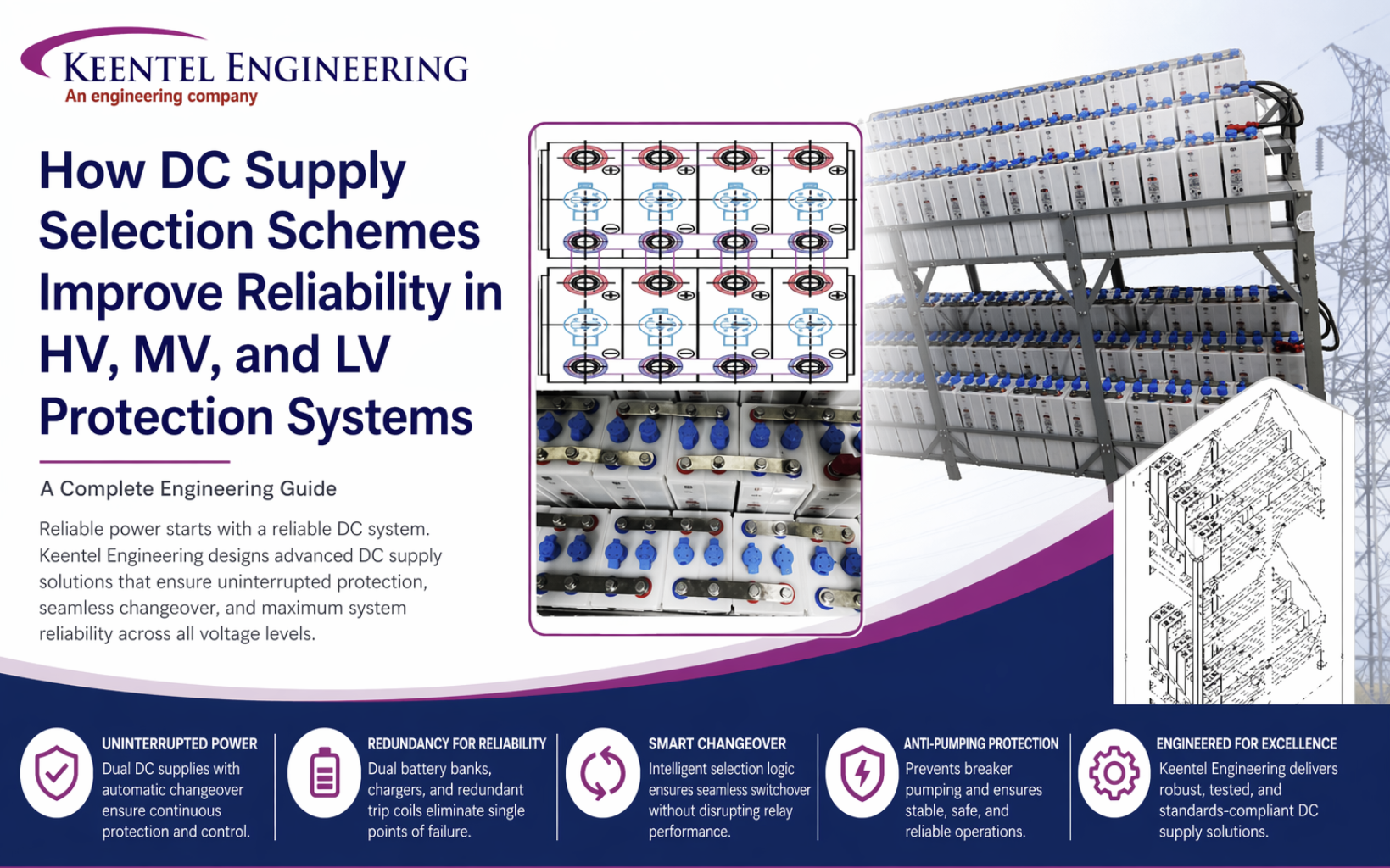
How DC Supply Selection Schemes Improve Reliability in HV,MV and LV Protection Systems A Complete Engineering Guide by Keentel Engineering
Apr 24, 2026 | Blog
Introduction
In modern power systems, reliability is not a luxury—it is a necessity. Whether in HV substations, MV industrial plants, or LV control systems, protection and control panels must function flawlessly, especially during fault conditions.
One of the most critical yet often overlooked aspects of system reliability is the DC supply selection scheme. This system ensures that protection relays, control circuits, and breaker operations remain energized even during disturbances, power loss, or equipment failure.
At Keentel Engineering, we design advanced DC supply architectures that deliver continuous operation, redundancy, and fault resilience across all voltage classes HV, MV and LV.
Why DC Supply is Essential for Protection Systems
During electrical faults, system conditions become unstable. AC supply can experience:
- Voltage dips
- Frequency disturbances
- Transient fluctuations
These conditions can disrupt protection relays and delay critical operations.
DC systems, however, provide:
- Stable voltage independent of system disturbances
- Instant availability through battery backup
- Reliable operation for protection and control devices
This is why DC supply forms the backbone of all modern protection systems.
The Need for DC Supply Selection Schemes
A single DC source creates a major risk: a single point of failure.
If the DC supply fails:
- Protection relays may stop functioning
- Circuit breakers may not trip
- Faults may escalate into major outages
To prevent this, engineers implement DC supply selection schemes, which:
- Use multiple DC sources
- Automatically switch between supplies
- Ensure uninterrupted operation
Dual DC Supply Architecture: The Industry Standard
The most reliable design approach is a dual DC supply system.
Key Components:
- Two independent battery systems
- Two DC chargers
- Automatic selection logic using relays
- Isolation between systems
How It Works:
- One DC supply operates as the primary source
- The second acts as a backup
- If the primary fails, the system automatically switches to the backup
- When the primary is restored, it resumes operation
This architecture ensures:
- No interruption to protection systems
- Continuous control functionality
- High system reliability
Redundancy: The Foundation of Reliable Power Systems
Redundancy is not optional it is essential in power system design.
Key Redundant Features:
- Dual DC systems
- Redundant trip coils in circuit breakers
- Independent protection schemes
Why it matters:
- Ensures faults are cleared instantly
- Prevents cascading failures
- Protects expensive equipment
In HV and MV systems, even milliseconds of delay in fault clearing can cause severe damage. Redundancy eliminates that risk.
Switching Time vs Relay Reset Time: A Critical Design Factor
When switching between DC supplies, a brief voltage dip occurs. This can impact relay performance.
Important Concept:
- Relay Reset Time = Time before relay loses memory/function
- Switching Time = Time taken to transfer supply
Design Rule:
Relay reset time must be longer than switching time
If not:
- Relays may reset
- Protection may fail
- System becomes vulnerable
At Keentel Engineering, we carefully coordinate these parameters to ensure seamless switching without loss of protection.
DC Mixing: A Hidden but Dangerous Risk
One of the most critical design mistakes is DC mixing connecting two DC systems improperly.
Risks:
- Circulating currents
- Short circuits
- Equipment damage
- System instability
Best Practices:
- Maintain strict isolation between DC systems
- Perform commissioning checks
- Test each circuit independently
Avoiding DC mixing is essential for system safety and reliability.
Circuit Breaker Pumping: A Common Operational Problem
What is Pumping?
Pumping occurs when:
- A breaker is commanded to close
- A fault exists
- The breaker trips
- The close command is still active
- The breaker repeatedly closes and trips
This creates:
- Continuous cycling
- Mechanical stress
- System instability
Anti-Pumping Protection: The Solution
To prevent pumping, systems use an anti-pumping relay.
How It Works:
- Allows only one closing operation per command
- Blocks repeated signals
- Stabilizes breaker behavior
Benefits:
- Prevents mechanical wear
- Ensures safe operation
- Improves system stability
This is a critical feature in all HV and MV breaker control designs.
Switching Devices in Control Systems
DC supply selection also relies on various switching devices:
Types:
- Manual switches
- Changeover switches
- Rotary selector switches
Features:
- Multiple positions
- Normally open and closed contacts
- High reliability contact design
These devices provide flexibility and control in complex electrical systems.
Conclusion
DC supply selection schemes are a cornerstone of reliable electrical system design. They ensure that protection and control systems remain operational under all conditions.
At Keentel Engineering, we specialize in:
- Advanced DC system design
- Redundancy planning
- Protection system engineering
- HV, MV, and LV control panel solutions
Our expertise ensures that your system remains safe, reliable, and compliant no matter the challenge.
25 Technical FAQs (With Answers)
1. Why is DC used in protection systems?
DC provides a stable and reliable power source that is not affected by system faults.
2. What happens if protection systems lose power?
They may fail to operate, leading to equipment damage and system instability.
3. What is a DC supply selection scheme?
It is a system that switches between multiple DC sources to ensure uninterrupted power.
4. Why are two DC supplies used?
To eliminate single points of failure and improve reliability.
5. What is a battery-backed DC system?
A system where batteries provide power when the main source fails.
6. What is redundancy in power systems?
Providing backup systems to ensure continuous operation.
7. Why are redundant trip coils used?
To ensure circuit breakers trip even if one coil fails.
8. What is automatic changeover?
A system that switches power sources without manual intervention.
9. What is relay reset time?
The time a relay can remain functional without power.
10. Why is switching time important?
It determines whether relays remain operational during supply transfer.
11. What happens during DC switching?
A brief voltage dip occurs, which may affect relays.
12. How can relay malfunction be avoided?
By ensuring relay reset time exceeds switching time.
13. What is DC mixing?
Unintended connection between different DC systems.
14. Why is DC mixing dangerous?
It can cause short circuits and equipment damage.
15. How is DC mixing prevented?
Through proper isolation and testing.
16. What is pumping in circuit breakers?
Repeated closing and tripping due to persistent faults.
17. Why is pumping harmful?
It causes mechanical stress and instability.
18. What is an anti-pumping relay?
A device that prevents repeated breaker operations.
19. How does anti-pumping work?
It blocks continuous closing signals after one operation.
20. What is a closing coil?
A component that closes a circuit breaker.
21. What are changeover switches?
Devices used to select between power sources.
22. What is a rotary switch?
A multi-position switch used in control systems.
23. Where are DC systems used?
In substations, industrial plants, and control panels.
24. Why is reliability critical in protection systems?
Because failures can lead to major outages and equipment damage.
25. How does Keentel Engineering help?
By designing robust, reliable, and compliant DC and protection systems.
Case Studies
Case Study 1: HV Substation Reliability Enhancement
Challenge:
A substation experienced unreliable protection during fault conditions due to a single DC supply.
Solution:
Keentel Engineering implemented:
- Dual DC supply system
- Automatic changeover logic
- Redundant breaker control circuits
Results:
- Continuous protection operation
- No failures during faults
- Improved system reliability
Case Study 2: MV Industrial Plant Stability Improvement
Challenge:
Frequent relay resets during power switching caused production interruptions.
Solution:
- Optimized switching time
- Selected relays with proper reset characteristics
- Redesigned DC distribution
Results:
- Elimination of nuisance trips
- Stable operations
- Increased plant uptime
Case Study 3: LV Control System Failure Due to Poor Design
Challenge:
Unexpected failures caused by improper DC wiring.
Root Cause:
DC mixing between two independent systems.
Solution:
- Complete redesign with proper isolation
- Testing and commissioning validation
- Improved wiring practices
Results:
- Safe operation restored
- Equipment protected
- Long-term reliability achieved

About the Author:
Sonny Patel P.E. EC
IEEE Senior Member
In 1995, Sandip (Sonny) R. Patel earned his Electrical Engineering degree from the University of Illinois, specializing in Electrical Engineering . But degrees don’t build legacies—action does. For three decades, he’s been shaping the future of engineering, not just as a licensed Professional Engineer across multiple states (Florida, California, New York, West Virginia, and Minnesota), but as a doer. A builder. A leader. Not just an engineer. A Licensed Electrical Contractor in Florida with an Unlimited EC license. Not just an executive. The founder and CEO of KEENTEL LLC—where expertise meets execution. Three decades. Multiple states. Endless impact.
Services

Let's Discuss Your Project
Let's book a call to discuss your electrical engineering project that we can help you with.

About the Author:
Sonny Patel P.E. EC
IEEE Senior Member
In 1995, Sandip (Sonny) R. Patel earned his Electrical Engineering degree from the University of Illinois, specializing in Electrical Engineering . But degrees don’t build legacies—action does. For three decades, he’s been shaping the future of engineering, not just as a licensed Professional Engineer across multiple states (Florida, California, New York, West Virginia, and Minnesota), but as a doer. A builder. A leader. Not just an engineer. A Licensed Electrical Contractor in Florida with an Unlimited EC license. Not just an executive. The founder and CEO of KEENTEL LLC—where expertise meets execution. Three decades. Multiple states. Endless impact.
Leave a Comment
We will get back to you as soon as possible.
Please try again later.