

A Coordinated Electric System Interconnection Review—the utility’s deep-dive on technical and cost impacts of your project.

Challenge: Frequent false tripping using conventional electromechanical relays
Solution: SEL-487E integration with multi-terminal differential protection and dynamic inrush restraint
Result: 90% reduction in false trips, saving over $250,000 in downtime

PJM Dynamic Model Development Guidelines (2026) Complete Engineering Guide for Interconnection Success By Keentel Engineering | Power System Studies Experts

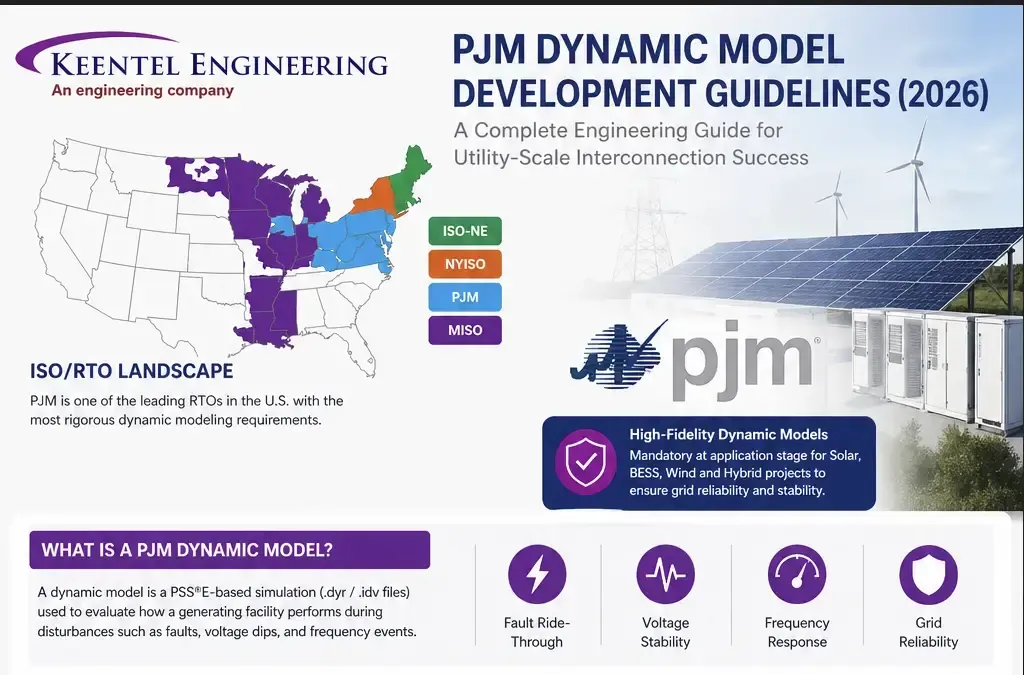
PJM Dynamic Model Guidelines 2026 infographic for utility-scale interconnection,
Calendar icon. D

Apr 27, 2026 | Blog

Introduction

The PJM Interconnection continues to raise the bar for grid reliability, especially with the rapid growth of inverter-based resources (IBRs) such as solar, wind, and battery energy storage systems (BESS). This Blog provide a structured and mandatory framework for modeling, validating, and submitting dynamic models for interconnection studies.


At Keentel Engineering, we specialize in helping developers navigate complex PJM requirements, ensuring first-pass approval, eliminating deficiencies, and accelerating project timelines.


What is a PJM Dynamic Model?

A PJM dynamic model is a PSS®E-based simulation model (.idv and .dyr files) used to evaluate how a generation facility behaves under disturbances such as:


  • Faults (voltage dips, frequency events) 
  • Grid instability 
  • Reactive power stress 
  • Transient conditions 


These models are mandatory at the Application Phase in NextGen and must reflect the actual plant design as closely as possible


Core Modeling Architecture for IBR Projects

1. Power Flow Representation (Critical Foundation)


PJM requires a fully aggregated equivalent model including:


  • Interconnection transmission line 
  • Main station transformer 
  • Collector system equivalent (mandatory) 
  • Inverter step-up transformers 
  • Aggregated inverter representation 
  • Reactive compensation devices 
  • Station and auxiliary loads 


This ensures accurate system-level representation for stability studies 


2. Dynamic Model Structure (IBR)


Each inverter-based plant must include three core modules:


REGC – Converter Model


  • Represents inverter interface with grid 
  • Controls current injection behavior 


REEC – Electrical Control Model


  • Translates voltage and power commands into current 
  • Controls P-Q behavior and limits 


REPC – Plant Controller


  • Governs plant-level voltage and frequency response 
  • Controls POI voltage and power output 


These modules collectively simulate real plant behavior under dynamic conditions 


Key Engineering Requirements (PJM Critical Compliance)

1. Maximum Facility Output (MFO)


  • Must be met at POI after losses 
  • Includes: 


  • Station loads 
  • Transformer losses 
  • Collector losses 


PJM explicitly verifies MFO through simulation studies 


2. Power Factor Requirement


For IBRs:


  • Must meet 0.95 lagging to 0.95 leading 
  • Measured at: 


  • High side of main transformer 


Reactive deficiencies are not allowed at submission 


3. Voltage Ride-Through (VRT)


  • Must survive 9-cycle fault at POI 
  • Must: 


  • Stay online 
  • Recover power quickly 
  • Inject reactive current during voltage dip 


Failure = automatic model rejection


4. Momentary Cessation (MC)


  • Must be eliminated wherever possible 
  • If unavoidable → must be justified 


PJM strongly discourages MC behavior 


5. Primary Frequency Response


  • Must include: 


  • 5% droop 
  • ±0.036 Hz deadband 


Required for grid stability compliance 


6. Flat Start Requirement


  • Model must run 20 seconds with no oscillation 
  • Variation ≤ 0.1 MW / 0.1 MVAR 


This validates model stability before disturbance testing


Advanced Modeling Insights (Where Most Projects Fail)

Common Mistakes


  • Mismatch between NextGen and PSS®E data 
  • Incorrect collector impedance modeling 
  • Unrealistic inverter parameters 
  • Missing plant controller logic 
  • Improper voltage control configuration 
  • Reactive deficiency at POI 


PJM explicitly requires parameter comparison tables to eliminate mismatch errors 


PJM Deliverables Checklist (Mandatory Submission Package)

Every project must submit:


  • Data Application Form 
  • .idv and .dyr files 
  • Dynamic Model Report 
  • Parameter comparison table 
  • MFO assessment 
  • Power factor assessment 
  • Flat start test results 
  • VRT test results 
  • Frequency response validation 


Missing any item = automatic deficiency notice 


Case Studies (Keentel Engineering – Confidential Projects)

Case Study 1: 250 MW Solar Project – First Pass Approval

Challenge:


  • No collector system equivalent 
  • Reactive deficiency at POI 


Solution:


  • Developed full collector impedance model 
  • Optimized inverter Q capability 
  • Implemented REPC voltage control 


Result:


  • Passed: 


  • MFO test 
  • PF test 
  • VRT test 


  • Zero deficiencies from PJM 

Case Study 2: 150 MW BESS Project – PSCAD + PSS®E Alignment

Challenge:


  • Mismatch between EMT and RMS models 
  • Frequency response failure

Solution:


  • Tuned REECC + REPC models 
  • Coordinated PSCAD and PSS®E parameters 
  • Enabled droop and deadband compliance 

Result:


  • Full compliance with: 
  • PRC standards 
  • PJM guidelines 
  • Approved at DP2 

Case Study 3: Hybrid Solar + Storage (300 MW)

Challenge:


  • Multi-inverter configuration 
  • Complex plant controller requirements 


Solution:


  • Implemented PLNTBU1 plant controller 
  • Modeled hybrid dispatch logic 
  • Eliminated momentary cessation


Result:


  • Successfully passed: 


  • VRT 
  • Flat start 
  • PF compliance 


  • Accepted without revisions 

Why Keentel Engineering?

We don’t just model  we engineer approval.


Our Expertise:


  • PJM / ERCOT / CAISO Interconnection 
  • PSS®E + PSCAD + TSAT 
  • NERC compliance modeling 
  • Dynamic + EMT studies 
  • First-pass submission success strategy 

Technical FAQ (Detailed Answers)

  • 1. When is a dynamic model required in PJM?

    Dynamic models are required at the Application Phase in NextGen, not later, making early engineering critical.


  • 2. What software must be used?

    PJM requires Siemens PSS®E, with version depending on queue cycle.

  • 3. Is PSCAD required?

    Yes — starting DP2 for Cycle 01 and beyond, EMT models (PSCAD) are mandatory 


  • 4. What is the biggest cause of rejection?

    Mismatch between:

    • NextGen data 
    • PSS®E model parameters 

  • 5. Can I use user-defined models (UDM)?

    Yes, but must include:

    • DLL files 
    • Source code 
    • Full documentation 
    • Parameter descriptions 

  • 6. What is the collector system requirement?

    Collector impedance (R, X, B) must be:

    • Provided in p.u. 
    • Based on 100 MVA base 

  • 7. What is MFO verification?

    A study ensuring:

    • Net MW at POI = requested MFO 
    • Includes all losses 

  • 8. What is flat start testing?

    Simulation with:

    • No disturbance 
    • Stable output for 20 seconds 

  • 9. What is SCR requirement for testing?

    Dynamic model tested with:

    • SCR = 3 
    • X/R = 5 

  • 10. What happens if Momentary Cessation exists?

    Must:

    • Be minimized 
    • Fully justified 

  • 11. Are PSS®E library models preferred?

    Yes — PJM strongly prefers them over UDMs.


  • 12. What is REECB model status?

    Not allowed.


  • 13. What is the role of REPC model?

    Controls:

    • Voltage 
    • Frequency 
    • Power output 

  • 14. How is reactive capability verified?

    Through:

    • P-Q curve 
    • Power factor assessment 

  • 15. What is the voltage control requirement?

    Must comply with FERC Order 827 (automatic voltage regulation)


  • 16. What is inverter current behavior requirement?

    • Must inject reactive current during faults 
    • Must recover within 1 second 
  • 16. What is inverter current behavior requirement?

    • Must inject reactive current during faults 
    • Must recover within 1 second 
  • 17. What is the acceptable frequency deadband?

    ±0.036 Hz


  • 18. What is dynamic model checklist?

    A mandatory QA document confirming:

    • All requirements are met 

  • 19. Can project parameters change after submission?

    Yes — but must be updated at DP1/DP2


  • 20. Who is responsible for model accuracy?

    The Project Developer — not PJM


Final Thought

The PJM Dynamic Model Guideline is not just a requirement it is a filter.


Projects that:


  • Understand it → move forward 
  • Ignore it → get delayed or rejected 


At Keentel Engineering we ensure your project is in the first category.


A smiling man with glasses and a beard wearing a blue blazer stands in front of server racks in a data center.

About the Author:

Sonny Patel P.E. EC

IEEE Senior Member

In 1995, Sandip (Sonny) R. Patel earned his Electrical Engineering degree from the University of Illinois, specializing in Electrical Engineering . But degrees don’t build legacies—action does. For three decades, he’s been shaping the future of engineering, not just as a licensed Professional Engineer across multiple states (Florida, California, New York, West Virginia, and Minnesota), but as a doer. A builder. A leader. Not just an engineer. A Licensed Electrical Contractor in Florida with an Unlimited EC license. Not just an executive. The founder and CEO of KEENTEL LLC—where expertise meets execution. Three decades. Multiple states. Endless impact.

Four workers in safety vests and helmets stand with arms crossed near wind turbines.

Let's Discuss Your Project

Let's book a call to discuss your electrical engineering project that we can help you with.

Man in a blazer and open shirt, looking at the camera, against a blurred background.

About the Author:

Sonny Patel P.E. EC

IEEE Senior Member

In 1995, Sandip (Sonny) R. Patel earned his Electrical Engineering degree from the University of Illinois, specializing in Electrical Engineering . But degrees don’t build legacies—action does. For three decades, he’s been shaping the future of engineering, not just as a licensed Professional Engineer across multiple states (Florida, California, New York, West Virginia, and Minnesota), but as a doer. A builder. A leader. Not just an engineer. A Licensed Electrical Contractor in Florida with an Unlimited EC license. Not just an executive. The founder and CEO of KEENTEL LLC—where expertise meets execution. Three decades. Multiple states. Endless impact.

Leave a Comment

Related Posts

Transmission line design infographic with BIM and power engineering solutions
By SANDIP R PATEL April 27, 2026
Explore advanced transmission line design services with BIM modeling, automated calculations, digital twins, and power engineering solutions by Keentel.
PJM NextGen application guide for utility-scale energy projects with solar, wind and battery storage
By SANDIP R PATEL April 25, 2026
Master the PJM NextGen application guide for utility-scale projects. Learn interconnection steps, technical data, and avoid delays. Get started today.
DC supply selection schemes improving reliability in HV, MV and LV protection systems
By SANDIP R PATEL April 24, 2026
Learn how DC supply selection schemes improve protection system reliability with dual DC architecture, redundancy, and anti-pumping solutions. Discover more.
Generator protection and control engineering solutions for power system stability
By SANDIP R PATEL April 24, 2026
Learn generator protection control engineering, ANSI 25 synchronization, relay schemes, and power system protection best practices. Discover expert solutions.
Solar capacity and availability testing for utility-scale power systems
By SANDIP R PATEL April 22, 2026
Utility-scale solar capacity testing, solar availability testing, and ASTM E2848 support for bankable performance. Learn more with Keentel.
PSCAD EMT vs RMS simulation infographic for power system stability, load flow, short circuit,
By SANDIP R PATEL April 22, 2026
Compare RMS vs EMT simulation using PSCAD. Learn when to use each for power system studies, inverter modeling, and grid stability. Discover more.
PSCAD power system modeling and simulation services for EMT studies.
By SANDIP R PATEL April 22, 2026
Explore PSCAD modeling, EMT simulation, and grid interconnection studies with expert insights. Learn advanced power system analysis techniques today.
ERCOT PVR promo with grid, solar, and checklist.
By SANDIP R PATEL April 21, 2026
Learn ERCOT Parameter Verification Report (PVR) requirements, PSCAD & PSS®E validation, and compliance best practices. Discover how to ensure accurate grid modeling.
Keentel Engineering power substation construction project
By SANDIP R PATEL April 19, 2026
Explore the full lifecycle of a power substation project with Keentel Engineering, covering design, construction, and commissioning. Learn more about AIS, GIS, and NERC compliance.