A Coordinated Electric System Interconnection Review—the utility’s deep-dive on technical and cost impacts of your project.
Challenge: Frequent false tripping using conventional electromechanical relays
Solution: SEL-487E integration with multi-terminal differential protection and dynamic inrush restraint
Result: 90% reduction in false trips, saving over $250,000 in downtime
ERCOT enforces all of the above through simulation, which means your model is your compliance case. The bar is now high:
- Whole-facility scope. The model must represent everything the IT load, the UPS and power conversion, the cooling plant, the protection and control systems in formats compatible with ERCOT's study platforms (PSS/E, PSCAD, TSAT).
- Real control loops, not approximations. Generic textbook representations are unacceptable. The model must capture the actual inner control behavior of your power electronics.
- Hardware-validated converter models. For electronic loads, the PSCAD model must be benchmarked against actual hardware testing including voltage ride-through and subsynchronous response. A model assembled from standard PSCAD library blocks fails by definition, because a generic block has never been tested against your vendor's hardware. The good news: validation is a hardware-type test, so results for a given converter product are reusable across every facility that uses it.
- Format migration. Facilities that previously submitted the older composite load model (CMLD) format must transition to EPRI's PERC1 format.
- Three checkpoints. Models are reviewed before the stability study begins (no model, no study), before each quarterly stability assessment, and for electronic loads one final time before energization, when you must submit as-built models with a documented comparison against the previously studied data and a sworn attestation that the model matches actual field settings. ERCOT's review takes 10 business days, extendable by 20 put it on your critical path.
- A living obligation. Change your technology, controls, or relay settings in a way that affects ride-through including converting a crypto mining site to an AI data center — and you've triggered a new interconnection study, even if your megawatts don't change.
| Parameter | Detail |
|---|---|
| System | 230 kV / 138 kV transmission corridors, wind and wet-snow icing exposure |
| Data basis | 15 years of minute-resolution forced-outage records + regional weather observations |
| Core methods | Event grouping, MVA performance curves, time-to-95%-restore, area outage rate curves, fragility modeling, rerun-history benefits, exceedance and log-domain risk metrics |
| Headline result | ≈85% of maximum resilience benefit at 60% of original capital; worst-event restoration window cut from 11 days to 5 in rerun-history terms |
| Decision supported | Capital portfolio selection; resilience plan filing; post-investment verification framework |
| System / Topic | Governing Standard(s) | What It Controls |
|---|---|---|
| Overall plant electrical distribution | IEEE 141 (Red Book); IEEE 666 | Distribution architecture, voltage selection, design of generating station auxiliary service systems |
| Power system studies | IEEE 399 (Brown Book); IEEE 551 | Load flow, symmetrical/asymmetrical short circuit, motor starting methodologies down to the lowest LV panelboard |
| Protection & coordination | IEEE 242 (Buff Book); IEEE 3004.5; IEEE C37 series | Generator relaying (21, 59N, 87G), time-current coordination, selective clearing between LV and MV tiers |
| GSU / UAT / SST transformers | IEEE C57.12.00 and C57 family | Transformer ratings, impedance, testing, loading |
| HV switchyard breakers | IEEE C37.06 | AC high-voltage circuit breaker preferred ratings |
| MV switchgear (13.8 kV) | IEEE C37.20.2; IEEE C37.20.7 | Metal-clad construction, compartmentalization, vacuum breakers; arc-resistant design with plenum venting |
| MV cable | UL 1072; ICEA S-93-639 (NEMA WC 74) | Type MV-105 shielded cable, 133% insulation level for HRG systems |
| LV switchgear (480 V) | IEEE C37.13; UL 1558 | Metal-enclosed LV power circuit breaker switchgear to 635 V, draw-out ACBs with electronic trip units |
| Motor control centers | UL 845; NEMA ICS 18 | LV-MCC construction, MCCB/MCP protection for motors under ~200 HP |
| Motors | NEMA MG-1 | Motor performance, starting characteristics, service factors |
| DC & battery systems | IEEE 485; IEEE 946 | Lead-acid battery sizing (125/250 VDC), DC auxiliary system design |
| Grounding | IEEE 80; IEEE 142 (Green Book) | Ground grid step/touch potential limits; system grounding including high-resistance grounding |
| Lightning protection | IEEE 998 | Direct-stroke shielding of switchyard and outdoor generator structures |
| Arc flash & electrical safety | IEEE 1584; NFPA 70E | Incident energy calculation; worker safety boundaries and PPE |
| Fire protection | NFPA 850 | Fire protection and risk management for combustion turbine generating plants |
| Installation code | NEC (NFPA 70); NESC | Wiring methods inside the plant fence; overhead/outdoor clearances at the switchyard |
| Interconnection & compliance | FERC LGIP; NERC MOD-025/026/027, PRC-019/024/029, FAC-008 | Interconnection process, model validation, protection/ride-through coordination, facility ratings |
| IFC / Construction Deliverable | Purpose |
|---|---|
| Stamped IFC packages | Legal basis for construction; P.E. responsible charge |
| Final relay settings & TCCs | Protection as-installed matches the coordination study |
| Calculation archive | Owner records; NERC audit evidence trail |
| Commissioning procedures | Safe, sequenced energization; MOD field testing |
| Construction support | RFIs, field changes, FAT/SAT witness |
| As-builts & model handoff | Operating baseline; future study currency |
| Metric | Outcome |
|---|---|
| Defects found pre-occupancy | Three topology defects and one settings-mismatch family corrected before load migration; the shared-switchboard defect alone would have invalidated the concurrently-maintainable claim on day one |
| IST findings | Fourteen additional discrepancies surfaced under scenario testing (control logic, alarm mapping, one generator sequencing fault) — all closed before handover instead of during operations |
| Black-building test | Passed on second execution; the first attempt exposed the generator sequencing fault under true block load, exactly the failure the compressed plan would never have found |
| Handover quality | Operations team certified on the actual failure scenarios; corrected EOPs and settings documentation delivered as controlled documents |
| Business outcome | Occupancy proceeded three weeks behind the original date — against an independent estimate that the uncorrected sequencing fault carried a high probability of a full facility outage within the first year |
Part 2 — Frequently Asked Questions: Large Load Interconnection
An electric grid must remain in continuous balance — generation onto the grid must equal consumption from it at every instant. PJM achieves this balance, and prices it, through a layered market architecture. Each layer operates on a different time horizon, and each one touches project economics differently.
| Domain | Key Standards / Codes | What They Govern |
|---|---|---|
| Fire safety | NFPA 855; UL 9540 / UL 9540A | Installation requirements, separation, gas management; system safety listing and thermal-runaway fire testing |
| Grid interconnection | IEEE 1547 (distribution); IEEE 2800 (transmission IBRs) | Ride-through, reactive capability, power quality, and performance at the point of interconnection |
| Power quality | IEEE 519 | Harmonic distortion limits at the PCC |
| Protection & grounding | IEEE 80 / 81 / 142; C37 series | Grounding system design and testing; protective relaying |
| Reliability compliance | NERC standards (incl. PRC ride-through requirements) | Registered-entity obligations for grid-connected storage |
Navigating Prohibited Foreign Entity Compliance for Energy Storage Projects
Aug 25, 2026 | Blog
Section 48E, the Material Assistance Cost Ratio, and What BESS Developers Must Get Right in 2026–2027
Executive Summary
Battery energy storage came out of the One Big Beautiful Bill Act (OBBBA, Pub. L. 119-21, enacted July 4, 2025) in better shape than wind and solar. Storage kept its long-runway Section 48E investment tax credit while wind and solar were pushed onto a hard beginning-of-construction cliff. But storage did not escape the new prohibited foreign entity (PFE) regime — and in several respects storage carries the heaviest burden of any technology under it.
Three facts define the 2026–2027 planning environment for storage developers:
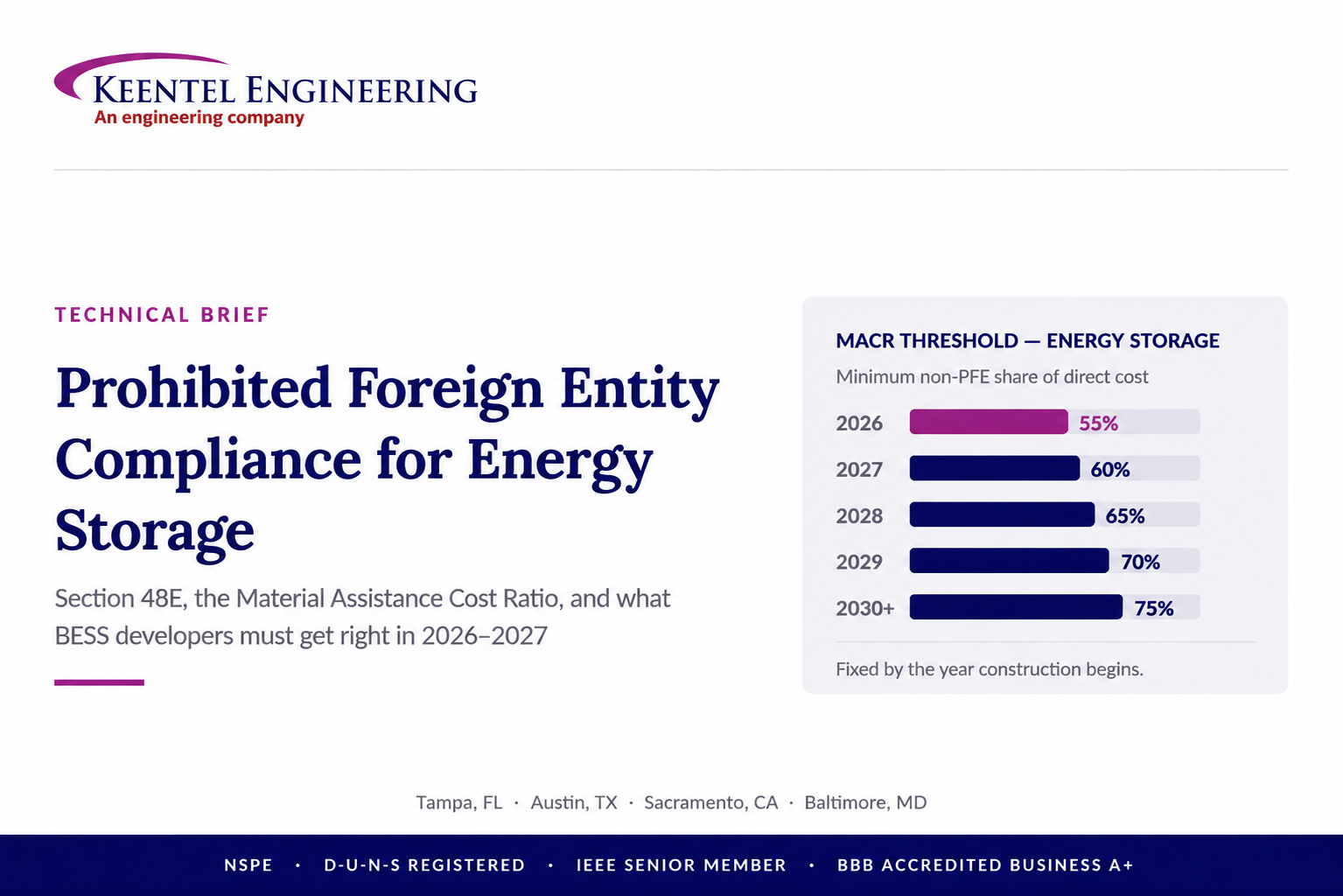
- Storage faces the highest material assistance thresholds of any generation or storage technology. An energy storage technology (EST) beginning construction in 2026 must demonstrate that at least 55% of its manufactured-product direct costs are not attributable to prohibited foreign entities. Generation facilities need only 40%. The storage threshold climbs to 75% for construction starting in 2030 or later.
- The battery supply chain is the most PFE-concentrated supply chain in the industry. Lithium iron phosphate cell manufacturing, cathode and anode active material production, separator and electrolyte supply, and midstream mineral refining are all heavily concentrated in a covered nation. Several of the largest global cell and integrated-system suppliers are named by statute as specified foreign entities.
- Storage cannot hedge into the production tax credit. Energy storage technology is eligible for Section 48E only. Generation projects worried about the Section 48E ten-year recapture exposure for prohibited payments can elect Section 45Y instead. Storage has no such escape hatch — the ITC recapture rule applies, and there is no alternative credit to fall back on.
IRS Notice 2026-15, released February 12, 2026, gave the market its first workable framework for calculating the material assistance cost ratio (MACR). It is, on balance, favorable — particularly for distributed fleets and for developers who can obtain supplier certifications. But it deliberately deferred the harder questions: what makes an entity a specified foreign entity, how ownership is traced, and what “effective control” means in a long-term service agreement or a software license. Treasury has committed to proposed regulations and to PFE-specific safe harbor tables by December 31, 2026.
This brief explains the statutory architecture, walks the MACR calculation as an engineer and a cost estimator would actually build it, translates the rules into procurement and contracting practice, and identifies the documentation package a project needs to survive diligence, a credit transfer, and an eventual examination.
1. Why This Matters More for Storage Than for Anything Else
The OBBBA restructured the technology-neutral credits along two axes: when the credit is available, and who and what may be inside the project.
On the first axis, storage did well. Wind and solar facilities must begin construction by July 4, 2026, or be placed in service by December 31, 2027. Energy storage technology under Section 48E was not subjected to that acceleration; storage remains on the longer phase-down curve, with the credit stepping down for projects beginning construction in 2034 and later and terminating thereafter.
On the second axis, storage did poorly — not because Congress wrote harsher rules for storage in every respect, but because the statute's percentage thresholds are highest for storage while the underlying supply chain is least diversified. That is the central tension of PFE compliance for battery energy storage systems (BESS).
Consider what a grid-scale BESS actually is, from a cost perspective. In a typical utility-scale AC-block or DC-block procurement, the battery modules and racks — cells, cell-to-pack hardware, module-level electronics — dominate the manufactured-product cost stack. The enclosure, thermal management system, fire detection and suppression, battery management system, DC combiners and disconnects, power conversion system, medium-voltage transformer, MV switchgear, auxiliary transformer, controls and the energy management system, AC and DC cabling, and the balance-of-plant steel each carry meaningful but individually smaller shares.
Now overlay the material assistance test. It does not ask whether the project contains PFE content. It asks what fraction of direct cost is not PFE-attributable — and whether that fraction clears the year's threshold. A project can contain Chinese-manufactured content and still qualify. What it cannot do is let that content dominate the cost stack. When the single largest line item in your bill of materials is the item most likely to be PFE-produced, the arithmetic gets difficult quickly.
PFE compliance for storage is not a tax-department exercise bolted onto an otherwise normal project. It is a procurement and engineering design constraint that has to be embedded at the specification stage, before the supply agreement is signed and before construction starts.
2. The Statutory Architecture: Three Independent Tests
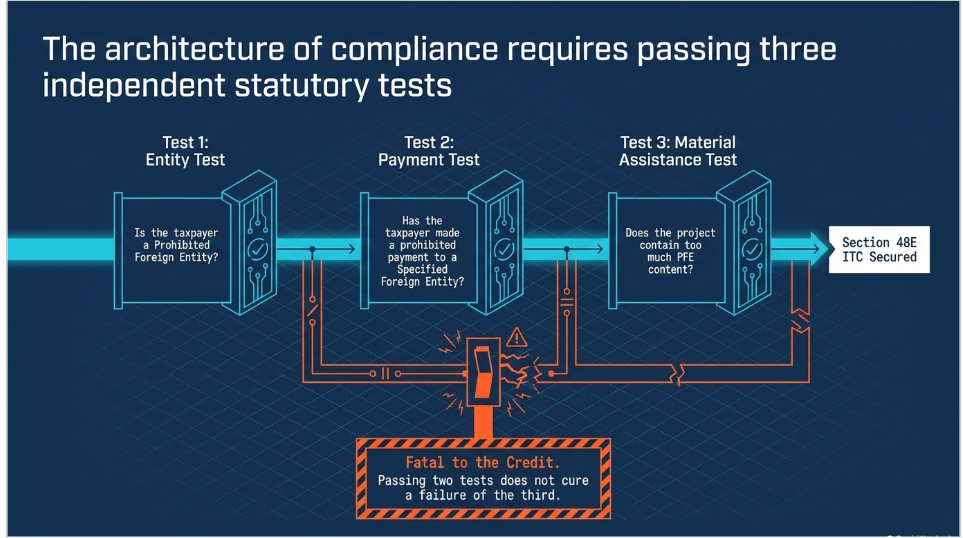
OBBBA added two new definitional paragraphs to the Internal Revenue Code: Section 7701(a)(51), defining prohibited foreign entity, and Section 7701(a)(52), defining material assistance from a prohibited foreign entity. Together with the credit-specific operative provisions in Sections 45Y, 48E and 45X, they create three independent tests. Failing any one of them is fatal to the credit. Passing two does not help you if you fail the third.
Test 1 — The entity test: Is the taxpayer itself a PFE?
A prohibited foreign entity is either a specified foreign entity (SFE) or a foreign-influenced entity (FIE).
Specified foreign entity
Specified foreign entity captures five categories:
- A foreign entity of concern as described in specified subparagraphs of Section 9901(8) of the FY2021 National Defense Authorization Act;
- An entity identified as a Chinese military company operating in the United States under Section 1260H of the FY2021 NDAA;
- An entity on certain lists required under the Uyghur Forced Labor Prevention Act (Pub. L. 117-78);
- An entity specified under Section 154(b) of the FY2024 NDAA — which names, by statute, Contemporary Amperex Technology Co. Ltd. (CATL), BYD Co. Ltd., Envision Energy Ltd., EVE Energy Co. Ltd., Gotion High-Tech Co. Ltd., Hithium Energy Storage Technology Co. Ltd., and any successor to those entities;
- A foreign-controlled entity — the government of a covered nation (including sub-national government), a citizen/national/resident of a covered nation, an entity organized under the laws of or with its principal place of business in a covered nation, or an entity controlled by any of the foregoing. “Covered nation” means China, Russia, Iran and North Korea. Control generally means more than 50% by vote, value, profits or capital interest, or beneficial ownership, with Section 318 attribution rules applying (excluding downward attribution under 318(a)(3)).
For storage developers, the fourth bullet is the one to internalize. Six of the most significant names in global battery and integrated-BESS supply are specified foreign entities by act of Congress, not by administrative listing. There is no fact-based argument to be made about them.
Foreign-influenced entity
Foreign-influenced entity captures entities under SFE influence. An entity is an FIE if, during the taxable year:
- An SFE has direct authority to appoint a covered officer — a board member, or an executive-level officer such as president, CEO, COO, CFO, general counsel or senior vice president;
- A single SFE owns at least 25% of the entity;
- One or more SFEs own at least 40% in the aggregate;
- At least 15% of the entity's debt is held in the aggregate by one or more SFEs; or
- The entity made a payment to an SFE in the preceding taxable year under a contract, agreement or other arrangement that entitles the SFE (or a related entity) to exercise effective control over the qualified facility, energy storage technology, or production of eligible components.
Status is generally tested as of the last day of the taxable year. Publicly traded entities receive modified treatment on the ownership and debt prongs — the ownership prongs are keyed to beneficial ownership reported under Rule 13d-3 of the Securities Exchange Act of 1934 (or an equivalent foreign rule), and the ownership prongs generally do not apply to a publicly traded entity or its 80%-controlled subsidiaries. Publicly traded entities remain fully subject to the effective control payment rules and the material assistance rules. The public-company relief is narrower than it first appears.
Test 2 — The payment test: Has the taxpayer made a prohibited payment to an SFE?
This is the “effective control” prong, and for storage it is the most under-appreciated risk in the entire regime.
Under Section 7701(a)(51)(D)(ii), effective control means contractual arrangements giving a counterparty specific authority over key aspects of production or operation — authority not otherwise captured by the ownership, officer or debt tests. The statute describes categories of contracts and terms treated as conferring effective control, including certain intellectual property licensing arrangements, subject to a bona fide purchase-or-sale-of-IP exception. Notice 2026-15 confirmed that the IP effective control provisions are read as a disjunctive list, and that they apply to contracts, agreements or arrangements entered into or modified on or after July 4, 2025.
Any payment under such an arrangement — regardless of size — can trigger the rule.
Why this matters disproportionately for storage: a grid-scale BESS is not a set-and-forget asset. It typically comes with a long-term service agreement (LTSA), a capacity maintenance or augmentation agreement, a warranty administered by the OEM, an OEM-supplied or OEM-licensed battery management and energy management software stack, remote monitoring and diagnostics, firmware update rights, and in many cases OEM involvement in dispatch envelope enforcement or operating-mode approval as a warranty condition. Every one of those creates an ongoing payment stream to the equipment supplier across the entire operating life — precisely the period during which the recapture rule is live.
A solar project pays its module supplier once. A storage project pays its integrator every year for fifteen years. The contractual architecture of that relationship is where PFE compliance for storage is won or lost.
Test 3 — The material assistance test: Does the project itself contain too much PFE content?
This is the MACR test, and it is the subject of Section 4 below
3. Effective Dates: What Applies When
Getting the timing right is essential, because different prongs switch on at different moments.
| Rule | Applies to | Calendar-year taxpayer |
|---|---|---|
| SFE prohibition (§§ 45Y, 48E, 45X) | Taxable years beginning after July 4, 2025 | 2026 |
| FIE prohibition — ownership / debt / officer prongs | Taxable years beginning after July 4, 2025 | 2026 |
| FIE — effective control payment prong | Taxable years beginning after July 4, 2027 | 2028 |
| § 48E ten-year recapture for prohibited payments | Credits claimed for taxable years beginning after July 4, 2027 | 2028 |
| Material assistance (qualified facilities and EST) | Construction beginning after December 31, 2025 | Construction start 2026+ |
| Material assistance (§ 45X eligible components) | Components sold in taxable years beginning after July 4, 2025 | 2026 sales |
| Prohibition on § 6418 credit transfer to an SFE | Taxable years beginning after enactment | 2026 |
Two practical consequences follow.
First, a project that began construction on or before December 31, 2025 is not subject to the material assistance test at all. The entity tests still apply to the taxpayer, but the MACR analysis does not. This is why the safe-harbor procurement activity of late 2025 was so intense, and why establishing and documenting a 2025 construction start remains one of the most valuable positions a storage portfolio can hold.
Second, the delayed effective date on the payment prong and the recapture rule is a planning window, not a reprieve. Contracts signed today will still be in force in 2028. An LTSA executed in 2026 with a supplier that is or becomes an SFE, containing terms that confer effective control, will start producing recapture exposure the moment the rule switches on. The drafting has to happen now.
4. The Material Assistance Cost Ratio: Thresholds and Formula
4.1 The formula
For a qualified facility or energy storage technology, the Clean Electricity MACR is:
MACR = (A − B) ÷ A
where A = total direct costs of all manufactured products and manufactured product components incorporated into the qualified facility or EST at the time of completion, and B = the portion of those direct costs attributable to items mined, produced or manufactured by a prohibited foreign entity.
The MACR measures the non-PFE share. Higher is better. The project qualifies if the MACR
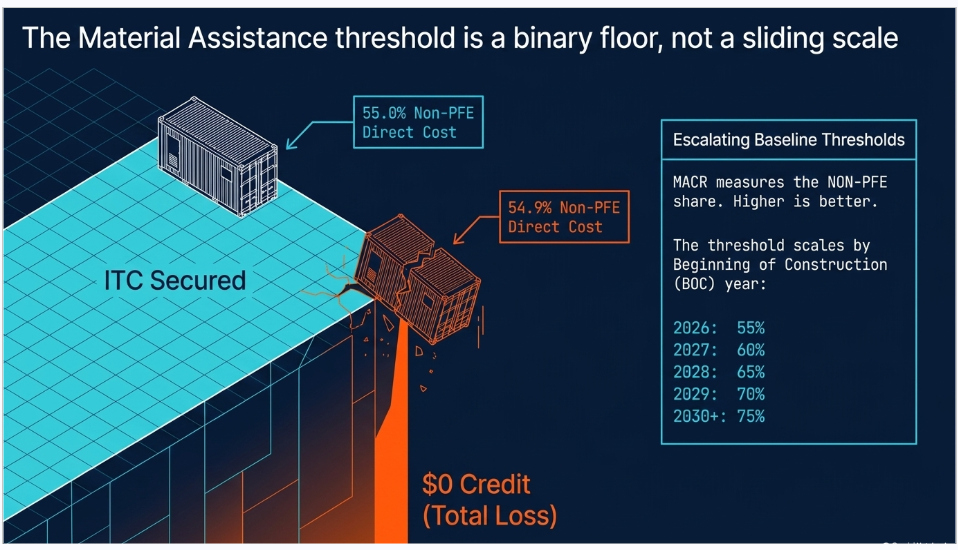
meets or exceeds the applicable threshold. This is the single most common point of confusion in the market — the threshold is a floor on clean content, not a ceiling on PFE content. A 2026 storage project with a MACR of 55.0% passes; a MACR of 54.9% fails, and the entire Section 48E credit is lost.
Note also the cliff structure. There is no partial credit, no proportional reduction, no cure period. The test is binary and it is applied to the
whole energy storage technology.
| Calendar year construction begins | Qualified facility (45Y/48E) | Energy storage technology (48E) |
|---|---|---|
| 2026 | 40% | 55% |
| 2027 | 45% | 60% |
| 2028 | 50% | 65% |
| 2029 | 55% | 70% |
| 2030 and later | 60% | 75% |
The year of beginning of construction fixes the threshold for the life of the project. A project that establishes a 2026 construction start is tested at 55% even if it is placed in service in 2029. This makes beginning of construction the single highest-leverage variable in storage PFE planning — see Section 6.
4.3 For reference — Section 45X eligible component thresholds
Relevant to storage developers because it shapes what your domestic and allied suppliers can economically build:
| Eligible component | 2026 | 2027 | 2028 | 2029 | 2030+ |
|---|---|---|---|---|---|
| Qualifying battery components | 60% | 65% | 70% | 80% | 85% |
| Inverters | 50% | 55% | 60% | 65% | 70% |
| Solar energy components | 50% | 60% | 70% | 80% | 85% |
| Wind energy components | 85% | 90% | — | — | — |
| Applicable critical minerals | 0% | 0% | 0% | 0% | 25% (2030) rising to 50% (2033+) |
The critical minerals schedule is worth noting: the threshold is zero through 2029, then ramps. Treasury is directed to issue critical-minerals threshold guidance by December 31, 2027.
5. Notice 2026-15: How the Calculation Actually Works
Notice 2026-15 (issued February 12, 2026) provides interim guidance and previews forthcoming proposed regulations. Taxpayers may rely on it for any Section 45Y or 48E qualified facility or EST beginning construction after December 31, 2025, until 60 days after publication of the forthcoming PFE safe harbor tables. Comments were due March 30, 2026.
5.1 The three-step Clean Electricity MACR
Step 1 — Identify
Determine the manufactured products (MPs) and manufactured product components (MPCs) incorporated into the EST. The regime requires looking two levels up the supply chain: the major equipment assemblies, and the components that go directly into them.
Step 2 — Cost
Determine the direct costs for each MP and MPC. Critically, the definition depends on whether the taxpayer produced or acquired the item:
- If the taxpayer produces the MP, direct costs include direct material and labor costs under Treas. Reg. § 1.263A-1(e)(2)(i)(A) and (B).
- If the taxpayer acquires the MP, direct costs are simply the taxpayer's acquisition cost for the MP and its incorporated MPCs.
For a typical storage developer buying integrated AC or DC blocks, this means acquisition cost is the starting point — but the developer still has to disaggregate what sits inside that acquisition cost to identify the MPCs and their PFE status.
Step 3 — Subtract
Reduce total direct costs by the costs attributable to PFE-produced MPs and MPCs, and divide by total direct costs.
A favorable and important nuance: if an MP is PFE-produced but contains MPCs that are not PFE-produced, only the PFE-produced MPCs count against the MACR. The taxpayer retains credit for non-PFE content inside a PFE-produced assembly. This is not an all-or-nothing rule at the assembly level, and it materially changes procurement strategy — a non-PFE cell inside a PFE-assembled module is not wasted.
5.2 The three interim safe harbors
None is mandatory. They can, in appropriate cases, be combined.
Identification Safe Harbor
Permits the taxpayer to use the domestic content safe harbor tables in existing IRS guidance (Notice 2025-08 sections 5.05, 5.06, 6.02 and 7.02; Notice 2024-41 § 3.02 for hydropower and pumped storage; Notice 2023-38 § 3.04 for offshore wind) as an exclusive list of MPs and MPCs. Items not on the list are disregarded. This converts an open-ended supply chain investigation into a bounded, standardized component list — an enormous practical benefit. It is available only for listed technologies.
Cost Percentage Safe Harbor
Available where the Identification Safe Harbor applies. Substitutes the Assigned Cost Percentages from the domestic content tables for fact-specific direct cost determinations:
MACR = (Total Percentage − Total PFE Percentage) ÷ Total Percentage
where Total Percentage is the sum of Assigned Cost Percentages for all listed MPs and MPCs incorporated, and Total PFE Percentage is the sum for those that are PFE-produced.
Two features of this safe harbor deserve emphasis:
- Steel and iron components listed on the tables are disregarded. You cannot improve your MACR under this method by buying domestic racking, foundations or structural steel. That is a real trap for developers accustomed to the domestic content framework, where steel and iron are a separate and highly useful test.
- The “Production” assigned cost percentage is counted as PFE-produced if the MP itself is PFE-produced. This differs from the domestic content rules and, in mixed-source situations, generally shifts the arithmetic in the taxpayer's favor relative to a strict all-or-nothing approach.
Certification Safe Harbor
Permits reliance on supplier certifications to establish (i) whether an item is PFE-produced or PFE-sourced, and (ii) the direct costs attributable to PFE-produced items — provided the taxpayer does not know or have reason to know the certification is inaccurate.
This is the workhorse provision for storage. Two clarifications make it usable:
- Only the manufacturer's PFE status is relevant, not the supplier's or distributor's. A U.S. distributor selling a PFE-manufactured product does not launder the product's status; conversely, a supplier's own corporate structure is not the question.
- The manufacturer's PFE status is generally tested in the year the MP or MPC is purchased. And if the taxpayer had no prior knowledge, a valid certification protects the taxpayer even if the manufacturer is later determined to be a PFE. This is meaningful protection against mid-project list additions.
5.3 Allocation methods
The 10% de minimis allocation. For qualified facilities and ESTs, taxpayers may assign MPs or MPCs of the same type across facilities or ESTs placed in service in the same taxable year without project-specific tracking, so long as the assigned items represent less than 10% of total direct costs of the facility or EST. For portfolio developers moving common components — controls, auxiliary equipment, cabling, protection devices — across sites, this removes a very large tracking burden.
The sub-1 MW BESS allocation method. For ESTs with capacity less than 1 MW(AC) placed in service in the same taxable year, taxpayers may compute an average direct cost for each MP/MPC type and a PFE Production Percentage based on the proportion of those items that were PFE-produced across a specified period, rather than tracking each unit individually.
Specified periods must be at least one whole calendar day, begin on the first day of the taxable year for the first period, be contiguous if shorter than a full taxable year, collectively cover every day of the taxable year, and not exceed the taxable year. Within those constraints there is substantial flexibility — which is exactly what a developer transitioning suppliers mid-year needs.
For commercial and industrial and community-scale storage fleets, this method is transformative. It also relieves the pathological result where an individual small unit fails the threshold because of how components happened to be blended into that specific enclosure.
5.4 Substantiation
A taxpayer using any safe harbor must attach a statement to the applicable form on which the credit is claimed, filed with the annual return for the first taxable year in which the credit is claimed, identifying the specific safe harbor used, the specific safe harbor tables applied (if applicable), and how the safe harbor was applied — for example, whether it was used to identify MPs and MPCs, to determine direct costs, or both.
This is not a checkbox. It is a positive disclosure that frames the examination, and it needs to be supported by a calculation package that can be reconstructed years later.
5.5 Domestic content is not MACR
Because Notice 2026-15 borrows the domestic content tables, there is a strong temptation to treat the domestic content analysis and the MACR analysis as one workstream. They are not the same, and treating them as interchangeable will produce wrong answers.
| Dimension | Domestic content bonus | Clean Electricity MACR |
|---|---|---|
| Question asked | Is it U.S.-manufactured? | Is it PFE-produced? |
| Non-U.S., non-PFE content | Counts against you | Counts for you |
| Steel and iron | Separate test; important | Disregarded under Cost Percentage SH |
| Direct costs (produced) | Material and labor | Material and labor |
| Direct costs (acquired) | — | Acquisition cost |
| Nameplate-capacity weighting | Central to allocation | Not used; binary per listed item, pro rata for mixed-source MPC |
| “Production” line item | Counted only if all listed MPCs are domestic | Counted as PFE if the MP is PFE-produced |
| Consequence of failure | Lose the bonus adder | Lose the entire credit |
A Korean-manufactured cell, a Japanese separator, a German inverter, a Canadian transformer — none of these help your domestic content position, and all of them help your MACR. That asymmetry should drive procurement.
6. Beginning of Construction: The Highest-Leverage Variable
Because the MACR threshold is fixed by the calendar year in which construction begins, and because the material assistance rules do not apply at all to projects that began construction on or before December 31, 2025, beginning of construction (BOC) is where storage developers should concentrate effort.
6.1 The tests available to storage
Storage was not covered by Notice 2025-42, which restricted the 5% safe harbor for wind and for solar facilities above 1.5 MW(AC). Beginning of construction for energy storage continues to be governed by the pre-IRA framework — Notices 2013-29, 2018-59 and 2022-61 — under which both methods remain available:
- Physical Work Test. Physical work of a significant nature, on-site or off-site, with off-site work performed under a binding written contract and the resulting property incorporated into the project. For storage, off-site physical work on custom-manufactured items — a project-specific main power transformer, custom MV switchgear lineups, purpose-built enclosures, custom collection cable — is the usual route. The work must be of a significant nature, judged qualitatively, not by cost.
- 5% Safe Harbor. Paying or incurring 5% or more of total project cost. For accrual-method taxpayers, the 3½-month rule and the economic performance rules govern when costs are treated as incurred, which is why safe-harbor equipment procurement is typically structured around delivery timing and title transfer.
Notice 2026-15 resolved a question that had been open through 2025. For purposes of the prohibited foreign entity rules under Section 7701(a)(51) and the material assistance rules under Section 7701(a)(52), the notice confirms that Notice 2025-42 does not apply. Instead, consistent with the statute, the principles of Notices 2013-29 and 2018-59 — together with subsequently issued guidance clarifying, modifying or updating them, as in effect on January 1, 2025 — govern beginning of construction for PFE and material assistance purposes.
This is a significant clarification with two consequences. First, it removes the concern that FEOC-specific BOC guidance might retroactively narrow the tests. Second, and less obviously, it means the BOC test for PFE purposes is frozen to a January 1, 2025 baseline. Guidance issued after that date does not move the PFE beginning-of-construction line, which insulates the material assistance analysis from the ongoing turbulence in wind and solar BOC guidance.
Both methods are subject to the continuity requirement, with the four-year continuity safe harbor as the practical anchor. A taxpayer using the Physical Work Test satisfies continuity through a continuous program of construction; a taxpayer using the 5% safe harbor through continuous efforts, which expressly allows permits and payments to count.
6.2 The Notice 2025-42 litigation — relevant context, indirect effect
On June 6, 2026, the U.S. District Court for the District of Columbia vacated Notice 2025-42 in its entirety and remanded to Treasury and the IRS, holding the notice arbitrary and capricious under the Administrative Procedure Act — principally for failing to give a reasoned explanation for treating wind and large solar differently from other technologies under a technology-neutral credit, and for failing to account for more than a decade of reliance on the dual-test framework. The vacatur was granted nationwide. An appeal and a possible stay were anticipated, and the court itself acknowledged appellate timing would extend past the July 4, 2026 wind/solar deadline.
For storage, the direct effect is nil — Notice 2025-42 never applied. The indirect effects are worth tracking:
- The court's reasoning cuts against technology-by-technology divergence in BOC rules. That is helpful to storage's continued access to the 5% safe harbor, but it also means Treasury could respond on remand by restricting the 5% safe harbor across the board with a better-reasoned record.
- The vacatur does not disturb the PFE beginning-of-construction position. Notice 2026-15 confirmed that Notice 2025-42 does not apply for Section 7701(a)(51) and (a)(52) purposes, and that the Notice 2013-29 / 2018-59 principles as in effect January 1, 2025 govern. The litigation is about the wind and solar credit deadline, not about material assistance.
- What the vacatur does not change: material assistance and FEOC restrictions, domestic content, prevailing wage and apprenticeship, post-BOC continuity, transferability and elective pay, and general credit eligibility all remain exactly as they were.
Practical posture: run both tracks. Anchor on physical work of a significant nature with an independently sufficient evidentiary record, and treat safe-harbor procurement as reinforcing optionality rather than as the sole foundation.
6.3 What a defensible BOC file contains
- Executed binding written contracts, with the binding-nature analysis documented (damages provisions, limitation clauses, enforceability under governing law).
- Manufacturer work orders, production schedules, shop travelers, serialized progress photographs, and factory acceptance test scheduling for off-site custom work.
- For on-site work: geotechnical completion, foundation excavation and rebar placement, trenching for the MV collection system, grounding grid installation, with dated field reports and daily logs.
- For 5% safe harbor: invoices, proof of payment, title transfer documentation, delivery records, storage arrangements, and a cost model showing the 5% computation against total expected project cost, with headroom against cost escalation.
- A continuity narrative maintained contemporaneously — not reconstructed later.
- Project definition and single-project aggregation analysis. Which units constitute the project matters for both BOC and for the MACR test, since the MACR is applied at the energy storage technology level.
7. Section 48E-Specific Exposure: Recapture and Transferability
7.1 The ten-year recapture rule
Under the OBBBA amendments to Section 50(a), a taxpayer that claims the Section 48E credit and subsequently makes an applicable payment to an SFE under a contract, agreement or arrangement conferring effective control, at any point during the ten years after the property is placed in service, faces 100% recapture of the previously claimed credit — the credit is retroactively reduced to zero in the year the payment occurs, with carryback and carryover adjustments. The rule applies to taxpayers allowed a Section 48E credit for taxable years beginning after July 4, 2027.
Three observations for storage:
First, ten years is longer than most storage LTSAs are short. The standard product in the market is a fifteen- to twenty-year service and augmentation arrangement. The recapture window sits entirely inside the service term.
Second, storage has no PTC alternative. Generation developers concerned about ITC recapture can pivot to Section 45Y, which has no analogous payment-based recapture. Energy storage technology is not eligible for Section 45Y. For storage, the Section 48E ITC is the only credit, and the recapture rule comes with it.
Third, SFE status is not static. The Section 154(b) list is statutory, but the Section 1260H and UFLPA lists are administratively maintained and can be expanded. A supplier that is not an SFE when the supply agreement is signed may become one during the recapture window. The contract has to contemplate that.
7.2 Credit transfer under Section 6418
A taxpayer transferring Section 48E credits under Section 6418 may not transfer to a specified foreign entity. The statutory restriction names SFEs specifically, not FIEs.
In practice, the transfer market has moved well beyond the statutory minimum. Buyers and their advisors are demanding:
- Seller representations as to non-PFE status of the seller and relevant upstream owners, tested as of the last day of the relevant taxable year;
- The MACR calculation package, with supporting supplier certifications;
- Representations that no effective control payment has been made and that no contract in force confers effective control;
- Covenants restricting the entry into or modification of contracts that could confer effective control during the recapture window;
- Indemnification for recapture and disallowance, often backstopped by tax insurance;
- Ongoing reporting during the recapture period.
PFE compliance quality is now priced. A project with a clean, well-documented MACR package and a well-drafted supply and service agreement transacts at a tighter discount than one with a defensible but thinly documented position. The engineering documentation is a financial asset.
8. Procurement and Contracting Playbook
8.1 Specification-stage decisions
- Set the MACR target above the threshold with margin. A 2026 project should target well above 55%, not 55.5%. Cost estimates move, scope changes, change orders happen, and the test is applied to actual direct costs at completion.
- Model the cost stack before selecting the technology. Run the MACR under both the direct cost method and the Cost Percentage Safe Harbor. They give different answers, and the better answer sometimes points to a different equipment configuration. Method selection is a substantive planning decision, not a formality.
- Recognize where substitution is realistic. Power conversion systems, medium-voltage transformers, MV switchgear, protection relays, SCADA and EMS hardware, HVAC, fire detection and suppression, and cabling all have credible non-PFE supply. Cells are the hard problem. Non-covered-nation cell capacity — Korean, Japanese, U.S., European, and increasingly Southeast Asian and Indian — is the pivot point of the entire analysis.
- Do not assume steel helps. Under the Cost Percentage Safe Harbor it is disregarded.
- Disaggregate the integrator. A single line item for “DC block, delivered” is not an answer to Step 1. The integrator has to open the box: cells, modules, racks, BMS, thermal system, fire system, enclosure, DC electrical, each with manufacturer identity and cost.
8.2 Supply agreement provisions
- PFE representations and warranties, given at signing, at each delivery, and at placed-in-service — covering the manufacturer's status under each of the five SFE categories and under the FIE ownership, debt, officer and effective-control prongs.
- Certification obligations in a form that satisfies the Certification Safe Harbor: identifying manufacturer, place of manufacture, PFE status, and direct cost attribution at the MP and MPC level, in a format the taxpayer can attach to its calculation package.
- Cost disclosure and disaggregation rights sufficient to build the MACR, with confidentiality protection for the supplier's commercially sensitive pricing.
- Audit and inspection rights, including factory access and the right to witness FAT — which the owner's engineer should be exercising in any event.
- Change-in-status provisions: notice obligations if the manufacturer or any upstream owner is added to a listed category; a right to substitute equipment; and price protection for the substitution.
- Delivery timing and title transfer terms aligned to the BOC strategy and to the taxable year in which the manufacturer's status is tested.
- Indemnification for credit loss attributable to a breach, sized realistically against the credit at risk rather than capped at contract value.
8.3 Structuring to avoid effective control
The goal is a commercial relationship that gives the supplier no authority over key aspects of the project's operation. Areas to scrutinize:
- Operating envelope and dispatch. Warranty terms that condition coverage on operating within defined limits are ordinary and appropriate. Terms that give the OEM approval rights over dispatch decisions, market participation strategy, or state-of-charge management move toward control.
- Software and IP licensing. Perpetual, non-conditional licenses look different from ongoing royalty arrangements with continuing supplier authority. The statute's bona fide purchase-or-sale-of-IP exception is the relevant path, and its scope is one of the open questions Treasury has been asked to clarify.
- O&M and augmentation. Who decides when to augment, what to install, and on what schedule? Owner-controlled augmentation with supplier supply obligations is a different posture than supplier-controlled augmentation.
- Data and remote access. Remote monitoring is normal. Remote control authority — the ability to change setpoints, curtail, or place the asset in a mode — is a control indicator.
- Personnel and key-decision rights. Any right of the supplier to designate operating personnel, or to approve the O&M contractor, warrants review.
None of this means an owner must forgo OEM service. It means the allocation of authority in the LTSA has to be drafted deliberately, with the effective control test in view, and with tax counsel reviewing the operative provisions rather than only the tax representations.
9. The Documentation Package
PFE compliance produces a deliverable, and the deliverable outlives the project's construction phase by a decade. A complete package includes:
- BOM decomposition to the MP and MPC level, mapped to the applicable safe harbor tables where the Identification Safe Harbor is used.
- Cost model reconciling total direct costs, distinguishing produced from acquired items, and tying to the accounting records and eventual ITC basis.
- MACR calculation memorandum — method selected, safe harbors elected, calculations shown, sensitivity to change orders documented.
- Supplier certification register — every certification, with dates, scope, the manufacturer's identity, and the knowledge/reason-to-know analysis supporting reliance.
- Entity status file — the taxpayer's own ownership, debt and officer analysis as of the last day of each relevant taxable year, including upstream tracing to the extent practicable.
- Contract review memorandum — effective control analysis for every agreement with a supplier, licensor or service provider, refreshed on each amendment.
- Beginning of construction file — as described in Section 6.3.
- Placed-in-service reconciliation — confirming the as-built configuration matches the modeled configuration, with change orders reflected in the final MACR.
- The return statement — prepared and reconciled to the calculation package.
- A monitoring protocol for the recapture window — periodic re-screening of suppliers against listed categories, and a payment review process before any new or amended agreement with an equipment supplier.
10. Open Questions Heading Into 2027
Notice 2026-15 was deliberately partial. The following remain unresolved, and each carries planning implications:
- PFE and SFE status determinations. Treasury deferred the definitional rules to proposed regulations. Ownership attribution through complex structures, the treatment of minority foreign investors, and whether a certification safe harbor will be extended to entity status (as it was to material assistance) are all open.
- Whether a “no-look-through” approach is adopted. Commentators have noted signals in other Treasury guidance suggesting a domestic-blocker-style simplification could be considered. Adoption would substantially reduce diligence burden in project finance structures.
- “Effective control” and the definition of a licensing agreement. The most consequential open item for storage, given the LTSA and software licensing exposure described above.
- Anti-circumvention and anti-abuse rules under Section 7701(a)(51)(D) and (K), which Treasury has said are coming.
- The PFE safe harbor tables, statutorily due December 31, 2026. Whether Treasury issues PFE-specific tables or continues to use the domestic content tables for both purposes is unknown. Either way, positions taken under the interim framework will need to be re-tested against the published tables. Projects beginning construction more than 60 days before the tables are published may continue to rely on the domestic content tables for the Clean Electricity MACR.
- Critical minerals thresholds, due by December 31, 2027.
- Qualified interconnection property. How interconnection costs included in ITC basis interact with the MACR is not fully settled — a live question for storage projects with substantial POI substation, MV/HV transformer and transmission line scope.
- Incremental capacity and additions. How the material assistance rules apply to capacity additions and augmentation at an existing facility is not fully addressed.
- The BOC litigation trajectory and whether Treasury reissues BOC guidance on remand with broader technology scope.
11. How Keentel Engineering Supports PFE Compliance
PFE compliance sits at the intersection of tax law, procurement, and electrical engineering. Tax counsel owns the legal conclusions. What the project needs alongside counsel is an engineering organization that can decompose the plant into its manufactured products and components, price them defensibly, evaluate substitution options against real electrical performance requirements, and produce documentation that survives diligence.
Keentel Engineering supports storage developers, sponsors and investors with:
- Bill of materials decomposition and MP/MPC mapping for AC-block, DC-block and modular BESS architectures, aligned to the applicable safe harbor tables.
- MACR modeling and sensitivity analysis under both the direct cost method and the Cost Percentage Safe Harbor, including scenario testing across supplier configurations and construction-start years.
- Equipment substitution engineering — evaluating non-PFE alternatives for power conversion systems, MV transformers, switchgear, protection and control, and auxiliary systems against short-circuit duty, protection coordination, grounding, arc-flash, harmonic and ride-through requirements, so that a compliance-driven substitution does not create an electrical performance or code compliance problem.
- Owner's engineer scope: specification development with PFE provisions embedded, technical bid evaluation, factory audits and FAT witnessing, and supplier documentation review.
- Beginning of construction technical documentation — physical work evidence packages, off-site custom manufacturing verification, and construction continuity records.
- Interconnection and POI engineering for storage projects, including system impact study support, protection and control design, and substation design from 30/60/90 to IFC.
- Diligence support for tax equity investors, credit transferees and lenders — independent technical review of the MACR package, BOM substantiation and BOC evidence.
Our four service lines — Electrical Design,
Power System Studies, NERC Compliance, and QA/QC — cover the technical scope from POI to the battery terminal.
Frequently Asked Questions
Scope and applicability
1. Do the PFE rules apply to my storage project if construction began in 2025?
The material assistance rules apply only to qualified facilities and energy storage technologies the construction of which begins after December 31, 2025. A project with a properly established and documented 2025 construction start is outside the MACR test entirely. The entity-level rules are different — they turn on the taxpayer's own status in the taxable year and apply to taxable years beginning after July 4, 2025 regardless of when construction began. And the Section 48E prohibited-payment recapture rule applies based on when the credit is claimed, not when construction started.
2. Do these rules apply to legacy Section 48 or Section 45 credits?
No. The PFE regime attaches to the technology-neutral credits under Sections 45Y and 48E and to the Section 45X manufacturing credit. Legacy credits under Sections 45 and 48 — generally available for projects under construction for tax purposes by the end of 2024 — are not subject to them.
3. Is energy storage eligible for Section 45Y as an alternative to Section 48E?
No. Energy storage technology is eligible for the Section 48E investment credit only. Section 45Y is a production credit for electricity produced at a qualified facility. This is why the “elect the PTC to avoid ITC recapture” strategy available to some generation projects is unavailable to storage.
4. Did OBBBA impose the 2027 placed-in-service deadline on storage?
No. The accelerated termination applied to wind and solar. Storage under Section 48E remains on the longer schedule, with the credit stepping down for projects beginning construction in 2034 and later and terminating for construction starting in 2036 and after. Storage's constraint is PFE compliance, not the credit deadline.
5. Do the rules apply to behind-the-meter and commercial-scale storage?
Yes — the material assistance rules apply to energy storage technology regardless of size. Notice 2026-15 does, however, provide a materially simpler allocation method for ESTs under 1 MW(AC) placed in service in the same taxable year (see Q19).
6. Does the MACR test apply project-by-project or portfolio-wide?
The test is applied at the level of the qualified facility or energy storage technology. Portfolio-level relief exists only where the specific allocation methods apply — the 10% de minimis rule and the sub-1 MW method — and each has its own conditions.
Entity status
7. What exactly is a “covered nation”?
China, Russia, Iran and North Korea, as defined by cross-reference to Title 10 of the U.S. Code.
8. Which battery companies are specified foreign entities by statute?
Section 154(b) of the FY2024 NDAA names CATL, BYD, Envision Energy, EVE Energy, Gotion High-Tech, Hithium Energy Storage Technology, and any successor to those entities. Because this listing is statutory, it is not subject to a facts-and-circumstances argument.
9. My developer entity has a minority foreign investor. Are we a foreign-influenced entity?
It depends on whether that investor is a specified foreign entity and on the thresholds: 25% ownership by a single SFE, 40% aggregate SFE ownership, 15% of debt held by SFEs, or direct authority to appoint a covered officer. Ownership below those thresholds by an SFE, or ownership at any level by a non-SFE foreign investor, does not by itself create FIE status. The attribution and tracing rules are where the difficulty lies, and Treasury has deferred those to proposed regulations.
10. Does the public-company exception solve this for a listed sponsor?
Only partially. The ownership prongs are modified for publicly traded entities and their 80%-controlled subsidiaries, keyed to beneficial ownership reported under Rule 13d-3 or an equivalent foreign rule. But publicly traded entities remain fully subject to the effective control payment rules and to the material assistance rules. The relief is narrower than it is often assumed to be.
11. When is entity status tested?
Generally as of the last day of the taxable year. That timing has planning implications — for equity transfers, debt refinancings, and board composition changes contemplated near year-end.
12. Does 15% SFE-held debt really disqualify us?
The debt prong is a real and often-overlooked trigger. It looks to debt held in the aggregate by one or more SFEs. Sponsors should screen not only equity but the full capital stack, including any participations and any debt held at the project company level.
MACR mechanics
13. Higher MACR is better, correct?
Correct, and this is the most common misunderstanding in the market. The MACR expresses the non-PFE share of direct costs. The project qualifies if the MACR meets or exceeds the year's threshold. For a 2026 storage project, the MACR must be at least 55%.
14. What is the consequence of missing the threshold by a small margin?
Total loss of the Section 48E credit for that energy storage technology. There is no proration and no partial credit. This is why margin above the threshold is essential.
15. Does the MACR include labor, EPC cost, and civil work?
The Clean Electricity MACR is built on the direct costs of manufactured products and manufactured product components. For items the taxpayer produces, direct costs include direct material and labor under Treas. Reg. § 1.263A-1(e)(2)(i)(A) and (B). For items the taxpayer acquires — the normal case for a developer buying equipment — the measure is acquisition cost. Site civil work and general construction labor are not manufactured products.
16. If a PFE assembles a module but the cells inside are not PFE-produced, do I lose the whole module cost?
No. Only the PFE-produced components count against the MACR. You retain credit for the non-PFE content inside a PFE-produced assembly. Under the Cost Percentage Safe Harbor, however, note that the “Production” assigned cost percentage is treated as PFE-produced if the MP itself is PFE-produced.
17. Whose status matters — the manufacturer's or the supplier's?
The manufacturer's. Notice 2026-15 clarified this. Buying a PFE-manufactured product through a U.S. distributor does not change its status. The manufacturer's status is generally tested in the year the item is purchased.
18. How deep into the supply chain must I look?
Two levels for Sections 45Y and 48E: the manufactured products incorporated into the project, and the manufactured product components that go directly into those manufactured products. You are not required to trace to raw materials for the Clean Electricity MACR. Section 45X manufacturers have a separate constituent-materials analysis.
19. What is the sub-1 MW BESS allocation method and who can use it?
It applies to energy storage technologies with capacity less than 1 MW(AC) placed in service in the same taxable year. Instead of unit-by-unit tracking, the taxpayer computes an average direct cost for each MP/MPC type and a PFE Production Percentage across a self-selected “specified period.” The specified periods must be at least one calendar day, start on the first day of the taxable year for the first period, be contiguous if shorter than the year, collectively cover the entire taxable year, and not exceed it. For distributed and C&I fleets this is the most valuable provision in the notice.
20. What is the 10% de minimis allocation?
For qualified facilities and ESTs, MPs or MPCs of the same type may be assigned across projects placed in service in the same taxable year without project-specific tracking, provided the assigned items represent less than 10% of total direct costs of the facility or EST.
Safe harbors
21. Do I have to use a safe harbor?
No. The direct cost method without any safe harbor remains available. The safe harbors are elective, and in appropriate cases can be combined. Which produces the better answer is a modeling question, not a doctrinal one — run both.
22. What does the Identification Safe Harbor actually do for me?
It converts an open-ended supply chain investigation into a bounded one. Using the domestic content safe harbor tables as an exclusive list, items not on the list are disregarded. This is a significant reduction in diligence scope, available for listed technologies.
23. Can I improve my MACR by sourcing domestic steel and racking?
Not under the Cost Percentage Safe Harbor — listed steel and iron components are disregarded for that method. This is a meaningful departure from the domestic content framework and catches developers who assume the two analyses run in parallel.
24. How much protection does a supplier certification actually give me?
Substantial, subject to a knowledge standard. You may rely on a certification to establish PFE status and direct cost attribution provided you do not know and do not have reason to know it is inaccurate. If you had no prior knowledge and the manufacturer is later determined to be a PFE, the certification protects you. The corollary is that “reason to know” is a real standard — a certification is not a substitute for reasonable diligence where facts are available.
25. What do I file with my return?
A statement attached to the applicable form on which the credit is claimed, with the annual return for the first taxable year in which the credit is claimed, identifying the safe harbor used, the specific tables applied, and how the safe harbor was applied.
26. What happens when the PFE safe harbor tables are published?
Treasury is statutorily directed to publish them by December 31, 2026. Reliance on Notice 2026-15 for Clean Electricity MACR purposes runs until 60 days after publication. Projects beginning construction more than 60 days before publication may continue to rely on the domestic content tables. Positions taken under the interim framework should nevertheless be stress-tested against a scenario in which the published tables assign different cost percentages.
Beginning of construction
27. Can storage still use the 5% safe harbor?
Yes. Notice 2025-42 applied only to wind and to solar facilities above 1.5 MW(AC). Beginning of construction for storage continues to be governed by Notices 2013-29, 2018-59 and 2022-61, under which both the Physical Work Test and the 5% safe harbor are available, subject to the continuity requirement.
28. Does the June 2026 vacatur of Notice 2025-42 change anything for storage?
Not directly. Its relevance is indirect and forward-looking: the court's reasoning disfavors unexplained technology-by-technology divergence in BOC rules, which cuts in storage's favor — but Treasury could respond on remand with better-reasoned guidance of broader scope, and the decision was expected to be appealed. Storage developers should not build a position that depends on the vacatur holding.
29. Which beginning-of-construction rules govern for PFE purposes specifically?
Notice 2026-15 answered this. For purposes of Section 7701(a)(51) and the material assistance rules under Section 7701(a)(52), Notice 2025-42 does not apply. The principles of Notices 2013-29 and 2018-59, together with subsequent guidance clarifying or modifying them as in effect on January 1, 2025, govern. In practical terms, the PFE beginning-of-construction test is frozen to a January 1, 2025 baseline and is insulated from later changes to wind and solar BOC guidance. Portfolios resting on a marginal construction start should still be documented to a standard that anticipates scrutiny — the substantive tests have not been relaxed.
30. Does the construction-start year fix my threshold permanently?
Yes. A project beginning construction in 2026 is tested at 55% regardless of when it is placed in service. This is the strongest argument for accelerating construction start where the supply chain position is otherwise marginal.
Recapture, transferability and contracting
31. What triggers the ten-year recapture?
An applicable payment to a specified foreign entity, made within ten years after the property is placed in service, under a contract or arrangement that entitles the SFE to exercise effective control. The consequence is 100% recapture — the credit is reduced to zero in the year of the payment, with carryback and carryover adjustments. It applies to taxpayers allowed a Section 48E credit for taxable years beginning after July 4, 2027.
32. Does a routine equipment purchase trigger it?
The rule targets payments under arrangements conferring effective control — not ordinary arm's-length purchases of goods. A one-time purchase of equipment on ordinary commercial terms is a different thing from an ongoing licensing or service relationship with continuing supplier authority. Where the line falls in specific LTSA and software license structures is precisely what Treasury has not yet clarified, which is why conservative drafting is warranted now.
33. Is a long-term service agreement with a Chinese OEM automatically fatal?
Not automatically. The question is whether the agreement confers effective control over the energy storage technology — authority over key aspects of operation — and whether payments are made under such an arrangement. The exposure is real and it is storage-specific, because the payment stream runs the length of the recapture window. Every LTSA, warranty administration agreement, software license, augmentation agreement and remote-services arrangement with an SFE counterparty should be reviewed against the effective control test by tax counsel.
34. Can I transfer Section 48E credits from a storage project?
Yes, under Section 6418, but not to a specified foreign entity. The statutory restriction names SFEs. Separately, the transfer market imposes its own requirements: MACR documentation, PFE representations, effective control covenants, indemnities and often tax insurance.
35. What if a supplier becomes a listed entity after I have contracted?
This is a foreseeable scenario, because the Section 1260H and UFLPA lists can be expanded administratively. Two protections matter: a valid supplier certification obtained without knowledge or reason to know of inaccuracy protects the material assistance position even if the manufacturer is later determined to be a PFE; and contractual change-in-status provisions with substitution rights and price protection protect the commercial position. The recapture exposure on future payments to a newly listed SFE is a separate problem that requires an exit or restructuring mechanism in the service agreement.
36. Should the tax representations sit only in the tax section of the supply agreement?
No. The effective control analysis turns on the operative commercial provisions — dispatch rights, approval rights, software license terms, augmentation decision authority, remote access scope. Tax counsel should review those provisions, not only the representations. A clean tax representation attached to a control-conferring operating structure does not help.
Practical planning
37. What is a realistic MACR target for a 2026 storage project?
Target meaningfully above 55% — the specific margin depends on the volatility of your cost stack, the maturity of your supplier commitments, and whether change orders are likely. The test is applied to actual direct costs at completion, and cost movement between financial close and mechanical completion is normal.
38. Where is the biggest lever in the BESS cost stack?
Cells and modules, because they typically dominate manufactured-product direct cost and are the most PFE-concentrated. Securing non-covered-nation cell supply is the highest-value action a storage developer can take on PFE compliance. Substitutions in power conversion, transformers, switchgear, protection, controls and auxiliaries help — but they generally cannot carry a project across the threshold on their own if the cells are PFE-produced.
39. Does a compliance-driven equipment substitution create engineering risk?
It can, and it is regularly underestimated. Swapping a PCS, a transformer or a switchgear lineup changes short-circuit contribution, protection coordination, grounding, arc-flash incident energy, harmonic performance, control interfaces, and grid-code ride-through behavior. Every substitution should be re-verified against the interconnection agreement, the applicable studies, and the utility's protection and control requirements before it is committed.
40. Where should we start?
With three things, in this order: (1) establish and document your beginning-of-construction position, because it fixes your threshold; (2) build the BOM decomposition and MACR model, because you cannot negotiate a supply agreement intelligently without knowing where you stand; and (3) get the supply and service agreement terms right, because the contract is what governs your position for the next decade.
Primary Authority
The analysis in this brief rests on the following primary sources. Readers should confirm the current status of each, as the regime is actively developing.
Statute
- One, Big, Beautiful Bill Act, Pub. L. No. 119-21, 139 Stat. 72 (July 4, 2025) — §§ 70512, 70513 and related provisions.
- IRC § 7701(a)(51) — definitions of prohibited foreign entity, specified foreign entity, foreign-influenced entity, foreign-controlled entity, effective control, covered nation; control and attribution rules; publicly traded entity exceptions.
- IRC § 7701(a)(52) — material assistance from a prohibited foreign entity; material assistance cost ratio; threshold percentages; safe harbor table authority; certification requirements.
- IRC § 48E — clean electricity investment credit, including energy storage technology; PFE restrictions.
- IRC § 45Y — clean electricity production credit; PFE restrictions.
- IRC § 45X — advanced manufacturing production credit; eligible components; PFE restrictions.
- IRC § 50(a) — recapture, as amended to add the ten-year prohibited-payment recapture applicable to § 48E.
- IRC § 6418 — transfer of credits; prohibition on transfer to a specified foreign entity.
- Treas. Reg. § 1.263A-1(e)(2)(i)(A), (B) — direct material and direct labor cost definitions incorporated by reference into the MACR.
- NDAA FY2021, Pub. L. 116-283 — § 9901(8) (foreign entity of concern) and § 1260H (Chinese military companies).
- Uyghur Forced Labor Prevention Act, Pub. L. 117-78, § 2(d)(2)(B) — entity lists.
- NDAA FY2024, Pub. L. 118-31, § 154(b) — statutorily named battery entities.
- 10 U.S.C. § 4872(f)(2) — definition of covered nation.
IRS guidance
- Notice 2026-15 (Feb. 12, 2026) — Guidance to Apply Interim Safe Harbors for Purposes of Determining a Taxpayer's Material Assistance from a Prohibited Foreign Entity; Other Prohibited Foreign Entity Guidance. The controlling interim guidance. Available at irs.gov/pub/irs-drop/n-26-15.pdf
- Notice 2025-08 — domestic content elective safe harbor; source of the safe harbor tables incorporated by Notice 2026-15 (§§ 5.05, 5.06, 6.02, 7.02).
- Notice 2024-41 — domestic content; § 3.02 tables for hydropower and pumped hydropower storage.
- Notice 2023-38 — domestic content; § 3.04 for offshore wind.
- Notice 2025-42 (Aug. 15, 2025) — beginning of construction for wind and solar. Vacated June 6, 2026. Confirmed by Notice 2026-15 as inapplicable for PFE and material assistance purposes.
- Notices 2013-29, 2018-59 and 2022-61 — the beginning-of-construction framework that governs energy storage, and that governs beginning of construction for PFE and material assistance purposes as in effect January 1, 2025.
Executive action and litigation
- Executive Order 14315, Ending Market Distorting Subsidies for Unreliable, Foreign-Controlled Energy Sources (July 7, 2025).
- Oregon Environmental Council v. IRS, No. 1:25-cv-4400 (D.D.C. June 6, 2026) — vacating Notice 2025-42 nationwide and remanding to Treasury and the IRS.
Pending
- Proposed regulations on PFE status, effective control, and the MACR — announced in Notice 2026-15; comments were due March 30, 2026.
- PFE safe harbor tables — statutorily due December 31, 2026.
- Applicable critical minerals threshold guidance — statutorily due December 31, 2027.
Disclaimer
This document is provided by Keentel Engineering LLC for general informational and educational purposes. It addresses engineering, procurement and documentation practices associated with federal clean energy tax credit compliance. It is not tax advice, legal advice, or an opinion on which any taxpayer may rely. Keentel Engineering is not a law firm or an accounting firm. Determinations of prohibited foreign entity status, material assistance cost ratio compliance, beginning of construction, credit eligibility, recapture exposure and transferability must be made by qualified tax counsel and accounting advisors based on the specific facts of each taxpayer and project.
The prohibited foreign entity regime is in an early and actively developing stage of implementation. Treasury and the IRS have stated their intention to issue proposed regulations and additional guidance, including safe harbor tables. Statutory listings may be amended and administrative lists may be expanded. Litigation affecting related guidance is ongoing. Readers should confirm the current state of the law before acting.
Keentel Engineering LLC is an independent engineering consultancy and is not affiliated with, endorsed by, or acting on behalf of any government agency, standards body, utility, transmission provider, equipment manufacturer, software vendor, or other organization referenced in this document. All third-party names are used for identification purposes only.
© 2026 Keentel Engineering LLC. All rights reserved.

About the Author:
Sandip "Sonny" R. Patel, P.E.
IEEE Senior Member · Founder & CEO, Keentel Engineering
In 1995, Sonny Patel earned his Electrical Engineering degree from the University of Illinois. But degrees don't build legacies — action does.
For three decades, he has worked the power industry from every side of the table: 16 years as a utility engineer at Exelon/Commonwealth Edison; generation leadership across hydroelectric, industrial steam turbine, and a 9 GW renewable fleet; NERC Regional Entity Senior Compliance Engineer and Audit Team Lead, auditing some of the nation's largest utilities; and testing and commissioning lead on equipment up to 765 kV — the very top of the North American grid.Utility. Generator. Regulator. Consultant. Few engineers have seen all four seats. Fewer still have sat in them.
His experience spans nuclear, hydro, conventional generation, renewables, oil and gas, mining — and today's data centers, where he is authoring a three-book series on data center design. He is a Licensed Professional Engineer in six states and a Licensed Electrical Contractor in Florida (Unlimited EC) — he doesn't just design the work; he's qualified to stand behind its execution.Today, as Founder and CEO of Keentel Engineering, Sonny leads a nationwide team of engineers delivering substation design, power system studies, NERC compliance, and commissioning — done right, coast to coast.Three decades. Every side of the table. One standard: accountable engineering.
Services

Let's Discuss Your Project
Let's book a call to discuss your electrical engineering project that we can help you with.
About the Author:
Sandip "Sonny" R. Patel, P.E.
IEEE Senior Member · Founder & CEO, Keentel Engineering
In 1995, Sonny Patel earned his Electrical Engineering degree from the University of Illinois. But degrees don't build legacies — action does.
For three decades, he has worked the power industry from every side of the table: 16 years as a utility engineer at Exelon/Commonwealth Edison; generation leadership across hydroelectric, industrial steam turbine, and a 9 GW renewable fleet; NERC Regional Entity Senior Compliance Engineer and Audit Team Lead, auditing some of the nation's largest utilities; and testing and commissioning lead on equipment up to 765 kV — the very top of the North American grid.
Utility. Generator. Regulator. Consultant. Few engineers have seen all four seats. Fewer still have sat in them.
His experience spans nuclear, hydro, conventional generation, renewables, oil and gas, mining — and today's data centers, where he is authoring a three-book series on data center design. He is a Licensed Professional Engineer in six states and a Licensed Electrical Contractor in Florida (Unlimited EC) — he doesn't just design the work; he's qualified to stand behind its execution.
Today, as Founder and CEO of Keentel Engineering, Sonny leads a nationwide team of engineers delivering substation design, power system studies, NERC compliance, and commissioning — done right, coast to coast.Three decades. Every side of the table. One standard: accountable engineering.
Leave a Comment
Thank you for contacting us.
We will get back to you as soon as possible.
We will get back to you as soon as possible.
Oops, there was an error sending your message.
Please try again later.
Please try again later.
Related Posts
By SANDIP R PATEL
•
October 3, 2026
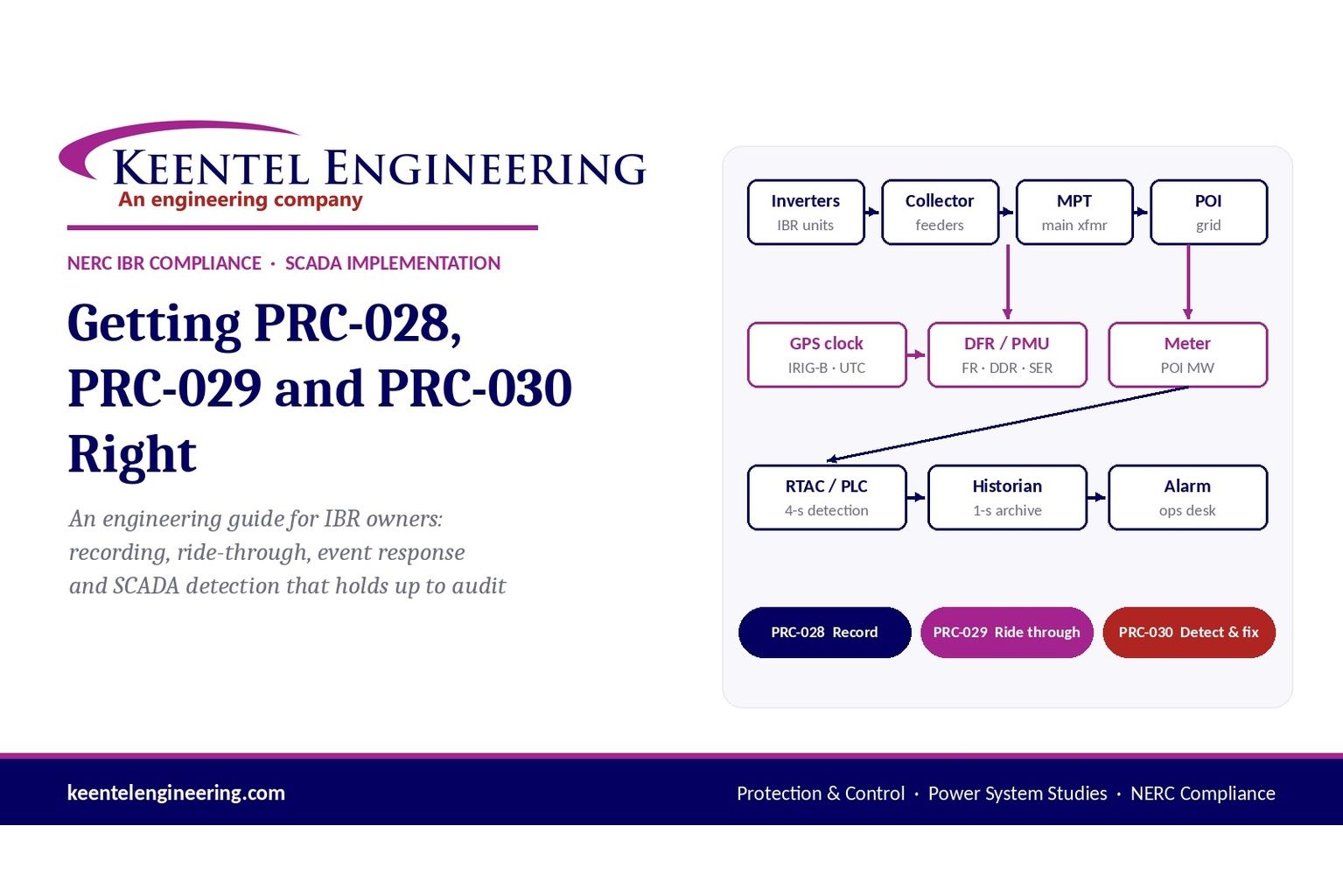
Engineering guide to PRC-028 disturbance recording, PRC-029 ride-through and PRC-030 event detection for inverter-based resources.
By SANDIP R PATEL
•
October 3, 2026
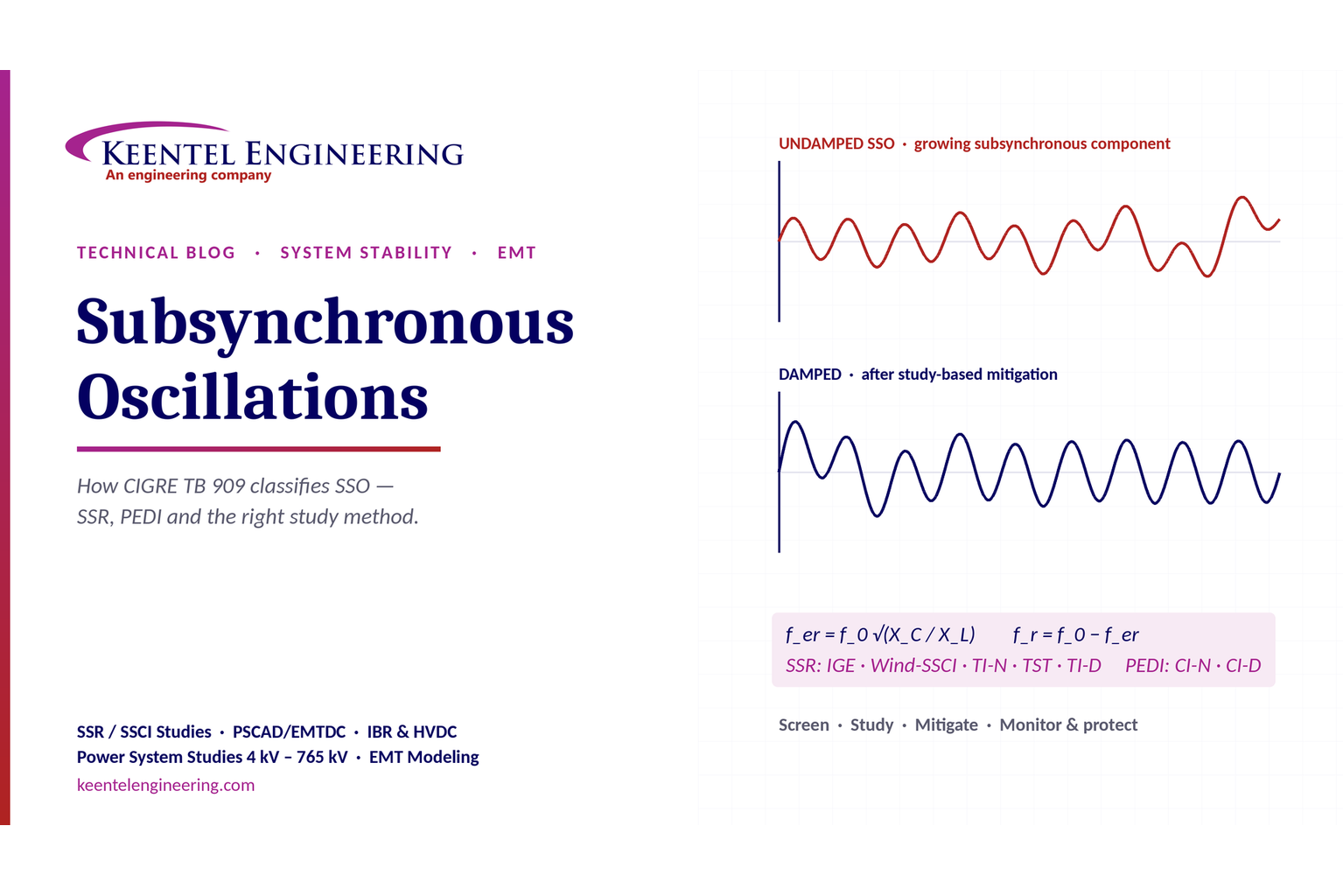
A practical guide to SSO classification, SSR, PEDI, Wind-SSCI, EMT analysis, mitigation and protection based on CIGRE TB 909.
By SANDIP R PATEL
•
October 3, 2026
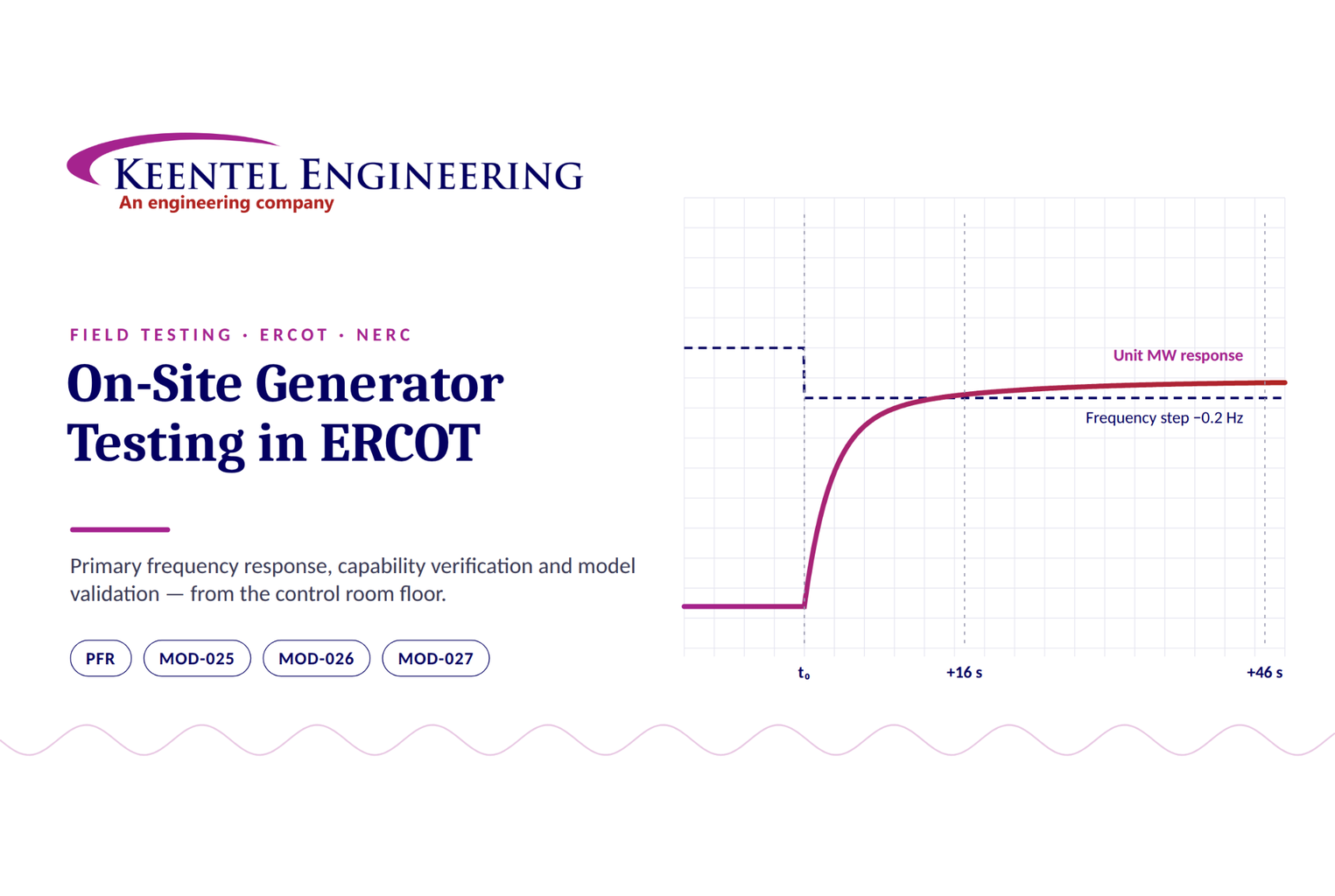
Learn ERCOT generator testing for PFR, MOD-025 and MOD-026/027, including staged tests, capability verification, dynamic models and field testing.
By SANDIP R PATEL
•
October 3, 2026
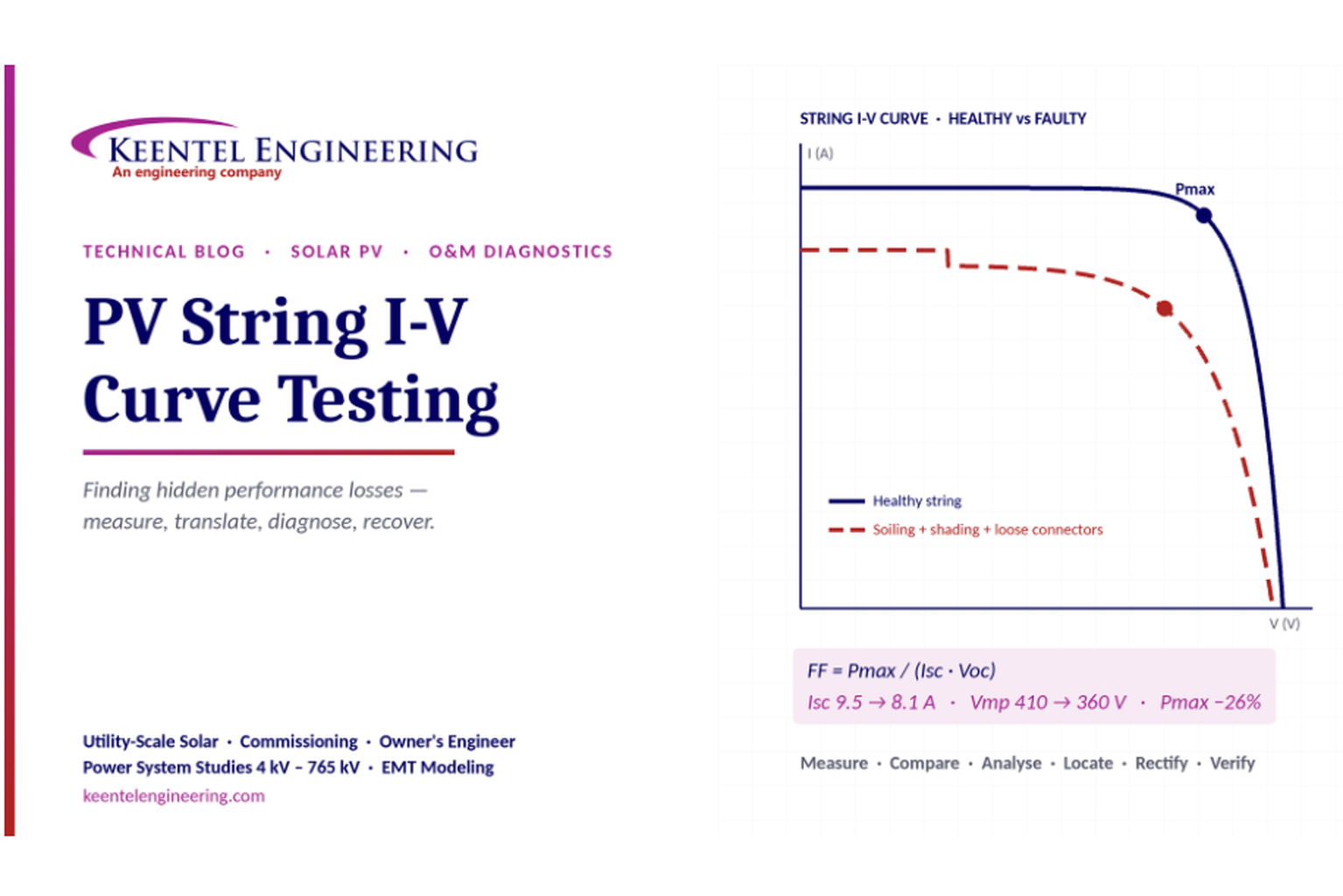
Learn how PV string I-V curve testing identifies hidden solar performance losses, including soiling, shading, mismatch, degradation, and wiring faults.
By SANDIP R PATEL
•
October 3, 2026
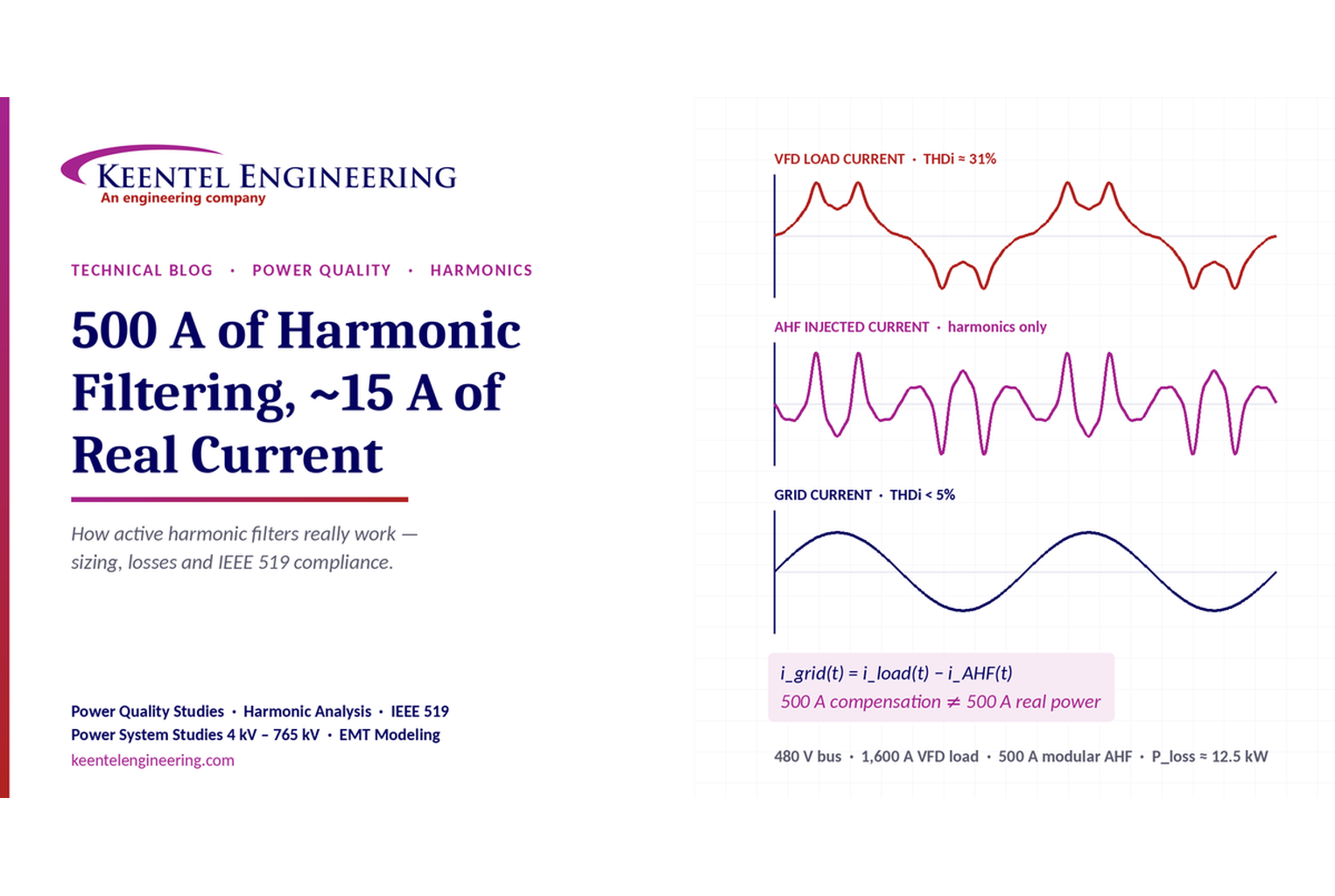
Learn how active harmonic filters work, how to size AHF systems, reduce VFD harmonics, calculate losses, and meet IEEE 519 TDD limits at the PCC.
By SANDIP R PATEL
•
October 3, 2026
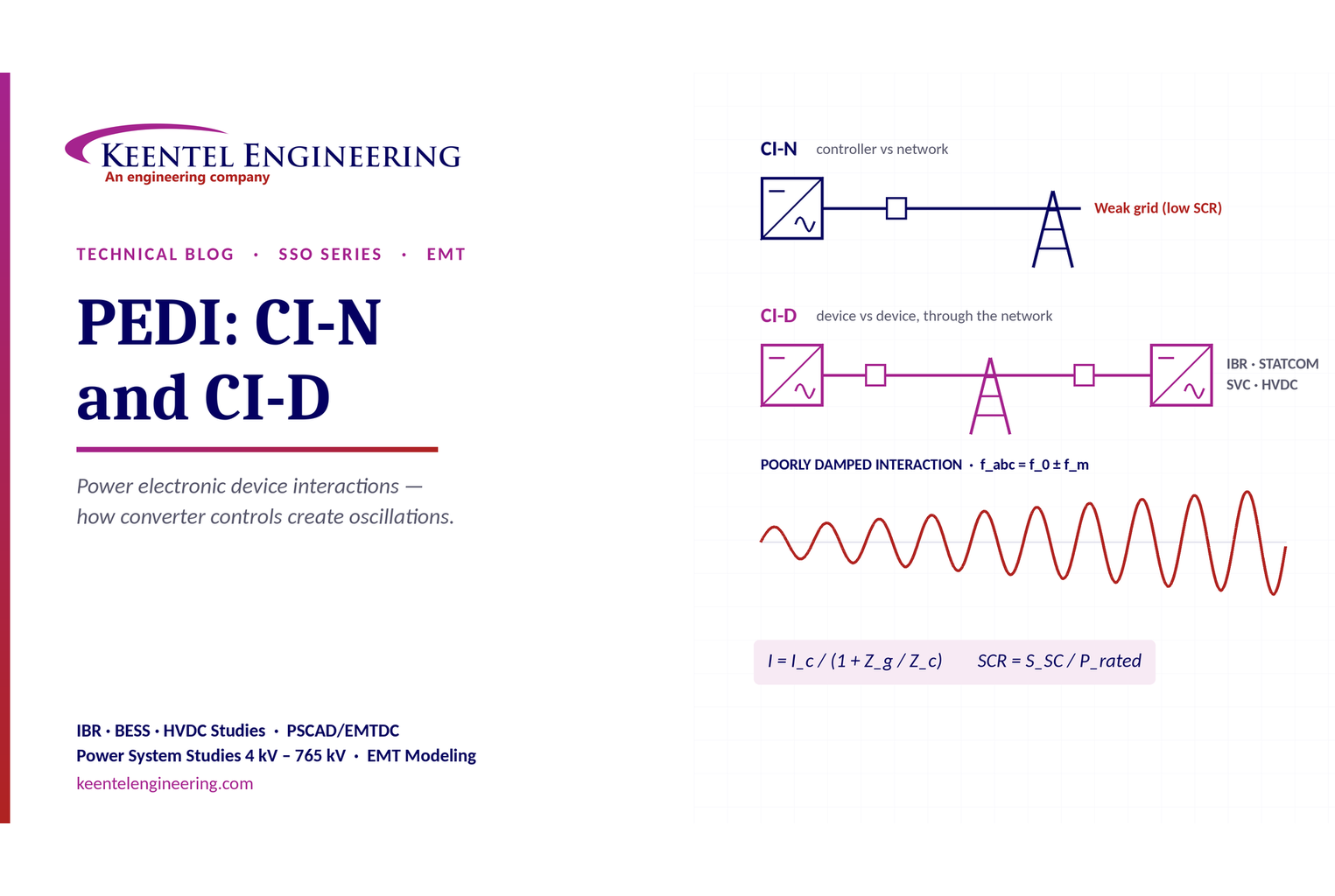
Learn power electronic device interactions (PEDI), including CI-N and CI-D, weak-grid stability, SCR, EMT studies, impedance analysis and mitigation for IBRs.
By SANDIP R PATEL
•
October 3, 2026
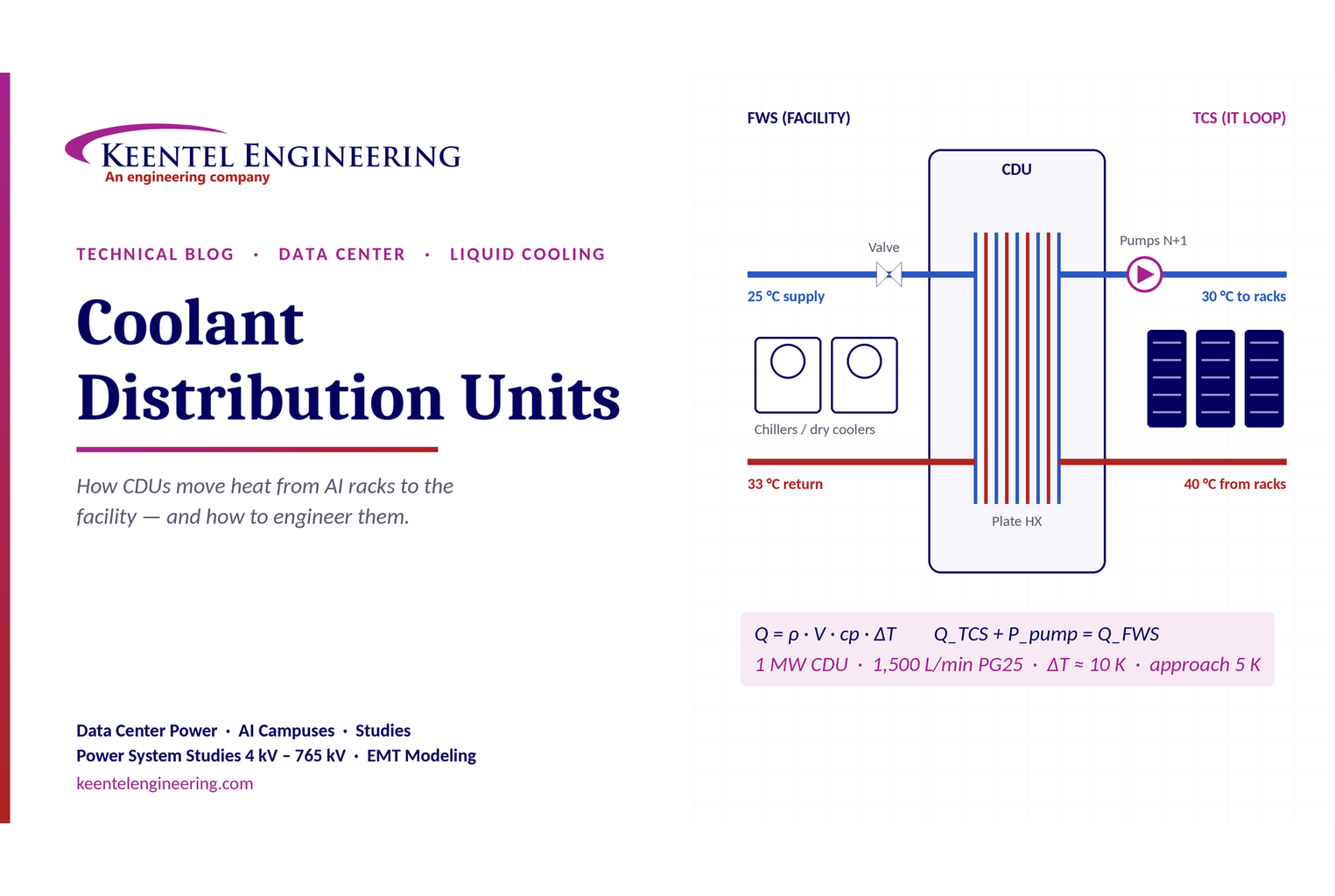
Learn how data center coolant distribution units (CDUs) work, including FWS and TCS loops, heat transfer, sizing, redundancy and liquid cooling for AI data centers.
By SANDIP R PATEL
•
October 3, 2026
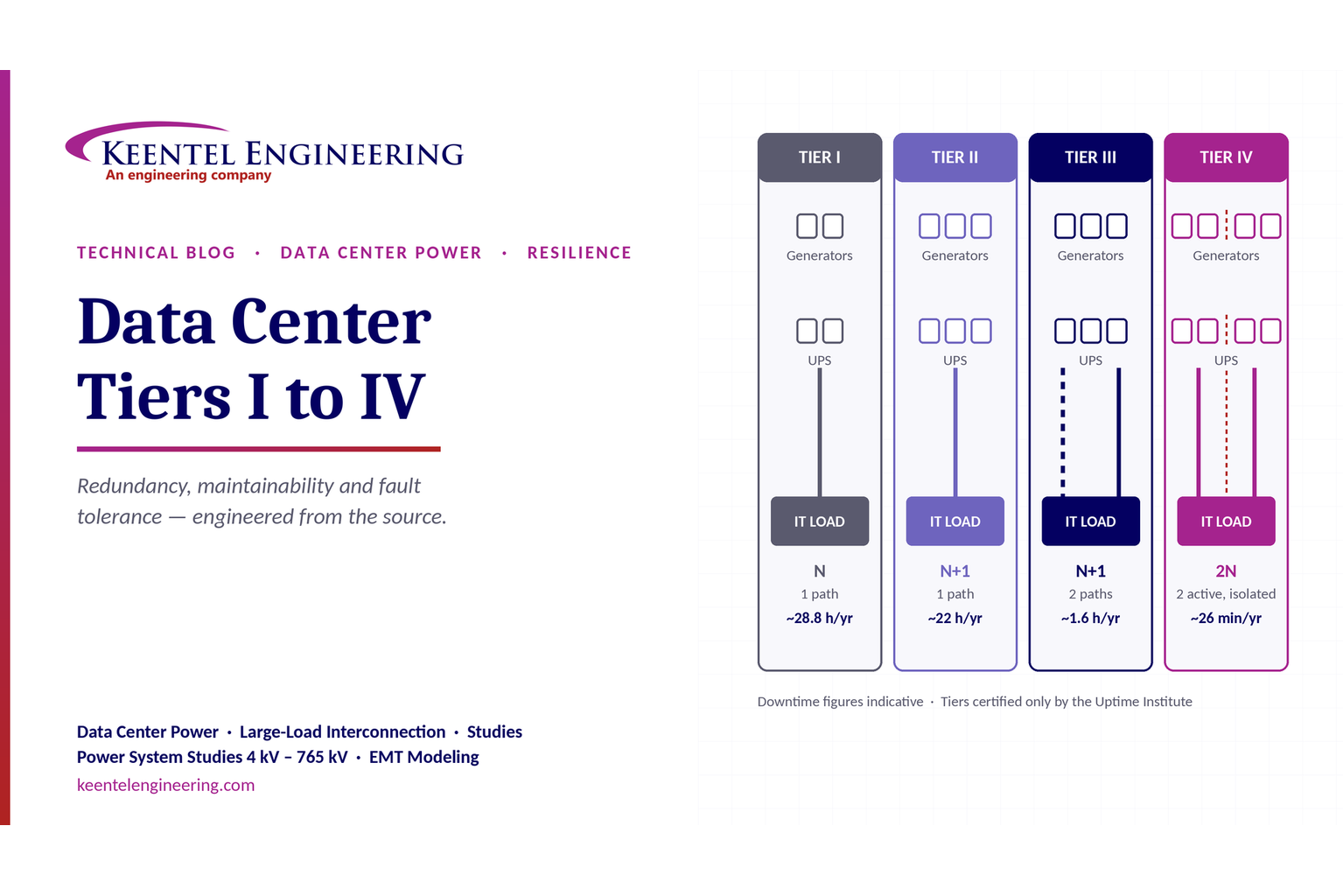
Compare Data Center Tiers I–IV, including redundancy, uptime, Tier III concurrent maintainability, Tier IV fault tolerance, UPS, generators and power design.
By SANDIP R PATEL
•
October 3, 2026
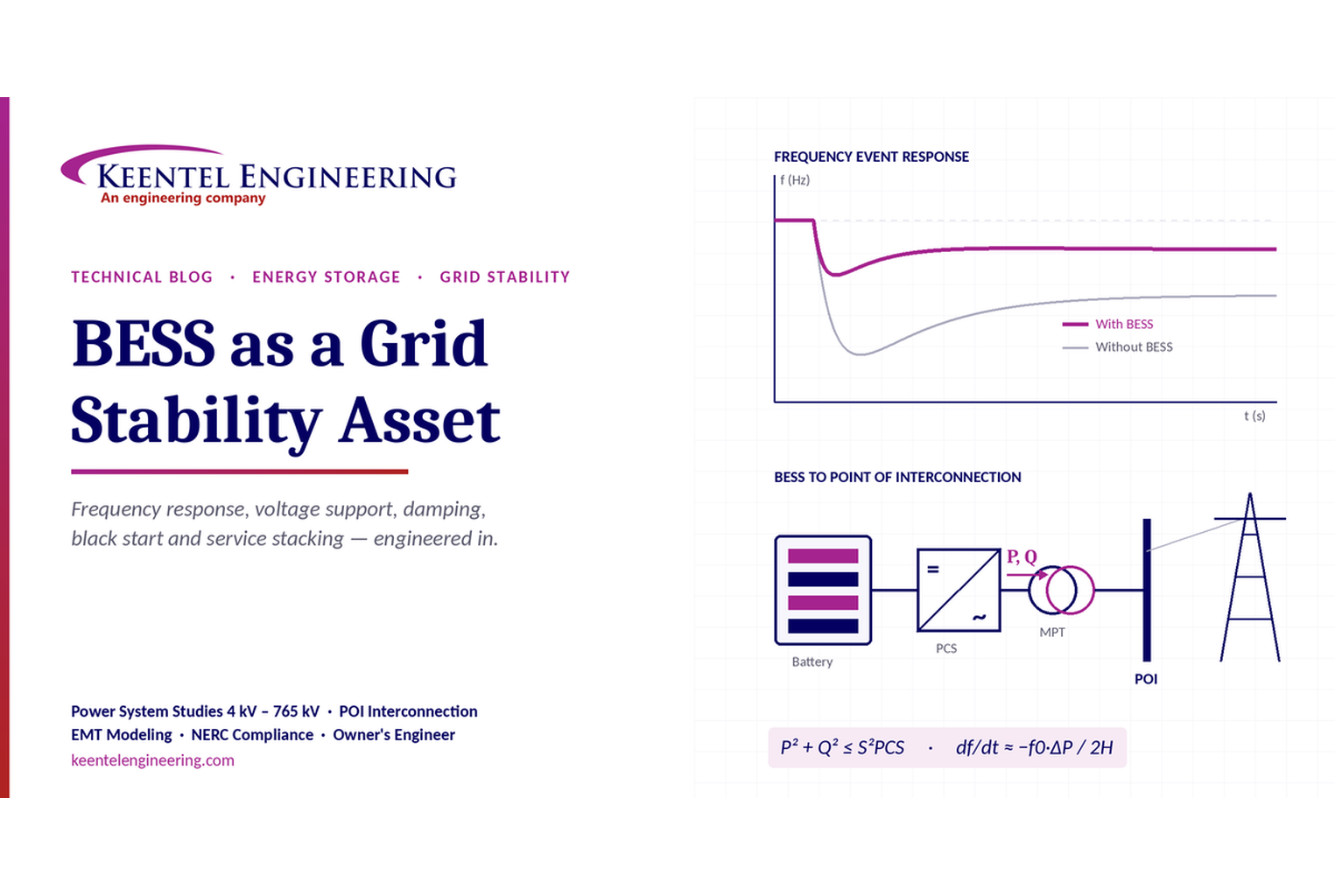
Learn how BESS supports grid stability through fast frequency response, voltage support, oscillation damping, black start, grid-forming controls and EMT studies.