A Coordinated Electric System Interconnection Review—the utility’s deep-dive on technical and cost impacts of your project.
Challenge: Frequent false tripping using conventional electromechanical relays
Solution: SEL-487E integration with multi-terminal differential protection and dynamic inrush restraint
Result: 90% reduction in false trips, saving over $250,000 in downtime
ERCOT enforces all of the above through simulation, which means your model is your compliance case. The bar is now high:
- Whole-facility scope. The model must represent everything the IT load, the UPS and power conversion, the cooling plant, the protection and control systems in formats compatible with ERCOT's study platforms (PSS/E, PSCAD, TSAT).
- Real control loops, not approximations. Generic textbook representations are unacceptable. The model must capture the actual inner control behavior of your power electronics.
- Hardware-validated converter models. For electronic loads, the PSCAD model must be benchmarked against actual hardware testing including voltage ride-through and subsynchronous response. A model assembled from standard PSCAD library blocks fails by definition, because a generic block has never been tested against your vendor's hardware. The good news: validation is a hardware-type test, so results for a given converter product are reusable across every facility that uses it.
- Format migration. Facilities that previously submitted the older composite load model (CMLD) format must transition to EPRI's PERC1 format.
- Three checkpoints. Models are reviewed before the stability study begins (no model, no study), before each quarterly stability assessment, and for electronic loads one final time before energization, when you must submit as-built models with a documented comparison against the previously studied data and a sworn attestation that the model matches actual field settings. ERCOT's review takes 10 business days, extendable by 20 put it on your critical path.
- A living obligation. Change your technology, controls, or relay settings in a way that affects ride-through including converting a crypto mining site to an AI data center — and you've triggered a new interconnection study, even if your megawatts don't change.
| Parameter | Detail |
|---|---|
| System | 230 kV / 138 kV transmission corridors, wind and wet-snow icing exposure |
| Data basis | 15 years of minute-resolution forced-outage records + regional weather observations |
| Core methods | Event grouping, MVA performance curves, time-to-95%-restore, area outage rate curves, fragility modeling, rerun-history benefits, exceedance and log-domain risk metrics |
| Headline result | ≈85% of maximum resilience benefit at 60% of original capital; worst-event restoration window cut from 11 days to 5 in rerun-history terms |
| Decision supported | Capital portfolio selection; resilience plan filing; post-investment verification framework |
| System / Topic | Governing Standard(s) | What It Controls |
|---|---|---|
| Overall plant electrical distribution | IEEE 141 (Red Book); IEEE 666 | Distribution architecture, voltage selection, design of generating station auxiliary service systems |
| Power system studies | IEEE 399 (Brown Book); IEEE 551 | Load flow, symmetrical/asymmetrical short circuit, motor starting methodologies down to the lowest LV panelboard |
| Protection & coordination | IEEE 242 (Buff Book); IEEE 3004.5; IEEE C37 series | Generator relaying (21, 59N, 87G), time-current coordination, selective clearing between LV and MV tiers |
| GSU / UAT / SST transformers | IEEE C57.12.00 and C57 family | Transformer ratings, impedance, testing, loading |
| HV switchyard breakers | IEEE C37.06 | AC high-voltage circuit breaker preferred ratings |
| MV switchgear (13.8 kV) | IEEE C37.20.2; IEEE C37.20.7 | Metal-clad construction, compartmentalization, vacuum breakers; arc-resistant design with plenum venting |
| MV cable | UL 1072; ICEA S-93-639 (NEMA WC 74) | Type MV-105 shielded cable, 133% insulation level for HRG systems |
| LV switchgear (480 V) | IEEE C37.13; UL 1558 | Metal-enclosed LV power circuit breaker switchgear to 635 V, draw-out ACBs with electronic trip units |
| Motor control centers | UL 845; NEMA ICS 18 | LV-MCC construction, MCCB/MCP protection for motors under ~200 HP |
| Motors | NEMA MG-1 | Motor performance, starting characteristics, service factors |
| DC & battery systems | IEEE 485; IEEE 946 | Lead-acid battery sizing (125/250 VDC), DC auxiliary system design |
| Grounding | IEEE 80; IEEE 142 (Green Book) | Ground grid step/touch potential limits; system grounding including high-resistance grounding |
| Lightning protection | IEEE 998 | Direct-stroke shielding of switchyard and outdoor generator structures |
| Arc flash & electrical safety | IEEE 1584; NFPA 70E | Incident energy calculation; worker safety boundaries and PPE |
| Fire protection | NFPA 850 | Fire protection and risk management for combustion turbine generating plants |
| Installation code | NEC (NFPA 70); NESC | Wiring methods inside the plant fence; overhead/outdoor clearances at the switchyard |
| Interconnection & compliance | FERC LGIP; NERC MOD-025/026/027, PRC-019/024/029, FAC-008 | Interconnection process, model validation, protection/ride-through coordination, facility ratings |
| IFC / Construction Deliverable | Purpose |
|---|---|
| Stamped IFC packages | Legal basis for construction; P.E. responsible charge |
| Final relay settings & TCCs | Protection as-installed matches the coordination study |
| Calculation archive | Owner records; NERC audit evidence trail |
| Commissioning procedures | Safe, sequenced energization; MOD field testing |
| Construction support | RFIs, field changes, FAT/SAT witness |
| As-builts & model handoff | Operating baseline; future study currency |
| Metric | Outcome |
|---|---|
| Defects found pre-occupancy | Three topology defects and one settings-mismatch family corrected before load migration; the shared-switchboard defect alone would have invalidated the concurrently-maintainable claim on day one |
| IST findings | Fourteen additional discrepancies surfaced under scenario testing (control logic, alarm mapping, one generator sequencing fault) — all closed before handover instead of during operations |
| Black-building test | Passed on second execution; the first attempt exposed the generator sequencing fault under true block load, exactly the failure the compressed plan would never have found |
| Handover quality | Operations team certified on the actual failure scenarios; corrected EOPs and settings documentation delivered as controlled documents |
| Business outcome | Occupancy proceeded three weeks behind the original date — against an independent estimate that the uncorrected sequencing fault carried a high probability of a full facility outage within the first year |
Part 2 — Frequently Asked Questions: Large Load Interconnection
An electric grid must remain in continuous balance — generation onto the grid must equal consumption from it at every instant. PJM achieves this balance, and prices it, through a layered market architecture. Each layer operates on a different time horizon, and each one touches project economics differently.
| Domain | Key Standards / Codes | What They Govern |
|---|---|---|
| Fire safety | NFPA 855; UL 9540 / UL 9540A | Installation requirements, separation, gas management; system safety listing and thermal-runaway fire testing |
| Grid interconnection | IEEE 1547 (distribution); IEEE 2800 (transmission IBRs) | Ride-through, reactive capability, power quality, and performance at the point of interconnection |
| Power quality | IEEE 519 | Harmonic distortion limits at the PCC |
| Protection & grounding | IEEE 80 / 81 / 142; C37 series | Grounding system design and testing; protective relaying |
| Reliability compliance | NERC standards (incl. PRC ride-through requirements) | Registered-entity obligations for grid-connected storage |
The Grid Is Coming for Your Data Center
Aug 21, 2026 | Blog
Inside NERC's Large Loads Action Plan — and what computational load operators must do before December 31, 2026
Here is a fact that should reorganize how you think about your relationship with the grid.
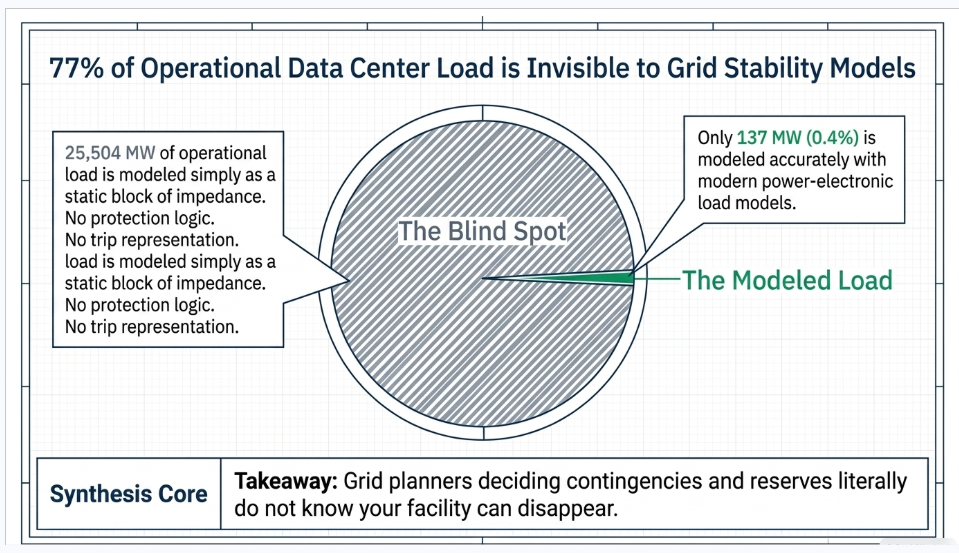
NERC asked utilities to submit the dynamic models they use to represent data centers in grid stability studies. The responses covered 33,282 MW of currently operational data center load. For 10,536 MW, the utility answered "None" when asked what protection-device model represented the facility. For another 14,968 MW, the answer was blank.
That means 25,504 MW — roughly 77% of the operational data center fleet those utilities serve — is represented in the models that determine whether the grid stays up as a static block of impedance. No representation of protection. No representation of the facility's ability to trip. No representation of what happens when voltage sags.
Only 137 MW — four tenths of one percent — used a modern power-electronic load model.
NERC's own summary: "Roughly three quarters of all data center load models are insufficient to represent data center dynamic behavior."
The planners deciding whether your region needs another transmission line, and the operators deciding what contingencies to hold reserves against, largely do not know your facility can disappear. That is the problem NERC is now solving, and it is solving it by making data centers regulated entities.
What Changed, and When It Lands
For twenty years, NERC regulated the supply side. Generators, transmission owners, balancing authorities, reliability coordinators — the entities that make and move electricity — carried mandatory, federally enforceable obligations. The entities that consume electricity did not. Load was something the grid planned around, not something the grid regulated.
On July 16, 2026, the Federal Energy Regulatory Commission issued an order in Docket No. RD26-7-000 directing NERC to file registry criteria and new Reliability Standards for computational loads by December 31, 2026, with a follow-on work plan due March 1, 2027. NERC had already been moving that way under its Large Loads Action Plan. FERC converted a voluntary schedule into a binding one — and pulled it forward. NERC's own filing had contemplated registry criteria in Q1 2027 with standards drafted across 2027. FERC compressed that by roughly a year.
As of August 19, 2026, two things sit in open comment periods closing September 18:
- Proposed Rules of Procedure revisions creating two new registered entity types — Computational Load Owner and Computational Load Operator — via changes to Appendices 2, 5A and 5B
- Three proposed foundational Reliability Standards — CLO-001-1, CLO-002-1 and CLO-003-1 — plus limited conforming updates to FAC-001-5 and FAC-002-5
If your facility clears the thresholds, it becomes a NERC registered entity: mandatory requirements, compliance audits, and civil penalty exposure at $1,584,648 per violation per day.
This is the most consequential regulatory development for the data center sector since interconnection queue reform. Here is how it happened, what the primary documents actually say, and what to do about it.
Part One: The Evidence Base
Regulators do not create new registered entity classes on theory. NERC built this case over three years across incident reviews, a mandatory industry survey, and two technical white papers.
The events
July 10, 2024 — Eastern Interconnection. A lightning arrestor failure on a 230 kV line triggered a sequence of faults over 82 seconds in the Virginia data center corridor. Voltage depressed to between 0.25 and 0.40 per unit. Approximately 1,500 MW of data center load disconnected — and critically, not because a utility shed it. It disconnected because customer-side protection and controls decided, autonomously and nearly simultaneously, to drop the grid and transfer to backup power.
Frequency rose to 60.053 Hz and took roughly four minutes to settle.
That is a survivable outcome in the Eastern Interconnection, which is enormous. NERC's analysis noted that an equivalent 1,500 MW loss in ERCOT would produce a frequency excursion on the order of 235 mHz rather than the 53 mHz observed. The event was a warning shot fired in the interconnection best equipped to absorb it.
January 2023 – September 2025 — ERCOT. NERC's January 2026 incident review catalogued 26 ride-through events involving indirect load loss greater than 100 MW from crypto mining facilities, concentrated in Central Texas, Far West Texas, the Panhandle and the North Zone. Facilities shed between 17% and 95% of pre-disturbance consumption; three-phase faults averaged around 65%.
The causes were unglamorous and fixable: constant-power electronic supplies that collapse within milliseconds of a voltage sag; facilities shedding significant load when single-phase voltage fell below roughly 0.7 per unit, tracking the ITIC curve dropout boundary; single-phase depressions triggering neutral overcurrent protection across an entire site; cooling variable-frequency drives with undervoltage trip thresholds set as high as 0.96 per unit — one of which shut down an entire facility on a 50-millisecond voltage depression during a normally cleared fault; and wye-wye transformer configurations that passed sags straight through.
NERC's gap assessment puts the behavioral finding more bluntly than any incident report does. These facilities, it says, "have demonstrated tendencies to disconnect for faults outside of their zone of protection — or more simply for faults on lines they are not connected to — which is unexpected. This type of behavior is not modeled in operational or operations planning analyses."
The physics
Composition. IT equipment is 60–95% of a data center's demand, essentially all of it behind power electronic converters. Cooling adds VFDs and inverters. Crypto runs on ASICs. Hydrogen electrolysis — also in scope for the broader large-load discussion — can be over 85% converter load. Legacy industrial load was dominated by induction motors with mechanical inertia and graceful degradation. This class has neither.
Ramp rate. NERC documented AI training facilities changing demand at 1.9 per unit per second sustained for roughly 250 milliseconds, measured on a 50 MW block inside a 200 MW facility. One North American data center ramped 450 MW down to 40 MW in 36 seconds, held near 7 MW for four hours, then walked back to 450 MW over minutes. A crypto facility dropped 298 MW in 25 seconds after a telecom failure, with residual oscillations of roughly 25 MW peak to peak.
The AI training profile. The gap assessment reproduces a modelled AI training load shape with real numbers: 32 ms rise from base to peak, a 736 ms plateau, a 32 ms fall, and 100 ms at base before the cycle repeats. That is a square wave with millisecond edges, cycling continuously. NERC notes that the best available positive-sequence load model — EPRI's aggregated EV-charger model — explicitly cannot replicate cyclic load injection of this kind.
Oscillation. Large loads can source forced oscillations across the 0.1 Hz to 30 Hz range, either from unintended control interactions or as a byproduct of the workload itself. A documented real-world case involved 14.7 Hz oscillations emerging from a data center. Anything above 5 Hz requires EMT modeling to evaluate — and nearly no utility performs EMT studies when integrating a large load.
Subharmonics. Prior IEEE work suggests subharmonic voltages should stay below 0.1% of nominal. NERC observes that "some AI workloads may produce subharmonics that are tens or hundreds of megawatts in magnitude," and that reducing them "is sometimes beyond the capability of traditional solutions such as static VAR compensators." Battery storage with grid-forming inverters can cut subharmonic current magnitude by roughly 70%.
Voltage sensitivity. Constant-power supplies draw more current as voltage falls — the opposite of the impedance behavior grid stability analysis historically assumed. Combined with protection designed to protect silicon rather than support the grid, you get load that vanishes precisely when the system most needs it.
Reactive behavior. Active front-end electronics operate near unity displacement power factor, but their input filters generate reactive power, making large facilities net capacitive. That forces nearby synchronous generators into reactive absorption, raising transfer angles and eroding angular stability margin.
Scale. As of April 2025, ERCOT's interconnection queue held roughly 136 GW of large load with energization dates through 2030 — against a system historic peak near 85 GW.
The framing NERC has adopted
Across the gap assessment, one comparison recurs deliberately: "it is arguable that these large loads can operate as controllable Bulk Electric System elements that can significantly ramp up and down with high oscillatory behavior… Their size, controllability, and variability introduce potential reliability risks to the BPS comparable to those of a generator but with the added complexity of being on the demand side."
Elsewhere: "the sudden addition or loss of large loads can have equivalent reliability impacts as generation contingencies." And: "emerging large loads are comparable to the size of significantly large generators… which create challenges for having a third party be responsible for their performance."
That last clause is the whole argument for registration, compressed into a sentence.
Part Two: How Unprepared Everyone Is
In September 2025, NERC issued a Level 2 Alert — a mandatory data request to registered entities on large load interconnection, study, commissioning and operations. It ran 105 questions with a mandatory data spreadsheet, with responses due January 28, 2026. NERC published the aggregated results in March 2026.
If you read one document in this corpus, read that one. It is the empirical foundation for everything that followed, and its findings are not what a
data center operator would expect.
The demand picture
| Total large load | Data center share | |
|---|---|---|
| End 2025 (in service) | 69.5 GW | Evans |
| 2028 forecast | 300.5 GW | Fernandez |
| 2030 forecast | 612.7 GW | Gates |
"Forecasts collected from the worksheet information indicate that load may increase by 300 GW between 2028 and 2030, with the bulk of this increase represented by data centers."
Use that number with NERC's own caveat attached: it says confidence in the 2028-and-beyond values "is questionable due to the differences associated with entity interpretations on the word 'forecast'" — some respondents gave maximum projected load, others a 50/50 confidence value. NERC treats its own headline number as evidence of a forecasting gap, not as a forecast.
The composition shift is starker than the growth. Of in-service large load at end 2025, 49% was industrial and 42% was data center or other computational. By end 2027, on the same respondents' projections, computational load is 90% and industrial load is 8%. Within the computational slice, AI data centers go from 3% to 17%, and facilities combining traditional, AI and crypto workloads go from 24% to 47%. Crypto falls from 14% to 8% of a much larger base — diluted, not displaced.
Geographically, growth concentrates in the East North Central, South Atlantic and West South Central census zones — the Ohio Valley, Northern Virginia, Atlanta, and the Dallas–Fort Worth/central Texas corridor.
The readiness picture
These are percentages of responding utilities that have the practice in question.
| Practice | Have it |
|---|---|
| Clear facility design, modeling and performance criteria in large load interconnection requirements | 13.2% |
| Established large load commissioning process | 8.4% |
| Process requiring large loads to provide and update modeling data | 9.2% |
| Operating protocols and communication infrastructure for ongoing large load operations | 21.8% |
| Coordinated real-time monitoring capability with BA/TOP/RC | 19.5% |
| Detailed list of modeling data, settings and parameters needed from large loads (TP/PC) | 22.4% |
| Interconnection and system-wide study process using steady-state and dynamic models | 30.2% |
| Same, using short-circuit models | 26.4% |
| Resource Planner studies accounting for intra-minute large load ramping | 6.2% |
| Resource Planner studies accounting for aggregate load loss and delayed reconnect | 13.1% |
| Any limit on how much load may disconnect or reconnect in a single disturbance | 10.3% |
And the finding that should stop you: 37% of Transmission Planners and Planning Coordinators reported having large loads on their system whose transient dynamic performance — including voltage and frequency ride-through characteristics — is simply unknown. In ReliabilityFirst the figure is 57.1%. Among Planning Coordinators that are not also Transmission Planners, it is two-thirds.
NERC also found that "nearly two-thirds of all submitting entities indicated a lack of experience in integrating modern data centers or other large loads."
What "nearly all" means
The report's most damning findings are qualitative, because the answer was near-unanimous:
- "Most responses indicated that no model verification is performed against on-site settings to verify the as-built model of the load facility."
- "Nearly all entities do not validate performance after energization."
- "Almost all of the entities indicated that they did not have a process to review performance and modeling during a multi-year load growth for large load projects." Phases 2 through 6 of your campus are, in practice, unstudied.
- "Nearly all entities indicated that no EMT study was performed when integrating large loads."
- On post-disturbance recovery requirements, protection coordination requirements, and oscillation mitigation: "Nearly all entities responding to this question indicated that there is not a process to coordinate" — three separate questions, three identical answers.
- "Nearly all entities indicated that large loads are not included in automatic load-shedding programs."
And on the model that most confident planners rely on: "the composite load model's structure is unable to capture the key features of computational load performance." NERC observed active disagreement — in one region "most of the TPs claimed that their models were accurate enough, but the PC for that area stated that most models are not" when compared against real system events.
The data problem, from the utility side
This thread is the clearest explanation of why registration is happening.
- Utilities largely cannot get models from you. One TO in a high-penetration area reported that "out of five entities contacted for a dynamic model, only one was able to provide a dynamic model."
- Utilities say they have no authority to ask. "Some entities reported that they could not gather this information because they lacked the authority to do so." And: "if an entity was unable to provide a model, a study could not be performed."
- Utilities mostly did not even try. "Roughly all (~85–90%) respondents indicated that they did not coordinate with large load entities when responding to this Alert" — which NERC flagged as "counter to the expectation."
- Contact channels are broken. Utilities reported "erroneous contact information" and no response "through their typical communication methods."
- Recorders exist but data doesn't flow. "Many indicated that these recordings are not accessible for the utility but that the device is present"; where the recorder is owned by the load, "their only method was a formal information request that may not be successful."
- Your peers are on record as exhausted. "Some reported that their large load entities are fatigued by the multitude of data requests."
- Some utilities have given up and gone to orbit. "A few entities use alternative methods like satellite imagery to validate the data center's progress for their demand projections."
The gap assessment adds the commercial explanation, and names names: "Data center operators are inherently protective of their operational data due to commercial sensitivity, cyber security concerns, and competitive pressures… Operators of cryptocurrency mining facilities in particular may avoid sharing detailed operational data due to market competitiveness and strategic responses to electricity price fluctuations."
It also identifies the structural problem behind speculative development: "The large load developer can be different than the entity that owns or operates the computational equipment. The developer might not have information on the end-user of the facility until late in the interconnection process. This can lead to gaps in the utility's ability to accurately study the proposed facility."
The numbers utilities are actually using
Where requirements exist, the Level 2 report captures what they look like — useful benchmarks for negotiating your own interconnection agreement:
- "Large load" definitions ranged from 100 kW to 400 MW, with clear clustering at 20, 50 and 75 MW. NERC's finding: "the 20 MW and above threshold captures roughly 90–95% of electrical size of all large load facilities." That sentence is why the proposed registration threshold is 20 MW.
- Ramp limits, where imposed, ranged 8 MW/min to 300 MW/min, with most between 10 and 30 MW/min. NERC notes this "is not a normal requirement for load."
- Oscillation limits: "requirements are set to limit the peak-to-peak measurement of the active power oscillation to 25 MW," and to "not inject at known system modes." Some entities set a minimum damping ratio.
- Maximum load loss from a single contingency: values "ranged from 300 MW to 2,600 MW," with a plurality at 300 MW. One ISO/RTO structure uses two tiers — "1,000 MW per Point of Interconnection" for TPL-001 contingency purposes and "2,600 MW of aggregate loss" as a frequency-stability system operating limit.
- Disturbance monitoring is sometimes triggered by a "75 MW or more behind the delivery point" threshold. ERCOT's Nodal Operating Guide Section 6.1 requires disturbance monitoring equipment for large loads at 75 MW or above on request — and NERC notes "since this requirement does not exist in NERC standards, there is a potential gap."
- 34.5% of utilities with large load interconnection requirements require no electrical recording device at all. In ReliabilityFirst that figure is 76.9%.
Two things you would not expect
Some utilities are running data center interconnection through generator interconnection machinery: "Some entities explained that they mirror the Small Generator Interconnection Agreement or Large Generator Interconnection Agreement processes to study these loads due to their complexity."
And at least one grid operator already has a direct kill switch: "One entity mentioned that the RC has telemetry set up so that they can issue curtailment commands directly to the load."
Regional readiness varies enormously
If you are siting, this matters. On nearly every measure, TRE (ERCOT) and ReliabilityFirst are the most prepared and NPCC is the least. NPCC scored 2.0% on design criteria, 2.0% on commissioning, 0.0% on modeling-update processes, 2.0% on operating protocols, 0.0% on disconnect/reconnect limits, and 7.1% on pre-energization coordination. ERCOT scored 30.0%, 16.7%, 20.0%, 23.3%, 15.0% and above on the same measures.
The corollary: mature framework means more will be asked of you up front, and fewer surprises later. Immature framework means an easier interconnection and a much higher chance that requirements arrive retroactively.
Part Three: The Regulatory Machinery
NERC describes its own effort as three concurrent workstreams: Registration, Reliability Standards, and Technical Insights. It is worth using NERC's framing, because the three run on different clocks and carry different legal weight.
The sequence
That it "is intended to supplement, rather than replace, any existing or new Reliability Standards." Guidelines still matter: they establish what a reasonable operator should have known.
May 4, 2026 — Level 3 Essential Action Alert. NERC's most severe alert level, requiring Board approval, used sparingly. Acknowledgement due May 11; full responses due August 3, 2026.July 16, 2026 — FERC Order, RD26-7-000. Under Section 215 of the Federal Power Act, FERC directed NERC to file new or modified Reliability Standards, Glossary changes, and Rules of Procedure revisions including registry criteria by December 31, 2026, and a work plan for further revisions by March 1, 2027. FERC cited data center consumption projections of 6.7%–12% of U.S. electricity by 2028, the July 2024 Virginia event, and the ERCOT record.
2025 – Q1 2026 — Technical foundation. The Large Loads Task Force was promoted to the Large Loads Working Group by the RSTC in December 2025. It produced Characteristics and Risks of Emerging Large Loads and Assessment of Gaps in Existing Practices, Requirements, and Reliability Standards for Emerging Large Loads, both March 2026. The gap assessment's contributor list runs to ERCOT, EPRI, AEP, Dominion, Duke, Exelon, Hydro-Québec, IESO, MISO, NYISO, SPP, PNNL, Oak Ridge, MITRE and others — with one named hyperscaler participant, from Microsoft. That imbalance is itself worth noticing.
November 21, 2025. NERC filed comments in FERC's ANOPR on large load interconnection reform, Docket RM26-4.March 16, 2026. NERC launched Project 2026-02. The SAR was posted for comment April 1 with comments due April 30; the Standards Committee approved drafting on May 20, 2026.
March 20, 2026. NERC supplemented its accelerated Large Loads Action Plan filing in RM26-4.
April 30 / May 2026 — Reliability Guideline. Risk Mitigation for Emerging Large Loads. Non-binding, and NERC is explicitAugust 19, 2026. Registry criteria and three draft standards posted. Comments close September 18.
On the speed
This is extraordinarily fast for NERC. Standards development normally runs three to five years through multiple ballot rounds. NERC is attempting registry criteria plus three new standards in roughly ten months — and FERC pulled the registry timeline forward from NERC's own Q1 2027 target.
NERC's answer to the process objection is deliberate: the proposed CLO standards are built from requirements already existing in other Reliability Standards that were previously compliance-vetted and industry-supported. NERC is not inventing obligations; it is porting proven ones onto a new functional entity.
It also means the genuinely novel questions — enforceable ride-through curves for load, model quality standards, ramp-rate limits — are largely deferred to Phase 2. Phase 1 establishes the entity and the plumbing. Anyone reading Phase 1 and concluding this is manageable should understand they are reading the easy half.
Part Four: Registration
The threshold test
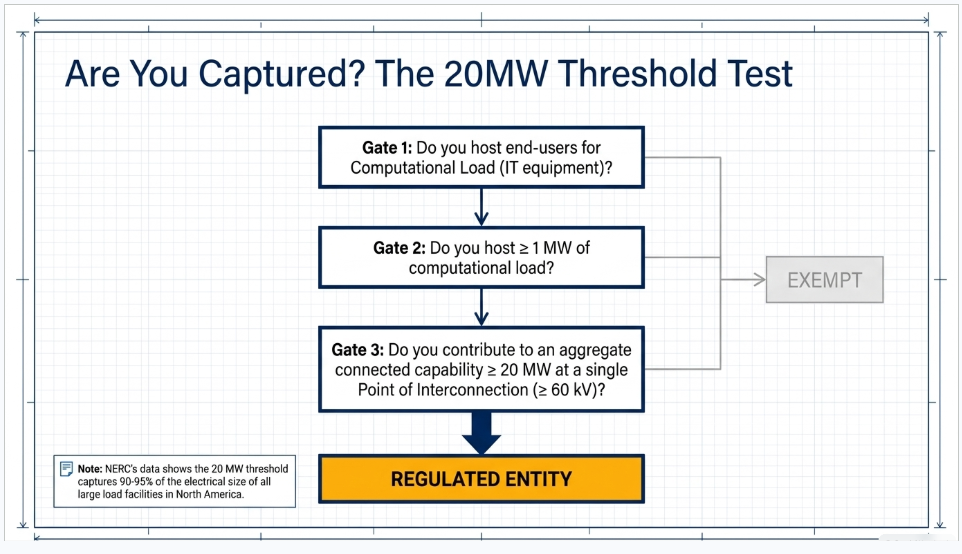
NERC's April 2026 posting proposed a three-part conjunctive test. An entity registers if it:
- Is an end-user, or an entity hosting end-users, receiving electric power for Computational Load — "load comprised of electric power demand from information technology equipment, such as servers, storage, and networking hardware"; and
- Hosts 1 MW or greater of computational load; and
- Contributes to an aggregate connected load capability greater than or equal to 20 MW at a single point of interconnection to the BPS at a voltage greater than or equal to 60 kV
Verify these against the currently posted Appendix 5B redlines. These values come from the April posting; the August 19 revision restructures the function into Owner and Operator roles, and thresholds are exactly the kind of parameter that moves between postings.
The 20 MW figure is not arbitrary. The Level 2 report found that "the 20 MW and above threshold captures roughly 90–95% of electrical size of all large load facilities," and that TO-defined thresholds clustered above 20 MW while DP thresholds fell below it.
Owner versus Operator
The April posting proposed a single "Computational Load Entity." The August 19 posting splits it into Computational Load Owner and Computational Load Operator, revising Appendices 2, 5A and 5B.
That split responds to the loudest objection to the April draft: in a colocation or build-to-suit arrangement, who is the regulated party? It mirrors the Generator Owner / Generator Operator architecture, letting facility obligations (models, protection settings, as-built configuration) be allocated separately from operational obligations (real-time communication, responding to operating instructions, data provision).
Whether it resolves multi-tenant colocation — where the landlord owns the electrical infrastructure and dozens of tenants independently drive the ramps — is the single most important thing to comment on before September 18.
Three ways NERC could have drawn the line
The gap assessment contains a passage that almost no summary covers, and it explains why the criteria look the way they do. NERC considered three candidate scopes for registration:
- All large loads register
- Power electronic-interfaced loads register
- Loads with a significant amount of IT equipment load register
Its own observation: "registration of all large loads or registration of power electronic-interfaced loads would include other large loads in addition to data centers or cryptocurrency mining facilities." Option 2 would sweep in every VFD-driven industrial motor load in North America. Option 3 — significant IT equipment load — is the only one that targets data centers and crypto without capturing manufacturing. That is the option the proposed criteria implement, which is why the test keys on IT equipment specifically rather than on power electronics or megawatts alone.
The fourteen functions
Recommendation 1 of the gap assessment is the closest thing that exists to a job description for a registered computational load entity. NERC recommends registering an entity type able to do the following:
- Provide accurate short-term demand forecast data
- Provide sufficient data to RC, TOP and BA for short-term demand forecasts and operating plans
- Provide accurate load model data and ongoing model updates
- Inform the TO of pertinent changes to load characteristics before and after energization
- Perform real-time and operations-planning coordination with TOP, BA and RC
- Comply with operating instructions from TOP, BA and RC, and ensure appropriate training for receiving those instructions
- Ensure compliance with disturbance ride-through requirements
- Ensure compliance with ramp rate requirements (down ramp and up ramp)
- Provide accurate dynamic model information to support interconnection and transmission planning studies, as early as possible
- Provide accurate information for interconnection studies
- Coordinate to establish a comprehensive commissioning process ensuring operational readiness
- Adhere to operating and communication protocols
- Ensure compliance with performance requirements to minimize and mitigate unintentional power oscillation interaction during normal and post-event conditions
- Provide the utility with a site vulnerability/risk assessment and mitigate issues discovered
- Notify the utility, close to real time, of security breaches
Read that list as the medium-term destination. Phase 1 will not implement all of it. Phase 2 is scoped to.
Why NERC chose standards over interconnection requirements
The gap assessment gives four reasons, and they are worth understanding because they define how much leverage contract negotiation will retain:
- "interconnecting utilities generally do not have the authority to assess performance-based financial penalties except under certain very limited circumstances"
- "NERC standards provide consistent performance requirements across the BPS, while interconnection requirements can vary between TOs or regions"
- "if large loads… do not have NERC standards directly applicable to them, the existing registered entities will then be responsible for the performance of the large loads. While this may have been appropriate for historical loads of significant size, emerging large loads are comparable to the size of significantly large generators… which create challenges for having a third party be responsible for their performance"
- "enforcement of interconnection procedure/agreement terms and conditions may vary, while enforcement mechanisms that exist for the NERC standards provide clarity"
NERC also left itself an explicit exit: "if interconnection requirements are seen as being more appropriate for addressing specific gaps, the LLWG's opinion in this area may change and this may reduce the need for registration of these new entities." That sentence is the strongest textual hook available to anyone arguing against registration in the comment record. It is also, at this point, a narrow one — FERC has since ordered the registry criteria filed.
The Load-Serving Entity backstory
The gap assessment returns four times to a piece of history worth knowing: the Load-Serving Entity function was removed from the NERC Rules of Procedure roughly ten years ago under risk-based registration reform. The paper repeatedly asks "whether the BPS impacts associated with large loads might warrant reconsidering reactivation of the LSE function."
NERC ultimately went a different route — a purpose-built computational load function rather than a revived LSE. But the LSE thread explains the structural diagnosis: "neither large loads nor LSEs are registered entity functions under the NERC registry criteria," and therefore "the existing Reliability Standards and interconnection requirements do not adequately mitigate large loads' reliability impacts on the BPS."
What registration actually means
- Mandatory, enforceable requirements applying to you directly by function, as a matter of federal law
- CMEP exposure — audits, spot checks, self-certifications, self-reporting, mitigation plans
- Civil penalties up to $1,584,648 per violation per day (the 2025 level, carried into 2026 after OMB cancelled the annual inflation adjustment). Penalties scale with reliability harm under FERC's Penalty Guidelines; a documented compliance program is a genuine mitigating factor
- Section 1600 data requests. Registered entities must respond to NERC information requests and can be required to develop corrective action plans. Today you cannot be compelled — which the gap assessment identifies as actively impairing event analysis: "Multiple events in the Eastern Interconnection and ERCOT have involved large loads reducing significant amounts of load during voltage disturbances… The significant gaps… can impair NERC and the Regional Entities from obtaining the needed information directly from the large load entities to perform thorough root-cause analysis"
- A standing compliance function — evidence retention, documented procedures, designated contacts, training records
- Public enforcement. Notices of Penalty are published. Expect registration status and compliance representations to migrate into colocation agreements, ESAs and financing covenants.
Registration of new computational load entities begins only after FERC approves the criteria. The filing deadline is December 31, 2026; approval and implementation follow.
Part Five: The Alert and the Standards
The Level 3 Alert is your preview
The seven Essential Actions were addressed to registered entities — TPs, PCs, TOs, TOPs, RCs and BAs. Not to you. NERC says so directly in its own primer: the August 3 deadline "only applies to currently registered entities, not the new entities that may be incorporated under the new registration criteria. However, computational load entities may see elements within the alert flow down to them."
Every action requires something from your facility:
| Essential Action | Applies to | What it extracts from you |
|---|---|---|
| 1. Modeling requirements | TP, PC | Electrical size, power factor, dynamic characteristics, IT vs. non-IT load composition, ramp rates, protective device details, on-site generation, facility use — with lifecycle updates. PERC1 as baseline model |
| 2. System studies | TP, PC | Study participation; identification of contingencies where your aggregate loss violates planning criteria |
| 3. "Qualified change" redefinition | PC | Your load growth, equipment setting changes and repurposing now trigger restudy |
| 4. Commissioning processes | TO | Full load/no-load testing with ±10% voltage variation, model verification, pre-energization checklists covering switching, design prints, protection circuitry, SCADA points and remedial action schemes |
| 5. Protection and load loss prevention | TP, PC, TO | Your facility-level relay settings, and coordination to achieve no non-consequential loss of firm load from normally cleared non-bus faults |
| 6. Dynamic fault recording | TO | Continuous low-resolution and trigger-based high-resolution recording of your performance during disturbances, shared with the ERO |
| 7. Operational communication | TOP, RC, BA | Interpersonal Communication capability and joint operating procedures with you |
Responses were due August 3, 2026. Your interconnecting utility has already told NERC what it will require of you. Asking to see that response is the highest-value phone call available to you this quarter.
The three standards
Project 2026-02 proposes three foundational standards, posted August 19 for comment through September 18. Registered Ballot Body members had to join the ballot pool by September 3, 2026 to vote.
CLO-001-1 — Computational Load Interconnection, Studies, and Modeling. Facility data, dynamic models, load composition, ramp characteristics, protective device settings, on-site generation; keeping it current across the lifecycle; supporting TP and PC studies.
CLO-002-1 — Computational Load Operational Data and Communications. Interpersonal Communication capability with TOP, RC and BA; operational data provision; reachability and responsiveness during events. This is the requirement class that converts a data center from an unreachable customer into an operational counterparty.
CLO-003-1 — Computational Load Protection Coordination and Disturbance Monitoring. Protection coordination with the transmission system, relay settings sharing, disturbance monitoring and data provision.
Plus limited conforming updates to FAC-001-5 and FAC-002-5.
The requirement text is in the posted drafts. The scope descriptions above reflect NERC's own characterization and the underlying SAR; read the drafts.
Why protection coordination is its own standard
The gap assessment explains the mechanism, and it is the clearest statement of a problem most operators do not know they have:
> "TOs set relay pickups, breaker clearing times, and reclosing schemes on their side of the meter. However, the TOs historically did not need to share those curves with the large load facility owner and operator who program uninterruptible power supply (UPS) and variable frequency drive disturbance ride-through logic. Therefore, the two protection schemes operate independently of one another. Without that visibility and communication, a normally cleared transmission fault can trigger protective systems on the load side even when it is cleared appropriately by the utility."
Two independent protection philosophies, no shared information, and a fault the grid handled correctly still takes your facility offline. CLO-003-1 exists to close that loop.
The paper goes further than most operators would expect into facility design: "Certain design considerations (e.g., the facility's transfer to backup power supply and the return to utility during/after voltage disturbances) for large loads can significantly impact the characteristics and risks of that large load as seen by the grid… This consideration could also extend to decisions regarding how data center compute is implemented from a software perspective."
NERC is describing workload orchestration as a reliability-relevant design decision. It also calls out UPS eco-mode versus double-conversion mode by name as a modeling-critical parameter, along with balance-of-plant loads and "the thresholds that trigger grid disconnection and transfer of load to local backup" — noting such information "is not readily available for inclusion in models."
Part Six: What Phase 2 Actually Reaches
The gap assessment ranks its risks by likelihood and impact. That ranking is the best available predictor of Phase 2 scope — and it contains a correction to the conventional wisdom.
Rated high impact and unmitigable by existing registered entities
These are the risks NERC says cannot be fixed without a registered load entity, which makes them the Phase 2 core:
Transmission adequacy · short-term demand forecasting · balancing and reserves · real-time and operations-planning coordination · proper integration and operational readiness · frequency stability (high likelihood in ERCOT specifically; low in the Eastern and Western Interconnections) · voltage stability · angular stability · oscillations · cyber security of large load · physical security
Ride-through: the real fight
There is currently no enforceable NERC standard establishing minimum voltage or frequency ride-through for load. PRC-024 and PRC-029 address generators only. The gap assessment is precise about why the obvious external standards do not fill the hole:
- IEEE 2800 "applies to generation resources only and does not address load facilities." It is the model of what does not exist for load.
- IEEE 1668 provides voltage sag ride-through testing practice for end-use equipment rated below 1,000 V — the Tennessee Valley Authority uses it to assess data center sag performance — but "it does not establish minimum ride-through performance requirements for large loads connecting to the BPS."
- The ITIC curve is used by operators to guess when large electronic loads will drop, but "may not be applicable for grid studies if there is a UPS between the grid and the power supplies. UPS settings or other site-level protections may impact the disturbance ride-through characteristics of the load."
- SEMI F47 — the canonical semiconductor-fab sag immunity standard, and the obvious analogue — appears nowhere in either document.
So the ride-through requirement, when it comes, will be purpose-built. ERCOT, SPP and Dominion Energy are already developing large load ride-through requirements, and ERCOT's NOGRR282 is the only named ride-through rule anywhere in the Level 2 record. Expect regional rules to arrive first and NERC to harmonize afterward.
One technical tension worth understanding, because it will shape how the requirement is written: "Requiring large loads to remain connected during disturbances… may mitigate rotor-angle or frequency stability problems… However, a large load maintaining full consumption during undervoltage conditions will increase the dynamic reactive power support necessary to maintain voltage stability." Ride-through is not free to the grid either. The requirement will be a negotiated curve, not a mandate to never trip.
Ramp rates and oscillations
Ramp rate compliance appears explicitly in Recommendation 1's function list — "down ramp and up ramp." Utilities already impose limits between 8 and 300 MW/min where they impose any.
On oscillations, NERC is candid that the science is incomplete: "there are no guidelines or limits by which a system owner/operator can identify that a given forced oscillation is a reliability risk," and "there is no established practice for determining whether the oscillation is a risk to reliability and what level of urgency is associated with the issue." But the direction is clear: "Oscillations need to be mitigated before they occur so that they do not occur in real time," and the risk "needs to be considered on an interconnection-wide basis."
There is also a lever available today that most operators do not know exists: "the TOP has the ability to deny the large load permission to operate if it is causing oscillation issues."
Harmonics: probably not coming
This corrects a common assumption, including one I made in an earlier version of this article. NERC rates harmonics low likelihood, low impact, and says directly: "It is not a significant impact to BPS reliability, so NERC-enforceable requirements are not necessary. This can be adequately addressed with existing registered entities' policies."
IEEE 519 continues to govern at the point of common coupling, with distortion management framed as a joint responsibility — you limit current distortion, the grid operator limits voltage distortion. Two caveats matter: IEEE 519 "does not provide universally applicable limits for interharmonics," and if on-site generation exceeds 10% of annual average load demand and includes inverter-based or distributed resources, IEEE 519 stops applying and IEEE 2800 or IEEE 1547 governs instead.
NERC also warns against treating power quality compliance as a reliability defense: "Power quality violations are not sufficient to indicate an imminent reliability risk, and power quality standards are not intended to be used as a basis for meeting reliability requirements."
Voltage fluctuation and flicker are likewise rated low/low. System restoration is rated low/low, because "large loads will not usually be included in restoration plans."
Modeling
The Level 3 Alert already names PERC1 as the minimum baseline model. The gap assessment describes it as "the most state-of-the-art model for large power-electronic loads," developed after the paper was drafted, and notes "some of the gaps may be reduced with the new PERC1 model." NERC's Load Modeling Working Group is running a Data Center Load Modeling Workshop on September 15, 2026.
Two structural obstacles are worth knowing. The best available positive-sequence alternative — EPRI's aggregated model — "is not available as a library model in any simulation tool other than GE PSLF." And model validation cannot simply copy the generator playbook: "Staged tests are generally not possible in a load facility like the exciter step response tests that can be conducted in power plants."
Load shedding and segmentability
A quiet requirement with real design consequences. NERC wants large loads to be divisible: "the manual or UFLS shedding of the entirety of a very large load could lead to over-frequency or overvoltage. The ability to partially shed large loads, either manually or as part of a UFLS scheme, may not be part of existing utility practices."
Manual load shed obligations are rated high impact precisely because "for a situation in which a TOP or DP needs to shed a portion of a large load but the particular load is not able to be segmented, other issues, such as voltage instability, could be caused by the shedding of the entirety of the load."
There is a registration wrinkle here too: if segmentation requires UFLS relays inside your facility, "a non-registered entity owning UFLS equipment might be a risk. Therefore, the load entity might need to be registered as a UFLS-Only DP."
A "largest credible load loss"
Every Balancing Authority submits its largest credible generator loss under BAL-003, feeding directly into interconnection frequency response obligations. NERC observes: "If the largest credible load loss is not analyzed on a recurring basis, there could be a gap in preparing for the load loss/reduction events."
A "largest credible load loss" submission analogous to the generator N-1 is a plausible Phase 2 outcome — and it would make your facility a named contingency in the operator's reserve math.
Part Seven: The Security Question
This is the quietest thread in the corpus and potentially the most disruptive, and it is more developed than most coverage suggests.
Cyber security of large load is rated high impact and explicitly not mitigable by existing registered entities: "Existing registered entities do not have adequate visibility of the large load asset owner's security protocols and practices to be able to appropriately provide requirements to mitigate the cyber security risks."
NERC names three specific threat scenarios:
- Coordinated destabilization. "Adversaries could coordinate cyber attacks that might intentionally overload the grid or initiate simultaneous disconnections that might destabilize the system."
- Workload manipulation — the data-center-specific threat. "Attackers may be able to manipulate workloads, potentially changing the demand of the load. These manipulations fall outside traditional operational parameters… data center security protocols are not reviewed or vetted via NERC standards."
- Insider and bad-actor control. "Bad-actor control of a large load could result in excessive ramp rate, oscillations, or other performance aberrations that could impact the BPS. Furthermore, no Reliability Standards provide requirements to prevent an insider threat from accessing operational systems of large loads."
The specific CIP gaps identified: CIP-004 (personnel vetting, identity verification, criminal background checks for access to critical cyber assets), CIP-006 (physical security of BES cyber systems), CIP-007 (access control), CIP-008 (incident reporting and response), and CIP-014 (physical security of critical transmission assets). None applies to large loads today. Neither does EOP-004: "Large load asset owners have no such mandate related to event reporting for the purpose of grid integrity, reliability, and resilience."
Nor do the personnel standards. "PER-003 requires RC, TOP, and BA staff performing reliability-related tasks to have NERC certifications… no such standards exist applicable to large loads."
On physical security, NERC proposes a boundary that will end up in contracts: "the data center will have to be responsible for the security inside the data center and the TO might be responsible for the security outside of the data center (e.g., the substation)."
All of this routes to the NERC Security Working Group, "including potential SARs." Nothing in Phase 1 imposes CIP obligations. But two of the fourteen functions in Recommendation 1 are already security functions — site vulnerability assessment, and near-real-time breach notification. The architecture is being built.
Notably, NERC is
less worried about the communication link than about the facility: cyber security of communications between large load and utility is rated low/low, on the reasoning that "data centers already have security practices" and "usually have tiered cyber security protection practices — although the security practices may not be consistent across the industry."
Part Eight: Six Things Worth Watching
1. The colocation allocation problem is not solved. The Owner/Operator split is progress, but a multi-tenant facility where the landlord owns the electrical infrastructure and dozens of tenants independently control the workloads driving the ramps does not decompose cleanly into two roles. NERC has already identified the underlying problem — "the large load developer can be different than the entity that owns or operates the computational equipment" — without solving it. Expect this to consume the September comment record, and expect the answer to reshape colocation contracts industry-wide. A related flag from the gap assessment: requirements for large loads "may need to be coordinated with NERC requirements for generation, such as in the case of a generator and a large load facility being co-located with a common point of interconnection."
2. The thresholds will drive structuring behavior. A 20 MW aggregate threshold at a single ≥60 kV interconnection invites multiple smaller interconnections, sub-60 kV service, and behind-the-meter configurations. NERC has run this play before with inverter-based resource registration. Watch for anti-fragmentation language.
3. Utilities already have a lever, and NERC told them to use it. Three separate times, the gap assessment recommends: "the TO could require that delays in the provision of necessary data by load entities result in delayed energization of load or delayed ramping of load." No registration required. If your data package is late, your energization date is the collateral. This is the single most actionable sentence in the corpus, and it is aimed at your counterparty, not at you.
4. The "qualified change" trap. NERC flags that "PCs may not have adequate knowledge of data centers to understand what should be considered a qualified change… This could lead to situations in which a large load performs a configuration change that significantly impacts the performance of the facility but does not meet the PC's definition of qualified change." Essential Action 3 tells PCs to fix that. Once they do, hardware refreshes, control setting changes and workload repurposing become restudy triggers. Build restudy lead time into deployment planning.
5. Behind-the-meter generation is genuinely unresolved. NERC says plainly that "it is unclear if and how utilities should consider information about behind-the-meter generation in load forecasts and resource adequacy studies," and that collocated generator and battery dynamics cannot be captured by current models. There is no FERC co-location docket analysis here, no capacity accreditation treatment, no position on whether co-located load is grid-connected. Do not read the silence as a safe harbor; read it as an unwritten chapter.
6. Speed versus durability. A December 31 filing produced on this schedule will be tested — in the ballot process, potentially on rehearing, and certainly in the first enforcement action. NERC's own gap assessment carries a disclaimer that "some of the requirements, practices, and modeling at the time of the publishing of this paper may be different than discussed in this paper." A standard drafted fast and challenged later is not a standard you can plan around with confidence.
Part Nine: What To Do Now
In the next 30 days
- Run the threshold test against every North American site and every pipeline project. Read the posted Appendix 5B redlines, not summaries.
- Register on the ERO Portal at eroportal.nerc.net, then request addition to the NERC-info listserv, Project 2026-02, the Large Loads Working Group and the Load Modeling Working Group.
- Create a Standards Balloting System account at sbs.nerc.net and request voter credentials to join the Registered Ballot Body. Critical detail most operators miss: only one person per entity per segment can join, and computational loads fall in Segment 7 — Large Electricity End Users. Decide internally who that person is before someone else in your company claims it, or before you find you have no seat at all.
- File comments. Registry criteria to ROPcomments@nerc.net; standards through SBS. Comment specifically on colocation allocation if it affects you.
- Ask your interconnecting utility for its August 3 Level 3 Alert response. It tells you exactly what will be asked of you.
In the next 90 days
- Inventory your data. Can you produce today: a dynamic model of your facility, IT vs. non-IT load split, ramp rate profile, protective device settings, on-site generation configuration, UPS operating mode and transfer thresholds, and as-built electrical documentation? Every gap becomes a compliance gap on the day registration takes effect. Given that only one in five facilities could produce a dynamic model when asked, this is where most operators actually stand.
- Audit your protection settings against the ERCOT diagnostic list: cooling VFD undervoltage thresholds, neutral overcurrent behavior under single-phase depressions, transformer configuration, and transfer-to-backup logic. A 0.96 p.u. VFD setting is a facility-wide trip waiting for a 50-millisecond sag.
- Determine whether your facility is segmentable and at what granularity. Partial-shed capability is a live requirement direction, and inability to segment is what NERC cites as making manual load shed a high-impact risk.
- Attend the LMWG Data Center Load Modeling Workshop on September 15, 2026.
- Establish an operational contact path with your TOP, BA and RC, staffed on the availability basis they operate on — not a daytime account-management channel. NERC has documented "erroneous contact information" as a live reliability finding.
In the next year
- Stand up a NERC compliance function. Named owner, evidence retention, documented procedures. Do not let it land on facilities management by default.
- Revisit your contracts. Allocate registration and compliance responsibility explicitly in colocation agreements, ESAs and build-to-suit arrangements. Address who holds the Segment 7 seat, who provides models, who carries penalty risk, and who owns the physical security boundary at the substation fence. Silence will not resolve in your favor.
- Build Phase 2 assumptions into procurement. If you are specifying UPS systems, transformers or cooling infrastructure with a ten-year life, assume ride-through and ramp-rate requirements are coming.
- Consider NERC membership to participate in governance, not just standards balloting.
- Watch the March 1, 2027 informational filing — NERC's Phase 2 roadmap and your earliest reliable read on substantive performance requirements.
Frequently Asked Questions
Q: Is my data center going to become a NERC registered entity?
If it meets the proposed criteria — hosting 1 MW or greater of computational load, contributing to aggregate connected load capability of 20 MW or greater at a single point of interconnection at 60 kV or above — then yes, under the April 2026 proposal. The August 19 revision restructures this into Computational Load Owner and Computational Load Operator functions. Verify current thresholds against the posted Appendix 5B redlines.
Q: When does this actually take effect?
NERC must file registry criteria and standards with FERC by December 31, 2026. Registration of new computational load entities begins only after FERC approval. Standards carry their own implementation plans and effective dates. Realistically, obligations begin in 2027 — but the data demands are landing on you now through the Level 3 Alert.
Q: Why is NERC moving this fast?
FERC ordered it. NERC's own plan had registry criteria filed in Q1 2027 with standards drafted across 2027; FERC's July 16 order compressed that to December 31, 2026. NERC is managing the compression by building the first standards from requirements already vetted in existing standards rather than drafting new ones.
Q: What is a Level 3 Alert and does it apply to me?
NERC alerts come in three levels; Level 3 "Essential Action" is the most severe, requires Board approval, and is used rarely. The May 4, 2026 alert applies to registered entities — TPs, PCs, TOs, TOPs, RCs and BAs. NERC's own primer says the deadline "only applies to currently registered entities… However, computational load entities may see elements within the alert flow down to them."
Q: Who registers in a colocation facility — the landlord or the tenant?
The most significant unresolved question. The August 19 Owner/Operator split is NERC's attempt at a structure that can answer it. Whether it works for multi-tenant facilities is exactly what the comment period should test. NERC has separately acknowledged that "the large load developer can be different than the entity that owns or operates the computational equipment" and that developers may not know their end user until late in the interconnection process.
Q: What are the penalties?
Up to $1,584,648 per violation per day — the 2025 inflation-adjusted maximum, unchanged for 2026 after OMB cancelled the annual adjustment. Actual penalties are calculated under FERC's Penalty Guidelines and scale with reliability harm, culpability, and the quality of your compliance program.
Q: Does this apply to cryptocurrency mining?
Yes, explicitly. Crypto generated much of the ERCOT event record driving this initiative, and NERC singles out miners on data sharing: "Operators of cryptocurrency mining facilities in particular may avoid sharing detailed operational data due to market competitiveness and strategic responses to electricity price fluctuations."
Q: What about behind-the-meter generation?
Genuinely unresolved. NERC says "it is unclear if and how utilities should consider information about behind-the-meter generation in load forecasts and resource adequacy studies," and that current models cannot capture collocated generator and battery dynamics. One concrete consequence exists today: if on-site generation exceeds 10% of annual average load demand and contains inverter-based or distributed resources, IEEE 519 stops governing your harmonics and IEEE 2800 or IEEE 1547 applies instead.
Q: We're under 20 MW. Are we clear?
Probably, under the current proposal — but note the 20 MW figure is aggregate connected load capability at a single point of interconnection, not your computational load alone and not your measured peak. A small tenant behind a large shared interconnection may be captured. NERC chose 20 MW because its survey found that threshold "captures roughly 90–95% of electrical size of all large load facilities," so it is unlikely to move upward.
Q: Can we split the site into multiple interconnections to stay below the threshold?
The structure exists. Two cautions. Thresholds are not final and anti-fragmentation language is a realistic outcome. And deliberately structuring around a reliability registration threshold is a poor posture if your facility later contributes to an event.
Q: What will CLO-001-1 require specifically?
Requirement text is in the drafts posted August 19 on the Project 2026-02 page. At scope level: interconnection, studies and modeling — facility data, dynamic models, load composition, ramp characteristics, protective device settings, and keeping it current. Read the posted draft rather than any summary, including this one.
Q: Why are the standards called "foundational"?
They are Phase 1. NERC built them from requirements already existing in other Reliability Standards that were compliance-vetted and industry-supported, to move within FERC's deadline. Phase 2 addresses the novel requirements — ride-through, ramp rates, performance obligations.
Q: Will we have to meet ride-through requirements?
Not under Phase 1. But it is the most prominent technical gap NERC identifies, and Recommendation 1 lists "ensure compliance with disturbance ride-through requirements" as a core function of the future registered entity. ERCOT, SPP and Dominion are already developing large load ride-through requirements. Treat it as probable and specify equipment accordingly.
Q: Can we just design to IEEE 1668, ITIC or SEMI F47?
None of them is a substitute. NERC says IEEE 1668 "does not establish minimum ride-through performance requirements for large loads connecting to the BPS." The ITIC curve "may not be applicable for grid studies if there is a UPS between the grid and the power supplies" — your UPS settings, not your IT equipment's tolerance, determine what the grid sees. IEEE 2800 applies to generation only. SEMI F47 appears nowhere in NERC's analysis. The eventual requirement will be purpose-built for BPS-connected load.
Q: Are harmonic limits coming?
Probably not from NERC. NERC rates harmonics low likelihood and low impact and states: "It is not a significant impact to BPS reliability, so NERC-enforceable requirements are not necessary." IEEE 519 continues to govern at the point of common coupling. Two caveats: IEEE 519 gives no universally applicable interharmonic limits, and NERC warns that "power quality standards are not intended to be used as a basis for meeting reliability requirements" — IEEE 519 compliance is not a reliability defense.
Q: What is the PERC1 model?
The model the Level 3 Alert names as the minimum baseline for representing computational load, described in NERC's gap assessment as "the most state-of-the-art model for large power-electronic loads." Expect your utility to request parameters to populate it. Use the bare model name; do not publish an expansion of the acronym.
Q: Our utility is asking for our protection relay settings. Do we have to provide them?
Today that request flows from Essential Action 5 and your interconnection agreement, not from a standard binding you. Once CLO-003-1 is effective, protection coordination and settings sharing become direct obligations. Practically, the information will be required either way, and the underlying problem is real: your UPS and VFD ride-through logic and the utility's relay settings currently operate in ignorance of each other, which is how a correctly cleared fault still takes your site down.
Q: What happens if we just don't provide data?
Your energization date. NERC recommends three separate times that "the TO could require that delays in the provision of necessary data by load entities result in delayed energization of load or delayed ramping of load." That lever requires no registration and no new standard. Separately, a Transmission Operator "has the ability to deny the large load permission to operate if it is causing oscillation issues."
Q: Are data centers included in load shedding programs?
Mostly not today — "nearly all entities indicated that large loads are not included in automatic load-shedding programs." That cuts both ways: no forced shedding, but no credit in the operator's toolkit either. NERC is actively examining inclusion, and wants large loads to be segmentable so a portion can be shed rather than the whole facility. If segmentation requires UFLS relays inside your fence, NERC notes you might need to register as a UFLS-Only Distribution Provider.
Q: Will CIP cybersecurity standards apply to us?
Not under Phase 1. But NERC rates cyber security of large load as high impact and explicitly unmitigable by existing registered entities, names CIP-004, CIP-006, CIP-007, CIP-008 and CIP-014 as gaps, notes you have no EOP-004 event reporting mandate, and lists site vulnerability assessment and near-real-time breach notification among the fourteen functions a registered computational load entity should perform. It routes the question to the NERC Security Working Group "including potential SARs." Treat it as a 2027–2028 question that is already being framed.
Q: What is Segment 7 and why does it matter?
Segment 7 — Large Electricity End Users — is the Registered Ballot Body segment computational loads fall into. Only one person per entity per segment may join. That single seat is your organization's vote on the standards that will bind you. NERC recommended joining by June 30, 2026; if you have not, do it now and settle internally who holds it.
Q: How do we participate in the standards process?
Register on the ERO Portal, create an SBS account, request voter credentials for the Registered Ballot Body, and join ballot pools when they form — you must join at initial formation. The ballot pool for this project closed September 3, 2026, but comments remain open until September 18 and further comment periods are anticipated. All standard drafting team meetings are public and open to contribution.
Q: Is there another comment period after September 18?
NERC's plan anticipates an additional Q4 2026 comment period if needed, with Board approval targeted for early December and the FERC filing by December 31, 2026.
Q: What happens on March 1, 2027?
FERC directed NERC to submit an informational filing setting out its work plan for additional standards modifications. That document is the Phase 2 roadmap.
Q: Does this apply outside the United States?
NERC's footprint covers the U.S., Canada and part of Baja California, Mexico, but enforcement differs by jurisdiction — Canadian provinces adopt NERC standards through their own regulatory processes and timelines. FERC's order binds NERC's filing obligation; Canadian applicability follows provincial adoption. Notably, NERC assesses Québec's large-load frequency stability risk as manageable today: its largest single load is an arc smelter near 1,000 MW, and its largest data center is around 30 MW.
Q: Which regions are furthest along?
ERCOT and ReliabilityFirst, consistently, across design criteria, commissioning, modeling and operational coordination. NPCC is the least mature on nearly every measure — 2.0% on design criteria, 0.0% on modeling-update processes, 0.0% on disconnect/reconnect limits. Interpret carefully: a mature framework means more asked of you up front and fewer retroactive surprises.
Q: We're a hyperscaler with a regulated utility affiliate. Is this new for us?
The compliance machinery will be familiar; the function is new. Existing registrations do not cover Computational Load Owner or Operator obligations, and the facility-level data, modeling and protection obligations attach to the data center itself.
Q: What single thing should we do first?
Ask your interconnecting Transmission Owner and Transmission Planner for their August 3, 2026 Level 3 Alert response, and separately confirm what dynamic model — if any — currently represents your facility in their planning cases. Given that roughly three quarters of operational data center load is modeled as a static ZIP block, there is a meaningful chance the answer is "none," and that is the conversation everything else follows from.
Q: We're a hyperscaler with a regulated utility affiliate. Is this new for us?
The compliance machinery will be familiar; the function is new. Existing registrations do not cover Computational Load Owner or Operator obligations, and the facility-level data, modeling and protection obligations attach to the data center itself.
NERC is doing something it has not done in its history as the federally certified Electric Reliability Organization: extending mandatory reliability obligations to electricity consumers. It is doing so under a FERC deadline, on a schedule that compresses a multi-year process into months.
The justification is in the documents. Gigawatt-scale load has disappeared from the grid in seconds because of protection settings no grid operator could see. Three quarters of the operational data center fleet is modeled as inert impedance. Thirty-seven percent of planners have large loads on their system whose dynamic behavior they cannot characterize at all. Utilities report they lack the authority to ask you for the data, and one in five of you could supply a model when asked.
Every one of those is a fixable problem, and none of them gets fixed by a customer relationship. That is the case for registration, and it is a strong one.
The comment window closes September 18, 2026. The filing lands December 31. Phase 2 scoping begins March 2027.
The operators who come out of this well will be the ones who spent 2026 getting their facility data, protection settings, model representation and operational relationships in order — rather than waiting to find out whether the rules would really apply to them.
Sources
Primary NERC documents
- NERC Large Loads Action Plan
- Large Load Action Plan: 2026–2027 Timeline
- Aggregated Report — Level 2 Alert: Large Load Interconnection, Study, Commissioning and Operations
- Assessment of Gaps in Existing Practices, Requirements, and Reliability Standards for Emerging Large Loads
- White Paper: Characteristics and Risks of Emerging Large Loads
- Essential Action to Industry — Level 3 Computational Load Alert
- Reliability Guideline: Risk Mitigation for Emerging Large Loads
- Primer for Computational Loads
- Checklist for Computational Load Entities
- Incident Review: Voltage-Sensitive Crypto Load Reductions
- Incident Review: Considering Simultaneous Voltage-Sensitive Load Reductions
- Large Loads Frequently Asked Questions
Registration and standards
- Computational Load Entity — Summary of Changes, April 2026 Posting
- Proposed Changes to Rules of Procedure
- Project 2026-02 Computational Loads
- Standard Authorization Request — Computational Load Alignment Phase 1
- ERO Enterprise 101 Informational Package
Regulatory
- FERC Order on Computational Loads, Docket RD26-7-000 (July 16, 2026)
- NERC Comments to FERC, Docket RM26-4 (March 2026)
Working groups and events
- Large Loads Working Group (LLWG)
- Load Modeling Working Group (LMWG)
- LMWG Workshop on Data Center Load Modeling, September 15, 2026
Commentary
- Willkie: FERC Orders New Reliability Standards for Data Centers and Other Computational Loads
- Steptoe: NERC Releases Proposed Registration Requirements for "Computational Load" Customers
- Morgan Lewis: NERC Alert Moves Data Centers From Emerging Risks to Planning Obligations
- American Public Power Association: FERC Sets Year-End Deadline for NERC

About the Author:
Sandip "Sonny" R. Patel, P.E.
IEEE Senior Member · Founder & CEO, Keentel Engineering
In 1995, Sonny Patel earned his Electrical Engineering degree from the University of Illinois. But degrees don't build legacies — action does.
For three decades, he has worked the power industry from every side of the table: 16 years as a utility engineer at Exelon/Commonwealth Edison; generation leadership across hydroelectric, industrial steam turbine, and a 9 GW renewable fleet; NERC Regional Entity Senior Compliance Engineer and Audit Team Lead, auditing some of the nation's largest utilities; and testing and commissioning lead on equipment up to 765 kV — the very top of the North American grid.Utility. Generator. Regulator. Consultant. Few engineers have seen all four seats. Fewer still have sat in them.
His experience spans nuclear, hydro, conventional generation, renewables, oil and gas, mining — and today's data centers, where he is authoring a three-book series on data center design. He is a Licensed Professional Engineer in six states and a Licensed Electrical Contractor in Florida (Unlimited EC) — he doesn't just design the work; he's qualified to stand behind its execution.Today, as Founder and CEO of Keentel Engineering, Sonny leads a nationwide team of engineers delivering substation design, power system studies, NERC compliance, and commissioning — done right, coast to coast.Three decades. Every side of the table. One standard: accountable engineering.
Services

Let's Discuss Your Project
Let's book a call to discuss your electrical engineering project that we can help you with.
About the Author:
Sandip "Sonny" R. Patel, P.E.
IEEE Senior Member · Founder & CEO, Keentel Engineering
In 1995, Sonny Patel earned his Electrical Engineering degree from the University of Illinois. But degrees don't build legacies — action does.
For three decades, he has worked the power industry from every side of the table: 16 years as a utility engineer at Exelon/Commonwealth Edison; generation leadership across hydroelectric, industrial steam turbine, and a 9 GW renewable fleet; NERC Regional Entity Senior Compliance Engineer and Audit Team Lead, auditing some of the nation's largest utilities; and testing and commissioning lead on equipment up to 765 kV — the very top of the North American grid.
Utility. Generator. Regulator. Consultant. Few engineers have seen all four seats. Fewer still have sat in them.
His experience spans nuclear, hydro, conventional generation, renewables, oil and gas, mining — and today's data centers, where he is authoring a three-book series on data center design. He is a Licensed Professional Engineer in six states and a Licensed Electrical Contractor in Florida (Unlimited EC) — he doesn't just design the work; he's qualified to stand behind its execution.
Today, as Founder and CEO of Keentel Engineering, Sonny leads a nationwide team of engineers delivering substation design, power system studies, NERC compliance, and commissioning — done right, coast to coast.Three decades. Every side of the table. One standard: accountable engineering.
Leave a Comment
Thank you for contacting us.
We will get back to you as soon as possible.
We will get back to you as soon as possible.
Oops, there was an error sending your message.
Please try again later.
Please try again later.
Related Posts
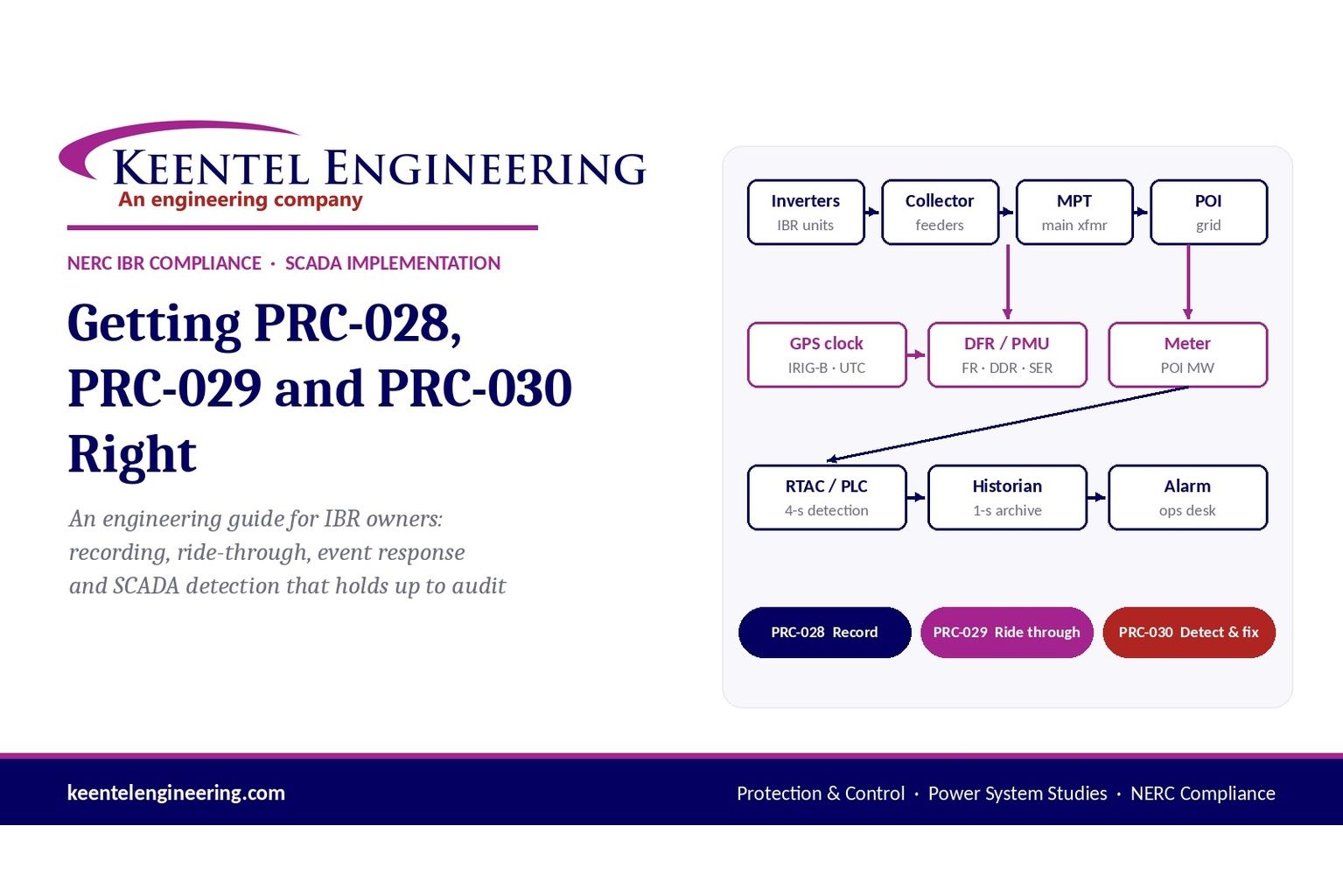
By SANDIP R PATEL
•
October 3, 2026
Engineering guide to PRC-028 disturbance recording, PRC-029 ride-through and PRC-030 event detection for inverter-based resources.
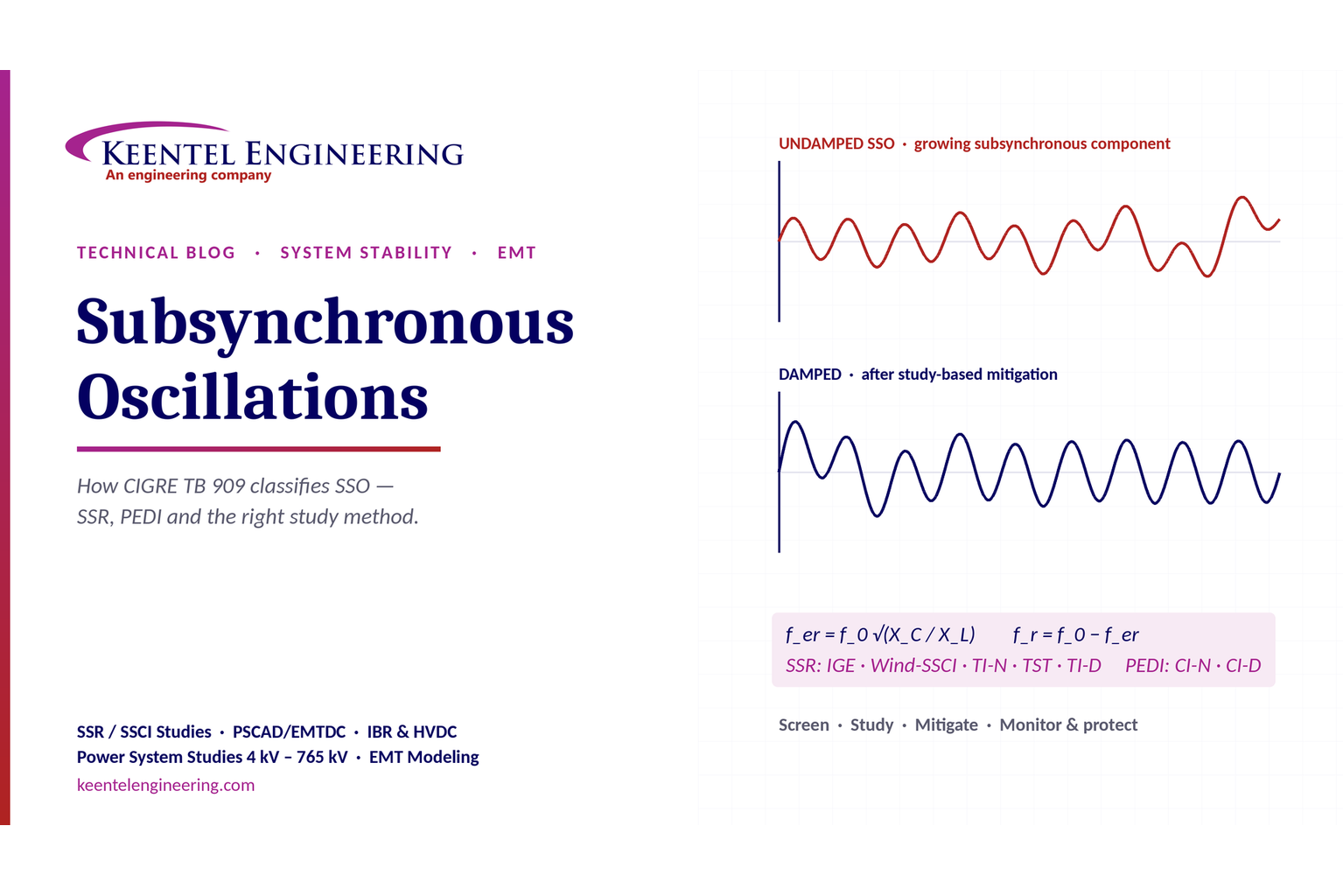
By SANDIP R PATEL
•
October 3, 2026
A practical guide to SSO classification, SSR, PEDI, Wind-SSCI, EMT analysis, mitigation and protection based on CIGRE TB 909.
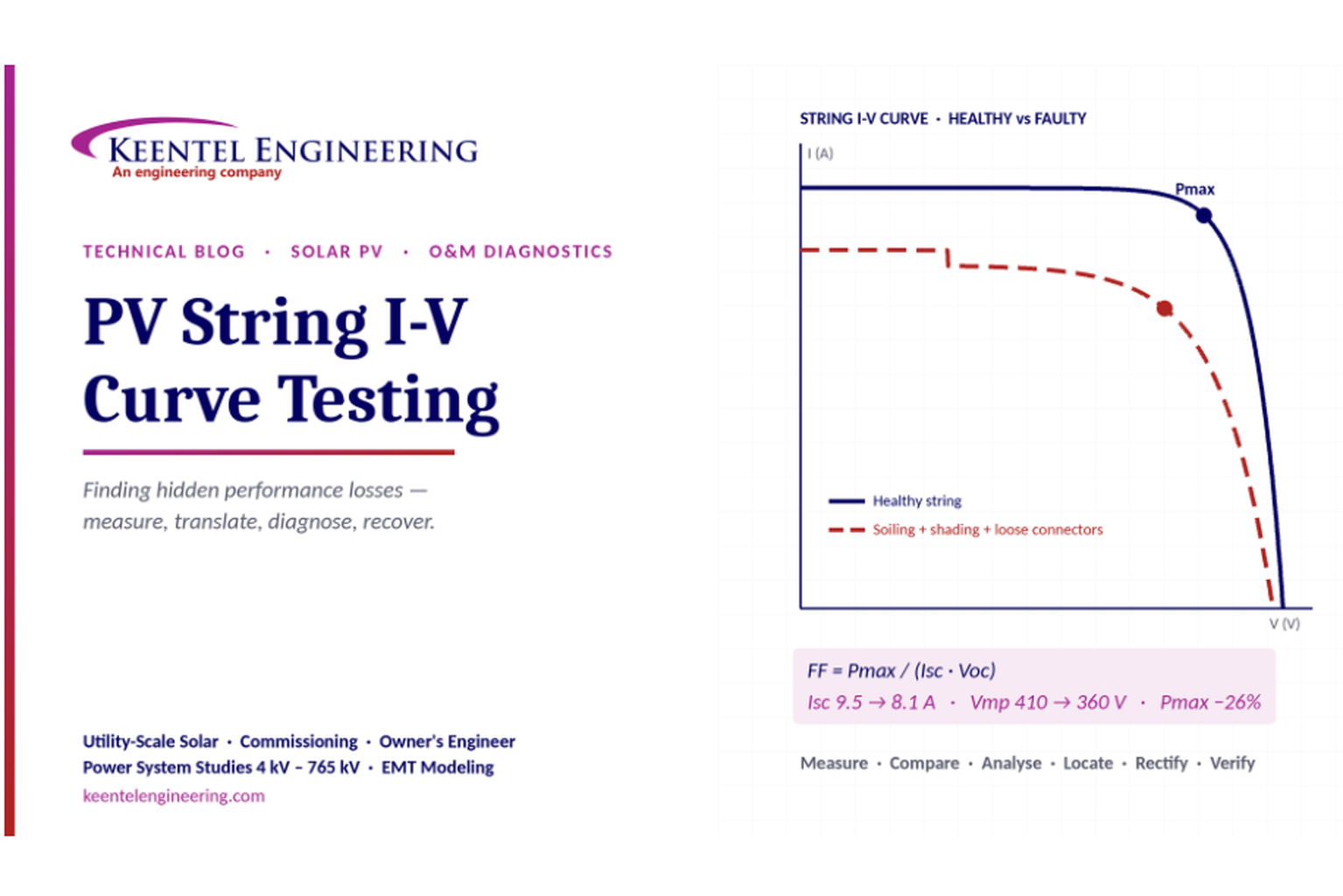
By SANDIP R PATEL
•
October 3, 2026
Learn how PV string I-V curve testing identifies hidden solar performance losses, including soiling, shading, mismatch, degradation, and wiring faults.
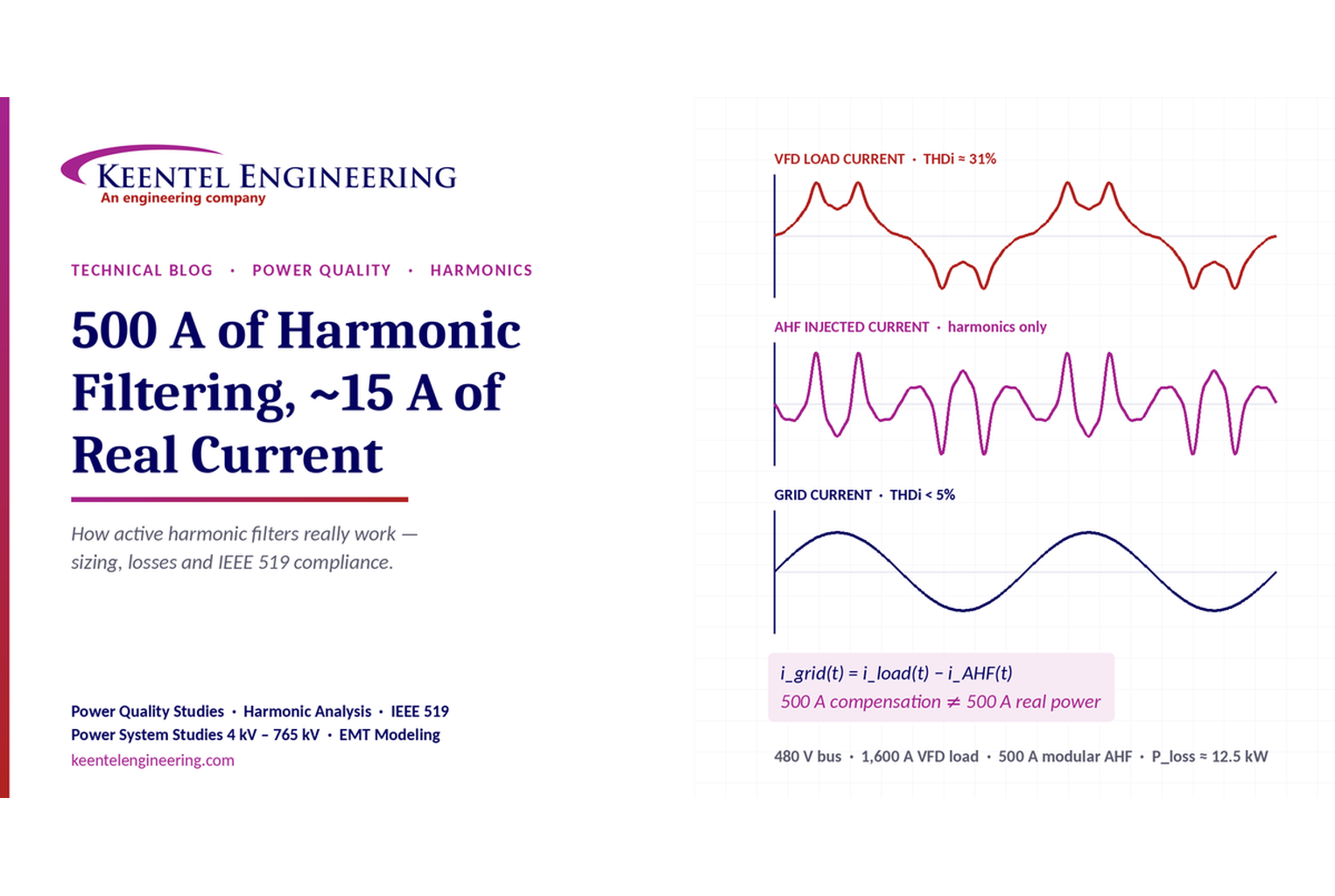
By SANDIP R PATEL
•
October 3, 2026
Learn how active harmonic filters work, how to size AHF systems, reduce VFD harmonics, calculate losses, and meet IEEE 519 TDD limits at the PCC.
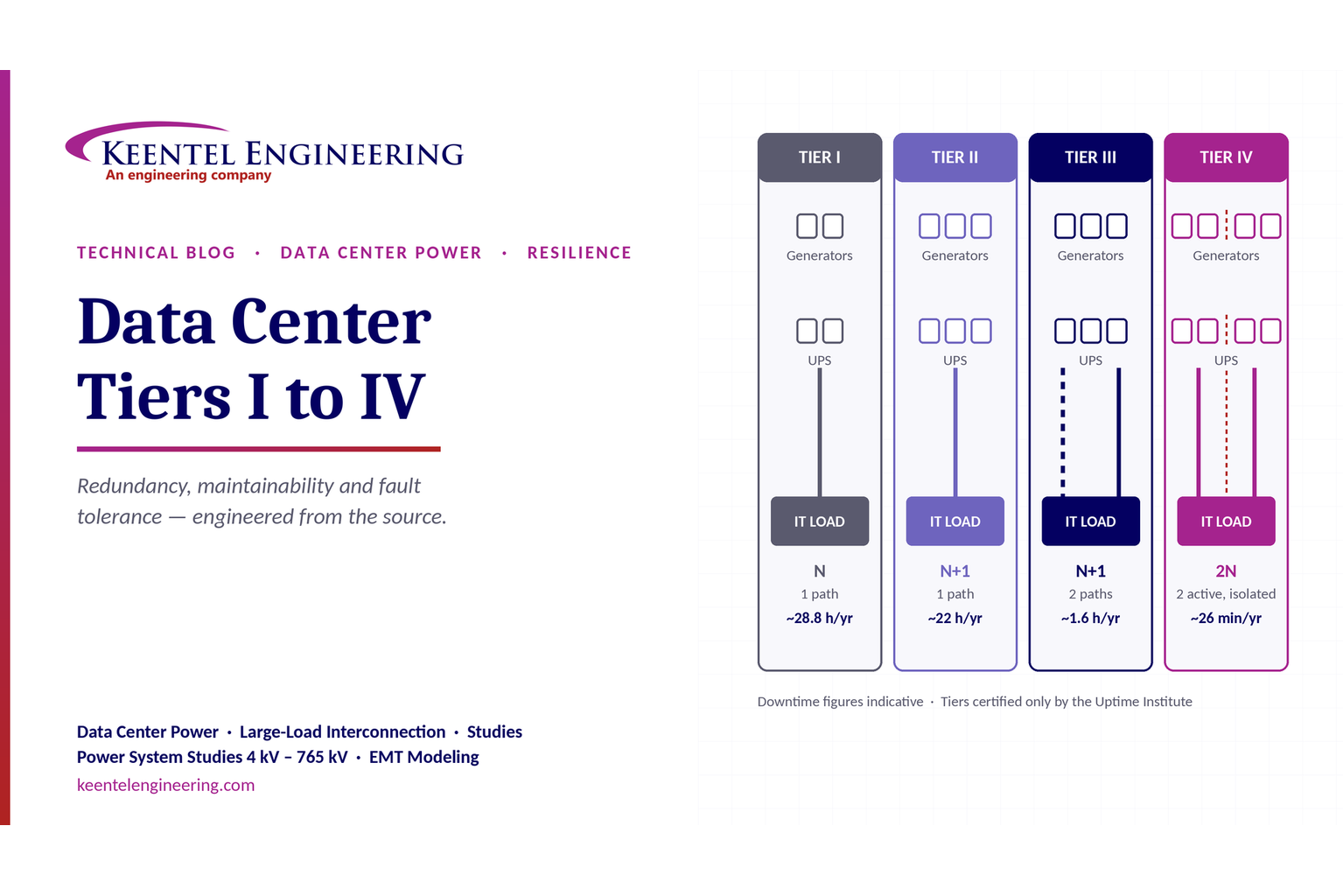
By SANDIP R PATEL
•
October 3, 2026
Compare Data Center Tiers I–IV, including redundancy, uptime, Tier III concurrent maintainability, Tier IV fault tolerance, UPS, generators and power design.
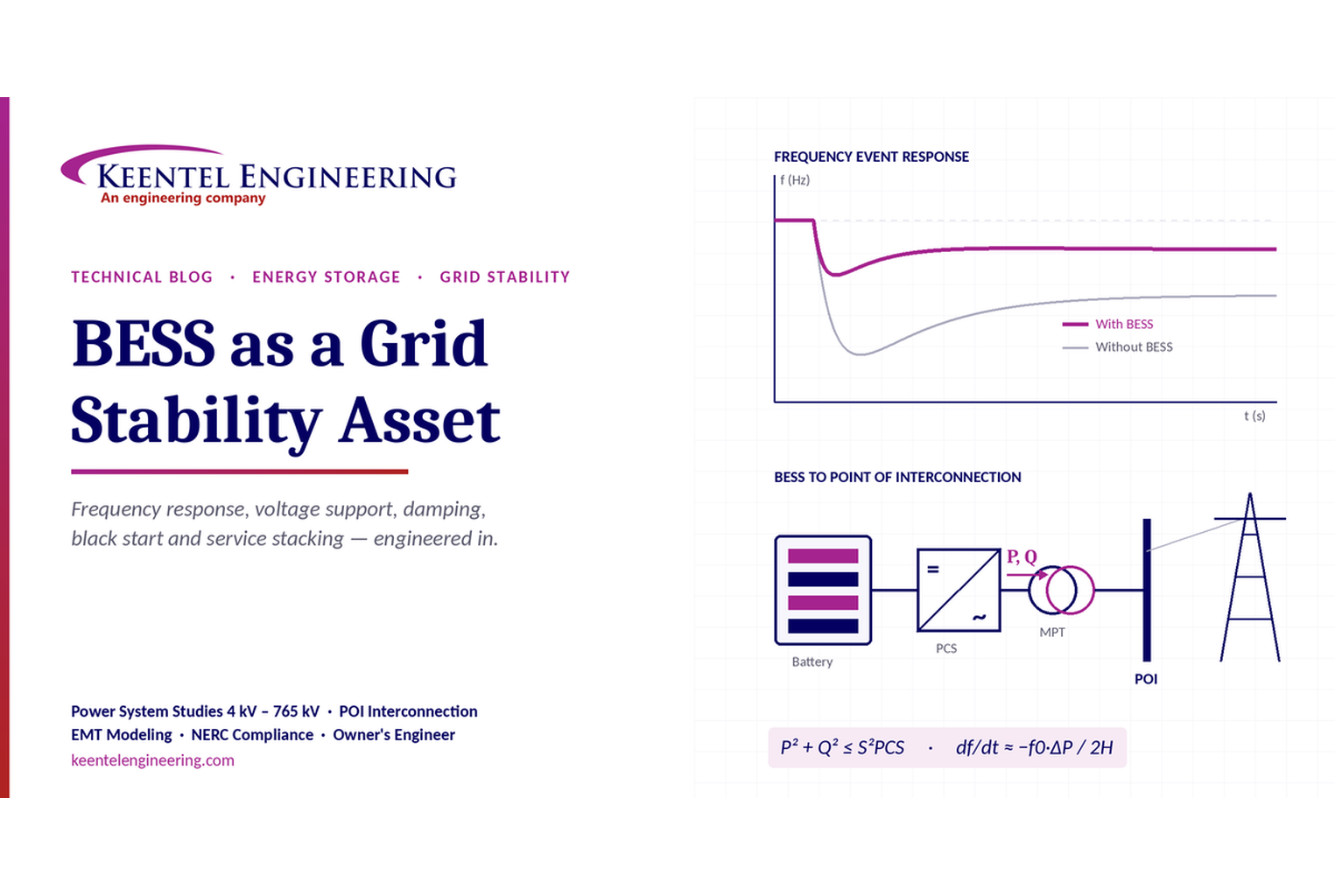
By SANDIP R PATEL
•
October 3, 2026
Learn how BESS supports grid stability through fast frequency response, voltage support, oscillation damping, black start, grid-forming controls and EMT studies.
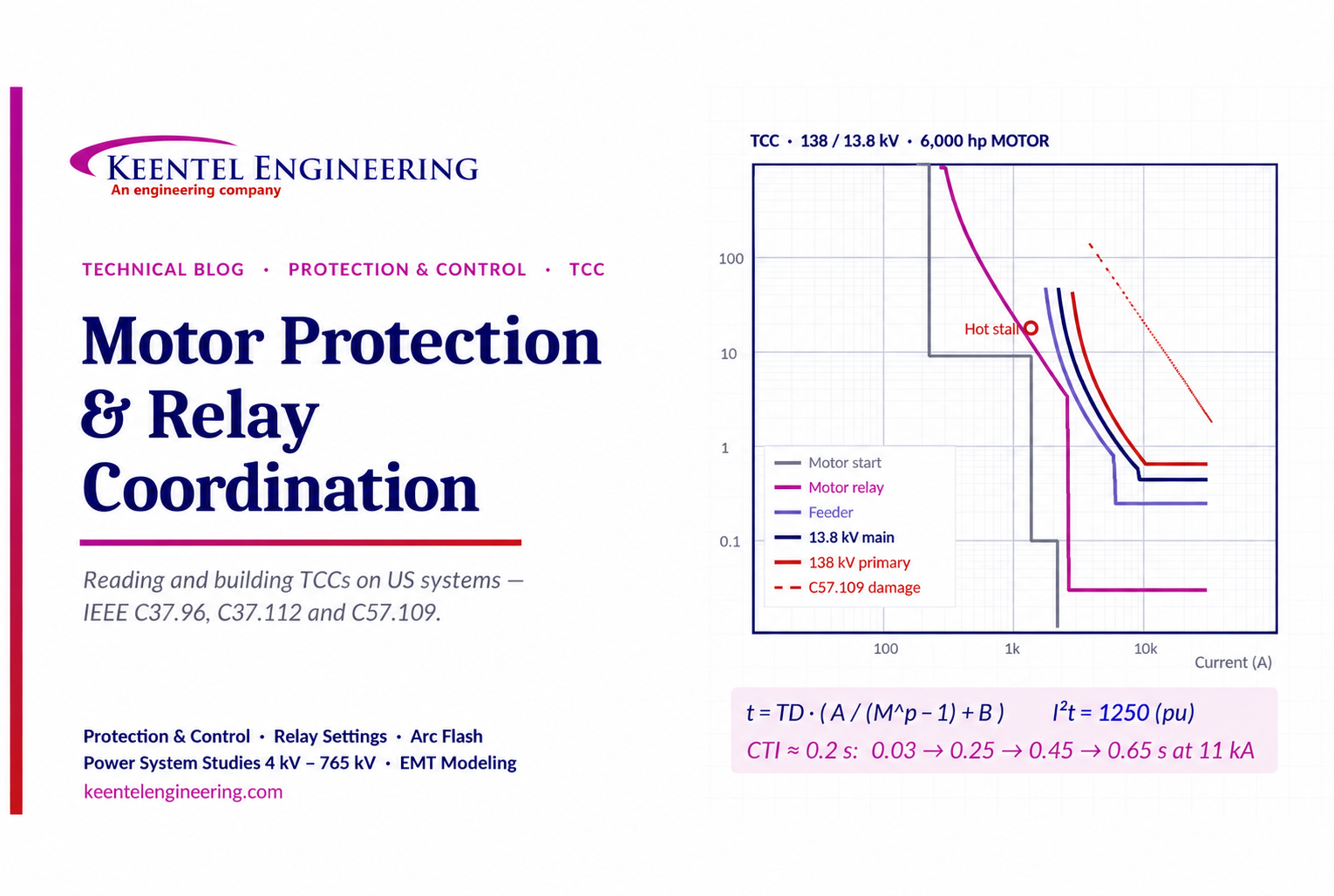
By SANDIP R PATEL
•
October 3, 2026
Learn motor protection and relay coordination using TCC curves, IEEE standards, transformer damage limits, CTI settings and a 138/13.8 kV example.
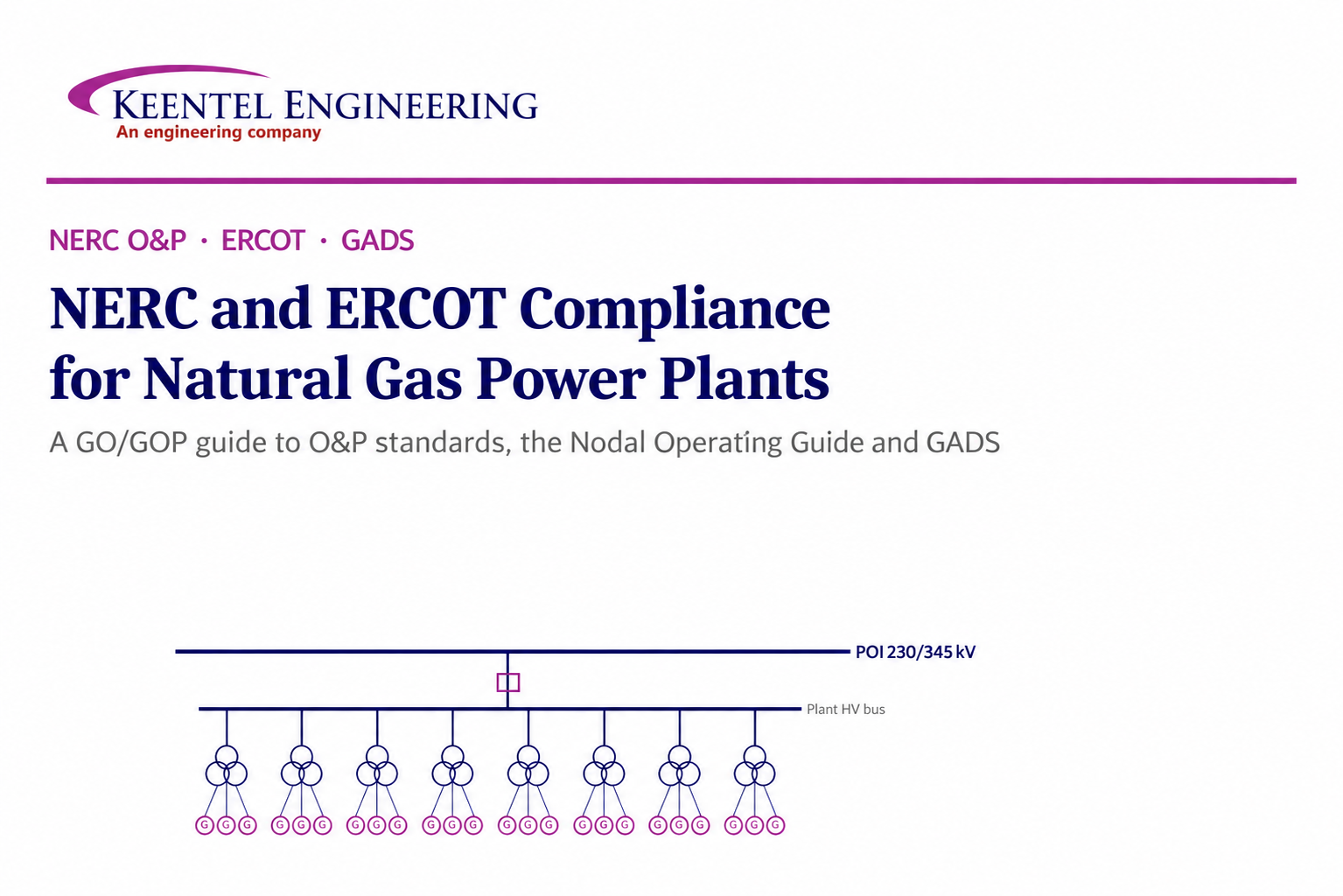
By SANDIP R PATEL
•
September 30, 2026
Learn NERC and ERCOT compliance requirements for natural gas power plants, including GO/GOP obligations, O&P standards, GADS reporting, and audits.
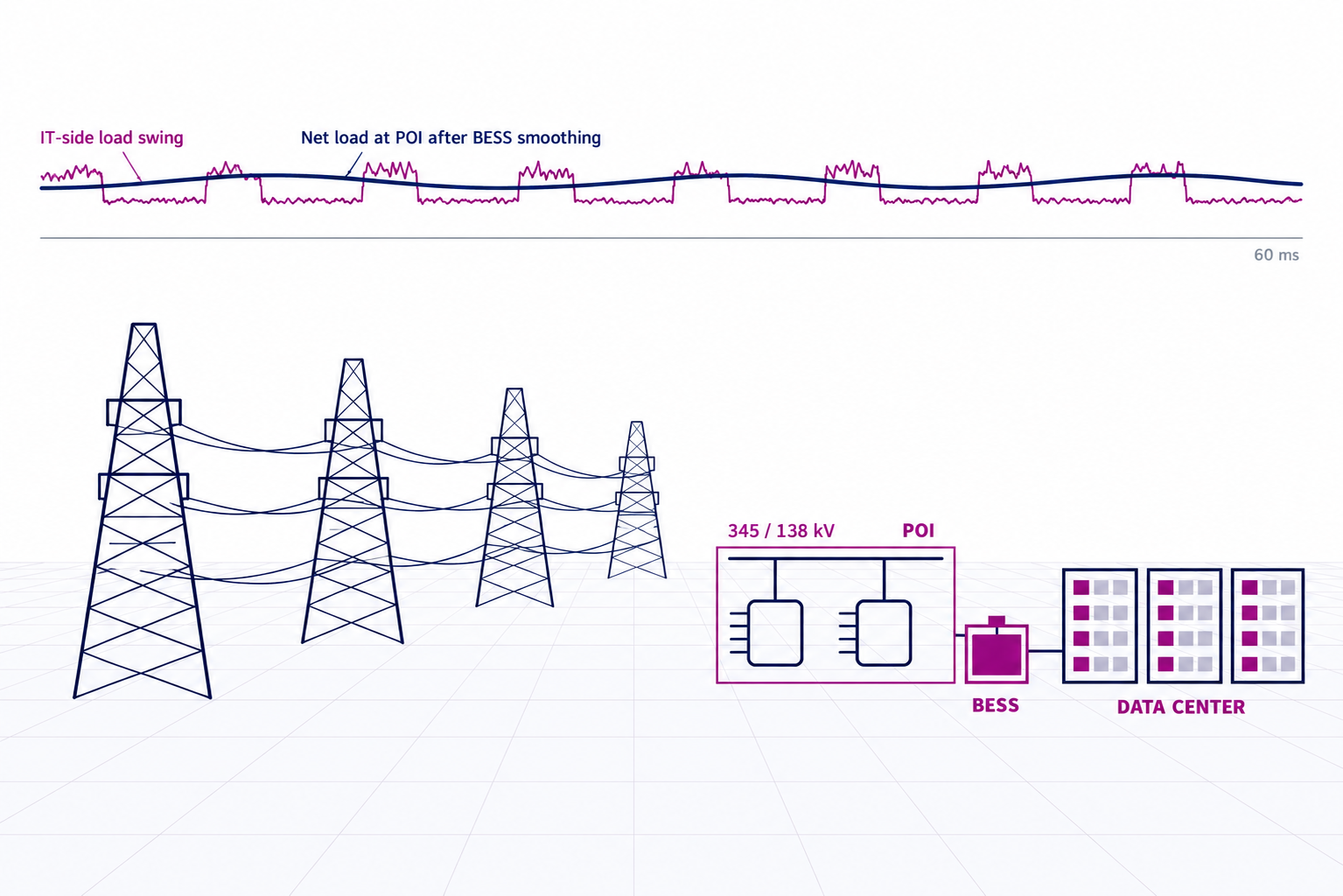
By SANDIP R PATEL
•
September 26, 2026
Learn how to prepare a MISO large-load interconnection package, including PSS®E models, BESS smoothing, harmonic data and transmission-owner requirements.