A Coordinated Electric System Interconnection Review—the utility’s deep-dive on technical and cost impacts of your project.
Challenge: Frequent false tripping using conventional electromechanical relays
Solution: SEL-487E integration with multi-terminal differential protection and dynamic inrush restraint
Result: 90% reduction in false trips, saving over $250,000 in downtime
The three operating regions you have to design to
| Device | Output vs voltage | Response | Best suited to | Main limitations |
|---|---|---|---|---|
| Mechanically switched capacitor or reactor | Proportional to voltage squared | Seconds; discrete steps; limited switching operations per day | Steady-state reactive supply, voltage profile, loss reduction | No dynamic capability; step voltage change on switching; capability collapses when most needed |
| Static var compensator | Capacitive branches proportional to voltage squared | A few cycles; continuously controllable | Continuous control where cost matters and deep voltage support is not the driver | Square-law capability loss; harmonic filters are part of the plant and interact with the network |
| STATCOM | Approximately proportional to voltage — constant current capability | One to two cycles closed loop; converter response faster still | Voltage stability margin, weak interconnections, fast disturbance recovery, flicker and unbalance compensation | Higher capital cost; converter losses; adds a converter and its control dynamics to the network |
| Synchronous condenser | Governed by machine capability and excitation | Excitation response in the hundreds of milliseconds; inherent inertial response instantaneous | System strength and inertia, short-circuit contribution, black start support | Rotating plant with maintenance and losses; slower controlled response than a converter |
| STATCOM with energy storage | Reactive as a STATCOM, plus real power within the storage rating | As STATCOM for reactive; real power limited by storage | Where a real power deficiency is part of the problem | Cost and complexity of the storage; different failure and maintenance profile |
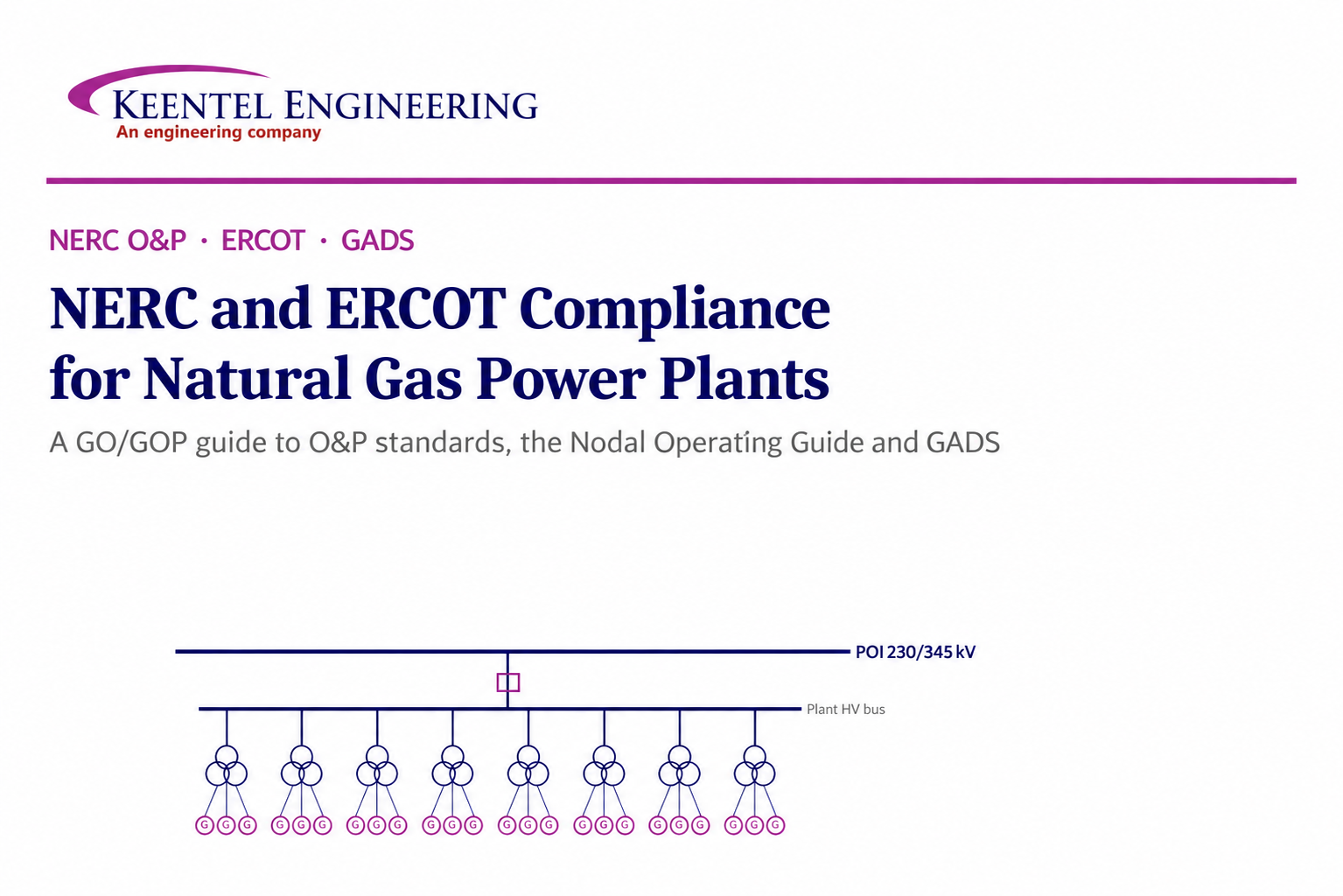
NERC and ERCOT Compliance for Natural Gas Power Plants
September 30, 2026 | Blog
A GO/GOP guide to the O&P Reliability Standards, the ERCOT Nodal Operating Guide and GADS reporting
Executive Summary
A new natural gas plant in ERCOT becomes subject to two regulatory systems at once. As a registered Generator Owner (GO) and Generator Operator (GOP), it must meet the NERC Reliability Standards enforced by Texas RE. As an ERCOT Resource, it must also meet the ERCOT Protocols, the Nodal Operating Guide, the Planning Guide and the PUCT's weather-preparedness rule. The two overlap, they change on different schedules, and they are audited by different bodies.
This guide sets out, standard by standard, what a gas-fired GO/GOP in ERCOT has to comply with today, what changes between now and 2029, and what does not apply. It explains where the engineering evidence comes from and how GADS reporting works for plants built from many smaller units. The applicability screen is taken directly from the NERC US Effective Date Status / Functional Applicability matrix, and the ERCOT items are checked against ERCOT's published revision requests.
The numbers that matter
32 NERC Operations & Planning (O&P) standards are currently enforceable for a GO/GOP in ERCOT: 21 apply to every gas plant and 11 depend on plant facts.
6 approved future versions take effect between 1 October 2026 and 1 April 2029. Two of them, PRC-024-4 and TOP-003-7, take effect on 1 October 2026.
20 ERCOT compliance areas sit alongside the NERC standards. They trace back to roughly 30 Nodal Operating Guide revision requests plus related Protocol, Planning Guide and PUCT rules.
20 MW is the GADS mandatory reporting threshold. It matters for reciprocating-engine plants, where individual engines are often just under it.
Key points
- Compliance starts on the day of registration, not later. Texas RE expects a newly registered generator to be audit-ready from day one, so the program has to be built before commercial operation.
- Much of the evidence is engineering rather than paperwork. Protection settings, Facility Ratings, capability tests and dynamic models make up the evidence for PRC, FAC, MOD and VAR requirements.
- The ERCOT and NERC obligations cover the same equipment. Governors, AVRs, voltage control and cold weather each appear in both rulebooks and should be managed as one obligation.
- The number of units multiplies the workload. A plant made of twenty-plus engines has twenty-plus sets of settings, maintenance records and notifications.
1. How Compliance Is Layered for an ERCOT Gas Plant
Four bodies set or enforce the rules that apply to a gas-fired generator in the ERCOT Interconnection. Knowing which one owns a given requirement tells you who audits it, how a violation is handled and where the current text lives.
| Layer | Who | What it sets | How it is enforced |
|---|---|---|---|
| Federal reliability | FERC and NERC | Mandatory Reliability Standards (BAL, COM, EOP, FAC, IRO, MOD, PER, PRC, TOP, TPL, VAR, CIP) | Texas RE compliance monitoring: audits, spot checks, self-certifications and self-logging |
| Regional entity | Texas Reliability Entity (Texas RE) | Registration, compliance monitoring and the ERCOT regional standard BAL-001-TRE-2 | Compliance Monitoring and Enforcement Program through Align and the Secure Evidence Locker |
| Market and grid operator | ERCOT | Protocols, Nodal Operating Guide, Planning Guide; Resource registration, telemetry, testing and operating requirements | ERCOT monitoring programs and performance metrics; referral to the PUCT |
| State regulator | Public Utility Commission of Texas (PUCT) | Weather emergency preparedness (16 TAC §25.55), emergency operations plans (16 TAC §25.53), approval of ERCOT rule changes | PUCT enforcement, including administrative penalties |
For ERCOT, the NERC Reliability Coordinator, Balancing Authority, Transmission Operator and Planning Coordinator functions are largely performed by ERCOT itself. When a standard says "provide data to the Transmission Operator" or "follow the Reliability Coordinator's Operating Instructions", in practice the counterparty is ERCOT, usually reached through the plant's QSE.
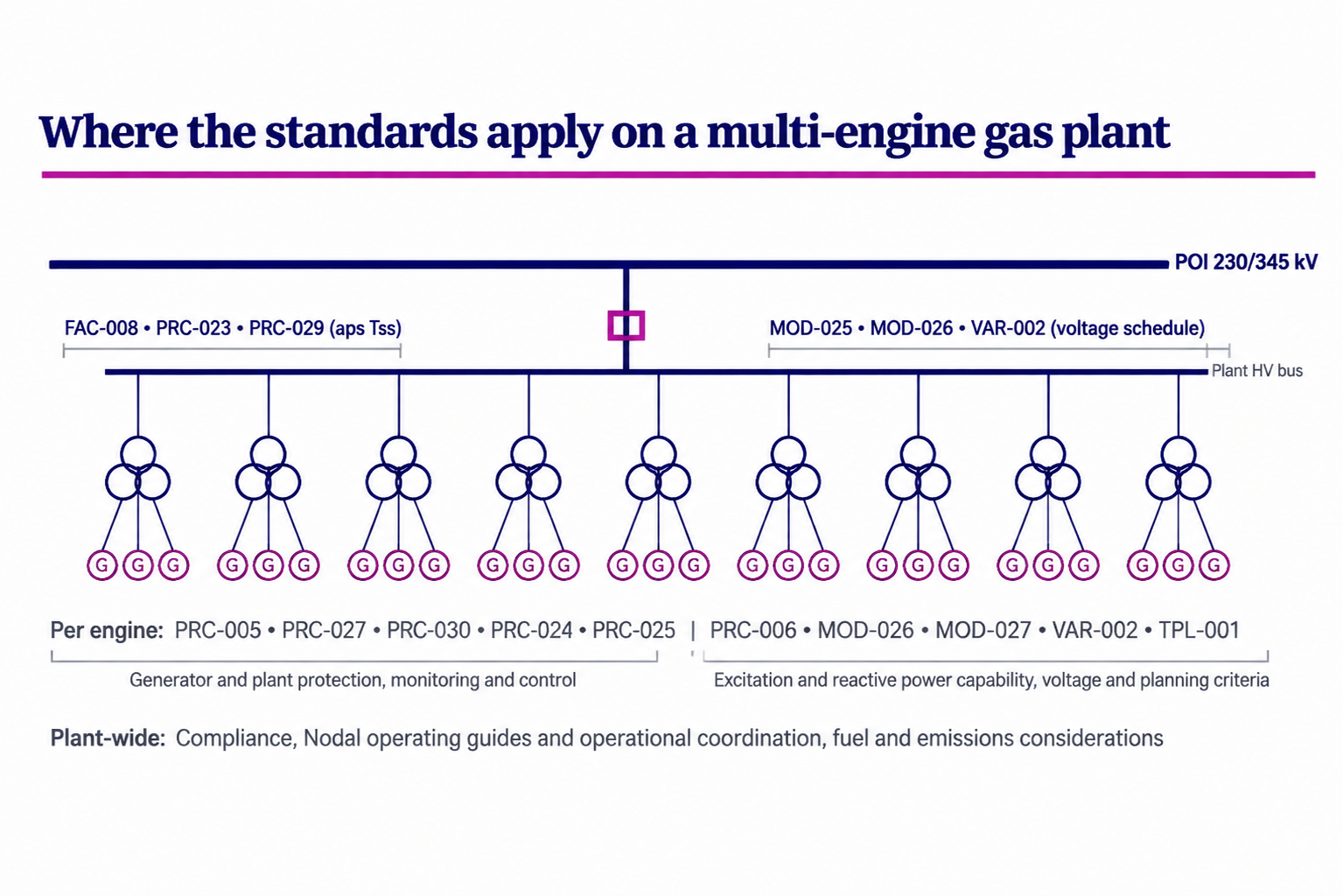
Figure 1 — Illustrative one-line of a multi-engine gas plant, showing where the main O&P standards and ERCOT requirements apply. Composite example for explanation only.
2. What Registration as GO and GOP Actually Commits You To
The Generator Owner owns the physical equipment and the engineering facts about it: ratings, protection settings, models, maintenance and design basis. The Generator Operator runs the plant in real time: it takes instructions, communicates, reports status changes and trains operators. One company often holds both registrations, but the obligations stay separate and are audited separately.
| Function | Typical owner of the evidence | Representative standards |
|---|---|---|
| Generator Owner (GO) | Asset owner, owner's engineer, EPC and OEM data, protection engineer, maintenance contractor | FAC-008, MOD-025, MOD-026, MOD-032, PRC-004, PRC-005, PRC-019, PRC-024, PRC-025, TPL-007, EOP-012 |
| Generator Operator (GOP) | Plant operations, control room, QSE interface | COM-001, COM-002, IRO-001, TOP-001, VAR-002 (operating requirements), PER-005/PER-006, EOP-004 |
| Both | Compliance lead and Senior Manager | BAL-001-TRE-2, IRO-010, TOP-003, EOP-004, EOP-012, VAR-002 |
"Audit-ready on the day it is registered"
Texas RE's guidance for new generator entities is blunt: the entity should be audit-ready on the day it is registered, and it should allow six to twelve months to prepare. Every applicable requirement needs an owner, a procedure, a control and evidence from the registration date. The first self-certifications typically follow within about two years. A program built after commercial operation starts with a backlog of potential noncompliance.
Practical rule
Start building the compliance program at least 12 months before commercial operation. The engineering evidence — settings, ratings, capability data, models — is produced during design and commissioning, and that is the cheapest time to capture it in a compliant form.
3. The 32 NERC O&P Standards That Apply Today
The list below comes from filtering the NERC applicability matrix to standards that are Mandatory Subject to Enforcement, and keeping each standard version that has at least one requirement flagged for GO or GOP. CIP cyber security, NUC-001, non-ERCOT regional standards and inverter-based resource standards were then removed; Section 5 explains why. "Conditional" means the standard applies only if a plant-specific fact is true.
| Standard | Title | Status for a gas plant |
|---|---|---|
| BAL-001-TRE-2 | Primary Frequency Response in the ERCOT Region | Applies |
| COM-001-3 | Communications | Applies |
| COM-002-4 | Operating Personnel Communications Protocols | Applies |
| EOP-004-4 | Event Reporting | Applies |
| EOP-005-3 | System Restoration from Blackstart Resources | Conditional |
| EOP-012-3 | Extreme Cold Weather Preparedness and Operations | Applies |
| FAC-001-4 | Facility Interconnection Requirements | Conditional |
| FAC-002-4 | Facility Interconnection Studies | Applies |
| FAC-003-5 | Transmission Vegetation Management | Conditional |
| FAC-008-5 | Facility Ratings | Applies |
| IRO-001-4 | Reliability Coordination — Responsibilities | Applies |
| IRO-010-5 | RC Data Specification and Collection | Applies |
| MOD-025-2 | Verification of Generator Real and Reactive Capability | Applies |
| MOD-026-2 | Generator Model Verification and Data Reporting | Applies |
| MOD-032-1 | Data for Power System Modeling and Analysis | Applies |
| PER-005-2 | Operations Personnel Training | Conditional |
| PER-006-1 | Specific Training for Personnel | Applies |
| PRC-002-5 | Disturbance Monitoring and Reporting | Conditional |
| PRC-004-6 | Protection System Misoperation Identification and Correction | Applies |
| PRC-005-6 | Protection System, Automatic Reclosing and Sudden Pressure Relaying Maintenance | Applies |
| PRC-012-2 | Remedial Action Schemes | Conditional |
| PRC-017-1 | RAS Maintenance and Testing | Conditional |
| PRC-019-2 | Coordination of Generating Unit Capabilities, Voltage Controls and Protection | Applies |
| PRC-023-6 | Transmission Relay Loadability | Conditional |
| PRC-024-3 / -4 | Frequency and Voltage Protection Settings for Generating Resources | Applies |
| PRC-025-2 | Generator Relay Loadability | Applies |
| PRC-026-2 | Relay Performance During Stable Power Swings | Conditional |
| PRC-027-1 | Coordination of Protection Systems for Performance During Faults | Conditional |
| TOP-001-6 | Transmission Operations | Applies |
| TOP-003-6.1 / -7 | TOP and BA Data Specification and Collection | Applies |
| TPL-007-4 | Planned Performance for Geomagnetic Disturbance Events | Conditional |
| VAR-002-4.1 | Generator Operation for Maintaining Network Voltage Schedules | Applies |
What resolves the conditional standards
| Plant fact | Standards it decides |
|---|---|
| Is any unit a designated Blackstart Resource? | EOP-005-3 |
| Does a Remedial Action Scheme act on the plant? | PRC-012-2, PRC-017-1 |
| Length, voltage and routing of the overhead gen-tie | FAC-003-5, PRC-023-6 |
| GSU high-side voltage and winding (wye-grounded at 200 kV and above) | TPL-007-4 |
| Has the plant been notified for disturbance recording or power-swing evaluation? | PRC-002-5, PRC-026-2 |
| Does a third party interconnect to the plant's facilities? | FAC-001-4 |
| Do plant personnel perform real-time control under direction of ERCOT? | PER-005-2 |
| Protection interfaces with the TO at the POI | PRC-027-1 |
At a 230 kV or 345 kV point of interconnection, TPL-007 and PRC-023 are usually live. The GSUs will almost always have wye-grounded high-voltage windings above 200 kV, and a gen-tie at that voltage normally carries load-responsive protection.
4. What Changes Between Now and 2029
Six approved future versions affect a gas-fired GO/GOP. None is a new obligation class, but each one requires procedures, data matrices or settings evidence to be revised before its effective date.
| Version | Effective | Replaces | What the plant has to do |
|---|---|---|---|
| PRC-024-4 | 1 Oct 2026 | PRC-024-3 | Settings re-verification against the revised no-trip curves; program document update. |
| TOP-003-7 | 1 Oct 2026 | TOP-003-6.1 | Updated data-specification response matrix. |
| EOP-004-5 | 1 Oct 2027 | EOP-004-4 | Event Reporting Operating Plan revision and training. |
| MOD-032-2 | 1 Apr 2028 (phased) | MOD-032-1 | Modeling-data package update to the revised data requirements. |
| IRO-010-6 | 1 Apr 2029 | IRO-010-5 | Updated RC data-specification response. |
| TOP-003-8 | 1 Apr 2029 | TOP-003-7 | Updated TOP/BA data-specification response. |
1 October 2026 is a double transition
PRC-024-3 and TOP-003-6.1 both go inactive on 30 September 2026, and their replacements take effect the next day. A plant commissioning in late 2026 should verify its frequency and voltage protection settings against PRC-024-4, not the version it may have been designed to.
Standards on the way out
PRC-017-1 (RAS maintenance and testing) shows an inactive date of 31 March 2027 in the NERC matrix, and MOD-026-1 has already been replaced by MOD-026-2, which consolidates
generator model verification with its GO requirements phasing in from 2027. A program should record these transitions explicitly, so that an auditor can see which version applied on any given date.
5. What Does Not Apply to a Gas Plant — and Why
An applicability determination is only defensible if it also records what was excluded and why. For a synchronous gas plant in ERCOT, the usual exclusions are:
| Excluded | Reason | Keep a record because… |
|---|---|---|
| PRC-028-1, PRC-029-1, PRC-030-1 | Inverter-based resource standards. A synchronous engine or turbine plant has no IBR. | A co-located battery or solar addition would bring them in immediately. |
| PRC-006-NPCC-2, PRC-006-SERC-03 | Regional UFLS variants for other Regions. | They appear in the GO rows of the NERC matrix. |
| VAR-501-WECC-4; VAR-001-5 (GOP) | WECC regional standard; VAR-001-5's GOP obligation comes from the WECC variance only. | VAR-001-5 is flagged GOP in the matrix. |
| BAL-001-TRE-2 outside ERCOT | Texas RE regional standard. | It does apply in ERCOT — keep it. |
| NUC-001-4 | Applies only where the plant supports nuclear plant interface requirements. | Flagged GO/GOP in the matrix. |
| CIP-002 to CIP-015 | Cyber security is a separate compliance discipline with its own impact categorization. | CIP-002 categorization and CIP-003 low-impact controls still apply to the plant; they are managed as a separate program. |
How to read the NERC matrix correctly
- Filter on status first. Only "Mandatory Subject to Enforcement" and "Subject to Future Enforcement" matter. Inactive versions make up most of the rows.
- Aggregate to the standard version. Applicability flags sit on individual requirements and parts. A version applies to a GO if any requirement is flagged GO.
- Ignore the second-category columns for a synchronous plant. The GO-2 and GOP-2 columns relate to the newer inverter-based registration categories.
- Record effective and inactive dates. That shows which version governed on any audit date.
6. The ERCOT Layer: Nodal Operating Guide Requirements for Gas Plants
ERCOT's operating requirements for generators are in the Nodal Operating Guide (NOG), and they change through Nodal Operating Guide Revision Requests (NOGRRs). Many NOGRRs were written to align ERCOT practice with a NERC standard, so the two rulebooks track each other closely. They are not identical, however, and ERCOT's versions are often more specific about test procedures, set points and reporting windows. The table groups the requirements that apply to a natural gas Generation Resource into 20 compliance areas.
| Compliance area | Where it lives | What the plant must do |
|---|---|---|
| Governor & Primary Frequency Response | NOG 2.2.7; Attachments 8C, 8J, 8N; NOGRR143, NOGRR271; NOGRR180 (combined cycle only — not applicable) | Governors in service and not blocked, with ERCOT droop/deadband performance; governor speed tests; PFR measurement; RRS limits on PFR. |
| AVR & Power System Stabilizers | NOG 2.2.5, 2.2.6; NOGRR174 | AVRs in automatic voltage control mode; PSS in service where required; AVR/PSS testing aligned with MOD-026. |
| Voltage Control & Tolerance Band | NOG 2.7.3.1–2.7.3.5, 2.2.10; NOGRR150, NOGRR167, NOGRR195; NPRR747 | Follow TSP/ERCOT voltage set points; standard set-point communication; hold voltage within the tolerance band; report deviations. |
| Reactive Capability Testing | NOG 3.3.2.1–3.3.2.3; NOGRR147; NPRR713 | Reactive capability (CURL) testing aligned with MOD-025. |
| Seasonal Net Capability | NOG Attachment 8D | Seasonal verification of unit net real power capability. |
| Frequency Relaying & Ride-Through | NOG 2.6, 2.6.2; NOGRR139 | Under/over-frequency relay set points to ERCOT criteria (aligned with PRC-024). |
| Disturbance Monitoring, PMU & High-Resolution Data | NOG 6.1; Attachment 8M; NOGRR142, 169, 189, 223, 255 | Fault, sequence-of-events, dynamic disturbance and PMU recording where required; data retention and reporting. |
| Protective Relaying | NOG 6.2 incl. 6.2.4, 6.2.5, 6.2.6.3.4 | Generator protection and relay requirements; relay failure response; maintenance and testing. |
| Telemetry, ICCP & WAN | NOG 7.1–7.4; NOGRR199, 230, 239, 275, 280; Protocols Telemetry Standards (NPRR979) | Telemetry accuracy, availability and calibration; WAN participant security and data protection (QSE). |
| Outage Coordination | NOG 2.4; NPRR1108 | ERCOT approval of Resource Planned Outages; submission lead times. |
| Ancillary Services & Monitoring | NOG 2.3, Section 9; NOGRR211 (RTC), 253 (ECRS), 283 (DRRS); NPRR1096, NPRR1309 | Sustained-capability rules for ECRS/Non-Spin/DRRS; QSE and Resource monitoring programs. |
| Emergency Operations | NOG Attachment 8L; NOGRR165, NOGRR251; PUCT 16 TAC §25.53 | Emergency Operations Plan content, including cold weather. |
| Weather Emergency Preparedness | PUCT 16 TAC §25.55; ERCOT declarations; NPRR1107 | Winter preparation by 1 Dec and summer by 1 Jun; Declarations of Weather Preparedness; ERCOT inspections and cure of deficiencies. |
| Alternative Fuel / Firm Fuel | NOG Attachment 8H; NPRR1120, 1169, 1241 (Firm Fuel Supply Service) | Gas-only plant: report alternative-fuel status as required; FFSS is voluntary. |
| Black Start | NOG Attachments 8A, 8I; NOGRR194 | Only if the plant is procured as a Black Start Resource. |
| Critical Natural Gas Infrastructure | NOGRR287 (pending PUCT; effective no earlier than 1 Apr 2027); RRC 16 TAC §3.65 | Obligations sit with TOs/DSPs and gas facilities; the plant benefits indirectly. |
| Dynamic Model Quality | Planning Guide 5.7.1, 6.2; PGRR075, 085, 102, 112 | Model Quality Test results; model parameters must match field settings. |
| GMD Data | NOG 6.1.1, 6.1.5.1; NOGRR214 | Mainly TO data; GSU transformer data support. |
| Change Tracking | Pending NOGRR284/288 (DRRS with ESR), NOGRR286 (765 kV limits) | Monitor for impact. |
| Not Applicable | NOGRR111 (combined cycle HSL telemetry); IBR-only NOGRR245, 272, 227, 246, 279 | Simple-cycle reciprocating-engine plant with no IBR. |
Nodal Operating Guide Section 2 at a glance
For a generator, the core of Section 2 is: 2.2.5 Automatic Voltage Regulators, 2.2.6
Power System Stabilizers, 2.2.7 Turbine Speed Governors, 2.2.8 Performance/Disturbance/Compliance Analysis, 2.2.10 response-time requirements, 2.4 outage coordination, 2.6 under/over-frequency relaying, and 2.7 voltage profile and operational voltage control. Section 2.7.3.5 sets out Resource Entity responsibilities. Section 6 covers disturbance monitoring and protective relaying, Section 7 telemetry and communications, Section 9 monitoring programs, and the Section 8 attachments carry the test procedures: 8C governor speed tests, 8D seasonal net capability verification, 8H alternative fuel capability and 8J primary frequency response measurement.
7. Where NERC and ERCOT Meet: Five Engineering Deep Dives
7.1 Governors and primary frequency response
BAL-001-TRE-2 is the Texas RE regional standard for primary frequency response, and NOG Section 2.2.7 and Attachments 8C and 8J carry ERCOT's governor requirements and measurement methods. Together they require that governors be in service, not blocked or limited by plant controls, set to ERCOT's droop and deadband performance, and able to deliver sustained response.
For an engine plant, the evidence is unit by unit. Each engine needs a record of its governor settings and in-service status. Each qualifying frequency event needs a performance review showing the plant's initial and sustained response. The most common gap is a plant-level controller that pulls output back to its MW set point after the governor responds, which defeats sustained response even though every governor is set correctly.
7.2 Voltage control: AVR, PSS and the tolerance band
VAR-002-4.1 requires the GOP to run the AVR in automatic voltage control mode, maintain the voltage schedule and report status changes. ERCOT adds the operational detail: NOG 2.2.5 for AVRs, 2.2.6 for PSS, 2.7.3 for voltage set points and Resource Entity duties. NOGRR195 set the generator voltage control tolerance band, effective 5 February 2021.
| Obligation | Source | Timing |
|---|---|---|
| AVR in automatic voltage control mode unless exempted | VAR-002-4.1; NOG 2.2.5 | Continuous |
| Notify of AVR or PSS status change (unless restored first) | VAR-002-4.1 | Within 30 minutes |
| Notify of change in reactive capability | VAR-002-4.1 | Within 30 minutes |
| Provide GSU tap settings and impedance data on request | VAR-002-4.1 | Within 30 days |
| Hold voltage within the tolerance band around the set point | NOG 2.7.3; NOGRR195 | Continuous |
| AVR/PSS testing aligned with model verification | NOG 2.2.5, 2.2.6; NOGRR174; MOD-026-2 | Per schedule |
With 24 AVRs, the 30-minute notification is the requirement most likely to be missed. Operators need a single, simple trigger for example, any AVR alarm on the plant controller means a call to the QSE and a log entry rather than a judgement call at 3 a.m.
7.3 The protection-settings trio: PRC-019, PRC-024 and PRC-025
These three standards all test generator protection and control settings against a different boundary:
- PRC-019-2 checks that voltage regulating controls and limiters coordinate with unit capability and protection, so that the AVR limiters act before protection trips the unit. It must be reviewed at least every five years and within 90 days of a qualifying change.
- PRC-024-3 (PRC-024-4 from 1 October 2026) checks that frequency and voltage protection does not trip the unit inside the no-trip zones. This includes auxiliary-system protection that can take a unit offline. NOG 2.6 adds ERCOT's under- and over-frequency set-point requirements.
- PRC-025-2 checks that load-responsive protection on the generator, GSU and unit auxiliary transformers will not trip at the loadability levels in Attachment 1.
The settings are the same, but the three pass/fail tests are different, so one settings database should drive all three evidence packages. PRC-005-6 then requires every protection component — relays, CTs and VTs, station DC supply, communications and control circuitry, and sudden pressure relays on the GSUs to be maintained at the intervals in its tables. On a multi-engine plant, that inventory runs to hundreds of components.
7.4 Capability, ratings and models
- FAC-008-5 requires a documented Facility Ratings methodology and ratings for every element up to the POI, set by the most limiting series component. At 230 kV and 345 kV, the most limiting element is often a disconnect switch, a jumper or a CT ratio rather than the transformer.
- MOD-025-2 verifies real and reactive capability within 12 months of commercial operation and every five years after. ERCOT's reactive capability testing (NOG 3.3.2, NOGRR147) should be run in the same campaign.
- MOD-026-2 verifies the excitation, governor and plant-control models against field behavior. ERCOT's Planning Guide model-quality requirements (PGRR075, PGRR085, PGRR102) require that model parameters match field settings.
- MOD-032-1 provides the steady-state, dynamic and short-circuit data that ERCOT's planning models use. MOD-032-2 takes over from 1 April 2028.
7.5 Cold weather: EOP-012-3 and PUCT §25.55 together
Since Winter Storm Uri, cold weather has been regulated twice over: by NERC through EOP-012-3 and by the PUCT through 16 TAC §25.55. A single weatherization program can satisfy both, but only if it is designed against both.
| Element | NERC EOP-012-3 | PUCT 16 TAC §25.55 |
|---|---|---|
| Design basis | Extreme Cold Weather Temperature determined for the unit | 95th-percentile weather-zone extremes, or the unit's historical extreme if more severe |
| Plan | Cold Weather Preparedness Plan with freeze-protection measures and operating limits | Winter and summer preparation measures; critical component identification |
| Gaps | Corrective Action Plans where the unit cannot operate at the design temperature | Cure of deficiencies found in ERCOT inspections |
| Deadlines | Annual training and plan review | Winter preparation by 1 December; summer by 1 June; Declarations of Weather Preparedness |
| Data | Annual NERC Cold Weather Section 1600 data submission | ERCOT inspections at least once every three years |
8. GADS, MIDAS and Cold Weather Data Reporting
8.1 What GADS requires
Under NERC's Section 1600 data request, any GO on the NERC Compliance Registry must report to the Generating Availability Data System for conventional units with a nameplate capacity of 20 MW or greater, and has had to since 1 January 2013. The 2026 GADS Data Reporting Instructions set out the details.
- Design data must be submitted before any event or performance data. The expanded design data set introduced in 2024 applies.
- Event data (outages, derates and reserve shutdowns) and performance data (hours, generation, starts) are due within 45 days after the end of each calendar quarter.
- Reciprocating engines have their own event-reporting row and cause codes. Since 2024, each event also carries a mandatory Contributing Operating Condition code, which includes cold weather, hot weather and ice or snow.
- Data is submitted to NERC's GADS reporting application through the OATI-hosted NERC webPortal.
8.2 The reciprocating-engine sizing problem
Large engine plants are built from many units of around 18 to 19 MW each, just below the 20 MW threshold. The GADS Data Reporting Instructions address this in two ways. First, where several engines and generators are combined, the group may be reported as a single unit or as individual units. Second, units that share an electric meter are treated as one "miscellaneous" unit sized by the group — and a group of 20 MW or more is mandatory to report.
| Configuration (illustrative 24 × 18.9 MW plant) | Reporting outcome |
|---|---|
| Each engine individually metered, reported as individual units | Each unit is below 20 MW. Reporting is voluntary per unit, which is a weak position for a 450 MW plant. |
| Engines grouped behind shared revenue meters (e.g., 3 groups of 8 = ~151 MW each) | Each metered group is a unit of 20 MW or more. Mandatory. |
| Whole plant as one unit (~453 MW) | Mandatory. This hides the engine-level availability that owners and OEM performance guarantees depend on. |
Recommendation
Decide the reporting configuration from the actual generator nameplate and the ERCOT metering and Resource registration, then confirm it in writing with NERC GADS staff and Texas RE before the first reportable quarter. Changing the unit configuration later breaks the performance history.
8.3 The other two data requests
- MIDAS: a quarterly Section 1600 data request for Protection System misoperations. It applies to GOs that own BES Protection Systems and links directly to PRC-004-6.
- Cold Weather data: an annual Section 1600 submission from every registered GO, covering Extreme Cold Weather Temperatures, Corrective Action Plans and operating constraints. It is tied to EOP-012.
9. What Commonly Gets Misstated
Summaries of ERCOT and NERC requirements in circulation including machine-generated ones often contain errors that would put a compliance program on the wrong footing. These are the ones that come up most often for gas plants, checked against the primary source.
| Claim | What the primary source says |
|---|---|
| "NOGRR287 is approved and in force." | The ERCOT Board recommended approval on 15 September 2026; PUCT approval is pending and the effective date is no earlier than 1 April 2027. Its obligations fall on Transmission Operators and distribution providers, not the generator. |
| "NOG 2.2.6 covers turbine speed governors." | 2.2.6 is Power System Stabilizers. Governors are 2.2.7. |
| "NOGRR111 applies to all gas plants." | It requires separate combustion and steam turbine High Sustained Limit telemetry for combined cycle resources only, and has been effective since 1 December 2013. |
| "NOG Section 2 mandates dual-fuel telemetry and testing." | There is no such Section 2 requirement. Alternative-fuel capability is reported under Attachment 8H, and fuel-backed obligations arise if the plant participates in the voluntary Firm Fuel Supply Service (NPRR1120 and later revisions). |
| "Firm Fuel Supply Service was created by NPRR1088." | FFSS was created by NPRR1120. |
| "All conventional generation must report GADS regardless of size." | The mandatory threshold is 20 MW nameplate. Smaller units report voluntarily unless grouped or commonly metered into a unit of 20 MW or more. |
| "Prepare for your Internal Controls Evaluation (ICE)." | The standalone ICE was removed in the ERO Enterprise internal controls guide of December 2025. Controls are now evaluated inside every compliance monitoring activity. |
| "Droop and deadband numbers are the same everywhere." | ERCOT specifies its own governor performance requirements in NOG 2.2.7 and the BAL-001-TRE-2 measures. Take the values from the current ERCOT text, not from another Region. |
10. The Compliance Calendar
Most violations at generator entities happen on a date a missed notification window, a lapsed maintenance interval or a late submission not in a missing procedure. A plant's calendar should contain at least the following.
| Obligation | Source | Frequency or deadline |
|---|---|---|
| AVR/PSS status and reactive-capability change notifications | VAR-002-4.1 | Within 30 minutes |
| GSU tap and impedance data | VAR-002-4.1 | Within 30 days of request |
| Event reporting | EOP-004-4; DOE OE-417 | Within 24 hours of recognition, per Attachment 1 |
| Misoperation identification and Corrective Action Plan | PRC-004-6 | Identify within 120 days; CAP within 60 days of cause |
| Protection System maintenance | PRC-005-6 | Per component-type intervals in Tables 1-1 to 1-5 and 2 |
| Coordination of controls and protection | PRC-019-2 | Every 5 years; within 90 days of a qualifying change |
| Real and reactive capability verification | MOD-025-2 | Within 12 months of COD, then every 5 years |
| Disturbance data on request | PRC-002-5 | Within 30 days of request (if applicable) |
| Cold weather plan review, training and NERC data | EOP-012-3; Section 1600 | Annually |
| Weather preparedness declarations | PUCT §25.55 | 1 December and 1 June |
| GADS event and performance data | Section 1600 | Within 45 days after each quarter |
| MIDAS misoperation data | Section 1600 | Quarterly |
| Governor tests and PFR performance | NOG 8C, 8J; BAL-001-TRE-2 | Per ERCOT schedule and each qualifying event |
| Seasonal net capability verification | NOG Attachment 8D | Per ERCOT schedule |
| Planned outage requests | NOG 2.4; NPRR1108 | ERCOT approval, per lead-time rules |
11. Composite Case Study: A 24-Engine Gas Plant in ERCOT
Composite example
This case study is a composite built for explanation. It does not describe any specific client, site, project, owner, manufacturer or utility.
Plant
The illustrative plant has twenty-four 18.9 MW gas engine-generator sets in eight groups of three, each group on a three-winding step-up transformer. A 345 kV switchyard and a short overhead gen-tie connect it to the POI. It is gas only, simple cycle, and registered as GO and GOP, with a third-party QSE.
Applicability outcome
- All 21 "Applies" standards were confirmed.
- Of the 11 conditional standards, TPL-007-4 and PRC-023-6 applied because of the 345 kV wye-grounded GSU windings and the gen-tie protection. PRC-027-1 applied at the TO interface.
- EOP-005, PRC-012 and PRC-017 were documented as not applicable after written confirmation that the plant was not a Blackstart Resource and had no RAS.
- FAC-003-5 was screened out on gen-tie length, and the determination was recorded.
What the gap assessment found
| Finding | Standard | Resolution |
|---|---|---|
| Plant controller returned output to MW set point within seconds of a frequency excursion | BAL-001-TRE-2; NOG 2.2.7 | Frequency-responsive logic added to the plant controller; event review procedure |
| Auxiliary-system undervoltage relays tripped inside the PRC-024 no-trip zone | PRC-024-3/-4 | Settings revised with a documented time delay; retained in the PRC-024-4 evidence |
| Facility Ratings stopped at the GSU; switchyard jumpers and CT ratios not rated | FAC-008-5 | Ratings extended to the POI; the most-limiting element proved to be a 345 kV disconnect switch |
| Operator procedure did not define an AVR "status change" for 24 units | VAR-002-4.1 | Single alarm-based trigger with a 30-minute call and log |
| GADS planned as 24 individual sub-20 MW units | Section 1600 | Reconfigured as eight metered groups; confirmed with GADS staff |
| Freeze protection designed to a milder temperature than the weather-zone extreme | EOP-012-3; §25.55 | Heat tracing upgraded; Corrective Action Plan closed before first winter |
None of these findings was a paperwork problem. Each one was an engineering fact that the compliance evidence exposed. That is typical: the program finds its value in the settings, ratings and controls, not in the binders.
12. Building the Program: An Eleven-Step Method
- Kickoff and data collection: one-lines, settings, OEM data, transformer tests, interconnection agreement, ERCOT registration data.
- Requirement-level applicability matrix, with each conditional item resolved and each requirement assigned to GO, GOP, QSE or contractor.
- Gap assessment of design, settings and planned O&M practice against every applicable requirement.
- Compliance program manual: governance, internal controls, evidence management, change management and noncompliance handling.
- Standard-specific procedures and plans, typically about 25 controlled documents for a gas GO/GOP.
- Technical evidence review: PRC-019, PRC-024 and PRC-025 settings, FAC-008 ratings, MOD-025 and MOD-026 plans, VAR-002 data and EOP-012 design.
- ERCOT compliance procedures for the 20 NOG areas, integrated with the NERC matrix.
- Evidence binders structured to the NERC Reliability Standard Audit Worksheets (RSAWs).
- A compliance calendar with owners and reminders.
- Role-based training for operators, engineers and management.
- A readiness review (mock audit) before registration or commercial operation.
Then, every quarter
Calendar management, evidence validation, regulatory change tracking across NERC, Texas RE, ERCOT and the PUCT, event and misoperation support, data-request responses, GADS and MIDAS submittals, and a quarterly status report. Each year: an internal compliance assessment, a procedure review, refresher training and weather-preparedness support ahead of 1 December and 1 June.
13. How Keentel Engineering Helps
Keentel Engineering combines NERC O&P compliance with the power system, protection and interconnection engineering that produces the evidence. For natural gas plants in ERCOT, that means one team can write the program, review the settings and ratings behind it, and keep it current.
| Service | What we deliver |
|---|---|
| NERC O&P 693 Compliance Program Development | Applicability matrices, gap assessments, compliance manuals, standard-specific procedures, RSAW-aligned evidence binders and readiness reviews for new and existing GO/GOP registrations. |
| Ongoing Compliance Management | Quarterly compliance support: calendar management, evidence validation, regulatory change tracking, event and misoperation support, self-certification and audit support through Align and the Secure Evidence Locker. |
| ERCOT Nodal Operating Guide Compliance | Governor and PFR, AVR/PSS, voltage control, reactive testing, telemetry, disturbance recording, outage coordination and NOGRR change tracking. |
| GADS, MIDAS and Cold Weather Reporting | Unit configuration, design data, quarterly event and performance reporting, misoperation reporting and the annual cold weather data submission. |
| Protection & Control Engineering | PRC-019, PRC-024 and PRC-025 coordination studies, PRC-005 maintenance program design, PRC-004 misoperation analysis and PRC-027 coordination. |
| Capability Testing, Ratings and Modeling | MOD-025 test procedures and reports, MOD-026 model verification, MOD-032 data packages, FAC-008 Facility Ratings and ERCOT model-quality submittals. |
| Weatherization and Cold Weather | EOP-012 Cold Weather Preparedness Plans, Extreme Cold Weather Temperature determination, Corrective Action Plans and PUCT §25.55 declaration and inspection readiness. |
| Power System Studies and Interconnection | EHV/HV/MV studies from 4 kV to 765 kV, POI interconnection engineering, GMD (TPL-007) support and owner's engineer services. |
Talk to us
Planning a new gas plant in ERCOT, or preparing for a Texas RE audit? Schedule a 15-minute call: calendly.com/keentel-engineering/15min
(813) 389-7871 | contact@keentelengineering.com | keentelengineering.com
14. Frequently Asked Questions
Q1. Which NERC functions does a natural gas plant register for?
Typically Generator Owner and Generator Operator. The owner of the equipment registers as GO; the entity that operates it in real time registers as GOP. One company can hold both.
Q2. How many NERC O&P standards apply to a gas GO/GOP in ERCOT?
32 standard versions are currently enforceable. 21 apply to every gas plant and 11 depend on plant facts such as blackstart designation, RAS, gen-tie configuration and notifications. Six future versions take effect by April 2029.
Q3. Do the CIP standards apply?
Yes, CIP-002 categorization and at least CIP-003 low-impact controls apply to a registered GO/GOP. They are normally run as a separate cyber security program from the O&P standards.
Q4. Do PRC-028, PRC-029 and PRC-030 apply to a gas plant?
No. They apply to inverter-based resources. A co-located battery or solar facility would bring them in.
Q5. What is BAL-001-TRE-2?
The Texas RE regional standard for primary frequency response in ERCOT. It requires governor performance and sustained frequency response from generating units.
Q6. What changes on 1 October 2026?
PRC-024-4 replaces PRC-024-3 and TOP-003-7 replaces TOP-003-6.1. Frequency and voltage protection settings should be verified against the PRC-024-4 no-trip zones.
Q7. What is a NOGRR?
A Nodal Operating Guide Revision Request — the process ERCOT uses to change its Nodal Operating Guide. Approved NOGRRs become binding operating requirements.
Q8. Which ERCOT sections matter most for a generator?
NOG Section 2 (governors, AVR, PSS, frequency relaying, voltage control, outage coordination), Section 6 (disturbance monitoring and protection), Section 7 (telemetry), Section 9 (monitoring programs) and the Section 8 test attachments.
Q9. Does NOGRR287 affect my plant?
Indirectly. It requires Transmission Operators and distribution providers to minimize overlap between load-shed circuits and critical natural gas infrastructure. It is pending PUCT approval and effective no earlier than 1 April 2027.
Q10. Does NOGRR111 apply to a simple-cycle plant?
No. It applies to combined cycle resources, requiring separate HSL telemetry for combustion and steam turbines.
Q11. How quickly must an AVR status change be reported?
Under VAR-002-4.1, within 30 minutes, unless the AVR is restored within that time.
Q12. How often must PRC-019 be reviewed?
At least once every five calendar years, and within 90 days of a change that affects coordination.
Q13. When is MOD-025 capability verification due?
Within 12 months of commercial operation for a new unit, and at least every five years after that.
Q14. How do EOP-012 and PUCT §25.55 relate?
Both regulate cold weather preparedness. EOP-012 is a NERC standard with Extreme Cold Weather Temperature, plans and Corrective Action Plans; §25.55 is the PUCT rule with 1 December and 1 June preparation deadlines and ERCOT inspections. One program can meet both if designed against both.
Q15. What is the GADS reporting threshold?
Conventional units with nameplate capacity of 20 MW or greater, owned by a GO on the NERC Compliance Registry.
Q16. My engines are under 20 MW each. Do I report GADS?
Possibly. Engines grouped as one unit or sharing a revenue meter form a unit sized by the group, which is mandatory at 20 MW or more. Confirm the configuration with NERC GADS staff and Texas RE.
Q17. When is GADS data due?
Event and performance data within 45 days after the end of each calendar quarter. Design data must be submitted first.
Q18. What is MIDAS?
NERC's quarterly Section 1600 data request for Protection System misoperations. It applies to GOs that own BES Protection Systems.
Q19. When should the compliance program be started?
At least 12 months before commercial operation. Texas RE expects a new generator to be audit-ready on the day it is registered and suggests six to twelve months of preparation.
Q20. What evidence do auditors look for?
For each requirement: a procedure, an owner, and dated records showing the requirement was met — settings files, test reports, logs, notifications, training records and submittals — organized to the RSAW.
Q21. What is the most common gap at new gas plants?
Usually engineering gaps rather than paperwork: plant controllers defeating sustained frequency response, auxiliary protection inside the PRC-024 no-trip zone, incomplete Facility Ratings and freeze protection designed to the wrong temperature.
Q22. Can Keentel run the ongoing compliance program?
Yes. We provide quarterly compliance management, GADS and MIDAS reporting, regulatory change tracking and Texas RE audit support, with the engineering depth to resolve technical findings.
References and Further Reading
NERC
- NERC, US Reliability Standards and Effective Date Status / Functional Applicability
- NERC, 2026 GADS Data Reporting Instructions
- NERC, Cold Weather Section 1600 Data Reporting Instructions
- NERC, MIDAS Section 1600 Data Request
Texas RE
ERCOT and PUCT
- ERCOT, Current Nodal Operating Guide
- ERCOT, revision request pages — NOGRR111, 139, 143, 147, 150, 167, 169, 174, 195, 199, 255, 283, 287
- ERCOT, NPRR1108, NPRR1120, NPRR1309
- ERCOT, Weatherization Trending Topic
- PUCT, 16 TAC §25.55 Weather Emergency Preparedness
Links were current as of September 2026.
Disclaimer
Educational purpose. This guide is general technical information for engineers, owners and operators. It is not legal advice, and it is not a compliance determination for any specific facility.
Applicability. Applicability depends on registration, plant configuration and regulator determinations. Standards, ERCOT rules and PUCT rules change; always confirm against the current text and effective dates before relying on this guide.
Composite examples. Case studies and illustrative configurations are composites built for explanation. They do not describe any specific client, site, project, owner, manufacturer or utility.
No warranty. Keentel Engineering makes no warranty, express or implied, as to the completeness or fitness for purpose of this information and accepts no liability for decisions made in reliance on it.
Trademarks and non-affiliation.
NERC, ERCOT, Texas RE, PUCT, OATI and other names are marks of their respective owners. Their use does not imply affiliation with or endorsement of Keentel Engineering.

About the Author:
Sandip "Sonny" R. Patel, P.E.
IEEE Senior Member · Founder & CEO, Keentel Engineering
In 1995, Sonny Patel earned his Electrical Engineering degree from the University of Illinois. But degrees don't build legacies — action does.
For three decades, he has worked the power industry from every side of the table: 16 years as a utility engineer at Exelon/Commonwealth Edison; generation leadership across hydroelectric, industrial steam turbine, and a 9 GW renewable fleet; NERC Regional Entity Senior Compliance Engineer and Audit Team Lead, auditing some of the nation's largest utilities; and testing and commissioning lead on equipment up to 765 kV — the very top of the North American grid.Utility. Generator. Regulator. Consultant. Few engineers have seen all four seats. Fewer still have sat in them.
His experience spans nuclear, hydro, conventional generation, renewables, oil and gas, mining — and today's data centers, where he is authoring a three-book series on data center design. He is a Licensed Professional Engineer in six states and a Licensed Electrical Contractor in Florida (Unlimited EC) — he doesn't just design the work; he's qualified to stand behind its execution.Today, as Founder and CEO of Keentel Engineering, Sonny leads a nationwide team of engineers delivering substation design, power system studies, NERC compliance, and commissioning — done right, coast to coast.Three decades. Every side of the table. One standard: accountable engineering.
Services

Let's Discuss Your Project
Let's book a call to discuss your electrical engineering project that we can help you with.
About the Author:
Sandip "Sonny" R. Patel, P.E.
IEEE Senior Member · Founder & CEO, Keentel Engineering
In 1995, Sonny Patel earned his Electrical Engineering degree from the University of Illinois. But degrees don't build legacies — action does.
For three decades, he has worked the power industry from every side of the table: 16 years as a utility engineer at Exelon/Commonwealth Edison; generation leadership across hydroelectric, industrial steam turbine, and a 9 GW renewable fleet; NERC Regional Entity Senior Compliance Engineer and Audit Team Lead, auditing some of the nation's largest utilities; and testing and commissioning lead on equipment up to 765 kV — the very top of the North American grid.
Utility. Generator. Regulator. Consultant. Few engineers have seen all four seats. Fewer still have sat in them.
His experience spans nuclear, hydro, conventional generation, renewables, oil and gas, mining — and today's data centers, where he is authoring a three-book series on data center design. He is a Licensed Professional Engineer in six states and a Licensed Electrical Contractor in Florida (Unlimited EC) — he doesn't just design the work; he's qualified to stand behind its execution.
Today, as Founder and CEO of Keentel Engineering, Sonny leads a nationwide team of engineers delivering substation design, power system studies, NERC compliance, and commissioning — done right, coast to coast.Three decades. Every side of the table. One standard: accountable engineering.
Leave a Comment
Thank you for contacting us.
We will get back to you as soon as possible.
We will get back to you as soon as possible.
Oops, there was an error sending your message.
Please try again later.
Please try again later.
Related Posts
By SANDIP R PATEL
•
September 26, 2026
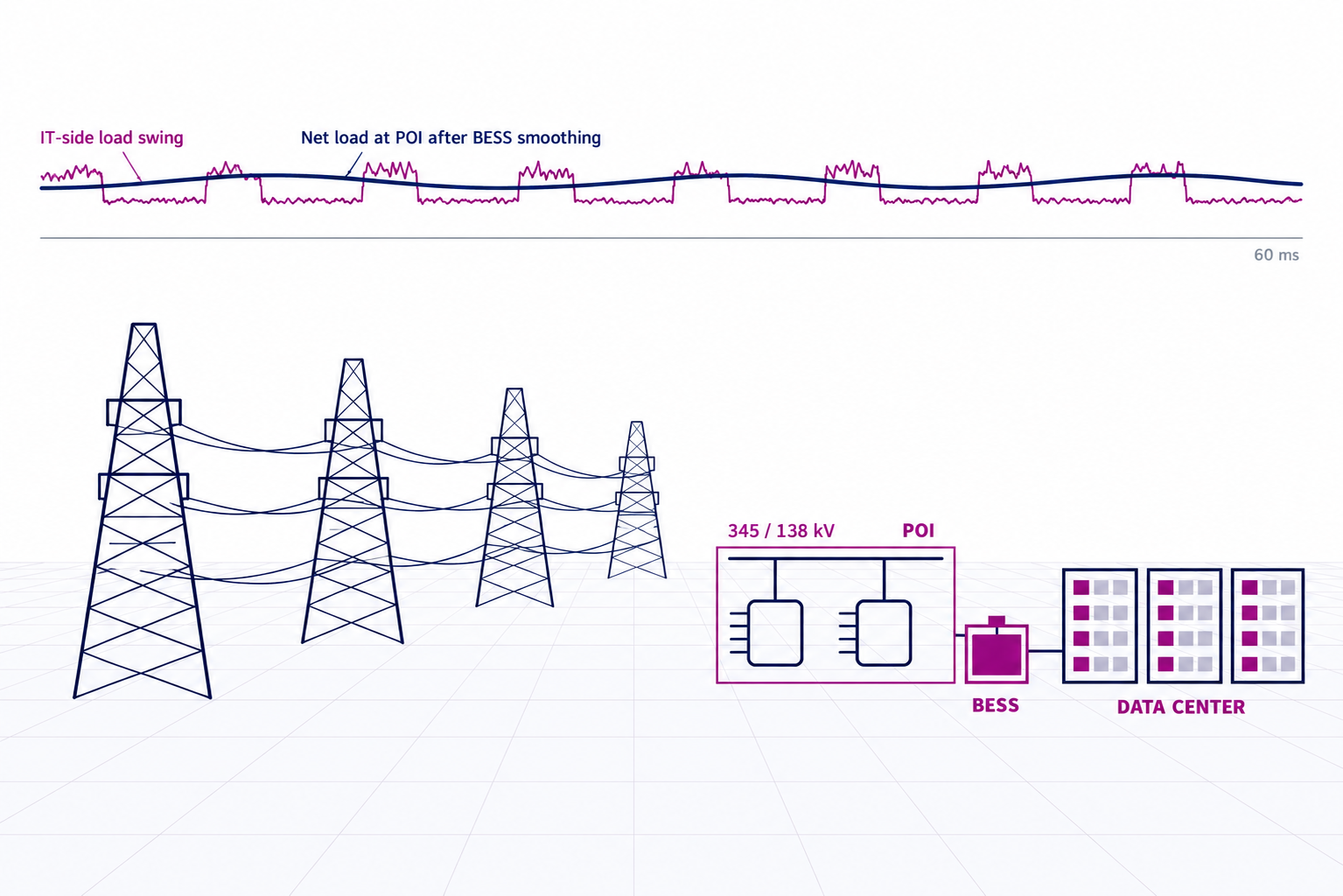
Learn how to prepare a MISO large-load interconnection package, including PSS®E models, BESS smoothing, harmonic data and transmission-owner requirements.

By SANDIP R PATEL
•
September 26, 2026
Learn where storage belongs in an 800 VDC AI data center, including capacitors, flywheels, BESS, fault current, protection, grounding, and EMT design.
By SANDIP R PATEL
•
September 26, 2026
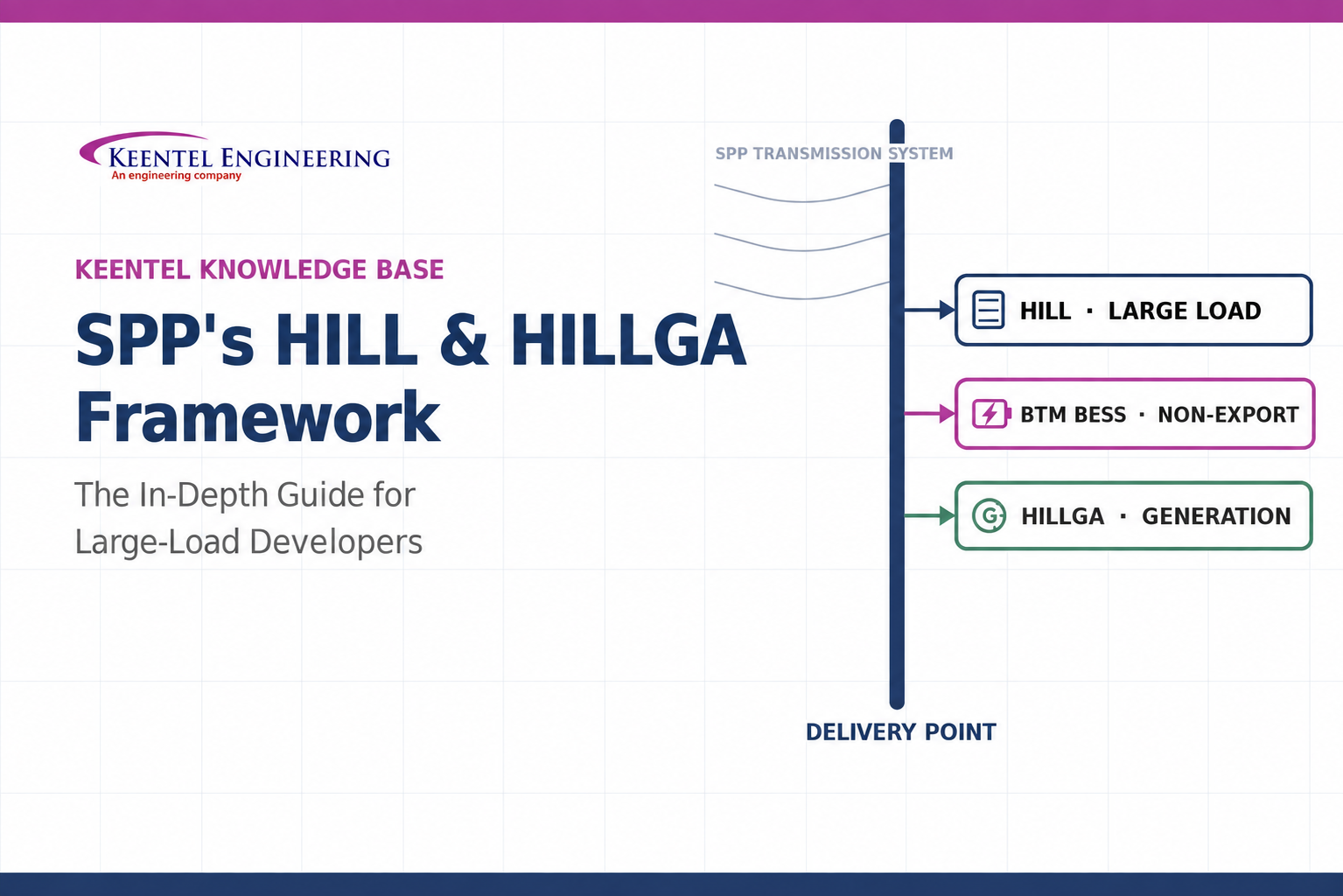
Learn how SPP’s HILL and HILLGA framework works for large-load projects, including studies, BTM generation, modeling, EMT requirements, and firm service.
By SANDIP R PATEL
•
September 25, 2026
Learn how IBR time synchronization, IEEE 2800, IRIG-B verification, and PTP solutions help meet disturbance monitoring compliance requirements.
By SANDIP R PATEL
•
September 24, 2026
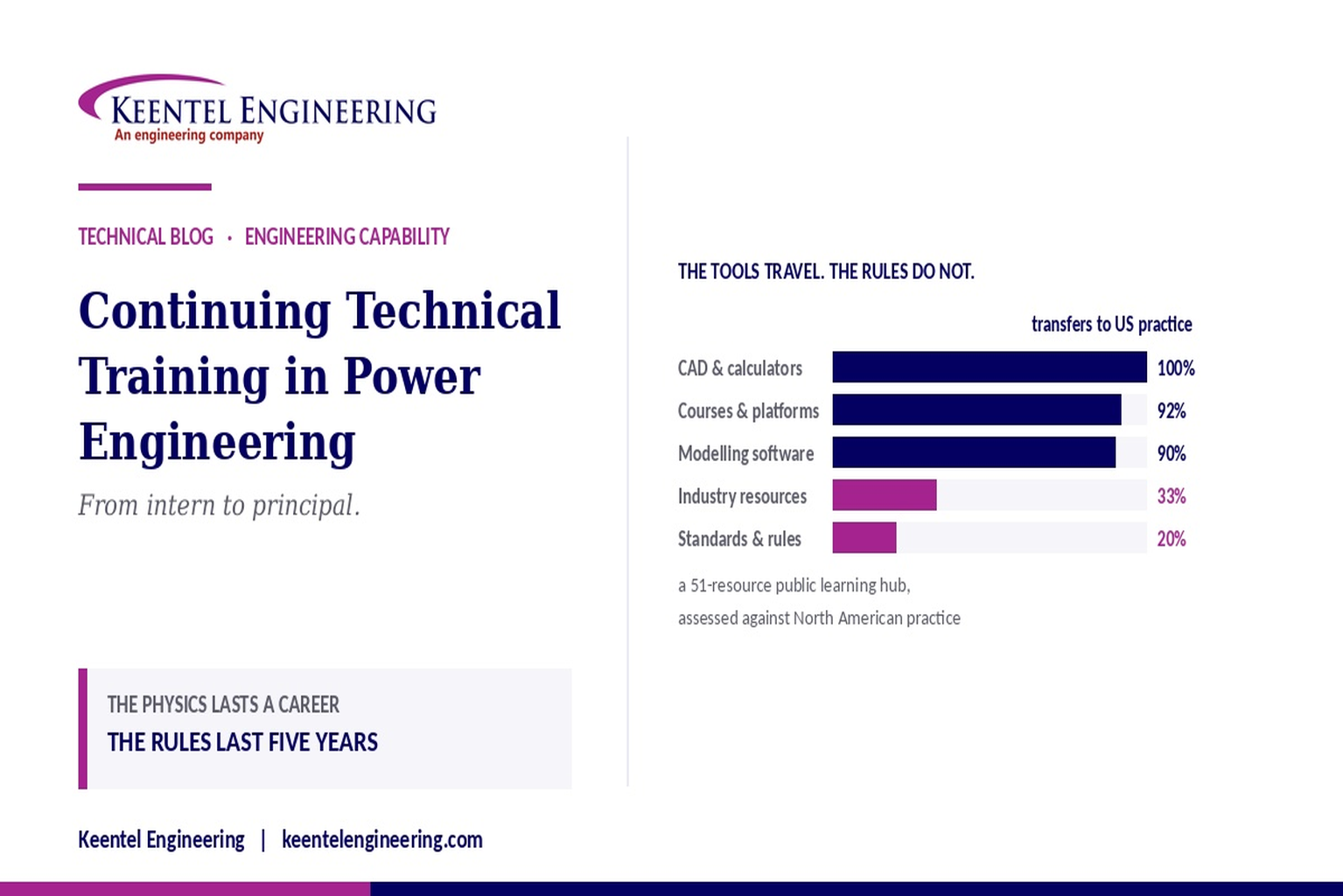
Learn why continuing technical training matters in power engineering, including standards, software skills, PDH requirements, and career growth.
By SANDIP R PATEL
•
September 22, 2026
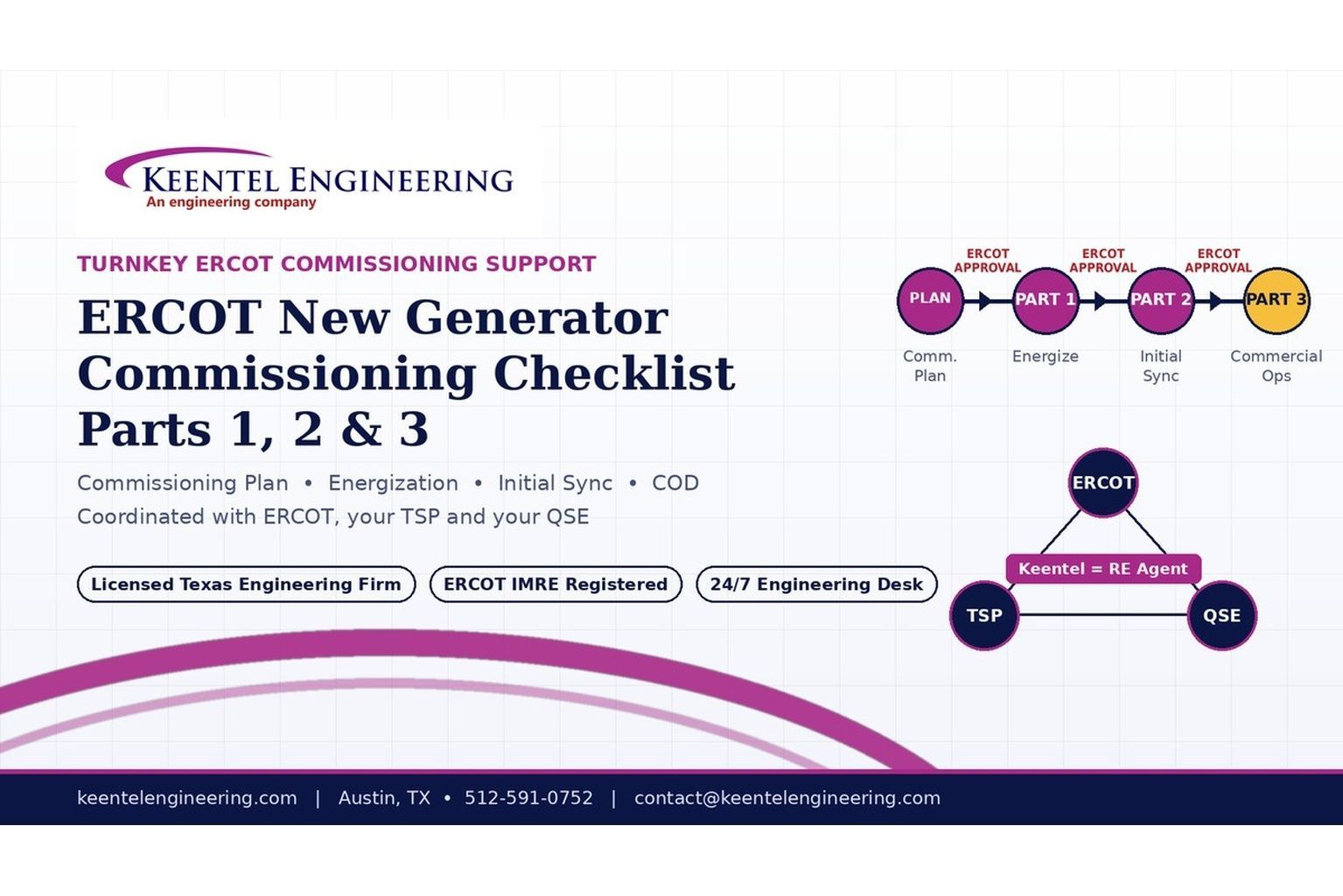
2026 ERCOT commissioning guide covering the Commissioning Plan, Checklist Parts 1–3, BESS requirements, TSP/QSE coordination, field testing and COD.
By SANDIP R PATEL
•
September 22, 2026
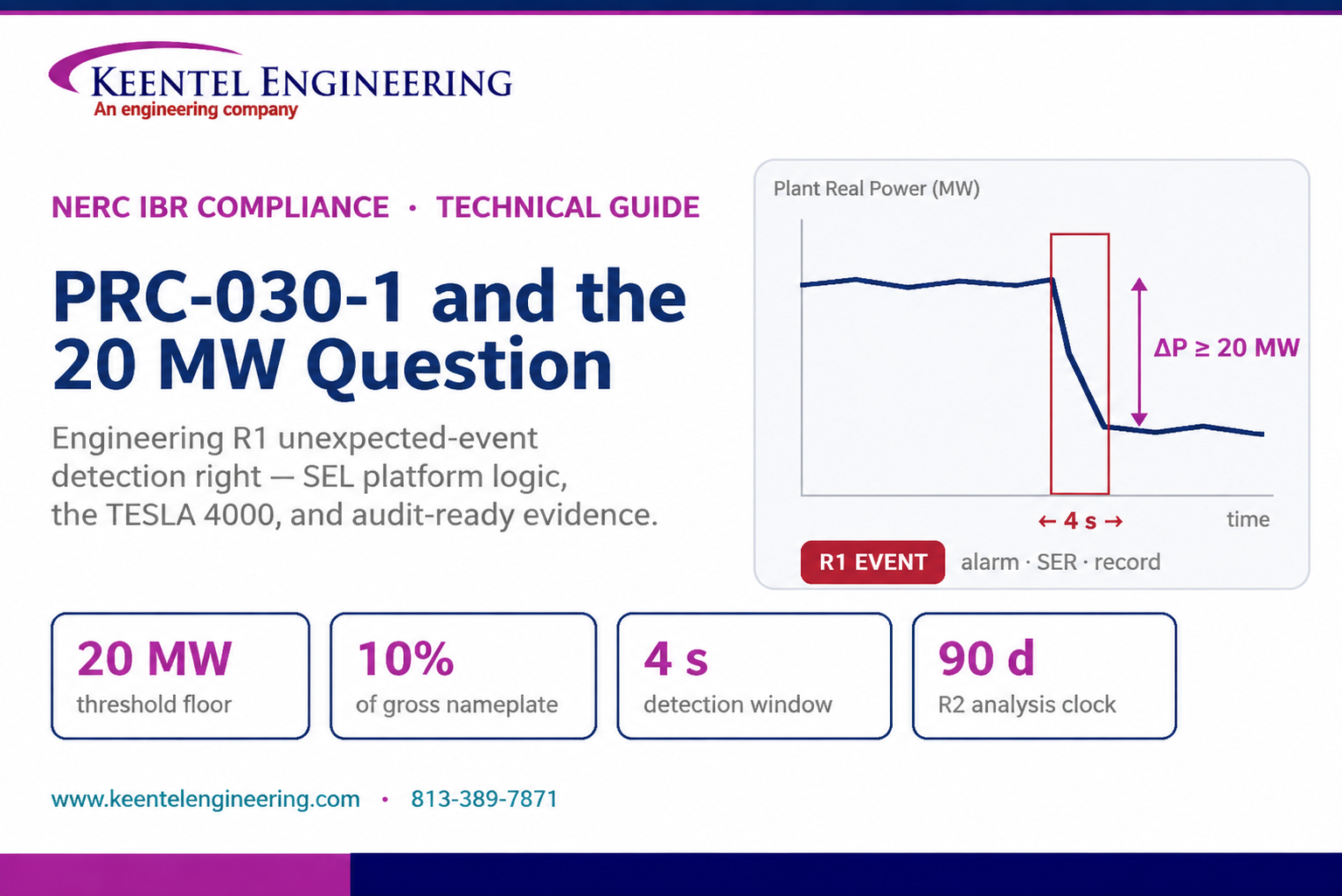
Learn PRC-030-1 R1 event detection requirements for inverter-based resources, SEL platforms, disturbance monitoring, and audit-ready compliance.
By SANDIP R PATEL
•
September 22, 2026
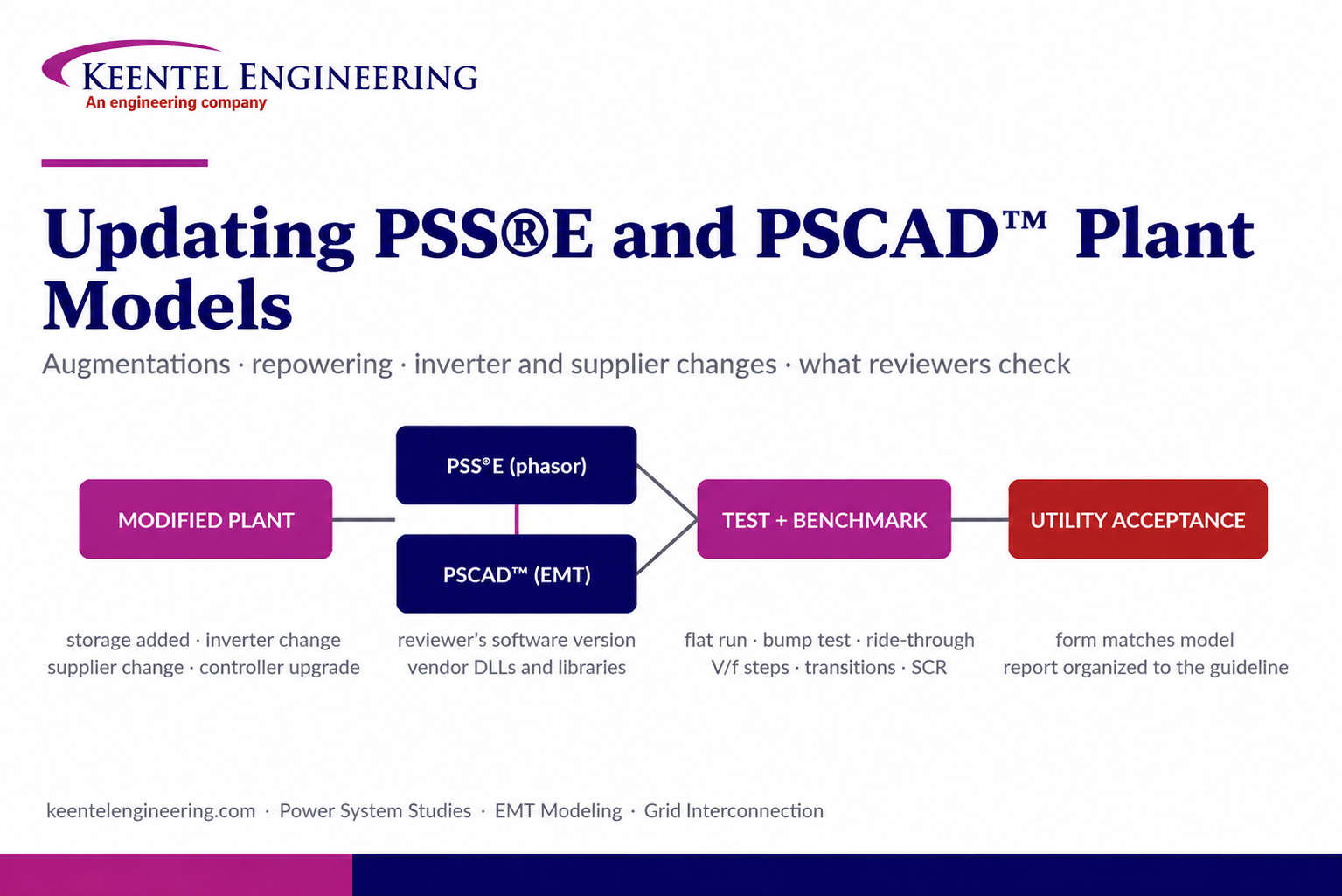
Learn how PSS®E and PSCAD™ model updates support plant augmentations, repowering, equipment changes, testing, benchmarking, and grid compliance.
By SANDIP R PATEL
•
September 20, 2026
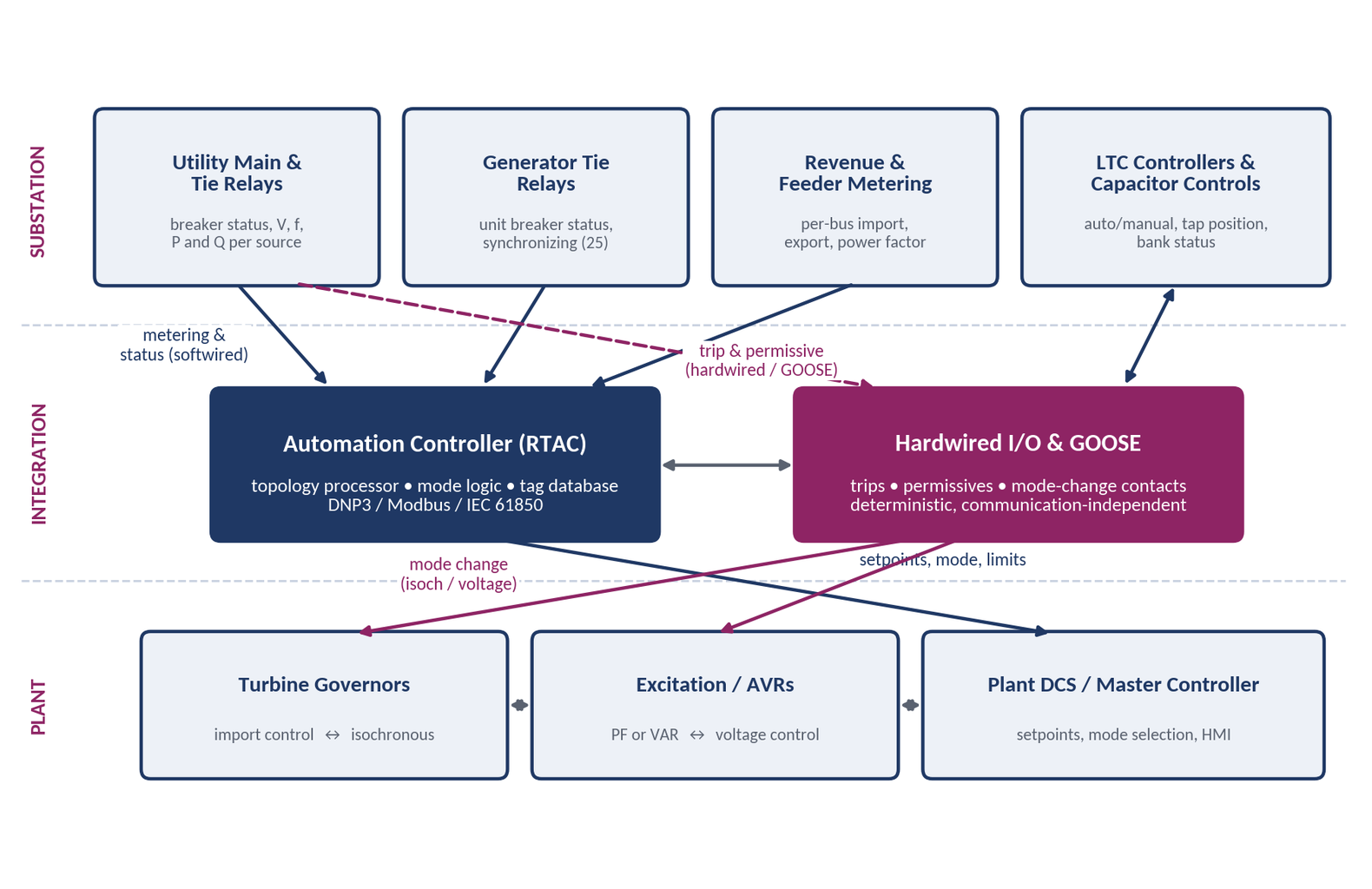
Learn CHP load following and island detection engineering for campus plants, including protection, controls, power studies, and grid transition design.