

A Coordinated Electric System Interconnection Review—the utility’s deep-dive on technical and cost impacts of your project.

Challenge: Frequent false tripping using conventional electromechanical relays
Solution: SEL-487E integration with multi-terminal differential protection and dynamic inrush restraint
Result: 90% reduction in false trips, saving over $250,000 in downtime

Electrical Systems in Nuclear Power Plants: Design, Safety, and Compliance Considerations

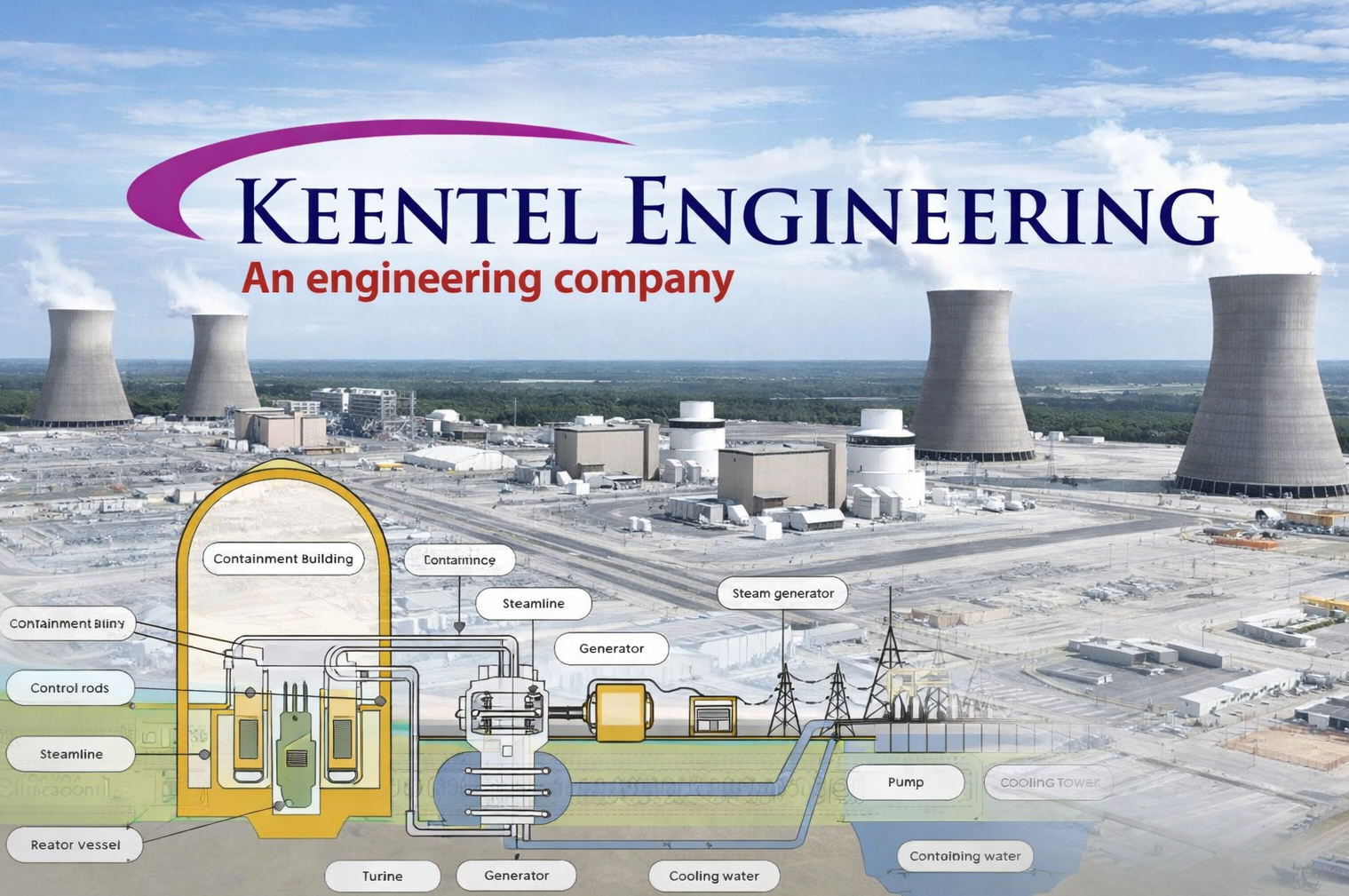
Keentel Engineering banner featuring a panoramic view of a nuclear power plant overlaid with a detailed cross-section diagram of nuclear reactor components, including the containment building, steam generator, and turbine.
Calendar icon. D

February 04, 2026 | Blog

Introduction

Electrical systems form the backbone of nuclear power plant safety, reliability, and operational continuity. Unlike conventional power plants, nuclear facilities impose extraordinary requirements on electrical power systems to ensure reactor safety, containment integrity, and compliance with stringent regulatory frameworks. From normal operation to extreme accident scenarios, electrical systems must perform predictably, independently, and without common-cause failure.


This article explores the architecture, safety classifications, redundancy philosophies, and regulatory drivers governing electrical systems in nuclear power plants, with a particular focus on Class 1E power systems, emergency power supplies, containment penetrations, and grid interface considerations.


Role of Electrical Systems in Nuclear Plant Safety

In nuclear facilities, electrical systems are not merely support infrastructure—they are safety-critical systems. Key safety functions dependent on electrical power include:


  • Reactor shutdown (SCRAM)
  • Core cooling and heat removal
  • Containment isolation
  • Instrumentation and control (I&C)
  • Emergency lighting and communications
  • Actuation of engineered safety features


Loss or degradation of electrical power can escalate plant conditions rapidly, which is why nuclear electrical designs are governed by defense-in-depth principles and single-failure criteria

Electrical-Systems-for-Nuclear-…


Classification of Nuclear Power Plant Electrical Systems

Safety-Related vs Non-Safety-Related Systems

Electrical systems in nuclear plants are broadly divided into:


  • Safety-related (Class 1E) systems
  • Non-safety-related systems


Class 1E systems are those required to function during design-basis events and accidents to prevent or mitigate radiological consequences.


Class 1E Electrical Power Systems

Definition and Purpose

Class 1E electrical systems are designed to perform essential safety functions under all credible operating and accident conditions, including:


  • Loss of off-site power
  • Station blackout
  • Seismic events
  • Flooding and fire scenarios
  • Loss-of-coolant accidents (LOCA)


These systems include:


  • Class 1E AC power distribution
  • Class 1E DC power systems
  • Instrumentation and control power
  • Electrical containment penetrations

Key Design Requirements for Class 1E Systems

1. Redundancy and Independence

  • Multiple independent power divisions
  • Physical and electrical separation
  • No single failure may disable all safety functions

2. Single Failure Criterion

Each safety function must be achievable despite the failure of any single active component, whether electrical, mechanical, or control-related


Electrical-Systems-for-Nuclear-…

3. Qualified Equipment

All Class 1E equipment must be:


  • Environmentally qualified
  • Seismically qualified
  • Tested for aging, radiation, temperature, pressure, and chemical exposure

On-Site Emergency AC Power Sources

Emergency Diesel Generators (EDGs)

Emergency diesel generators serve as the primary on-site AC backup power source following loss of off-site power. Critical requirements include:


  • Automatic start and load acceptance
  • Fast response time
  • Capability to power safety loads independently
  • Periodic surveillance and load testing


EDGs must be capable of supporting full safety load sequencing, including large motor starting without unacceptable voltage dips.


DC Power Systems and Energy Storage

Role of DC Systems

DC power systems provide:


  • Control power for breakers and relays
  • Power for protection systems
  • Instrumentation and control reliability
  • Short-term power during transition events


Battery systems are typically designed to supply power for extended periods during station blackout conditions, ensuring operators retain control and visibility.


Instrumentation and Control Power Systems

Reliability Requirements

Instrumentation and control systems rely on highly stable, noise-free power sources. Design considerations include:


  • Redundant DC supplies
  • Isolation from non-safety systems
  • Harmonic mitigation
  • Continuous monitoring and alarm indication


Loss of I&C power is treated as a major safety concern due to its impact on situational awareness and automated protection.


Containment Electrical Penetration Assemblies (EPAs)

Purpose and Safety Function

Containment electrical penetrations allow electrical conductors to pass through containment boundaries without compromising pressure integrity or leak tightness.


Key requirements include:


  • Leak rate limits
  • Fire resistance
  • Pressure and temperature qualification
  • LOCA survivability
  • Continuous monitoring capability


Failure of a penetration must not result in containment breach or loss of safety functions

Electrical-Systems-for-Nuclear-…


Interface Between Nuclear Plants and the Grid

Off-Site Power Importance

Off-site power is considered the preferred power supply, supporting:


  • Normal operation
  • Safe shutdown
  • Emergency system readiness


Nuclear plants typically require multiple independent off-site power circuits, designed to minimize simultaneous failure risks.


Station Blackout (SBO) Considerations

Station blackout represents one of the most severe electrical scenarios. Electrical designs must account for:


  • Complete loss of off-site and on-site AC power
  • Extended coping duration
  • Alternate AC sources
  • Load shedding and prioritization
  • Operator training and procedures


Post-event industry experience has significantly strengthened SBO design requirements.


Aging, Life Extension, and Electrical Asset Management

Electrical systems must remain reliable over extended plant lifetimes, often exceeding original design expectations. Effective asset management includes:


  • Condition monitoring
  • Preventive maintenance
  • Cable aging assessments
  • Transformer and switchgear diagnostics
  • Periodic testing and surveillance programs

Frequently Asked Questions (FAQ)

  • 1. What makes electrical systems in nuclear plants different from conventional plants?

    Nuclear electrical systems are safety-critical, must meet single-failure criteria, and must operate under extreme accident conditions while maintaining containment integrity.

  • 2. What is a Class 1E electrical system?

    Class 1E systems are safety-related electrical systems required to function during design-basis accidents to prevent or mitigate radiological consequences.

  • 3. Why is redundancy required in nuclear electrical systems?

    Redundancy ensures that no single failure can disable critical safety functions, supporting defense-in-depth safety philosophy.

  • 4. How are emergency diesel generators tested?

    EDGs undergo factory qualification, site acceptance testing, periodic surveillance testing, and full load testing to verify reliability.

  • 5. Why are DC power systems critical in nuclear plants?

    DC systems power protection relays, breaker controls, and instrumentation, especially during transitions or blackout conditions.

  • 6. What is the single failure criterion?

    It requires that safety systems perform their intended function even if one component fails during an accident.

  • 7. How are electrical systems protected from fire?

    Fire-resistant materials, cable separation, fire barriers, and compliance with nuclear fire protection standards are mandatory.

  • 8. What happens if off-site power is lost?

    On-site emergency power systems automatically start and supply safety loads to maintain reactor safety and cooling.

  • 9. Why are containment electrical penetrations so critical?

    They preserve containment pressure boundaries while allowing electrical connectivity, preventing radioactive release.

  • 10. How long must nuclear electrical systems operate during emergencies?

    Design requirements vary, but systems must support safe shutdown and cooling for extended durations, including station blackout coping periods.


A smiling man with glasses and a beard wearing a blue blazer stands in front of server racks in a data center.

About the Author:

Sonny Patel P.E. EC

IEEE Senior Member

In 1995, Sandip (Sonny) R. Patel earned his Electrical Engineering degree from the University of Illinois, specializing in Electrical Engineering . But degrees don’t build legacies—action does. For three decades, he’s been shaping the future of engineering, not just as a licensed Professional Engineer across multiple states (Florida, California, New York, West Virginia, and Minnesota), but as a doer. A builder. A leader. Not just an engineer. A Licensed Electrical Contractor in Florida with an Unlimited EC license. Not just an executive. The founder and CEO of KEENTEL LLC—where expertise meets execution. Three decades. Multiple states. Endless impact.

Four workers in safety vests and helmets stand with arms crossed near wind turbines.

Let's Discuss Your Project

Let's book a call to discuss your electrical engineering project that we can help you with.

Man in a blazer and open shirt, looking at the camera, against a blurred background.

About the Author:

Sonny Patel P.E. EC

IEEE Senior Member

In 1995, Sandip (Sonny) R. Patel earned his Electrical Engineering degree from the University of Illinois, specializing in Electrical Engineering . But degrees don’t build legacies—action does. For three decades, he’s been shaping the future of engineering, not just as a licensed Professional Engineer across multiple states (Florida, California, New York, West Virginia, and Minnesota), but as a doer. A builder. A leader. Not just an engineer. A Licensed Electrical Contractor in Florida with an Unlimited EC license. Not just an executive. The founder and CEO of KEENTEL LLC—where expertise meets execution. Three decades. Multiple states. Endless impact.

Leave a Comment

Related Posts

US Grid Code Requirements – Droop Control & Fast Frequency Response (FFR) | BESS IEEE 2800
By SANDIP R PATEL May 4, 2026
Learn how droop control and fast frequency response (FFR) enable IEEE 2800 compliance for BESS, solar, and wind in US grid interconnections.
PJM Cycle 1 Interconnection Infographic: 220 GW Storage & Grid Update
By SANDIP R PATEL May 2, 2026
PJM's Cycle 1 reform brings a 220 GW storage-led pipeline. See how BESS and new modeling impact grid reliability.
Battery storage financing project with utility-scale BESS and solar farm infrastructure
By SANDIP R PATEL May 2, 2026
Explore battery storage financing strategies, tax credits, tariffs, and BESS revenue models. Learn how to optimize projects and maximize returns.
CAISO IPE 5.0 Cluster 16 deliverability and queue management infographic
By SANDIP R PATEL May 2, 2026
Discover CAISO IPE 5.0 interconnection updates, including queue reforms, deliverability changes, and Cluster 16 impacts. Learn how it affects your projects.
FERC Order 2023 interconnection process diagram showing power generation
By SANDIP R PATEL May 1, 2026
FERC Order 2023: interconnection reforms, cluster studies & grid impact. Learn key changes fast.
SEL-2240 Axion industrial automation platform
By SANDIP R PATEL May 1, 2026
Explore SEL-2240 Axion, a modular I/O control system with RTAC automation and EtherCAT networking. Discover applications, features, and benefits.
Transmission line design infographic with BIM and power engineering solutions
By SANDIP R PATEL April 27, 2026
Explore advanced transmission line design services with BIM modeling, automated calculations, digital twins, and power engineering solutions by Keentel.
PJM Dynamic Model Guidelines 2026 infographic for utility-scale interconnection,
By SANDIP R PATEL April 27, 2026
Learn PJM dynamic model development, PSS®E model validation, and interconnection compliance requirements. Discover expert strategies for approval.
PJM NextGen application guide for utility-scale energy projects with solar, wind and battery storage
By SANDIP R PATEL April 25, 2026
Master the PJM NextGen application guide for utility-scale projects. Learn interconnection steps, technical data, and avoid delays. Get started today.