

A Coordinated Electric System Interconnection Review—the utility’s deep-dive on technical and cost impacts of your project.

Utilizing FACTS Technology to Address Grid Interconnection Issues for Large-Scale Wind Farms

Calendar icon. D

February 1, 2023 | Blog

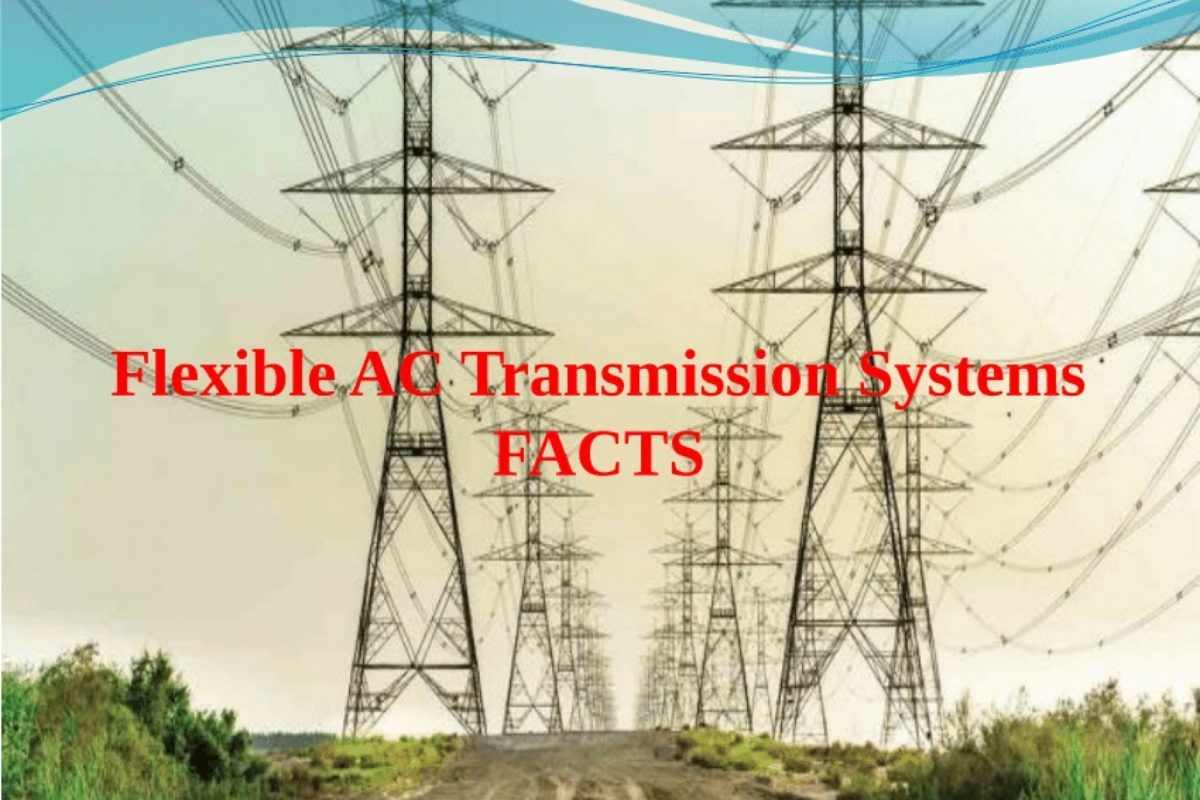
Power transmission towers against a cloudy sky, title: Flexible AC Transmission Systems (FACTS).

Introduction

As the demand for renewable energy grows, wind farms play an essential role in meeting sustainable energy targets. However, integrating large-scale wind farms into existing transmission systems introduces several grid interconnection issues—including voltage instability, capacitor switching transients, and power quality disturbances.

FACTS (Flexible AC Transmission System) technology offers a proven solution to these challenges by enabling dynamic reactive power compensation, voltage support, and fault ride-through. This blog explores how FACTS devices improve grid integration for utility-scale wind projects.

Need engineering support for wind integration? Visit our Utility-Scale Wind Farm Services


Addressing Steady-State Low Voltage

One of the most common issues in wind farm interconnection is steady-state low voltage on regional transmission networks. Induction generators in wind turbines consume reactive power, leading to voltage instability.

FACTS devices such as:

  • Static Var Compensators (SVCs)
  • Static Synchronous Compensators (STATCOMs)

help maintain voltage levels by supplying or absorbing reactive power in real-time, preventing undervoltage and maintaining grid stability.

These studies are part of our Power System Studies scope at Keentel.


Gearbox Protection from Capacitor Switching

Capacitor bank switching, while commonly used for voltage support, causes voltage step changes that can lead to premature gearbox damage in wind turbines.

FACTS solutions like:

  • Dynamic Voltage Restorers (DVRs)
  • Dynamic Reactive Power Compensators (DRPCs)

offer controlled switching without mechanical shocks. These power-electronic systems eliminate sudden voltage spikes and extend turbine component life.


Wind Generator Ride-Through Capability

Wind turbines are vulnerable to voltage sags and swells, often resulting in forced disconnection from the grid. FACTS devices help maintain ride-through capability by rapidly injecting reactive power to stabilize voltage.

Advanced STATCOM systems, equipped with fast-response controllers, detect transients and instantly restore voltage to acceptable levels.


Power Quality on Local Distribution Networks

Wind generators connected near distribution feeders can introduce power quality issues like voltage flicker and transients. FACTS technologies such as:

  • DSTATCOMs (Distribution STATCOMs)
  • Dynamic Voltage Controllers (DVCs)

address local power quality challenges by providing fine-tuned reactive compensation, ensuring clean, flicker-free delivery to downstream customers.


Hybrid FACTS + Capacitor Bank Solutions

A cost-effective way to meet grid code and interconnection requirements is to deploy a hybrid solution:

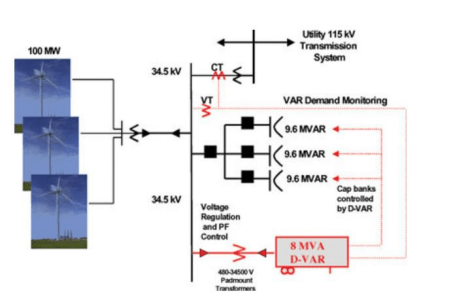
  • Install a D-VAR™ system at the 34.5 kV collector bus
  • Integrate it with low-cost capacitor banks

The D-VAR continuously monitors voltage, injecting or absorbing VARs within 1 cycle (0.017 sec), and “soft-switches” capacitors to eliminate step voltage changes.

For capacitor bank switching protection and modeling, see POI Interconnection Engineering Support

Diagram of a wind farm connected to a utility grid with VAR demand monitoring and power factor control, including D-VAR system.

Temporary Overload Mode for Transient Stability

Modern FACTS systems support temporary overloads—up to 3.0x rated output for 1 second. This provides extra short-term reactive power to help the wind farm withstand transmission voltage dips and remain online during transients.

This dynamic response ensures continued power generation, especially during grid faults, faults on parallel circuits, or switching operations.


Summary

Wind farm grid interconnection introduces voltage, power quality, and operational risks—especially as capacities scale. FACTS technologies provide:

  • Dynamic voltage control
  • Reactive power compensation
  • Ride-through stability
  • Protection from capacitor switching impacts

Power electronic-based FACTS systems outperform traditional capacitor banks by offering precise, variable, and instantaneous control. As wind penetration increases across the grid, these systems will be central to ensuring NERC compliance, reliability, and performance optimization.

See real-world engineering applications in our Wind Integration Case Studies

Need to Engineer FACTS Integration for Your Wind Farm?

Keentel Engineering delivers utility-scale solutions for STATCOM, SVC, D-VAR™, BESS, and hybrid FACTS projects. From reactive power studies to modeling and commissioning, we ensure wind farms interconnect safely, reliably, and cost-effectively.


A smiling man with glasses and a beard wearing a blue blazer stands in front of server racks in a data center.

About the Author:

Sonny Patel P.E. EC

IEEE Senior Member

In 1995, Sandip (Sonny) R. Patel earned his Electrical Engineering degree from the University of Illinois, specializing in Electrical Engineering . But degrees don’t build legacies—action does. For three decades, he’s been shaping the future of engineering, not just as a licensed Professional Engineer across multiple states (Florida, California, New York, West Virginia, and Minnesota), but as a doer. A builder. A leader. Not just an engineer. A Licensed Electrical Contractor in Florida with an Unlimited EC license. Not just an executive. The founder and CEO of KEENTEL LLC—where expertise meets execution. Three decades. Multiple states. Endless impact.

Four workers in safety vests and helmets stand with arms crossed near wind turbines.

Let's Discuss Your Project

Let's book a call to discuss your electrical engineering project that we can help you with.

Man in a blazer and open shirt, looking at the camera, against a blurred background.

About the Author:

Sonny Patel P.E. EC

IEEE Senior Member

In 1995, Sandip (Sonny) R. Patel earned his Electrical Engineering degree from the University of Illinois, specializing in Electrical Engineering . But degrees don’t build legacies—action does. For three decades, he’s been shaping the future of engineering, not just as a licensed Professional Engineer across multiple states (Florida, California, New York, West Virginia, and Minnesota), but as a doer. A builder. A leader. Not just an engineer. A Licensed Electrical Contractor in Florida with an Unlimited EC license. Not just an executive. The founder and CEO of KEENTEL LLC—where expertise meets execution. Three decades. Multiple states. Endless impact.

Leave a Comment

Related Posts

Advanced large load modeling for grid reliability with data center power systems.
By SANDIP R PATEL April 10, 2026
Learn how large load modeling improves grid reliability for data centers and modern power systems using advanced EMT, dynamic studies, and compliance strategies.
ERCOT large load interconnection surge with data centers, renewable energy, and grid reliability
By SANDIP R PATEL April 10, 2026
ERCOT faces a surge in large load interconnections driven by AI data centers. Explore grid challenges, batch studies, and developer strategies
Data center power diagram with MVDC, UPS, transformers, generators, and IT load.
By SANDIP R PATEL April 10, 2026
Learn how EMT modeling improves data center grid stability, AI load integration, and power quality. Expert insights by Keentel Engineering.
Advanced power system diagram with five buses, generator, transformer, and protection system
By SANDIP R PATEL April 7, 2026
Advanced power system studies for DER, EMT modeling, and grid stability. Expert T&D co-simulation by Keentel Engineering.
MOD-026-2 compliance diagram for dynamic model validation of inverter-based resources in power
By SANDIP R PATEL April 7, 2026
Learn MOD-026-2 compliance requirements for dynamic model verification and validation of inverter-based resources, ensuring power system reliability and NERC compliance.
PJM First Use rule elimination for DER interconnection under FERC Order 2222
By SANDIP R PATEL April 7, 2026
Explore PJM’s First Use rule reform, DER interconnection changes, and FERC Order 2222 impacts on solar, BESS, and distribution-level grid integration.
Advanced PSSE and PSCAD modeling services for solid-state transformers in data center power systems
By SANDIP R PATEL April 7, 2026
Advanced PSSE and PSCAD modeling for solid-state transformers in data centers. Ensure grid compliance, stability, and high-performance power systems.
FlexGEB smart building with solar, HVAC, battery storage, and grid-connected energy systems.
By SANDIP R PATEL April 6, 2026
Explore FlexGEB smart buildings using solar, storage, HVAC, and IoT to boost energy efficiency, demand flexibility, and grid resilience.
Keentel Engineering data center design services banner highlighting uptime, grid reliability
By SANDIP R PATEL April 6, 2026
Keentel Engineering delivers data center electrical design for uptime, grid stability, AI workloads, and utility-ready interconnection planning.