A Coordinated Electric System Interconnection Review—the utility’s deep-dive on technical and cost impacts of your project.
Challenge: Frequent false tripping using conventional electromechanical relays
Solution: SEL-487E integration with multi-terminal differential protection and dynamic inrush restraint
Result: 90% reduction in false trips, saving over $250,000 in downtime
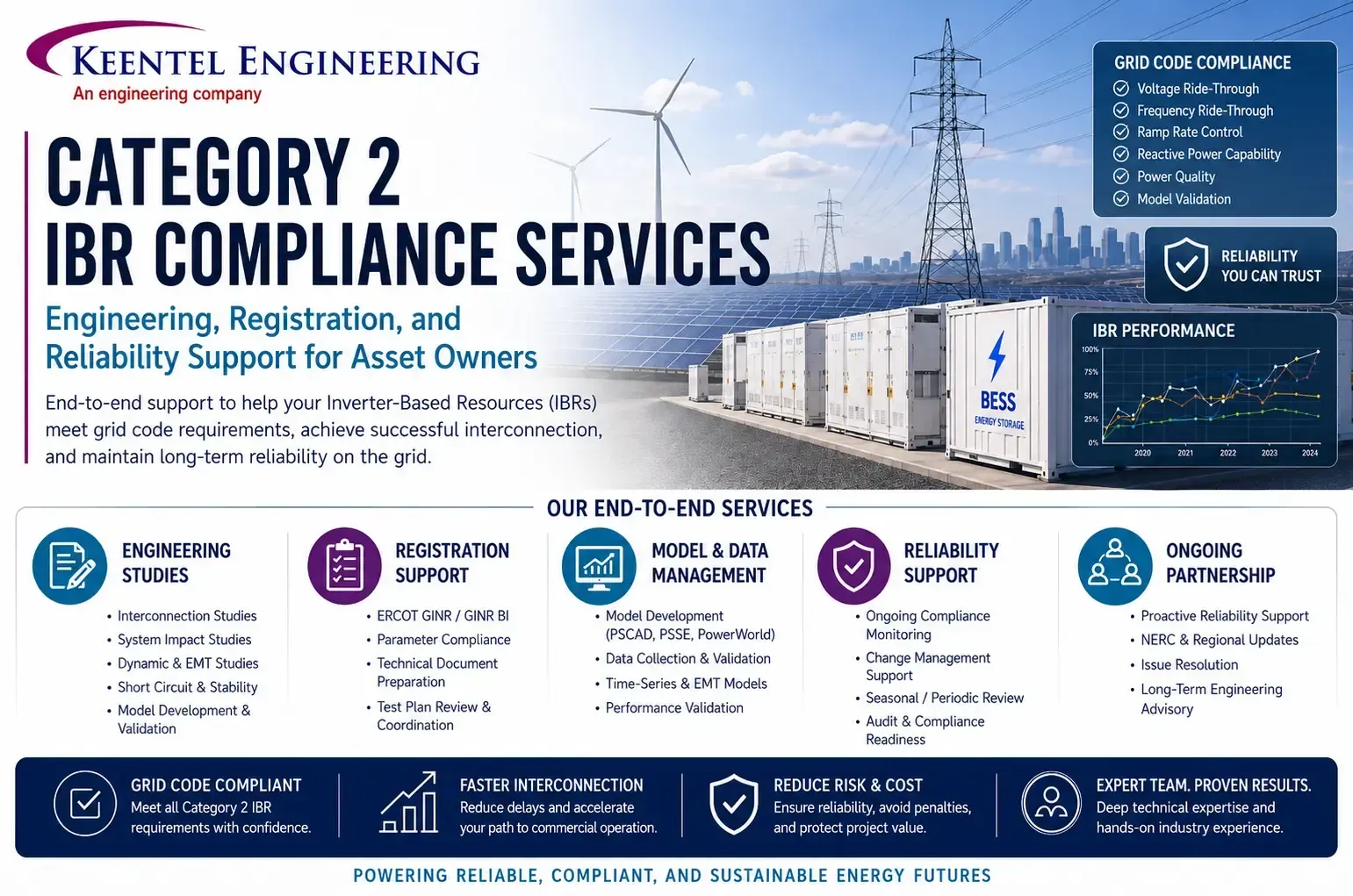
Category 2 IBR Compliance Services Engineering, Registration, and Reliability Support for Asset Owners
May 16, 2026 | Blog
The New Era of NERC Oversight for Inverter-Based Resources
The electric power industry is entering a new reliability era driven by the rapid growth of inverter-based resources (IBRs). Solar photovoltaic plants, battery energy storage systems (BESS), wind facilities, and hybrid renewable projects are no longer considered peripheral contributors to the North American grid. They are now central to generation adequacy, system stability, and operational reliability.
As the penetration of inverter-based generation increases, the Federal Energy Regulatory Commission (FERC) and the North American Electric Reliability Corporation (NERC) have fundamentally changed the compliance landscape through the Category 2 IBR Registration Initiative.
Beginning May 15, 2026, qualifying non-BES inverter-based resources connected to the Bulk Power System (BPS) will become subject to mandatory NERC registration and compliance requirements. For many owners and operators, this represents the first time they will operate within the NERC Compliance Monitoring and Enforcement Program (CMEP).
Keentel Engineering provides comprehensive Category 2 IBR compliance services designed to help asset owners navigate this evolving regulatory environment with technical precision and operational confidence.
Understanding Category 2 IBR Registration
Category 2 registration applies to non-BES inverter-based generating resources that:
- Have or contribute to an aggregate gross nameplate capacity of 20 MVA or greater
- Are connected through a system designed primarily for delivering power to a common point of connection
- Are interconnected at 60 kV or greater
This includes:
- Solar PV plants
- Wind generation facilities (Type 3 and Type 4)
- Battery Energy Storage Systems (BESS)
- Hybrid renewable facilities
- Co-located inverter-based resources
Historically, many of these facilities operated outside mandatory NERC Reliability Standards because they did not meet the BES definition. However, NERC determined these resources could materially impact bulk power system reliability and therefore required regulatory oversight.
Why Category 2 Compliance Is Different from Traditional Generator Compliance
Keentel Engineering evaluates whether facilities qualify under Category 2 registration thresholds.
Our assessments include:
- Aggregate MVA analysis
- Hybrid resource evaluation
- Point of interconnection review
- Voltage threshold analysis
- BES and non-BES determination
- Aggregation boundary review
This process is critical because incorrect applicability assumptions can lead to:
- Registration failures
- Expanded compliance scope
- Enforcement exposure
- Audit findings
GO/GOP Functional Role Mapping
One of the most misunderstood aspects of Category 2 registration is the distinction between:
- Generator Owner (GO)
- Generator Operator (GOP)
Keentel Engineering performs detailed functional responsibility evaluations to identify:
- Asset ownership responsibilities
- Operational control responsibilities
- Third-party operator obligations
- Joint ownership exposure
- Registration coordination requirements
This becomes particularly important in:
- Hybrid facilities
- Tax equity structures
- Asset-managed projects
- Third-party operations agreements
CMEP-Ready Documentation Development
Regional Entities are heavily relying on documentation during registration and compliance evaluations.
Keentel Engineering develops:
- Single-line diagrams
- Registration support packages
- Functional relationship diagrams
- Interconnection documentation reviews
- Asset verification spreadsheets
- Compliance evidence repositories
Our documentation approach aligns with:
- ERO Enterprise CMEP Practice Guide
- NERC registration RFIs
- Regional Entity audit expectations
Reliability Standards Gap Analysis
Keentel Engineering helps clients understand which Reliability Standards currently apply and which future standards may become applicable.
Current enforceable standards include:
- BAL-001-TRE-2
- IRO-010-5
- MOD-032-1
- PRC-012-2
- PRC-017-1
- TOP-003-6.1
- VAR-001-5
- VAR-002-4.1
Future evolving standards include:
- PRC-028-1
- PRC-029-1
- PRC-030-1
- MOD-026
- MOD-033
- EMT modeling requirements
IBR Modeling and Order No. 901 Engineering Support
FERC Order No. 901 significantly expands technical obligations for inverter-based resources.
Keentel Engineering supports:
- Dynamic model validation
- MOD-032 data preparation
- PSCAD studies
- EMT modeling
- Ride-through assessments
- Disturbance monitoring evaluations
- PRC-029 readiness
- PRC-028 event recording support
These services help clients align with:
- Model validation requirements
- Planning study expectations
- Reliability coordinator data needs
- Future NERC standards
Why Early Preparation Matters
Waiting until 2026 to begin compliance preparation creates significant risk.
Many Category 2 owners underestimate the time required for:
- Data collection
- Role mapping
- Engineering studies
- Documentation development
- Registration coordination
- Compliance evidence creation
Early preparation reduces:
- Audit exposure
- Registration delays
- Engineering rework
- Enforcement risk
- Interconnection conflicts
Category 2 Case Studies
Case Study 1 – Solar + BESS Hybrid Registration Assessment
Challenge
A utility-scale solar developer operating a 150 MW solar PV facility with a co-located 80 MW BESS system needed to determine whether the hybrid configuration triggered Category 2 registration obligations.
The client faced uncertainty regarding:
- Aggregation methodology
- DC-coupled versus AC-coupled evaluation
- Ownership responsibility allocation
- GOP designation
Keentel Engineering Solution
Keentel Engineering conducted:
- Aggregation boundary analysis
- Single-line diagram review
- Gross aggregate MVA evaluation
- Functional GO/GOP responsibility mapping
- CMEP Practice Guide alignment review
Outcome
Keentel Engineering identified that the hybrid facility met Category 2 applicability thresholds and developed:
- Registration support documentation
- Updated one-line diagrams
- Functional registration matrix
- Compliance readiness roadmap
The client successfully initiated Regional Entity coordination with reduced registration risk.
Case Study 2 – Wind Facility PRC-029 Readiness Review
Challenge
A wind generation owner operating multiple Type 4 wind facilities needed to evaluate future PRC-029 ride-through compliance obligations.
The owner lacked:
- Verified inverter ride-through settings
- Disturbance response documentation
- PPC coordination validation
- Dynamic model consistency
Keentel Engineering Solution
Keentel Engineering performed:
- Ride-through capability assessment
- Inverter control evaluation
- Dynamic model review
- Protection coordination assessment
- Voltage and frequency tolerance analysis
Outcome
The client received:
- PRC-029 readiness gap report
- Recommended settings adjustments
- Compliance evidence templates
- Future modeling roadmap
The project significantly reduced future enforcement and operational risk.
Case Study 3 – Multi-Owner Hybrid Registration Support
Challenge
Two independent entities jointly owned a solar + storage hybrid project interconnected at 115 kV.
The owners incorrectly assumed only one entity required registration.
Keentel Engineering Solution
Keentel Engineering analyzed:
- Functional ownership responsibilities
- Common point of interconnection
- Aggregate MVA contribution
- GOP operational obligations
Outcome
Keentel Engineering determined both owners required Category 2 GO registration and developed:
- Registration coordination strategy
- Compliance role matrix
- Supporting technical documentation
This prevented future registration conflicts and potential compliance violations.
Technical FAQ Guide for Category 2 IBR Compliance
FAQ 1: How is gross aggregate nameplate capacity calculated for Category 2 IBRs?
Gross aggregate nameplate capacity is determined using the apparent power rating (MVA) of inverter equipment contributing to the common point of connection. Operational limitations, export restrictions, and dispatch constraints are generally not considered in the calculation.
FAQ 2: Do reactive compensation devices count toward Category 2 aggregation thresholds?
No. Dynamic or static reactive devices such as STATCOMs, capacitor banks, and reactors do not contribute toward gross aggregate nameplate capacity calculations.
FAQ 3: Can separate ownership structures avoid Category 2 applicability?
No. Ownership does not eliminate aggregation obligations. Multiple owners contributing to the same qualifying common point of connection may each require registration.
FAQ 4: How are DC-coupled solar and BESS systems evaluated?
DC-coupled systems are evaluated based on the inverter-based export capability delivered through the common point of interconnection. Certain DC/DC converter ratings may not independently contribute toward aggregation totals depending on configuration.
FAQ 5: Why are EMT studies becoming more important for IBRs?
EMT studies are increasingly necessary because inverter controls operate on very fast timescales that traditional transient stability models cannot fully represent. Weak grid conditions, inverter interactions, and protection issues often require EMT analysis.
FAQ 6: What is the relationship between PRC-028 and model validation?
PRC-028 disturbance monitoring requirements support event analysis and provide data necessary for validating dynamic and EMT models following grid disturbances.
FAQ 7: How does PRC-029 affect inverter settings?
PRC-029 requires IBRs to maintain ride-through capability during abnormal frequency and voltage conditions. This often requires coordination between inverter firmware, plant power controllers, and protection settings.
FAQ 8: What is the purpose of MOD-032 for Category 2 IBRs?
MOD-032 ensures planners and operators receive accurate modeling data necessary for power system analysis and reliability assessments.
FAQ 9: Why are Regional Entities requesting one-line diagrams during registration?
Single-line diagrams are used to evaluate:
- Aggregation boundaries
- Voltage levels
- Common points of connection
- Functional relationships
- Hybrid resource configurations
These diagrams directly affect applicability determinations.
FAQ 10: What is considered the common point of connection?
The common point of connection is generally where the collector system connects to the 60 kV or higher Bulk Power System. This location is often identified in interconnection agreements.
FAQ 11: Can a BESS alone trigger Category 2 registration?
Yes. A standalone battery energy storage system interconnected at 60 kV or higher with aggregate inverter capacity of 20 MVA or greater may independently qualify as a Category 2 resource.
FAQ 12: How does hybrid aggregation differ from BES aggregation?
Category 2 aggregation focuses specifically on inverter-based resources and does not aggregate with synchronous generation for registration threshold determination.
FAQ 13: What are the biggest engineering risks for Category 2 entities?
Common risks include:
- Inaccurate models
- Improper ride-through settings
- Incomplete documentation
- Protection coordination errors
- Failure to understand aggregation rules
FAQ 14: Why is model validation becoming a regulatory priority?
Multiple grid events demonstrated that modeled IBR behavior often differed significantly from actual field performance, creating planning and operational reliability concerns.
FAQ 15: How does Keentel Engineering support technical compliance?
Keentel Engineering combines NERC compliance expertise with:
- Power system studies
- Protection engineering
- Dynamic modeling
- EMT analysis
- Registration strategy
- Audit readiness
This integrated approach helps clients manage both technical and regulatory risk.

About the Author:
Sandip "Sonny" R. Patel, P.E.
IEEE Senior Member · Founder & CEO, Keentel Engineering
In 1995, Sonny Patel earned his Electrical Engineering degree from the University of Illinois. But degrees don't build legacies — action does.
For three decades, he has worked the power industry from every side of the table: 16 years as a utility engineer at Exelon/Commonwealth Edison; generation leadership across hydroelectric, industrial steam turbine, and a 9 GW renewable fleet; NERC Regional Entity Senior Compliance Engineer and Audit Team Lead, auditing some of the nation's largest utilities; and testing and commissioning lead on equipment up to 765 kV — the very top of the North American grid.Utility. Generator. Regulator. Consultant. Few engineers have seen all four seats. Fewer still have sat in them.
His experience spans nuclear, hydro, conventional generation, renewables, oil and gas, mining — and today's data centers, where he is authoring a three-book series on data center design. He is a Licensed Professional Engineer in six states and a Licensed Electrical Contractor in Florida (Unlimited EC) — he doesn't just design the work; he's qualified to stand behind its execution.Today, as Founder and CEO of Keentel Engineering, Sonny leads a nationwide team of engineers delivering substation design, power system studies, NERC compliance, and commissioning — done right, coast to coast.Three decades. Every side of the table. One standard: accountable engineering.
Services

Let's Discuss Your Project
Let's book a call to discuss your electrical engineering project that we can help you with.
About the Author:
Sandip "Sonny" R. Patel, P.E.
IEEE Senior Member · Founder & CEO, Keentel Engineering
In 1995, Sonny Patel earned his Electrical Engineering degree from the University of Illinois. But degrees don't build legacies — action does.
For three decades, he has worked the power industry from every side of the table: 16 years as a utility engineer at Exelon/Commonwealth Edison; generation leadership across hydroelectric, industrial steam turbine, and a 9 GW renewable fleet; NERC Regional Entity Senior Compliance Engineer and Audit Team Lead, auditing some of the nation's largest utilities; and testing and commissioning lead on equipment up to 765 kV — the very top of the North American grid.
Utility. Generator. Regulator. Consultant. Few engineers have seen all four seats. Fewer still have sat in them.
His experience spans nuclear, hydro, conventional generation, renewables, oil and gas, mining — and today's data centers, where he is authoring a three-book series on data center design. He is a Licensed Professional Engineer in six states and a Licensed Electrical Contractor in Florida (Unlimited EC) — he doesn't just design the work; he's qualified to stand behind its execution.
Today, as Founder and CEO of Keentel Engineering, Sonny leads a nationwide team of engineers delivering substation design, power system studies, NERC compliance, and commissioning — done right, coast to coast.Three decades. Every side of the table. One standard: accountable engineering.
Leave a Comment
Thank you for contacting us.
We will get back to you as soon as possible.
We will get back to you as soon as possible.
Oops, there was an error sending your message.
Please try again later.
Please try again later.
Related Posts
By SANDIP R PATEL
•
September 26, 2026
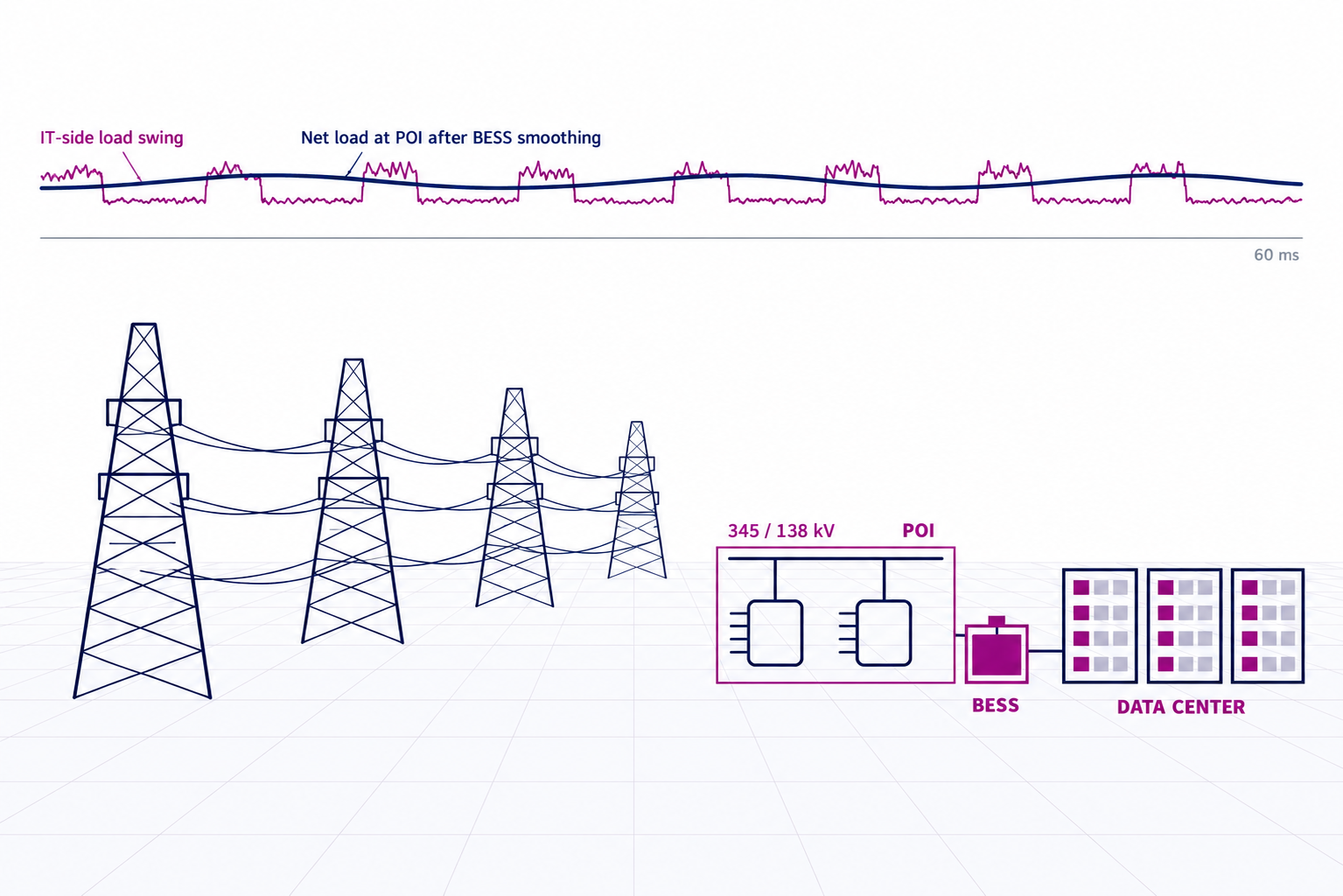
Learn how to prepare a MISO large-load interconnection package, including PSS®E models, BESS smoothing, harmonic data and transmission-owner requirements.
By SANDIP R PATEL
•
September 26, 2026
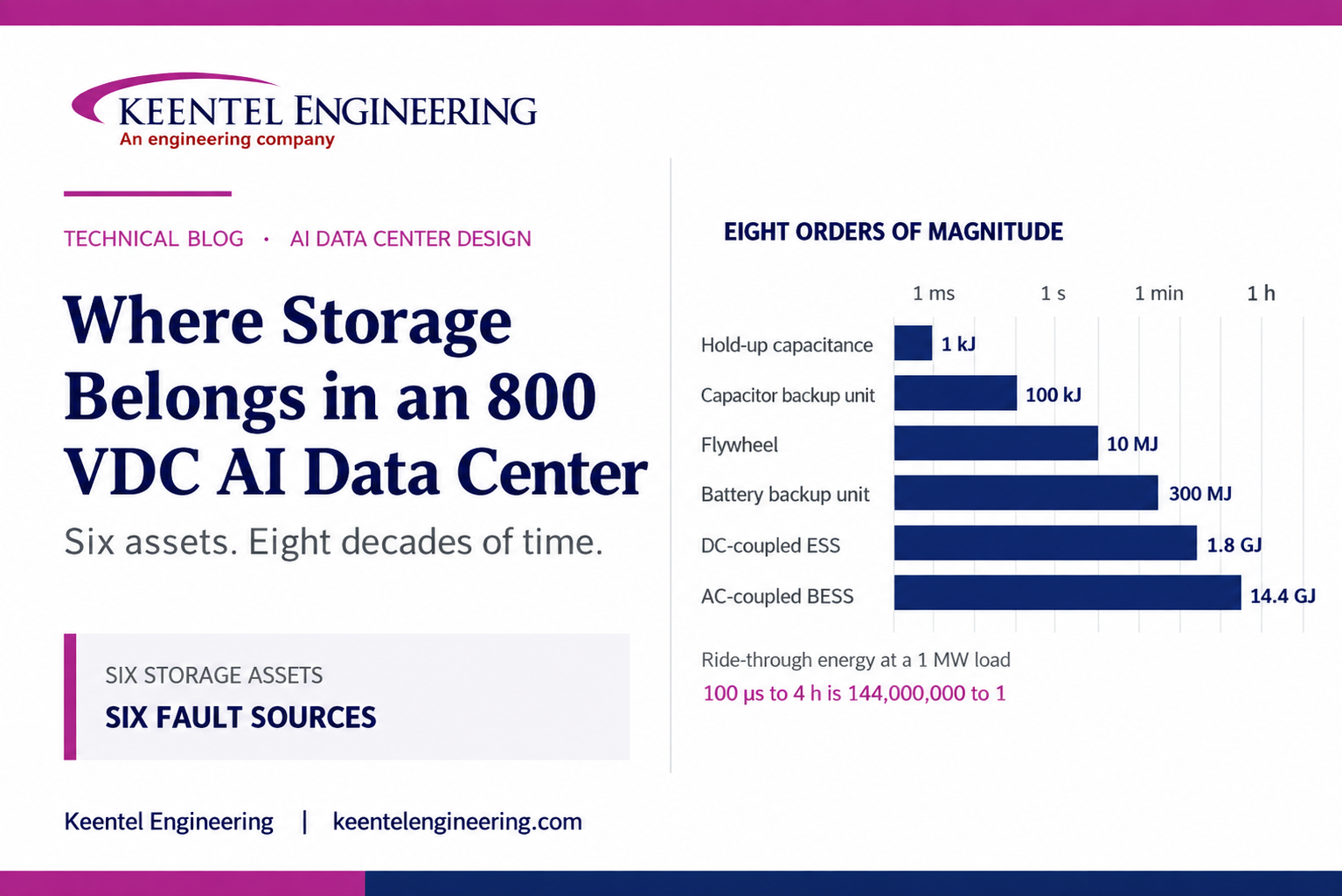
Learn where storage belongs in an 800 VDC AI data center, including capacitors, flywheels, BESS, fault current, protection, grounding, and EMT design.
By SANDIP R PATEL
•
September 26, 2026
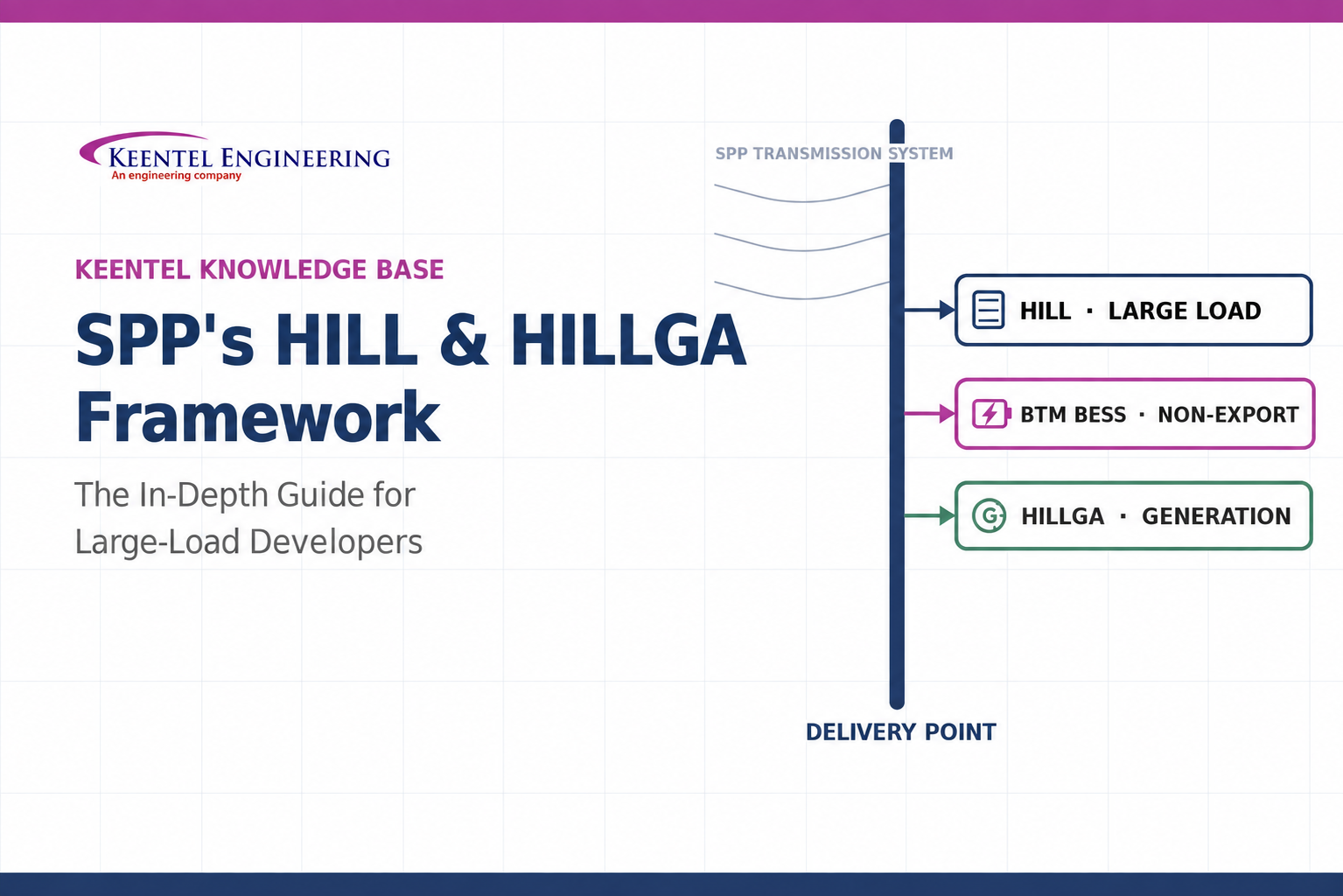
Learn how SPP’s HILL and HILLGA framework works for large-load projects, including studies, BTM generation, modeling, EMT requirements, and firm service.
By SANDIP R PATEL
•
September 25, 2026
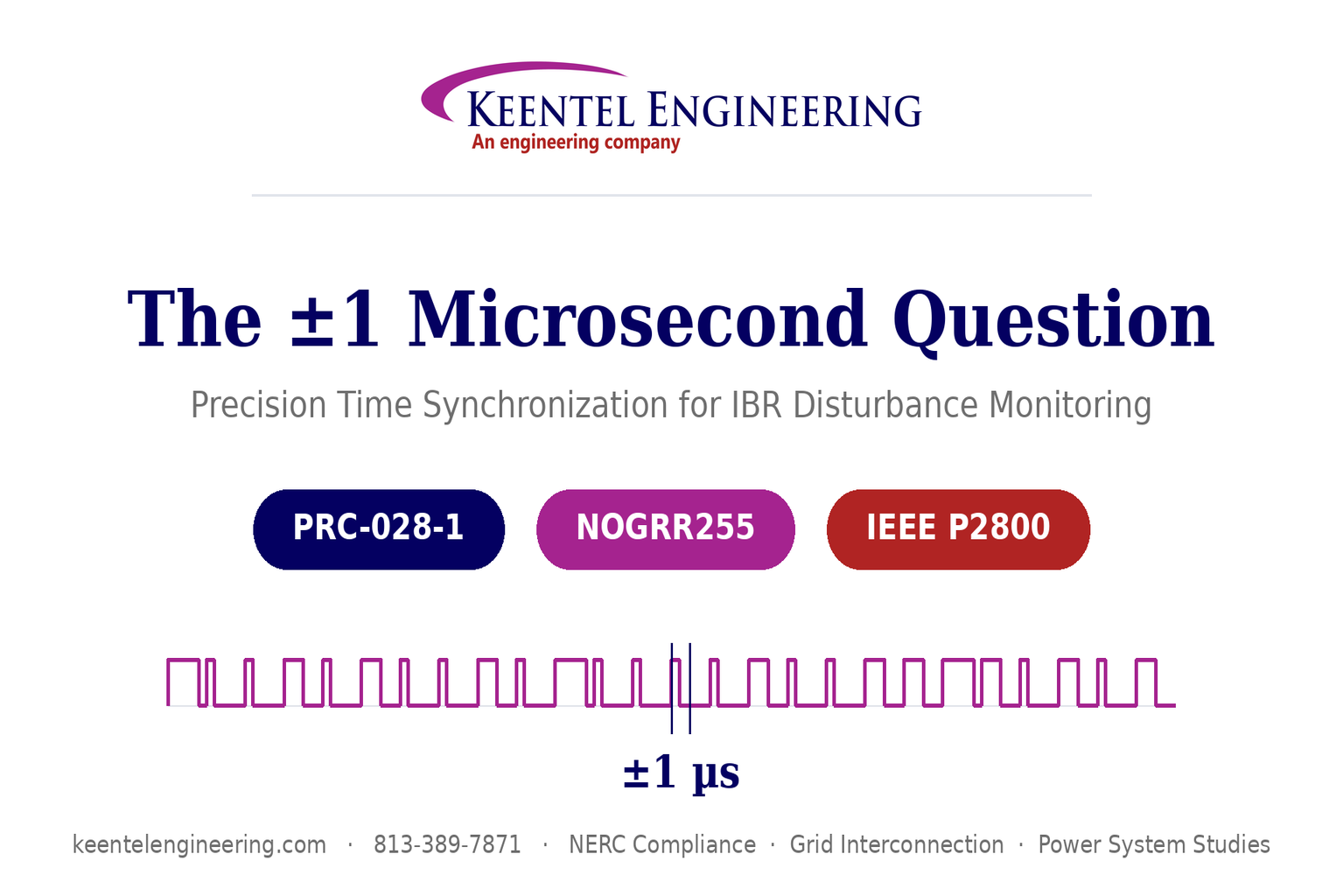
Learn how IBR time synchronization, IEEE 2800, IRIG-B verification, and PTP solutions help meet disturbance monitoring compliance requirements.
By SANDIP R PATEL
•
September 24, 2026
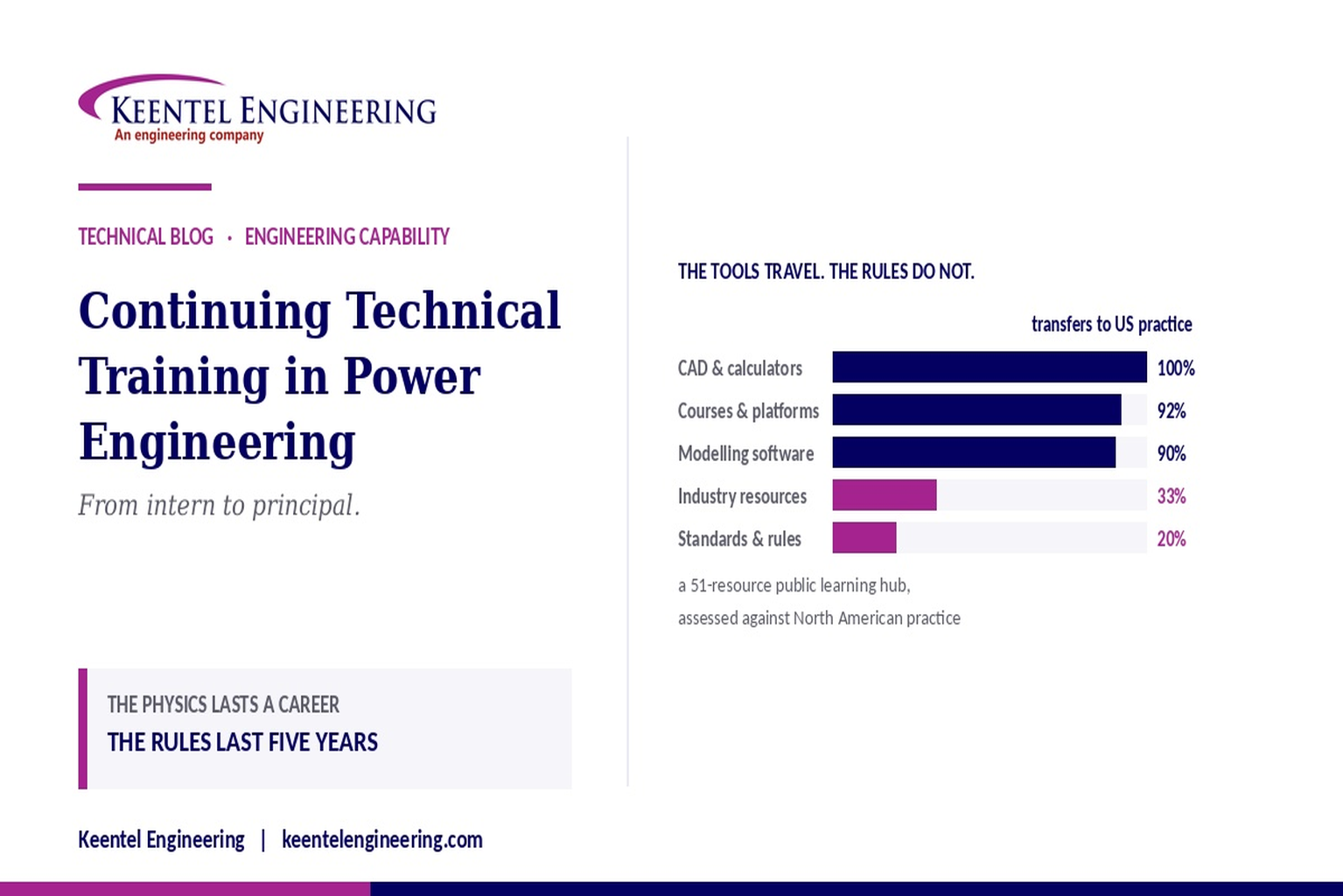
Learn why continuing technical training matters in power engineering, including standards, software skills, PDH requirements, and career growth.
By SANDIP R PATEL
•
September 22, 2026
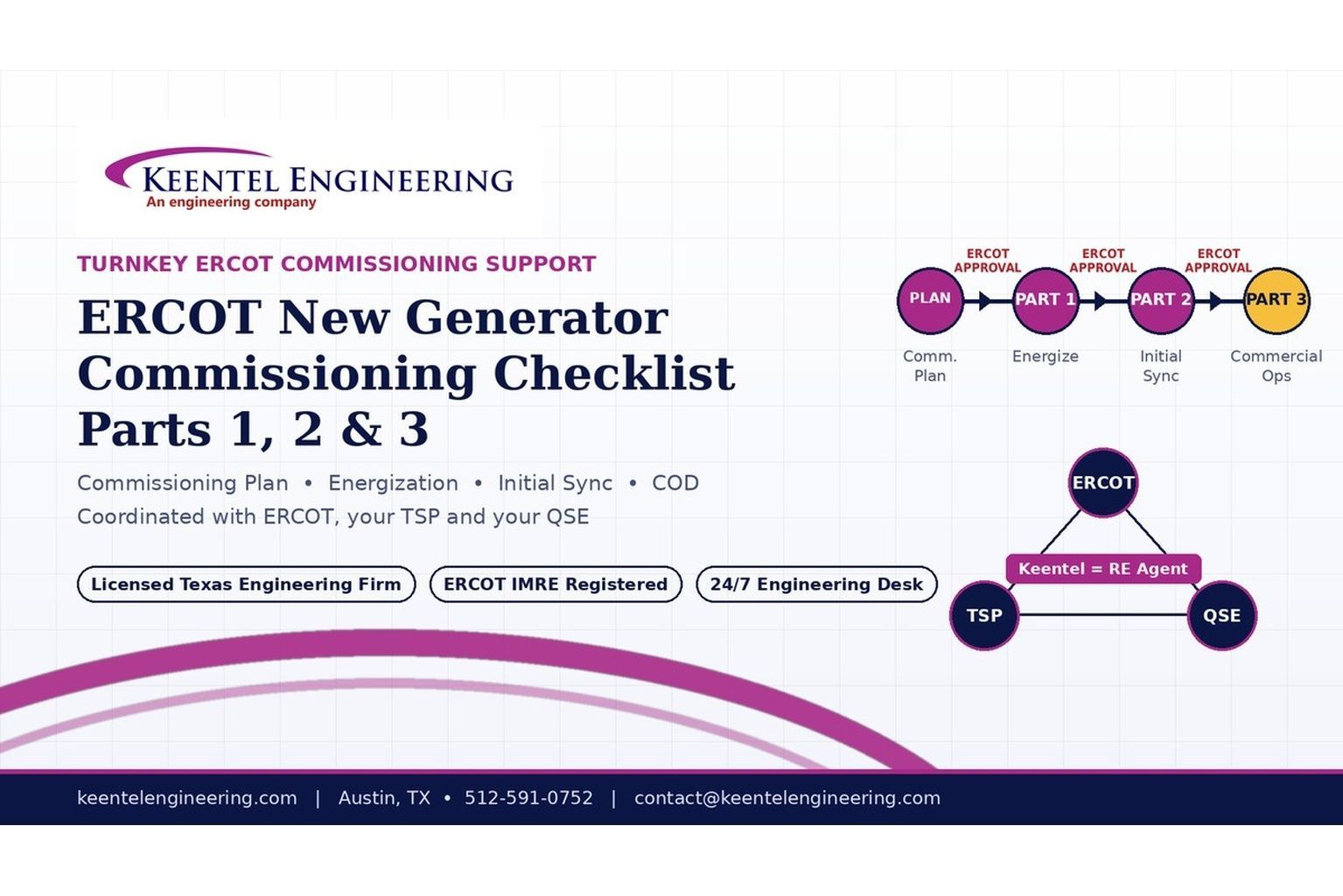
2026 ERCOT commissioning guide covering the Commissioning Plan, Checklist Parts 1–3, BESS requirements, TSP/QSE coordination, field testing and COD.
By SANDIP R PATEL
•
September 22, 2026
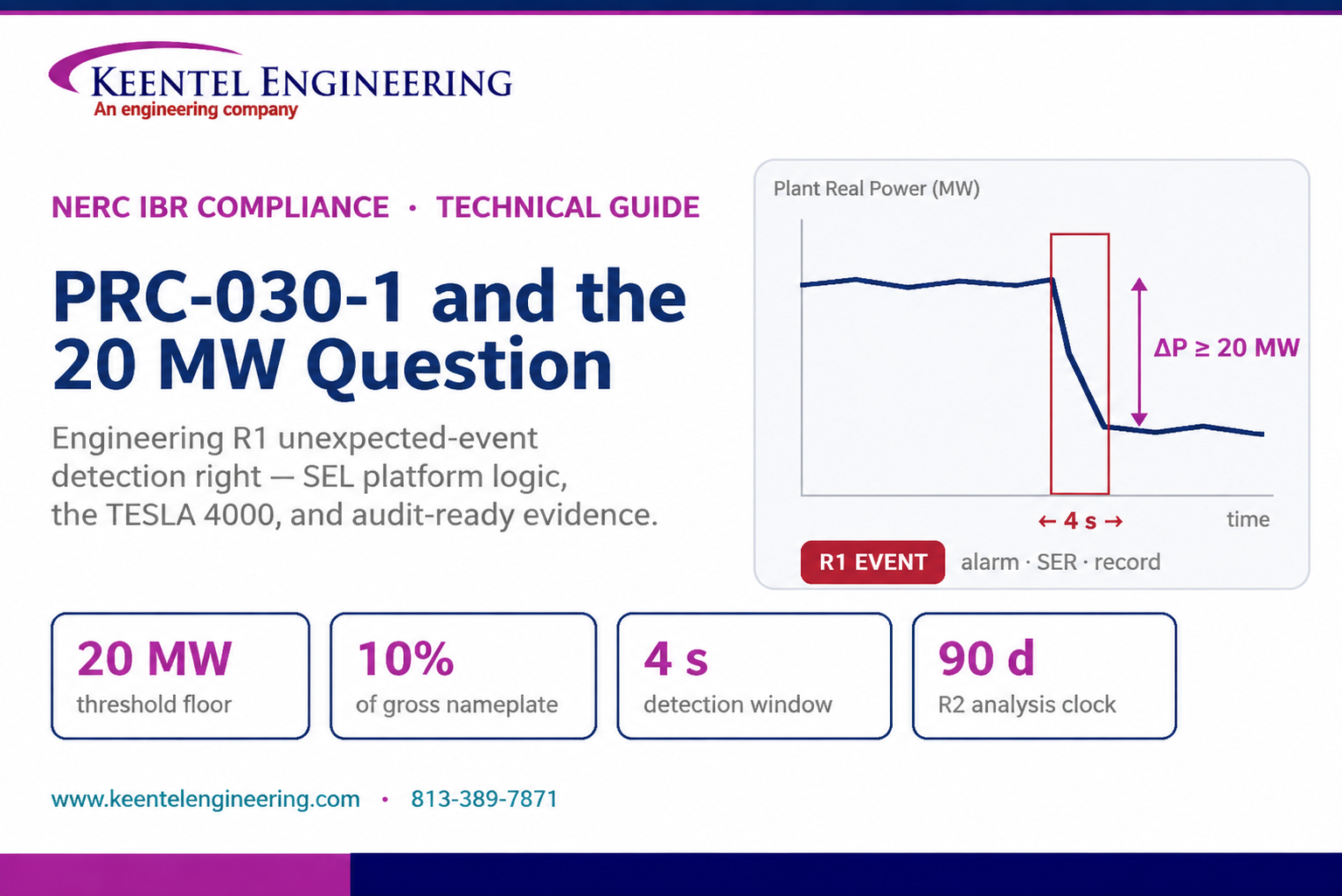
Learn PRC-030-1 R1 event detection requirements for inverter-based resources, SEL platforms, disturbance monitoring, and audit-ready compliance.
By SANDIP R PATEL
•
September 22, 2026
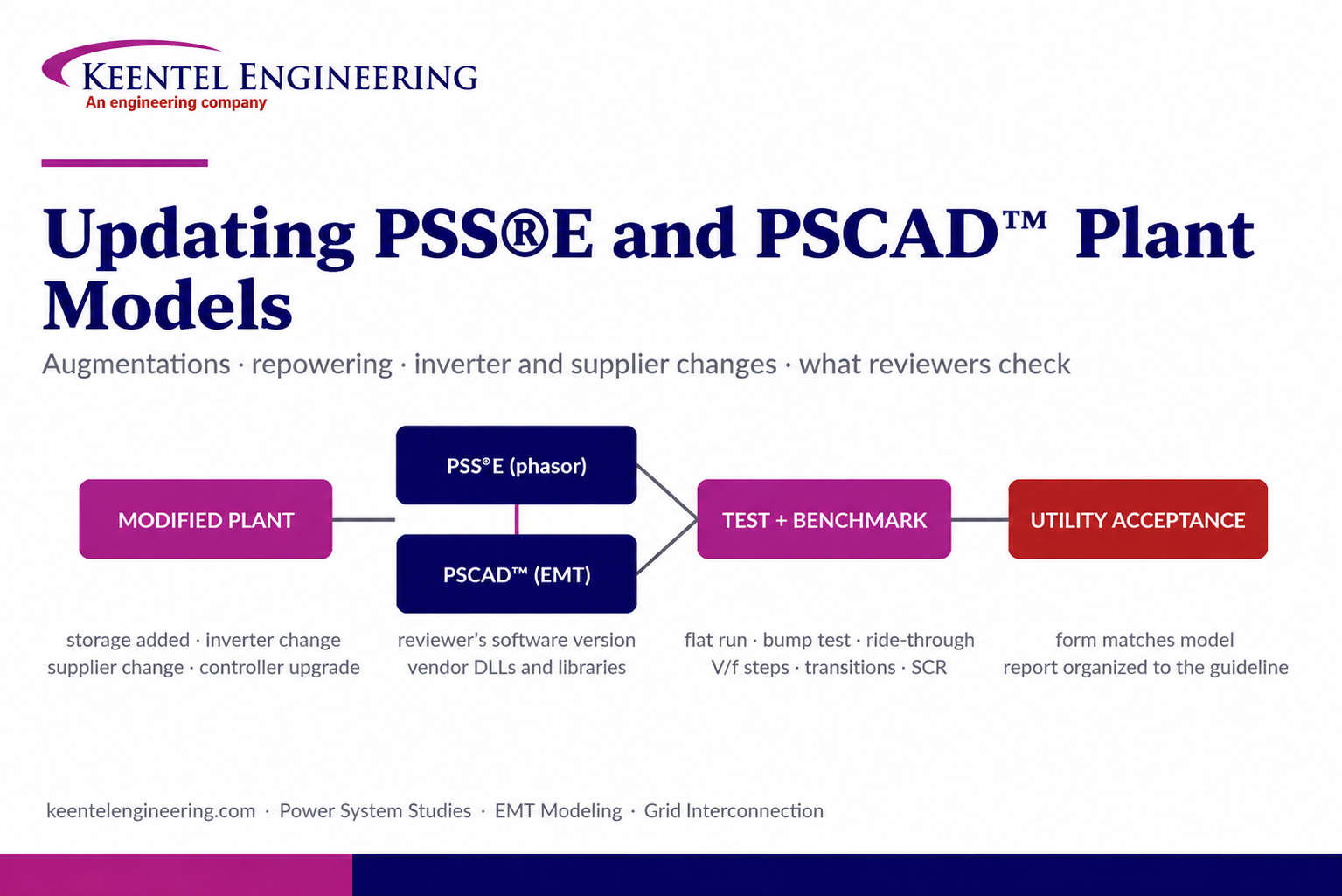
Learn how PSS®E and PSCAD™ model updates support plant augmentations, repowering, equipment changes, testing, benchmarking, and grid compliance.
By SANDIP R PATEL
•
September 20, 2026
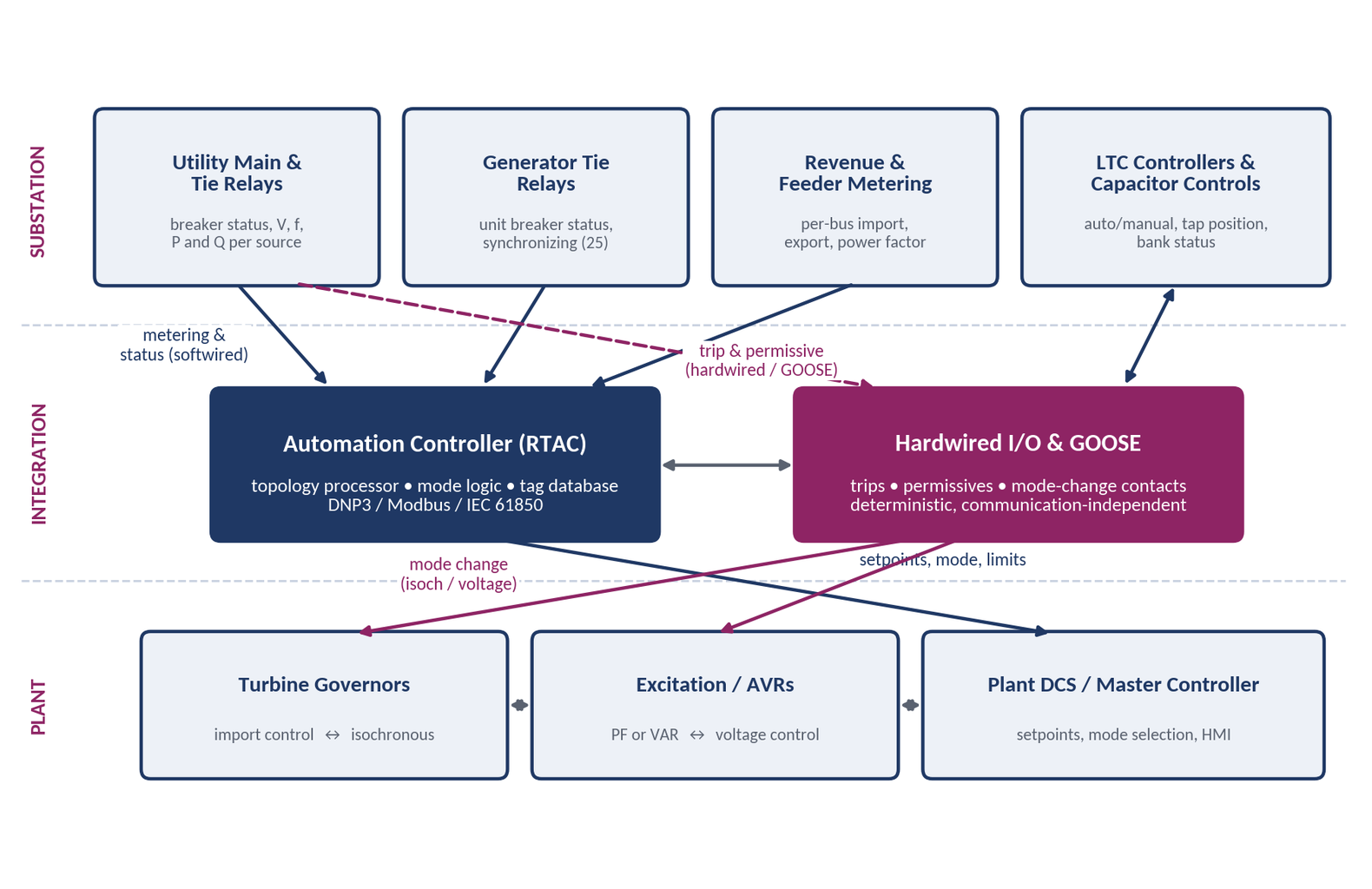
Learn CHP load following and island detection engineering for campus plants, including protection, controls, power studies, and grid transition design.