A Coordinated Electric System Interconnection Review—the utility’s deep-dive on technical and cost impacts of your project.
Challenge: Frequent false tripping using conventional electromechanical relays
Solution: SEL-487E integration with multi-terminal differential protection and dynamic inrush restraint
Result: 90% reduction in false trips, saving over $250,000 in downtime
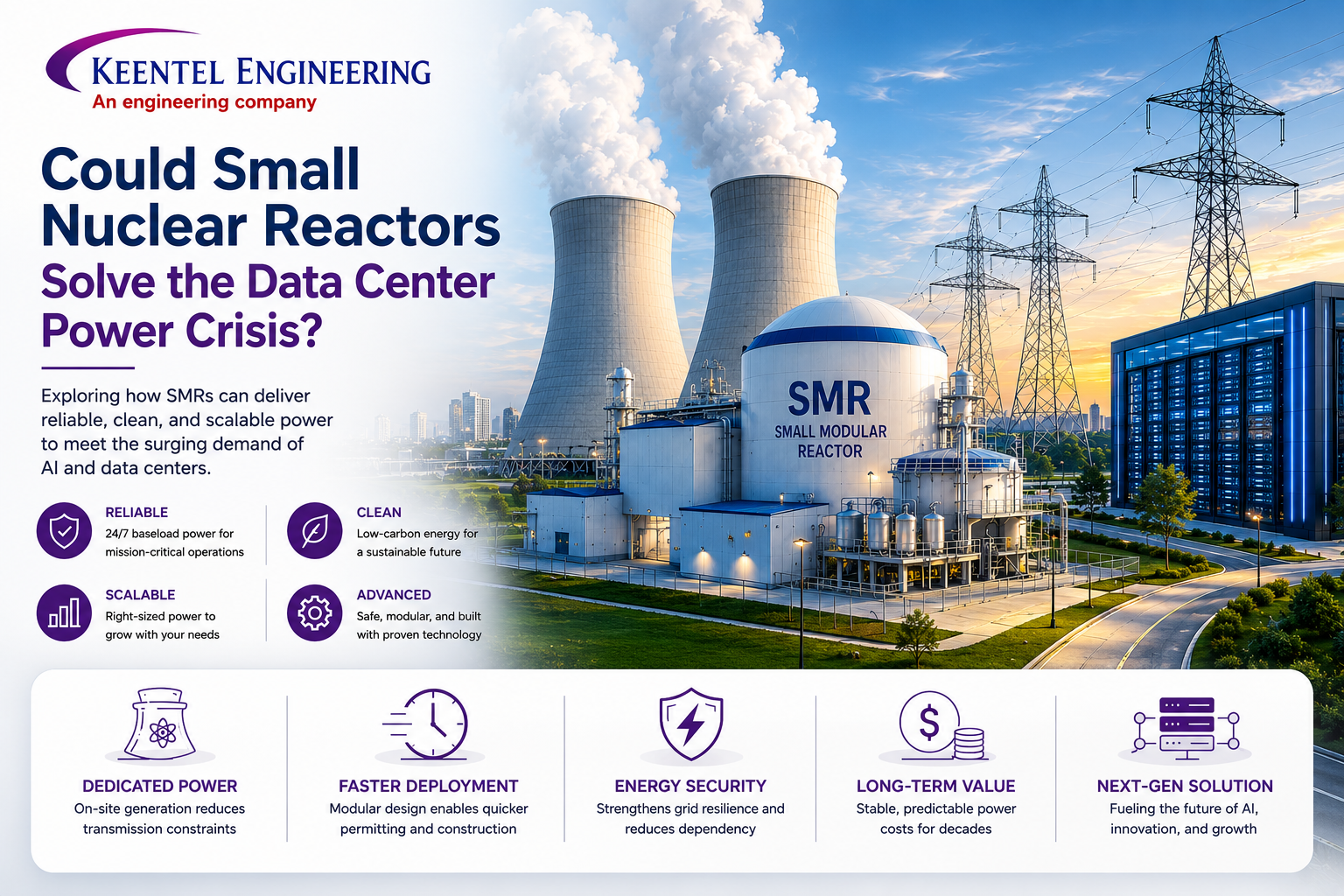
Could Small Nuclear Reactors Solve the Data Center Power Crisis?
May 31, 2026 | Blog
Data centers have a power problem, and it's getting worse fast. The same facilities driving the AI boom are consuming electricity at a scale the grid wasn't built to deliver, and the usual fixes are running out of room. Renewables are intermittent and land-hungry. Power purchase agreements that once looked like a clean-energy slam dunk are struggling to deliver the firm, around-the-clock power these facilities actually need. Into that gap steps an unexpected candidate: small modular nuclear reactors, or SMRs.
The idea is genuinely compelling, and also genuinely unproven at scale. Here's an honest look at why the data center industry is paying attention, and what still has to be true before SMRs become a real option.
Why data centers are looking at nuclear at all
The core appeal of nuclear is that it produces firm, low-carbon, weather-decoupled power. A data center can't afford to slow down because the wind died or the sun set, and it increasingly can't afford the carbon either, as sustainability reporting mandates tighten around the sector.
Nuclear delivers on both fronts. It's the second-largest source of low-carbon electricity after hydropower, supplying roughly 18 percent of US electricity and nearly 22 percent of the EU's. Its capacity factor (the share of time it actually produces at full output) is around 92 percent, roughly double that of renewables and far ahead of wind (around 35 percent) and solar (around 25 percent). That generation profile of steady, high, predictable output happens to match the always-on demand of a data center almost perfectly.
There's also a footprint argument. Nuclear emits below 50 grams of CO2 per kWh, a fraction of gas (around 450) or coal (around 1,050). It uses dramatically less land than renewables for the same output, and surprisingly little water: an SMR uses around 60 liters per MWh versus over 3,000 for a traditional nuclear or concentrated-solar plant. Uranium's mass-to-energy ratio is extraordinary; a sliver of uranium produces what would take a thousand kilograms of coal.
What makes SMRs different from the nuclear plants you already know
Traditional nuclear plants are enormous, bespoke, and notoriously slow and expensive to build. Roughly 80 percent of nuclear's cost comes from construction, much of it indirect, and modern build times have stretched to roughly double what they were in the 1960s. That track record is exactly what scares investors away.
SMRs try to break that pattern through modularity. Rather than pouring a unique megaproject on site, SMRs are built from standardized designs in factories, shipped, and assembled. The promise is shorter timelines, more consistent quality, and lower cost per unit. They span a wide capacity range, up to around 300 MW, with even smaller "microreactors" below 50 MW.
Small reactors aren't new, either. They've powered submarines and icebreakers since the 1950s. What's new is adapting that proven concept for commercial power, with newer designs that swap water cooling for liquid metals, molten salts, or gases, and that can run on recycled or composite fuels. The most discussed designs include molten salt reactors, sodium-cooled fast reactors, and very-high-temperature reactors, each with different efficiency, safety, and waste tradeoffs.
The money question
Cost is, candidly, the determining factor in almost every decision here, and the picture is mixed.
Current SMR cost estimates land higher than established renewables. Illustrative levelized-cost figures put SMRs somewhere in the range of $35 to $90 per MWh depending on the vendor, versus around $39 for onshore wind and $44 for utility solar. Long-term-operation nuclear can be as low as $34. So on a pure dollars-per-MWh basis, SMRs don't win.
But that comparison misses the point the white paper keeps returning to: the value of an SMR is firm power, not intermittent power. You're not paying for cheap electrons; you're paying for electrons that are reliably there. And there are paths to improving the economics: building on-site to avoid transmission costs integrating with storage, using AI-driven digital twins to de-risk financing and permitting, and even co-producing hydrogen from reactor heat, which could open additional revenue and incentives.
Some hard costs won't disappear. Nuclear-grade quality control raises concrete costs by around 23 percent and steel by around 41 percent, largely from documentation and testing. And the absence of a common regulatory framework keeps adding cost during construction.
The elephants in the room
The white paper is refreshingly direct that SMRs carry real baggage, and so will I.
Safety and proliferation.
Modular reactors raise legitimate questions about weapons proliferation (especially around fuel-cycle technologies) and physical security. The paper cites a striking figure that a majority of early-stage SMR designs in development carry instability risk tied to their core power-control systems. SMR proponents counter with passive safety, factory quality control, and self-regulating physics-based shutdown, but standardized safety measures and regulation still lag the technology.
Waste.
This one is nuanced and worth not glossing over. SMRs can generate spent fuel more frequently and in greater volume than conventional reactors, by up to a factor of 30 by some analyses. Some designs reduce initial spent-fuel activity, but long-term radiotoxicity can actually be higher in certain designs due to increased plutonium content; one comparison cites 47 percent higher 10,000-year radiotoxicity. Other designs perform far better. The point is that waste outcomes vary enormously by design, and the industry hasn't settled this.
Public acceptance.
Support sits around 42 percent in the EU and 57 percent in the US, and conventional nuclear's recent history of delays and overruns hasn't helped. Winning trust will be slow.
A timing mismatch worth flagging
There's one technical wrinkle the paper raises that deserves emphasis: most SMRs are designed for steady-state generation, while data center demand, especially AI workloads, can be highly variable.
A reactor that wants to run flat and a load that surges and dips are not an automatic match. Pairing SMRs with renewables and storage in a managed microgrid is the proposed answer, but reconciling steady generation with variable demand is real engineering work, not a solved problem.
Where this is actually heading
Despite the caveats, momentum is real. Data centers are being planned next to existing nuclear plants (co-location simplifies regulation), early SMR designs are beginning to clear regulatory milestones, and developers have started signing agreements for reactors aimed at data center and industrial sites. Government policy in the US has shifted from excluding nuclear to treating SMRs as green power worth funding.
The honest conclusion is the one the white paper lands on: SMRs are a promising, maturing technology that data center operators have good reason to take seriously, but the technology must be proven before regulators allow mass deployment. The most realistic near-term role isn't nuclear replacing renewables; it's nuclear working alongside them, supplying the firm baseload that wind, solar, and storage can't yet guarantee.
For an industry that absolutely cannot afford to go dark, that firmness may be worth paying a premium for, if and when the technology delivers on its promises.
TECHNICAL FAQ
Fundamentals
Q1. What is a small modular reactor (SMR)?
An SMR is a nuclear reactor with a smaller power output than conventional plants, built from standardized components manufactured in a factory and assembled on site. They typically range up to around 300 MW; units below roughly 50 MW are called microreactors. The "modular" part is the key innovation: factory production aims to deliver faster timelines and more consistent quality than bespoke megaprojects.
Q2. How does an SMR actually generate electricity?
The same physical principle as any reactor: nuclear fuel heats a coolant, which boils water into steam, which spins an electricity-generating turbine. What differs in newer SMRs is the coolant (liquid metals, molten salts, or gases instead of water) and sometimes the fuel.
Q3. Are small reactors a new, untested idea?
No. Small reactors have powered submarines and icebreaker vessels since the 1950s, giving the underlying concept a long track record of resilience and stability. What's new is commercializing them for grid and on-site power with modern designs and fuels.
Reactor types and fuel
Q4. What are the main SMR designs being pursued?
Three families come up most often: molten salt reactors (using molten fluorides or chlorides as coolant, able to consume waste from other reactors), sodium-cooled fast reactors (using molten sodium, running hot and at lower pressure for efficiency and safety gains, with high-level waste management benefits), and very-high-temperature reactors (gas-cooled, producing high-temperature heat useful for industrial processes). About 70 percent of currently operating plants worldwide are pressurized water reactors (PWRs), but emerging SMRs largely move away from that.
Q5. What fuels do SMRs use? What are LEU, HALEU, and TRISO?
- LEU (Low-Enriched Uranium): uranium enriched to less than 5 percent U-235.
- HALEU (High-Assay Low-Enriched Uranium): enriched to 5–20 percent U-235; many advanced designs need it.
- TRISO (TRi-structural ISOtropic): uranium encapsulated in robust multilayer core-shell particles designed to retain fission byproducts, often described as one of the most damage-resistant fuels available
Other fuel approaches include metallic fuel (low-temperature) and molten salts (liquid fuel with strong safety characteristics). Advanced reactors are being designed to use a broader fuel spectrum, including material currently classified as spent-fuel waste.
c
Q6. What is a "fast reactor" and why does it matter?
Fast reactors are among the most promising future designs because they can recycle spent fuel from current reactors, reducing waste. The most advanced 4th-generation large reactors use the far more common U-238 isotope and are designed to be safer and more sustainable. Future technologies aim to raise fuel-use efficiency from today's roughly 5 percent by at least an order of magnitude.
Suitability for data centers
Q7. Why is an SMR's generation profile a good fit for data centers?c
Data centers need firm, continuous, around-the-clock power. SMRs provide high-capacity-factor baseload generation (nuclear runs at about 92.5 percent capacity factor) that is weather-decoupled, meaning it doesn't drop when wind or sun fade. That steady profile aligns well with a data center's steady, high demand. A data center can consume up to 50 times the energy per unit floor space of a commercial office building, so a reliable baseload source with generation buffer is valuable.
Q8. Should a data center use an SMR or a microreactor?
The paper suggests SMRs are the better fit for larger data centers, especially in power-constrained regions, while microreactors may suit smaller data centers or serve as an alternative to energy storage.
Q9. What's the catch with matching SMRs to data center demand?
Most SMRs are built for steady-state generation, but data center demand, particularly AI workloads, can be variable. If that demand variability can't be smoothed, it creates challenges for both the reactor and the facility. The proposed mitigation is integrating SMRs into microgrids alongside renewables and storage, with digital energy-management systems balancing supply and demand. Reconciling steady generation with variable load remains an open engineering question.
Q10. On-site or grid-connected?
Both are options. On-site (behind-the-meter) deployment avoids transmission bottlenecks and provides proximity to the load, which is attractive in regions like the US with long transmission-approval timelines. Grid-connected deployment is also possible but can reduce utility-grid resilience and introduce regional uncertainty. Co-locating near existing nuclear plants can simplify the regulatory path, though aging infrastructure is a limitation.
Safety
Q11. How do SMRs approach safety differently?
Through several layers: main safety systems that engage without operator action and without requiring a full shutdown; passive safety systems with few moving parts that work without backup power (for example, passive heat removal); reactor shells built to withstand extreme weather; AI-supported monitoring for early malfunction detection; safe removal of hydrogen generated during operation; and closed-loop cooling. Much of the safety derives from self-regulation based on natural physics rather than active intervention.
Q12. What are the genuine safety and security concerns?
Proliferation risk (especially around fuel-cycle technologies), nuclear terrorism, and physical security. The paper also flags that a majority of early-stage SMR designs in development carry instability risk related to their core power-control systems and operating characteristics. These are real, acknowledged concerns, not just perception, and standardized safety frameworks still lag the technology.
Environment and waste
Q13. What is the carbon and resource footprint?
Emissions are below 50 gCO2/kWh, versus roughly 450 for gas and 1,050 for coal. Nuclear uses about 5 tonnes of key minerals (copper, nickel, rare earths) per MW, less than solar (around 7 t/MW) or wind (around 10–15 t/MW). Land use is dramatically lower: roughly 360 times less than wind and 75 times less than solar for comparable output. Water use is around 60 L/MWh, far below the 3,000+ L/MWh of conventional nuclear or concentrated solar.
cc
Q14. Is SMR waste better or worse than conventional nuclear?
It's complicated and design-dependent. SMRs can produce spent fuel more frequently and in greater volume than PWRs, by up to a factor of 30 in some analyses. Some designs lower initial spent-fuel activity (one cited example offers 40 percent lower initial activity than a PWR), but long-term radiotoxicity can be higher due to increased plutonium content (one example cites 47 percent higher 10,000-year radiotoxicity). Other designs perform much better on long-term radiotoxicity but produce larger spent-fuel volumes. There's no single answer; waste outcomes depend heavily on burn-up rates and design.
Q15. What's being done about waste management?
Research programs are working on separation technologies that reduce radiotoxicity and proliferation risk, recycling of spent fuel, and AI-enabled material treatment. Finland and Sweden are at the final stage of building the world's first permanent repository for spent fuel, storing low-enriched uranium oxide in crystalline bedrock inside graphite and copper containers, engineered to withstand events like earthquakes and future ice ages. Decommissioning waste is categorized as Low-Level Waste (classes A/B/C) or the more hazardous Greater-Than-Class-C, which requires careful disposal.
Regulation, cost, and deployment
Q16. Why has nuclear historically been so expensive, and how do SMRs change that?
Around 80 percent of conventional nuclear's cost is construction, much of it indirect, and build times have roughly doubled since the 1960s. SMRs aim to cut costs through factory manufacturing, standardized designs, simplified project management, and reliable supplier networks. But some costs are stubborn: nuclear-grade quality control adds around 23 percent to concrete and 41 percent to steel costs.
Q17. How do SMRs compare on levelized cost of electricity (LCOE)? c
LCOE is the average net cost of generation over an asset's lifetime. Illustrative figures: utility solar around $44/MWh, onshore wind around $39, offshore wind around $66, river hydro around $87, long-term-operation nuclear around $34, and SMRs roughly $35–$90 depending on vendor. SMRs currently estimate higher than common renewables; their value proposition is firm power, not lowest cost.
Q18. Is SMR licensing easier than for big reactors?
Generally yes. SMR regulatory processes move through several decision-limited stages, making the burden lighter than for conventional plants. Geolocation and application type matter most in the early stages and should ease as more units deploy and consistency builds. Running initial projects on existing nuclear sites can shorten licensing, environmental assessment, and site preparation. Machine learning is being applied to accelerate licensing further.
Q19. What role does AI play across the SMR lifecycle?
A significant and recurring one: AI supports cybersecurity, resiliency, and performance during operations; digital twins model and pre-test facilities to de-risk financing and permitting; machine learning accelerates licensing; and AI assists in decommissioning risk management and materials treatment. Notably, the relationship is circular, AI needs data center power to run, and data centers may turn to SMRs to get it.
Q20. Can SMRs do more than generate electricity?c
Yes. They can directly produce hydrogen from reactor heat, a process forecast to be cheaper than electrolysis powered by renewables or gas. This can improve return on investment and open additional funding and incentives.
Q21. What's the realistic near-term outlook?
SMRs offer reliable, scalable, safe baseload carbon-free power that fits data center needs, but the technology must be proven before regulators permit mass deployment. The most realistic near-term role is complementary: SMRs working alongside renewables and storage rather than replacing them. Some capacity is likely to be offered through decade-plus power purchase agreements, where a developer owns and operates the system and sells the power, a model that helps developers deliver investor returns. Wider adoption depends on regulatory standardization across geographies, manufacturing maturity, and a skilled workforce, with the bonus that SMRs require significantly less staff than conventional plants.

About the Author:
Sandip "Sonny" R. Patel, P.E.
IEEE Senior Member · Founder & CEO, Keentel Engineering
In 1995, Sonny Patel earned his Electrical Engineering degree from the University of Illinois. But degrees don't build legacies — action does.
For three decades, he has worked the power industry from every side of the table: 16 years as a utility engineer at Exelon/Commonwealth Edison; generation leadership across hydroelectric, industrial steam turbine, and a 9 GW renewable fleet; NERC Regional Entity Senior Compliance Engineer and Audit Team Lead, auditing some of the nation's largest utilities; and testing and commissioning lead on equipment up to 765 kV — the very top of the North American grid.Utility. Generator. Regulator. Consultant. Few engineers have seen all four seats. Fewer still have sat in them.
His experience spans nuclear, hydro, conventional generation, renewables, oil and gas, mining — and today's data centers, where he is authoring a three-book series on data center design. He is a Licensed Professional Engineer in six states and a Licensed Electrical Contractor in Florida (Unlimited EC) — he doesn't just design the work; he's qualified to stand behind its execution.Today, as Founder and CEO of Keentel Engineering, Sonny leads a nationwide team of engineers delivering substation design, power system studies, NERC compliance, and commissioning — done right, coast to coast.Three decades. Every side of the table. One standard: accountable engineering.
Services
Let's Discuss Your Project
Let's book a call to discuss your electrical engineering project that we can help you with.
About the Author:
Sandip "Sonny" R. Patel, P.E.
IEEE Senior Member · Founder & CEO, Keentel Engineering
In 1995, Sonny Patel earned his Electrical Engineering degree from the University of Illinois. But degrees don't build legacies — action does.
For three decades, he has worked the power industry from every side of the table: 16 years as a utility engineer at Exelon/Commonwealth Edison; generation leadership across hydroelectric, industrial steam turbine, and a 9 GW renewable fleet; NERC Regional Entity Senior Compliance Engineer and Audit Team Lead, auditing some of the nation's largest utilities; and testing and commissioning lead on equipment up to 765 kV — the very top of the North American grid.
Utility. Generator. Regulator. Consultant. Few engineers have seen all four seats. Fewer still have sat in them.
His experience spans nuclear, hydro, conventional generation, renewables, oil and gas, mining — and today's data centers, where he is authoring a three-book series on data center design. He is a Licensed Professional Engineer in six states and a Licensed Electrical Contractor in Florida (Unlimited EC) — he doesn't just design the work; he's qualified to stand behind its execution.
Today, as Founder and CEO of Keentel Engineering, Sonny leads a nationwide team of engineers delivering substation design, power system studies, NERC compliance, and commissioning — done right, coast to coast.Three decades. Every side of the table. One standard: accountable engineering.
Leave a Comment
Thank you for contacting us.
We will get back to you as soon as possible.
We will get back to you as soon as possible.
Oops, there was an error sending your message.
Please try again later.
Please try again later.
Related Posts
By SANDIP R PATEL
•
October 13, 2026
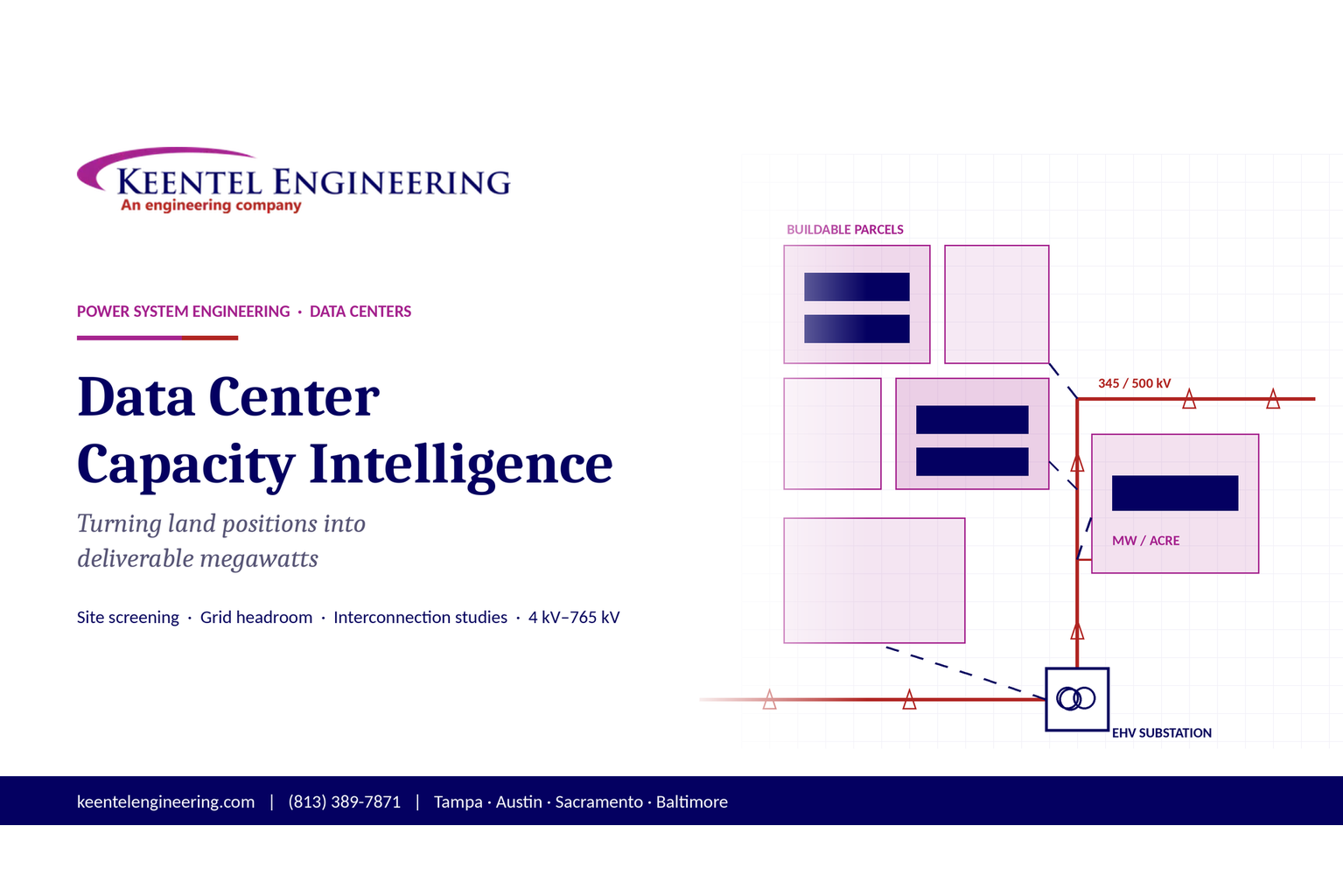
Plan data center capacity with land screening, MW-per-acre estimates, grid power availability and interconnection feasibility studies from Keentel Engineering.
By SANDIP R PATEL
•
October 11, 2026
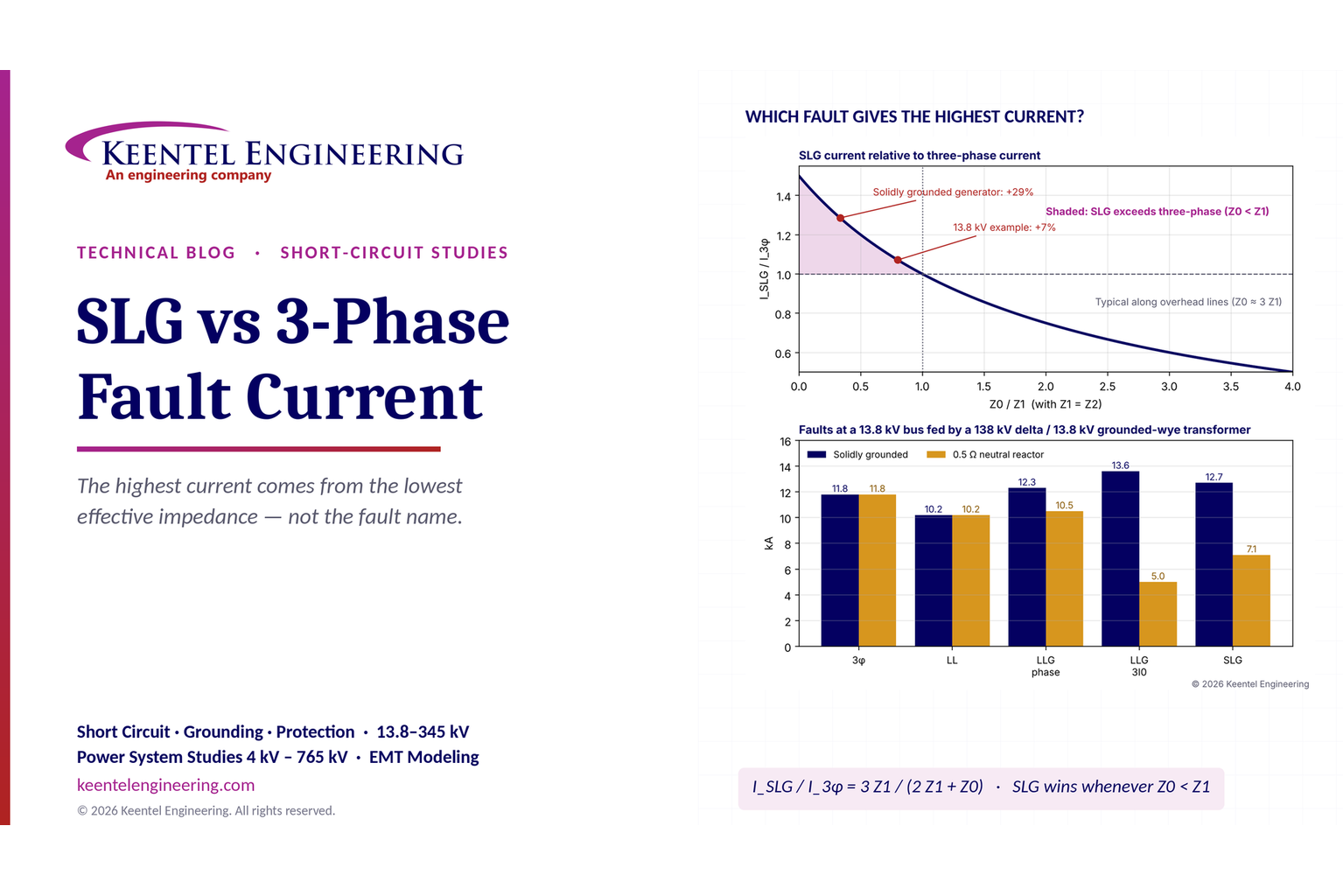
Learn which fault produces the highest current at a bus, why SLG faults can exceed three-phase faults, and how symmetrical components determine fault duty.
By SANDIP R PATEL
•
October 11, 2026
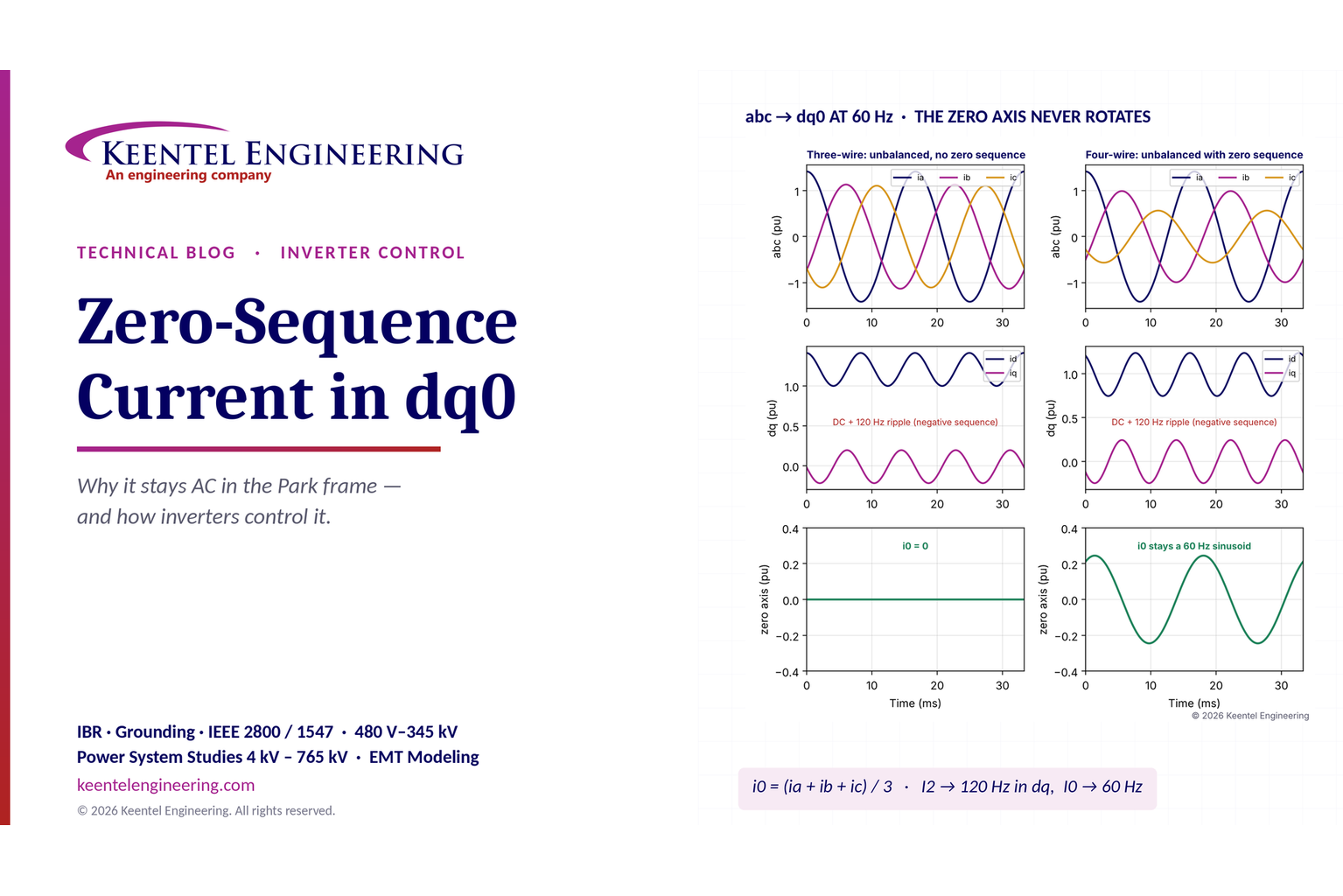
Learn why zero-sequence current pulsates in the dq0 frame, how Park's transformation works, and how inverter controls handle unbalance and ground faults.
By SANDIP R PATEL
•
October 11, 2026
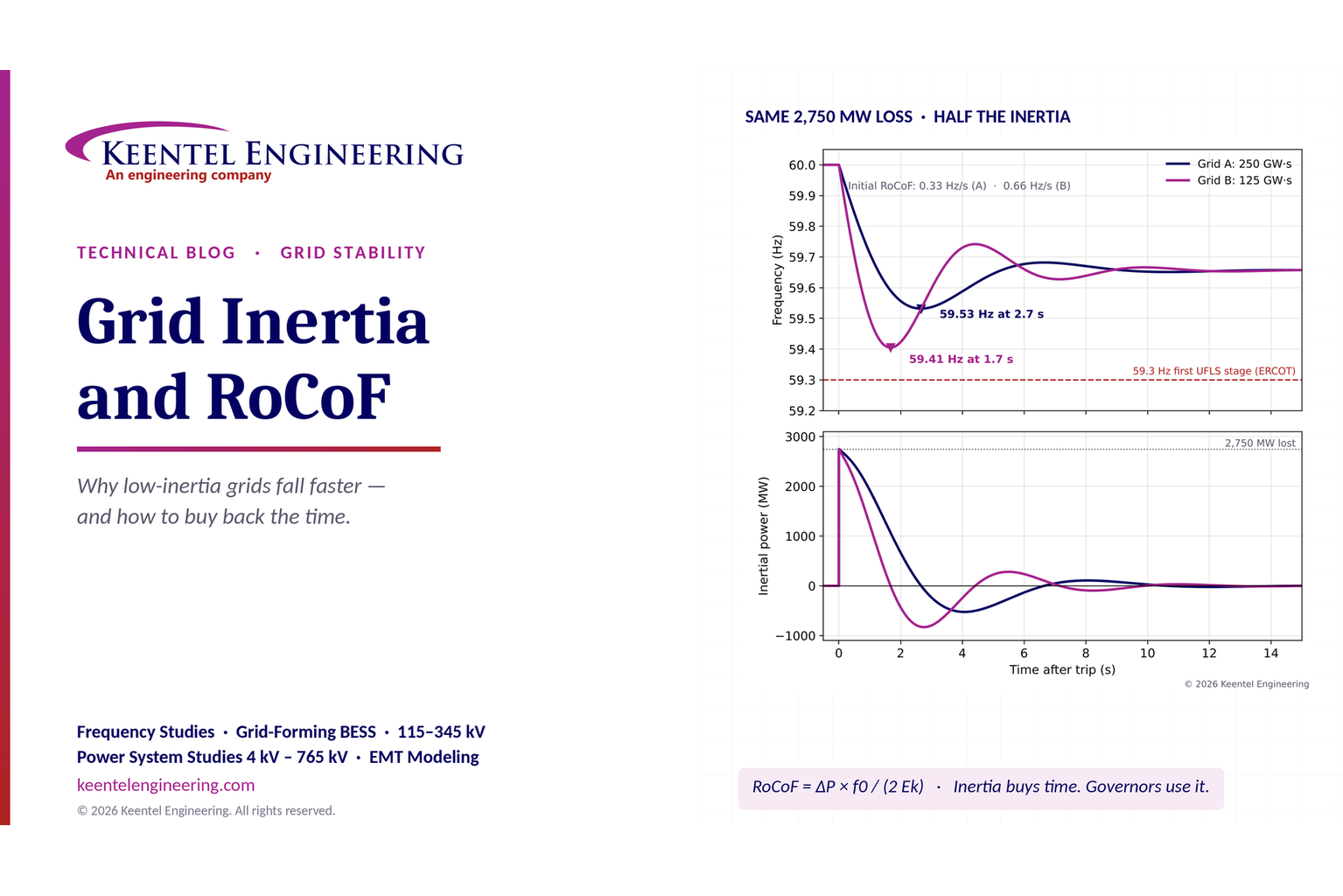
Explore grid inertia, RoCoF and frequency response, with swing equation calculations, frequency nadir analysis and US power system simulation examples.
By SANDIP R PATEL
•
October 11, 2026
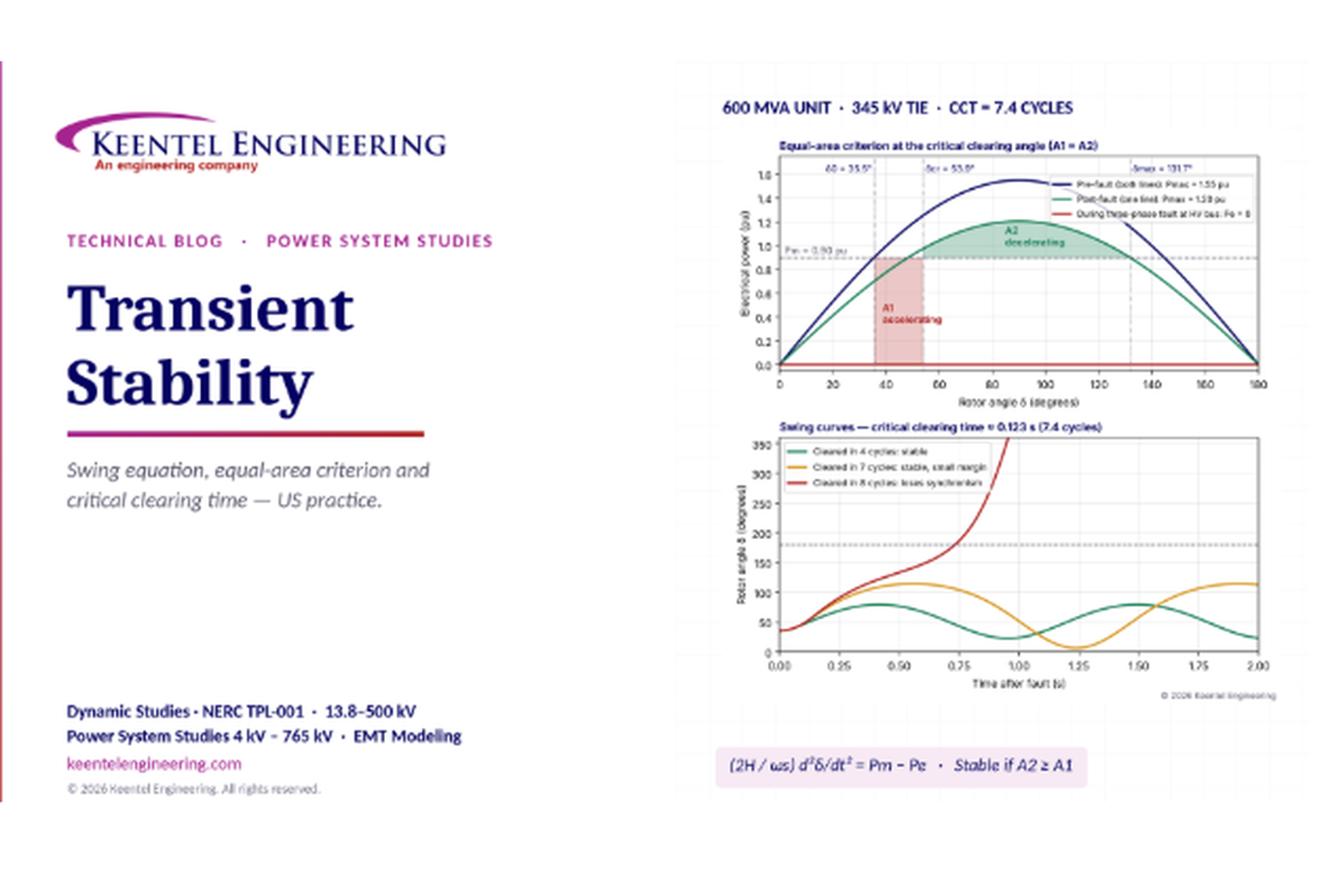
Learn transient stability analysis, swing equation, equal-area criterion and critical clearing time with a 345 kV worked example and NERC TPL-001 guidance.
By SANDIP R PATEL
•
October 11, 2026
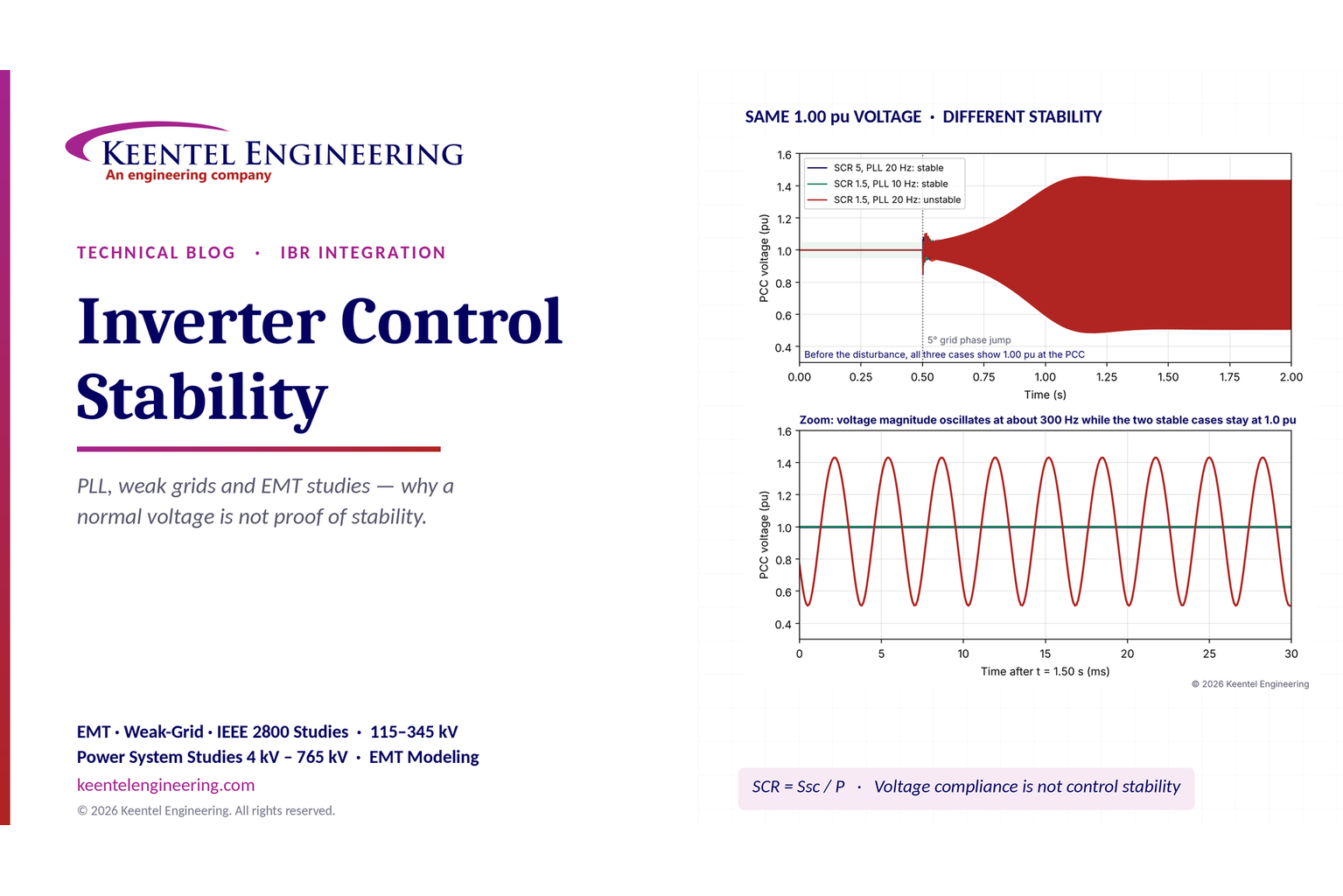
Learn why inverter controls become unstable in weak grids, how PLL bandwidth and SCR affect stability, and how PSCAD EMT studies identify and mitigate oscillations.
By SANDIP R PATEL
•
October 11, 2026
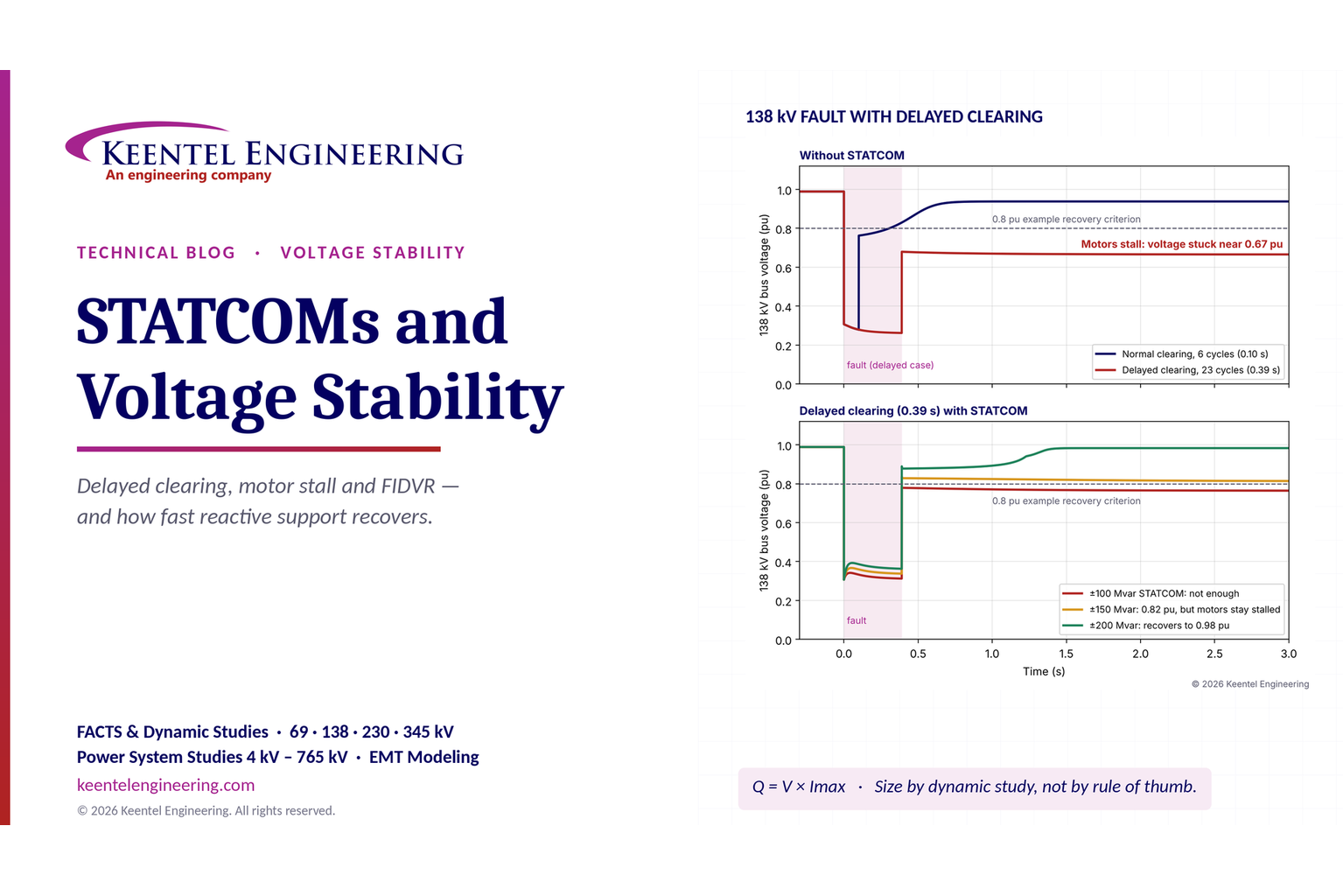
Learn how STATCOMs improve voltage stability and prevent FIDVR. Explore reactive power sizing, delayed fault clearing, NERC criteria and 138 kV simulation results.
By SANDIP R PATEL
•
October 10, 2026
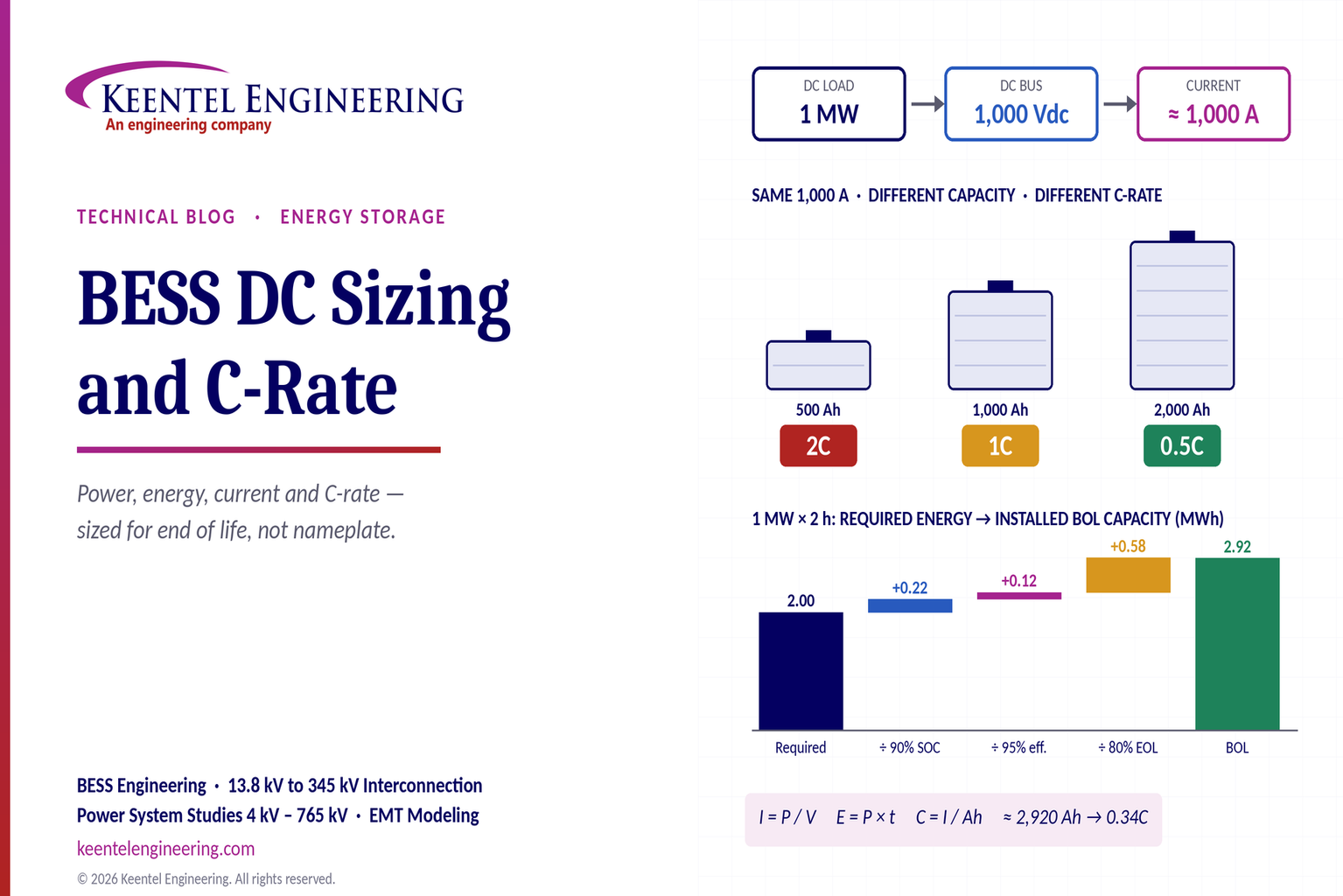
Learn BESS DC sizing with power, energy, current and C-rate calculations, battery losses, degradation and a 100 MW/400 MWh utility-scale example.
By SANDIP R PATEL
•
October 10, 2026
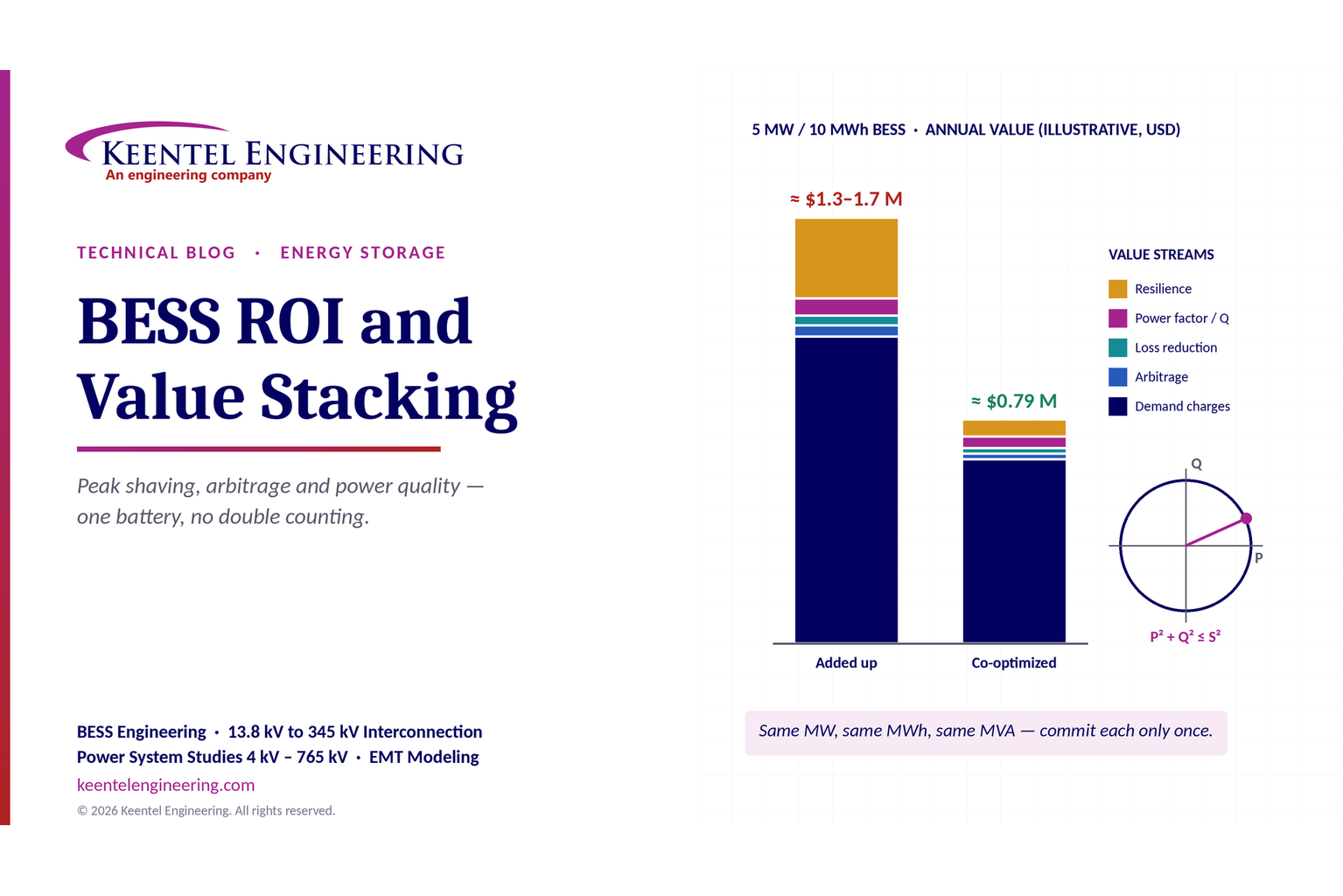
Learn how BESS ROI is calculated using peak shaving, energy arbitrage, power quality and battery storage economics, with a practical 5 MW/10 MWh example.