A Coordinated Electric System Interconnection Review—the utility’s deep-dive on technical and cost impacts of your project.
Challenge: Frequent false tripping using conventional electromechanical relays
Solution: SEL-487E integration with multi-terminal differential protection and dynamic inrush restraint
Result: 90% reduction in false trips, saving over $250,000 in downtime
ERCOT enforces all of the above through simulation, which means your model is your compliance case. The bar is now high:
- Whole-facility scope. The model must represent everything the IT load, the UPS and power conversion, the cooling plant, the protection and control systems in formats compatible with ERCOT's study platforms (PSS/E, PSCAD, TSAT).
- Real control loops, not approximations. Generic textbook representations are unacceptable. The model must capture the actual inner control behavior of your power electronics.
- Hardware-validated converter models. For electronic loads, the PSCAD model must be benchmarked against actual hardware testing including voltage ride-through and subsynchronous response. A model assembled from standard PSCAD library blocks fails by definition, because a generic block has never been tested against your vendor's hardware. The good news: validation is a hardware-type test, so results for a given converter product are reusable across every facility that uses it.
- Format migration. Facilities that previously submitted the older composite load model (CMLD) format must transition to EPRI's PERC1 format.
- Three checkpoints. Models are reviewed before the stability study begins (no model, no study), before each quarterly stability assessment, and for electronic loads one final time before energization, when you must submit as-built models with a documented comparison against the previously studied data and a sworn attestation that the model matches actual field settings. ERCOT's review takes 10 business days, extendable by 20 put it on your critical path.
- A living obligation. Change your technology, controls, or relay settings in a way that affects ride-through including converting a crypto mining site to an AI data center — and you've triggered a new interconnection study, even if your megawatts don't change.
| Parameter | Detail |
|---|---|
| System | 230 kV / 138 kV transmission corridors, wind and wet-snow icing exposure |
| Data basis | 15 years of minute-resolution forced-outage records + regional weather observations |
| Core methods | Event grouping, MVA performance curves, time-to-95%-restore, area outage rate curves, fragility modeling, rerun-history benefits, exceedance and log-domain risk metrics |
| Headline result | ≈85% of maximum resilience benefit at 60% of original capital; worst-event restoration window cut from 11 days to 5 in rerun-history terms |
| Decision supported | Capital portfolio selection; resilience plan filing; post-investment verification framework |
| System / Topic | Governing Standard(s) | What It Controls |
|---|---|---|
| Overall plant electrical distribution | IEEE 141 (Red Book); IEEE 666 | Distribution architecture, voltage selection, design of generating station auxiliary service systems |
| Power system studies | IEEE 399 (Brown Book); IEEE 551 | Load flow, symmetrical/asymmetrical short circuit, motor starting methodologies down to the lowest LV panelboard |
| Protection & coordination | IEEE 242 (Buff Book); IEEE 3004.5; IEEE C37 series | Generator relaying (21, 59N, 87G), time-current coordination, selective clearing between LV and MV tiers |
| GSU / UAT / SST transformers | IEEE C57.12.00 and C57 family | Transformer ratings, impedance, testing, loading |
| HV switchyard breakers | IEEE C37.06 | AC high-voltage circuit breaker preferred ratings |
| MV switchgear (13.8 kV) | IEEE C37.20.2; IEEE C37.20.7 | Metal-clad construction, compartmentalization, vacuum breakers; arc-resistant design with plenum venting |
| MV cable | UL 1072; ICEA S-93-639 (NEMA WC 74) | Type MV-105 shielded cable, 133% insulation level for HRG systems |
| LV switchgear (480 V) | IEEE C37.13; UL 1558 | Metal-enclosed LV power circuit breaker switchgear to 635 V, draw-out ACBs with electronic trip units |
| Motor control centers | UL 845; NEMA ICS 18 | LV-MCC construction, MCCB/MCP protection for motors under ~200 HP |
| Motors | NEMA MG-1 | Motor performance, starting characteristics, service factors |
| DC & battery systems | IEEE 485; IEEE 946 | Lead-acid battery sizing (125/250 VDC), DC auxiliary system design |
| Grounding | IEEE 80; IEEE 142 (Green Book) | Ground grid step/touch potential limits; system grounding including high-resistance grounding |
| Lightning protection | IEEE 998 | Direct-stroke shielding of switchyard and outdoor generator structures |
| Arc flash & electrical safety | IEEE 1584; NFPA 70E | Incident energy calculation; worker safety boundaries and PPE |
| Fire protection | NFPA 850 | Fire protection and risk management for combustion turbine generating plants |
| Installation code | NEC (NFPA 70); NESC | Wiring methods inside the plant fence; overhead/outdoor clearances at the switchyard |
| Interconnection & compliance | FERC LGIP; NERC MOD-025/026/027, PRC-019/024/029, FAC-008 | Interconnection process, model validation, protection/ride-through coordination, facility ratings |
| IFC / Construction Deliverable | Purpose |
|---|---|
| Stamped IFC packages | Legal basis for construction; P.E. responsible charge |
| Final relay settings & TCCs | Protection as-installed matches the coordination study |
| Calculation archive | Owner records; NERC audit evidence trail |
| Commissioning procedures | Safe, sequenced energization; MOD field testing |
| Construction support | RFIs, field changes, FAT/SAT witness |
| As-builts & model handoff | Operating baseline; future study currency |
| Metric | Outcome |
|---|---|
| Defects found pre-occupancy | Three topology defects and one settings-mismatch family corrected before load migration; the shared-switchboard defect alone would have invalidated the concurrently-maintainable claim on day one |
| IST findings | Fourteen additional discrepancies surfaced under scenario testing (control logic, alarm mapping, one generator sequencing fault) — all closed before handover instead of during operations |
| Black-building test | Passed on second execution; the first attempt exposed the generator sequencing fault under true block load, exactly the failure the compressed plan would never have found |
| Handover quality | Operations team certified on the actual failure scenarios; corrected EOPs and settings documentation delivered as controlled documents |
| Business outcome | Occupancy proceeded three weeks behind the original date — against an independent estimate that the uncorrected sequencing fault carried a high probability of a full facility outage within the first year |
Part 2 — Frequently Asked Questions: Large Load Interconnection
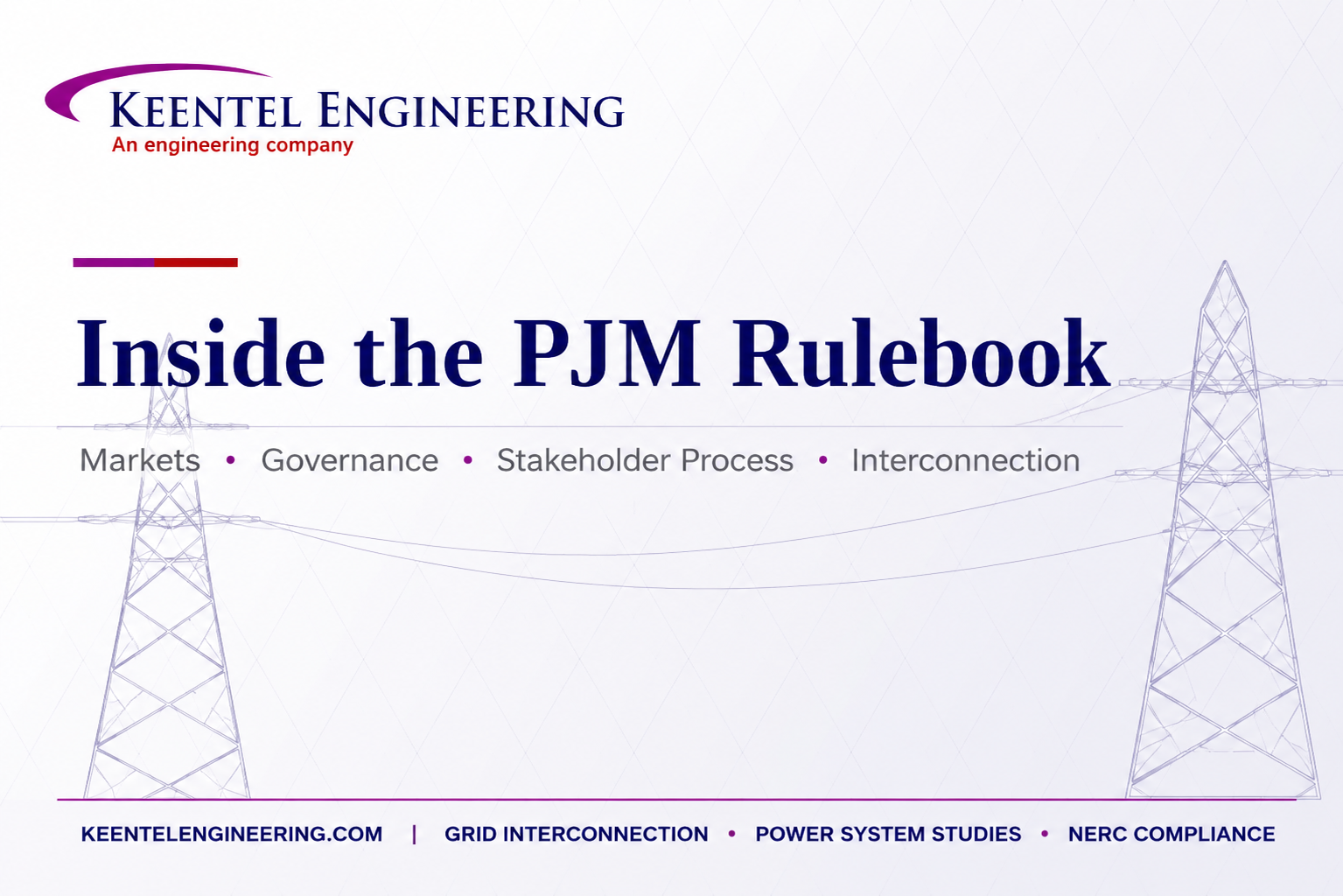
Inside the PJM Rulebook
Jul 15, 2026 | Blog
How PJM Markets, Governance, and the Stakeholder Process Shape Interconnection Outcomes — and How Developers and Large Loads Can Engage
1. Why the Rulebook Matters as Much as the Rules
Most developers, independent power producers, and large-load customers experience PJM Interconnection the same way: as a set of requirements that arrive fully formed. A model quality checklist. A study deposit schedule. A ride-through obligation. A capacity accreditation methodology. The rules land on your project, and your job is to comply.
But every one of those requirements was once a problem statement in a committee room. It was debated, redrafted, voted on by five stakeholder sectors, approved by an independent board, and filed with the Federal Energy Regulatory Commission (FERC) before it ever appeared in a tariff or a business practice manual. Understanding that machinery — how PJM is governed, how its markets are structured, and how its rules are actually made — is not academic. It determines when new requirements will hit your development pipeline, how much lead time you will have, and whether you have any voice in shaping them.
At Keentel Engineering, we have long argued that grid interconnection is a first-order engineering input, not a downstream administrative step. The same logic applies one level up: the regulatory and stakeholder processes that produce interconnection requirements are themselves a first-order planning input. A developer who understands the PJM stakeholder pipeline can see requirements coming twelve to twenty-four months before they bind.
One who does not will discover them in a study report, a deficiency letter, or a capacity auction result.
This article walks through PJM's role, jurisdiction, market architecture, governance structure, and rulemaking process — and then connects each of these to the practical decisions that generation developers, storage owners, and large electronic loads face today. A detailed FAQ follows in Part II.
2. What PJM Is and What It Is Not
PJM Interconnection, L.L.C. is the regional transmission organization (RTO) and independent system operator (ISO) for all or part of thirteen states and the District of Columbia — spanning Pennsylvania, New Jersey, Maryland (the three states that give PJM its name), Delaware, Ohio, Michigan, Illinois, Indiana, Virginia, West Virginia, North Carolina, Kentucky, and a small portion of Tennessee. Headquartered in Valley Forge, Pennsylvania, PJM operated for decades as a utility power pool before becoming the nation's first fully functioning RTO in 2002. It is now the largest wholesale electricity market operator in North America by load served.
Three distinctions define what PJM actually does, and each one matters for how you engage with it:
- Operator, not owner — PJM does not own the grid. Transmission-owning utilities that join PJM retain ownership of their lines, substations, and equipment, but transfer functional operational control to PJM. These participating transmission owners are compensated through PJM's Open Access Transmission Tariff when their facilities are used. This is why your interconnection project deals with both PJM (studies, agreements, queue administration) and a transmission owner (facility design standards, construction, cost estimates) — two parties, two sets of requirements, one project.
- Wholesale, not retail — PJM operates the high-voltage bulk power system under FERC jurisdiction. Lower-voltage distribution facilities — generally 100 kV and below, though the precise boundary follows the facilities designated under the transmission owners' agreements — remain under state or local jurisdiction. This jurisdictional seam is exactly where many distributed generation, community solar, and behind-the-meter projects live, and it dictates whether your interconnection runs through PJM's process or a state-jurisdictional utility process.
- Independent and non-discriminatory — PJM is a non-profit entity whose core mandate, under FERC oversight, is non-discriminatory grid access: any qualified buyer or seller of wholesale electricity connects and transacts under the same rules. That neutrality is also why PJM's rules change only through a structured, transparent stakeholder process — which is the subject of this article.
Keentel Perspective
The operator/owner split is the single most underestimated fact in PJM interconnection. Developers routinely budget for the PJM study process and are then surprised by transmission-owner facility requirements, design standards, and interconnection facilities costs. Treat the transmission owner as a full counterparty from day one — in your schedule, your single-line development, and your cost model.
3. The Market Architecture: Four Mechanisms, One Balance
An electric grid must remain in continuous balance — generation onto the grid must equal consumption from it at every instant. PJM achieves this balance, and prices it, through a layered market architecture. Each layer operates on a different time horizon, and each one touches project economics differently.
| Market | Time Horizon | What It Does | Why It Matters to Your Project |
|---|---|---|---|
| Day-Ahead Energy Market | Next operating day, hourly | Schedules supply against forecasted demand using security-constrained economic dispatch (SCED); the majority of energy transacts here | Sets the primary revenue benchmark for dispatchable assets; congestion modeling here drives locational value |
| Real-Time Energy Market | Five-minute intervals | Reconciles forecast vs. actual conditions — outages, weather, congestion — procuring balancing energy from synchronized resources | Exposure for intermittent resources; DART spreads drive storage and hybrid dispatch strategy |
| Ancillary Services Markets | Concurrent with energy | Procures reserves and regulation to maintain frequency, voltage, and NERC reliability margins | Stackable revenue for BESS and fast-responding resources; performance obligations follow |
| Capacity Market (RPM) | Three years forward (tariff design) | Base Residual Auction plus incremental auctions procure committed capacity by location, with penalties for non-performance | Capacity accreditation (ELCC) and non-performance risk are now central to solar, wind, and storage pro formas |
Two features of this architecture deserve emphasis. First, security-constrained economic dispatch means the market model respects transmission limits: a higher-cost resource near a load center can clear ahead of a cheaper remote one when congestion binds. Location is priced, which is why interconnection point selection is an economic decision, not just a feasibility question. Second, the Reliability Pricing Model (RPM) capacity construct is a planning instrument, not just a revenue stream — its three-year-forward design (compressed in recent auction cycles) exists to signal where investment in new supply is needed. When capacity prices in a locational deliverability area spike, that is the market telling developers where the next tranche of projects will pencil.
Keentel Perspective
Market design and interconnection engineering are converging. Capacity accreditation now depends on demonstrated performance characteristics; ride-through obligations under IEEE 2800 and NERC PRC-029 determine whether an inverter-based resource stays online during the disturbances that capacity commitments are meant to cover; and
EMT model quality determines whether PJM believes your plant does what your pro forma assumes. The study models you submit are, increasingly, market documents.
4. Governance: Who Actually Decides
PJM is overseen by an independent Board of Managers consisting of ten members — nine elected members plus the PJM CEO serving ex officio. Members serve staggered three-year terms and must collectively bring expertise across utilities, finance, regulation, engineering, and markets. The Board's independence is structural: it is the body that decides whether stakeholder-endorsed rule changes are filed with FERC.
Beneath the Board sits the stakeholder apparatus where the substantive work happens. Two Senior Standing Committees anchor the structure: the Members Committee, composed of representatives of all PJM members and reporting directly to the Board, and the Markets and Reliability Committee, which consolidates input from the technical committees covering markets, operations, and planning. Both senior committees require a two-thirds supermajority to pass a proposal.
Voting in the senior committees uses sector-weighted voting across five member sectors, each carrying exactly twenty percent of the total vote regardless of how many members show up:
| Sector | Typical Members | Interests in Play |
|---|---|---|
| Generation Owners | IPPs, utility generation affiliates, storage owners | Energy and capacity revenues, interconnection cost allocation, performance obligations |
| Other Suppliers | Marketers, traders, demand response providers, aggregators | Market design, credit policy, product definitions |
| Transmission Owners | Utilities with transmission assets in PJM | Transmission rates, planning, facility standards, cost recovery |
| Electric Distributors | Load-serving utilities, municipals, cooperatives | Load costs, capacity obligations, allocation of transmission charges |
| End-Use Customers | Large industrials, data centers, state consumer advocates | Total cost of power, reliability, large-load interconnection terms |
The design intent is straightforward: no sector can dominate by turnout. If thirty end-use customers attend a vote against six members from each other sector, those thirty votes still control only the end-use sector's twenty percent. Coalition-building across sectors is therefore not optional — it is the arithmetic of how anything passes. A proposal needs broad, cross-sector support to reach the two-thirds threshold, which is why PJM rule changes tend to be negotiated packages rather than clean wins for any one interest.
Around the voting structure sit several bodies that shape outcomes without voting. The Organization of PJM States (OPSI) represents the utility regulatory commissions of the fourteen PJM jurisdictions, coordinating state positions and advising PJM on regulators' concerns. The Consumer Advocates of the PJM States (CAPS) represents the state consumer advocate offices — and is unique among RTO consumer organizations in being funded through a FERC-authorized tariff mechanism. User groups such as the Public Interest and Environmental Organizations User Group (PIEOUG) give non-member organizations structured access to PJM staff and the Board. FERC itself holds regulatory oversight over the entire structure and may place non-voting representatives on standing committees.
5. How a PJM Rule Is Actually Made
The path from idea to enforceable tariff language follows a defined pipeline. Any stakeholder — including a non-member — can initiate it. The stages below are where a developer's engineering and commercial teams should be paying attention:
- Stage 1: Problem statement and issue charge — A stakeholder brings a problem statement and issue charge to a technical committee. If approved, PJM and stakeholders develop a work plan: which committee owns the issue, and whether the end product is manual language or tariff revisions. This is the earliest signal — problem statements filed today describe the compliance obligations of two years from now.
- Stage 2: Solution development — PJM typically develops a solutions package with options; other stakeholders may sponsor competing solutions. Technical debate happens here — modeling requirements, study assumptions, cost allocation formulas. This is where engineering input has the most leverage, because positions harden as packages advance.
- Stage 3: Senior committee votes — A supported solution advances to the Markets and Reliability Committee and then the Members Committee, each requiring a two-thirds sector-weighted supermajority. Members vote for, against, or abstain.
- Stage 4: Board action and FERC filing — The PJM Board decides whether to file the endorsed change with FERC under Section 205 of the Federal Power Act. Notably, the Members Committee can also vote (by two-thirds supermajority) to file a Section 205 change even without Board approval — and any individual or group can file a Section 206 complaint at FERC asserting that an existing PJM rule is unjust and unreasonable, with no committee approval required at all.
Why This Pipeline Matters to Developers
Nearly every major interconnection reform of recent years — cluster study transition, expedited interconnection pathways, EMT model requirements for inverter-based resources, large-load interconnection terms, capacity accreditation reform — moved through exactly this pipeline before it bound anyone. The stakeholder calendar is a forward schedule of your future compliance obligations. Monitoring it is cheap; discovering a new requirement mid-queue is not.
6. Participation Is Open and Underused
PJM stakeholder meetings are open to the public unless otherwise noted, with remote participation routinely available. Agendas, presentation materials, and issue-tracking histories are posted through PJM's Meeting Center, and non-members may attend and ask questions. Full membership — which carries voting rights — requires an application and an annual fee (currently $5,000 for most member classes), a modest sum against the value of a vote in processes that set study deposits, cost allocation, and performance obligations.
For most developers and large-load customers, the practical engagement model is layered: monitor the committees relevant to your asset class; coordinate with sector coalitions that share your position (experienced stakeholders rarely go it alone); engage your state commission through OPSI channels where state policy is implicated; and reserve direct membership and voting for organizations with sustained PJM exposure. The issues are technical, the history runs decades deep, and the language is tariff language — which is precisely why engineering-literate participation is disproportionately effective.
7. What This Means Right Now: The Issues Moving Through the Pipeline
The stakeholder process is currently the arena for the questions that will define PJM development economics for the rest of the decade:
- Large loads and co-location — Data center growth has made large-load interconnection the defining reliability question in PJM. How co-located and grid-connected large loads are studied, charged, and obligated to ride through disturbances is being worked out in stakeholder forums now — in parallel with NERC's large-loads reliability work and ERCOT's NOGRR282 precedent on electronic load ride-through.
- Inverter-based resource performance — PJM's EMT modeling requirements for inverter-based resources — PSCAD model quality, benchmarking against field behavior, and validation checklists — trace directly to NERC disturbance analyses and IEEE 2800 adoption. Model quality expectations continue to tighten, and resources with unbenchmarked or vendor-generic models face study delays and restudy risk.
- Interconnection process reform — Queue reform continues to evolve, including expedited pathways for shovel-ready projects. Eligibility criteria and readiness deposits are stakeholder-negotiated parameters — meaning they can and will change as the backlog picture changes.
- Capacity accreditation and RPM reform — Capacity market rules — accreditation methods, must-offer obligations, penalty structures — are under near-continuous revision following recent auction outcomes and FERC proceedings. For storage and renewables, accreditation methodology is often worth more to the pro forma than any energy-market design change.
8. How Keentel Engineering Fits In
Keentel Engineering is a power systems and
grid interconnection consulting firm headquartered in Tampa, Florida, with offices in Austin, Sacramento, and Baltimore. We work at exactly the intersection this article describes: where PJM's rules, studies, and stakeholder-driven requirements meet the engineering of real projects. Our service lines map to the PJM landscape as follows:
| Keentel Service Line | Where It Meets the PJM Process |
|---|---|
| Grid Interconnection Engineering | Queue strategy, feasibility through facilities studies, interconnection agreement technical support, POI selection informed by congestion and deliverability — for generation, storage, and large loads |
| Power System Studies | Load flow, short circuit, stability, and deliverability analysis aligned to PJM planning criteria; SCR assessment and weak-grid screening for inverter-based resources |
| EMT Modeling & Model Validation | PSCAD model development, benchmarking, and quality-checklist compliance for IBRs; hardware-in-the-loop and field-data validation to withstand model quality review |
| NERC Compliance | PRC, MOD, FAC, and CIP-adjacent standard applicability, evidence programs, and audit readiness — including PRC-028 disturbance monitoring and PRC-029 ride-through for IBRs |
| Substation & Transmission Design | 30/60/90/IFC design progression for collector substations, POI switchyards, and transmission-owner-compliant interconnection facilities |
| Renewables & BESS Engineering | Plant-level electrical design, protection and control, grounding (IEEE 80/81), and commissioning support from concept through energization |
| Owner's Engineer Services | Independent technical oversight across the interconnection lifecycle — study review, TO/EPC interface management, and regulatory-requirement tracking so nothing lands on your project unseen |
The through-line in all of it is the thesis we opened with: interconnection is a first-order engineering input. The developers who win in PJM treat the tariff, the stakeholder calendar, and the study models as design constraints from day one — not as paperwork at the end. Keentel exists to make that posture practical.
9. Conclusion
PJM is not a black box. It is a transparent, rule-bound institution whose markets balance the largest grid footprint in North America and whose requirements are written in open committee rooms by the very sectors they govern. For developers, storage owners, and large loads, that transparency is an asset — but only for those who use it. Understand the market architecture, watch the stakeholder pipeline, engage where your interests are at stake, and build your engineering program to anticipate the rules rather than react to them.
Keentel Engineering supports clients across every stage of that program — from the first single-line diagram to the final compliance filing. Part II below answers the questions we hear most often.
Frequently Asked Questions
Q1. What is PJM, in one paragraph?
PJM Interconnection, L.L.C. is the regional transmission organization (RTO) and independent system operator (ISO) for all or part of thirteen states and the District of Columbia. It operates — but does not own — the high-voltage transmission grid in its footprint, runs the wholesale electricity markets (day-ahead energy, real-time energy, ancillary services, and the RPM capacity market), performs regional transmission planning, and administers the generation and load interconnection processes. It is a non-profit entity regulated by FERC, headquartered in Valley Forge, Pennsylvania, and became the nation's first fully functioning RTO in 2002.
Q2. What is the difference between an RTO and an ISO?
Functionally, very little in day-to-day terms — both are independent entities that operate transmission systems they do not own and administer open-access wholesale markets. 'RTO' is a FERC designation carrying a defined scope of regional responsibilities (notably regional transmission planning). PJM holds both designations for its territory. What matters practically is independence: PJM's operational decisions and market administration are insulated from the commercial interests of the utilities whose assets it controls.
Q3. Who regulates PJM, and who regulates my retail electric service?
FERC regulates PJM — its tariff, its market rules, and the rates for transmission service on the bulk power system, which is interstate commerce. Retail electric service to homes and businesses is regulated by state utility commissions (for investor-owned utilities), municipalities (for municipal utilities), or cooperative boards. If your concern is a retail bill or local service quality, the venue is your utility and state commission, not PJM or FERC. If your concern is wholesale market design, transmission rates, or interconnection rules, the venue is PJM's stakeholder process and, ultimately, FERC.
Q4. Where is the line between transmission and distribution?
As a general rule of thumb, facilities above roughly 100 kV are transmission under PJM operational control and FERC jurisdiction, while lower-voltage facilities are distribution under state or local jurisdiction. In practice the boundary follows the specific facilities designated under the participating transmission owners' agreements, and there are exceptions in both directions. The jurisdictional determination matters enormously for project developers: it decides whether your interconnection is studied under PJM's process or a state-jurisdictional utility process, with different timelines, cost structures, and technical requirements.
Q5. PJM doesn't own the grid — so who am I actually dealing with on an interconnection project?
Both PJM and the local transmission owner (TO). PJM administers the queue, performs or coordinates the studies, and is the counterparty for interconnection service. The TO owns the physical facilities, applies its own design and facility connection standards, builds (or approves) the interconnection facilities and network upgrades, and bills for them. Successful projects manage both relationships in parallel — a schedule slip or design misalignment with the TO can stall a project even when the PJM process is on track.
Q6. What are PJM's four markets, briefly?
The day-ahead energy market schedules supply against forecasted demand for each hour of the next operating day and is where most energy transacts. The real-time energy market balances actual conditions at five-minute intervals, covering forecast error, outages, and congestion. Ancillary services markets procure reserves and regulation to maintain frequency, voltage, and NERC reliability margins. The capacity market (RPM) commits supply years in advance through the Base Residual Auction and incremental auctions, paying resources for the promise of availability — with penalties for non-performance during emergencies.
Q7. Why does most energy trade day-ahead rather than in real time?
Predictability and physics. Large plants need startup lead time, fuel arrangements, and crew scheduling; the day-ahead market lets suppliers commit against a firm schedule. It also lets PJM manage congestion in advance through security-constrained economic dispatch. The real-time market then handles only the deviations. For asset owners, the day-ahead/real-time (DART) spread is itself a managed exposure — and for storage, a core element of dispatch strategy.
Q8. What is security-constrained economic dispatch (SCED)?
The optimization PJM uses to schedule and dispatch resources at least cost while respecting transmission limits. 'Security-constrained' means the solution cannot overload lines or violate reliability criteria — so when congestion binds, a costlier resource in the right location clears ahead of a cheaper one in the wrong location. This is why locational marginal prices differ across the footprint, and why the interconnection point you choose is a revenue decision, not just a feasibility decision.
Q9. What is the Reliability Pricing Model (RPM) and why should a developer care?
RPM is PJM's capacity market — a forward auction construct (designed to run three years ahead of each delivery year, though recent auction schedules have been compressed) that pays resources for committed future availability, priced by location. It exists to attract and retain enough supply for long-term reliability. Developers should care because capacity revenue is a major line in most PJM pro formas, because accreditation methodology (how many MW of capacity credit your resource earns) is under active reform, and because non-performance during emergencies carries significant penalties. Capacity commitments are engineering commitments: your plant's ride-through, availability, and performance characteristics are what you are selling.
Q10. How is PJM governed?
By an independent ten-member Board of Managers — nine elected members plus the PJM CEO — with staggered three-year terms and required expertise across utilities, finance, regulation, engineering, and markets. The Board decides whether stakeholder-endorsed rule changes are filed with FERC. Beneath the Board, a structured stakeholder committee system develops and votes on proposals, anchored by two Senior Standing Committees: the Members Committee and the Markets and Reliability Committee.
Q11. How does sector-weighted voting work?
PJM members are divided into five sectors — Generation Owners, Other Suppliers, Transmission Owners, Electric Distributors, and End-Use Customers — and each sector controls exactly twenty percent of the vote in the senior committees regardless of attendance. Thirty members of one sector showing up against six from each other sector still control only their sector's twenty percent. Senior committee passage requires a two-thirds supermajority, which makes cross-sector coalition-building a structural necessity: no single interest group can force a rule change through.
Q12. Can a non-member participate in PJM processes?
Yes, meaningfully. Stakeholder meetings are open to the public (with remote participation typically available), non-members can attend and ask questions, and any stakeholder — member or not — can bring a problem statement to a technical committee to initiate a rule change discussion. What non-members cannot do is vote. Anyone can also file a Section 206 complaint at FERC asserting an existing PJM rule is unjust and unreasonable, entirely outside the committee process.
Q13. What does PJM membership cost and what does it buy?
The standard annual membership fee is currently $5,000 (with certain exceptions), plus an application process and eligibility requirements. Membership buys voting rights in the committee structure and a formal seat in the process that sets study procedures, cost allocation, market rules, and performance obligations. For organizations with sustained PJM exposure — an active development pipeline, an operating fleet, or a large load — the fee is trivially small against the value of standing in those decisions.
Q14. How does a rule change actually move from idea to tariff?
A stakeholder brings a problem statement and issue charge to a technical committee; if approved, PJM and stakeholders develop a work plan and a solutions package (competing stakeholder solutions are permitted). A supported solution advances through the Markets and Reliability Committee and the Members Committee, each requiring a two-thirds sector-weighted supermajority. The PJM Board then decides whether to file the change with FERC under Section 205 of the Federal Power Act. The Members Committee can also file under Section 205 by two-thirds vote without Board approval, and any party can pursue Section 206 relief at FERC independently. FERC's acceptance is what makes the change enforceable.
Q15. What are OPSI and CAPS?
OPSI — the Organization of PJM States — is the association of utility regulatory commissions from the fourteen PJM jurisdictions. It coordinates state regulatory positions on PJM issues and advises PJM on regulators' concerns, while each commission retains its independent statutory authority. CAPS — Consumer Advocates of the PJM States — represents the state consumer advocate offices, votes in the End-Use Customer sector, and is unique among RTO consumer organizations in being funded through a FERC-authorized tariff mechanism. Both are useful coordination channels when a developer's or large load's interests align with state policy or consumer-cost positions.
Q16. How should a developer or large-load customer monitor PJM without drowning in meetings?
Triage by asset class and exposure. Identify the two or three committees and task forces where your issues live (interconnection process, capacity accreditation, large-load rules, IBR performance), track their agendas through PJM's Meeting Center and issue-tracking pages, and set internal review gates: any problem statement touching your pipeline gets an engineering impact assessment. Coalition participation multiplies leverage — most experienced stakeholders coordinate positions rather than acting alone. Keentel provides this monitoring and impact-assessment function as part of our owner's engineer services.
Q17. Which stakeholder issues matter most to inverter-based resources right now?
Three clusters. First, EMT model quality: PSCAD model development, benchmarking, and validation requirements continue to tighten, and unbenchmarked vendor-generic models are a leading cause of study friction. Second, performance standards: IEEE 2800 adoption and NERC ride-through requirements (PRC-029) are converging with PJM study practice, alongside disturbance monitoring obligations (PRC-028). Third, capacity accreditation: how ELCC-style methods credit solar, wind, storage, and hybrids is under active revision and directly moves project value. All three are engineering questions being settled in stakeholder and regulatory forums.
Q18. Which issues matter most to data centers and other large loads?
How large loads are studied and interconnected (timelines, deposits, cost responsibility), whether and how they must ride through grid disturbances rather than tripping en masse (the issue ERCOT addressed through NOGRR282 and NERC is addressing through its large-loads reliability work), co-location rules for loads sited at generation, and how load growth is reflected in capacity obligations and transmission cost allocation. These questions are actively moving through PJM stakeholder and FERC processes now, and their outcomes will shape data center siting economics across the footprint.
Q19. Does engaging in the stakeholder process actually change outcomes?
Yes — with realistic expectations. The two-thirds, sector-weighted structure means no single participant dictates results, but it equally means well-organized coalitions with credible technical positions routinely shape solution packages before they harden. The highest-leverage engagement is early (problem statement and solution-development stages) and technical (study assumptions, modeling requirements, eligibility criteria), which is where engineering-literate participants have an outsized voice relative to their vote share.
Q20. How does Keentel Engineering support clients in the PJM footprint?
Across the full lifecycle: interconnection queue strategy and study support (feasibility through facilities); power system studies aligned to PJM planning criteria; PSCAD/EMT model development, benchmarking, and validation for inverter-based resources; NERC compliance programs including PRC-028 and PRC-029 applicability and evidence; substation and transmission design through 30/60/90/IFC milestones to transmission-owner standards; renewables and BESS plant engineering; and owner's engineer services that include regulatory and stakeholder-pipeline monitoring so new requirements never reach your project unassessed. Contact us at contact@keentelengineering.com or (813) 389-7871.
About Keentel Engineering
Keentel Engineering is a power systems and grid interconnection consulting firm headquartered in Tampa, Florida, with offices in Austin, Sacramento, and Baltimore. Our service lines span grid interconnection engineering, substation and transmission design,
power system studies NERC compliance, renewables and BESS engineering, EMT modeling, and
owner's engineer services. We serve developers, independent power producers, utilities, and large-load customers across North American RTO/ISO footprints.
| Contact | Details |
|---|---|
| Headquarters | 400 N Ashley Dr STE 2600, Tampa, FL 33602 |
| Phone | (813) 389-7871 |
| contact@keentelengineering.com | |
| Florida Firm Registration | No. 36853 |
| Additional Offices | Austin, TX • Sacramento, CA • Baltimore, MD |
Disclaimer:
Keentel Engineering is an independent consulting firm and is not affiliated with, endorsed by, or sponsored by PJM Interconnection, L.L.C., the Federal Energy Regulatory Commission (FERC), the North American Electric Reliability Corporation (NERC), the Organization of PJM States (OPSI), Consumer Advocates of the PJM States (CAPS), or any other organization referenced in this document. All product names, standards, and trademarks are the property of their respective owners and are referenced for identification purposes only. This document summarizes publicly available regulatory and market-process information as of the date of preparation; market rules, tariff provisions, fees, and stakeholder procedures change frequently and readers should verify current requirements directly with PJM and FERC. Nothing herein constitutes engineering, legal, financial, or regulatory advice for any specific project or proceeding.

About the Author:
Sandip "Sonny" R. Patel, P.E.
IEEE Senior Member · Founder & CEO, Keentel Engineering
In 1995, Sonny Patel earned his Electrical Engineering degree from the University of Illinois. But degrees don't build legacies — action does.
For three decades, he has worked the power industry from every side of the table: 16 years as a utility engineer at Exelon/Commonwealth Edison; generation leadership across hydroelectric, industrial steam turbine, and a 9 GW renewable fleet; NERC Regional Entity Senior Compliance Engineer and Audit Team Lead, auditing some of the nation's largest utilities; and testing and commissioning lead on equipment up to 765 kV — the very top of the North American grid.Utility. Generator. Regulator. Consultant. Few engineers have seen all four seats. Fewer still have sat in them.
His experience spans nuclear, hydro, conventional generation, renewables, oil and gas, mining — and today's data centers, where he is authoring a three-book series on data center design. He is a Licensed Professional Engineer in six states and a Licensed Electrical Contractor in Florida (Unlimited EC) — he doesn't just design the work; he's qualified to stand behind its execution.Today, as Founder and CEO of Keentel Engineering, Sonny leads a nationwide team of engineers delivering substation design, power system studies, NERC compliance, and commissioning — done right, coast to coast.Three decades. Every side of the table. One standard: accountable engineering.
Services

Let's Discuss Your Project
Let's book a call to discuss your electrical engineering project that we can help you with.
About the Author:
Sandip "Sonny" R. Patel, P.E.
IEEE Senior Member · Founder & CEO, Keentel Engineering
In 1995, Sonny Patel earned his Electrical Engineering degree from the University of Illinois. But degrees don't build legacies — action does.
For three decades, he has worked the power industry from every side of the table: 16 years as a utility engineer at Exelon/Commonwealth Edison; generation leadership across hydroelectric, industrial steam turbine, and a 9 GW renewable fleet; NERC Regional Entity Senior Compliance Engineer and Audit Team Lead, auditing some of the nation's largest utilities; and testing and commissioning lead on equipment up to 765 kV — the very top of the North American grid.
Utility. Generator. Regulator. Consultant. Few engineers have seen all four seats. Fewer still have sat in them.
His experience spans nuclear, hydro, conventional generation, renewables, oil and gas, mining — and today's data centers, where he is authoring a three-book series on data center design. He is a Licensed Professional Engineer in six states and a Licensed Electrical Contractor in Florida (Unlimited EC) — he doesn't just design the work; he's qualified to stand behind its execution.
Today, as Founder and CEO of Keentel Engineering, Sonny leads a nationwide team of engineers delivering substation design, power system studies, NERC compliance, and commissioning — done right, coast to coast.Three decades. Every side of the table. One standard: accountable engineering.
Leave a Comment
Thank you for contacting us.
We will get back to you as soon as possible.
We will get back to you as soon as possible.
Oops, there was an error sending your message.
Please try again later.
Please try again later.
Related Posts
By SANDIP R PATEL
•
October 11, 2026
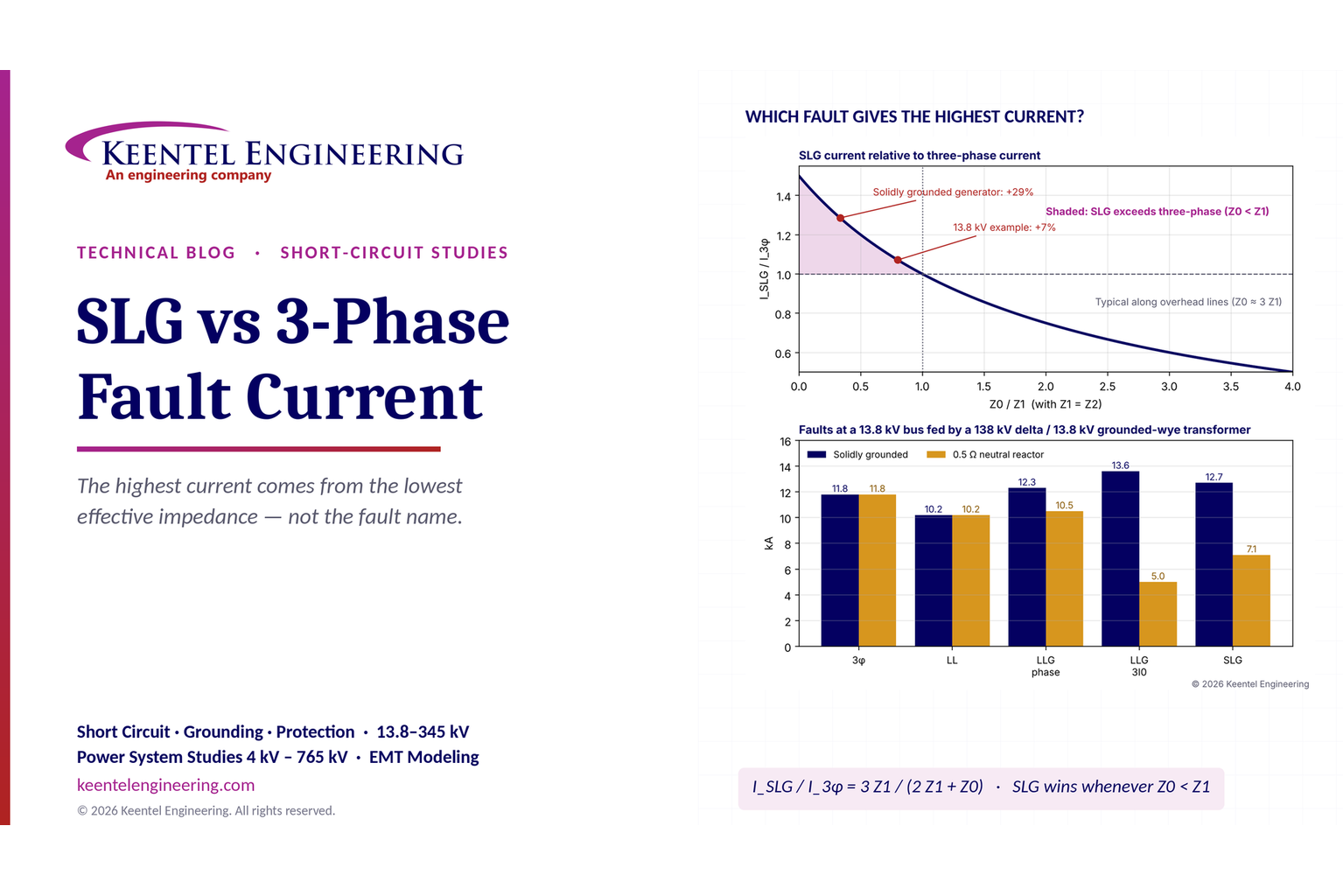
Learn which fault produces the highest current at a bus, why SLG faults can exceed three-phase faults, and how symmetrical components determine fault duty.
By SANDIP R PATEL
•
October 11, 2026
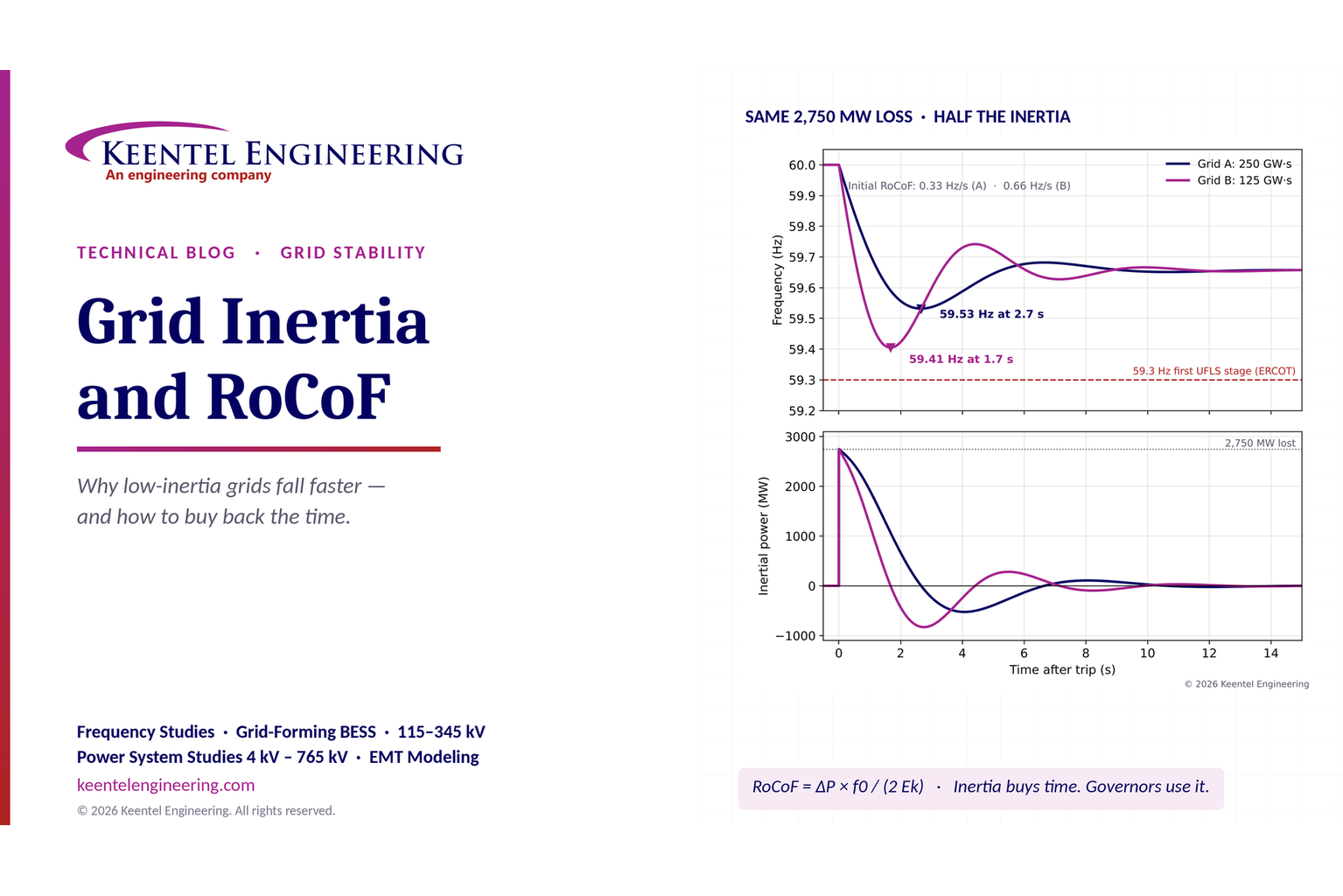
Explore grid inertia, RoCoF and frequency response, with swing equation calculations, frequency nadir analysis and US power system simulation examples.
By SANDIP R PATEL
•
October 11, 2026
Learn transient stability analysis, swing equation, equal-area criterion and critical clearing time with a 345 kV worked example and NERC TPL-001 guidance.
By SANDIP R PATEL
•
October 11, 2026
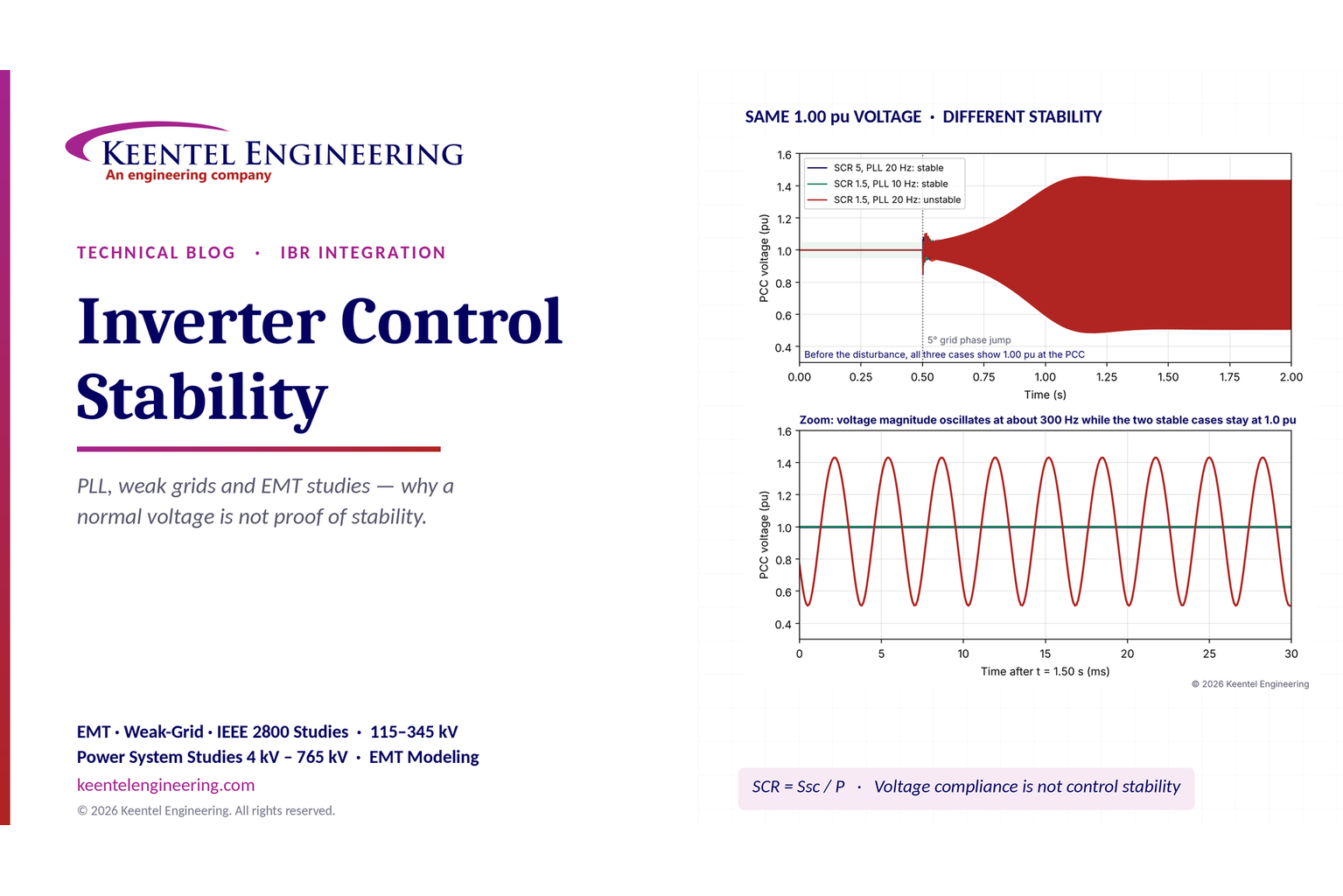
Learn why inverter controls become unstable in weak grids, how PLL bandwidth and SCR affect stability, and how PSCAD EMT studies identify and mitigate oscillations.
By SANDIP R PATEL
•
October 11, 2026
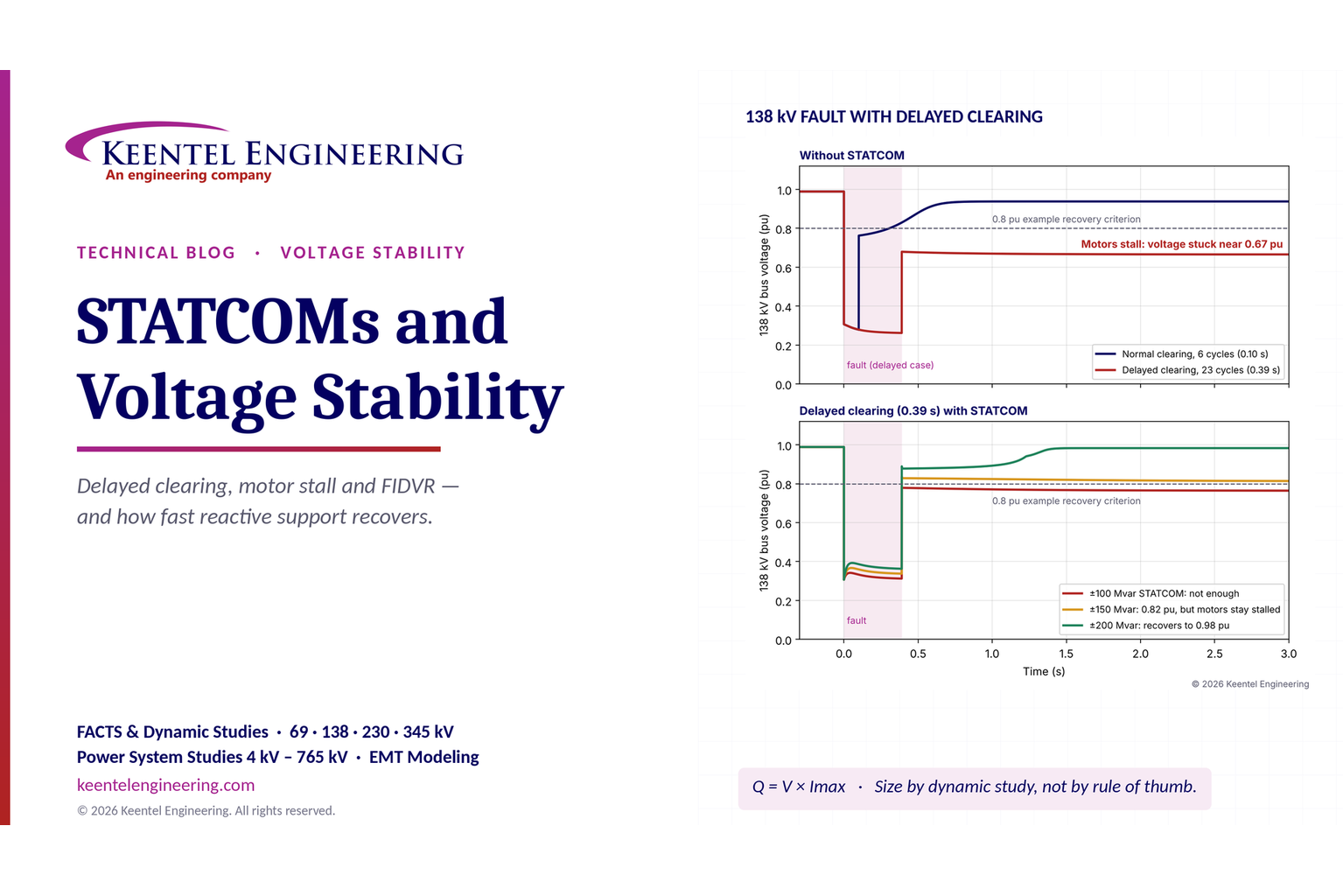
Learn how STATCOMs improve voltage stability and prevent FIDVR. Explore reactive power sizing, delayed fault clearing, NERC criteria and 138 kV simulation results.
By SANDIP R PATEL
•
October 10, 2026
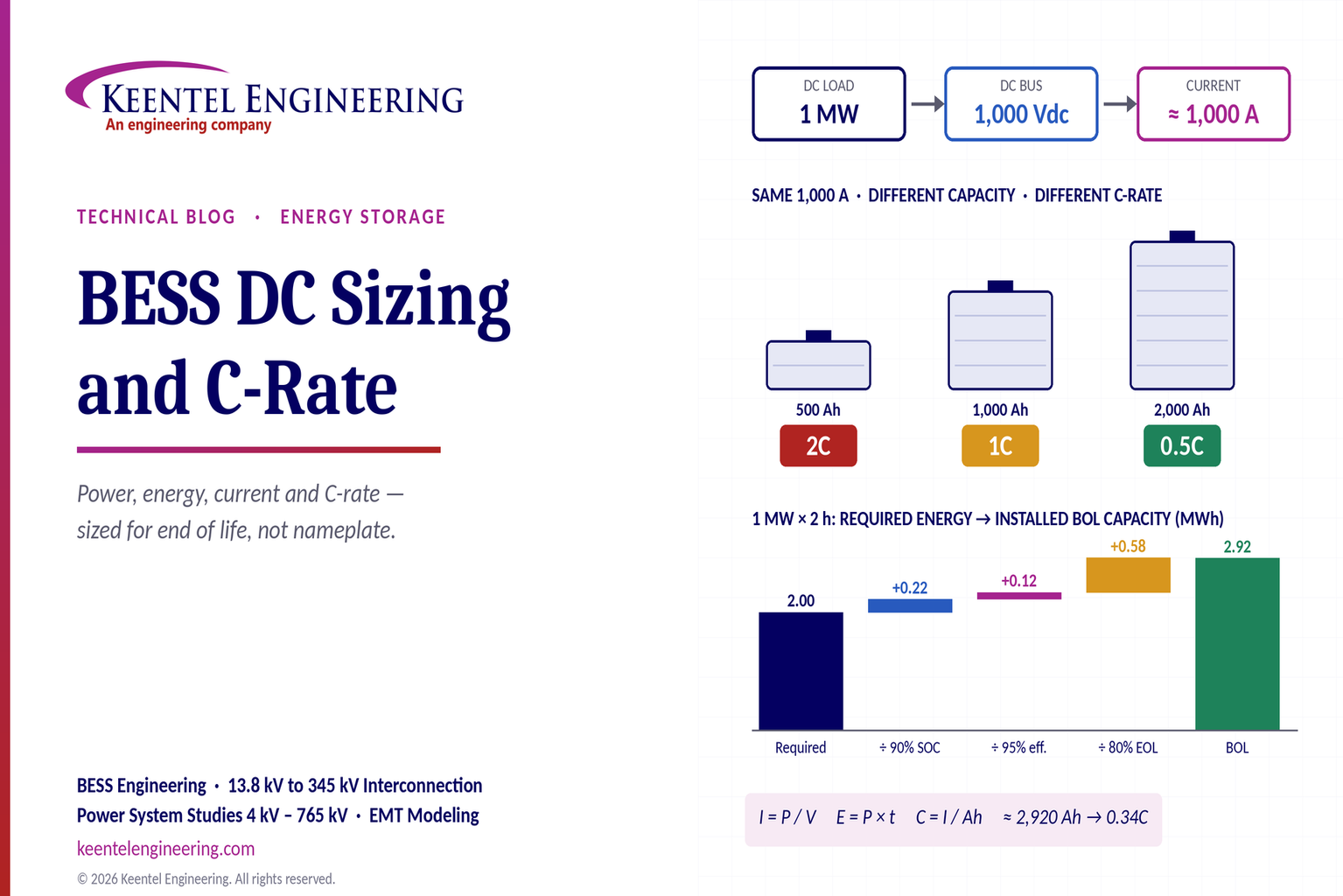
Learn BESS DC sizing with power, energy, current and C-rate calculations, battery losses, degradation and a 100 MW/400 MWh utility-scale example.
By SANDIP R PATEL
•
October 10, 2026
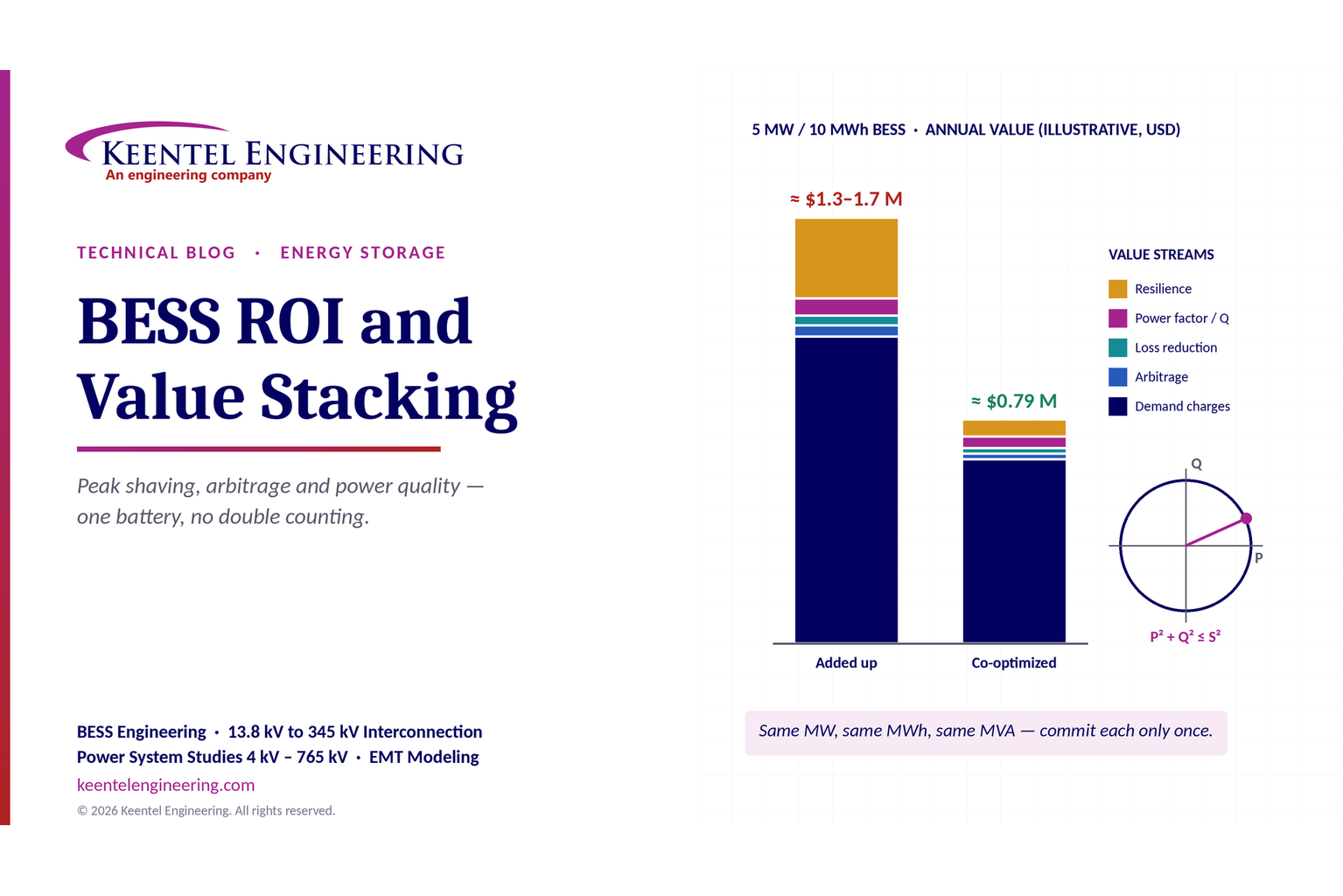
Learn how BESS ROI is calculated using peak shaving, energy arbitrage, power quality and battery storage economics, with a practical 5 MW/10 MWh example.
By SANDIP R PATEL
•
October 10, 2026
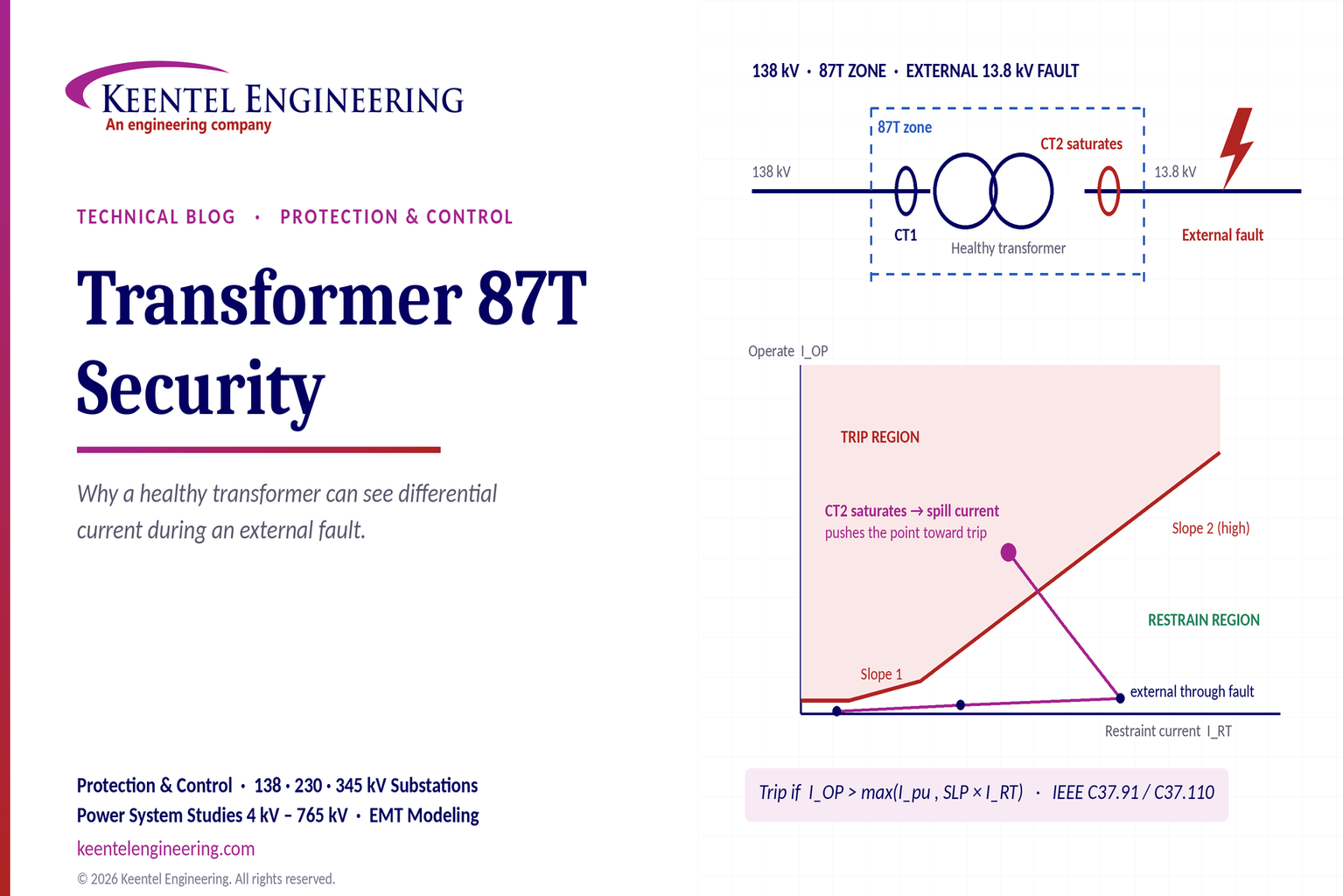
Learn why transformer differential relays detect current during external faults, how CT saturation causes spill current, and how secure 87T protection prevents trips.
By SANDIP R PATEL
•
October 10, 2026
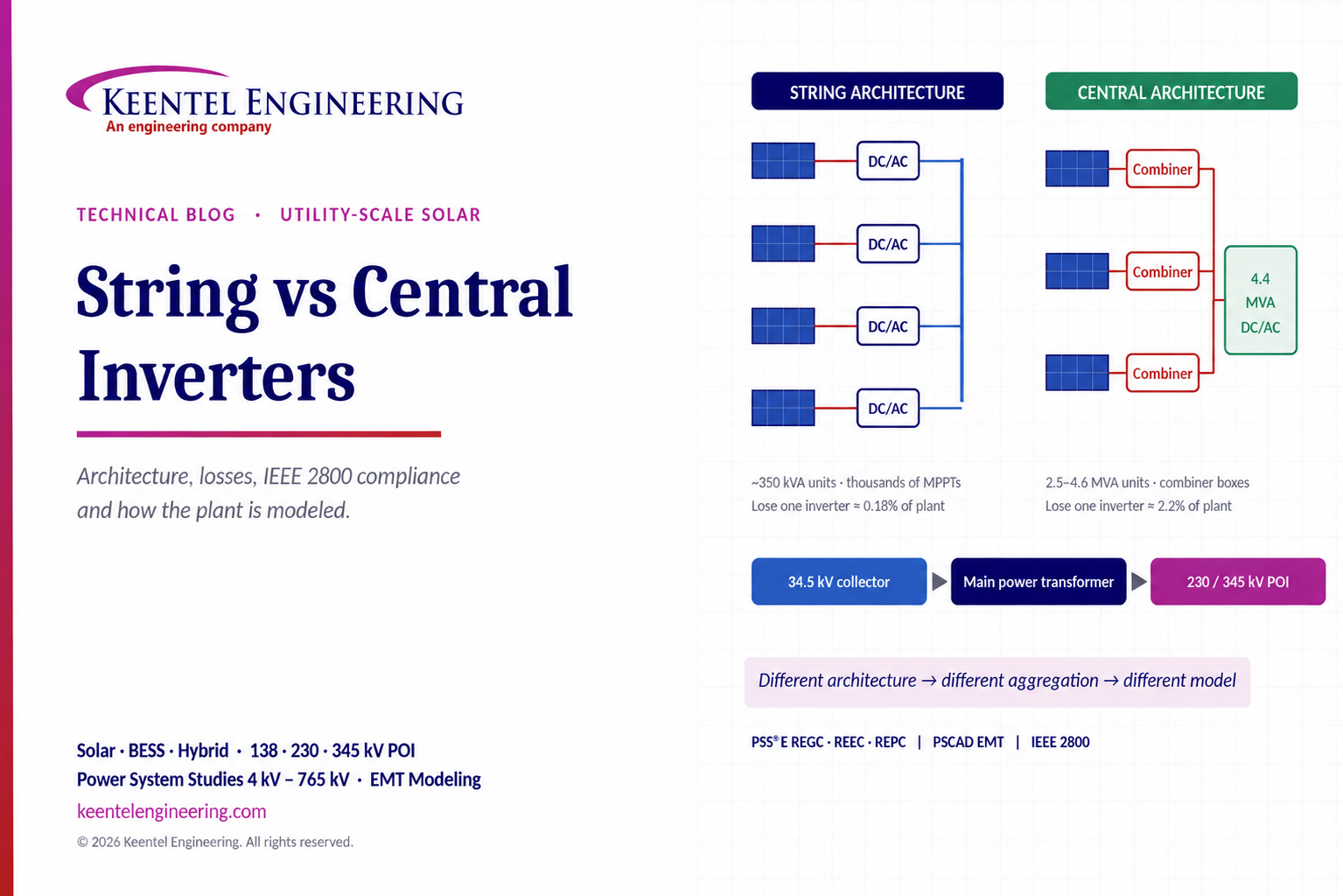
Compare string vs central inverters for utility-scale solar, including efficiency, maintenance, grid compliance, reactive power and interconnection studies.