A Coordinated Electric System Interconnection Review—the utility’s deep-dive on technical and cost impacts of your project.
Challenge: Frequent false tripping using conventional electromechanical relays
Solution: SEL-487E integration with multi-terminal differential protection and dynamic inrush restraint
Result: 90% reduction in false trips, saving over $250,000 in downtime
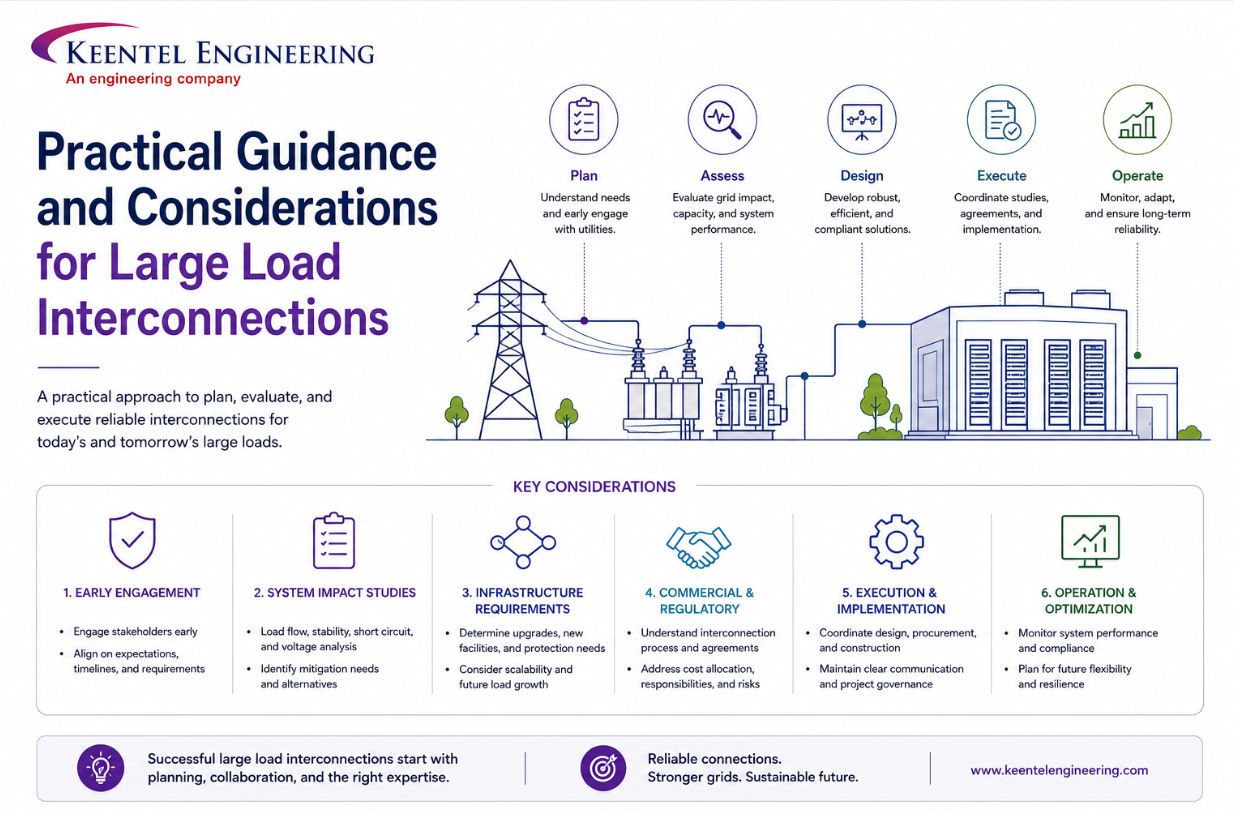
Practical Guidance and Considerations for Large Load Interconnections
May 30, 2026 | Blog
Quick Navigation
Introduction
The power grid is entering a period of transformation unlike anything seen in decades. After years of flat or even negative load growth, utilities across North America are suddenly facing large load interconnection requests measured not in megawatts but in hundreds and even thousands of megawatts per facility. Data centers — driven by the global expansion of cloud computing, artificial intelligence, and large language models — are the dominant driver of this shift, but they are far from the only one. This article lays out the key considerations our team applies when supporting utilities, developers, and regulators navigating this new landscape.
Why Large Loads Are Different
The grid has always accommodated industrial customers — arc furnaces, manufacturing plants, refineries, and mining operations. So why are today's large loads creating unprecedented engineering challenges?
Scale. Gigawatt-class campuses, once unheard of, are now appearing regularly in interconnection queues. In some regional analyses, data centers alone represent 80 percent or more of large load interconnection demand by capacity.
Speed. A modern data center can be designed and built in roughly two years, sometimes faster. Transmission infrastructure, generation, and substation expansion — by contrast — can take five to ten years once planning, permitting, and approval timelines are accounted for. This timing mismatch is now one of the central tensions in grid planning.
Load characteristics. Modern data centers are dominated by power electronic equipment — variable frequency drives, uninterruptible power supplies, rectifiers, and switching converters. Recent analysis suggests that 80 percent or more of a typical data center's load is power-electronic in nature. The dynamic behavior of these loads is fundamentally different from the motor-dominated industrial loads of the past. That distinction matters most when it comes to stability analysis and the studies required for safe integration.
Confidentiality. Unlike traditional industrial customers, hyperscale operators treat the internal architecture of their facilities as proprietary. This creates real friction in the interconnection process, where transmission planners need detailed equipment data to run meaningful power system studies.
→
Related: Large Load Interconnection Engineering for Data Centers — how Keentel Engineering supports utilities and developers through each phase of the large load interconnection process, from feasibility through post-energization monitoring.
Emerging Reliability Concerns
Two large load disconnection events in a major Mid-Atlantic region brought these issues into sharp focus. In one incident, approximately 1,500 MW of data center load tripped offline in response to a grid fault — even though the protection and control system performed exactly as designed. A subsequent event saw roughly 1,800 MW disconnect under similar conditions. In both cases, the trips occurred because of protection settings inside the customer facilities — voltage thresholds, UPS trip points, and timer settings — that the host utility had limited visibility into beforehand.
These events are leading indicators of a broader category of risks that large load interconnections can introduce:
- Ride-through performance failures, where loads trip offline in response to normal grid disturbances they should be able to withstand
- Voltage and frequency stability impacts from rapid, large-magnitude load swings
- Power quality concerns, including harmonics, flicker, and transient events caused by fast-switching power electronics
- Subsynchronous oscillations and torsional interactions with nearby synchronous generation
- Millisecond-scale load ramping — sub-second variations that can stress system controls and protection coordination
- Protection coordination challenges between utility-side and customer-side equipment
Public data curves from operating data centers show load variations of 5 to 10 MW occurring at sub-second timescales, with occasional drops from 30 MW to 5 MW and back within seconds. This stochastic behavior, multiplied across many facilities, introduces operational uncertainty that current planning and operating practices were never designed to handle.
Key Takeaway
The goal of post-interconnection monitoring is to identify a 20 MW anomaly before it escalates to an 1,800 MW event. That requires data sharing agreements, real-time telemetry, and a continuous feedback loop between operations and engineering — not a one-time interconnection study.
Rethinking the Interconnection Process
The generator interconnection process has evolved significantly over the past two decades, particularly in response to the rapid growth of inverter-based resources. The large load side, by comparison, often lacks the same level of standardization, transparency, and rigor. Many utilities still administer load interconnections through serial, non-transparent processes with limited published data and inconsistent requirements across customers.
A robust large load interconnection framework should include the following elements.
1. Safeguarding Existing Customers
Before any new large load is brought online, the host utility and regulator must ensure that existing customers are not disadvantaged. This means careful attention to tariff design, cost allocation, and rate structure. Tools to consider include customer-paid interconnection and network upgrade costs, financial guarantees and application fees, exit penalties and minimum demand charges, demand ratchets tied to ramp-up schedules, and minimum load factor requirements.
2. Raising the Barrier to Entry
When the cost of submitting an application is low, speculative requests flood the queue and make it difficult for credible developers to get timely study results. A higher, more thoughtful barrier — financial, technical, and commercial — filters out projects that are unlikely to be built. The generation side has been moving in this direction for years. The load side can benefit from the same lesson.
3. A Transparent and Streamlined Process
A modern large load interconnection process should mirror the structure of generator interconnection: application, initial screens, feasibility study, system impact study (potentially clustered), facility study, interconnection agreement, construction, commissioning, and post-interconnection monitoring. Each phase needs clear timelines, documented deliverables, and consistent treatment across all customers.
4. Technical Requirements
Until recently, very few US jurisdictions had formal technical requirements for large loads — a stark contrast to European practice, where grid codes have imposed structured requirements on large load customers for over a decade. Requirements should address, at minimum: ride-through behavior under voltage and frequency excursions, reactive power and voltage response, power quality limits, protection coordination, monitoring and data sharing obligations, and load ramping characteristics. Without a coordinated regulatory framework, utilities that impose strong requirements risk losing development to neighboring jurisdictions with weaker standards — a dynamic that pushes everyone toward the lowest common denominator.
5. Quality Models and Studies
Sound decisions depend on sound models. For large load interconnections, that means a layered study approach scaled to the size and grid impact of the facility:
- Power flow studies to identify thermal overloads, congestion, and voltage problems driving network upgrade needs
- Positive-sequence transient stability studies for ride-through, voltage stability, and electromechanical oscillations
- Electromagnetic transient (EMT) studies for power electronic interactions, controller dynamics, phase-locked loop behavior, and subsynchronous phenomena
- Short circuit studies for breaker duty and protection coordination, especially where co-located or behind-the-meter generation is present
A 50 MW standalone load may not justify full EMT analysis. A gigawatt-scale AI campus sited near a large inverter-based resource almost certainly does.
→
Related: EMT Modeling for Data Centers and AI Grid Stability — a deep dive into when and why electromagnetic transient studies are required for large load interconnections, and what the study process looks like in practice.
6. Post-Interconnection Monitoring
Once a facility is energized, the engineering work is not finished. Operational monitoring is essential for catching performance issues before they escalate into system events. This requires defined data sharing agreements, continuous telemetry, and a feedback loop between the customer's operations team and the utility's planning and protection functions.
The Modeling Challenge
A modern data center is not a simple lumped load. It contains power distribution units, cooling systems (increasingly served by variable frequency drives), lighting, UPS systems, backup generation, filters, and increasingly advanced devices such as behind-the-meter battery energy storage and e-STATCOMs used to smooth load variability for AI training workloads.
Representing this internal complexity in grid models is non-trivial. The level of detail required scales with the size and grid impact of the facility. Critically, much of the data needed to build accurate models — equipment specifications, control settings, protection setpoints — resides with the customer or the original equipment manufacturer. Establishing data sharing protocols with appropriate confidentiality protections is therefore a prerequisite to good modeling, not an afterthought.
The same modeling discipline that the industry has applied to inverter-based generation over the past decade now needs to extend to large loads. Protection settings, ramp characteristics, and ride-through behavior all need to be documented, verified, and kept current as equipment and firmware evolve — exactly the approach that Keentel Engineering's power system studies practice applies across generation, transmission, and now large load interconnections.
Mitigation Technologies
Several technologies are emerging or maturing to help integrate large loads more gracefully into the bulk power system.
E-STATCOMs — energy-augmented static synchronous compensators — combine traditional reactive power support with a small energy buffer behind the power electronics. This allows real power injection on millisecond timescales, enough to smooth out the fastest load variations even though they cannot sustain large injections for long. For AI training workloads that cycle rapidly, this capability addresses a grid reliability concern that conventional reactive compensation cannot.
Behind-the-meter battery energy storage can shave peak demand, provide ride-through support during grid disturbances, and enable flexible operation of the underlying compute or industrial load. As battery costs continue to fall, co-located storage is becoming a standard design element for large load interconnections rather than an optional add-on.
Grid-forming inverters and integrated energy parks — combining generation, storage, and load behind a coordinated control system — are increasingly being considered for the largest facilities, particularly where transmission capacity is constrained or reliability requirements are high.
Load flexibility itself is a powerful tool. Most transmission capacity is unused most of the time; the binding constraint is peak conditions. A load that can shift, curtail, or back off during those hours can often be accommodated using existing capacity that a firm, inflexible load could not. The technology to enable this is generally mature. The regulatory and commercial structures to support it are still evolving.
The Regulatory Question
A recurring question in this space is: who has the authority to impose technical requirements on large load customers?
Under current frameworks, transmission providers can establish interconnection requirements for any entity connecting to their system. Historically, those requirements have focused on generation. There is nothing preventing utilities and ISO/RTOs from extending similar requirements to large loads today — but doing so on a utility-by-utility basis produces inconsistent rules across regions and creates the race-to-the-bottom dynamic mentioned earlier.
A more uniform approach would benefit from action at the federal level. Reliability organizations face an additional barrier: their standards apply to registered entities, and there is currently no registration classification for large load customers. Until that gap is closed, even well-crafted reliability standards cannot be enforced against the facilities they are intended to govern.
The direction of travel across multiple industry forums and regulatory bodies is clear. The pace remains uneven. In the meantime, utilities acting under existing authority — by publishing clear technical requirements, requiring meaningful data from applicants, and enforcing ride-through and power quality standards at the interconnection agreement stage — can move faster than the federal process without waiting for it.
Closing Perspective
The growth of large loads represents one of the most significant engineering challenges the power industry has faced in a generation. The path forward is not to slow the build — demand for data, computation, and electrification is not going to wait. The path forward is to raise the engineering and regulatory bar so that speed and reliability are not in conflict.
Frequently Asked Questions
Why are data centers treated differently than other large industrial loads?
Modern data centers introduce a combination of characteristics that older industrial loads did not. They are larger in scale — hundreds to thousands of megawatts per site — dominated by power electronic equipment rather than rotating machinery, capable of ramping at millisecond timescales, and operated by entities that treat internal facility design as proprietary. That combination changes both the technical studies required for safe interconnection and the data-sharing practices needed to execute those studies accurately.
What caused the recent large data center disconnection events?
In both publicly documented events, a normal grid fault occurred and the utility's protection and control systems operated exactly as designed. The unexpected outcome was that hundreds of megawatts of data center load tripped offline — driven by protection settings inside the customer facilities, such as UPS trip points, voltage thresholds, and timer settings, that the host utility had limited visibility into beforehand. The lesson is not that equipment failed, but that the absence of shared technical information between utility and customer created an unknown operating state that produced a system impact far larger than anticipated.
Is stricter interconnection requirements slowing data center development?
The available evidence suggests it is not. Jurisdictions that have meaningfully tightened their large load interconnection processes and technical requirements continue to attract significant data center development. The underlying demand for compute, cloud services, and AI infrastructure is strong enough that reasonable engineering and commercial requirements appear to be absorbed rather than diverting projects to regions with weaker standards.
Who has the authority to set technical requirements for large loads?
Transmission providers can establish interconnection requirements for any entity connecting to their system, and that authority extends to large loads today. The challenge is uniformity: one-off utility requirements produce inconsistent rules across regions. Federal action would provide a more level framework. Reliability organizations face an additional barrier — their standards apply to registered entities, and there is currently no registration classification for large load customers, meaning even a well-crafted reliability standard cannot yet be directly enforced against these facilities.
What is load flexibility, and why does it matter for grid reliability?
Load flexibility refers to a customer's ability to shift, reduce, or curtail consumption during certain hours. Most transmission capacity is unused most of the time — the binding constraint is peak conditions lasting a few hours per year. A flexible large load that can back down during those hours, by dispatching behind-the-meter storage, shifting compute workloads to other sites, or curtailing non-critical operations, can often be served by existing transmission capacity that a firm, inflexible load of the same size could not. The enabling technology is generally mature. The regulatory and commercial structures to support flexibility as a grid service are still developing.
What is an e-STATCOM and why is it relevant to large load interconnections?
An e-STATCOM is a static synchronous compensator with a small energy storage buffer behind its power electronics. A traditional STATCOM provides reactive power support only. The energy buffer lets an e-STATCOM also inject real power on millisecond timescales, making it well suited to smoothing the fast load variations seen in AI training workloads and other rapidly cycling data center operations. It is not a substitute for bulk energy storage, but it meaningfully reduces the high-frequency ramping-related stress that large loads can impose on surrounding transmission and generation.
What kinds of studies are required for a large load interconnection?
The right study set scales with the size and grid impact of the facility. At minimum, power flow studies identify thermal, congestion, and voltage problems and the network upgrades needed to address them. Positive-sequence transient stability studies cover ride-through, voltage stability, and electromechanical oscillations. Electromagnetic transient (EMT) studies become important for large facilities, especially those sited near significant inverter-based resources, because they capture power electronic interactions and subsynchronous phenomena that positive-sequence models cannot represent. Short circuit studies cover breaker duty and protection coordination, particularly where co-located or behind-the-meter generation is present.
How can confidentiality concerns be balanced with the need for technical data sharing?
Customer architecture, equipment selection, and control strategies are genuine competitive information. At the same time, transmission planners need detailed equipment and control data to run the studies that protect both the customer and the wider grid. The workable path is structured data sharing under confidentiality agreements, with information protected to the same level as other critical infrastructure data the industry already handles routinely. Establishing those agreements at the application stage — rather than after an incident — avoids the situation where critical protection and ride-through data is exchanged only after a disconnection event has already occurred.
What should a utility do first when it starts receiving large load interconnection requests?
Three priorities tend to deliver the most value early. First, raise the barrier to entry with application fees, financial guarantees, and credible commercial milestones to filter speculative requests and protect study resources for viable projects. Second, publish a clear, transparent interconnection process so customers understand what is expected at each stage. Third, define the technical data the utility will require from customers — protection settings, ride-through behavior, ramp characteristics, equipment specifications — and require it as part of the initial application rather than after energization. These steps can be implemented under existing utility authority without waiting for federal regulatory action.
Need Engineering Support for Large Load Interconnections?
Large load interconnection projects require more than a standard utility application. They need clear technical requirements, accurate modeling, power flow studies, EMT analysis, protection review, and post-interconnection monitoring to reduce reliability risk.
Keentel Engineering supports utilities, developers, data center operators, and regulators with large load interconnection planning, technical study development, mitigation strategies, and grid reliability engineering.
Whether you are evaluating a new data center campus, reviewing customer-side protection settings, or preparing interconnection study requirements, our team can help you move forward with a structured, defensible engineering approach.

About the Author:
Sandip "Sonny" R. Patel, P.E.
IEEE Senior Member · Founder & CEO, Keentel Engineering
In 1995, Sonny Patel earned his Electrical Engineering degree from the University of Illinois. But degrees don't build legacies — action does.
For three decades, he has worked the power industry from every side of the table: 16 years as a utility engineer at Exelon/Commonwealth Edison; generation leadership across hydroelectric, industrial steam turbine, and a 9 GW renewable fleet; NERC Regional Entity Senior Compliance Engineer and Audit Team Lead, auditing some of the nation's largest utilities; and testing and commissioning lead on equipment up to 765 kV — the very top of the North American grid.Utility. Generator. Regulator. Consultant. Few engineers have seen all four seats. Fewer still have sat in them.
His experience spans nuclear, hydro, conventional generation, renewables, oil and gas, mining — and today's data centers, where he is authoring a three-book series on data center design. He is a Licensed Professional Engineer in six states and a Licensed Electrical Contractor in Florida (Unlimited EC) — he doesn't just design the work; he's qualified to stand behind its execution.Today, as Founder and CEO of Keentel Engineering, Sonny leads a nationwide team of engineers delivering substation design, power system studies, NERC compliance, and commissioning — done right, coast to coast.Three decades. Every side of the table. One standard: accountable engineering.
Services

Let's Discuss Your Project
Let's book a call to discuss your electrical engineering project that we can help you with.
About the Author:
Sandip "Sonny" R. Patel, P.E.
IEEE Senior Member · Founder & CEO, Keentel Engineering
In 1995, Sonny Patel earned his Electrical Engineering degree from the University of Illinois. But degrees don't build legacies — action does.
For three decades, he has worked the power industry from every side of the table: 16 years as a utility engineer at Exelon/Commonwealth Edison; generation leadership across hydroelectric, industrial steam turbine, and a 9 GW renewable fleet; NERC Regional Entity Senior Compliance Engineer and Audit Team Lead, auditing some of the nation's largest utilities; and testing and commissioning lead on equipment up to 765 kV — the very top of the North American grid.
Utility. Generator. Regulator. Consultant. Few engineers have seen all four seats. Fewer still have sat in them.
His experience spans nuclear, hydro, conventional generation, renewables, oil and gas, mining — and today's data centers, where he is authoring a three-book series on data center design. He is a Licensed Professional Engineer in six states and a Licensed Electrical Contractor in Florida (Unlimited EC) — he doesn't just design the work; he's qualified to stand behind its execution.
Today, as Founder and CEO of Keentel Engineering, Sonny leads a nationwide team of engineers delivering substation design, power system studies, NERC compliance, and commissioning — done right, coast to coast.Three decades. Every side of the table. One standard: accountable engineering.
Leave a Comment
Thank you for contacting us.
We will get back to you as soon as possible.
We will get back to you as soon as possible.
Oops, there was an error sending your message.
Please try again later.
Please try again later.
Related Posts
By SANDIP R PATEL
•
October 11, 2026
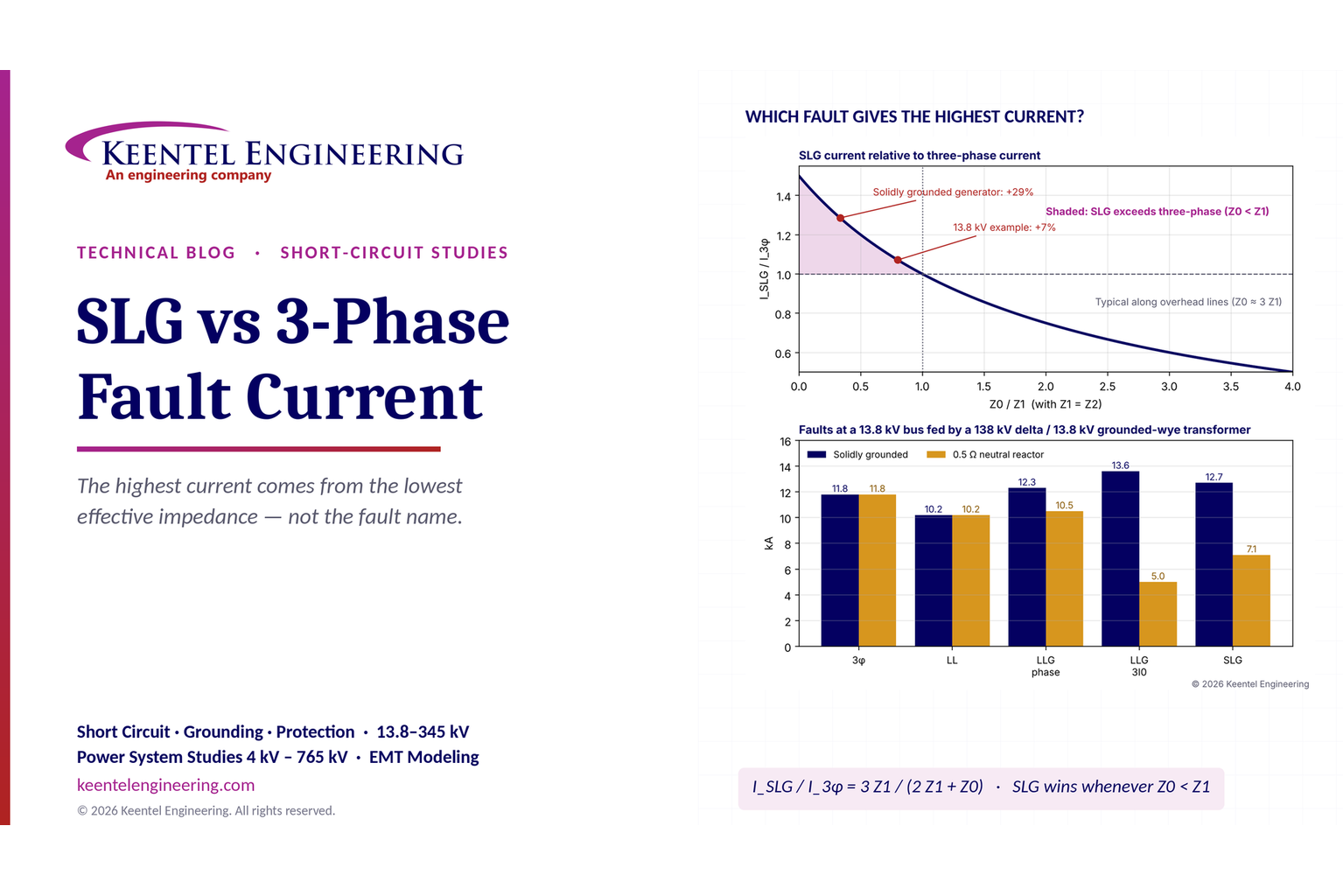
Learn which fault produces the highest current at a bus, why SLG faults can exceed three-phase faults, and how symmetrical components determine fault duty.
By SANDIP R PATEL
•
October 11, 2026
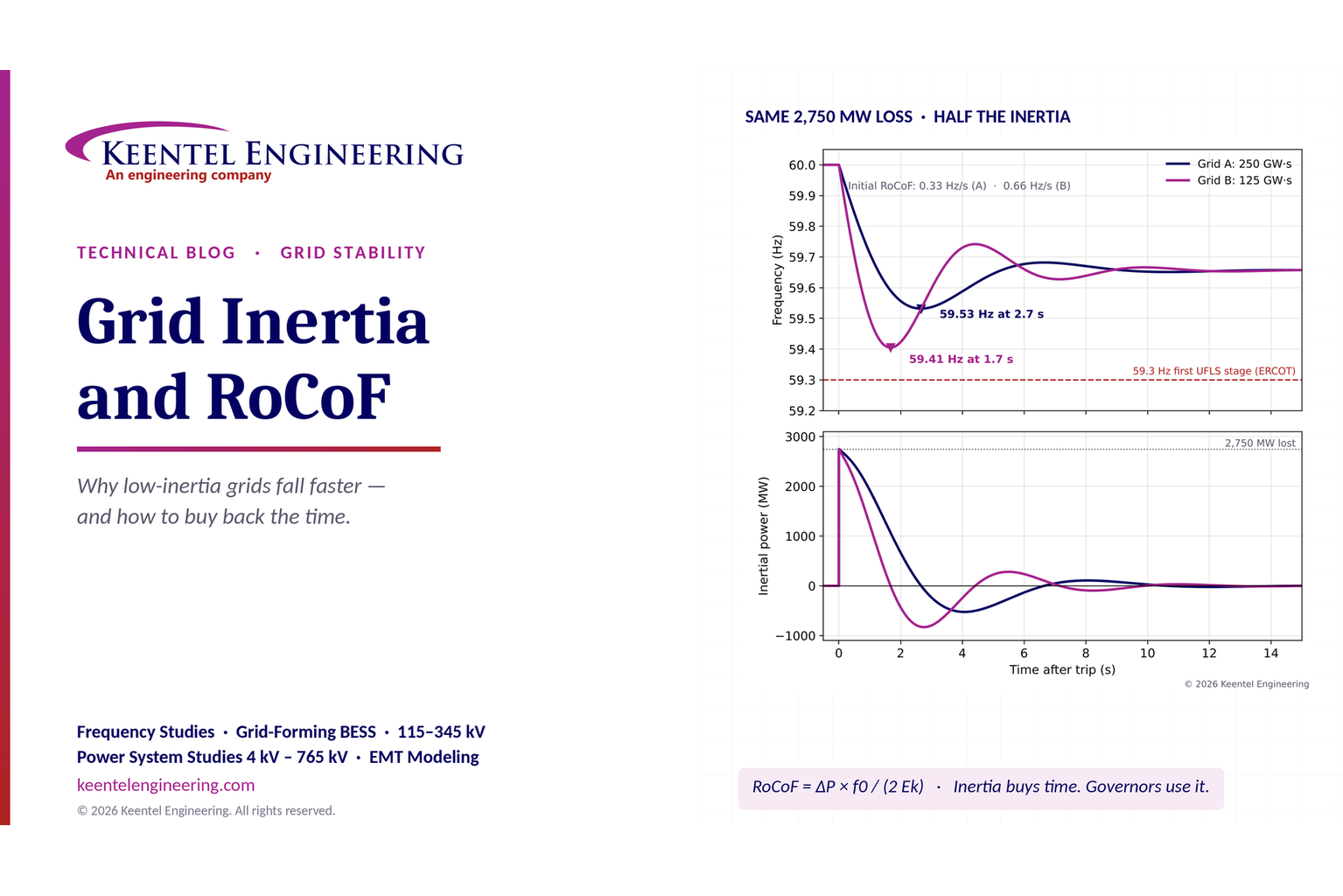
Explore grid inertia, RoCoF and frequency response, with swing equation calculations, frequency nadir analysis and US power system simulation examples.
By SANDIP R PATEL
•
October 11, 2026
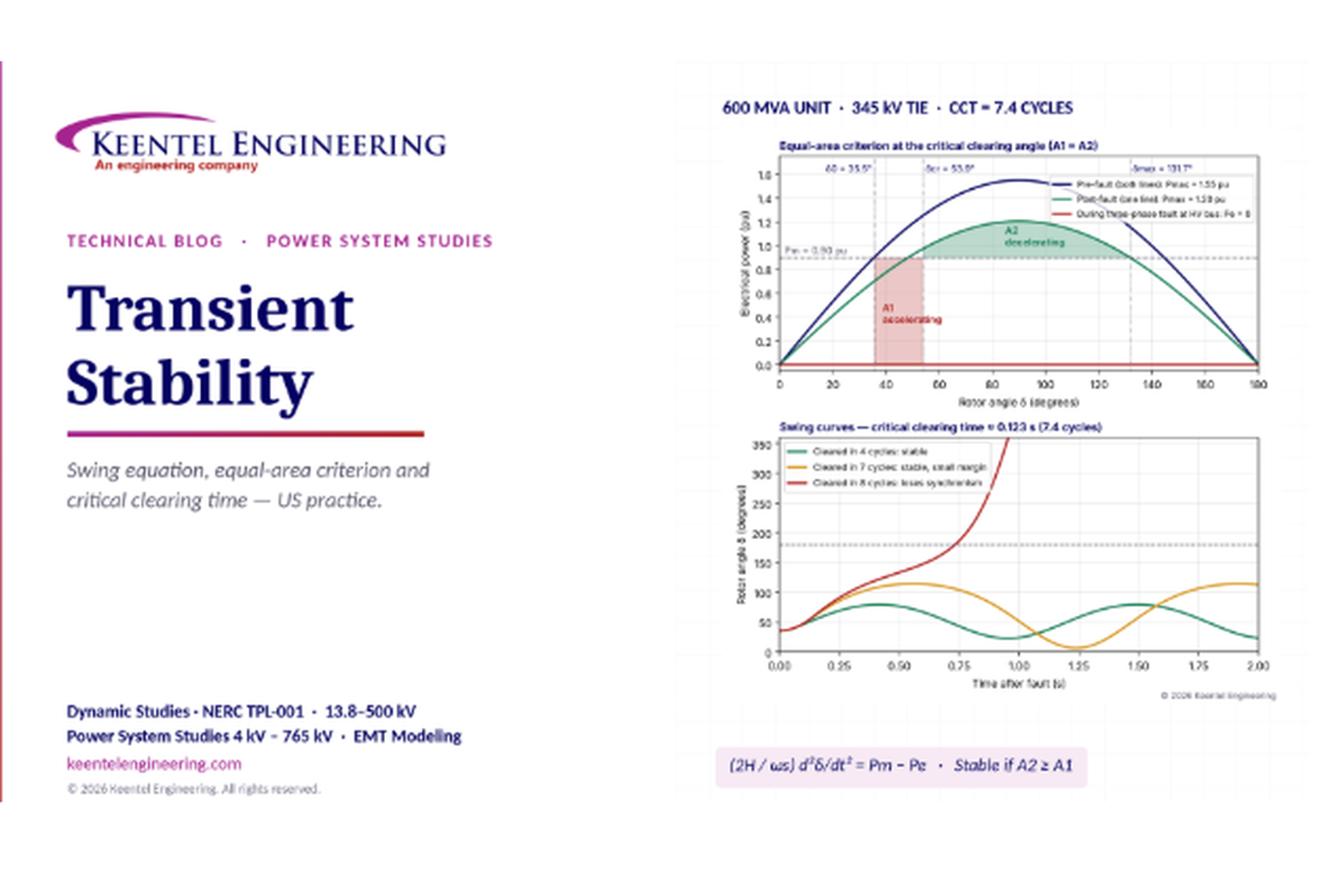
Learn transient stability analysis, swing equation, equal-area criterion and critical clearing time with a 345 kV worked example and NERC TPL-001 guidance.
By SANDIP R PATEL
•
October 11, 2026
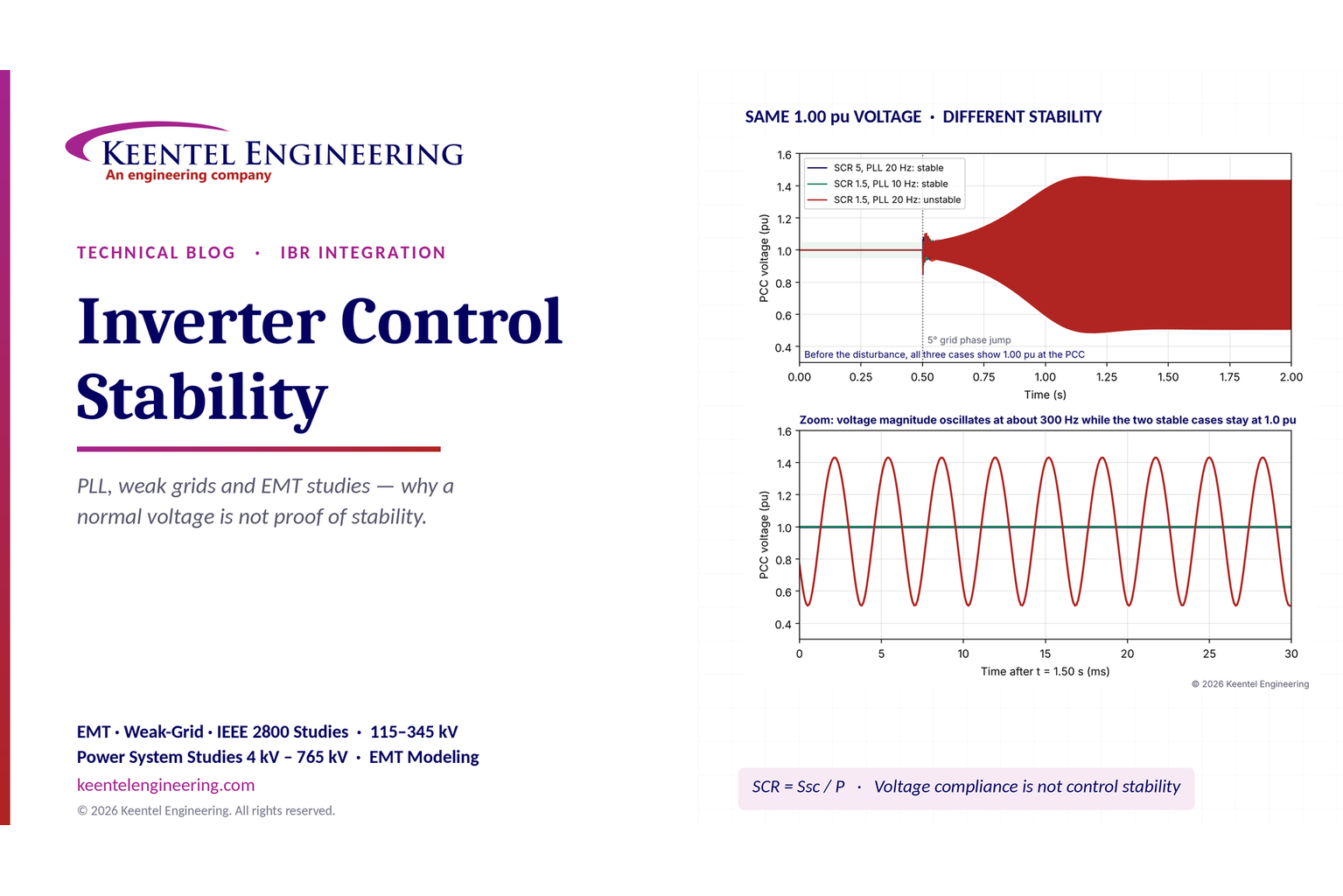
Learn why inverter controls become unstable in weak grids, how PLL bandwidth and SCR affect stability, and how PSCAD EMT studies identify and mitigate oscillations.
By SANDIP R PATEL
•
October 11, 2026
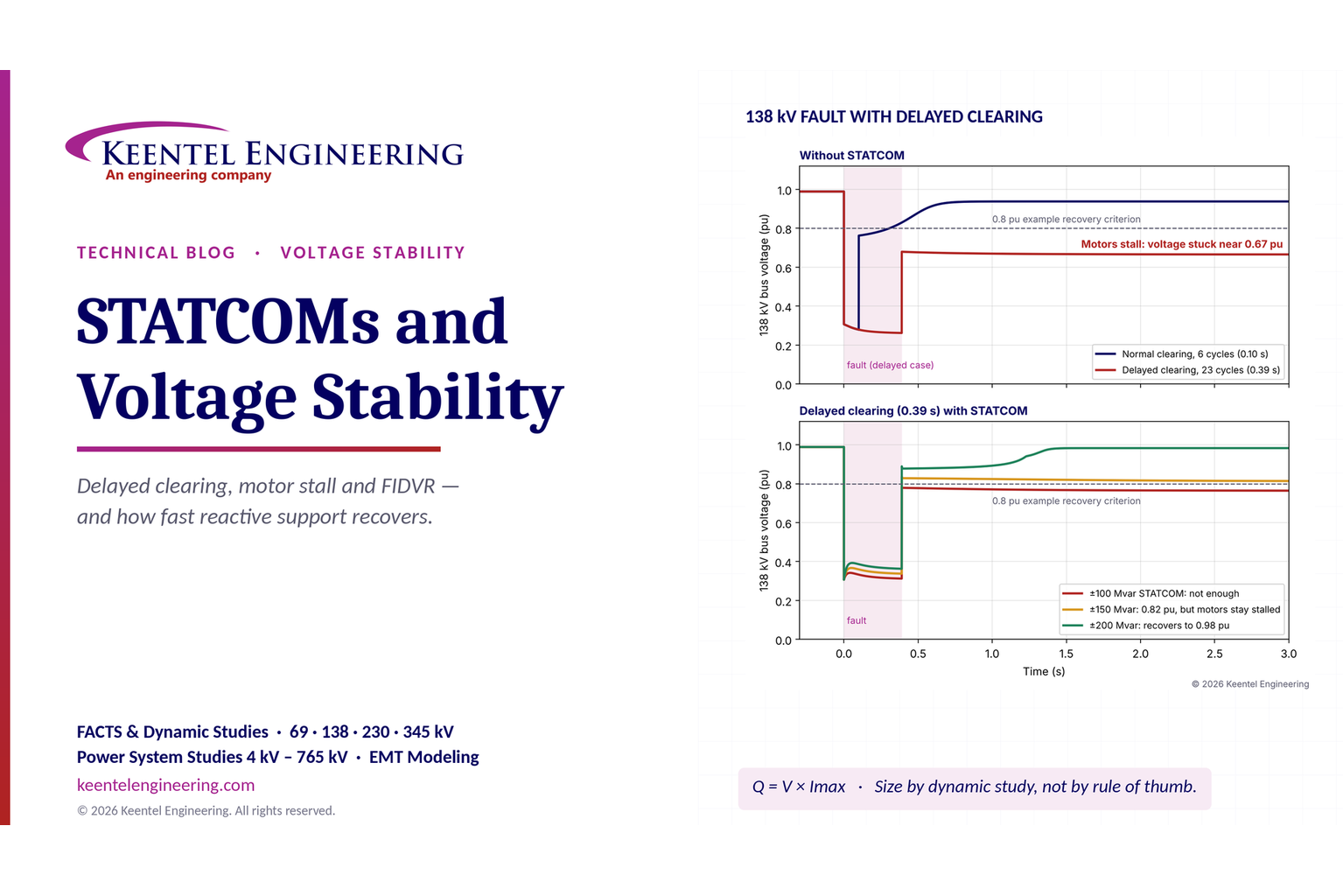
Learn how STATCOMs improve voltage stability and prevent FIDVR. Explore reactive power sizing, delayed fault clearing, NERC criteria and 138 kV simulation results.
By SANDIP R PATEL
•
October 10, 2026
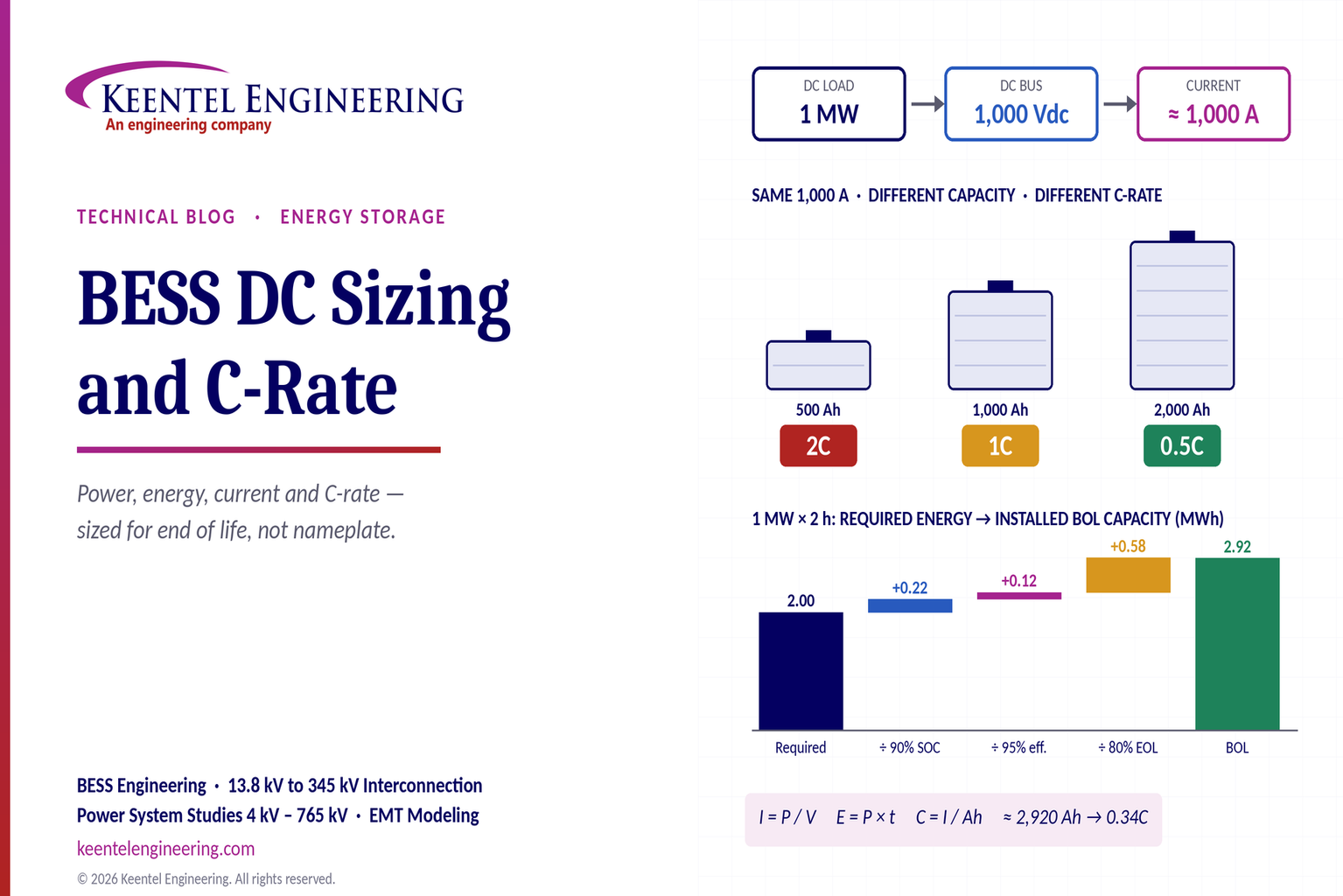
Learn BESS DC sizing with power, energy, current and C-rate calculations, battery losses, degradation and a 100 MW/400 MWh utility-scale example.
By SANDIP R PATEL
•
October 10, 2026
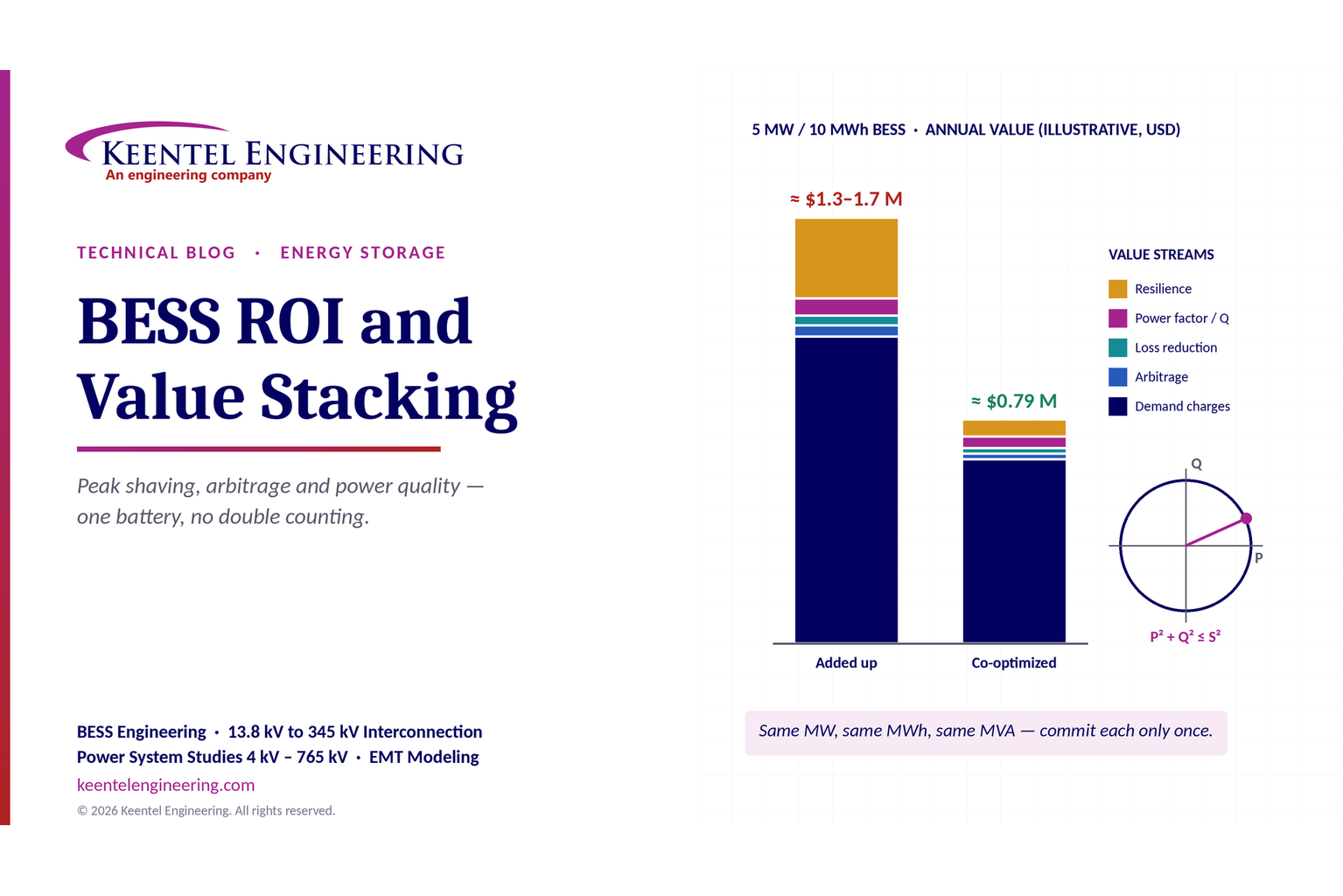
Learn how BESS ROI is calculated using peak shaving, energy arbitrage, power quality and battery storage economics, with a practical 5 MW/10 MWh example.
By SANDIP R PATEL
•
October 10, 2026
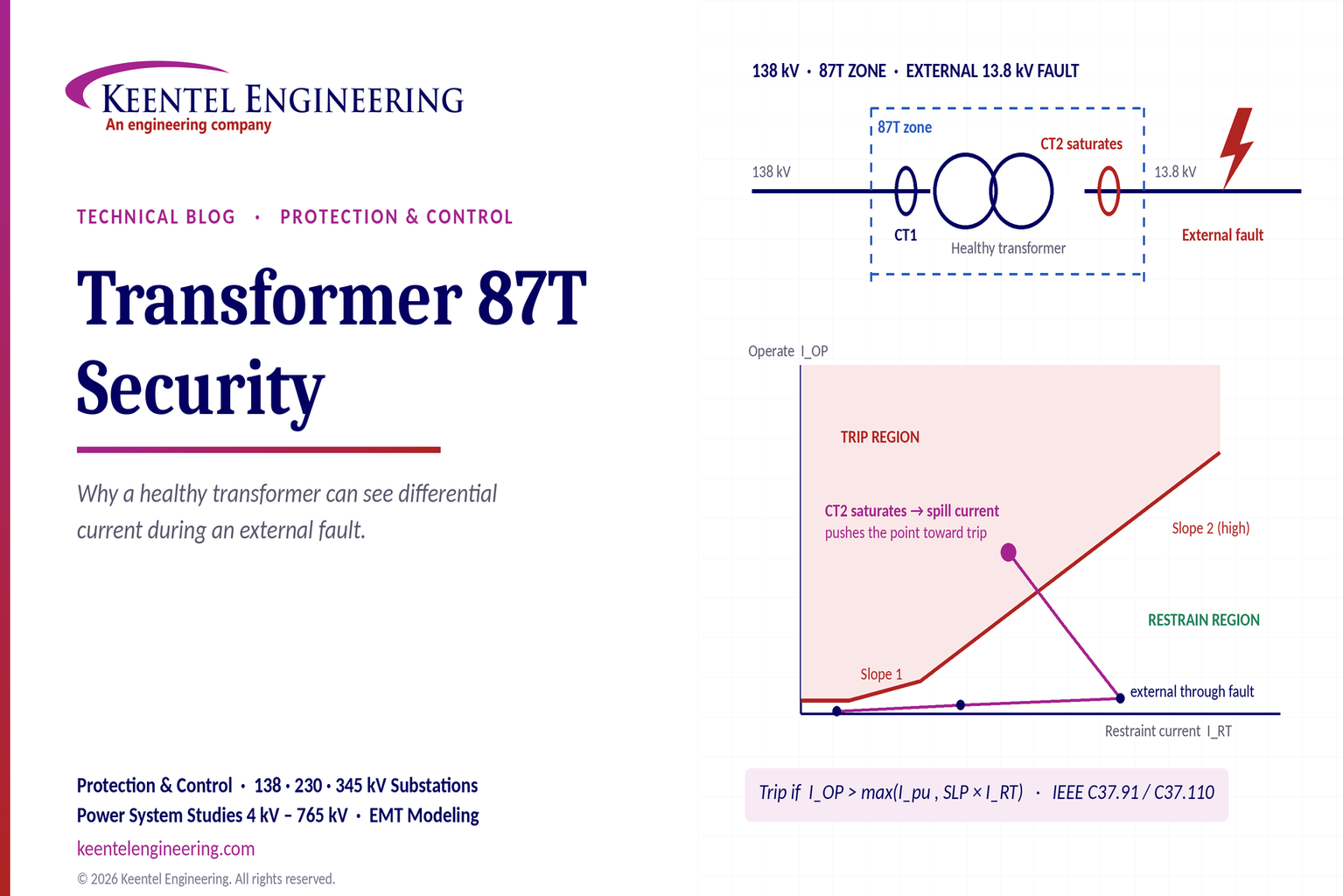
Learn why transformer differential relays detect current during external faults, how CT saturation causes spill current, and how secure 87T protection prevents trips.
By SANDIP R PATEL
•
October 10, 2026
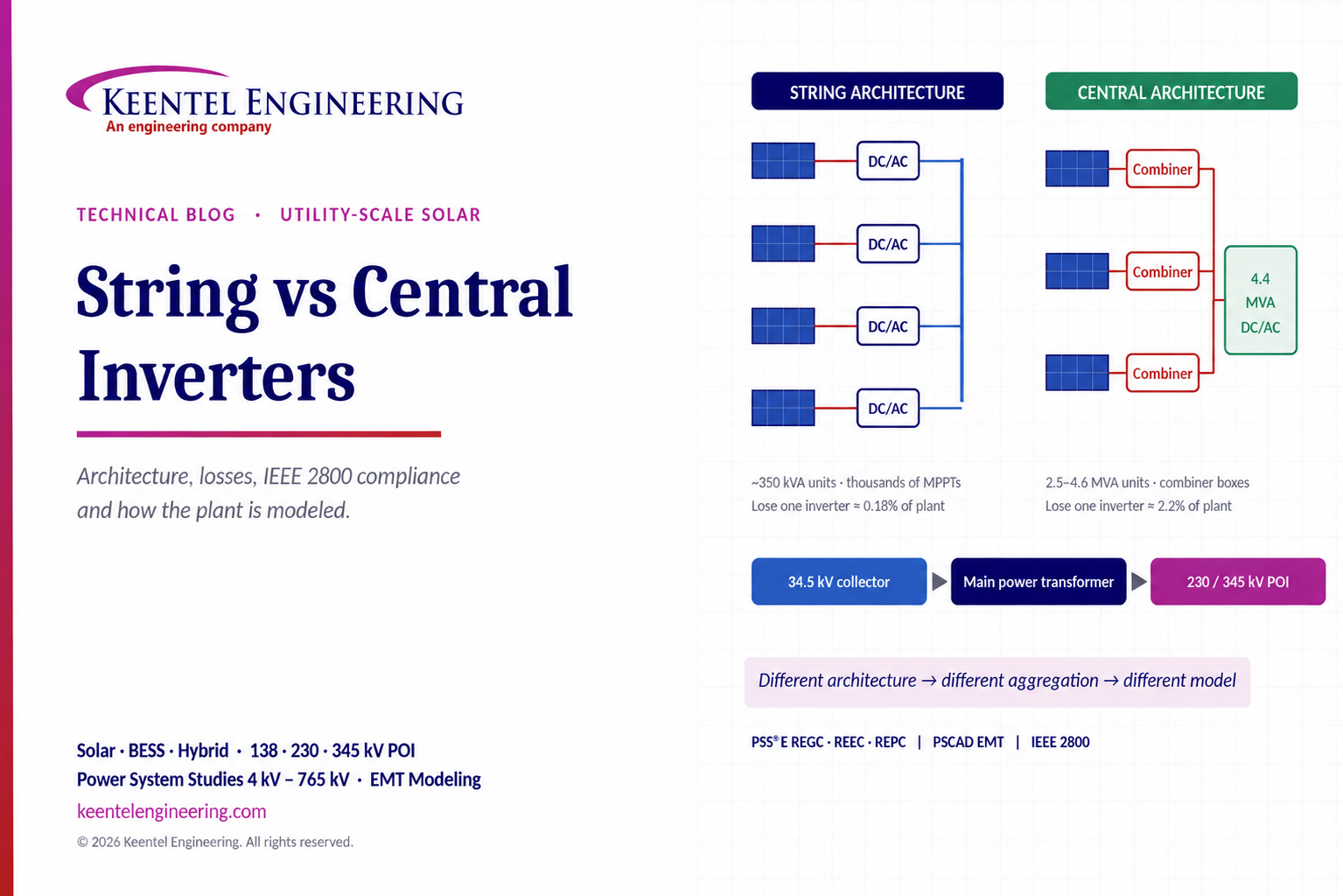
Compare string vs central inverters for utility-scale solar, including efficiency, maintenance, grid compliance, reactive power and interconnection studies.