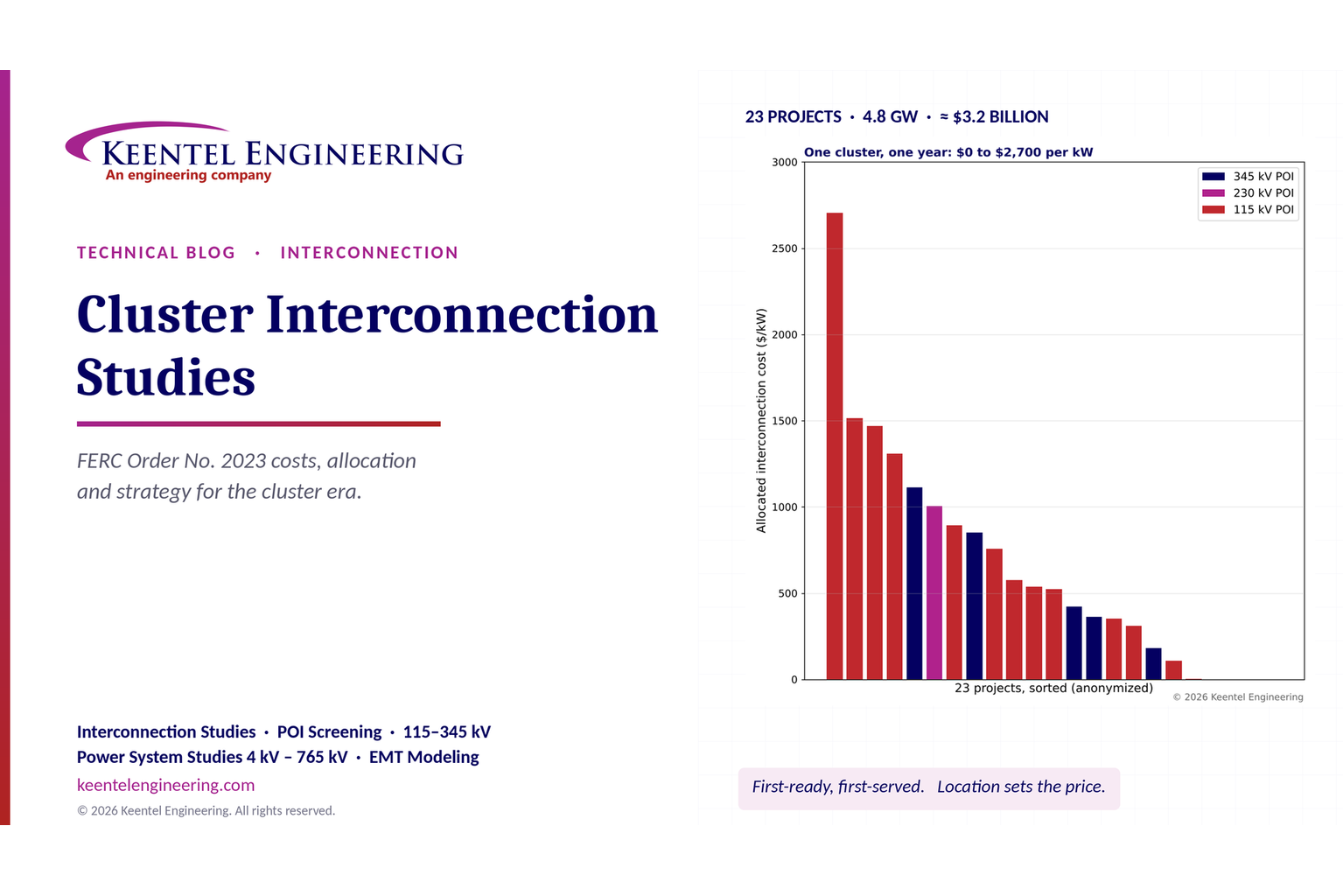


A Coordinated Electric System Interconnection Review—the utility’s deep-dive on technical and cost impacts of your project.

Challenge: Frequent false tripping using conventional electromechanical relays
Solution: SEL-487E integration with multi-terminal differential protection and dynamic inrush restraint
Result: 90% reduction in false trips, saving over $250,000 in downtime

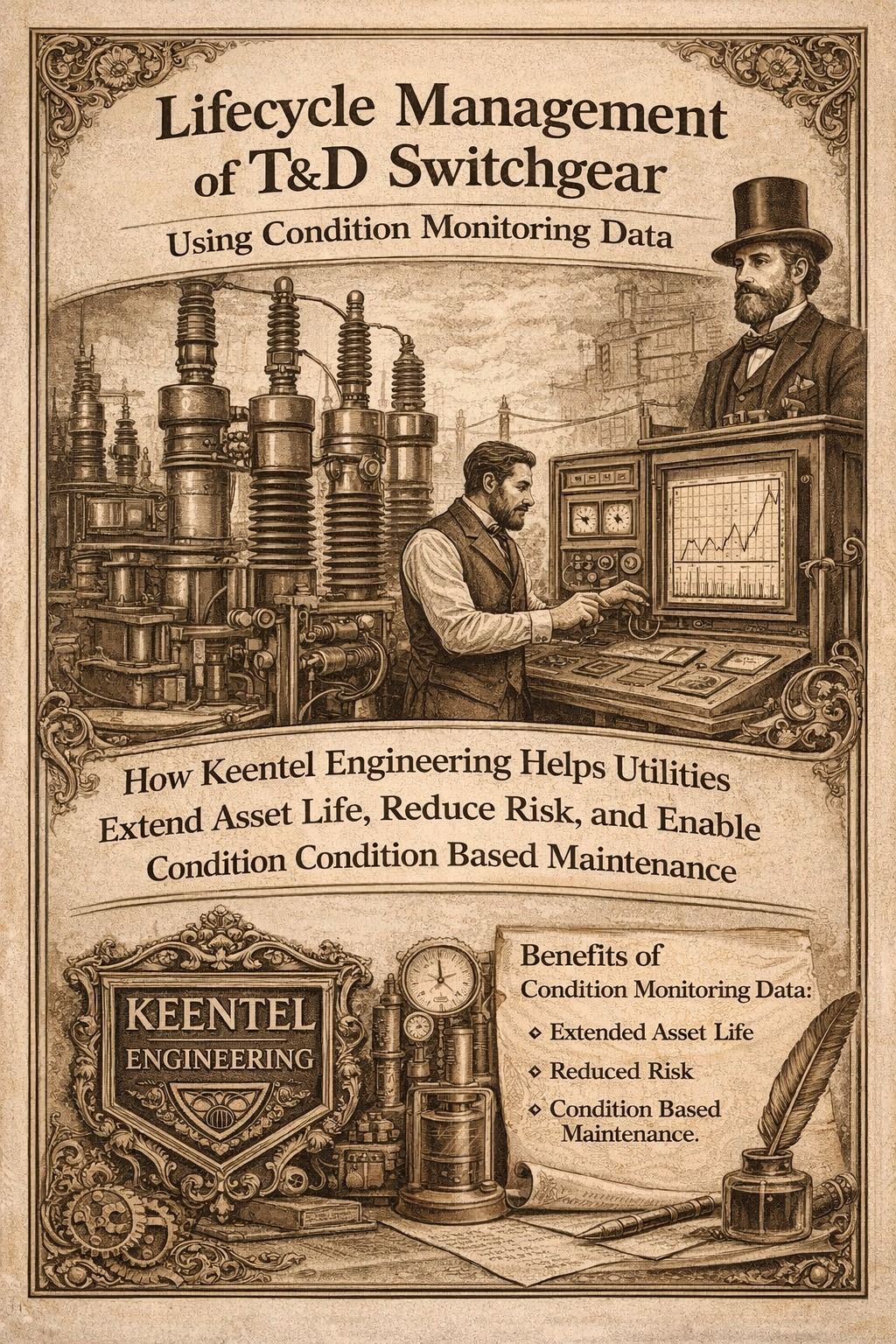
Lifecycle Management of T&D Switchgear Using Condition Monitoring Data

Lifecycle management of T&D switchgear using condition monitoring data, showing engineers analyzing substation equipment health to support condition-based maintenance.
Calendar icon. D

january 25, 2026 | Blog

How Keentel Engineering Helps Utilities Extend Asset Life, Reduce Risk, and Enable Condition-Based Maintenance

Transmission and Distribution (T&D) switchgear assets across North America and globally are aging while being subjected to increasing operational stress, higher fault duties, renewable interconnections, and evolving grid operating conditions. Historically, utilities relied on time-based maintenance and periodic inspections. While simple to administer, this approach often results in either unnecessary maintenance or, worse, unexpected in-service failures.

Modern utilities are rapidly transitioning toward condition-based maintenance (CBM) and risk-informed asset management, driven by online condition monitoring, advanced analytics, and standardized digital substation architectures. 

Keentel Engineering applies these industry-proven methodologies to help utilities, developers, and asset owners improve reliability, extend asset life, and optimize capital planning.


What Is Condition Monitoring for T&D Switchgear?

Condition monitoring is the continuous or periodic acquisition of physical measurements that reflect the health of switchgear components and functions. These measurements are converted into Condition Indicators (CIs), which are then evaluated against known degradation mechanisms to determine asset condition and risk.


Key Definitions


  • Condition Measurement: Measurement of a physical parameter related to asset health (e.g., current, pressure, temperature).
  • Condition Indicator (CI): A quantitative or qualitative indicator derived from one or more measurements.
  • Symptom: A CI exceeding defined thresholds, indicating degradation.
  • Asset Health Index (AHI): An aggregated representation of asset condition and likelihood of failure.


Unlike traditional diagnostics that focus on individual tests, condition monitoring integrates multiple data streams to provide a holistic, technology-independent view of switchgear health.


Switchgear Assets Covered

The lifecycle management framework applies to a wide range of substation assets, including:


  • High-voltage and medium-voltage circuit breakers
  • Reclosers and fault interrupters
  • Gas (SF₆ and alternative gases), vacuum, and oil technologies
  • Operating mechanisms, interrupters, and auxiliary/control circuits


Both transmission and distribution voltage classes are addressed, ensuring consistency across the entire substation asset portfolio.


From Raw Data to Actionable Condition Indicators

Physical Measurements

Modern switchgear monitoring systems collect a wide range of measurements, including:


  • Trip and close coil current and voltage
  • Contact travel and operating timing
  • Main current interruption and arcing time
  • Gas density, pressure, humidity, and purity
  • Temperature, infrared thermography, and vibration
  • Partial discharge activity


These measurements may be acquired continuously, periodically, or during switching operations.

Types of Condition Indicators

Directly Measured Indicators


  • Gas pressure or density
  • Cabinet temperature
  • Supply voltage


Calculated Indicators


  • Opening and closing time
  • Break time and arcing time
  • Gas leak rate


Profiles and Diagnostic Signatures


  • Coil current profiles
  • Contact travel curves
  • Vibro-acoustic signatures
  • Infrared and X-ray images


Condition indicators intentionally abstract away sensor and technology complexity, enabling standardized analysis across different breaker designs and manufacturers.


Degradation Mechanisms vs. Condition Indicators

Common Degradation Mechanisms

  • Mechanical wear and friction in operating mechanisms
  • Contact erosion and increased resistance
  • Dielectric degradation of insulating media
  • Gas leakage and contamination
  • Control and auxiliary circuit failures


Each degradation mechanism is correlated with condition indicators using ranked relationships (high, medium, low correlation). This enables:


  • Selection of the most effective indicators
  • Reduction of unnecessary sensors
  • Improved diagnostic confidence
  • Support for Failure Mode and Effects Analysis (FMEA)


Keentel Engineering uses this correlation framework to design optimized monitoring and assessment programs tailored to asset criticality and utility objectives.


Basic, Intermediate, and Advanced Monitoring Strategies

Basic Monitoring


Basic monitoring relies on data typically already available in breaker control cabinets:


  • Coil current and voltage
  • Auxiliary contact timing (52a/52b)
  • Cabinet temperature
  • Operation counters


This level provides strong insight into mechanical performance with minimal installation effort.


Intermediate Monitoring


Intermediate monitoring enhances diagnostics by adding:


  • Gas pressure and density trending
  • Main current monitoring
  • Static contact resistance


This level significantly improves detection of electrical wear, gas leakage, and insulation degradation.


Advanced Monitoring


Advanced monitoring provides the highest diagnostic accuracy and includes:


  • Contact travel and dynamic resistance measurement (DRM)
  • Partial discharge monitoring
  • Vibro-acoustic analysis
  • Infrared thermography and X-ray imaging


These methods are typically applied to critical assets or aging populations where life-extension decisions are required.


Asset Health Index for Switchgear

A critical insight reinforced is that asset age alone is not a reliable indicator of health. New assets may perform poorly, while older assets may remain in excellent condition.


The Asset Health Index (AHI) framework:


  • Aggregates condition indicators by failure mode
  • Preserves time-to-action urgency
  • Aligns with ISO 55000 asset management principles
  • Supports condition-based maintenance and replacement planning


Keentel Engineering develops switchgear-specific AHI models aligned with utility risk tolerance and regulatory expectations.


Digital Substations and IEC 61850 Integration

Condition monitoring must integrate seamlessly with modern digital substations. 


  • IEC 61850 logical nodes for switchgear monitoring
  • High-speed peer-to-peer communications (GOOSE, Sampled Values)
  • CIM for enterprise asset management
  • COMTRADE for disturbance and event analysis


Keentel Engineering ensures monitoring architectures are interoperable, scalable, and future-proof.


How Keentel Engineering Supports Switchgear Lifecycle Management

Keentel Engineering provides end-to-end services, including:


  • Switchgear condition monitoring strategy development
  • Monitoring system specification and sensor selection
  • Degradation mechanism and FMEA-based assessments
  • Asset Health Index modeling and analytics
  • IEC 61850 and digital substation integration
  • Life-extension, refurbishment, and replacement planning


Our approach is vendor-neutral, standards-based, and tailored to each client’s operational and regulatory environment.


Frequently Asked Questions (FAQ)

  • 1. What is condition-based maintenance for switchgear?

    Condition-based maintenance uses real-time and periodic condition indicators to determine when maintenance is required, rather than relying on fixed time intervals.

  • 2. Why is coil current analysis so important?

    Coil current profiles provide early insight into mechanical friction, plunger issues, and control circuit problems with minimal instrumentation.

  • 3. How does gas density trending improve reliability?

    Trending detects leaks well before alarm thresholds are reached, allowing planned maintenance instead of emergency outages.

  • 4. What causes unexpected switchgear failures?

    Incomplete diagnostics, unmonitored degradation mechanisms, extreme environmental stress, or incorrect data interpretation can all contribute.

  • 5. How is an Asset Health Index calculated?

    AHI aggregates multiple condition indicators by failure mode and assigns urgency-based scores rather than a single age-based value.

  • 6. Is age a reliable indicator of switchgear condition?

    discourages using age as a primary health metric.

  • 7. Which indicators best detect contact erosion?

    Cumulative interrupted current, dynamic resistance measurement, and arcing time are the most effective indicators.

  • 8. How does IEC 61850 support condition monitoring?

    IEC 61850 provides standardized logical nodes and data models for seamless integration with protection and control systems.

  • 9. Can monitoring reduce forced outages?

    Yes. Early detection of degradation allows corrective action before failure occurs.

  • 10. How many sensors are needed for effective monitoring?

    Using correlation analysis, utilities can minimize sensors while still capturing the most informative condition indicators.

  • 11. What is the difference between monitoring and diagnostics?

    Monitoring collects data; diagnostics interpret that data to identify degradation and failure modes.

  • 12. Are non-intrusive methods reliable?

    Yes. Most modern condition monitoring methods are non-intrusive and proven in service.

  • 13. When is advanced monitoring justified?

    Advanced monitoring is justified for critical assets, aging fleets, or when life-extension decisions are required.

  • 14. Can monitoring be retrofitted to existing substations?

    Yes. Most monitoring systems can be retrofitted with minimal outage impact.

  • 15. How does condition monitoring support regulatory compliance?

    It provides auditable, data-driven justification for maintenance, replacement, and capital planning decisions.

  • 16. What role does FMEA play in switchgear assessment?

    FMEA links condition indicators to failure modes, improving diagnostic accuracy and prioritization.

  • 17. Are alternative gases supported in monitoring programs?

    Yes. addresses SF₆ and alternative gas mixtures.

  • 18. How often should condition indicators be reviewed?

    Review frequency depends on asset criticality, operating duty, and observed degradation trends.

  • 19. Does condition monitoring replace inspections?

    No. It complements inspections by focusing them where risk is highest.

  • 20. How can Keentel Engineering help my utility?

    Keentel Engineering delivers standards-based, vendor-neutral lifecycle management solutions tailored to your assets and objectives.


Man in a blazer and open shirt, looking at the camera, against a blurred background.

About the Author:

Sonny Patel P.E. EC

IEEE Senior Member

In 1995, Sandip (Sonny) R. Patel earned his Electrical Engineering degree from the University of Illinois, specializing in Electrical Engineering . But degrees don’t build legacies—action does. For three decades, he’s been shaping the future of engineering, not just as a licensed Professional Engineer across multiple states (Florida, California, New York, West Virginia, and Minnesota), but as a doer. A builder. A leader. Not just an engineer. A Licensed Electrical Contractor in Florida with an Unlimited EC license. Not just an executive. The founder and CEO of KEENTEL LLC—where expertise meets execution. Three decades. Multiple states. Endless impact.

Four workers in safety vests and helmets stand with arms crossed near wind turbines.

Let's Discuss Your Project

Let's book a call to discuss your electrical engineering project that we can help you with.

Man in a blazer and open shirt, looking at the camera, against a blurred background.

About the Author:

Sonny Patel P.E. EC

IEEE Senior Member

In 1995, Sandip (Sonny) R. Patel earned his Electrical Engineering degree from the University of Illinois, specializing in Electrical Engineering . But degrees don’t build legacies—action does. For three decades, he’s been shaping the future of engineering, not just as a licensed Professional Engineer across multiple states (Florida, California, New York, West Virginia, and Minnesota), but as a doer. A builder. A leader. Not just an engineer. A Licensed Electrical Contractor in Florida with an Unlimited EC license. Not just an executive. The founder and CEO of KEENTEL LLC—where expertise meets execution. Three decades. Multiple states. Endless impact.

Leave a Comment

Related Posts

Frequency response characteristics of voltage measurement systems illustrated with substation and wa
By SANDIP R PATEL January 21, 2026
Explore frequency response characteristics of voltage measurement systems used in power substations and grid analysis by Keentel Engineering.
Keentel Engineering white paper cover on reevaluating IEEE and IEC substation standards for increase
By SANDIP R PATEL January 21, 2026
Professional white paper cover by Keentel Engineering on reevaluating IEEE and IEC substation standards, featuring an electrical substation under fault conditions.
Learn how PJM D-Curve reactive capability testing is performed for wind farms and inverter-based res
By SANDIP R PATEL January 15, 2026
Learn how PJM D-Curve reactive capability testing is performed for wind farms and inverter-based resources, including testing requirements, measurement basis, and eDART submission support.
Energy sector integration showing power grids, wind turbines, solar energy, and multi-energy system
By SANDIP R PATEL January 1, 2026
Explore how energy sector integration reshapes modern power grids, improving decarbonization, resilience, and system planning based on CIGRE TB 973 insights.
Diagram illustrating real-code EMT modeling for HVDC, FACTS, and inverter-based resources in power s
By SANDIP R PATEL January 1, 2026
Learn how IEEE/CIGRE real-code EMT modeling improves HVDC, FACTS, and inverter-based resource studies with higher fidelity, compliance accuracy, and tool-independent simulation.
A practical guide to upcoming NERC Reliability Standards (2026–2028), key effective dates, and compl
By SANDIP R PATEL December 29, 2025
A practical guide to upcoming NERC Reliability Standards (2026–2028), key effective dates, and compliance readiness for inverter-based resource owners.
Cover of a guide on ERCOT Model Quality Tests for IBR owners and developers, wit
By SANDIP R PATEL December 26, 2025
Complete technical guide to ERCOT Model Quality Tests (MQT) for inverter-based resources. Covers PRC-029-1, IEEE 2800-2022, PSCAD, SCR testing, and pass/fail criteria.
Graphic for PRC-030-1, event analysis for inverter-based resources. Solar farm, technicians monitoring data, equipment.
By SANDIP R PATEL December 26, 2025
PRC-030-1 compliance guide for Generator Owners covering IBR event analysis, corrective action plans, audit requirements, and post-disturbance obligations.
Power lines against a twilight sky with digital network lines overlayed, spanning an open field.
By SANDIP R PATEL December 19, 2025
A practical guide to NERC PRC-029-1 for inverter-based resource owners. Learn ride-through requirements, compliance timelines, exemptions, and how Keentel Engineering supports PRC-029-1 readiness.