

A Coordinated Electric System Interconnection Review—the utility’s deep-dive on technical and cost impacts of your project.
Challenge: Frequent false tripping using conventional electromechanical relays
Solution: SEL-487E integration with multi-terminal differential protection and dynamic inrush restraint
Result: 90% reduction in false trips, saving over $250,000 in downtime
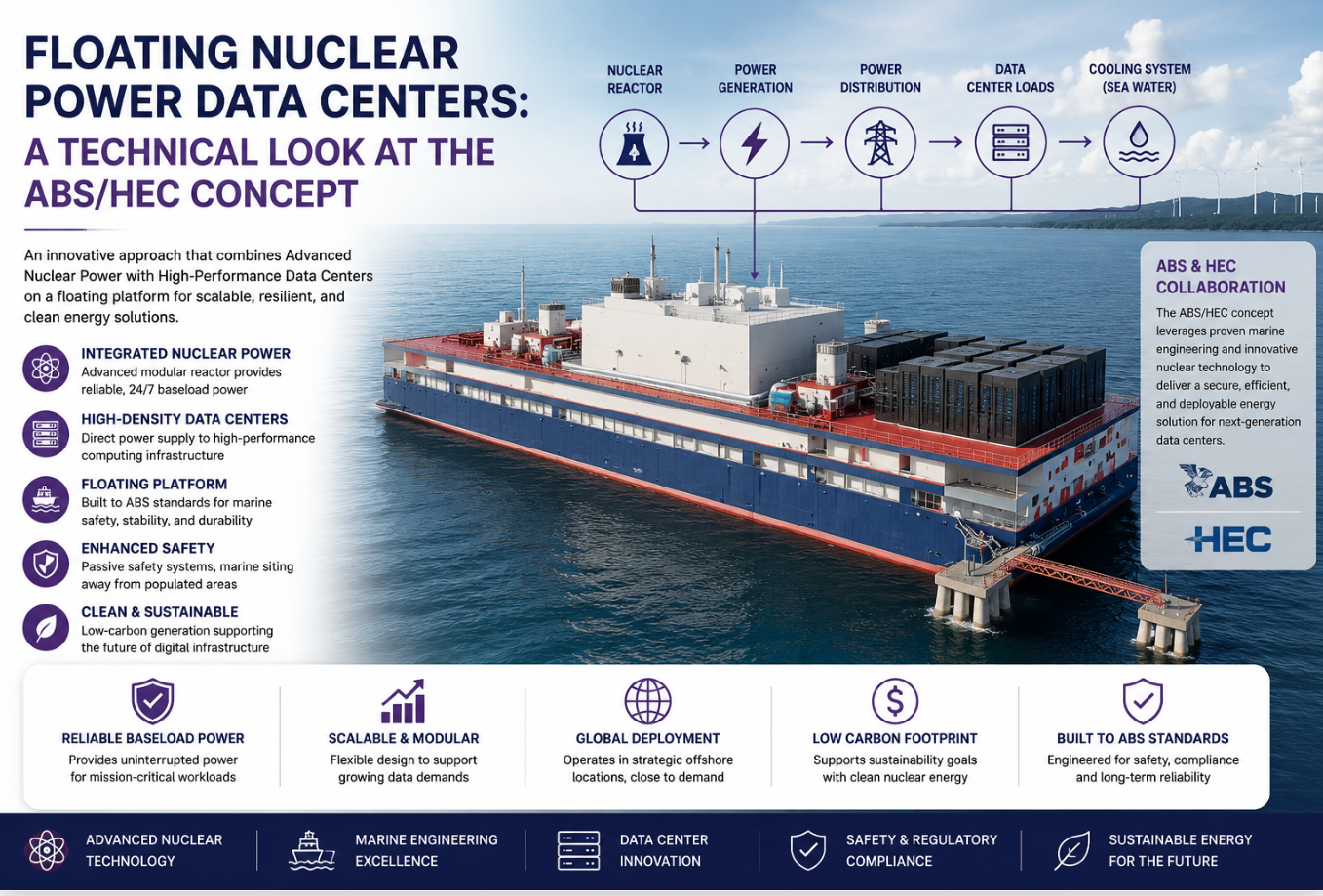
Floating Nuclear Power Data Centers: A Technical Look at the ABS/HEC Concept
June 1, 2026 | Blog
As AI training and inference workloads scale, the binding constraint on data center growth is shifting from silicon to power delivery and heat rejection. New high-density racks push both per-rack power and waste-heat density upward, while grid operators — mid-transition away from fossil generation — are increasingly unable or unwilling to underwrite large new interconnections without curtailment clauses. The concept study from the American Bureau of Shipping (ABS), developed with Herbert Engineering Corp (HEC), addresses this by integrating generation, cooling, and compute onto a single classed marine asset: a pier-moored, nuclear-powered floating data center.
Power architecture
The design is an extension of HEC's floating nuclear power plant (FNPP), retaining its modular power-plant sections fore and aft and inserting the data center amidships. Generation comes from four BWXT Advanced Nuclear Reactors (BANR), each rated at 50 MWt, for 200 MWt total. After conversion, the plant delivers up to 70 MWe to the servers and ancillary cooling. The reactors use a high-temperature gas-cooled (HTGR) architecture with TRISO fuel and a stated fuel life of roughly five years.
The unit is designed to operate grid-independent. A shore connection is supported but not required, which means generation must track server demand in islanded operation. The study notes that advanced SMR designs can achieve load-following on the order of 10% of rated power per minute; to bridge the response gap,
server load can be shaped via task scheduling and traffic throttling over the shore data link, and containerized or cabinet-form battery energy storage can be added for peak-shaving and to absorb reactor output during low-demand periods (e.g., overnight load troughs).
Compute and cooling
Cooling is built around the Nautilus EcoCore system — a modular air-cooling architecture using an external water body as the ultimate heat sink, already fielded on a floating data center at the Port of Stockton. The atomic unit is a 2.5 MW EcoCore block composed of nine modules: one COOL2500 distribution unit (four compressor/evaporator/condenser modules), two PWR-LV-2500 power units, one RES-LV-1250 redundancy unit, four AISLE-HT hot-aisle units, and one AISLE-CL accessory unit.
Key block parameters from the study:
- Block footprint: 13.75 m × 21.96 m ≈ 301.95 m²
- Rated heat-rejection density: 8.6 kW/m² (max ~11.03 kW/m²)
- PUE: ≤1.15 (so a 2.5 MW block delivers ~2.174 MW to compute)
- Heat-sink constraint: ~2 °C max rise in the ultimate heat-sink water
- Block mass: ~272.2 MT
- Minimum floor-to-ceiling clearance above servers: 9.2 m for air recirculation
Because the design sizes volume and floor area by available power and the cooling envelope rather than by server type, it is server-agnostic. The baseline mid-density case assumes 160 racks per block at ~13.6 kW/rack (≈2.72 kW/server at five servers/rack), giving a server-footprint-to-cooling-area ratio of ~3. The study also runs a high-end case using NVIDIA DGX H100/H200 nodes (~10.2 kW each, 8U, ~130.45 kg): at ~51 kW/rack, only ~45 racks fit per block within the existing reactor power and EcoCore capacity, dropping floor-area ratio to ~12 (sparse usage) at ~36 MT of servers per block. Denser high-power configurations would require both
higher generation and more capable cooling (e.g., direct-to-chip or immersion), which were outside the study scope.
Naval architecture and structure
Principal particulars: 172 m LOA (≈60 m of data center inserted into the 112 m FNPP, split by a transverse bulkhead at midships), 50 m molded beam, 23 m depth, 6.2 m operating draft, ~50,983 MT design displacement.
The data center comprises three main volumes, each housing eight 2.5 MW EcoCore blocks — 24 blocks ≈ 60 MW nominal demand, consuming roughly 85–90% of the 70 MWe rating, with the balance reserved for peak cooling and unmodeled ancillaries. The top volume is arranged as superstructure. To maintain a continuous deck between power-plant and compute sections, reactor-room clearance was raised from 7 m to 10 m.
Structurally, the dominant challenge is discontinuity: longitudinal bulkheads (other than the shell) do not align across the FNPP-to-data-center transition. The power-plant sections keep their B/5 collision bulkheads and route steel outboard of the reactor compartments to preserve insulation and radiological shielding; the central compute volume omits longitudinal subdivision (to keep an open ~45 m span) and replaces shielding bulkheads with pillars, relying on transverse bulkheads/cofferdams at each power-plant boundary for shielding. Load transfer across the joint uses large soft-toed triangular brackets protruding ~9 m into the data center, plus radiused brackets at the superstructure. Deck heights: inner bottom at 3 m ABL, second deck at 13 m ABL, cambered main deck at 23–24 m ABL, superstructure top at 34 m. Pillars on a 6 m longitudinal pitch at CL, 7.5 m P&S and 15 m P&S reduce girder spans to ~7.5 m. Frame spacing is 0.75 m longitudinally; vertical stiffeners at 800 mm; deck longitudinals at 750 mm inboard of the 22.5 m bulkheads, transitioning to 833 mm outboard.
Scantlings followed ABS Steel Barge and Marine Vessel Rules across four vertical analysis regions. The 2024 ABS Steel Barge Rules yielded a required hull-girder section modulus of 470,652 cm²·m. Local scantling requirements governed over hull-girder bending, leaving the as-designed section modulus ~13% over minimum in the nuclear sections and ~62% over in the data center section. Total steel weight is ~16,300 MT (≈10,760 MT nuclear sections, ≈5,090 MT data center section, including transitional structure). For stability, the design is checked against the full IMO Intact Stability Code General and Weather Criteria plus MARPOL damage stability — well beyond the minimal pontoon check — and meets them readily given the large beam, dense subdivision, and high freeboard, using double-bottom ballast under the data center to relieve hogging.
Thermal-environmental envelope
Heat rejection is the siting driver. The plant can shed on the order of 200 MWt (~700 MBtu/hr), and the minimum under-keel current needed to dissipate it scales inversely with the allowed seawater Delta-T — typically ~10 °C in open water but as low as ~2 °C in inland/coastal waters, which sharply increases required flow. The study performed no environmental impact or facility-security analysis and flags both as site-dependent prerequisites; uncontrolled discharge could drive >5 °C local Delta-T in some cases.
Regulatory and maturity caveats
Licensing splits across regimes: nuclear systems under an approved regulator (e.g., the NRC) and the barge/marine systems under ABS Class. The authors are explicit that advanced nuclear maturity is currently low, so the analysis leans on terrestrial design data, and a ~200 MW "hyperscale" variant (comparable to next-gen Microsoft/Alphabet/Amazon/Meta/Apple campuses) would require modularized higher-power reactors, immersion-class cooling, undersea fiber, permanent crew accommodation, and possibly a helipad.
TECHNICAL FAQ
What generation technology does the design use?
Four BWXT Advanced Nuclear Reactors (BANR), 50 MWt each (200 MWt total), of HTGR type with TRISO fuel and ~5-year fuel life, delivering up to 70 MWe.
Can it run without grid connection?
Yes. It's designed for islanded operation; a shore connection is optional. In islanded mode, generation must follow load, aided by ~10%/min reactor load-following, server-side demand shaping, and optional battery storage for peak-shaving.
What is the cooling system and how efficient is it?
The Nautilus EcoCore modular air-cooling system using surrounding water as the ultimate heat sink, at a PUE of ≤1.15. Each 2.5 MW block rejects 8.6 kW/m² (max ~11.03), occupies ~302 m², weighs ~272 MT, and is limited to ~2 °C rise in heat-sink water.
How much compute does it support?
24 EcoCore blocks ≈ 60 MW nominal, ~85–90% of the 70 MWe rating. In the mid-density baseline that's 160 racks/block at ~13.6 kW/rack; with high-end DGX H100/H200 racks (~51 kW), only ~45 racks/block fit within current power and cooling.
What are the principal particulars?
≈172 m LOA, 50 m beam, 23 m depth, 6.2 m operating draft, ~50,983 MT design displacement, ~16,300 MT total steel weight.
What governs the structural design?
Discontinuity between the FNPP and data center sections. Local scantlings (not hull-girder bending) dominated sizing; required section modulus is 470,652 cm²·m, with margins of ~13% (nuclear) and ~62% (data center) over minimum. Open compute spans are carried on pillared grillage girders with transitional bracketry across the joint.
What stability standards apply?
Rather than the minimal IMO pontoon check, the design is verified against the full IMO Intact Stability General and Weather Criteria plus MARPOL damage stability, met using double-bottom ballast under the data center.
What is the thermal/siting constraint?
~200 MWt of waste heat must be dissipated; required under-keel current rises as the allowed seawater Delta-T falls (≈10 °C open water down to ~2 °C inland/coastal). A site-specific environmental study is required.
Why pier-moored rather than offshore?
To enable high-speed fiber, backup power, and crew access. Offshore would impose satellite latency or costly undersea cable, plus permanent accommodation. No anchoring system is included.
What licensing is required?
Nuclear systems under an approved nuclear regulator (e.g., NRC); barge and marine systems under ABS Class.
Is this a buildable design today?
No — it's a high-level concept study. Advanced nuclear maturity is low, so it relies on terrestrial design data, and security/environmental analyses are deferred to site selection.
Can it scale to hyperscale?
Conceptually, a ~200 MW variant could match major hyperscale campuses, but it would need higher-power modular reactors, advanced (immersion) cooling, undersea fiber, permanent crew quarters, and possibly a helipad.

About the Author:
Sonny Patel P.E. EC
IEEE Senior Member
In 1995, Sandip (Sonny) R. Patel earned his Electrical Engineering degree from the University of Illinois, specializing in Electrical Engineering . But degrees don’t build legacies—action does. For three decades, he’s been shaping the future of engineering, not just as a licensed Professional Engineer across multiple states (Florida, California, New York, West Virginia, and Minnesota), but as a doer. A builder. A leader. Not just an engineer. A Licensed Electrical Contractor in Florida with an Unlimited EC license. Not just an executive. The founder and CEO of KEENTEL LLC—where expertise meets execution. Three decades. Multiple states. Endless impact.
Services

Let's Discuss Your Project
Let's book a call to discuss your electrical engineering project that we can help you with.

About the Author:
Sonny Patel P.E. EC
IEEE Senior Member
In 1995, Sandip (Sonny) R. Patel earned his Electrical Engineering degree from the University of Illinois, specializing in Electrical Engineering . But degrees don’t build legacies—action does. For three decades, he’s been shaping the future of engineering, not just as a licensed Professional Engineer across multiple states (Florida, California, New York, West Virginia, and Minnesota), but as a doer. A builder. A leader. Not just an engineer. A Licensed Electrical Contractor in Florida with an Unlimited EC license. Not just an executive. The founder and CEO of KEENTEL LLC—where expertise meets execution. Three decades. Multiple states. Endless impact.
Leave a Comment
We will get back to you as soon as possible.
Please try again later.