A Coordinated Electric System Interconnection Review—the utility’s deep-dive on technical and cost impacts of your project.
Challenge: Frequent false tripping using conventional electromechanical relays
Solution: SEL-487E integration with multi-terminal differential protection and dynamic inrush restraint
Result: 90% reduction in false trips, saving over $250,000 in downtime
The three operating regions you have to design to
| Device | Output vs voltage | Response | Best suited to | Main limitations |
|---|---|---|---|---|
| Mechanically switched capacitor or reactor | Proportional to voltage squared | Seconds; discrete steps; limited switching operations per day | Steady-state reactive supply, voltage profile, loss reduction | No dynamic capability; step voltage change on switching; capability collapses when most needed |
| Static var compensator | Capacitive branches proportional to voltage squared | A few cycles; continuously controllable | Continuous control where cost matters and deep voltage support is not the driver | Square-law capability loss; harmonic filters are part of the plant and interact with the network |
| STATCOM | Approximately proportional to voltage — constant current capability | One to two cycles closed loop; converter response faster still | Voltage stability margin, weak interconnections, fast disturbance recovery, flicker and unbalance compensation | Higher capital cost; converter losses; adds a converter and its control dynamics to the network |
| Synchronous condenser | Governed by machine capability and excitation | Excitation response in the hundreds of milliseconds; inherent inertial response instantaneous | System strength and inertia, short-circuit contribution, black start support | Rotating plant with maintenance and losses; slower controlled response than a converter |
| STATCOM with energy storage | Reactive as a STATCOM, plus real power within the storage rating | As STATCOM for reactive; real power limited by storage | Where a real power deficiency is part of the problem | Cost and complexity of the storage; different failure and maintenance profile |
ERCOT New Generator Commissioning Checklist 2026: Commissioning Plan, Parts 1–3 & BESS
September 22, 2026 | Blog
Keentel Engineering | ERCOT Commissioning Support Services
Why commissioning is where ERCOT projects win or lose their schedule
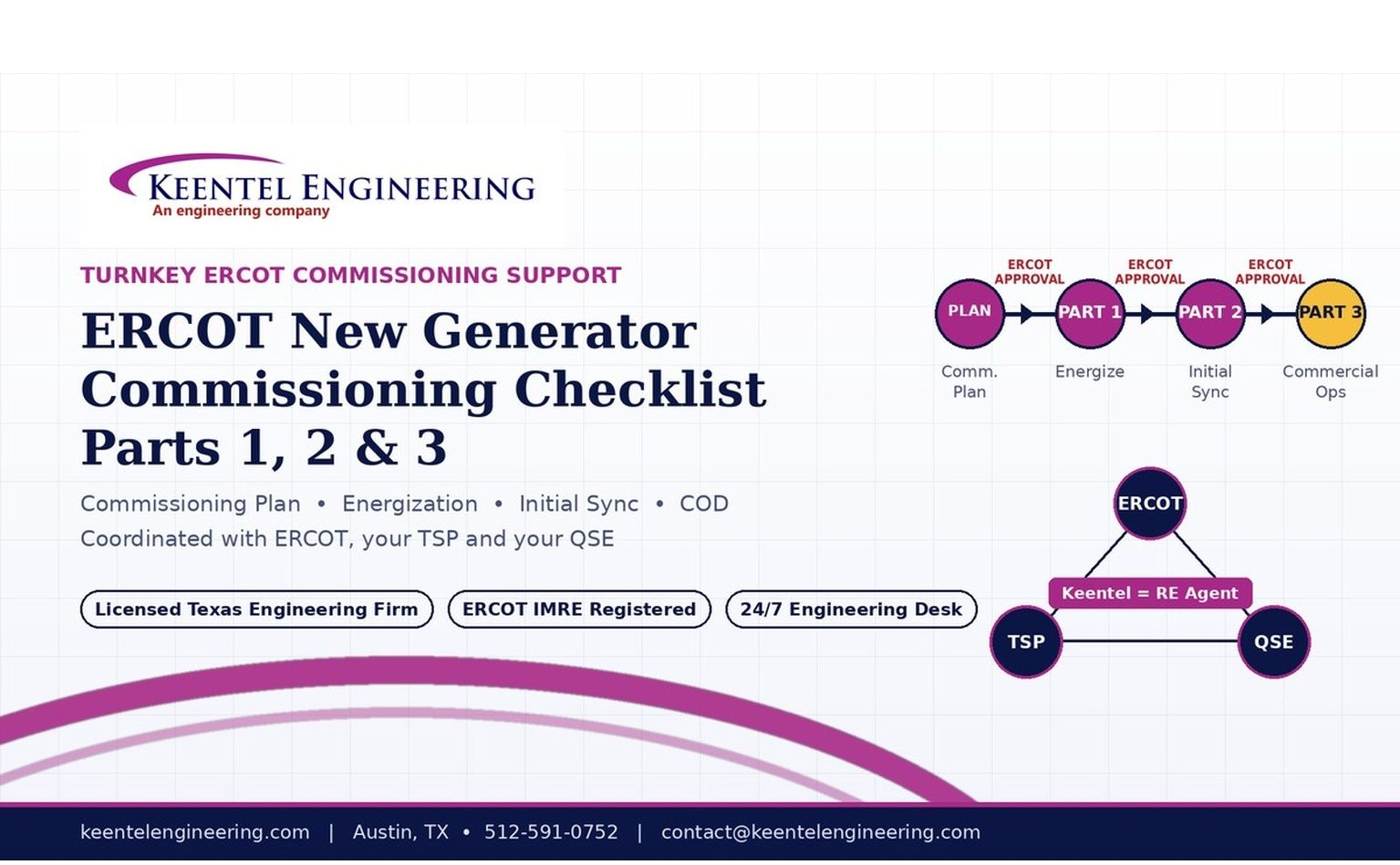
Getting a generation or storage project through the ERCOT interconnection queue is only half the job. Between mechanical completion and commercial operation sits a regulated approval sequence — the ERCOT New Generator Commissioning Checklist — that converts an Interconnecting Entity into a fully registered, commercially operating Resource Entity (RE).
The checklist is not a single form. It is a pre-approval Commissioning Plan followed by three gated submittals (Part 1, Part 2, Part 3), each of which requires explicit ERCOT sign-off before the next step can begin. Every gate depends on three outside parties doing their part on time: ERCOT, the Transmission Service Provider (TSP) and the project's Qualified Scheduling Entity (QSE). A telemetry point that isn't mapped, an ESI ID that isn't active, or a hold-point schedule that isn't agreed can each cost weeks — and on a battery project, the clock is literally running from the day Part 2 is approved.
Keentel Engineering provides this scope as a standalone, turnkey service: we build the Commissioning Plan, prepare and submit all three checklist parts, run the field-test program, and manage the three-way coordination so the owner's team can focus on construction and energization. As a licensed Texas professional engineering firm and an ERCOT-registered Independent Market Information System Registered Entity (IMRE), we can act as the Resource Entity's designated Agent — holding MIS access, submitting through RIOO, and corresponding with ERCOT directly — or in a purely advisory role if the owner prefers to hold the RE seat in-house. Our engineering desk operates 24/7, which matters during back-feed, first sync and overnight test windows.
Below is the process as we run it, followed by a technical FAQ drawn from the questions owners, EPCs and QSEs ask us most often.
Phase 0 — The Commissioning Plan (30 days before Part 1)
The Commissioning Plan is the foundation of the entire checklist lifecycle. ERCOT must formally approve it before any site equipment can be energized.
Timing
Submitted through the ERCOT RIOO-IS portal no later than 30 days prior to the date the RE intends to file Checklist Part 1. Note: the Caommissioning Plan is handled entirely within the RIOO workflow — it is not emailed to the commissioning request mailbox.
What ERCOT is looking for
The plan describes how the facility will be operated during commissioning, lays out the detailed test schedule, and identifies the critical milestones from back-feed through initial synchronization to COD. ERCOT audits it for grid-stability risk and, once satisfied, issues the approval that opens the checklist process.
Keentel turnkey deliverables:
- Milestones timeline — a Gantt-level schedule tracking back-feed (energization), initial sync, hold-point releases, field testing and COD.
- Dynamic modeling package — finalization of the Resource Asset Registration Form (RARF) / RIOO technical data profile so the resource is modeled correctly before energization requests are filed.
- Operational rules document — testing power caps, charge/discharge rules (for storage), auxiliary power sourcing, and the operating status protocol the QSE will follow.
- For BESS / Energy Storage Resources (ESR): state-of-charge (SoC) management strategy, the source of auxiliary power for the first battery charge before certification, separate charging and discharging test sequences, and confirmation of thermal management (HVAC/liquid cooling) and fire-suppression automated logic to ERCOT and the TSP.
Three-way coordination at Phase 0:
| Party | Role |
|---|---|
| QSE | Reviews the plan milestones against its scheduling-desk capacity and confirms it can support ONTEST/OUTL status handling and NDCRC test submissions on the proposed dates. |
| TSP | Aligns the proposed back-feed date with local outage windows and regional switching schedules; confirms POI protection settings are ready for review. |
| ERCOT | Audits the plan for stability risk and issues formal approval to begin the checklist lifecycle. |
Part 1 — Request for Energization of Resource Entity Equipment
Part 1 is the gate that allows the high-voltage switchyard breakers to be closed and the main power transformer, medium-voltage collection system and station service energized without the resource generating (or inverters modulating).
Timing. Submitted at least 7 business days before the target energization / back-feed date.
Core requirements:
- Telemetry verification. Station telemetry to the QSE and TSP must be active, accurate and proven reliable. ERCOT checks the ICCP telemetry queue for a 48-hour window of clean, uninterrupted data with no dropouts.
- Primary and backup data paths. The RE must document both communication paths from the plant controller to the QSE's control center.
- Network model. ERCOT verifies the resource node is active in the current Network Operations Model change cycle.
- Settlements. An Electric Service Identifier (ESI ID) must be fully established in the ERCOT settlement system to capture load — including auxiliary load — during the energized-but-not-generating period.
- EPS metering. The ERCOT Polled Settlement (EPS) metering design package must show revenue meters calibrated and communication links live.
BESS-specific Part 1 items. For an ESR, the 48-hour clean telemetry stream must include the storage-specific points: State of Charge (MWh), Maximum Operating Discharge Limit (MW), Maximum Operating Charge Limit (MW) and inverter availability status. Because a battery site draws meaningful auxiliary power even when idle (chillers, HVAC, controls), the aux-load ESI ID must be active so that consumption is correctly tracked and settled.
Keentel turnkey deliverables:
- Point-to-point telemetry mapping architecture (plant controller → QSE → ERCOT, primary and backup).
- 48-hour clean data attestation, coordinated with the QSE and verified against ERCOT's queue.
- EPS metering certification package.
- Completed, officer-signed Part 1 form, uploaded to RIOO-IS and emailed to CommissioningRequests@ercot.com.
Three-way coordination at Part 1:
| Party | Role |
|---|---|
| QSE | Establishes the live ICCP stream to ERCOT and confirms data quality across the 48-hour window. |
| TSP | Verifies POI protection settings match the approved coordination study and performs the physical switching to energize the yard; co-establishes EPS metering communication points. |
| ERCOT | Confirms the network model, audits the telemetry queue and issues Part 1 approval. |
Part 2 — Request for Initial Synchronization
Part 2 authorizes the generator — or, for storage, the Power Conversion System (PCS/inverter) breakers — to close and connect to the ERCOT grid for the first time, flowing power for tuning and testing.
Timing. Submitted after Part 1 is closed out and the resource is physically ready to synchronize.
The 20 MVA boundary. Requirements scale with capacity:
- ≤ 20 MVA — typically approved to test across the full output range immediately.
- > 20 MVA — subject to a hold-point release schedule. Output is capped (for example, 20 MW blocks or a set percentage of the site) until steady-state data demonstrates stable behavior, then released incrementally.
For Intermittent Renewable Resources (wind and solar), sub-parts 2a and 2b may apply under Planning Guide criteria.
Operational status control. Once Part 2 is approved, the resource's status is managed entirely through the QSE's telemetry: ONTEST during active tuning or test blocks, OUTL (Output Limited) or OUT when resting or unavailable, and ON for normal availability.
The 365-day clock (storage). Under ERCOT Planning Guide rules (PGRR103), an ESR has a strict 365-day maximum window from Part 2 approval to achieve Part 3 commercial operation. Exceeding it requires a Good Cause Exception request. The formal sync date must be logged immediately, because it starts that clock.
Keentel turnkey deliverables:
- Hold-point compliance matrix for >20 MVA sites, with the release schedule pre-agreed with ERCOT and the TSP.
- Operational status attestation demonstrating the QSE can toggle and reflect ONTEST/OUTL in real time.
- 365-day window entry and schedule-risk tracking for storage projects.
- Completed, officer-signed Part 2 form, uploaded to RIOO-IS and emailed to the commissioning request mailbox.
Three-way coordination at Part 2:
| Party | Role |
|---|---|
| QSE | Submits live test schedules through the NDCRC portal, manages market mitigation during tests, and drives ONTEST/OUTL status. |
| TSP | Monitors POI voltage swings during initial inverter/breaker closures; confirms anti-islanding and protection behavior. |
| ERCOT | Issues explicit operational clearance for initial sync and tracks real-time stability parameters through the hold-point releases. |
Part 3 — Request to Commission a Resource (Commercial Operations)
Part 3 is the final gateway. It proves the resource can support grid reliability dynamically and respond correctly to automated dispatch, transitioning it from a testing node to a settled, commercial market participant.
Field-test requirements:
- Reactive Power Capability Test — full leading and lagging reactive capability at the POI.
- Automatic Voltage Regulator (AVR) / Voltage Support Service (VSS) Test — rapid, automatic correction of POI voltage deviations within the verified reactive capability curve.
- Primary Frequency Response (PFR) Test — governor or governor-like droop response to high/low frequency deviations, captured with high-speed data.
- Power System Stabilizer (PSS) and Curtailment Tests — where applicable to the technology.
- SCED base-point adherence — telemetry logs demonstrating the resource follows Security-Constrained Economic Dispatch instructions.
- Weather Preparedness Declaration — a signed attestation of summer/winter weatherization compliance, required for final execution unless COD falls outside the peak windows, in which case it rolls into the regular biannual declaration.
BESS-specific Part 3 items.
The ESR must demonstrate precise charge-to-discharge transitions on SCED base points (full charge at −MW through full discharge at +MW), PFR droop performance appropriate for the fastest-responding asset class on the grid, and AVR/reactive support while charging and discharging. If the project intends to participate in premium Ancillary Services — Responsive Reserve (RRS), ERCOT Contingency Reserve Service (ECRS) or Fast Frequency Response (FFR) — those qualification tests are typically bundled here, before Part 3 closes out.
Keentel turnkey deliverables:
- AVR & VSS compliance log with field engineering data.
- PFR test report with raw high-speed data.
- Reactive capability test report.
- SCED adherence records.
- AS qualification test support (RRS/ECRS/FFR) in coordination with the QSE.
- Weather Preparedness Declaration preparation.
- Completed, officer-signed Part 3 form, uploaded to RIOO-IS and emailed to the commissioning request mailbox.
Three-way coordination at Part 3:
| Party | Role |
|---|---|
| QSE | Finalizes Ancillary Services qualification tests and transitions the asset out of ONTEST into standard economic dispatch. |
| TSP | Reviews final power-quality metrics and provides permanent interconnection sign-off. |
| ERCOT | Accepts the Part 3 upload, declares the resource commercially operational and transitions it to market settlements. |
Submission protocol — how not to get rejected
ERCOT is strict about the submission path, and a rejected upload resets your lead time:
- Commissioning Plan — RIOO-IS portal only. Do not email it to the commissioning mailbox.
- Checklist Parts 1, 2 and 3 — fully completed, signed by an RE corporate officer, uploaded to the RIOO-IS portal, and simultaneously emailed to CommissioningRequests@ercot.com.
- Every part is gated: Part 2 cannot be filed until Part 1 is approved and closed; Part 3 cannot be filed until Part 2 testing is complete.
As an IMRE-registered entity acting as the RE's Agent, Keentel manages the RIOO uploads, the mailbox submittals and ERCOT correspondence directly — the owner's officer signs, and we handle the rest.
Roles at a glance — who owns what
| Entity | Primary responsibility during commissioning |
|---|---|
| Resource Entity (RE) | Owns registration; maintains the RARF (for storage, keeping inverter clip limits aligned with cell degradation and ambient constraints); ultimate responsibility for executing tests and submitting checklists. |
| QSE | Establishes ICCP links; routes real-time SCADA/telemetry to ERCOT; validates storage-specific telemetry calculations; submits test requests via NDCRC; manages ONTEST/OUTL/ON status. |
| TSP | Coordinates the physical interconnection at the POI; verifies protection and anti-islanding settings; performs switching; co-establishes EPS metering; provides permanent sign-off. |
| ERCOT | Approves the Commissioning Plan; audits 48-hour telemetry queues; builds/verifies the network model; issues Part 1, 2 and 3 approvals. |
| Keentel Engineering (RE Agent / Advisor) | Builds the plan and all submittals, runs the test program, produces the compliance documentation and coordinates all three parties on the owner's behalf. |
Technical FAQ
Q: Is ERCOT commissioning support available as a standalone service, or only bundled with design or study work?
Yes, standalone. Many owners have their EPC, OEM and QSE already in place and need one accountable party to own the Commissioning Plan, the three checklist parts and the field-test program. Keentel provides exactly that scope on its own, or integrated with our interconnection studies, RARF/dynamic modeling and owner's engineer services where those are also needed.
Q: What is the difference between acting as the Resource Entity's Agent and providing advisory support?
As RE Agent, Keentel is designated on the checklist forms, holds ERCOT MIS/RIOO access under our IMRE registration, submits the Commissioning Plan and Parts 1–3, and handles ERCOT correspondence directly. The owner's corporate officer still signs each part. In an advisory role, the owner's staff hold the RE seat and make the submittals; we prepare the packages, run the tests and manage TSP/QSE coordination behind them. We recommend the Agent model for owners without a standing ERCOT operations team — it removes the administrative critical path.
Q: What is an IMRE, and why does it matter for commissioning?
An Independent Market Information System Registered Entity is an entity registered with ERCOT to access the Market Information System and act on behalf of Market Participants. It is what allows a consultant to be designated as the RE's Agent with its own credentialed access, rather than working through borrowed logins or relaying every item through the owner.
Q: How far in advance should we engage a commissioning consultant?
Ideally 90–120 days before planned back-feed. The Commissioning Plan itself must be in ERCOT's hands 30 days before Part 1, Part 1 needs 7 business days' lead, and before either of those the RARF must be finalized, telemetry mapped, the QSE's ICCP path established and the ESI ID and EPS metering in place. Those dependencies are what consume the calendar.
Q: What exactly does the 48-hour clean telemetry requirement mean?
ERCOT inspects the ICCP telemetry queue from your QSE and expects every required point to have streamed continuously with no dropouts for 48 consecutive hours. A single communications interruption restarts the window. This is why we validate the primary and backup paths and run the stream well before the Part 1 filing date rather than the week of.
Q: Why does a battery site need an ESI ID before it has generated anything?
Because it is already a load. Chillers, HVAC, controls and communications draw power the moment the station is energized, and ERCOT's settlement system needs an active ESI ID to capture and clear that auxiliary consumption during Parts 1 and 2.
Q: Our project is 120 MW. How does the 20 MVA threshold affect Part 2?
Any site above 20 MVA is subject to a hold-point release schedule. You will be capped — commonly 20 MW blocks or a percentage of site capacity — and released incrementally as ERCOT and the TSP confirm stable steady-state behavior at each step. We pre-negotiate the hold-point matrix during the Commissioning Plan phase so releases are not renegotiated in the field.
Q: What is the 365-day clock, and what happens if we miss it?
For Energy Storage Resources, ERCOT Planning Guide rules (PGRR103) require Part 3 commercial operation within 365 days of Part 2 approval. Missing it requires filing a Good Cause Exception request. We log the sync date on day one and track the test program against that deadline as a schedule risk.
Q: What do ONTEST, OUTL, OUT and ON mean?
These are resource statuses the QSE telemeters to ERCOT. ONTEST signals the resource is online for tuning or testing and should be excluded from normal economic dispatch; OUTL indicates available but output-limited (for example, under a hold-point cap); OUT means unavailable; ON is normal availability. Part 2 requires the QSE to demonstrate it can toggle these correctly in real time.
Q: What is NDCRC and who uses it?
The Net Dependable Capability and Reactive Capability portal is where the QSE submits test schedules and results to ERCOT. Keentel prepares the test plans and data; the QSE files them. Coordinating that hand-off is part of the turnkey scope.
Q: Which field tests are required for Part 3?
Reactive power capability (leading and lagging), AVR/voltage support, Primary Frequency Response, PSS and curtailment tests where applicable, and SCED base-point adherence. For storage, this includes demonstrating charge-to-discharge transitions on SCED instructions. We produce a formal report for each with the raw high-speed data ERCOT expects.
Q: Can Ancillary Service qualification tests be done at the same time?
Yes, and for a BESS they usually should be. RRS, ECRS and FFR qualification tests are typically bundled into the Part 3 test campaign so the resource enters the market qualified on day one rather than returning for a second test window.
Q: Is the Weather Preparedness Declaration always required before COD?
It is required for final Part 3 execution unless commercial operation begins outside the peak summer or winter windows, in which case it is bundled into the regular semi-annual declaration cycle. We prepare the attestation either way.
Q: What are the most common causes of checklist rejection or delay?
In our experience: telemetry dropouts inside the 48-hour window; RARF data that does not match the as-built inverter limits; the ESI ID or EPS metering not active at Part 1; Commissioning Plans emailed instead of filed in RIOO; checklist forms not signed by a corporate officer; and hold-point schedules that were never agreed in writing before first sync.
Q: How does Keentel coordinate with a TSP and QSE we've already contracted?
We act as the single technical point of contact. With the QSE, we align telemetry mapping, ICCP validation, status handling and NDCRC submittals. With the TSP, we align POI protection and anti-islanding settings, switching windows for back-feed, EPS metering points and final sign-off. Our engineering desk is staffed 24/7, so overnight energization and test windows have a live engineer on call.
Q: Does Keentel hold a Texas engineering license?
Yes. Keentel Engineering is a licensed Texas professional engineering firm with a Texas office in Austin, in addition to offices in Tampa, Sacramento and Baltimore. Our test reports and compliance documentation are prepared under the supervision of Texas-licensed Professional Engineers.
Ready to commission?
Whether you need a fully turnkey RE Agent for the entire Commissioning Plan-through-Part 3 lifecycle, or engineering support behind your own operations team, Keentel Engineering can scope it quickly. Send us your POI, TSP, QSE, target energization and COD dates and inverter/storage OEM, and we will come to the first call with a proposed approach and schedule.
Schedule a call: Select a Date & Time - Calendly
Email:
contact@keentelengineering.com |
Texas office: 512-591-0752
Keentel Engineering — Licensed Texas Engineering Firm | ERCOT IMRE Registered | NSPE | IEEE Senior Member | BBB A+ | D-U-N-S Registered

About the Author:
Sandip "Sonny" R. Patel, P.E.
IEEE Senior Member · Founder & CEO, Keentel Engineering
In 1995, Sonny Patel earned his Electrical Engineering degree from the University of Illinois. But degrees don't build legacies — action does.
For three decades, he has worked the power industry from every side of the table: 16 years as a utility engineer at Exelon/Commonwealth Edison; generation leadership across hydroelectric, industrial steam turbine, and a 9 GW renewable fleet; NERC Regional Entity Senior Compliance Engineer and Audit Team Lead, auditing some of the nation's largest utilities; and testing and commissioning lead on equipment up to 765 kV — the very top of the North American grid.Utility. Generator. Regulator. Consultant. Few engineers have seen all four seats. Fewer still have sat in them.
His experience spans nuclear, hydro, conventional generation, renewables, oil and gas, mining — and today's data centers, where he is authoring a three-book series on data center design. He is a Licensed Professional Engineer in six states and a Licensed Electrical Contractor in Florida (Unlimited EC) — he doesn't just design the work; he's qualified to stand behind its execution.Today, as Founder and CEO of Keentel Engineering, Sonny leads a nationwide team of engineers delivering substation design, power system studies, NERC compliance, and commissioning — done right, coast to coast.Three decades. Every side of the table. One standard: accountable engineering.
Services

Let's Discuss Your Project
Let's book a call to discuss your electrical engineering project that we can help you with.
About the Author:
Sandip "Sonny" R. Patel, P.E.
IEEE Senior Member · Founder & CEO, Keentel Engineering
In 1995, Sonny Patel earned his Electrical Engineering degree from the University of Illinois. But degrees don't build legacies — action does.
For three decades, he has worked the power industry from every side of the table: 16 years as a utility engineer at Exelon/Commonwealth Edison; generation leadership across hydroelectric, industrial steam turbine, and a 9 GW renewable fleet; NERC Regional Entity Senior Compliance Engineer and Audit Team Lead, auditing some of the nation's largest utilities; and testing and commissioning lead on equipment up to 765 kV — the very top of the North American grid.
Utility. Generator. Regulator. Consultant. Few engineers have seen all four seats. Fewer still have sat in them.
His experience spans nuclear, hydro, conventional generation, renewables, oil and gas, mining — and today's data centers, where he is authoring a three-book series on data center design. He is a Licensed Professional Engineer in six states and a Licensed Electrical Contractor in Florida (Unlimited EC) — he doesn't just design the work; he's qualified to stand behind its execution.
Today, as Founder and CEO of Keentel Engineering, Sonny leads a nationwide team of engineers delivering substation design, power system studies, NERC compliance, and commissioning — done right, coast to coast.Three decades. Every side of the table. One standard: accountable engineering.
Leave a Comment
Thank you for contacting us.
We will get back to you as soon as possible.
We will get back to you as soon as possible.
Oops, there was an error sending your message.
Please try again later.
Please try again later.
Related Posts
By SANDIP R PATEL
•
September 22, 2026
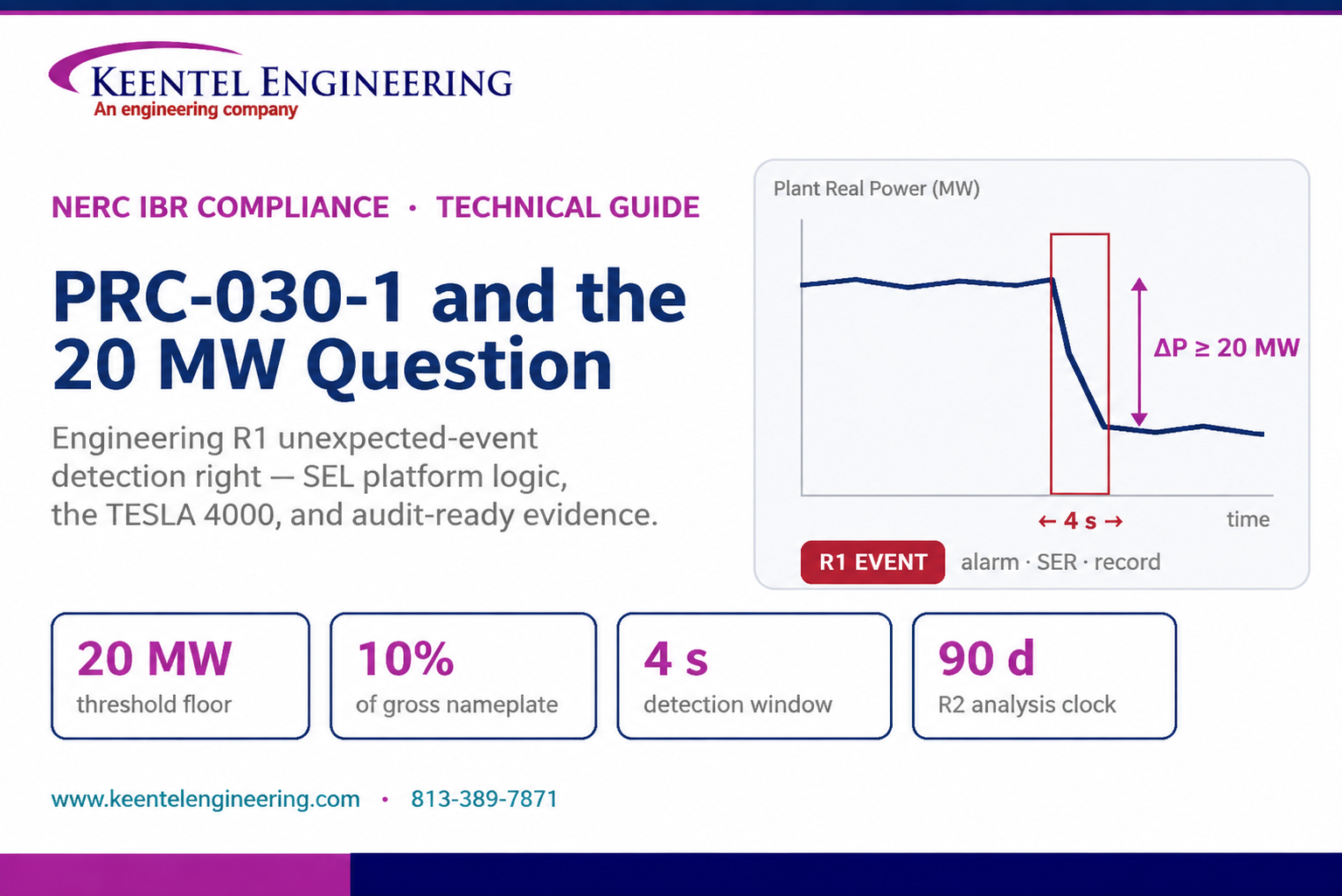
Learn PRC-030-1 R1 event detection requirements for inverter-based resources, SEL platforms, disturbance monitoring, and audit-ready compliance.
By SANDIP R PATEL
•
September 22, 2026
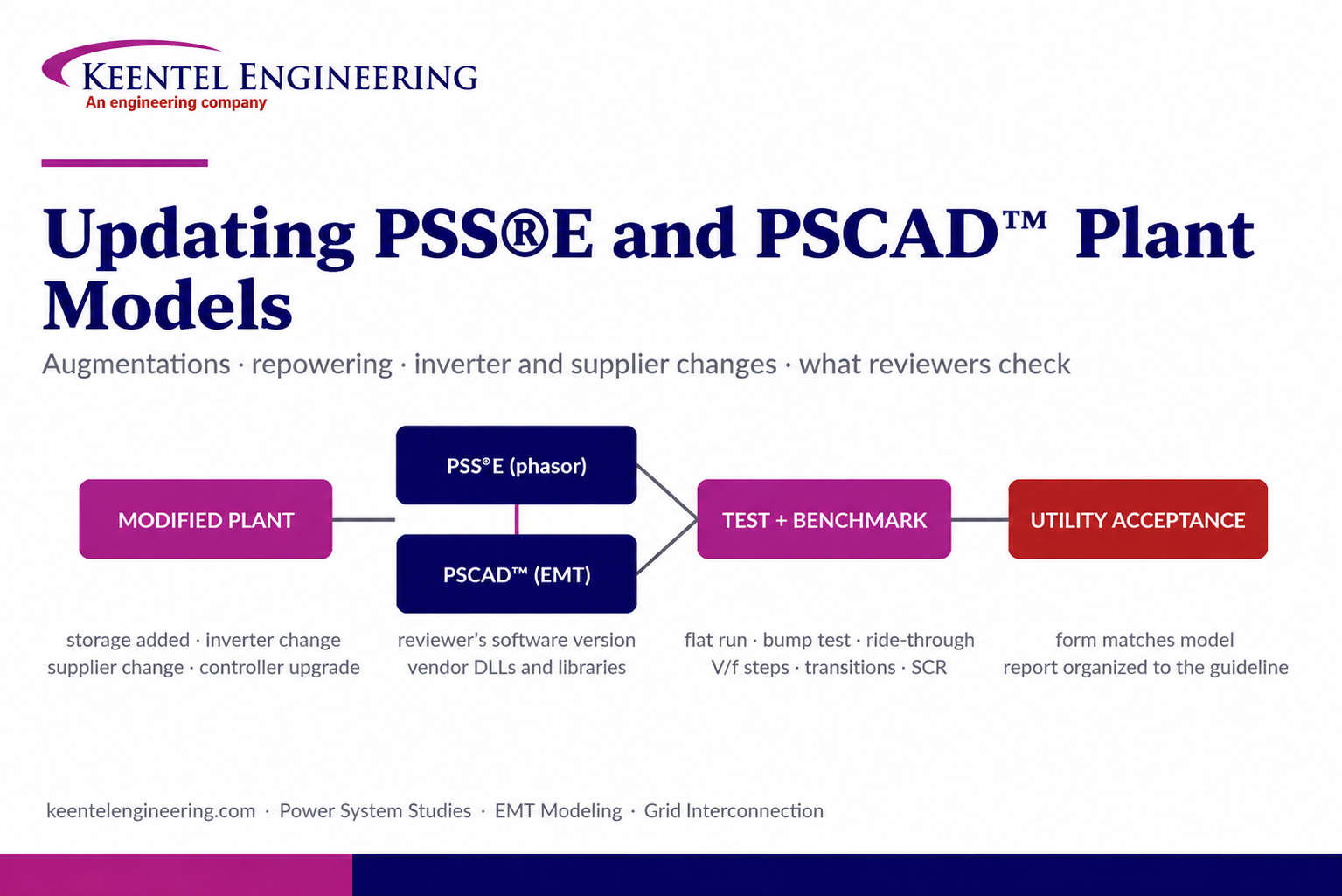
Learn how PSS®E and PSCAD™ model updates support plant augmentations, repowering, equipment changes, testing, benchmarking, and grid compliance.
By SANDIP R PATEL
•
September 20, 2026
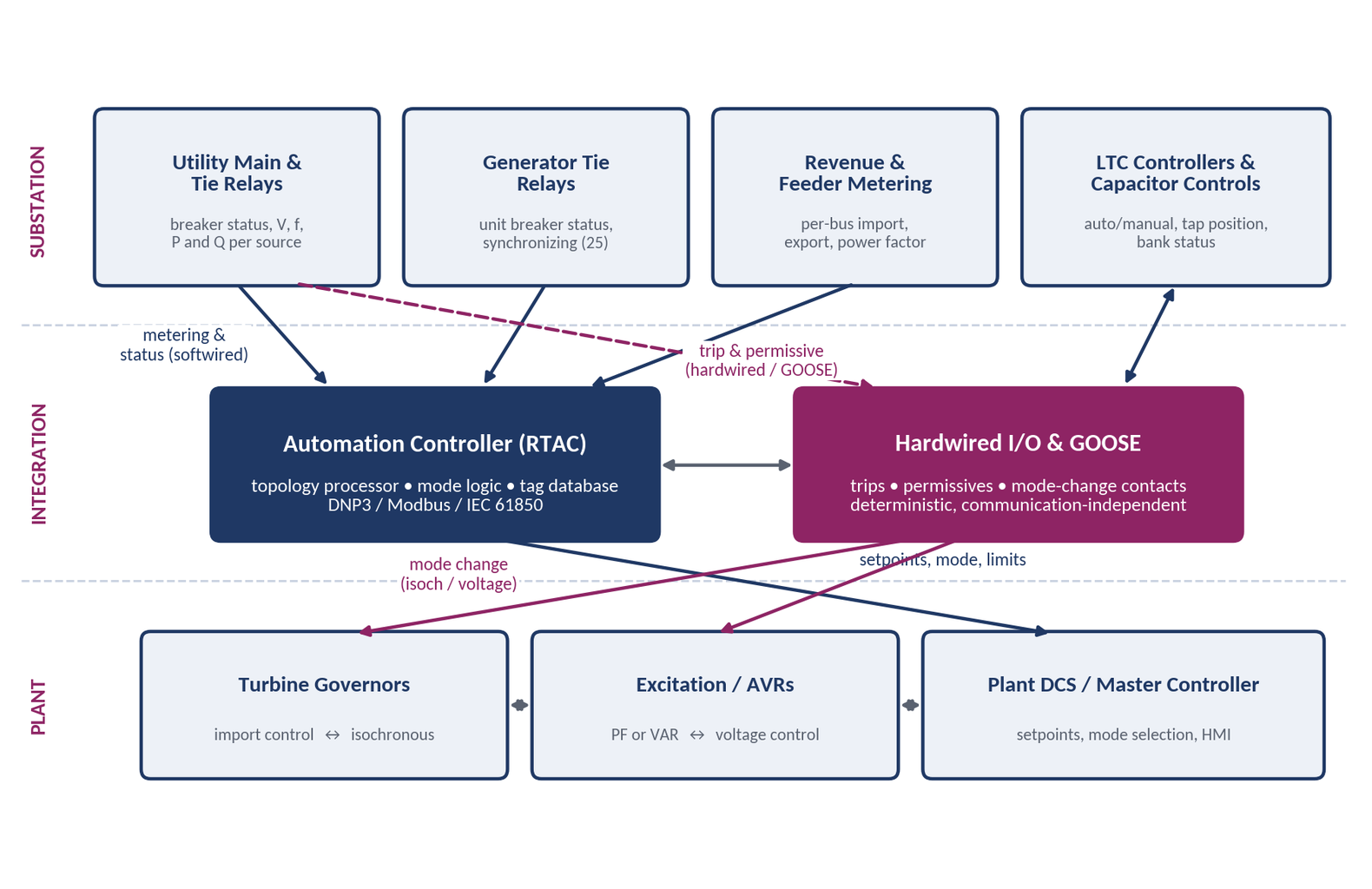
Learn CHP load following and island detection engineering for campus plants, including protection, controls, power studies, and grid transition design.
By SANDIP R PATEL
•
September 20, 2026
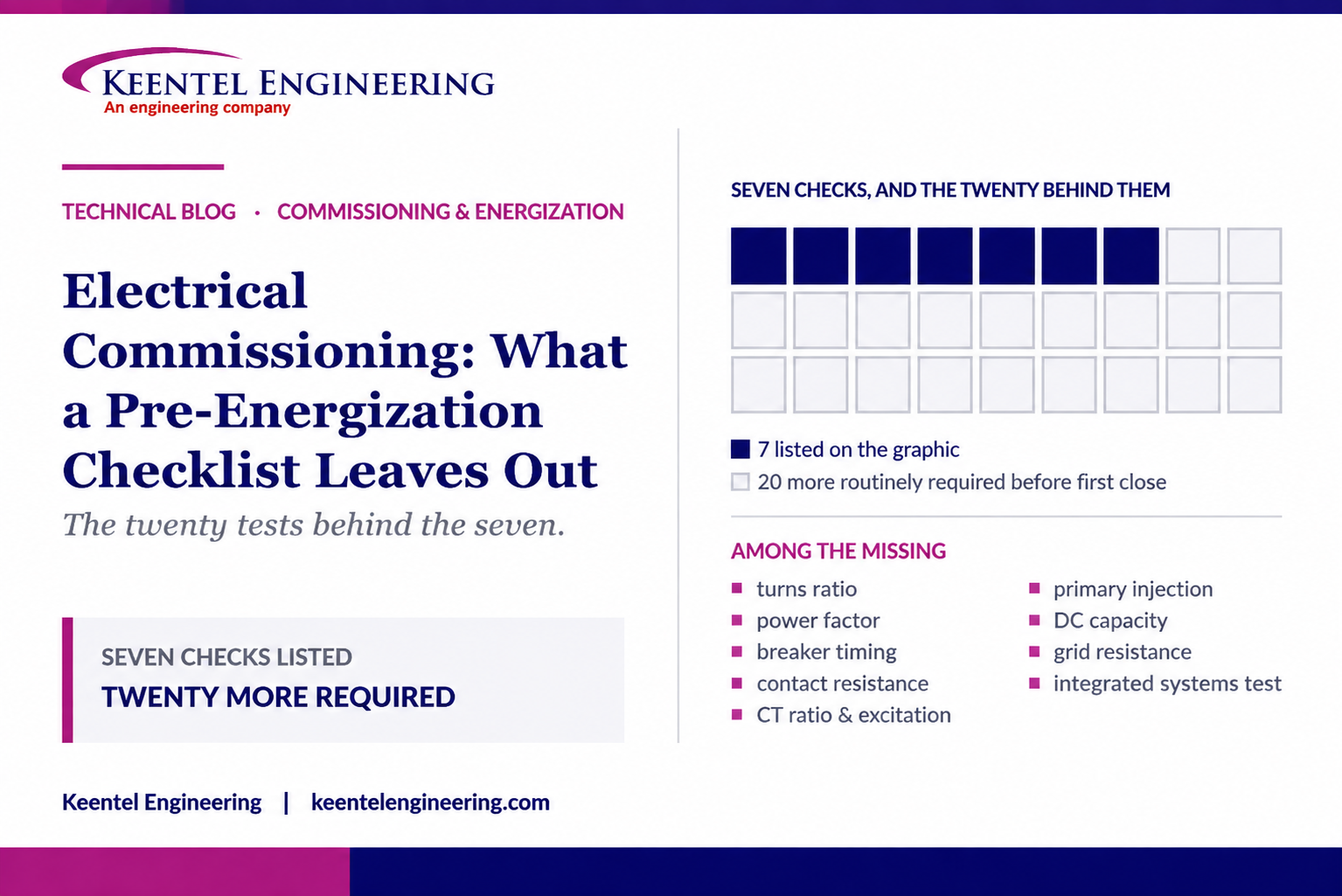
Learn what a pre-energization checklist misses, including electrical testing, protection checks, commissioning steps, and safe energization practices.
By SANDIP R PATEL
•
September 20, 2026
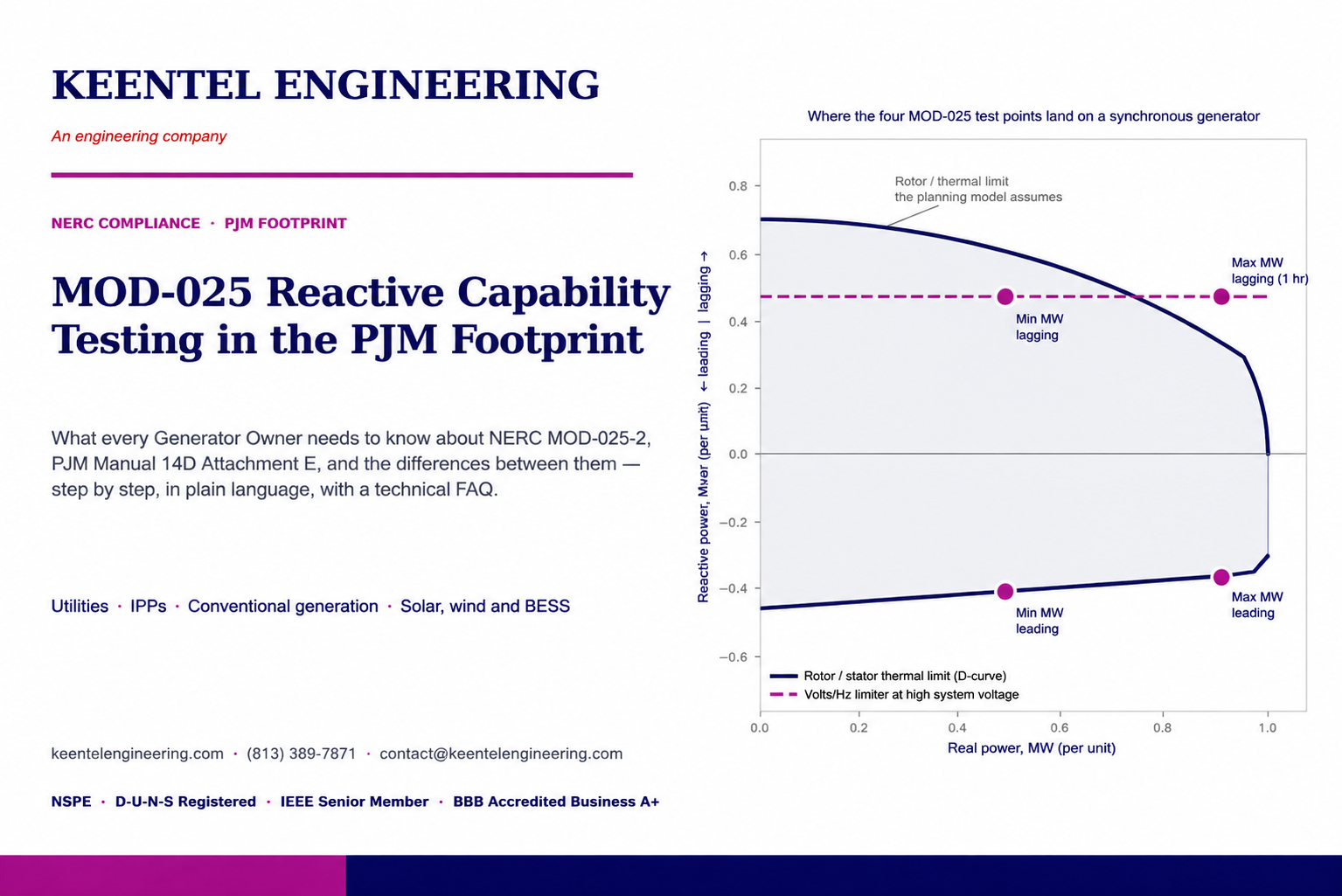
NERC MOD-025-2 Generator Owners, MOD-025-2 reactive power testing, generator capability verification, NERC Attachment 1, MOD-025 compliance testing
By SANDIP R PATEL
•
September 20, 2026
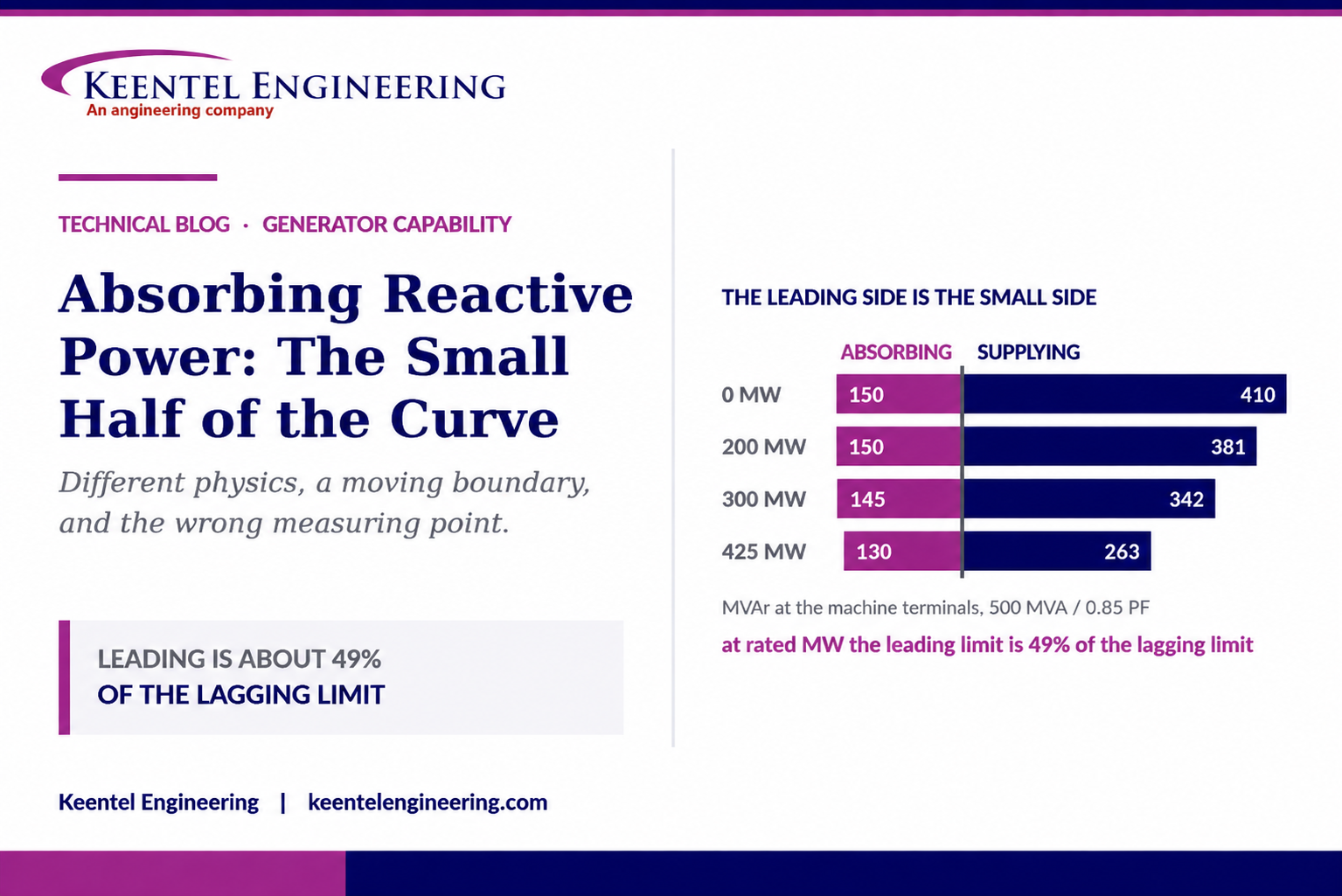
Understand generator capability curves, reactive power absorption, MVAr limits, MOD-025 verification, protection coordination, and grid requirements.
By SANDIP R PATEL
•
September 20, 2026
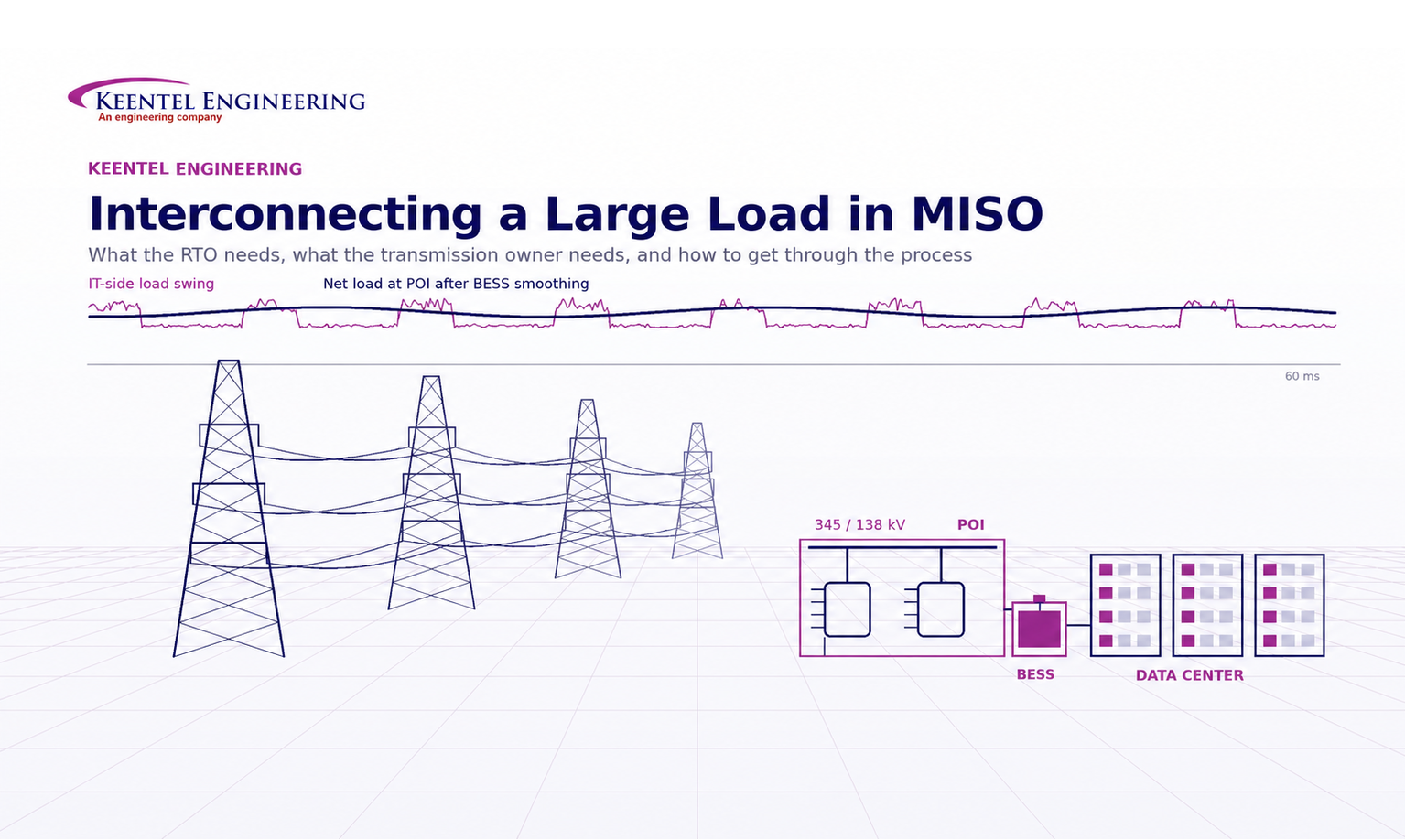
Understand MISO large load interconnection requirements for data centers, including TO data, PSS®E models, ride-through, harmonics, BESS and EPR.
By SANDIP R PATEL
•
September 19, 2026
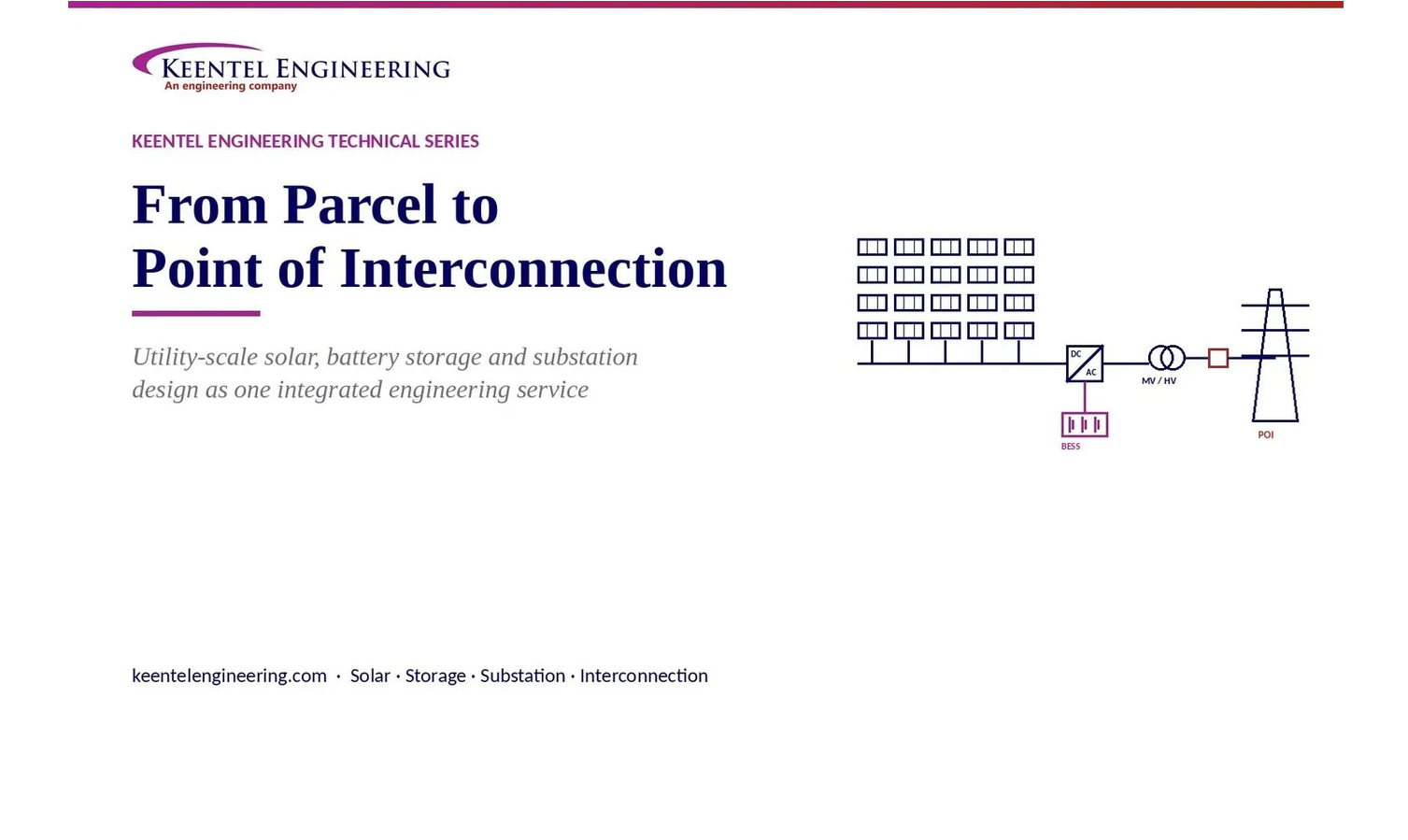
Explore utility scale solar engineering from site assessment to POI interconnection, including PV design, BESS, substation and grid studies.
By SANDIP R PATEL
•
September 18, 2026
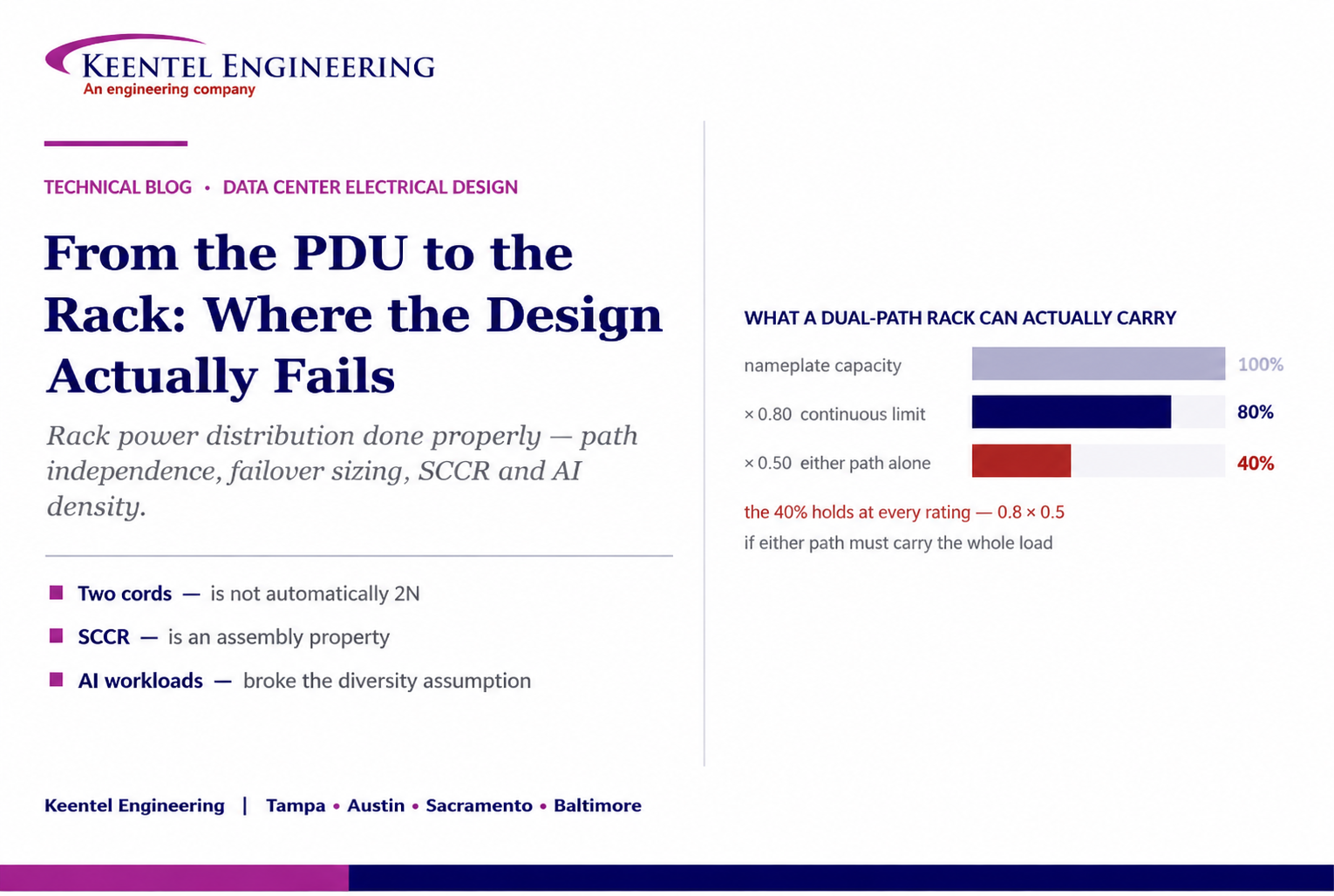
Learn how to size rack power distribution, PDU and RPP systems for continuous loads, A/B redundancy, failover capacity, SCCR and high-density AI data centers.