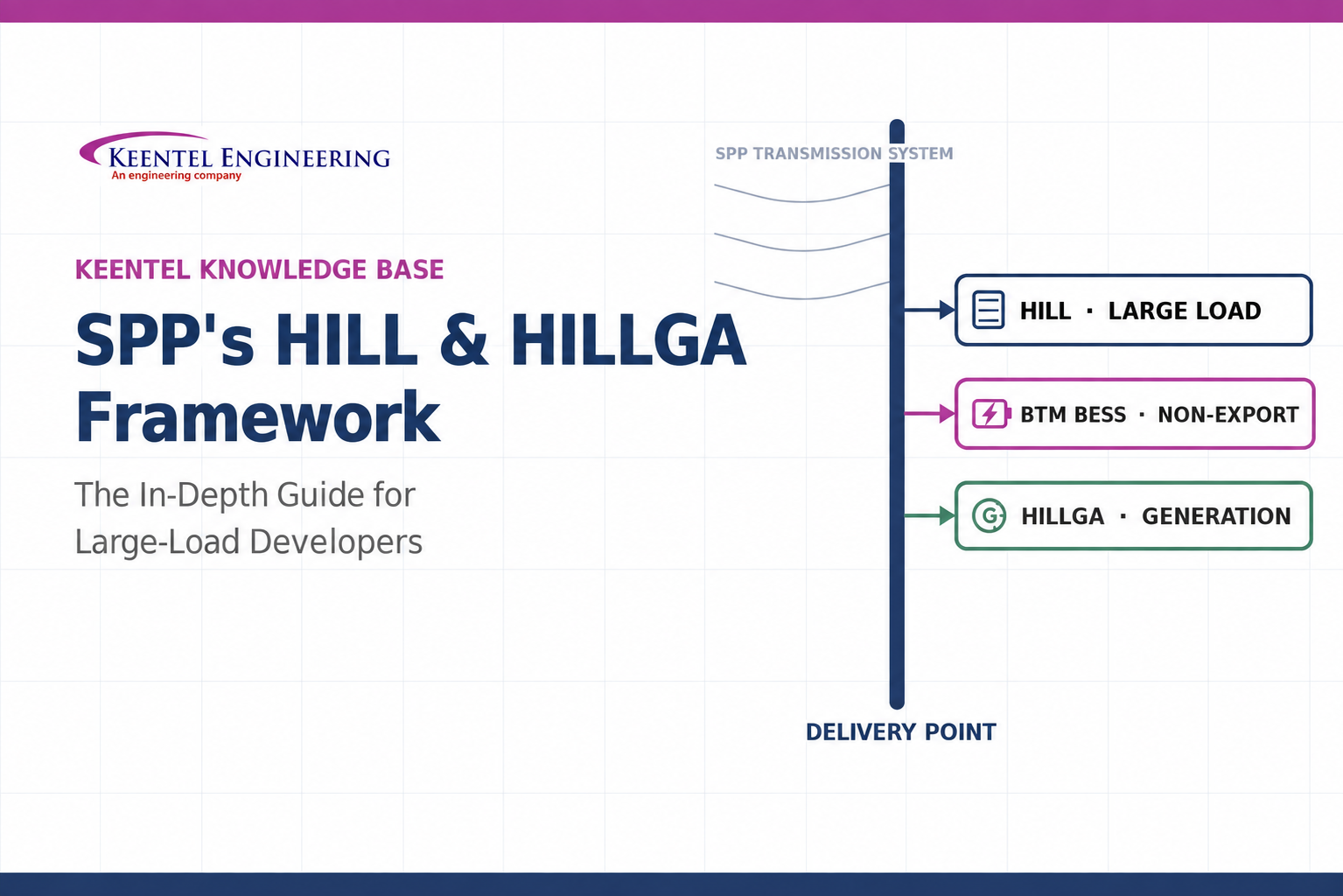

A Coordinated Electric System Interconnection Review—the utility’s deep-dive on technical and cost impacts of your project.

Challenge: Frequent false tripping using conventional electromechanical relays
Solution: SEL-487E integration with multi-terminal differential protection and dynamic inrush restraint
Result: 90% reduction in false trips, saving over $250,000 in downtime

Category Metric
VPP capacity (Lunar Energy) 650 MW
Lunar funding raised US$232 million
Data center BESS example 31 MW / 62 MWh
ERCOT grid-scale batteries 15+ GW
LDES tenders (H1 2026) Up to 9.3 GW
Lithium-ion share of LDES by 2030 77%
FEOC initial threshold 55%
BESS tariff rate (2026) ~55%
Capacity gain from analytics 5–15%

Beyond Positive Sequence Modeling: The Future of Power System Studies for High DER Grids

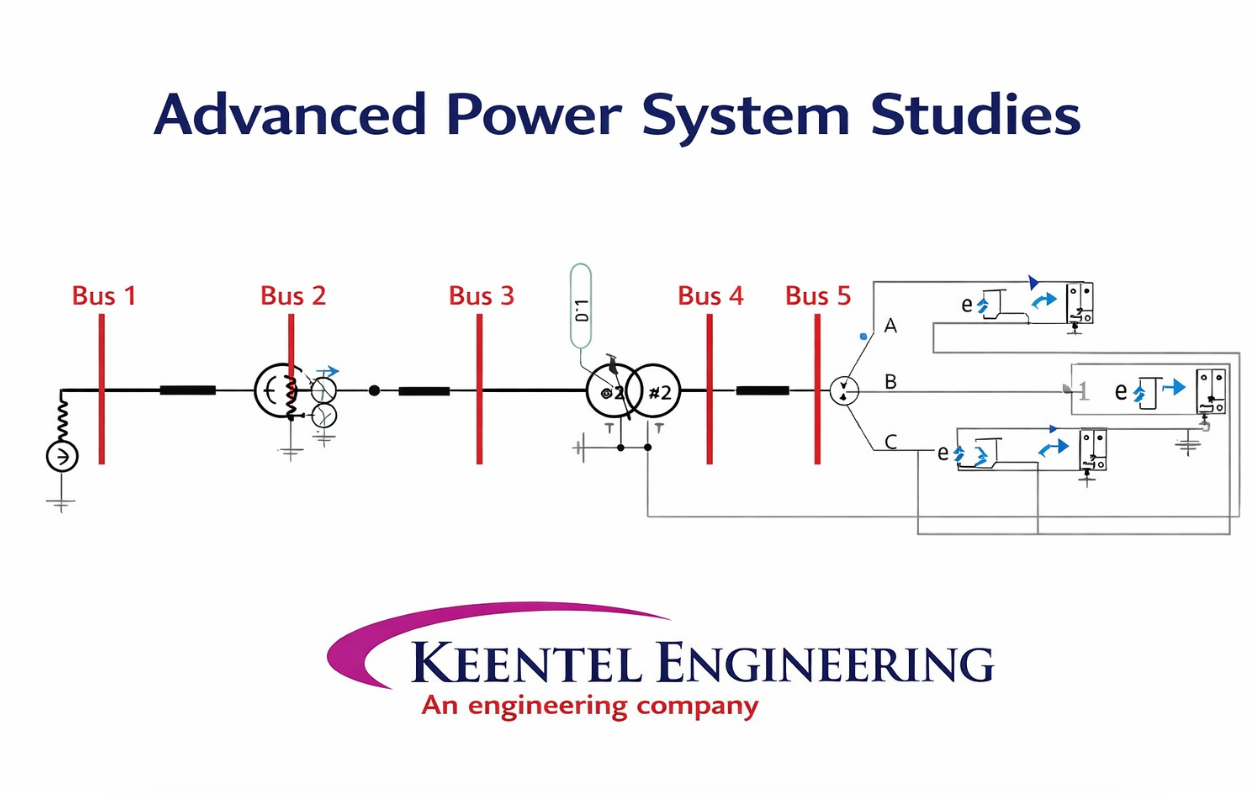
Advanced power system diagram with five buses, generator, transformer, and protection system
Calendar icon. D

Apr 7, 2026  | blog

A Technical Deep Dive for Utilities, Developers & Grid Operators

Introduction

The rapid growth of Distributed Energy Resources (DERs)—solar, wind, BESS, and inverter-based resources has fundamentally changed how power systems behave. Traditional simulation methods, especially positive sequence RMS (Root Mean Square) models, are increasingly insufficient for capturing real-world grid dynamics under high DER penetration.


The NERC technical report highlights a critical industry shift:


  • Moving “beyond positive sequence” toward T&D co-simulation and EMT-based modeling.


At Keentel Engineering we specialize in helping utilities, developers, and asset owners transition to these advanced modeling frameworks ensuring compliance, accuracy, and grid reliability.


What is “Beyond Positive Sequence” Modeling?

Traditional positive sequence models assume:


  • Balanced three-phase systems 
  • Aggregated loads and DERs 
  • Simplified system behavior 


However, real grids especially distribution systems are:


  • Unbalanced 
  • Highly dynamic 
  • Spatially diverse 


“Beyond positive sequence” refers to simulation approaches that:


  • Model phase-level behavior 
  • Capture unbalanced faults 
  • Integrate transmission + distribution (T&D co-simulation) 
  • Include EMT (electromagnetic transient) dynamics 

Key Limitations of Traditional Positive Sequence Models

1. Inability to Capture Unbalanced Fault Behavior


Positive sequence models:


  • Use averaged voltages 
  • Ignore phase-level differences 


Result:


  • Underestimation of DER tripping during faults 


2. Aggregation Masks Real DER Behavior


DER_A models aggregate:


  • Thousands of distributed devices into one equivalent 


Problem:


  • Cannot capture location-specific voltage variations 
  • Misses feeder-level dynamics 


3. Voltage Profile Variability Across Feeders


Voltage varies significantly:


  • Along feeder length 
  • With DER placement 


In some cases:


  • Voltage increases with distance (reverse power flow scenarios) 


Positive sequence models cannot represent this behavior accurately.


4. Transformer Configuration Impacts Are Ignored


Transformer winding (Δ-Y, Y-Y, etc.):


  • Changes phase voltages during faults 


Leads to incorrect DER tripping predictions in simplified models .


5. Motor Stalling & FIDVR Not Accurately Modeled


  • Fault-Induced Delayed Voltage Recovery (FIDVR) 
  • Induction motor dynamics 


Require detailed modeling beyond aggregated approaches. 


When Should You Go Beyond Positive Sequence?

Based on NERC findings, advanced modeling is required when:


  • High DER penetration (>20–30%)
  • Unbalanced fault studies are critical
  • DER tripping accuracy impacts planning decisions
  • Motor stalling / FIDVR risk exists
  • Mixed DER vintages (IEEE 1547-2003 vs 2018)
  • DERs located near disturbance points


Key Insight:


  • Distant buses → positive sequence is adequate 
  • Nearby buses → detailed modeling required 

T&D Co-Simulation: The Industry Solution

What is T&D Co-Simulation?

A combined simulation of:


  • Transmission system (PSSE, PSLF) 
  • Distribution system (OpenDSS, CYME, etc.) 


Enables:


  • Phase-level modeling 
  • Real DER behavior representation 
  • Accurate fault response 

Key Use Cases

1. Motor Stalling & Load Recovery


  • DERs can mitigate or worsen FIDVR 
  • Requires EMT-level accuracy 


2. Mixed DER Modeling (IEEE 1547)


  • Different ride-through settings 
  • Different trip thresholds 


Single aggregated model may not be sufficient.


3. Voltage Profile Analysis


  • Feeder-level voltage diversity 
  • DER location impacts 


4. DER Tripping Accuracy


  • Phase-specific tripping 
  • Realistic system response

Key Technical Observations from NERC

Aggregated models are still useful but limited


  • Good for bulk planning trends 
  • Not for detailed local behavior 


DER_A model is “adequate but not perfect”


  • Works well in many cases 
  • Fails in: 


  • Mixed vintages 
  • Unbalanced faults 
  • Localized studies 


EMT studies are the most accurate but expensive


Challenges include:


  • Data requirements (2x–10x increase) 
  • Long simulation times (months) 
  • High computational cost 

How Keentel Engineering Helps

At Keentel Engineering  we bridge the gap between traditional studies and next-generation grid modeling.

Our Core Services

Advanced Power System Studies


  • RMS + EMT simulations 
  • PSSE, PSCAD, PowerFactory 


T&D Co-Simulation


  • Transmission + distribution integration 
  • DER impact analysis 


DER Modeling & Compliance


  • DER_A parameterization 
  • IEEE 1547 compliance 
  • NERC PRC / MOD / TPL support 


Grid Code & Interconnection Studies


  • ERCOT, CAISO, PJM, WECC 
  • Dynamic and transient stability 


EMT & Inverter-Based Resource Studies


  • Fast control dynamics 
  • Grid-forming / grid-following behavior 


Protection & Control Integration


  • Relay coordination 
  • System stability under faults 

Why Choose Keentel Engineering?

  • 30+ years of engineering expertise
  • Deep expertise in NERC & ISO requirements
  • Advanced modeling tools (PSSE, PSCAD, TSAT, PowerFactory)
  • Proven experience in renewable & BESS projects
  • End-to-end engineering + compliance support

Frequently Asked Questions (FAQs)

  • 1. What is the biggest limitation of positive sequence modeling?

    It assumes balanced conditions and aggregated behavior, which leads to inaccurate results for unbalanced faults and high DER penetration scenarios.


  • 2. When should utilities use T&D co-simulation?

    When detailed feeder-level behavior, DER tripping, or voltage variations significantly impact system stability.


  • 3. Is DER_A model sufficient for all studies?

    No. It works for many planning studies but may fail in:

    • Mixed DER vintages 
    • Unbalanced fault conditions 
    • Localized distribution effects 

  • 4. What is EMT simulation and when is it required?

    EMT (Electromagnetic Transient) simulation models fast dynamics and is required for:

    • Inverter-based resources 
    • Protection studies 
    • Fast control interactions 

  • 5. Why do DERs behave differently across a feeder?

    Because voltage varies along the feeder due to:

    • Distance 
    • Load 
    • DER placement 

  • 6. Can positive sequence models underestimate DER tripping?

    Yes. They use averaged voltages, which are often higher than actual phase voltages during faults.


  • 7. What is FIDVR and why is it important?

    Fault-Induced Delayed Voltage Recovery occurs due to motor stalling and can cause voltage instability especially in high DER systems.


  • 8. How do transformer configurations affect DER behavior?

    They change phase voltages during faults, impacting DER ride-through and tripping behavior.


  • 9. What are mixed DER vintages?

    Systems with DERs installed under different standards (e.g., IEEE 1547-2003 vs 2018), leading to different responses.


  • 10. Why is EMT modeling expensive?

    It requires:

    • Detailed models 
    • High computational power 
    • Long simulation times 

  • 11. Are positive sequence models still useful?

    Yes for system-wide planning and trend analysis, but not for detailed DER behavior.


  • 12. What software is used for advanced studies?

    • PSSE / PSLF (RMS) 
    • PSCAD / EMTP (EMT) 
    • PowerFactory 
    • OpenDSS 

  • 13. What is T&D interface modeling?

    It represents the interaction between transmission and distribution systems critical for DER studies.


  • 14. How does DER penetration affect grid stability?

    Higher DER levels increase:

    • Voltage variability 
    • Control interactions 
    • Risk of instability 

  • 15. What is the role of DER ride-through settings?

    They determine whether DERs stay online or trip during disturbances.


  • 16. Can DERs improve grid stability?

    Yes—if properly controlled, they can provide voltage support and reduce disturbances.


  • 17. What is the future of grid modeling?

    Hybrid approaches:

    • Positive sequence + T&D co-simulation 
    • EMT for critical scenarios 

  • 18. What industries need these studies?

    • Utilities 
    • Renewable developers 
    • Data centers 
    • Industrial facilities 

  • 19. How does Keentel ensure accuracy?

    By combining:

    • Advanced tools 
    • Real system data 
    • NERC-compliant methodologies 

  • 20. How can Keentel support my project?

    We provide:

    • Full interconnection studies 
    • DER modeling 
    • Compliance support 
    • Engineering design & analysis 


Final Thoughts

The power grid is no longer simple, balanced, or predictable.


The future belongs to advanced simulation frameworks that capture real-world complexity.


Keentel Engineering is your partner in that transition.


Man in a blazer and open shirt, looking at the camera, against a blurred background.

About the Author:

Sonny Patel P.E. EC

IEEE Senior Member

In 1995, Sandip (Sonny) R. Patel earned his Electrical Engineering degree from the University of Illinois, specializing in Electrical Engineering . But degrees don’t build legacies—action does. For three decades, he’s been shaping the future of engineering, not just as a licensed Professional Engineer across multiple states (Florida, California, New York, West Virginia, and Minnesota), but as a doer. A builder. A leader. Not just an engineer. A Licensed Electrical Contractor in Florida with an Unlimited EC license. Not just an executive. The founder and CEO of KEENTEL LLC—where expertise meets execution. Three decades. Multiple states. Endless impact.

Four workers in safety vests and helmets stand with arms crossed near wind turbines.

Let's Discuss Your Project

Let's book a call to discuss your electrical engineering project that we can help you with.

Man in a blazer and open shirt, looking at the camera, against a blurred background.

About the Author:

Sonny Patel P.E. EC

IEEE Senior Member

In 1995, Sandip (Sonny) R. Patel earned his Electrical Engineering degree from the University of Illinois, specializing in Electrical Engineering . But degrees don’t build legacies—action does. For three decades, he’s been shaping the future of engineering, not just as a licensed Professional Engineer across multiple states (Florida, California, New York, West Virginia, and Minnesota), but as a doer. A builder. A leader. Not just an engineer. A Licensed Electrical Contractor in Florida with an Unlimited EC license. Not just an executive. The founder and CEO of KEENTEL LLC—where expertise meets execution. Three decades. Multiple states. Endless impact.

Leave a Comment

Related Posts

MOD-026-2 compliance diagram for dynamic model validation of inverter-based resources in power
By SANDIP R PATEL April 7, 2026
Learn MOD-026-2 compliance requirements for dynamic model verification and validation of inverter-based resources, ensuring power system reliability and NERC compliance.
PJM First Use rule elimination for DER interconnection under FERC Order 2222
By SANDIP R PATEL April 7, 2026
Explore PJM’s First Use rule reform, DER interconnection changes, and FERC Order 2222 impacts on solar, BESS, and distribution-level grid integration.
Advanced PSSE and PSCAD modeling services for solid-state transformers in data center power systems
By SANDIP R PATEL April 7, 2026
Advanced PSSE and PSCAD modeling for solid-state transformers in data centers. Ensure grid compliance, stability, and high-performance power systems.
FlexGEB smart building with solar, HVAC, battery storage, and grid-connected energy systems.
By SANDIP R PATEL April 6, 2026
Explore FlexGEB smart buildings using solar, storage, HVAC, and IoT to boost energy efficiency, demand flexibility, and grid resilience.
Keentel Engineering data center design services banner highlighting uptime, grid reliability
By SANDIP R PATEL April 6, 2026
Keentel Engineering delivers data center electrical design for uptime, grid stability, AI workloads, and utility-ready interconnection planning.
Centralized substation protection and control (CPC) system with LAN network, Ethernet switches.
By SANDIP R PATEL April 6, 2026
CPC centralizes substation protection using real-time data, improving reliability, reducing costs, and enabling smart grids.
Digital substation with switchyard, relay room, and grid control for smart grid infrastructure.
By SANDIP R PATEL April 6, 2026
Explore the hidden challenges of digital substations including IEC 61850 interoperability, cybersecurity risks network overload, and timing failures. Learn how expert engineering ensures reliable future ready power systems.
NERC BAL-007-1 Explained banner with power lines and April 1, 2027 effective date.
By SANDIP R PATEL April 3, 2026
Learn how NERC BAL-007-1 ensures energy adequacy, ERA methods, and proactive grid reliability strategies for utilities, developers & BAs.
Future NERC reliability standards for power grid and cybersecurity by Keentel Engineering
By SANDIP R PATEL April 1, 2026
Explore upcoming NERC Reliability Standards (2026–2029), including BAL-007 energy assessments, IBR ride-through rules, cybersecurity (CIP-003-9), and extreme weather planning. Learn compliance strategies, risks, and real-world case studies.