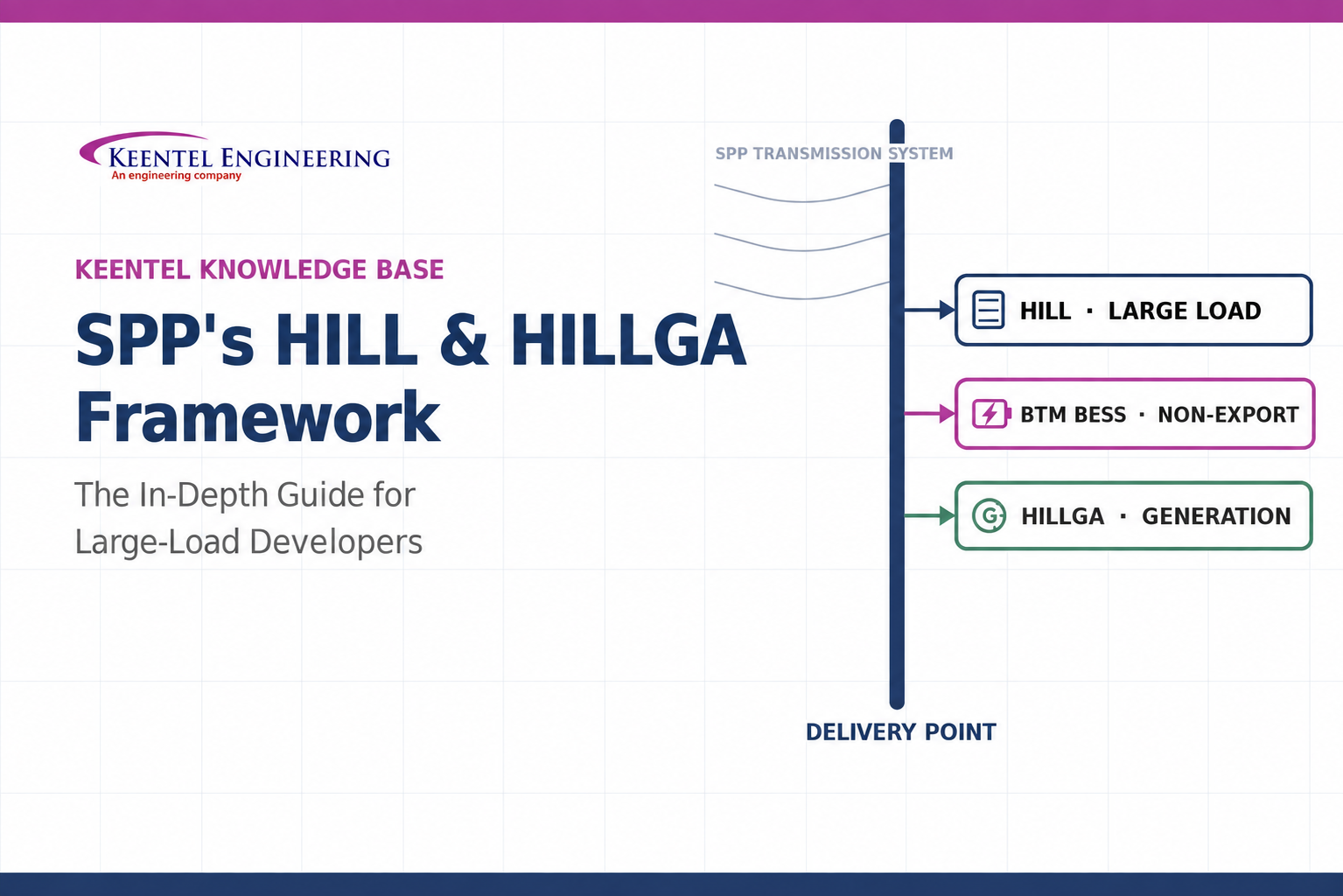

A Coordinated Electric System Interconnection Review—the utility’s deep-dive on technical and cost impacts of your project.

Challenge: Frequent false tripping using conventional electromechanical relays
Solution: SEL-487E integration with multi-terminal differential protection and dynamic inrush restraint
Result: 90% reduction in false trips, saving over $250,000 in downtime

Sustaining Accurate Facility Ratings: Best Practices from ERO Enterprise

Calendar icon. D

July 15, 2025 | Blog

A person in a hard hat and vest examines a clipboard in front of three computer monitors displaying technical diagrams.

In the evolving landscape of power system reliability, ensuring accurate facility ratings is not just a regulatory requirement—it's a foundational pillar for operational integrity, grid stability, and public trust. The ERO Enterprise Facility Ratings Report outlines a comprehensive set of best practices, thematic challenges, and field-proven solutions to help utilities, generator owners, transmission operators, and engineering firms like Keentel Engineering uphold the highest standards in NERC compliance.

This blog breaks down the critical insights from the ERO Enterprise’s May 2023 Facility Ratings Themes Report, providing actionable guidance for utilities and engineering teams.


Why Accurate Facility Ratings Matter

Facility ratings form the bedrock for planning, operations, loadability, modeling, and regulatory compliance. Inaccurate or outdated ratings can cause

  • Mismatches in EMS or planning models
  • Underreported bottlenecks
  • Violations of NERC reliability standards
  • Compromised public and grid safety

These ratings do not exist in isolation. They directly influence operational decisions, system planning, field configuration management, and ambient-adjusted ratings (e.g., per FERC Order 881).


The Four Key Themes Identified by ERO Enterprise

Theme 1: Lack of Awareness

One of the most frequent contributors to inaccurate ratings is a lack of awareness and ownership of the facility ratings program.

Observations

  • Many entities lack clarity on program ownership and roles.
  • Poorly defined controls and documentation processes.
  • Cross-departmental training is often missing.

Best Practices

  • Assign a Facility Ratings Program Sponsor with authority.
  • Clearly define roles and internal controls.
  • Train all staff and contractors involved in the rating process.
  • Use field verification with photographic evidence.
  • Establish a corrective action process for ongoing quality improvement.

Theme 2: Inadequate Asset and Data Management

Outdated or fragmented asset data systems contribute heavily to rating inaccuracies.

Observations

  • Multiple uncoordinated databases.
  • Lack of communication between engineering, field, and compliance teams.
  • Data errors from manual entry or untrained staff.

Best Practices

  • Use a Single Official Master Database.
  • Document workflows for data entry, verification, and retrieval.
  • Apply peer reviews and access control to avoid data manipulation.
  • Train contractors and internal staff on asset tracking protocols.

Theme 3: Inadequate Change Management

From emergency restoration to M&A activity, unrecorded or undocumented changes can corrupt the accuracy of facility ratings.

Observations

  • Poor coordination between departments post-maintenance.
  • Ratings databases not updated after equipment changes.
  • Local field changes (e.g., redlines) often overlooked.

Best Practices

  • Develop a change checklist and approval workflow.
  • Conduct periodic field walk-downs.
  • Require QA/QC reviews after any equipment change.
  • Use a flowchart to govern change reporting and update sequences.

Theme 4: Inconsistent Rating Methodologies

Observations

  • Entities use multiple rating methods inconsistently.
  • Staff are unsure how to apply methodology to various assets.
  • Jointly-owned facilities present coordination challenges.

Best Practices

  • Develop and maintain a detailed, consistent rating methodology.
  • Apply the same method across equipment classes.
  • Train all departments on methodology application.
  • Coordinate with other owners for joint facility alignment.

Human Factors: The Role of Change Leadership

A key insight from the report is that people—not just processes—are at the heart of sustaining accurate ratings.

Key Change Challenges

  • Employees naturally resist change (a psychological phenomenon called anaklesis).
  • Six emotional stages of change: Avoidance, Betrayal, Resistance, Uncertainty, Practice, Take On.
  • Misalignment between technical management and human engagement.

Managerial Leadership Tools

  • Assess emotional readiness for change.
  • Provide context (why the change matters).
  • Offer best advice with empathy.
  • Follow the ABC³ approach: Always Be Communicating, Closing, and Caring.

These soft skills are crucial for ensuring that even the best technical protocols are followed consistently.


Sustaining Your Facility Ratings Program

Creating a sustainable program means embedding controls into every phase of the lifecycle.

Foundational Elements

  1. Appoint a ratings sponsor and process owner.
  2. Define your program’s scope, components, and workflow.
  3. Establish a verified baseline for equipment and ratings.
  4. Periodically validate accuracy.
  5. Apply human performance tools to build long-term accountability.

Integrating Technology

  • Use smart asset management systems for real-time data logging.
  • Integrate facility rating updates into digital twin platforms.
  • Conduct field verification using mobile GIS or AR devices.

Facility Walkdowns: The Ground-Level View

The ERO emphasizes that field verification ("walkdowns") is a vital practice to ensure:

  • Data integrity of physical assets.
  • Identification of components not captured in legacy records.
  • Real-time updates to baseline data.

Tips for Walkdowns

  • Identify all current-carrying components.
  • Include tap changers, bus links, expansion joints.
  • Note test links, isolation switches, and cooling configurations.
  • Look for differences between "as-designed" and "as-installed" assets.

Mitigation and Root Cause Analysis

Regulators are shifting toward a more proactive mitigation model, which includes:

  • Holistic controls (people, process, technology)
  • Risk-based field prioritization
  • Consolidated platforms for asset and rating management
  • Root cause analysis: from isolated errors to systemic process flaws

Implications for Utilities and Engineering Partners

For engineering service providers like Keentel Engineering, the insights from this report are transformative:

  • Strengthen QA/QC for design-build and retrofit projects.
  • Integrate ERO best practices into SCADA, EMS, and relay settings reviews.
  • Ensure that your facility designs align with clients’ FAC-008 compliance obligations.
  • Partner with asset owners to create digital rating models for substations and lines.

Conclusion

Facility ratings represent far more than a numerical value—they are a reflection of organizational discipline, engineering accuracy, and regulatory accountability. The themes and best practices outlined by the ERO Enterprise should guide every utility and consulting partner toward a more reliable and resilient grid.

At Keentel Engineering, we offer comprehensive services to support your facility rating program—from model development and field audits to database design and NERC compliance consulting. Connect with us to elevate the reliability of your infrastructure.


Frequently Asked Questions (FAQ)

  • 1. What is a Facility Rating?

    A facility rating is the maximum continuous load-carrying capability of a transmission element, determined by its most limiting component under specified conditions.

  • 2. Why are accurate facility ratings critical?

    Inaccurate ratings can lead to equipment overload, modeling errors, and NERC compliance violations, which may result in penalties or grid instability.

  • 3. What is FERC Order 881?

    Order 881 requires utilities to implement Ambient-Adjusted Ratings (AARs) for transmission lines, making dynamic ratings a compliance and operational necessity.

  • 4. What’s the most common reason for rating inaccuracies?

    The leading cause is lack of awareness and ownership, followed by poor change and asset management.

  • 5. What is a "baseline" in facility ratings?

    A baseline refers to the initial validated data set of all facility components used to determine ratings.

  • 6. What is anaklesis in change management?

    Anaklesis refers to the emotional resistance to change, especially when it threatens personal identity or routines.

  • 7. What role does leadership play in sustaining accurate ratings?

    Managerial leadership is essential to motivate, communicate, and embed new behaviors, ensuring systems are used properly.

  • 8. What is the ABC³ approach?

    ABC³ stands for:

    • Always Be Communicating
    • Always Be Closing
    • Always Be Caring

    It’s a people-centric change leadership method.


  • 9. What is the difference between facility rating and equipment rating?

    Equipment rating refers to the rating of a single device, while facility rating is the rating of a collection of devices (e.g., a substation line segment).

  • 10. How do utilities verify ratings in the field?

    Through walkdowns, which involve physically inspecting and documenting each facility component.

  • 11. How often should facility ratings be reviewed?

    It’s recommended to periodically validate ratings, especially after any asset change, restoration, or commissioning activity.

  • 12. What tools support facility ratings compliance?

    Master databases, digital twins, EMS/SCADA interfaces, mobile inspection tools, and QA tracking systems.

  • 13. How do asset and data management impact ratings?

    Improper data entry, lack of documentation, or outdated systems can result in critical rating errors.

  • 14. What is FAC-008?

    It is the NERC Reliability Standard that governs the methodology and documentation for Facility Ratings.

  • 15. What is the ABRUPT™ model?

    A change management model describing six emotional phases: Avoidance, Betrayal, Resistance, Uncertainty, Practice, and Take On.

  • 16. What are some examples of devices that can affect ratings?

    • Bus links
    • Tap changers
    • Expansion joints
    • Test links
    • Isolation switches
    • Cooling systems

  • 17. How can Keentel Engineering help with NERC compliance?

    We offer engineering studies, field audits, change tracking tools, and documentation aligned with FAC-008, FAC-003, and Order 881.

  • 18. What’s the best way to start a facility rating program?

    Begin by defining ownership, building a verified baseline, and creating internal controls for data and change management.

  • 19. How does contractor work impact ratings?

    Unverified contractor work may introduce errors; hence, field validation and contractor training are crucial.

  • 20. What are the risks of inconsistent rating methodologies?

    They can lead to incorrect system planning, incompatible model data, and non-compliance with reliability standards.


Ready to Improve Your Facility Ratings Program?

Whether you need help with field verification, change management protocols, or aligning with FAC-008 and FERC Order 881, Keentel Engineering is ready to support your compliance journey.


Man in a blazer and open shirt, looking at the camera, against a blurred background.

About the Author:

Sonny Patel P.E. EC

IEEE Senior Member

In 1995, Sandip (Sonny) R. Patel earned his Electrical Engineering degree from the University of Illinois, specializing in Electrical Engineering . But degrees don’t build legacies—action does. For three decades, he’s been shaping the future of engineering, not just as a licensed Professional Engineer across multiple states (Florida, California, New York, West Virginia, and Minnesota), but as a doer. A builder. A leader. Not just an engineer. A Licensed Electrical Contractor in Florida with an Unlimited EC license. Not just an executive. The founder and CEO of KEENTEL LLC—where expertise meets execution. Three decades. Multiple states. Endless impact.

Four workers in safety vests and helmets stand with arms crossed near wind turbines.

Let's Discuss Your Project

Let's book a call to discuss your electrical engineering project that we can help you with.

Man in a blazer and open shirt, looking at the camera, against a blurred background.

About the Author:

Sonny Patel P.E. EC

IEEE Senior Member

In 1995, Sandip (Sonny) R. Patel earned his Electrical Engineering degree from the University of Illinois, specializing in Electrical Engineering . But degrees don’t build legacies—action does. For three decades, he’s been shaping the future of engineering, not just as a licensed Professional Engineer across multiple states (Florida, California, New York, West Virginia, and Minnesota), but as a doer. A builder. A leader. Not just an engineer. A Licensed Electrical Contractor in Florida with an Unlimited EC license. Not just an executive. The founder and CEO of KEENTEL LLC—where expertise meets execution. Three decades. Multiple states. Endless impact.

Leave a Comment

Related Posts

FlexGEB smart building with solar, HVAC, battery storage, and grid-connected energy systems.
By SANDIP R PATEL April 6, 2026
Explore FlexGEB smart buildings using solar, storage, HVAC, and IoT to boost energy efficiency, demand flexibility, and grid resilience.
Keentel Engineering data center design services banner highlighting uptime, grid reliability
By SANDIP R PATEL April 6, 2026
Keentel Engineering delivers data center electrical design for uptime, grid stability, AI workloads, and utility-ready interconnection planning.
Centralized substation protection and control (CPC) system with LAN network, Ethernet switches.
By SANDIP R PATEL April 6, 2026
CPC centralizes substation protection using real-time data, improving reliability, reducing costs, and enabling smart grids.
Digital substation with switchyard, relay room, and grid control for smart grid infrastructure.
By SANDIP R PATEL April 6, 2026
Explore the hidden challenges of digital substations including IEC 61850 interoperability, cybersecurity risks network overload, and timing failures. Learn how expert engineering ensures reliable future ready power systems.
NERC BAL-007-1 Explained banner with power lines and April 1, 2027 effective date.
By SANDIP R PATEL April 3, 2026
Learn how NERC BAL-007-1 ensures energy adequacy, ERA methods, and proactive grid reliability strategies for utilities, developers & BAs.
Future NERC reliability standards for power grid and cybersecurity by Keentel Engineering
By SANDIP R PATEL April 1, 2026
Explore upcoming NERC Reliability Standards (2026–2029), including BAL-007 energy assessments, IBR ride-through rules, cybersecurity (CIP-003-9), and extreme weather planning. Learn compliance strategies, risks, and real-world case studies.
Substation equipment testing and validation process with electrical panels and FAT inspection
By SANDIP R PATEL March 31, 2026
Learn the complete substation testing lifecycle including Type Testing, FAT, and SAT. Discover how to reduce risks, improve reliability, and ensure NERC compliance.
Internal inspection engineers identifying root causes in industrial equipment at Keentel Engineering
By SANDIP R PATEL March 31, 2026
Explore advanced transformer failure analysis methods, diagnostics, and prevention strategies used by power system engineers.
Power system engineering services for data centers and industrial large load integration
By SANDIP R PATEL March 28, 2026
Explore SEL PMU devices, IEEE-compliant synchrophasor tech, and grid monitoring solutions for real-time visibility, stability, and renewable integration.