

A Coordinated Electric System Interconnection Review—the utility’s deep-dive on technical and cost impacts of your project.
Challenge: Frequent false tripping using conventional electromechanical relays
Solution: SEL-487E integration with multi-terminal differential protection and dynamic inrush restraint
Result: 90% reduction in false trips, saving over $250,000 in downtime
| Category | Metric |
|---|---|
| VPP capacity (Lunar Energy) | 650 MW |
| Lunar funding raised | US$232 million |
| Data center BESS example | 31 MW / 62 MWh |
| ERCOT grid-scale batteries | 15+ GW |
| LDES tenders (H1 2026) | Up to 9.3 GW |
| Lithium-ion share of LDES by 2030 | 77% |
| FEOC initial threshold | 55% |
| BESS tariff rate (2026) | ~55% |
| Capacity gain from analytics | 5–15% |
PMU , Synchrophasor Technology and Wide Area Monitoring Systems (WAMS): Transforming Grid Visibility and Stability in Modern Power Systems
Mar 28, 2026 | blog
1. Introduction: The Shift from SCADA to High-Resolution Grid Intelligence
Traditional SCADA systems, while foundational, operate at time resolutions of seconds far too slow for today’s dynamic grids dominated by inverter-based resources (IBRs), renewable variability and complex interconnections.
Enter synchrophasor technology and Wide Area Monitoring Systems (WAMS) a paradigm shift enabling:
- Sub-second situational awareness
- Real-time angle stability monitoring
- Oscillation detection and damping
- Data-driven operational decision-making
For utilities, ISOs, and developers, synchrophasors are no longer optional they are becoming critical infrastructure for grid reliability and compliance.
2. What Are Synchrophasors? A Precise Engineering Definition
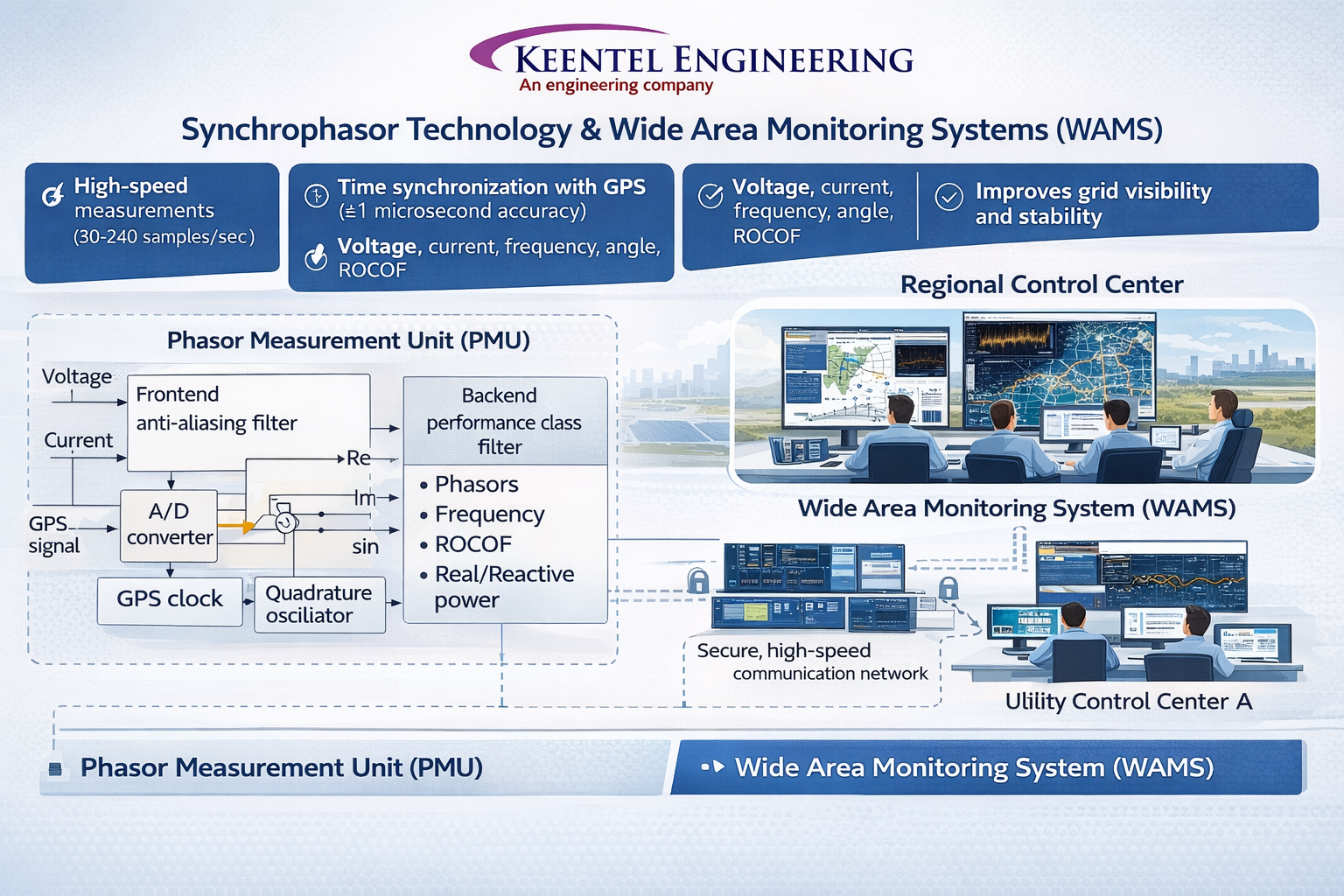
A synchrophasor is a time-synchronized measurement of electrical quantities (voltage/current phasors) referenced to a common time source, typically GPS.
Key Characteristics:
- Time synchronization accuracy: ±1 microsecond
- Reporting rates: 30–240 samples per second
- Measured parameters:
- Voltage magnitude & angle
- Current magnitude & angle
- Frequency
- Rate of Change of Frequency (ROCOF)
Governing Standard:
- IEEE C37.118.1 / C37.118.2
- Defines measurement accuracy and communication protocols
PMUs are the field devices that generate synchrophasor data.
Functional Components:
- Signal Acquisition
- CT/PT inputs (HV/MV substations)
- GPS Time Synchronization
- Provides absolute timestamp alignment across grid
- Phasor Estimation Engine
- Uses Discrete Fourier Transform (DFT) or advanced filtering
- Communication Interface
- Streams data to Phasor Data Concentrators (PDCs)
3. Phasor Measurement Units (PMUs): The Core Hardware Layer
Why PMUs Are Superior to SCADA
| Feature | SCADA | PMU |
|---|---|---|
| Sampling Rate | 2–4 sec | 30–240 samples/sec |
| Time Sync | None | GPS synchronized |
| Data Type | RMS values | Phasors + dynamic data |
| Use Case | Monitoring | Dynamic stability analysis |
4. Wide Area Monitoring Systems (WAMS): System-Level Architecture
WAMS integrates PMUs across geographically dispersed locations into a unified monitoring platform.
Core Architecture:
PMUs → Local PDCs → Central PDC → Control Center Applications
Components Explained:
🔹 Phasor Data Concentrators (PDCs)
- Align data streams by timestamp
- Filter bad/missing data
- Aggregate multiple PMU inputs
🔹 Communication Network
- Fiber optic / MPLS / microwave
- Latency requirement: <100 ms for real-time applications
🔹 Control Center Applications
- Visualization dashboards
- Stability monitoring tools
- Oscillation detection systems
5. Key Applications of Synchrophasors and WAMS
5.1 Real-Time Angle Stability Monitoring
Voltage phase angle differences across the grid directly indicate system stress.
- Large angle separation → instability risk
- Enables operators to detect impending blackouts
5.2 Oscillation Detection and Damping
PMUs can identify:
- Inter-area oscillations (0.1–1 Hz)
- Local oscillations (1–3 Hz)
Advanced analytics:
- Mode estimation
- Damping ratio calculation
- Real-time alarms
5.3 Frequency Stability & ROCOF Monitoring
Critical for:
- Low-inertia systems (IBR-heavy grids)
- Under-frequency load shedding (UFLS)
5.4 Model Validation (PSSE / TSAT / PSCAD)
Synchrophasor data is used to:
- Validate dynamic models
- Tune inverter controls
- Ensure compliance with interconnection studies
5.5 Event Analysis and Post-Disturbance Forensics
High-resolution data enables:
- Fault reconstruction
- Relay performance validation
- Root cause analysis
6. Integration with Renewable and Inverter-Based Resources (IBRs)
Modern grids are transitioning toward:
- Solar PV
- Wind
- Battery Energy Storage Systems (BESS)
Challenges:
- Reduced system inertia
- Fast transient behavior
- Complex control interactions
Role of Synchrophasors:
- Monitor inverter dynamics
- Detect control instabilities
- Support grid-forming vs grid-following analysis
7. Synchrophasors vs EMS vs SCADA: Hybrid Operational Framework
System Role
- SCADA
- Steady-state monitoring
- EMS
- Control & dispatch
- WAMS
- Dynamic situational awareness
Future grids rely on integrated SCADA + EMS + WAMS architecture
8. Communication and Data Challenges
8.1 Latency Constraints
- Real-time applications require <100 ms
- Protection applications require even lower
8.2 Data Volume
- High sampling rates → massive data streams
- Requires:
- Data compression
- Edge processing
8.3 Cybersecurity Risks
- GPS spoofing
- Data injection attacks
9. NERC and Grid Code Relevance
Synchrophasor deployment supports compliance with:
- NERC PRC standards
- MOD-026 / MOD-027 (Model validation)
- TPL standards (system stability)
Regional relevance:
- ERCOT → dynamic model validation (DWG requirements)
- WECC → oscillation monitoring
- PJM / SPP → interconnection and disturbance analysis
10. Future of WAMS: AI, Big Data, and Predictive Analytics
Next-generation systems are integrating:
🔹 Artificial Intelligence
- Predict instability before it occurs
- Automated control actions
🔹 Digital Twins
- Real-time grid replicas
- Continuous model calibration
🔹 Edge Computing
- Local decision-making at substations
11. Challenges in Implementation
- High capital cost for PMU deployment
- Communication infrastructure upgrades
- Data management complexity
- Integration with legacy systems
12. Case Studies (Confidential – Representative Engineering Scenarios)
Case Study 1: Oscillation Detection in a Renewable-Rich Grid
Scenario:
- A 500 MW solar plant connected to a weak grid exhibited oscillations.
Solution:
- PMUs installed at POI and nearby substations
- Identified 0.4 Hz oscillation mode
- Adjusted inverter control parameters
Result:
- Damping improved from 2% → 8%
- Grid stability restored
Case Study 2: Angle Stability Monitoring in Transmission Corridor
Scenario:
- High loading in a 345 kV corridor caused angle separation concerns.
Solution:
- WAMS deployed across 5 substations
- Real-time angle monitoring implemented
Result:
- Operators prevented cascading outage
- Improved situational awareness
Case Study 3: Model Validation for BESS Integration
Scenario:
- Battery system model mismatch during dynamic studies.
Solution:
- Synchrophasor data used for validation
- Updated PSSE dynamic model
Result:
- Accurate simulation alignment
- Successful interconnection approval
13. Conclusion: Synchrophasors as the Backbone of the Future Grid
Synchrophasors and WAMS are no longer emerging technologies they are essential tools for modern grid operation.
They enable:
- Faster decision-making
- Improved reliability
- Better integration of renewables
- Compliance with evolving standards
For engineering firms like Keentel Engineering, synchrophasor expertise is critical in delivering:
- High-fidelity modeling
- Grid compliance solutions
- Advanced system studies
Technical FAQs (Engineer-Level)
1. What is Total Vector Error (TVE) in PMU measurements?
TVE quantifies the accuracy of synchrophasor measurements as defined in IEEE C37.118.1.
2. What is the typical reporting rate of PMUs?
30, 60, or 120 samples per second depending on system requirements.
3. How does GPS synchronization impact PMU accuracy?
It ensures time alignment across geographically dispersed measurements within microseconds.
4. What is ROCOF and why is it important?
Rate of Change of Frequency indicates system inertia and stability conditions.
5. How are PMUs used in oscillation detection?
They provide high-resolution time-series data for modal analysis.
6. What is a PDC?
A Phasor Data Concentrator aggregates and aligns PMU data streams.
7. How do synchrophasors support NERC compliance?
They enable model validation, disturbance analysis, and system monitoring.
8. What is the difference between static and dynamic phasors?
Dynamic phasors account for time-varying signals and transient conditions.
9. What communication protocols are used in WAMS?
IEEE C37.118.2 and IEC 61850 extensions.
10. Can PMUs be used for protection?
Yes, but with stringent latency and reliability requirements.
11. What is angle stability?
It refers to maintaining synchronism between generators.
12. How do synchrophasors help renewable integration?
They monitor fast dynamics of inverter-based resources.
13. What are inter-area oscillations?
Low-frequency oscillations between large grid regions.
14. What is damping ratio?
A measure of how quickly oscillations decay.
15. How is PMU data used in PSSE?
For model validation and tuning.
16. What are the cybersecurity risks in WAMS?
GPS spoofing, data injection, and communication attacks.
17. What is latency requirement for real-time WAMS?
Typically less than 100 ms.
18. What is the role of edge computing in WAMS?
Local processing to reduce latency and data load.
19. How do PMUs differ from digital fault recorders?
PMUs provide continuous synchronized data, while DFRs capture events.
20. What is the future of synchrophasor technology?
Integration with AI, predictive analytics, and digital twins.

About the Author:
Sonny Patel P.E. EC
IEEE Senior Member
In 1995, Sandip (Sonny) R. Patel earned his Electrical Engineering degree from the University of Illinois, specializing in Electrical Engineering . But degrees don’t build legacies—action does. For three decades, he’s been shaping the future of engineering, not just as a licensed Professional Engineer across multiple states (Florida, California, New York, West Virginia, and Minnesota), but as a doer. A builder. A leader. Not just an engineer. A Licensed Electrical Contractor in Florida with an Unlimited EC license. Not just an executive. The founder and CEO of KEENTEL LLC—where expertise meets execution. Three decades. Multiple states. Endless impact.
Services

Let's Discuss Your Project
Let's book a call to discuss your electrical engineering project that we can help you with.

About the Author:
Sonny Patel P.E. EC
IEEE Senior Member
In 1995, Sandip (Sonny) R. Patel earned his Electrical Engineering degree from the University of Illinois, specializing in Electrical Engineering . But degrees don’t build legacies—action does. For three decades, he’s been shaping the future of engineering, not just as a licensed Professional Engineer across multiple states (Florida, California, New York, West Virginia, and Minnesota), but as a doer. A builder. A leader. Not just an engineer. A Licensed Electrical Contractor in Florida with an Unlimited EC license. Not just an executive. The founder and CEO of KEENTEL LLC—where expertise meets execution. Three decades. Multiple states. Endless impact.
Leave a Comment
We will get back to you as soon as possible.
Please try again later.