

A Coordinated Electric System Interconnection Review—the utility’s deep-dive on technical and cost impacts of your project.

Challenge: Frequent false tripping using conventional electromechanical relays
Solution: SEL-487E integration with multi-terminal differential protection and dynamic inrush restraint
Result: 90% reduction in false trips, saving over $250,000 in downtime

Category Metric
VPP capacity (Lunar Energy) 650 MW
Lunar funding raised US$232 million
Data center BESS example 31 MW / 62 MWh
ERCOT grid-scale batteries 15+ GW
LDES tenders (H1 2026) Up to 9.3 GW
Lithium-ion share of LDES by 2030 77%
FEOC initial threshold 55%
BESS tariff rate (2026) ~55%
Capacity gain from analytics 5–15%

Global Grid Scale BESS Market 2026: Statistical Deep Dive into Deployment Trends, China’s Dominance, Australia’s Scale Up and US Diversification

Western grid transformation with wind turbines, solar panels, HVDC, and EMT simulations.
Calendar icon. D

february 25/2026  | blog

February 2026 Analysis | Grid-Scale Battery Energy Storage Systems (BESS)

The first month of 2026 has already revealed a structural shift in the global battery energy storage system (BESS) market. While deployments slowed year-over-year, the industry is simultaneously scaling to larger project sizes, tightening safety standards, intensifying competition, and beginning to diversify beyond lithium-ion technology particularly in the United States.


This in-depth statistical analysis synthesizes the latest deployment data, technology milestones, policy impacts, and market positioning signals shaping the global grid-scale BESS landscape.


Executive Summary

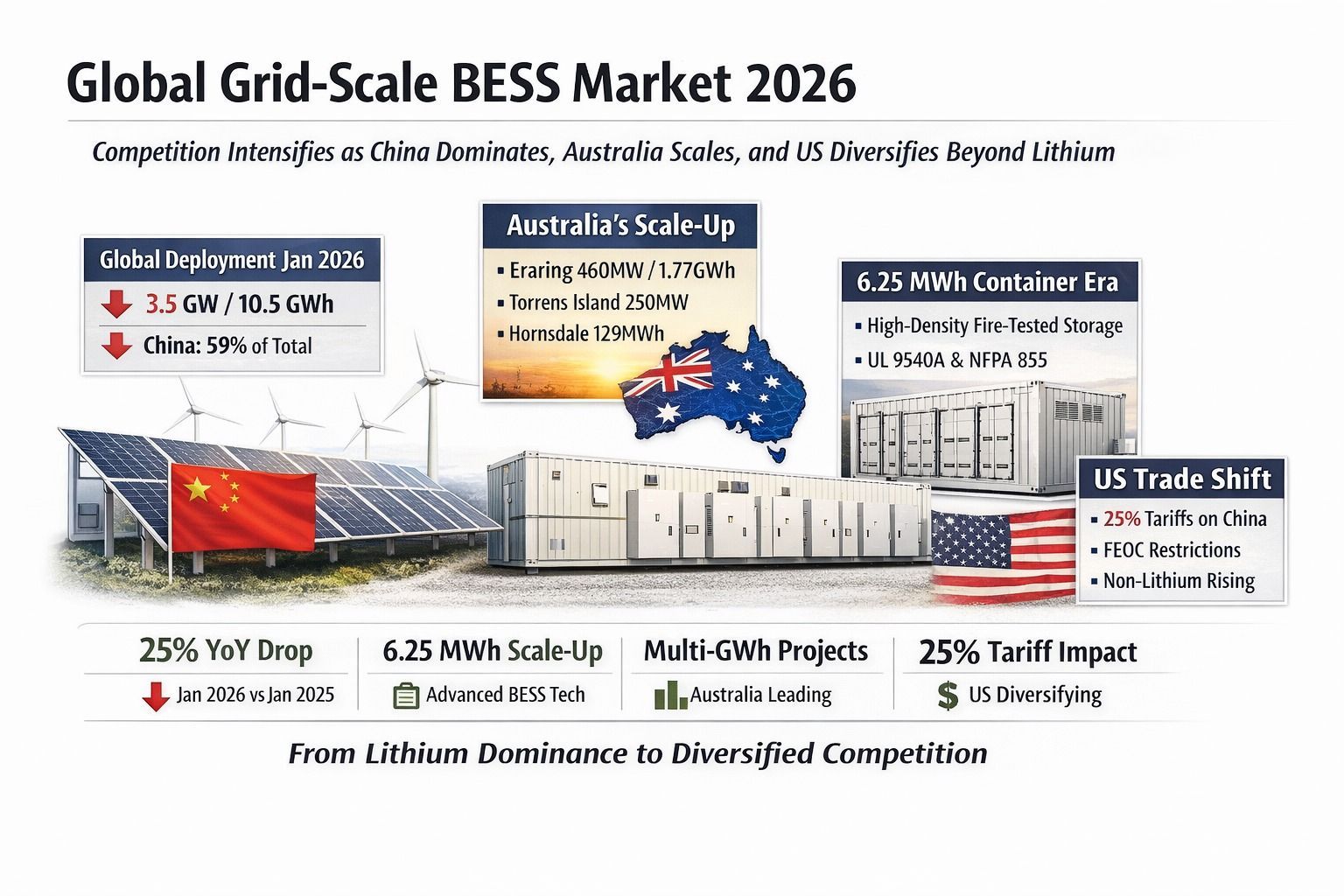
  • Global January 2026 deployments fell 25% YoY to 3.5GW / 10.5GWh.
  • China still accounts for ~59% of global deployed energy capacity, despite a domestic slowdown.
  • Australia continues scaling into multi GWh assets, reinforcing its role as a proving ground.
  • Container-level energy density reached 6.25MWh, marking a new industry benchmark.
  • US FEOC and Section 301 tariffs are accelerating diversification beyond lithium-ion.
  • Competitive pressure is increasing  “each megawatt will be competing.”


The market is not contracting  it is maturing.


1. Global Deployment Snapshot: January 2026 vs January 2025

Table 1 – Global Grid-Scale BESS Deployments

Metric January 2025 January 2026 YoY Change
Power Capacity 5.2 GW 3.5 GW -25%
Energy Capacity 13.8 GWh 10.5 GWh -24%

Interpretation

  • The slowdown does not indicate structural weakness.


  • Instead, it reflects:


  • China policy recalibration
  • Project timing shifts
  • Increased procurement scrutiny under trade rules
  • Competitive saturation in certain ancillary markets


The industry is entering a capital discipline phase.


2. Regional Market Breakdown: Who Is Driving Deployment?

Table 2 – Regional Deployment (January 2026)

Region Power (MW) Energy (MWh/GWh) Share of Global Energy
China 1,900 MW 6.2 GWh ~59%
Oceania >2 GWh ~19%
Europe 628 MW 1,358 MWh ~13%
North America 169 MW 523 MWh ~5%
South & Central America 110 MW 220 MWh ~2%

Key Observations

  • China remains the gravitational center of the global BESS market.
  • Oceania had its strongest month on record, driven largely by Australia.
  • Europe continues steady scaling.
  • North America is transitioning under policy shifts.

3. China: Still Dominant, But Cooling

Table 3 – China YoY Deployment Comparison

Metric Jan 2025 Jan 2026 Change
Power 3.9 GW 1.9 GW -30% to -50%
Energy 9.52 GWh 6.2 GWh ~19%

Despite the slowdown:


  • China still accounts for the majority of global capacity.
  • Large-scale standalone storage projects (e.g., 2GWh project in Xinjiang) demonstrate continued scale.
  • However, domestic policy adjustments are moderating growth velocity.


Conclusion: China is still the engine but it is no longer accelerating at previous rates.


4. Australia: From Demonstration to Multi-GWh Maturity

Australia continues to serve as a global proving ground for utility-scale BESS.

Table 4 – Australia’s Storage Scaling Timeline

Year Project Size Significance
2017 Hornsdale Power Reserve 129 MWh First major grid-scale battery
2023 Torrens Island BESS 250 MW Mature large-scale deployment
2026 Eraring Battery 1 460 MW / 1.77 GWh Multi-GWh era

Market Implications

  • Rapid scale-up from sub-200MWh systems to nearly 2GWh assets.
  • Revenue stacking (arbitrage, FCAS, capacity support) becoming more competitive.
  • Market saturation signals emerging — hence the statement.


“Each megawatt will be competing.”

Australia is transitioning from early mover advantage to market efficiency optimization.


5. Technology Escalation: The 6.25MWh Container Era

A critical 2026 milestone was the completion of the world’s first open-door large-scale fire test of a 6.25MWh containerized BESS system.

Table 5 – Container Energy Density Evolution

Period Typical Container Size
2017 Hornsdale Power Reserve
2023 Torrens Island BESS
2026 Eraring Battery 1

This represents:


  • 2x energy density increase from early systems
  • Scaling via ultra-large 1175Ah cells
  • Compliance with UL 9540A 2025 and NFPA 855-2026

Table 6 – Fire Test Conditions (Worst-Case Scenario)

Parameter Condition
State of Charge 100%
Fire Suppression Disabled
Door Condition Fully open
Container Spacing 15 cm
Result

Why This Matters

As container densities increase:


The industry is entering an era of engineering-led differentiation.


6. US Trade Policy: The Beginning of Diversification

On January 1, 2026:


  • FEOC restrictions took effect
  • Section 301 tariffs rose to 25% on Chinese BESS imports

Table 7 – Policy Impact Summary

Policy Mechanism Market Effect
FEOC restrictions Procurement uncertainty, supply chain reshuffling
25% tariffs Upward cost pressure on Chinese imports
45X manufacturing credit Incentivizes domestic production
Domestic content ITC adder Up to ~40% ITC potential

Cost Benchmark Shift

Chinese lithium-ion systems:


  • Still competitive
  • But narrowing price gap
  • Risk-adjusted economics increasingly favor compliant supply chains


The result?

The US market is moving beyond a lithium-only future.


7. Long-Duration Economics: Beyond 4-Hour Storage

Lithium-ion remains cost-effective for:


  • 1–4 hour applications


But for:


  • 6–10 hour durations
  • Capacity adequacy markets
  • AI-driven data center load balancing


Non-lithium technologies are gaining traction.

Table 8 – Technology Positioning by Duration

Duration Lithium-Ion Non-Lithium (Flow, Organic)
1–4 hours Strong benchmark Competitive
4–6 hours Marginal cost advantage Increasingly viable
6–10 hours Cost pressure Advantage emerging

8. Pipeline Momentum: Construction & Supply Deals

Table 9 – Projects Entering Construction or Supply Agreements

While January operational capacity slowed:

Metric January 2026
Total GWh 15.6 GWh
Projects ≥1 GWh 6
Regions China (3), US, Romania, Italy

This suggests:

  • Strong medium-term deployment momentum
  • Larger average project size
  • Continued global expansion

9  Competitive Landscape: The Era of Margin Compression

We are witnessing a structural shift:

Phase Characteristic
2017–2020 Early adopter premium
2021–2024 Rapid scaling
2025–2026 Competitive maturity

Key signals:


  • Slower YoY growth
  • Procurement complexity
  • Technology differentiation
  • Policy-driven supply chain shifts
  • Larger standardized systems


The industry is entering its utility-grade industrial phase.


10. 2026–2028 Outlook

Based on current indicators:


  • China remains volume leader.
  • Australia continues refining grid integration economics.
  • Europe expands steadily.
  • US diversifies technology and supply chains.
  • Container density likely to exceed 7MWh within 24–36 months.
  • Long-duration (>6h) storage market share expected to increase.


Global annual deployment is likely to remain strong, but volatility will increase quarter-to-quarter due to:


  • Policy timing
  • Tariff adjustments
  • Capital cost pressures
  • Grid interconnection bottlenecks

Conclusion: The BESS Market Is Not Slowing — It Is Maturing

January 2026’s data does not represent contraction.

It represents transition:


  • From lithium-only dominance → diversified chemistries
  • From pilot projects → multi-GWh scale
  • From rapid growth → disciplined competition
  • From safety assumptions → validated extreme-condition testing
  • From price leadership → risk-adjusted economics


The next phase of grid-scale storage will be defined by:


  • Engineering quality
  • Regulatory compliance
  • Domestic manufacturing capability
  • Long-duration economics
  • Bankability under extreme conditions


And as Australia’s market leader summarized:


  • Each megawatt will be competing.
  • The global BESS industry has entered its competitive era.


A smiling man with glasses and a beard wearing a blue blazer stands in front of server racks in a data center.

About the Author:

Sandip "Sonny" R. Patel, P.E.

IEEE Senior Member · Founder & CEO, Keentel Engineering

In 1995, Sonny Patel earned his Electrical Engineering degree from the University of Illinois. But degrees don't build legacies — action does.

For three decades, he has worked the power industry from every side of the table: 16 years as a utility engineer at Exelon/Commonwealth Edison; generation leadership across hydroelectric, industrial steam turbine, and a 9 GW renewable fleet; NERC Regional Entity Senior Compliance Engineer and Audit Team Lead, auditing some of the nation's largest utilities; and testing and commissioning lead on equipment up to 765 kV — the very top of the North American grid.

Utility. Generator. Regulator. Consultant. Few engineers have seen all four seats. Fewer still have sat in them.His experience spans nuclear, hydro, conventional generation, renewables, oil and gas, mining — and today's data centers, where he is authoring a three-book series on data center design. He is a Licensed Professional Engineer in six states and a Licensed Electrical Contractor in Florida (Unlimited EC) — he doesn't just design the work; he's qualified to stand behind its execution.Today, as Founder and CEO of Keentel Engineering, Sonny leads 51 engineers delivering substation design, power system studies, NERC compliance, and commissioning — done right, coast to coast.Three decades. Every side of the table. One standard: accountable engineering

Four workers in safety vests and helmets stand with arms crossed near wind turbines.

Let's Discuss Your Project

Let's book a call to discuss your electrical engineering project that we can help you with.

Man in a blazer and open shirt, looking at the camera, against a blurred background.

About the Author:

Sandip "Sonny" R. Patel, P.E.

IEEE Senior Member · Founder & CEO, Keentel Engineering

In 1995, Sonny Patel earned his Electrical Engineering degree from the University of Illinois. But degrees don't build legacies — action does.

For three decades, he has worked the power industry from every side of the table: 16 years as a utility engineer at Exelon/Commonwealth Edison; generation leadership across hydroelectric, industrial steam turbine, and a 9 GW renewable fleet; NERC Regional Entity Senior Compliance Engineer and Audit Team Lead, auditing some of the nation's largest utilities; and testing and commissioning lead on equipment up to 765 kV — the very top of the North American grid.Utility. Generator. Regulator. Consultant. Few engineers have seen all four seats. Fewer still have sat in them.His experience spans nuclear, hydro, conventional generation, renewables, oil and gas, mining — and today's data centers, where he is authoring a three-book series on data center design. He is a Licensed Professional Engineer in six states and a Licensed Electrical Contractor in Florida (Unlimited EC) — he doesn't just design the work; he's qualified to stand behind its execution.Today, as Founder and CEO of Keentel Engineering, Sonny leads 51 engineers delivering substation design, power system studies, NERC compliance, and commissioning — done right, coast to coast.Three decades. Every side of the table. One standard: accountable engineering

Leave a Comment

Related Posts

Structure height and voltage in transmission line design guide by Keentel Engineering with power tow
By SANDIP R PATEL August 22, 2026
Learn how transmission structure height is calculated using NESC clearance rules, sag-tension analysis, voltage classes, terrain, span length, and IEEE standards.
Gas-insulated substation design and engineering diagram.
By SANDIP R PATEL August 22, 2026
Explore gas-insulated substations (GIS), including design, GIS vs AIS, SF₆ alternatives, grounding, VFTO, safety, and key IEEE and IEC standards.
Sizing AC cables in a utility-scale solar PV plant technical guide by Keentel Engineering, showing N
By SANDIP R PATEL August 22, 2026
Learn NEC-based AC cable sizing for utility-scale solar PV plants, including ampacity, voltage drop, derating factors, short-circuit checks, and inverter examples.
By SANDIP R PATEL August 22, 2026
Learn how NERC's new data center rules affect registration, modeling, protection, compliance, and what computational load operators should do now.
POI interconnection engineering for large loads and data centers.
By SANDIP R PATEL August 20, 2026
2026 guide to POI interconnection for data centers and large loads. Explore ISO/RTO requirements, grid studies, PSCAD modeling, costs, timelines and NERC rules.
Solar and battery storage shared bus resonance diagram
By SANDIP R PATEL August 20, 2026
Learn how shared 480 V solar and BESS buses create resonance, harmonic, grounding, and transformer issues—and how proper engineering prevents failures.
12.47 kV pole-mounted distribution transformer assembly designed for U.S. IEEE and NESC utility stan
By SANDIP R PATEL August 20, 2026
Learn U.S. pole-mounted transformer design requirements, including IEEE, ANSI, and NESC standards, voltage classes, grounding, protection, and DER considerations.
Neutral grounding resistor sizing guide for HRG and LRG power system grounding applications
By SANDIP R PATEL August 20, 2026
Learn how to size neutral grounding resistors using IEEE and NEC practices, including HRG/LRG selection, fault current calculations, duty ratings, and examples.
PRC-023-6 BESS relay loadability compliance guide
By SANDIP R PATEL August 19, 2026
Understand PRC-023-6 for utility-scale BESS: applicability, the 39-month rule, relay loadability, setting criteria, Category 2 IBRs, and audit evidence.