A Coordinated Electric System Interconnection Review—the utility’s deep-dive on technical and cost impacts of your project.
Challenge: Frequent false tripping using conventional electromechanical relays
Solution: SEL-487E integration with multi-terminal differential protection and dynamic inrush restraint
Result: 90% reduction in false trips, saving over $250,000 in downtime
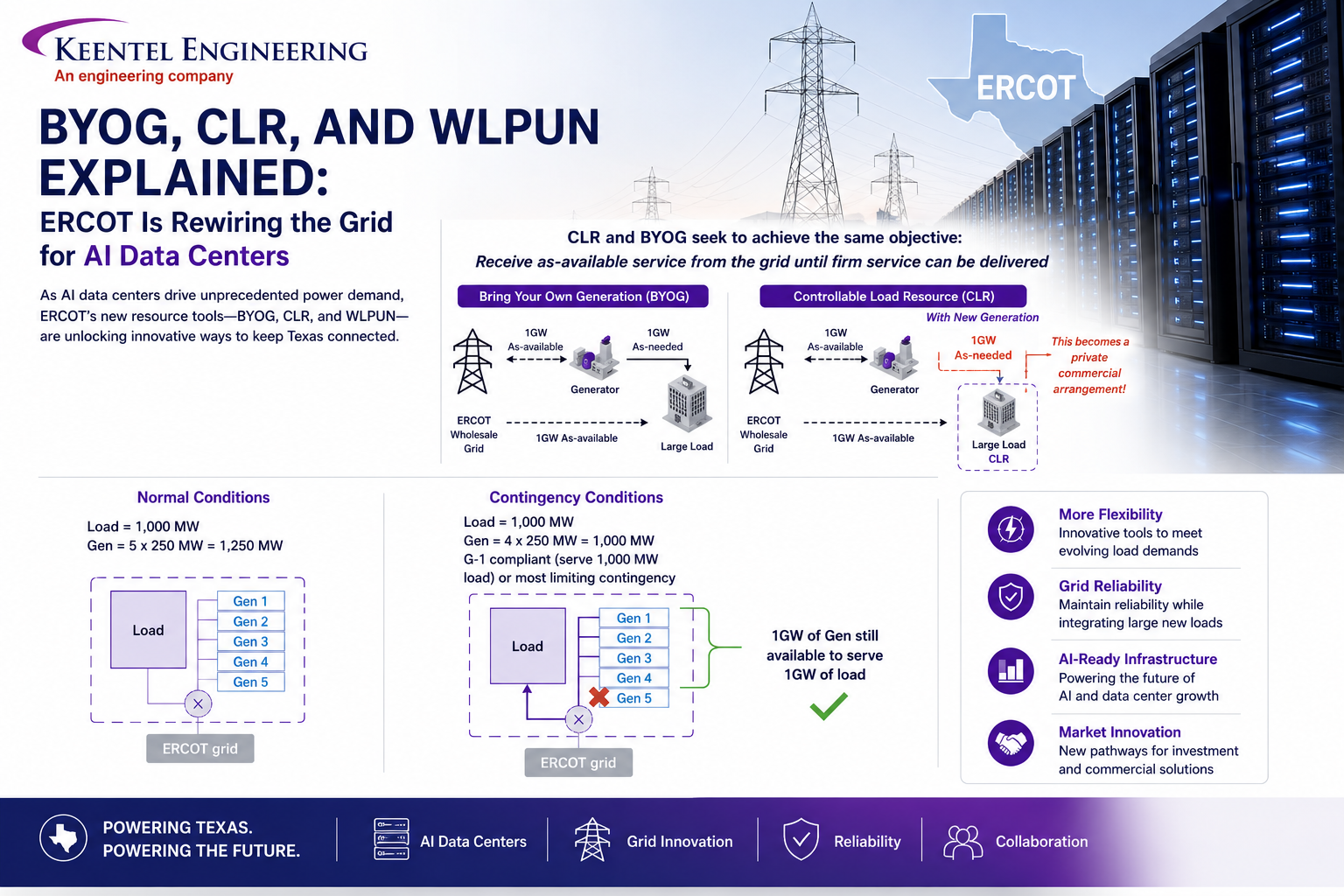
BYOG, CLR, and WLPUN Explained: How ERCOT Is Rewiring the Grid for AI Data Centers
May 30, 2026 | Blog
The 410-Gigawatt Problem
In April 2026, ERCOT testified before the Texas House Committee on State Affairs with a number that stopped the room: ERCOT is now tracking approximately 410 GW of Large Loads seeking interconnection — and roughly 87% of them are data centers.
For context, ERCOT's all-time peak demand has historically sat around 85 GW. The new queue represents nearly five times that figure, concentrated overwhelmingly in AI-driven compute facilities. Oncor's service territory alone holds 259 GW of pending Large Load requests. Submissions surged in Q1 2026 — 198 new applications in a single quarter — as hyperscalers race to lock in firm service.
The grid was never built for this. And that single reality is why three acronyms — BYOG, CLR, and WLPUN — have become the most important terms in Texas energy policy.
This blog walks through what each framework means, how they interact, where ERCOT and stakeholders disagree, and what's on the Batch Zero timetable through August 2026.
Why "Speed to Power" Became the Defining Problem
Before unpacking the frameworks, it helps to understand the bottleneck.
Under ERCOT's legacy single-study interconnection process, every new Large Load project submitted to a Transmission Service Provider (TSP) triggered an individual study. When another developer filed a request in the same transmission zone, all prior studies were invalidated and impacted projects had to be restudied. This created a "restudy loop" — projects repeatedly pulled back into review as new requests entered the queue, sometimes adding years to timelines.
Meanwhile, transmission build-out takes 5–7 years. AI data center developers commit hundreds of millions of dollars to GPU clusters that need power now, not in 2031.
The result: a structural mismatch between hyperscaler capital deployment cycles and grid construction cycles.
BYOG, CLR, and WLPUN are all, fundamentally, attempts to close that gap — by letting large loads come online with on-site or co-located generation, take as-available service from the grid in the interim, and curtail when the transmission system requires it.
What Is BYOG? (Bring Your Own Generation)
BYOG (Bring Your Own Generation) is a site configuration in which a Large Load — typically an AI data center — is co-located with its own on-site generation behind a single Point of Interconnection (POI) to the ERCOT grid. The load draws from the co-located generator first; the grid provides backup, top-up, or as-available service.
The promise of BYOG is simple: a developer who can build a gas plant, fuel cells, or a renewable-plus-storage facility on the same parcel as the data center doesn't need to wait for transmission upgrades to bring up first-MW operations.
The Two BYOG Scenarios
Scenario 1 — G+1 Configuration (No SLF Required):
On-site generation is sized such that even after losing the single largest contingency (the largest generator unit, "G-1," or a common electrical element, "X-1"), remaining generation can still serve the full energized load.
Example: Load = 1,000 MW, Generation = 5 × 250 MW = 1,250 MW. Lose one unit, and 1,000 MW of generation remains to serve 1,000 MW of load.
This configuration arguably already satisfies ERCOT's G-1 and N-1 planning standards on a stand-alone basis. The site can be served without invoking a Self-Limiting Facility (SLF) concept. Only a minor revision to combine the Full Interconnection Study (FIS) and Large Load Interconnection Study (LLIS) into a single steady-state model would be needed.
Scenario 2 — Sub-G+1 Configuration (SLF Required):
Anything less than G+1. On-site generation can serve the load under normal operating conditions, but a G-1 contingency would force the load to draw additional power from the grid.
Example: Load = 1,000 MW, Generation = 2 × 500 MW. Lose one unit, and only 500 MW of generation remains to serve 1,000 MW of load — the other 500 MW must come from the grid.
This creates a transmission security risk and triggers the need for either network upgrades or an SLF. An SLF is both a physical and a regulatory compliance mechanism — typically enforced via breaker logic and reverse power relays — that ensures the load never exceeds an approved grid draw limit, regardless of internal configuration.
What Is WLPUN? (Withdrawal-Limited Profile Unit)
WLPUN (Withdrawal-Limited Profile Unit / Generator Allocated Load vs. Actual Load) is the ERCOT framework that governs how large behind-the-meter loads — like co-located AI data centers — draw power from the grid. It allows co-located facilities to generate their own power while limiting grid draw to designated stability thresholds.
In practical terms, WLPUN is the regulatory expression of a sub-G+1 BYOG site that needs an SLF. It is registered with ERCOT as a Private Use Network (PUN) with a Self-Limiting Feature, consistent with the NPRR1026 framework.
The SLF ensures net real power at the POI never exceeds the approved interconnection limit at any moment in time — regardless of what the internal load or generation is doing.
Key WLPUN attributes:
- Load and generation are both registered with ERCOT.
- The interconnection limit applies to net MW at the POI, not to gross load or gross generation.
- Transmission planning does not assume simultaneous full load and full generation.
- Either the supply side (Generation Resource / Energy Storage Resource) or the demand side (Controllable Load Resource) may participate in the ERCOT market at a given time — but not both simultaneously (that scenario, called a "Netted Network," is currently classified as not feasible by ERCOT).
- The largest modeled contingency depends on internal configuration. If generators share a common step-up transformer, transformer loss may be the most limiting event; if generators are electrically independent, individual G-1 contingencies apply.
WLPUN is what most people are referring to when they talk about the "self-limiting" model for AI data centers in ERCOT today.
What Is CLR? (Controllable Load Resource)
CLR (Controllable Load Resource)
is a Large Load that registers with ERCOT as dispatchable demand and follows Security-Constrained Economic Dispatch (SCED) base points within a registered operating range.
A CLR operates with three key parameters:
- PC (Planned Consumption) — the firm awarded MW (for example, 0–100 MW).
- LPC (Low Power Consumption) — the minimum operational floor.
- MPC (Maximum Power Consumption) — the upper operational capability, which is not a planning guarantee.
In an illustrative ERCOT example, a developer might request 150 MW in Year 1. ERCOT performs steady-state and stability studies and allocates capacity in phases — say, 100 MW firm (PC) in Years 1–4, with operational capability up to 150 MW (MPC) until a transmission upgrade unlocks the full request in Year 5.
What makes CLR powerful: the load is dispatchable. ERCOT can instruct it to curtail down to LPC when there's a binding transmission constraint. In exchange, the load gets access to capacity that wouldn't be available under traditional firm service.
The Four ERCOT "Batch Zero" Constructs
ERCOT identified four constructs for integrating CLR and BYOG concepts:
| Construct | Description | ERCOT Feasibility |
|---|---|---|
| Load-Only CLR | Large Load registers entirely as a CLR at the POI. No generation or storage behind the POI is capable of synchronizing, paralleling, or exporting to the ERCOT grid. | Potentially feasible |
| CLR with Non-Synchronous Backup Generation | Large Load registers as a CLR and uses behind-the-meter backup generation that cannot synchronize with the ERCOT grid and cannot export power at the POI. | Potentially feasible |
| BYOG Self-Limiting Facility (SLF) | Co-located Large Load and Generation behind a single POI under a defined net injection/withdrawal limit enforced at the POI. The WLPUN model. | Potentially |
| Netted Network | Same physical layout as SLF, but load and generation participate simultaneously in Energy and Ancillary Services markets behind the same POI. | Not feasible |
BYOG vs. CLR: Same Goal, Different Mechanism
Here's the core insight from the Large Load Working Group debate: BYOG and CLR are trying to do the same thing.
Both seek to let a Large Load receive as-available service from the grid until firm service can be delivered. Both rely on the load curtailing when the transmission system requires it. The difference is in the regulatory plumbing.
- BYOG SLF (WLPUN) treats the site as a net resource at the POI, with a hard physical cap enforced by breaker logic.
- CLR treats the load as a dispatchable market participant that follows SCED basepoints.
A growing view in the industry is that CLR + co-located generation can enable every BYOG configuration — and that pairing a CLR with separately registered co-located generation may actually be the cleaner, more flexible mechanism. Under that model, the generation-to-load coordination becomes a private commercial arrangement, not an ERCOT regulatory burden.
ERCOT has indicated that a separately settled and registered Generation Resource or Energy Storage Resource
can be co-located behind the same POI as a CLR — it just can't be the mechanism by which the load qualifies as a CLR. Stakeholders are seeking written confirmation of this in the protocols.
7. Battery Room Design
For all of the above reasons, the batteries should occupy a dedicated room — never adjacent to control rooms or other critical areas.
Engineering and commissioning sequencing matters:
- All fire detection, fire suppression, and gas extraction systems must be installed and commissioned before batteries are placed.
- Cabling and battery rack frames can be installed in parallel with safety system commissioning.
- DC cable length to the AC drive must be considered — long runs introduce voltage drop and impose copper costs.
- Location should be such that, in the event of a fire, automatic suppression activates while personnel evacuate and the room can be sealed and ventilated safely.
For
utility-scale outdoor BESS, the same principles apply at containerized scale: separation between containers, segregated cooling, dedicated fire suppression per container, and stand-off distances from substations and control buildings.
How CLRs Are Dispatched: SCED Base Points, Ramping, and Possible Relaxations
A CLR must maintain consumption at the SCED-dispatched base point within a margin of error over a roughly 5-minute interval, and must ramp linearly between base points across SCED intervals. This is a meaningful operational burden — your data center workload management has to coordinate with grid dispatch signals.
A proposal under discussion is that ERCOT consider treating CLRs more like Intermittent Renewable Resources (IRRs):
- The load does not chase the base point unless behind a binding constraint.
- The load follows the base point down to LPC only when curtailed.
- Deviation charges apply only when over-consuming while curtailed.
This is exactly how ERCOT treats wind and solar today. Applying the same logic to large flexible loads would dramatically reduce compliance overhead while preserving grid reliability
The Batch Zero Timeline
All of this — BYOG, CLR, WLPUN, SLF rules —
is being codified through ERCOT's Batch Zero revision request package, which moves on a tight 2026 schedule:
- March 4, 2026 — ERCOT files Batch Zero Revision Request(s).
- April 8, 2026 — ERCOT files CLR/BYOG Revision Request(s).
- April 20, 2026 — ERCOT Board Meeting.
- May 6, 2026 — Protocols Review Subcommittee (PRS) vote.
- May 7, 2026 — Reliability and Operations Subcommittee (ROS) vote.
- May 19–20, 2026 — Technical Advisory Committee (TAC) vote.
- June 1, 2026 — Target ERCOT Board approval.
- August 1, 2026 — Target effective date of new protocols.
Behind it sits a parallel rulemaking at the Public Utility Commission of Texas:
- PUC Project 58480 (16 TAC § 25.370, Large Load Forecasting Rule) — adopted and effective March 1, 2026. After 2026, only Large Loads with an executed interconnection agreement meeting Project 58481 requirements will be counted in the Large Load forecast.
- PUC Project 58481 (proposed 16 TAC § 25.194, Large Load Interconnection Standards) — Proposal for Publication on March 12, 2026. Introduces an Intermediate Agreement with site control, financial security at $50,000/MW (20% refundable), and disclosures; and an Interconnection Agreement with site control, financial security, an interconnection fee of $50,000/MW that converts to non-refundable, and Contribution in Aid of Construction (CIAC).
If your project is in the queue today, these dates matter — they determine when the framework you'll operate under is locked in.
From Single Study to Batch Study
The other major shift coming out of Batch Zero is the transition from single-study to batch-study interconnection.
Under the new model, ERCOT compiles all submitted applications every roughly six months, studies them together as a single batch, and allocates capacity that is then reserved — preventing the cascading restudies that have historically delayed projects. Communication touchpoints between ERCOT, TSPs, and developers are being redesigned for transparency, and a Large Load Portal is targeted for end-of-2026 implementation to give developers direct access to project status.
For BYOG, CLR, and WLPUN, the batch process is the delivery vehicle. The new constructs only matter if they can be studied and allocated in time for the AI data center buildout — and that's exactly what Batch Zero is designed to do.
Technical Frequently Asked Questions
Q1: What does WLPUN stand for?
WLPUN stands for Withdrawal-Limited Profile Unit (sometimes phrased as Generator Allocated Load vs. Actual Load). It is the ERCOT framework that regulates how large behind-the-meter loads draw power from the grid, allowing co-located facilities to self-generate while capping grid withdrawal at designated stability thresholds.
Q2: Is WLPUN the same as a Self-Limiting Facility (SLF)?
They are closely related but not identical. A Self-Limiting Facility (SLF) is the physical and regulatory compliance mechanism — breaker logic, reverse power relays, and protocol-level enforcement — that ensures net real power at the POI never exceeds the approved interconnection limit. WLPUN is the broader unit designation under which a Private Use Network (PUN) hosting both load and generation operates with that SLF enforcement. In practice, when people say "WLPUN," they generally mean a PUN with an SLF as defined under the NPRR1026 framework.
Q3: What does BYOG stand for and how is it different from WLPUN?
BYOG stands for Bring Your Own Generation — a site configuration where a Large Load is co-located with on-site generation behind a single POI. WLPUN is the regulatory mechanism that governs how a BYOG site interacts with the grid when its design is anything less than G+1 redundant. A G+1 BYOG site arguably does not need a WLPUN/SLF designation; a sub-G+1 BYOG site does.
Q4: What is G+1 configuration?
G+1 is a generation redundancy design in which on-site generation is sized so that even after losing the single largest contingency (the largest generator, G-1, or the most limiting common electrical element, X-1), remaining generation can still serve the full energized load. A 1,000 MW load served by 5 × 250 MW units is G+1: losing any one unit leaves 1,000 MW of generation to serve 1,000 MW of load.
Q5: Why might G+1 sites not need an SLF?
Because a G+1 site already satisfies ERCOT's G-1 and N-1 planning standards on a stand-alone basis. Under any single contingency, the on-site generation can serve the load without drawing additional power from the grid. There is therefore no transmission security risk that an SLF is needed to mitigate. The argument is that only a minor procedural change — allowing the FIS (Full Interconnection Study, for generation) and LLIS (Large Load Interconnection Study, for the load) to be combined into a single steady-state study — is needed to recognize this.
Q6: Can a CLR have co-located generation?
Yes — with a key caveat. ERCOT has indicated that a separately settled and registered Generation Resource or Energy Storage Resource may be co-located behind the same POI as a CLR. However, that generation cannot be the mechanism by which the load qualifies as a CLR. The CLR registration must stand on its own as a dispatchable demand resource.
Q7:What is the difference between the Load-Only CLR (1A) and CLR with Non-Synchronous Backup (1B) constructs?
In Construct 1A, no generation or storage behind the POI can synchronize, parallel, or export to the ERCOT grid at all. The site is modeled purely as load. In Construct 1B, the site may have backup generation behind the meter, but that generation must be non-synchronous with the ERCOT grid — typically meaning a true break-before-make transfer where the load is disconnected from ERCOT before the backup picks up. No parallel operation, no export, no market participation by the backup generation. ERCOT still models the facility as load-only at the POI.
Q8: What is the Netted Network construct and why is it not feasible?
The Netted Network construct (Construct 3) would have load and generation behind a single POI participating simultaneously in both the supply and demand sides of the ERCOT market, subject to the POI interconnection limit. ERCOT has classified this as not feasible under current protocols because it would require simultaneous supply-and-demand market participation behind a single net cap — creating settlement, dispatch, and reliability challenges that the current market design cannot accommodate.
Q9: What is SCED and how do CLRs interact with it?
SCED (Security-Constrained Economic Dispatch) is ERCOT's 5-minute real-time dispatch optimization. It sets a base point (target MW) for each dispatchable resource every 5 minutes, considering transmission constraints. A CLR must maintain consumption at its dispatched base point within an acceptable margin during each 5-minute interval and must ramp linearly between intervals when the base point changes. Failure to follow dispatch can result in deviation charges, similar to those imposed on generation resources.
Q10: Could CLR dispatch be relaxed like Intermittent Renewable Resource (IRR) dispatch?
This is an active proposal in the Large Load Working Group. Under IRR-style dispatch, the resource does not chase the base point unless behind a binding constraint; it only follows the base point down when curtailed; and deviation charges apply only when over-consuming while curtailed. Applying this model to CLRs would reduce operational complexity for data center operators while preserving ERCOT's ability to manage transmission constraints — but it has not been formally adopted as of the most recent public materials.
Q11:What is NPRR1026 and why does it matter?
NPRR1026 is the Nodal Protocol Revision Request that established the framework for Self-Limiting Facilities and the treatment of Private Use Networks with co-located generation. It is the existing protocol basis on which the BYOG Self-Limiting Facility construct (Construct 2) sits. Subsequent revision requests in the Batch Zero package build on or refine the NPRR1026 framework.
Q12: What are NPRR1188 and NPRR1255?
NPRR1188 is a planned 2026 revision that aligns nodal pricing with local congestion prices — important for how CLRs are settled financially when transmission constraints bind. NPRR1255 covers mitigation methods needed for the small-project pathway. Both are referenced in ERCOT's CLR materials as prerequisites for the Load-Only CLR construct to be energized.
Q13: What is Batch Zero?
Batch Zero is ERCOT's initial implementation of the new Batch Study Framework — the bundle of NPRRs and PGRRs (Planning Guide Revision Requests) that transition Large Load interconnection from individual single studies to clustered batch studies conducted approximately every six months. It also encompasses the CLR/BYOG revision requests that codify the constructs described above. Target effective date is August 1, 2026.
Q14: What is the financial security requirement under PUC Project 58481?
The proposed rule requires $50,000/MW in financial security at the Intermediate Agreement stage, with 20% refundable. At the Interconnection Agreement stage, the $50,000/MW figure converts to a non-refundable interconnection fee, plus any required Contribution in Aid of Construction (CIAC) and ongoing financial security. For a 500 MW data center, that's $25 million in interconnection fees alone, before CIAC.
Q15:Which TSPs have the most Large Load requests?
As of March 26, 2026, Oncor leads with approximately 259 GW of Large Load requests in its service territory — by far the largest, reflecting the concentration of data center development in North Texas. AEP follows with 46 GW, LCRA TSC with 60 GW, CNP with 37 GW, WETT with 30 GW, and other TSPs with smaller portfolios.
Q16: How fast is the queue growing?
ERCOT's Large Load queue has gone from about 6.7 GW observed/in-progress in 2025 to a projected 410.6 GW by 2030 — a roughly 60-fold increase across five years. Q1 2026 alone saw 198 new Large Load applications, the highest single quarter on record, driven primarily by AI data center developers seeking firm service before the new rules and financial requirements take full effect.
Q17: What is FMECA and why does it matter for BESS design?
FMECA (Failure Modes, Effects and Criticality Analysis) is a systematic engineering review of every credible failure mode in a system, its effect on operation, and its criticality. For BESS, FMECA covers single-cell failures, module failures, string failures, array failures, DC-DC converter failures, AC drive failures, transformer failures, and control system failures — and asks what each one does to operation, safety, and recovery time. A good FMECA drives architectural decisions like multi-array redundancy, hardware-level ESD, and physical separation between battery buildings.
Q18: What is the practical difference for a developer between filing as a CLR versus a WLPUN/BYOG SLF?
A CLR developer commits to dispatchable, curtailable demand under SCED — accepting that real-time consumption above the firm PC level is not guaranteed. The site itself does not need to host generation. A WLPUN/BYOG SLF developer commits to a physical self-limiting cap at the POI enforced by hardware, with co-located generation supplying the load when grid draw would otherwise exceed the cap. Both can deliver speed-to-power, but the CLR path is operationally simpler (no generation siting required) while the WLPUN path delivers higher firm-equivalent availability through self-supply. Many developers will likely combine the two: register the load as a CLR while privately contracting for co-located generation outside the ERCOT regulatory perimeter.
The Bottom Line
The Texas grid is being asked to host more new load in the next five years than it has built in the last fifty. The legacy single-study, firm-service-only interconnection model cannot deliver that capacity in time.
BYOG, CLR, and WLPUN are the three frameworks Texas is using to bridge the gap — letting Large Loads come online with self-supply and as-available grid service while transmission catches up. They are not interchangeable, and the regulatory boundaries between them are still being drawn through the Batch Zero process scheduled for finalization in mid-2026.
For developers, the implication is clear: the framework you choose determines your speed-to-power, your operational obligations, your settlement exposure, and your capital deployment risk. Understanding the distinctions between BYOG, CLR, and WLPUN — and the constructs that sit beneath each — is no longer a regulatory nicety. It's a core part of building large-scale compute infrastructure in ERCOT.

About the Author:
Sandip "Sonny" R. Patel, P.E.
IEEE Senior Member · Founder & CEO, Keentel Engineering
In 1995, Sonny Patel earned his Electrical Engineering degree from the University of Illinois. But degrees don't build legacies — action does.
For three decades, he has worked the power industry from every side of the table: 16 years as a utility engineer at Exelon/Commonwealth Edison; generation leadership across hydroelectric, industrial steam turbine, and a 9 GW renewable fleet; NERC Regional Entity Senior Compliance Engineer and Audit Team Lead, auditing some of the nation's largest utilities; and testing and commissioning lead on equipment up to 765 kV — the very top of the North American grid.Utility. Generator. Regulator. Consultant. Few engineers have seen all four seats. Fewer still have sat in them.
His experience spans nuclear, hydro, conventional generation, renewables, oil and gas, mining — and today's data centers, where he is authoring a three-book series on data center design. He is a Licensed Professional Engineer in six states and a Licensed Electrical Contractor in Florida (Unlimited EC) — he doesn't just design the work; he's qualified to stand behind its execution.Today, as Founder and CEO of Keentel Engineering, Sonny leads a nationwide team of engineers delivering substation design, power system studies, NERC compliance, and commissioning — done right, coast to coast.Three decades. Every side of the table. One standard: accountable engineering.
Services

Let's Discuss Your Project
Let's book a call to discuss your electrical engineering project that we can help you with.
About the Author:
Sandip "Sonny" R. Patel, P.E.
IEEE Senior Member · Founder & CEO, Keentel Engineering
In 1995, Sonny Patel earned his Electrical Engineering degree from the University of Illinois. But degrees don't build legacies — action does.
For three decades, he has worked the power industry from every side of the table: 16 years as a utility engineer at Exelon/Commonwealth Edison; generation leadership across hydroelectric, industrial steam turbine, and a 9 GW renewable fleet; NERC Regional Entity Senior Compliance Engineer and Audit Team Lead, auditing some of the nation's largest utilities; and testing and commissioning lead on equipment up to 765 kV — the very top of the North American grid.
Utility. Generator. Regulator. Consultant. Few engineers have seen all four seats. Fewer still have sat in them.
His experience spans nuclear, hydro, conventional generation, renewables, oil and gas, mining — and today's data centers, where he is authoring a three-book series on data center design. He is a Licensed Professional Engineer in six states and a Licensed Electrical Contractor in Florida (Unlimited EC) — he doesn't just design the work; he's qualified to stand behind its execution.
Today, as Founder and CEO of Keentel Engineering, Sonny leads a nationwide team of engineers delivering substation design, power system studies, NERC compliance, and commissioning — done right, coast to coast.Three decades. Every side of the table. One standard: accountable engineering.
Leave a Comment
Thank you for contacting us.
We will get back to you as soon as possible.
We will get back to you as soon as possible.
Oops, there was an error sending your message.
Please try again later.
Please try again later.
Related Posts
By SANDIP R PATEL
•
October 11, 2026
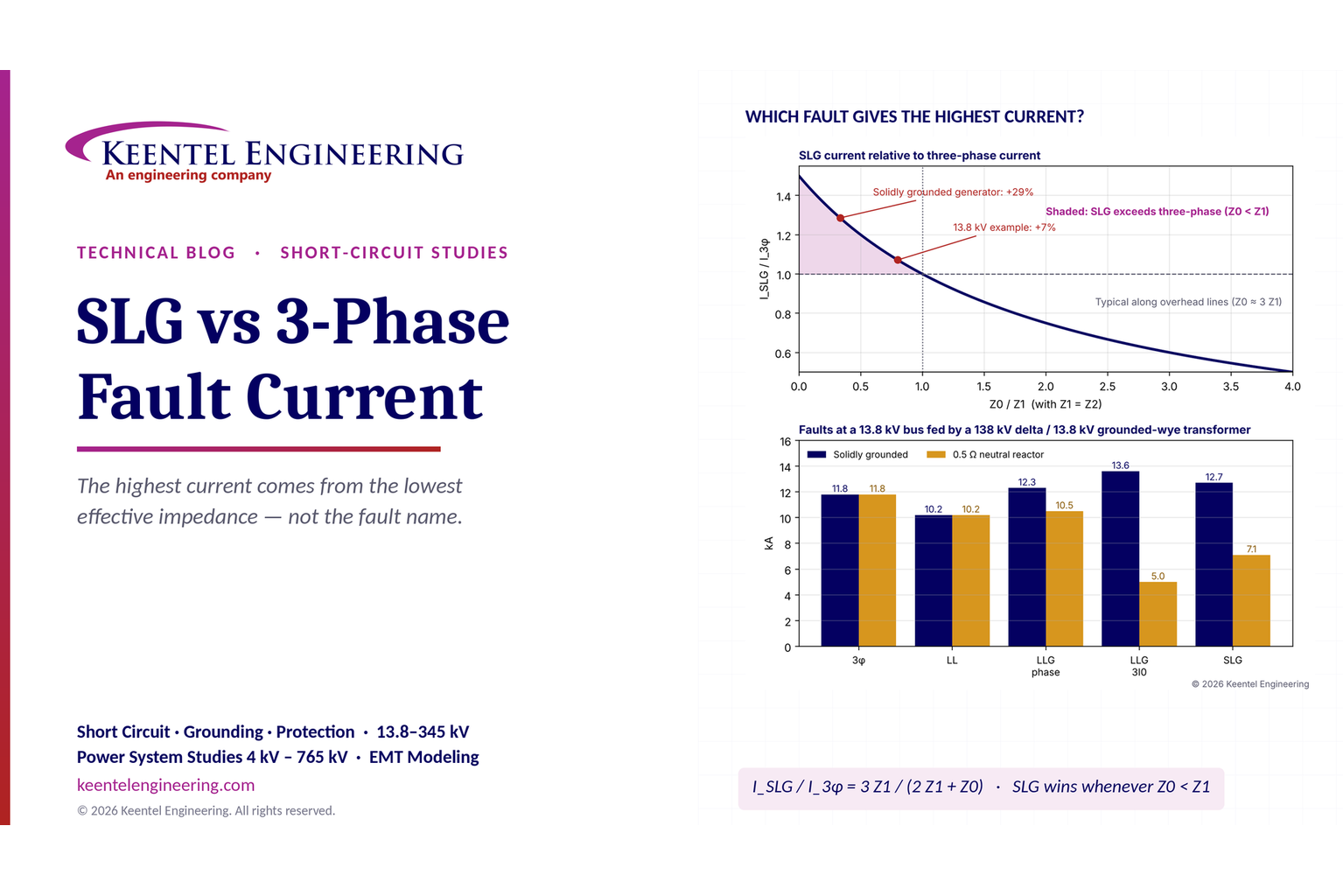
Learn which fault produces the highest current at a bus, why SLG faults can exceed three-phase faults, and how symmetrical components determine fault duty.
By SANDIP R PATEL
•
October 11, 2026
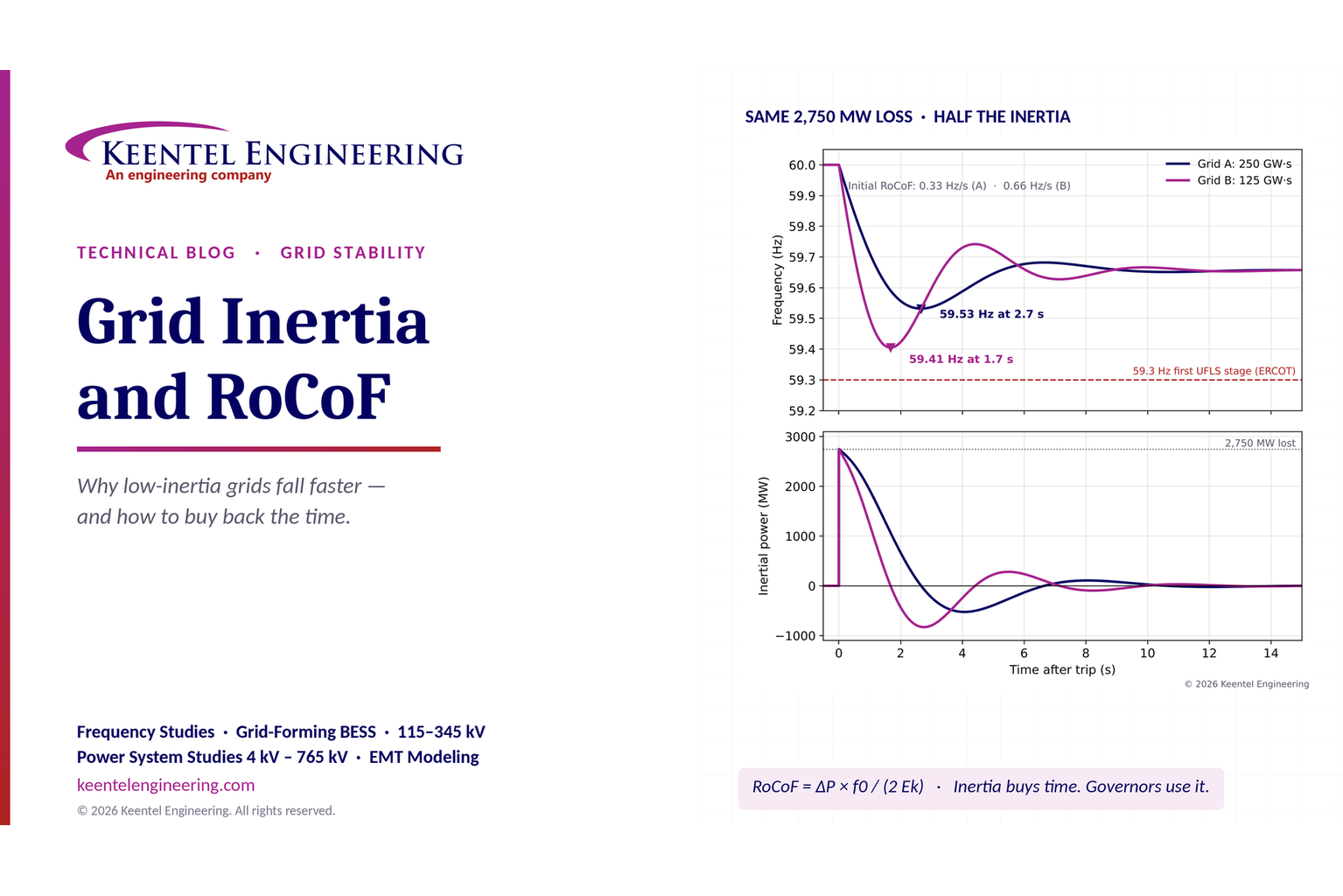
Explore grid inertia, RoCoF and frequency response, with swing equation calculations, frequency nadir analysis and US power system simulation examples.
By SANDIP R PATEL
•
October 11, 2026
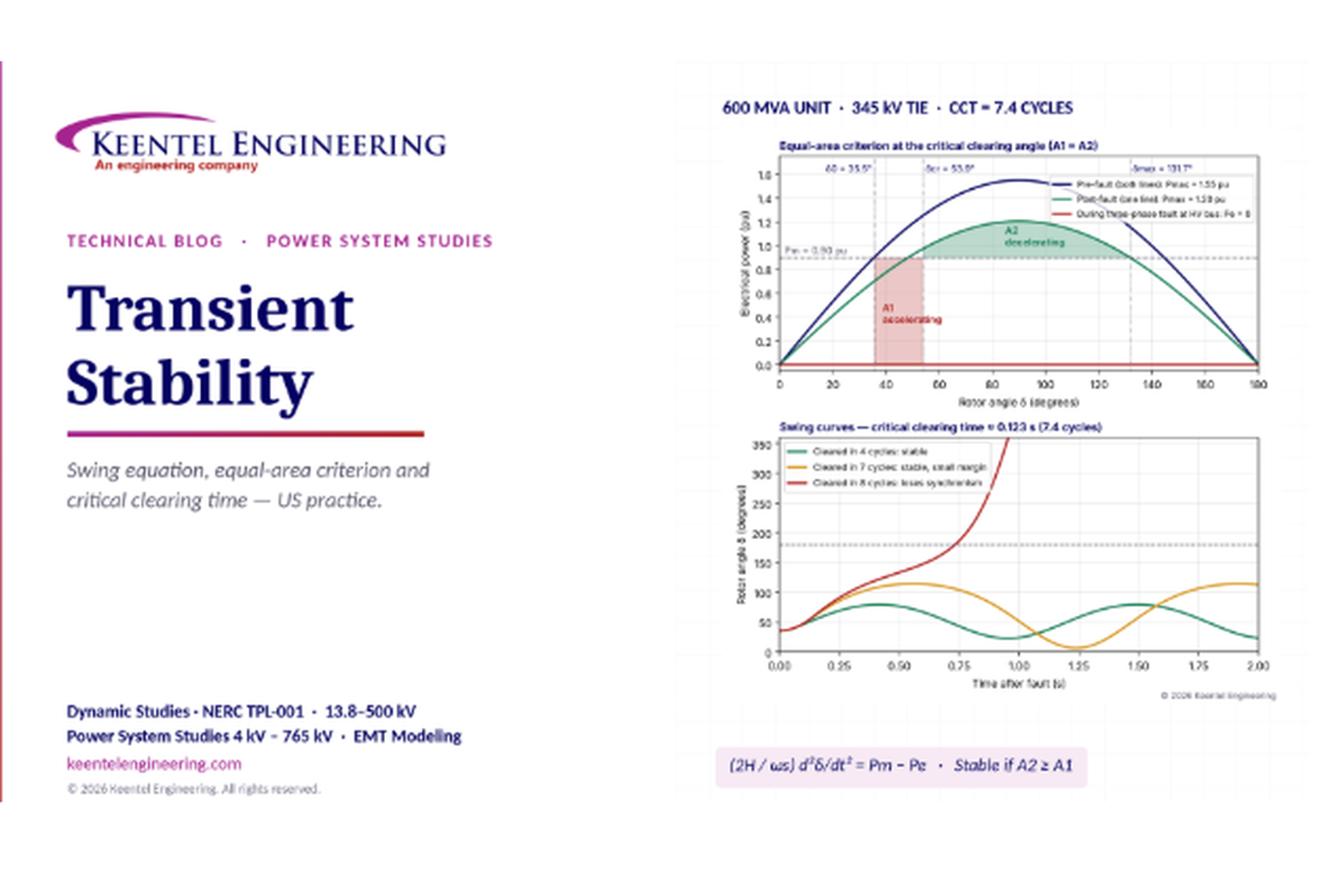
Learn transient stability analysis, swing equation, equal-area criterion and critical clearing time with a 345 kV worked example and NERC TPL-001 guidance.
By SANDIP R PATEL
•
October 11, 2026
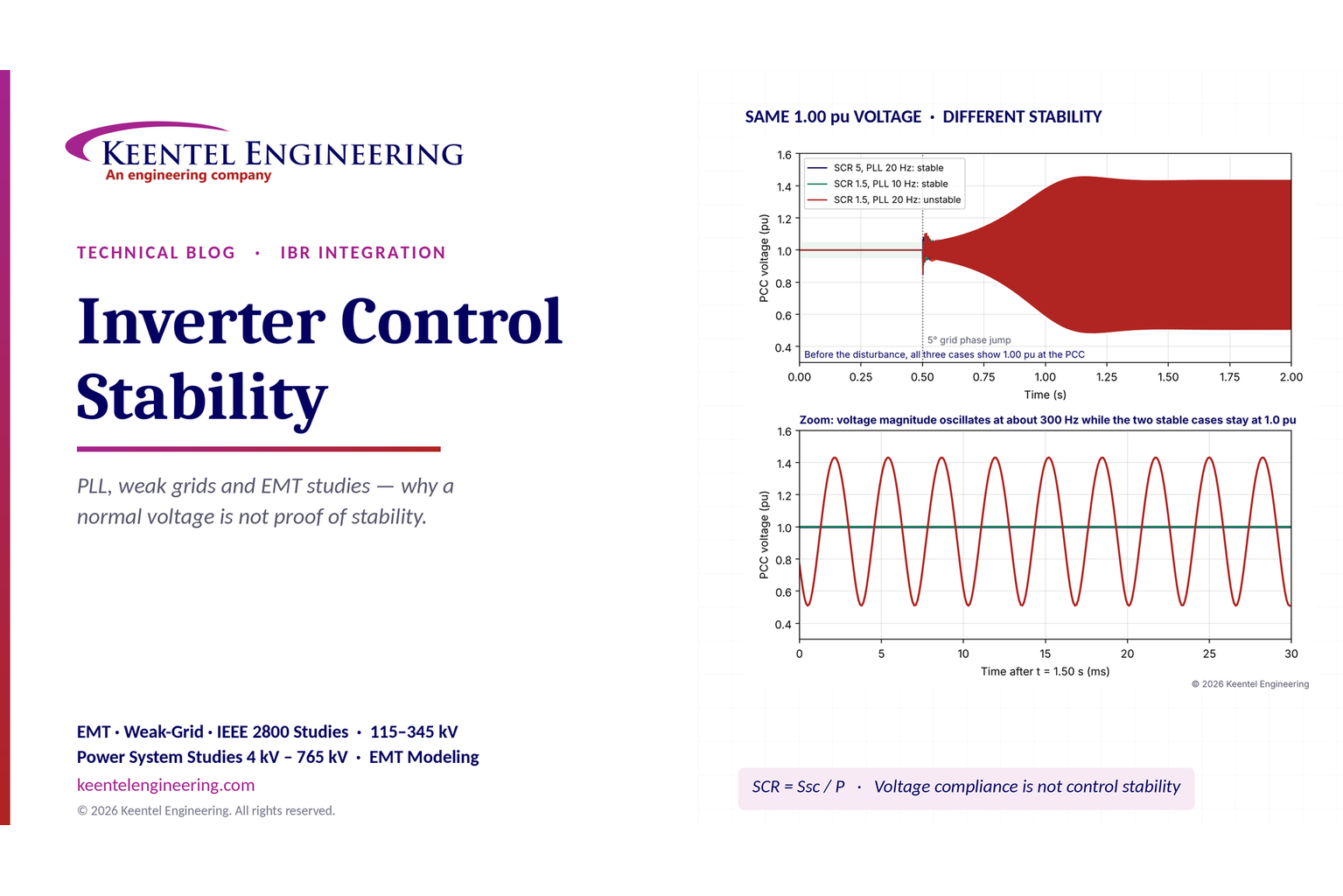
Learn why inverter controls become unstable in weak grids, how PLL bandwidth and SCR affect stability, and how PSCAD EMT studies identify and mitigate oscillations.
By SANDIP R PATEL
•
October 11, 2026
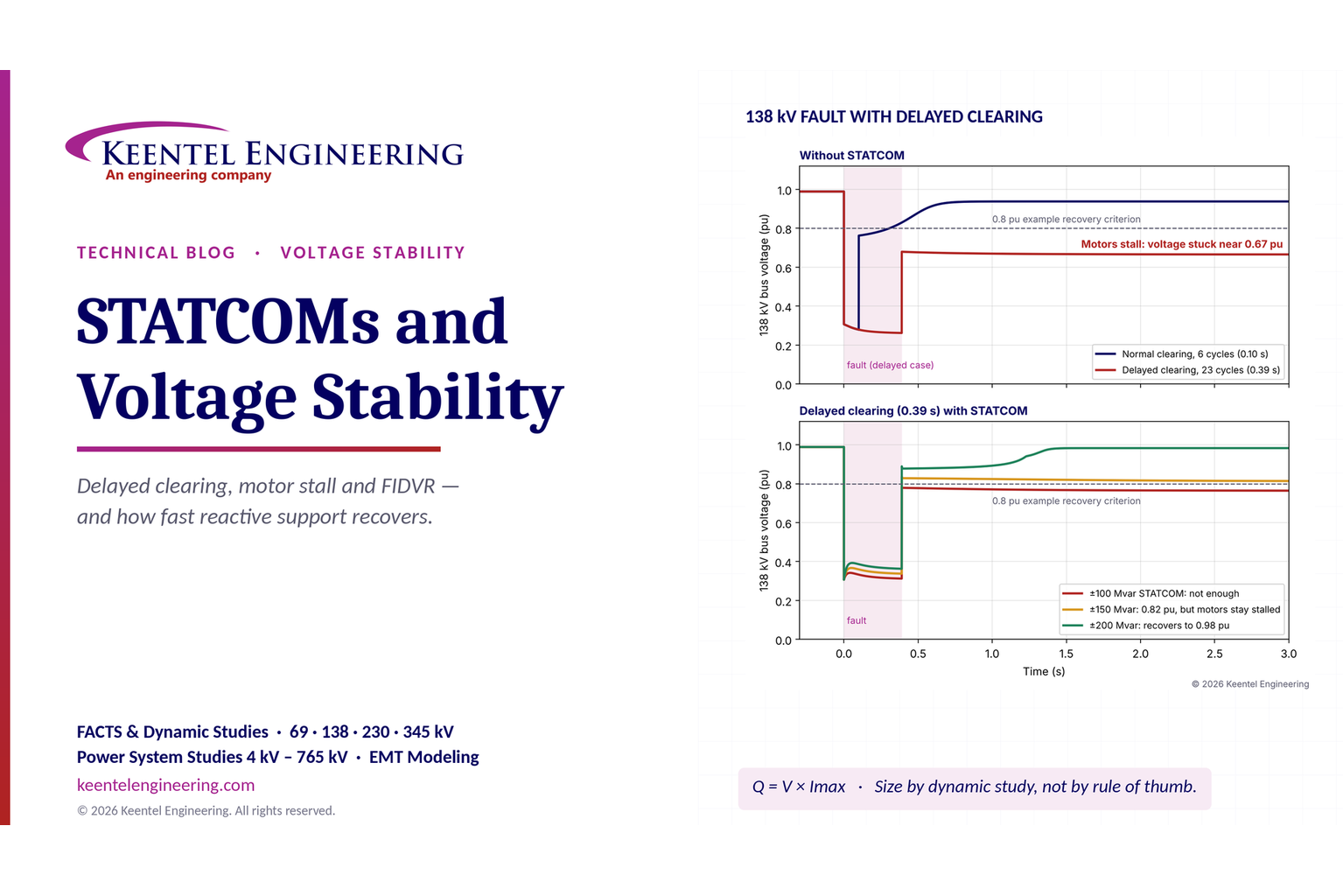
Learn how STATCOMs improve voltage stability and prevent FIDVR. Explore reactive power sizing, delayed fault clearing, NERC criteria and 138 kV simulation results.
By SANDIP R PATEL
•
October 10, 2026
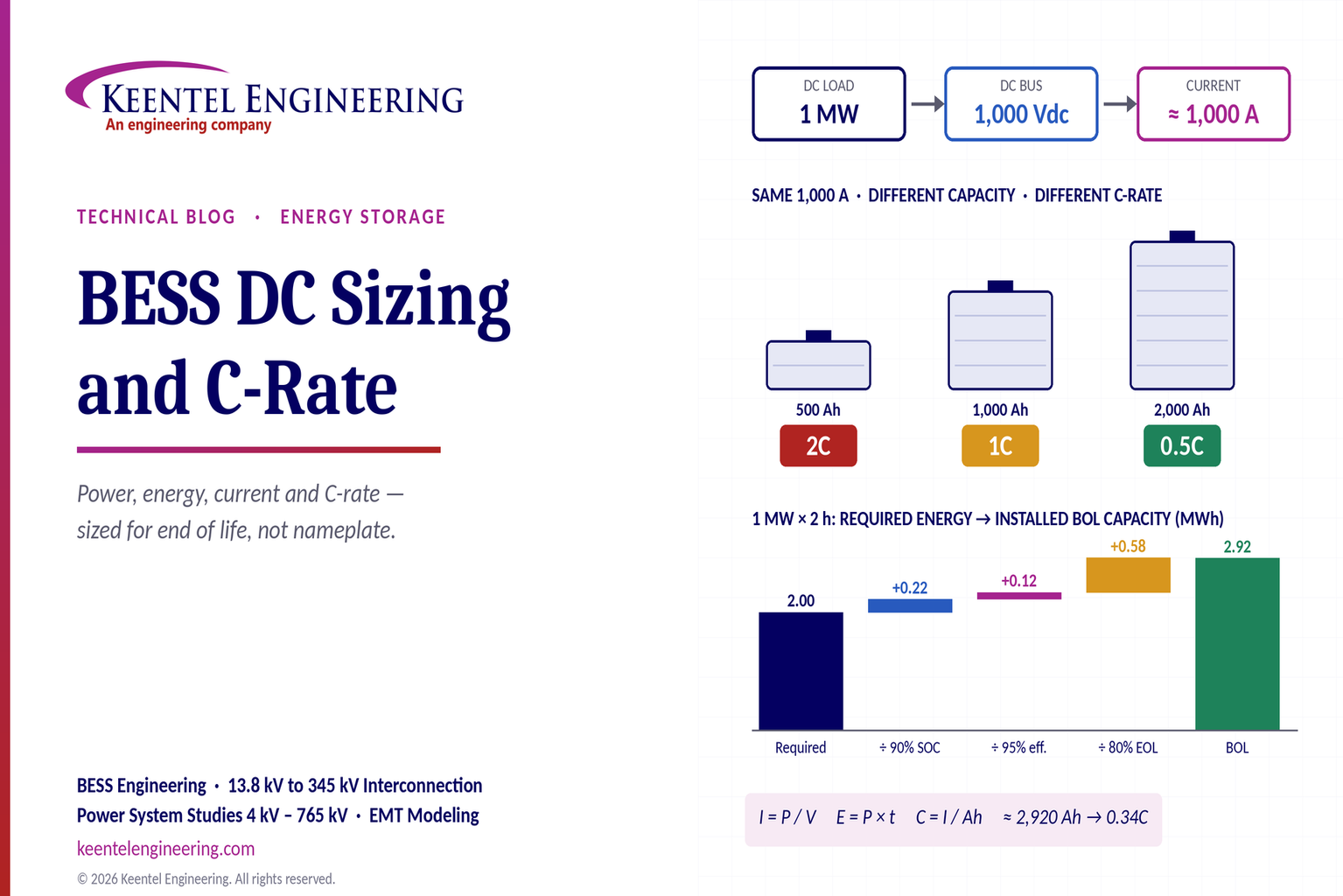
Learn BESS DC sizing with power, energy, current and C-rate calculations, battery losses, degradation and a 100 MW/400 MWh utility-scale example.
By SANDIP R PATEL
•
October 10, 2026
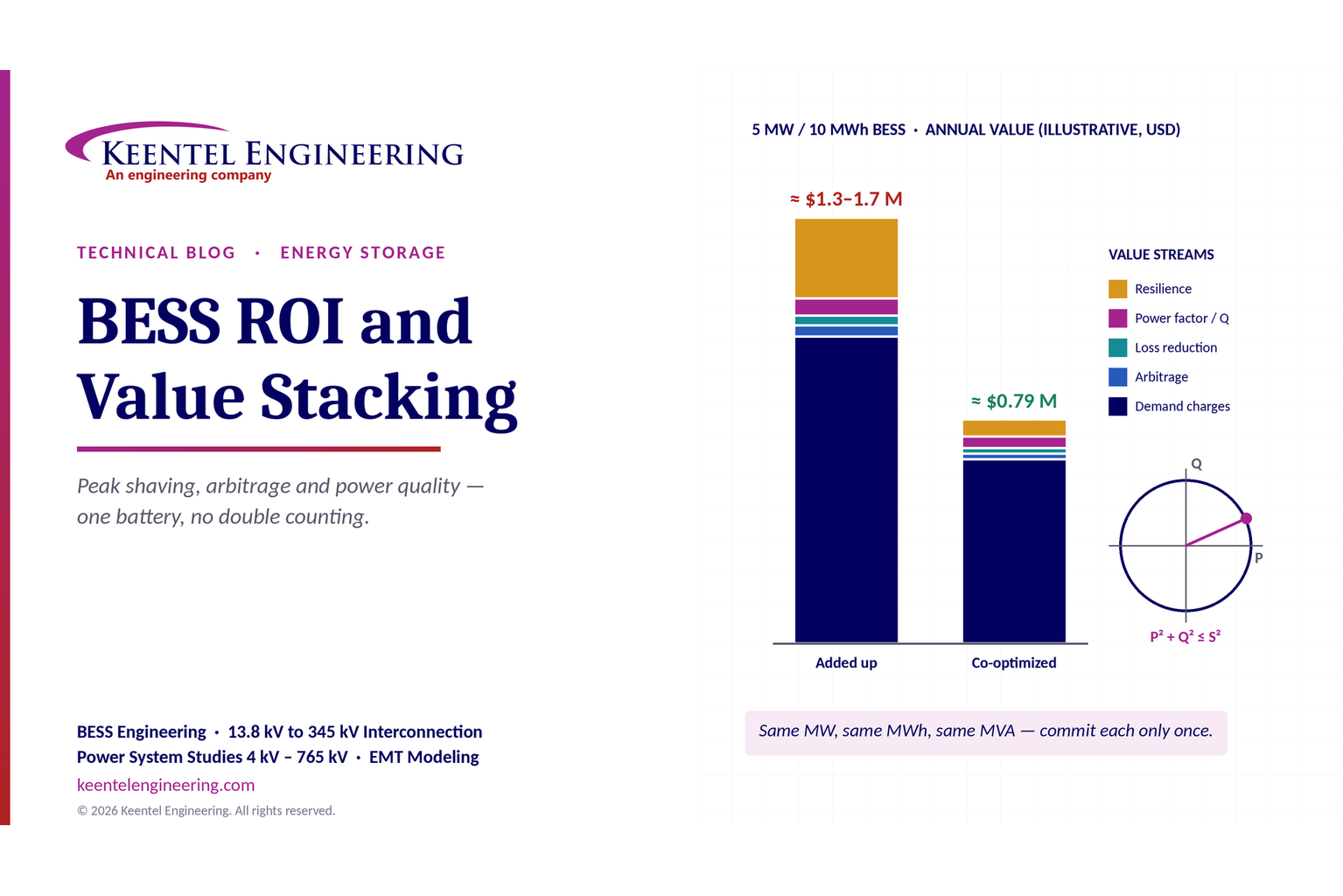
Learn how BESS ROI is calculated using peak shaving, energy arbitrage, power quality and battery storage economics, with a practical 5 MW/10 MWh example.
By SANDIP R PATEL
•
October 10, 2026
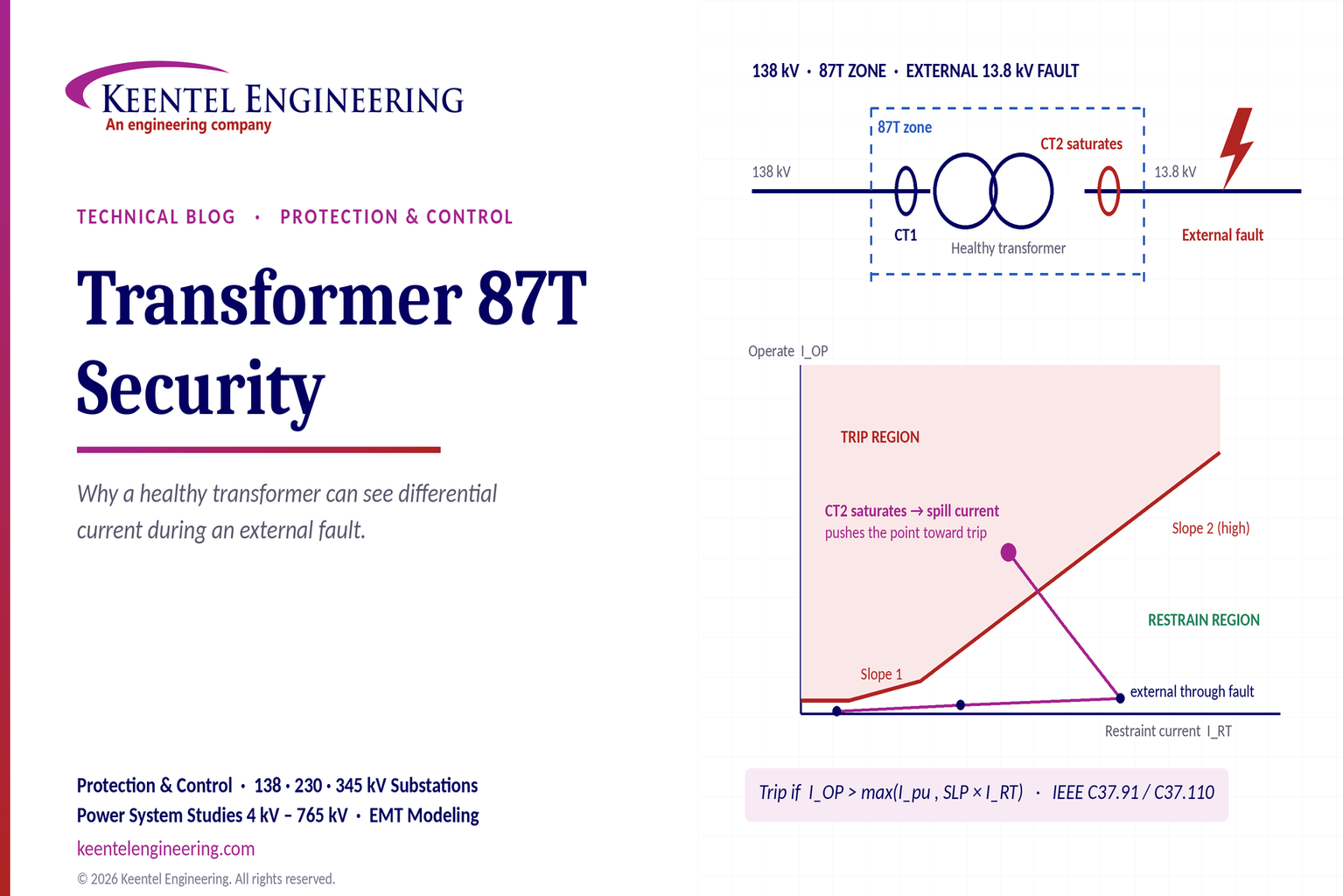
Learn why transformer differential relays detect current during external faults, how CT saturation causes spill current, and how secure 87T protection prevents trips.
By SANDIP R PATEL
•
October 10, 2026
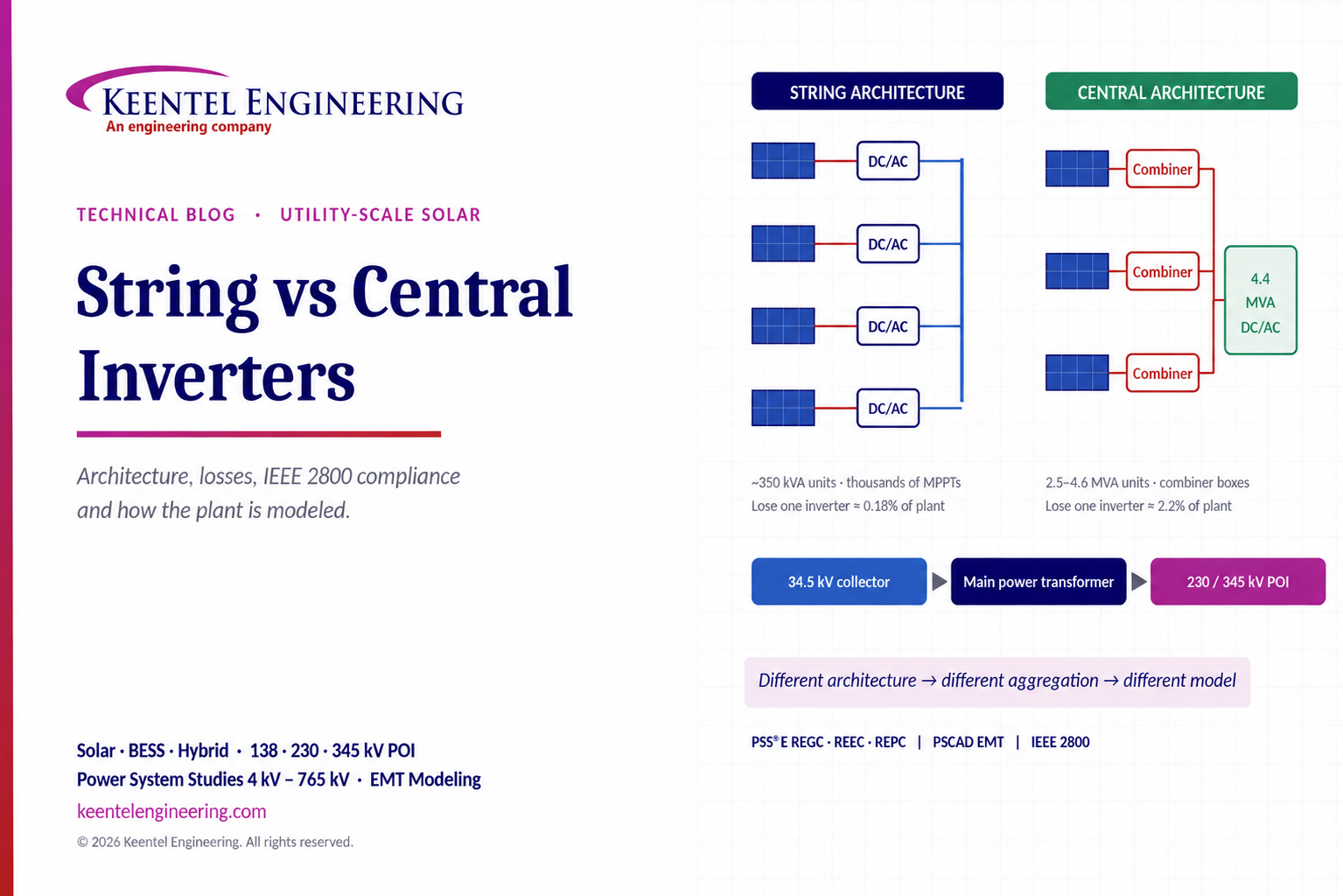
Compare string vs central inverters for utility-scale solar, including efficiency, maintenance, grid compliance, reactive power and interconnection studies.