

A Coordinated Electric System Interconnection Review—the utility’s deep-dive on technical and cost impacts of your project.

Challenge: Frequent false tripping using conventional electromechanical relays
Solution: SEL-487E integration with multi-terminal differential protection and dynamic inrush restraint
Result: 90% reduction in false trips, saving over $250,000 in downtime

Category Metric
VPP capacity (Lunar Energy) 650 MW
Lunar funding raised US$232 million
Data center BESS example 31 MW / 62 MWh
ERCOT grid-scale batteries 15+ GW
LDES tenders (H1 2026) Up to 9.3 GW
Lithium-ion share of LDES by 2030 77%
FEOC initial threshold 55%
BESS tariff rate (2026) ~55%
Capacity gain from analytics 5–15%

What is T&D Co-Simulation?

Confusing Physical Connections with Logical Nodes in IEC 61850

ERCOT Data & Modeling Requirements (2026): A Complete Engineering Guide for Grid Compliance and Power System Studies

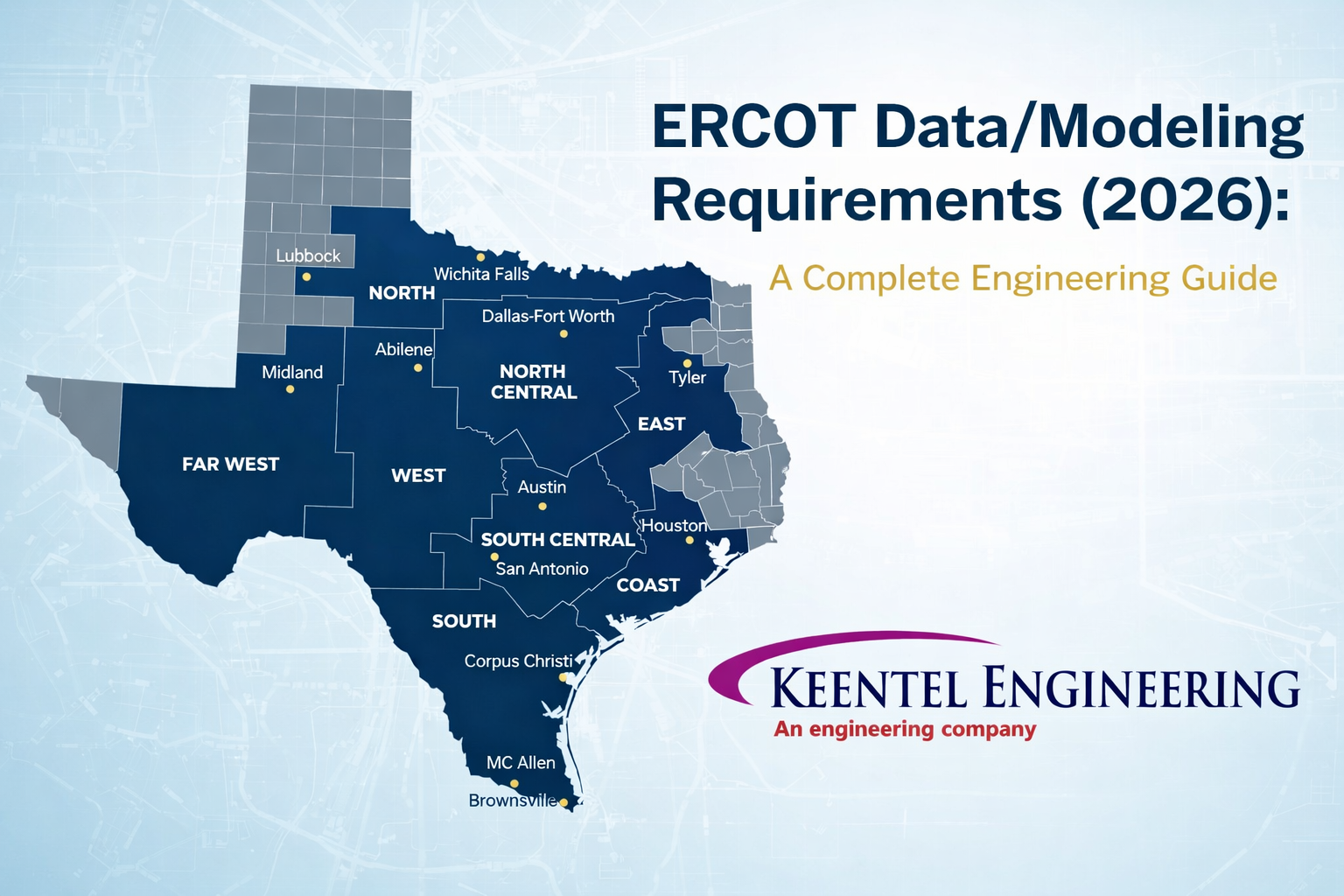
The image shows a map of Texas, highlighting regions associated with ERCOT
Calendar icon. D

 Apr 16, 2022  | blog

Introduction

In today’s rapidly evolving grid driven by renewable integration, large loads (AI/data centers), and inverter-based resources accurate power system modeling is no longer optional. It is the foundation of reliability, compliance, and interconnection success.

The ERCOT Planning Guide Section 6: Data/Modeling (2026) establishes strict


requirements for:


  • Steady-state modeling 
  • Dynamic and transient simulations 
  • Short circuit analysis 
  • Load forecasting 
  • Resource registration 
  • GIC (Geomagnetic Disturbance) modeling 


For developers, utilities, and large load customers, failure to comply can lead to:


  • Interconnection delays 
  • Study rejections 
  • Compliance violations 
  • Cost overruns 


At Keentel Engineering, we specialize in helping clients meet these requirements through advanced modeling, simulation, and compliance services.


1. Steady-State Modeling: The Foundation of Grid Planning

ERCOT requires simulation-ready base cases representing system conditions for planning studies. 


Key Requirements:


  • Annual and seasonal load flow models 
  • Built using PSS®E format 
  • Updated: 


  • Annually 
  • Biannually 
  • Off-cycle (for major system changes) 


Critical Engineering Insight


Steady-state models must accurately represent:


  • Transmission topology 
  • Generator dispatch (MW / MVAr) 
  • Load forecasts 
  • Future transmission projects 


Practical Impact


If your project data is inaccurate:


  • Your project may be misrepresented in congestion or voltage studies 
  • You risk failed interconnection studies 

2. Dynamic Modeling: The Most Critical Requirement for Modern Grid Compliance

Dynamic modeling simulates real-world disturbances, including:


  • Faults 
  • Frequency deviations 
  • Voltage instability 
  • Inverter behavior 


ERCOT mandates that all dynamic devices must be modeled and validated. 

2.1 What Must Be Modeled?

For Generators & Energy Storage:


  • Turbines, inverters, controllers 
  • Plant-level controls 
  • Collector systems 


For Transmission Systems:


  • FACTS devices (SVC, STATCOM) 
  • Protection systems 
  • Load shedding schemes 
  • Transformers with LTC 

2.2 Model Validation Requirements (Critical)

ERCOT requires rigorous model quality testing, including:

Mandatory Tests:


  • Flat start test 
  • Small voltage disturbance 
  • Large voltage disturbance (fault or ride-through) 
  • Frequency response test 
  • System strength test (SCR sensitivity) 


Additional IBR Tests:


  • Phase angle jump 
  • Loss of synchronous machine 
  • PSCAD validation 


Engineering Reality


Most project delays occur here.

Common issues:


  • Incorrect inverter models 
  • Poor parameter tuning 
  • Missing validation reports 

3. Short Circuit Modeling: Protection & Equipment Design

ERCOT requires annual development of short circuit cases. 

Requirements:


  • Positive and zero-sequence data 
  • Consistent bus numbering with load flow cases 
  • Inclusion of: 


  • Generators 
  • Transmission lines 
  • ESR


Why It Matters:


Short circuit levels impact:


  • Breaker ratings 
  • Relay settings 
  • Equipment selection

4. Transmission Project Tracking (TPIT): Planning Transparency

ERCOT maintains a Transmission Project and Information Tracking (TPIT) report. 

PJM's update highlights three specific interconnection mechanisms with direct engineering implications:

CIR Transfer


The new Capacity Interconnection Rights (CIR) transfer process allows retiring generators to transfer their grid connection rights to replacement resources at the same site. This streamlined process affirmed by FERC in its January 29, 2026 order promotes efficient reuse of existing transmission infrastructure. For engineering teams working on repowering or replacement projects, understanding how to structure the CIR transfer documentation is now a critical competency.


Surplus Interconnection Service


This mechanism allows the unused portion of an existing interconnection service allocation to be utilized — for example, adding battery storage to an underutilizing renewable facility. Engineering teams designing co-located storage additions must account for how surplus service is calculated, documented, and approved within PJM's study framework.


Provisional Interconnection Service


This service allows generators to begin operating and injecting energy before all required network upgrades are completed, provided that an interim deliverability study confirms no transmission violations. PJM is expanding availability of this service to generators that do not yet qualify for Capacity Interconnection Rights but can offer energy in the interim. For developers facing long upgrade timelines, provisional service can be the difference between a project that generates revenue on schedule and one that waits years for final approvals.


5. Load Modeling & Forecasting

ERCOT requires annual load data submissions from TSPs.


Inputs Considered:


  • Economic trends 
  • Weather 
  • Efficiency improvements 
  • Customer behavior 


Emerging Challenge:


Large loads (AI/data centers, crypto, industrial electrification) are changing grid dynamics.


6. Large Load Modeling: A New Grid Challenge

ERCOT has strict requirements for large load interconnection modeling. 


Key Rules:


  • Must complete Large Load Interconnection Study (LLIS) 
  • Cannot be added to models until: 
  • Studies are complete 
  • Agreements executed 


Co-located Loads:


  • Must update Resource Registration 
  • Considered a material modification 

7. Resource Registration: The Gateway to ERCOT Models

Every resource must go through formal registration  . 

Includes:


  • Generators 
  • Energy Storage 
  • Load Resources 
  • Settlement-only generators 


Key Requirement:


  • Data must be: 


  • Complete 
  • Accurate 
  • Continuously updated 

8. GIC Modeling: Protecting the Grid from Solar Storms

ERCOT requires modeling of Geomagnetically-Induced Currents (GIC). 


Purpose:


  • Assess transformer heating 
  • Evaluate system vulnerability 
  • Ensure NERC TPL-007 compliance 


Engineering Importance:


This is a high-growth compliance area, especially for:


  • EHV substations 
  • Large transformers 

9. Why This Matters for Developers &

Failure to comply with ERCOT modeling requirements can result in:


  • Interconnection study rejection 
  • Delayed COD (Commercial Operation Date) 
  • Additional study costs 
  • Regulatory non-compliance 

How Keentel Engineering Supports ERCOT Compliance

We provide end-to-end services:

  • Steady-State Modeling (PSS®E)
  • Dynamic Modeling (PSSE, PSCAD, TSAT)
  • Model Validation & Testing
  • Short Circuit Studies
  • Large Load Interconnection Support
  • GIC Modeling & NERC Compliance
  • Resource Registration Support

Technical FAQ (For Engineers & Developers)

  • 1. What is the difference between steady-state and dynamic models?

    Steady-state models simulate normal operating conditions, while dynamic models simulate disturbances such as faults and frequency deviations.


  • 2. Why does ERCOT require dynamic model validation?

    To ensure models accurately represent real-world equipment behavior during disturbances.

  • 3. What software is typically required?

    • PSS®E 
    • PSCAD 
    • TSAT 
    • PowerFactory 

  • 4. What happens if dynamic data is rejected?

    ERCOT can reject submissions, requiring resubmittal within 30 days, delaying project timelines. 


  • 5. What is a flat start test?

    A no-disturbance simulation verifying proper model initialization.


  • 6. What is SCR (Short Circuit Ratio) testing?

    It evaluates system strength and inverter stability under weak grid conditions.


  • 7. Are inverter-based resources treated differently?

    Yes additional validation tests such as ride-through and phase angle response are required.


  • 8. What is the TPIT report used for?

    Tracking transmission project status and planning system expansion.


  • 9. How often are steady-state models updated?

    • Annually 
    • Biannually 
    • As needed (off-cycle updates) 

  • 10. What is LLIS (Large Load Interconnection Study)?

    A required study to evaluate the impact of large loads on the grid.


  • 11. Can large loads be modeled before study completion?

    No ERCOT prohibits inclusion until all conditions are met.


  • 12. What is Resource Registration?

    A formal process to submit all technical data for a resource before inclusion in ERCOT models.


  • 13. What data is required for generators?

    • Electrical parameters 
    • Dynamic models 
    • Control settings 
    • Validation reports 

  • 14. What is GIC modeling used for?

    Assessing grid impact from geomagnetic disturbances (solar storms).


  • 15. What is the biggest modeling challenge today?

    Accurate modeling of inverter-based resources (IBRs).


  • 16. What are common modeling errors?

    • Incorrect parameters 
    • Missing dynamic models 
    • Poor validation

  • 17. How are load forecasts developed?

    Using economic, demographic, and weather-based inputs.


  • 18. What happens if load data is missing?

    ERCOT estimates and inserts default values into models. 


  • 19. Why is consistency between models important?

    Ensures reliable results across:

    • Load flow 
    • Short circuit 
    • Dynamic simulations 

  • 20. How does Keentel Engineering help reduce risk?

    By providing validated, ERCOT-compliant models that pass review the first time.


Conclusion

ERCOT’s 2026 Data/Modeling requirements reflect a fundamental shift:


  • From static grid assumptions → to high-fidelity, dynamic, data-driven systems.


For developers, utilities, and large load customers, success now depends on:


  • Accurate modeling 
  • Strong validation 
  • Deep understanding of grid behavior 

Work With Keentel Engineering

If you're working on:


  • Solar / Wind / BESS projects 
  • Large load / Data Center interconnections 
  • Transmission planning 
  • NERC compliance


A smiling man with glasses and a beard wearing a blue blazer stands in front of server racks in a data center.

About the Author:

Sonny Patel P.E. EC

IEEE Senior Member

In 1995, Sandip (Sonny) R. Patel earned his Electrical Engineering degree from the University of Illinois, specializing in Electrical Engineering . But degrees don’t build legacies—action does. For three decades, he’s been shaping the future of engineering, not just as a licensed Professional Engineer across multiple states (Florida, California, New York, West Virginia, and Minnesota), but as a doer. A builder. A leader. Not just an engineer. A Licensed Electrical Contractor in Florida with an Unlimited EC license. Not just an executive. The founder and CEO of KEENTEL LLC—where expertise meets execution. Three decades. Multiple states. Endless impact.

Four workers in safety vests and helmets stand with arms crossed near wind turbines.

Let's Discuss Your Project

Let's book a call to discuss your electrical engineering project that we can help you with.

Man in a blazer and open shirt, looking at the camera, against a blurred background.

About the Author:

Sonny Patel P.E. EC

IEEE Senior Member

In 1995, Sandip (Sonny) R. Patel earned his Electrical Engineering degree from the University of Illinois, specializing in Electrical Engineering . But degrees don’t build legacies—action does. For three decades, he’s been shaping the future of engineering, not just as a licensed Professional Engineer across multiple states (Florida, California, New York, West Virginia, and Minnesota), but as a doer. A builder. A leader. Not just an engineer. A Licensed Electrical Contractor in Florida with an Unlimited EC license. Not just an executive. The founder and CEO of KEENTEL LLC—where expertise meets execution. Three decades. Multiple states. Endless impact.

Leave a Comment

Related Posts

Power grid towers with digital network illustration and engineering article title.
By SANDIP R PATEL April 15, 2026
A detailed overview of PJM interconnection reforms, including the shift to a Cycle-based model, reduced queue delays, and the impact on grid reliability, project development, and engineering services.
Biggest Mistakes in Analyzing Modern Substation Schematics
By SANDIP R PATEL April 11, 2026
Discover 15 critical mistakes in modern substation schematic analysis, including IEC 61850, protection zones, GOOSE, CT/VT issues, and grid reliability risks.
Advanced large load modeling for grid reliability with data center power systems.
By SANDIP R PATEL April 10, 2026
Learn how large load modeling improves grid reliability for data centers and modern power systems using advanced EMT, dynamic studies, and compliance strategies.
ERCOT large load interconnection surge with data centers, renewable energy, and grid reliability
By SANDIP R PATEL April 10, 2026
ERCOT faces a surge in large load interconnections driven by AI data centers. Explore grid challenges, batch studies, and developer strategies
Data center power diagram with MVDC, UPS, transformers, generators, and IT load.
By SANDIP R PATEL April 10, 2026
Learn how EMT modeling improves data center grid stability, AI load integration, and power quality. Expert insights by Keentel Engineering.
Advanced power system diagram with five buses, generator, transformer, and protection system
By SANDIP R PATEL April 7, 2026
Advanced power system studies for DER, EMT modeling, and grid stability. Expert T&D co-simulation by Keentel Engineering.
MOD-026-2 compliance diagram for dynamic model validation of inverter-based resources in power
By SANDIP R PATEL April 7, 2026
Learn MOD-026-2 compliance requirements for dynamic model verification and validation of inverter-based resources, ensuring power system reliability and NERC compliance.
PJM First Use rule elimination for DER interconnection under FERC Order 2222
By SANDIP R PATEL April 7, 2026
Explore PJM’s First Use rule reform, DER interconnection changes, and FERC Order 2222 impacts on solar, BESS, and distribution-level grid integration.
Advanced PSSE and PSCAD modeling services for solid-state transformers in data center power systems
By SANDIP R PATEL April 7, 2026
Advanced PSSE and PSCAD modeling for solid-state transformers in data centers. Ensure grid compliance, stability, and high-performance power systems.