
A Coordinated Electric System Interconnection Review—the utility’s deep-dive on technical and cost impacts of your project.
Challenge: Frequent false tripping using conventional electromechanical relays
Solution: SEL-487E integration with multi-terminal differential protection and dynamic inrush restraint
Result: 90% reduction in false trips, saving over $250,000 in downtime
The three operating regions you have to design to
| Device | Output vs voltage | Response | Best suited to | Main limitations |
|---|---|---|---|---|
| Mechanically switched capacitor or reactor | Proportional to voltage squared | Seconds; discrete steps; limited switching operations per day | Steady-state reactive supply, voltage profile, loss reduction | No dynamic capability; step voltage change on switching; capability collapses when most needed |
| Static var compensator | Capacitive branches proportional to voltage squared | A few cycles; continuously controllable | Continuous control where cost matters and deep voltage support is not the driver | Square-law capability loss; harmonic filters are part of the plant and interact with the network |
| STATCOM | Approximately proportional to voltage — constant current capability | One to two cycles closed loop; converter response faster still | Voltage stability margin, weak interconnections, fast disturbance recovery, flicker and unbalance compensation | Higher capital cost; converter losses; adds a converter and its control dynamics to the network |
| Synchronous condenser | Governed by machine capability and excitation | Excitation response in the hundreds of milliseconds; inherent inertial response instantaneous | System strength and inertia, short-circuit contribution, black start support | Rotating plant with maintenance and losses; slower controlled response than a converter |
| STATCOM with energy storage | Reactive as a STATCOM, plus real power within the storage rating | As STATCOM for reactive; real power limited by storage | Where a real power deficiency is part of the problem | Cost and complexity of the storage; different failure and maintenance profile |
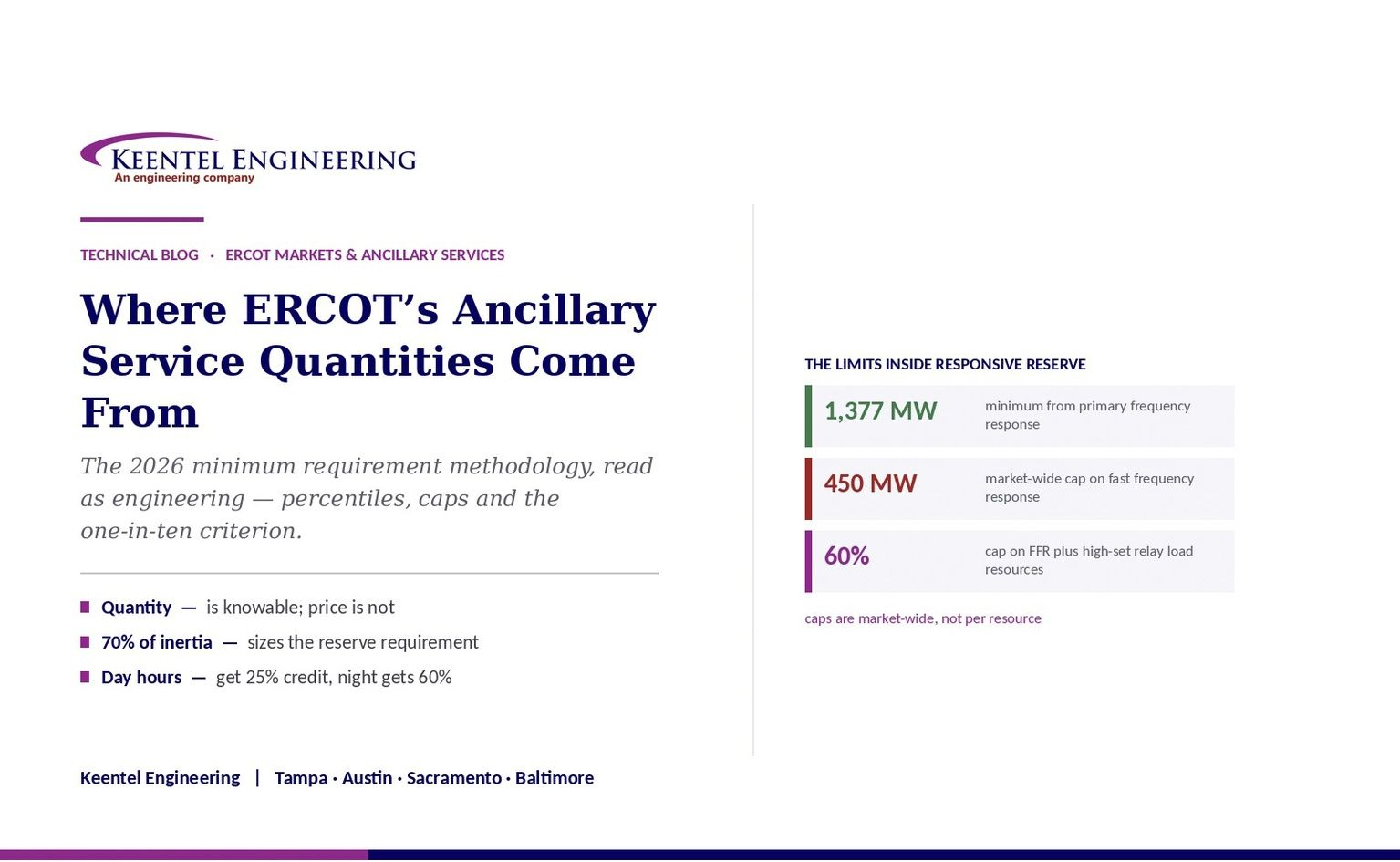
Where ERCOT’s Ancillary Service Quantities Come From
September 19, 2026 | Blog
The 2026 Minimum Requirement Methodology, Read as Engineering — the Percentiles, Caps, Inertia Assumptions and the One-in-Ten Criterion That Decide How Much Reserve Gets Bought Every Hour of the Year
1. Executive Summary
Every hour of every day, ERCOT procures a defined quantity of each ancillary service. Those quantities are not set by the market. They are calculated in advance by a methodology developed annually, reviewed by the ERCOT Board and approved by the Public Utility Commission of Texas, and they determine the size of the market a resource is competing in before any offer is submitted.
The 2026 methodology was recommended by the Board on 23 September 2025, approved by the Commission on 6 November 2025, and took effect on 1 January 2026 — which places it alongside the start of real-time co-optimisation. It covers Regulation Up and Down, Responsive Reserve, ERCOT Contingency Reserve Service and Non-Spinning Reserve.
Most commentary on ancillary services in ERCOT discusses prices. This paper works through the quantities, because the quantity is upstream of the price and it is knowable in advance. Four things in the methodology are worth any storage developer’s attention.
- Responsive Reserve carries three hard structural limits: a floor on how much must come from primary frequency response, a cap of 450 megawatts on fast frequency response across the entire market, and a limit of sixty percent of the total requirement on the combined contribution of fast frequency response and high-set relay load resources. Those caps bound the addressable market for storage in that product regardless of how competitive an offer is.
- Both Responsive Reserve and the frequency recovery component of the contingency reserve are sized to cover seventy percent of historic system inertia conditions — so the requirement moves with the inertia on the system, which is itself moving.
- The contingency and non-spin requirements come from a Monte Carlo optimisation tuned to a one-in-ten-year probability that operating reserves fall below a defined threshold. That single reliability criterion sets nearly three hundred requirement values covering every hour of the year.
- The engine credits only twenty-five percent of historically available capacity during day hours against sixty percent at night — a deliberate asymmetry that raises daytime requirements and is rarely discussed.
The rest of the paper works through each service, the arithmetic behind it, and what a resource owner and an engineer should each take from it.
The framing worth carrying
Ancillary service revenue is a function of quantity and price. Price is uncertain and competitive; quantity is calculated, published in advance, and driven by variables you can watch.
A developer who understands the drivers of the quantity has forward visibility that a price forecast alone cannot give.
2. What the Methodology Governs
The requirement to produce this methodology comes from the ERCOT Protocols, which oblige ERCOT to develop the methodologies for determining ancillary service amounts at least annually, and to have that methodology reviewed by the Board and approved by the Commission.
It covers four services.
| Service | What it does | Response requirement |
|---|---|---|
| Regulation Up and Regulation Down | Continuously corrects actual frequency to scheduled frequency and supports the applicable reliability performance measures | Continuous, automatic response to ERCOT deployment |
| Responsive Reserve (RRS) | Arrests frequency decline after a disturbance and holds it until slower reserves arrive | Immediate — primary frequency response, fast frequency response, or high-set underfrequency relay action |
| ERCOT Contingency Reserve Service (ECRS) | Restores frequency after a significant deviation, recovers deployed Regulation, covers intra-hour net load uncertainty, and supplies dispatch capacity when it is short | Rampable to a specified output within ten minutes |
| Non-Spinning Reserve (Non-Spin) | Replaces lost generating capacity, covers load forecast uncertainty, addresses net load ramp risk, and supplies dispatch capacity when it is short | Rampable or interruptible within thirty minutes, sustainable for at least four consecutive hours |
Two definitional points matter for a resource owner. The eligibility lists are broad and specific: contingency reserve may be provided by unloaded on-line generation capacity, quick start generation resources, load resources with or without high-set underfrequency relays, controllable load resources, and generation resources operating in synchronous condenser fast-response mode. And non-spin has a duration requirement embedded in its definition — four consecutive hours — which is a capability question rather than a capacity question, and is the reason duration matters commercially.
3. The Publication Calendar
The cadence is worth knowing precisely, because it determines when a developer learns what the market will be.
- Annual requirements for the upcoming year are posted to the Market Information System by 20 December.
- Incremental adjustments for a particular month are posted before the 20th of the preceding month.
- If requirements for a specific operating day prove insufficient for expected conditions, ERCOT may post an updated requirement for that day closer to real time.
- For months beyond the published horizon, the forecast requirement is set equal to the historical requirement for the same month of the previous year.
That last provision is a useful and underused fact. For any month beyond the published year, the working assumption is last year’s figure for the same month — which means a long-dated revenue model built on the published requirement is implicitly assuming no change, and that the change, when it comes, arrives through the annual methodology rather than gradually.
4. Regulation: The 95th Percentile of Net Load Forecast Error
Regulation requirements are built from forecast error, and the construction is specific.
The base Regulation Up requirement for a given hour is the ninety-fifth percentile of the positive net load forecast error for the same month of the previous two years, where net load is load minus wind minus solar. The base Regulation Down requirement is the ninety-fifth percentile of the negative net load forecast error over the same window. The stated design intent is that sufficient Regulation is available to cover the ninety-fifth percentile of deployed regulation or net load variability.
Three features of that construction have consequences.
- It is net load, not load. Wind and solar output is subtracted before the error is computed, so the requirement is driven by the combined uncertainty of demand and renewable output rather than demand alone. As renewable penetration rises, the error distribution widens even if load forecasting does not change.
- It is backward-looking over two years. The requirement for a month reflects what actually happened in that month across the previous two years. A structural change in the system — a large block of new capacity, a change in forecasting method — propagates into the requirement with a lag.
- Up and Down are computed separately from opposite tails. They are not symmetric and there is no reason to expect them to be. A system whose forecast errors skew in one direction will show a persistent asymmetry between the two products.
The methodology also allows the net load variability to be updated to account for accumulated area control error, which is a recognition that a percentile of forecast error is a proxy for balancing need rather than a direct measurement of it.
5. The Renewable Capacity Adjustment
A pure backward-looking percentile would systematically under-procure in a system adding renewable capacity quickly, because last year’s error distribution was produced by a smaller fleet. The methodology corrects for this explicitly, and the correction is one of the more interesting pieces of engineering in the document.
ERCOT calculates the increase in installed wind capacity and the increase in installed solar capacity, then adds incremental megawatts derived from wind and solar forecast error adjustment tables, varying by month of the year and hour of the day.
The capacity increase is defined precisely: the total nameplate capacity of wind or solar resources in the ERCOT network model at the time of the procurement study, minus the total nameplate capacity of those resources in the model at the end of the month being studied from the previous year. So it is a model-based count, not a queue-based one — capacity enters the calculation when it enters the network model.
The adjustment tables themselves come from a study ERCOT performs annually, using techniques similar to a well-known 2008 wind integration study but applied to actual wind and solar data. That lineage is worth noting: the framework for translating renewable capacity into regulation requirement is nearly two decades old in concept and is refreshed annually against real operating data.
Why this matters for a revenue forecast
Regulation requirements should be expected to grow as long as wind and solar capacity is growing, and the growth is mechanical rather than discretionary — it follows from installed nameplate entering the network model.
A developer tracking the interconnection queue and energisation dates has a leading indicator of the regulation requirement, one methodology cycle ahead of the posting.
6. The CPS1 Penalty Loop
The methodology contains a feedback mechanism that adjusts Regulation procurement based on how well the system has actually been controlled, measured by the control performance standard score.
| Trigger | Adjustment | Applies to |
|---|---|---|
| ERCOT monthly average CPS1 score below 140% for a specific month | Additional 10% of both Regulation Up and Regulation Down | The hours in which the CPS1 score was below 140% |
| ERCOT 12-month rolling average CPS1 score below 140% | Additional 10% of both Regulation Up and Regulation Down in the following month | The hours in which the hourly CPS1 score was below 140% |
| CPS1 score falls below 100% | The adjustment increases to 20% | As above |
Two observations. The adjustment is hour-targeted rather than blanket — it applies to the specific hours where performance was poor, which means it responds to the shape of the problem rather than its average. And it is genuinely a feedback loop: poor frequency control leads to more regulation being bought, which should improve control, which removes the adder. For a resource owner, a period of degraded system control is a period of elevated regulation procurement, with a lag of roughly a month.
7. RRS: Six Blocks and an Inertia Assumption
Responsive Reserve is structured differently from Regulation. Rather than an hourly value, the requirement is published by month in six blocks covering four-hour intervals, based on expected diurnal load, solar and wind patterns for that month.
The sizing basis is the part worth understanding. The amounts are set to cover seventy percent of historic system inertia conditions for each block of hours in the month.
That is a specific and consequential choice. Responsive Reserve exists to arrest frequency decline after a generation trip, and how fast frequency falls after a trip depends on system inertia — less inertia means a faster decline and therefore a need for more and faster reserve. Sizing to the seventieth percentile of historic inertia means the requirement is set against a reasonably conservative inertia condition rather than the average, and that it moves as the inertia distribution moves.
Since system inertia in ERCOT trends downward as synchronous generation is displaced by inverter-based resources, the inertia distribution that feeds this calculation is not stationary. A requirement sized against last year’s inertia distribution will be sized against a lower one next year.
The methodology also introduces an equivalency ratio between load resources and generation resources providing Responsive Reserve, used to establish total reserves, with the day-ahead market applying a one-to-one ratio. The ratio is published by four-hour block alongside the monthly requirement — which means the effective quantity available from different resource types is itself a published, varying parameter.
8. The Three Caps That Shape Storage Revenue in RRS
This section contains the most commercially consequential content in the entire methodology, and it is stated in a single dense paragraph that is easy to read past.
| Limit | The number | What it constrains |
|---|---|---|
| Minimum from primary frequency response | Determined monthly by study, and not less than 1,377 MW | A floor on how much Responsive Reserve must come from resources providing genuine primary frequency response. ERCOT may raise it if the posted quantity would harm reliability or would require additional Regulation to be deployed |
| Maximum from fast frequency response | 450 MW | A hard market-wide ceiling on the fast frequency response contribution, regardless of how much capability exists or how it is priced |
| Combined cap on FFR and high-set relay load resources | 60% of the total RRS requirement in the day-ahead market | Bounds the combined share from fast frequency response and load resources controlled by high-set underfrequency relay |
| Self-arranged limit | 60% from FFR and load resources excluding controllable load resources | The same structural limit applied to a QSE self-arranging its own RRS obligation |
For a storage developer, the fast frequency response cap is the number to internalise. It is a market-wide ceiling, not a per-resource one. Once the fleet capable of providing that product exceeds the cap, additional capability competes for a fixed quantity, and the marginal economics change character entirely — from a growing market to a zero-sum one.
The primary frequency response floor cuts the other way and is worth understanding as an opportunity. It guarantees a minimum quantity procured from resources providing genuine primary frequency response, and it is a floor that ERCOT may raise. Whether a storage resource qualifies to provide that product rather than fast frequency response is a control system and testing question, not a hardware one — and it determines which side of the cap the resource sits on.
The methodology also notes that if the percentage level for these resource categories is changed in the Protocols, that change flows into these requirements. The caps are policy parameters, revisable through the stakeholder process, and worth tracking as such.
9. The Temperature-Gated Reserve Discount Factor
One adjustment in the Responsive Reserve methodology deserves separate treatment because it links unit performance directly to procurement, and because its trigger is a weather condition.
ERCOT procures an additional 200 megawatts of Responsive Reserve for each percentage point of Reserve Discount Factor when the factor is estimated to be less than one. The adjustment applies only to those four-hour blocks where the eighty-fifth percentile of weighted average temperature exceeds ninety-five degrees Fahrenheit.
Two things are embedded there.
- The Reserve Discount Factor is derived from generator performance during unannounced testing. A fleet that under-delivers against its reserve obligations in testing produces a factor below one, and the system buys more reserve to compensate. Performance in a test has a direct, quantified procurement consequence.
- The temperature gate confines the adjustment to the hottest blocks. That is a rational targeting of the hours where reserve adequacy is most at risk and where thermal derating is most likely to be the cause of under-delivery — but it also means the adjustment is a summer phenomenon, concentrated in exactly the blocks where prices are already highest.
A separate adjustment accounts for resources operating in synchronous condenser fast-response mode providing Responsive Reserve, and it applies only to four-hour blocks where system inertia is typically expected to be below 250 gigawatt-seconds. That threshold is worth noting as one of the few places where a specific inertia figure appears in a market procurement rule.
10. ECRS and Non-Spin: What Each Is Actually For
The two products are often discussed together because they are sized together, but their purposes are distinct and the distinction explains their eligibility rules.
| ECRS | Non-Spin | |
|---|---|---|
| Response time | Ramp to a specified output within 10 minutes | Ramp or interrupt within 30 minutes |
| Duration | Not specified in the same terms | Must sustain at a specified output, or remain interrupted, for at least four consecutive hours |
| Who can provide it | Unloaded on-line generation capacity, quick start generation resources, load resources with or without high-set underfrequency relays, controllable load resources, and generation resources in synchronous condenser fast-response mode | Generation resources, controllable load resources interruptible within 30 minutes, and other load resources able to reduce consumption on an instruction within 30 minutes and hold until recalled |
| Why it is deployed | Restore frequency within 10 minutes of a significant deviation; recover deployed Regulation; cover intra-hour net load forecast uncertainty when online thermal ramping capability is short; supply dispatch capacity when SCED is short | Replace lost generating capacity; cover load and forecast uncertainty when online reserve is short; address net load ramp risk; supply dispatch capacity when SCED is short |
The net load ramp rationale for Non-Spin is stated explicitly and is worth quoting in substance: periods when load is increasing while wind or solar output is falling require other resources to increase output or come online quickly, so net load ramp risk should be accounted for in the Non-Spin requirement. Forecast uncertainty analysis alone may not cover exposure to generation loss and ramp risk together, which is why additional reserve is carried.
For a storage owner, the four-hour sustain requirement on Non-Spin is the operative constraint. It is a capability requirement embedded in the product definition, and it is one of the clearest places where duration converts directly into market access.
11. The Probabilistic Engine
ECRS and Non-Spin requirements are not set by percentile in the way Regulation is. They come out of a Monte Carlo optimisation that balances risks against credits.
11.1 The Risk Side
- Historic net load forecast errors at thirty minutes ahead and six hours ahead.
- Historic rolling six-hour-ahead forced outages of conventional resources.
- Both drawn from the previous four years — a longer window than the two years used for Regulation.
- Plus an explicit adjustment for expected increase in solar forecast error due to expected growth in installed solar capacity. ERCOT states the reasoning directly: solar capacity keeps growing, more capacity means more megawatts of forecast error, and relying on historical solar forecast error alone would under-estimate the requirement.
11.2 The Credit Side
- Historic online capacity that can be ramped to within thirty minutes and sustained for four hours.
- Historic offline capacity that can be brought online within thirty minutes.
The engine then consumes the risks and a fraction of the historically available capacity, runs the optimisation, and produces a combined requirement for each month and hour. The hourly split between ECRS and Non-Spin is then derived using the thirty-minute-ahead and six-hour-ahead forecast error alongside the combined requirement.
A small note for anyone reading the published methodology closely: the parenthetical describing the output count appears to contain a typographical slip — twelve months by twenty-four hours gives 288 distinct requirement values, which are then applied across the 8,760 hours of the year. The substance is unaffected, and the structure is twelve-by-twenty-four.
12. The One-in-Ten Criterion
The convergence criterion for the optimisation is the single most important sentence in the methodology, because it is the reliability standard that everything else serves.
The requirements are set so that there is a one-in-ten-year probability of operational reserves dropping below the higher of two thresholds: the sum of procured Regulation Up and Responsive Reserve, or the Watch threshold of 3,000 megawatts of physical responsive capability — due to uncertainty in net load forecast and conventional resource availability.
Several things follow from that formulation and are worth drawing out.
- It is a probabilistic standard, not a deterministic one. The requirement is not sized to survive a named worst case; it is sized so that a defined shortfall has a stated annual likelihood. That is a more defensible framing and a less intuitive one.
- The threshold is dynamic. Because one arm of it is the sum of procured Regulation Up and Responsive Reserve, and those quantities themselves vary by hour and month, the level the reserves must stay above moves with the other products. The services are coupled by construction.
- The 3,000 megawatt physical responsive capability floor anchors it. Where the sum of the other products is low, the Watch threshold governs, which prevents the criterion from becoming trivially easy in low-requirement hours.
- The risks named are net load forecast uncertainty and conventional resource availability. Those are the two dimensions the Monte Carlo samples, and anything outside them — a correlated event, a common-mode failure, an extreme weather scenario beyond the historic sample — is outside the criterion by construction.
The last point is not a criticism. Every probabilistic standard is defined over a sample space, and stating what is inside it is more honest than implying universal coverage. It does mean that the criterion answers a specific question, and a resource owner or planner should know which question.
Buried in the description of the engine is a parameter choice with a substantial effect on the answer, and it receives no explanation in the methodology itself.
The optimisation consumes sixty percent of the historically available capacity for night hours — hours ending 23 through 5 — and only twenty-five percent of the historically available capacity for day hours, hours ending 6 through 22.
In other words, the engine gives itself substantially less credit for capacity that has historically been available during the day than at night. Less credit on the capacity side means more requirement on the procurement side, so daytime ECRS and Non-Spin requirements are structurally higher than the raw risk figures alone would produce.
The engineering logic is not stated, and any reading is inference. The most plausible explanation is that historically available daytime capacity is less dependable in the moment it is needed: it may already be committed to serving the daytime load peak, it is more exposed to thermal derating in summer afternoons, and the day is when solar forecast error and the evening net load ramp coincide with it. Crediting it at a quarter rather than three-fifths is a conservative treatment of capacity that looks available in retrospect but may not be available at the moment of stress.
Whatever the reasoning, the effect on a revenue model is direct. The daytime requirement is elevated by a parameter choice, not by observed daytime risk alone, and anyone modelling ECRS or Non-Spin quantities from risk statistics without applying the same asymmetry will under-estimate the day and over-estimate the night.
14. Frequency Recovery Capacity and the Real-Time Adder
14.1 Frequency Recovery Capacity in ECRS
The ECRS requirement may be increased beyond the optimisation result to account for the capacity needed to recover frequency following a large unit trip. That component is computed for each hour of each month as the capacity required after a supply-side trip to recover frequency, based on expected diurnal load, solar and wind patterns, covering seventy percent of historic system inertia conditions, with an adjustment for the Regulation Up requirement in that hour.
The seventy percent inertia basis appears here for the second time, and the appearance of the Regulation Up requirement inside the ECRS calculation is another instance of the coupling noted in Section 12. These products are not independently sized.
14.2 The Real-Time Non-Spin Adder
After posting the annual and monthly quantities, ERCOT monitors weather and the net load forecast near real time and may procure up to an additional 1,000 megawatts of Non-Spin for operating hours meeting three conditions together: the hours are identified as having increased potential for high forecast variability; there is a risk that actual net load could exceed forecast after appropriate forecast model selection; and the expected available capacity and reserves, including the posted minimum Non-Spin, are insufficient to cover the projected net load forecast uncertainty risk.
All three conditions must hold. This is a discretionary, conditional, near-real-time lever with a stated ceiling — and for a resource owner it represents up to a gigawatt of additional Non-Spin demand appearing on short notice in exactly the hours where the system is stressed.
14.3 The MSSC Floor
One final constraint: the minimum Non-Spin procured from resources dispatchable by security-constrained economic dispatch in any hour shall not be less than the lower of the most severe single contingency value and the Non-Spin requirement for that hour.
That provision ensures a defined share of Non-Spin sits with resources the dispatch engine can actually move, rather than with resources that satisfy the product definition but are not dispatchable in the same way. It is a quality-of-reserve requirement layered on top of a quantity requirement.
15. What This Means for a Storage Owner
Pulling the commercially relevant threads together.
- The fast frequency response cap of 450 megawatts is market-wide. Model it as a ceiling on the addressable quantity for that product, not as a constraint on your resource, and understand that once the qualified fleet exceeds it the competition is for a fixed pool.
- Qualification matters more than capability. Whether a resource provides primary frequency response or fast frequency response determines which limit it sits under — a floor that ERCOT may raise, or a hard cap. That is a control and testing question with a direct revenue consequence.
- Duration is written into the product. Non-Spin requires the ability to sustain for four consecutive hours. That is not a market preference; it is in the definition of the service.
- Performance in unannounced testing has a quantified procurement effect through the Reserve Discount Factor, and it is amplified in the hottest four-hour blocks where prices are highest. Under-delivery in a test is not only a compliance matter.
- Regulation requirements should be expected to grow with wind and solar capacity, mechanically, through the capacity adjustment. The interconnection queue and energisation schedule are a leading indicator.
- The day and night asymmetry means daytime ECRS and Non-Spin requirements are structurally elevated relative to the underlying risk statistics.
- The real-time Non-Spin adder can add up to 1,000 megawatts of demand on short notice in stressed hours — an upside that a model built only on posted quantities will miss.
- Watch the methodology cycle, not just the postings. Requirements are revised annually through a document that is published, reviewed by the Board and approved by the Commission. The caps and the parameters are policy variables, and changes to them are visible well before they take effect.
16. What This Means for an Engineer
The methodology is a market document and it is full of engineering.
- Inertia appears twice as a sizing basis — seventy percent of historic conditions for Responsive Reserve and for the frequency recovery component of ECRS — and once as a threshold, at 250 gigawatt-seconds, gating the synchronous condenser adjustment. System inertia is a procurement input, and it is falling.
- Synchronous condenser fast-response mode appears as an eligible capability for both Responsive Reserve and ECRS. That is a real plant capability with real engineering behind it, and it is recognised in the procurement rules.
- The distinction between primary frequency response and fast frequency response is a control system distinction with a market boundary attached. Governor-type continuous proportional response and relay or controller-triggered step response are different behaviours, and the methodology treats them differently and caps them differently.
- The equivalency ratio between load resources and generation resources, published by four-hour block, is an explicit statement that a megawatt of reserve from one resource type is not equivalent to a megawatt from another for reliability purposes.
- Forecast error is the primary driver across every product. Improving forecast accuracy — of load, of wind, of solar — reduces the reserve the system must carry, which is one of the few levers that reduces cost without reducing reliability.
For anyone doing interconnection or plant engineering in ERCOT, the useful reframing is that the quantities a plant can sell into are determined by system-level properties — inertia, forecast error, fleet performance in testing — that engineering work influences directly.
17. Keentel ERCOT Services
Keentel Engineering works across the engineering that determines whether an ERCOT resource can deliver what it offers, and the interconnection and compliance work that gets it to that point.
17.1 Resource Qualification and Performance
- Assessment of resource capability against ancillary service product definitions — primary frequency response versus fast frequency response, response time, duration sustainability and the qualification pathway for each.
- Plant controller and inverter control review for frequency response behaviour, including droop, deadband, response time and sustained delivery.
- Telemetry and state-of-charge architecture supporting award feasibility and deliverability, including the limit reporting and base point handling that determine whether awards can be honoured.
- Preparation for and support through qualification and unannounced performance testing, and investigation where a resource has under-delivered.
- Synchronous condenser and synchronous condenser fast-response mode evaluation for existing and new plant.
17.2 Interconnection and Studies
- ERCOT interconnection engineering, application support and study-phase technical packages, and coordination with the transmission service provider and ERCOT.
- Steady-state, dynamic and electromagnetic transient model development, collector system modelling, model quality testing and submittal.
- System strength screening and weak-grid electromagnetic transient studies, control interaction assessment, and determination of the minimum system strength for stable operation.
- Short-circuit, protective coordination, arc-flash, load flow, reactive capability and harmonic studies.
- Inertia and frequency response contribution assessment for conventional, storage and hybrid resources.
17.3 Compliance
- Ride-through design evaluation and capability assessment at the point of interconnection, covering both the ERCOT requirements and the applicable reliability standards.
- Disturbance monitoring architecture, model verification and validation, and protection system maintenance programme support.
- Registration applicability assessment and compliance programme development, with evidence structured during design and commissioning.
17.4 Plant Design and Owner’s Engineer
- Point-of-interconnection and substation design, collector system design, grounding and lightning protection, and protection and control design.
- Equipment specification including model deliverable and usage-rights requirements, and bid normalisation so proposals can be compared on equivalent terms.
- Design review of EPC and vendor submittals, QA/QC of third-party studies and models, and commissioning specification and test procedure development.
Keentel Engineering holds a Florida Certificate of Authorization and maintains offices in Tampa, Austin, Sacramento, and Baltimore, supporting projects across the interconnections.
18. Frequently Asked Questions
Q1. Who decides how much ancillary service ERCOT buys?
A methodology developed at least annually under the ERCOT Protocols, reviewed by the ERCOT Board and approved by the Public Utility Commission of Texas. The 2026 methodology was Board-recommended on 23 September 2025, Commission-approved on 6 November 2025, and effective 1 January 2026.
Q2. When are the quantities published?
Annual requirements for the upcoming year are posted to the Market Information System by 20 December. Incremental monthly adjustments are posted before the 20th of the preceding month. ERCOT may also post a day-specific update closer to real time if requirements prove insufficient for expected conditions.
Q3. What happens for months beyond the published year?
The forecast requirement is set equal to the historical requirement for the same month of the previous year. A long-dated model built on the published figure is therefore implicitly assuming no change until the next methodology cycle.
Q4. How is the Regulation requirement calculated?
Regulation Up is the 95th percentile of positive net load forecast error for the same month of the previous two years, where net load is load minus wind minus solar. Regulation Down is the 95th percentile of the negative error over the same window. Net load variability may be updated to account for accumulated area control error.
Q5. Why net load rather than load?
Because the balancing need is driven by the combined uncertainty of demand and renewable output, not demand alone. As wind and solar penetration rises, the error distribution widens even if load forecasting itself does not change.
Q6. How does the methodology avoid under-procuring as renewables grow?
Through an explicit capacity adjustment. ERCOT calculates the increase in installed wind and solar nameplate — measured in the network model, at the time of the procurement study against the end of the same month the previous year — and adds incremental megawatts from forecast error adjustment tables that vary by month and hour.
Q7. Where do those adjustment tables come from?
From a study ERCOT performs annually, using techniques similar to a well-known 2008 wind integration study but applied to actual wind and solar operating data.
Q8. What is the CPS1 adjustment?
A feedback loop. If the monthly average control performance score falls below 140% for a month, an extra 10% of Regulation Up and Down is applied to the hours where the score was below 140%. The same applies off the 12-month rolling average for the following month. If the score falls below 100%, the adjustment rises to 20%.
Q9. How is Responsive Reserve structured?
By month, in six blocks covering four-hour intervals, based on expected diurnal load, solar and wind patterns. The amounts cover 70% of historic system inertia conditions for each block, and an equivalency ratio between load resources and generation resources is published alongside them.
Q10. Why is inertia the sizing basis?
Because Responsive Reserve exists to arrest frequency decline after a generation trip, and how fast frequency falls depends on system inertia. Less inertia means a faster decline and a need for more and faster reserve. Sizing to the 70th percentile of historic inertia sets the requirement against a reasonably conservative condition.
Q11. Does that mean the requirement will change as inertia falls?
Yes, mechanically. The inertia distribution feeding the calculation is not stationary — it trends downward as synchronous generation is displaced by inverter-based resources — so a requirement sized against one year’s distribution will be sized against a lower one the next.
Q12. What are the caps on Responsive Reserve composition?
Three. A minimum from primary frequency response resources, determined monthly by study and not less than 1,377 MW. A maximum of 450 MW from fast frequency response. And a day-ahead limit of 60% of the total requirement on the combined contribution of fast frequency response and load resources controlled by high-set underfrequency relay.
Q13. Why does the 450 MW cap matter so much for storage?
Because it is market-wide, not per-resource. Once the qualified fleet capable of providing fast frequency response exceeds that ceiling, additional capability competes for a fixed quantity and the marginal economics change from a growing market to a zero-sum one.
Q14. Can a storage resource sit on the other side of that cap?
That is the right question to ask. The primary frequency response floor is a minimum ERCOT must procure and may raise; the fast frequency response limit is a ceiling. Which category a resource qualifies under is a control system and testing matter rather than a hardware one, and it has a direct revenue consequence.
Q15. What is the Reserve Discount Factor adjustment?
ERCOT procures an additional 200 MW of Responsive Reserve for each percentage point of Reserve Discount Factor when the factor is below one, applying only to four-hour blocks where the 85th percentile of weighted average temperature exceeds 95°F. The factor is derived from generator performance during unannounced testing.
Q16. So test performance affects procurement?
Directly and quantifiably. A fleet that under-delivers in unannounced testing produces a factor below one and the system buys more reserve to compensate, concentrated in the hottest blocks — which are also the highest-priced hours.
Q17. What is the difference between ECRS and Non-Spin?
Response time and duration. ECRS must ramp to a specified output within 10 minutes. Non-Spin must ramp or interrupt within 30 minutes and sustain for at least four consecutive hours. Their eligible provider lists and deployment rationales differ accordingly.
Q18. How are ECRS and Non-Spin quantities determined?
By a Monte Carlo optimisation. Risks are historic 30-minute-ahead and 6-hour-ahead net load forecast errors and historic rolling 6-hour-ahead forced outages of conventional resources, over the previous four years, plus an adjustment for expected growth in solar forecast error. Credits are historic online capacity rampable in 30 minutes and sustainable four hours, and historic offline capacity startable in 30 minutes.
Q19. What is the reliability criterion behind the optimisation?
A one-in-ten-year probability that operational reserves drop below the higher of two thresholds: the sum of procured Regulation Up and Responsive Reserve, or the Watch threshold of 3,000 MW of physical responsive capability — due to uncertainty in net load forecast and conventional resource availability.
Q20. Why does that formulation matter?
Because it is probabilistic rather than deterministic, because the threshold is dynamic — one arm of it is the sum of two other products, so the services are coupled by construction — and because the risks it samples are specifically net load uncertainty and conventional resource availability. Anything outside those dimensions is outside the criterion by design.
Q21. What is the day and night asymmetry in the engine?
The optimisation credits 60% of historically available capacity for night hours, hours ending 23 through 5, but only 25% for day hours, hours ending 6 through 22. Less credit on the capacity side means more requirement on the procurement side, so daytime requirements are structurally elevated.
Q22. Why the difference?
The methodology does not explain it, so any reading is inference. The most plausible explanation is that historically available daytime capacity is less dependable at the moment of need — already committed to the daytime peak, more exposed to summer thermal derating, and coinciding with solar forecast error and the evening net load ramp.
Q23. Can ERCOT buy more Non-Spin after the quantities are posted?
Yes, up to an additional 1,000 MW, where three conditions hold together: the hours are identified as having increased potential for high forecast variability; actual net load could exceed forecast after appropriate model selection; and expected capacity and reserves including the posted minimum are insufficient to cover the projected risk.
Q24. Is there a floor on where Non-Spin comes from?
Yes. The minimum Non-Spin procured from resources dispatchable by security-constrained economic dispatch in any hour shall not be less than the lower of the most severe single contingency value and the Non-Spin requirement for that hour — a quality-of-reserve requirement layered on the quantity.
Q25. What is the single most useful takeaway?
That quantity is knowable in advance and price is not. The drivers of the quantity — renewable capacity entering the network model, system inertia, fleet test performance, forecast error — are all observable. A developer who tracks them has forward visibility into the size of the market that a price forecast alone cannot provide.
References and Further Reading
Primary Source
- ERCOT Methodologies for Determining Minimum Ancillary Service Requirements — Board recommended 23 September 2025, approved by the Public Utility Commission of Texas 6 November 2025, effective 1 January 2026 — Electric Reliability Council of Texas
ERCOT Market Rules
- ERCOT Nodal Protocols — including Section 3.16, Standards for Determining Ancillary Service Quantities, and the ancillary service definitions and qualification requirements — Electric Reliability Council of Texas
- ERCOT Nodal Operating Guide — including Section 2.3.1.1 on the Responsive Reserve obligation, and the provisions covering synchronous condenser fast-response mode — Electric Reliability Council of Texas
- ERCOT Market Information System Ancillary Service Requirement Postings — including the ancillary service methodology and study materials published with them — Electric Reliability Council of Texas
- ERCOT Real-Time Co-optimization plus Batteries Materials — covering the market design in effect alongside this methodology — Electric Reliability Council of Texas
Reliability and Technical Context
- NERC Reliability Standards — including the BAL series covering control performance, disturbance control and frequency response, which underlie the control performance measures referenced in the Regulation methodology — North American Electric Reliability Corporation
- NERC Reliability Guidelines on Frequency Response, Primary Frequency Control and Inertia — including reliability guideline material on fast frequency response capability — North American Electric Reliability Corporation
- IEEE Std 2800 — Standard for Interconnection and Interoperability of Inverter-Based Resources — covering frequency response and ride-through capability relevant to resource qualification — IEEE Standards Association
Notice and Disclaimer
This document is original technical content prepared by Keentel Engineering LLC for general professional information. It is not market, trading, investment, legal or project-specific engineering advice, and it does not constitute a revenue forecast, a qualification determination, or a compliance determination for any resource.
Descriptions of the methodology, its parameters, thresholds and procedures are summaries of the source document as published for the 2026 requirement year, prepared for orientation. They are not a substitute for the methodology itself or for the ERCOT Protocols and Operating Guides, which govern in every respect. ERCOT market rules and methodologies are revised at least annually and parameters may change; confirm the current version and the posted requirements with ERCOT before making any decision.
Where this paper draws inferences that the source document does not state — including the reasoning offered for the day and night capacity credit asymmetry and the commercial implications discussed throughout — those are Keentel Engineering’s own engineering assessment and should not be attributed to ERCOT, the Public Utility Commission of Texas, or any other party.
Keentel Engineering LLC is an independent engineering consultancy. Reference to any market operator, regulator, standard, industry organisation, or resource category in this document does not imply affiliation with, endorsement by, or sponsorship from any such organisation.

About the Author:
Sandip "Sonny" R. Patel, P.E.
IEEE Senior Member · Founder & CEO, Keentel Engineering
In 1995, Sonny Patel earned his Electrical Engineering degree from the University of Illinois. But degrees don't build legacies — action does.
For three decades, he has worked the power industry from every side of the table: 16 years as a utility engineer at Exelon/Commonwealth Edison; generation leadership across hydroelectric, industrial steam turbine, and a 9 GW renewable fleet; NERC Regional Entity Senior Compliance Engineer and Audit Team Lead, auditing some of the nation's largest utilities; and testing and commissioning lead on equipment up to 765 kV — the very top of the North American grid.Utility. Generator. Regulator. Consultant. Few engineers have seen all four seats. Fewer still have sat in them.
His experience spans nuclear, hydro, conventional generation, renewables, oil and gas, mining — and today's data centers, where he is authoring a three-book series on data center design. He is a Licensed Professional Engineer in six states and a Licensed Electrical Contractor in Florida (Unlimited EC) — he doesn't just design the work; he's qualified to stand behind its execution.Today, as Founder and CEO of Keentel Engineering, Sonny leads a nationwide team of engineers delivering substation design, power system studies, NERC compliance, and commissioning — done right, coast to coast.Three decades. Every side of the table. One standard: accountable engineering.
Services

Let's Discuss Your Project
Let's book a call to discuss your electrical engineering project that we can help you with.
About the Author:
Sandip "Sonny" R. Patel, P.E.
IEEE Senior Member · Founder & CEO, Keentel Engineering
In 1995, Sonny Patel earned his Electrical Engineering degree from the University of Illinois. But degrees don't build legacies — action does.
For three decades, he has worked the power industry from every side of the table: 16 years as a utility engineer at Exelon/Commonwealth Edison; generation leadership across hydroelectric, industrial steam turbine, and a 9 GW renewable fleet; NERC Regional Entity Senior Compliance Engineer and Audit Team Lead, auditing some of the nation's largest utilities; and testing and commissioning lead on equipment up to 765 kV — the very top of the North American grid.
Utility. Generator. Regulator. Consultant. Few engineers have seen all four seats. Fewer still have sat in them.
His experience spans nuclear, hydro, conventional generation, renewables, oil and gas, mining — and today's data centers, where he is authoring a three-book series on data center design. He is a Licensed Professional Engineer in six states and a Licensed Electrical Contractor in Florida (Unlimited EC) — he doesn't just design the work; he's qualified to stand behind its execution.
Today, as Founder and CEO of Keentel Engineering, Sonny leads a nationwide team of engineers delivering substation design, power system studies, NERC compliance, and commissioning — done right, coast to coast.Three decades. Every side of the table. One standard: accountable engineering.
Leave a Comment
Thank you for contacting us.
We will get back to you as soon as possible.
We will get back to you as soon as possible.
Oops, there was an error sending your message.
Please try again later.
Please try again later.
Related Posts
By SANDIP R PATEL
•
September 22, 2026
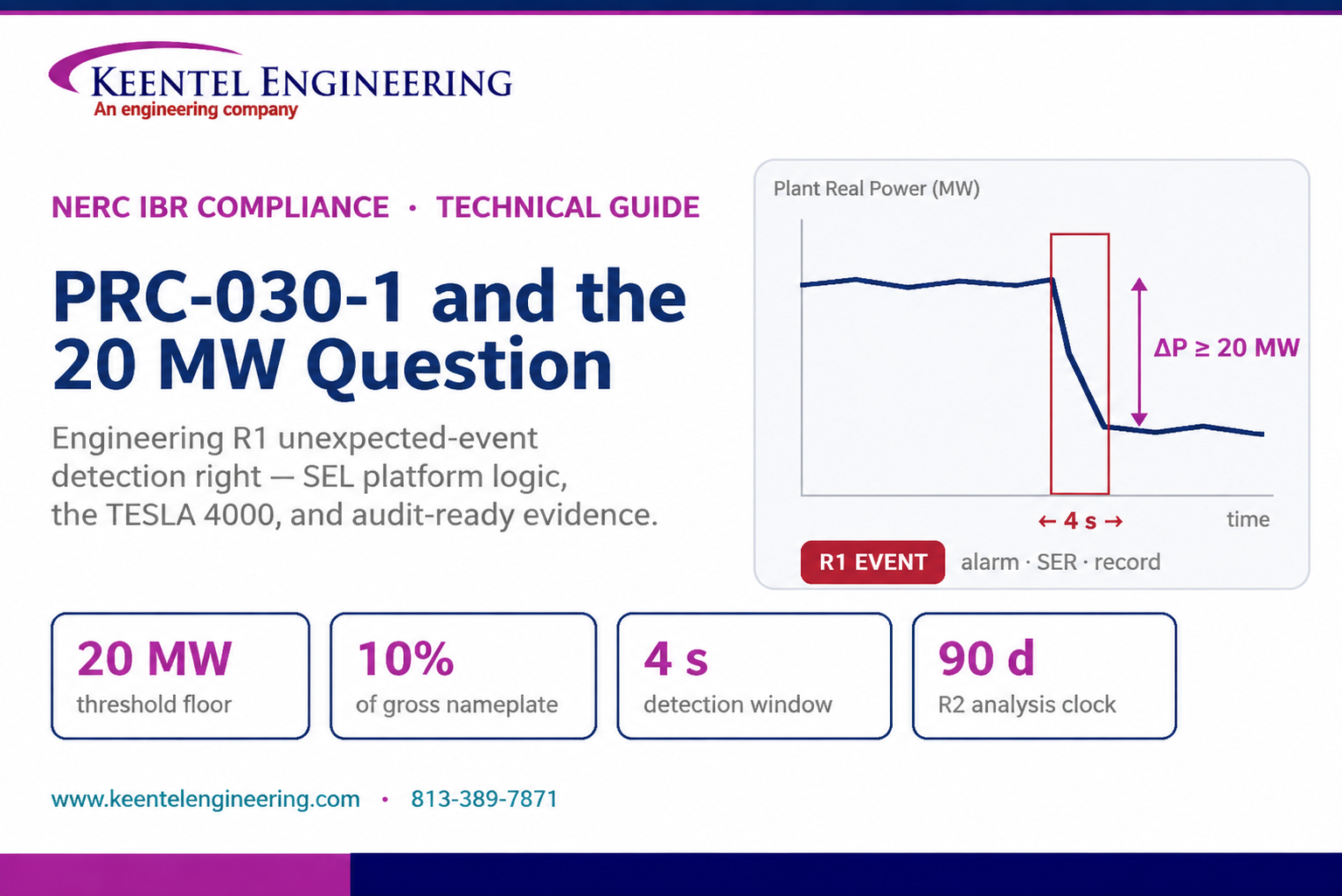
Learn PRC-030-1 R1 event detection requirements for inverter-based resources, SEL platforms, disturbance monitoring, and audit-ready compliance.

By SANDIP R PATEL
•
September 22, 2026
Learn how PSS®E and PSCAD™ model updates support plant augmentations, repowering, equipment changes, testing, benchmarking, and grid compliance.
By SANDIP R PATEL
•
September 20, 2026
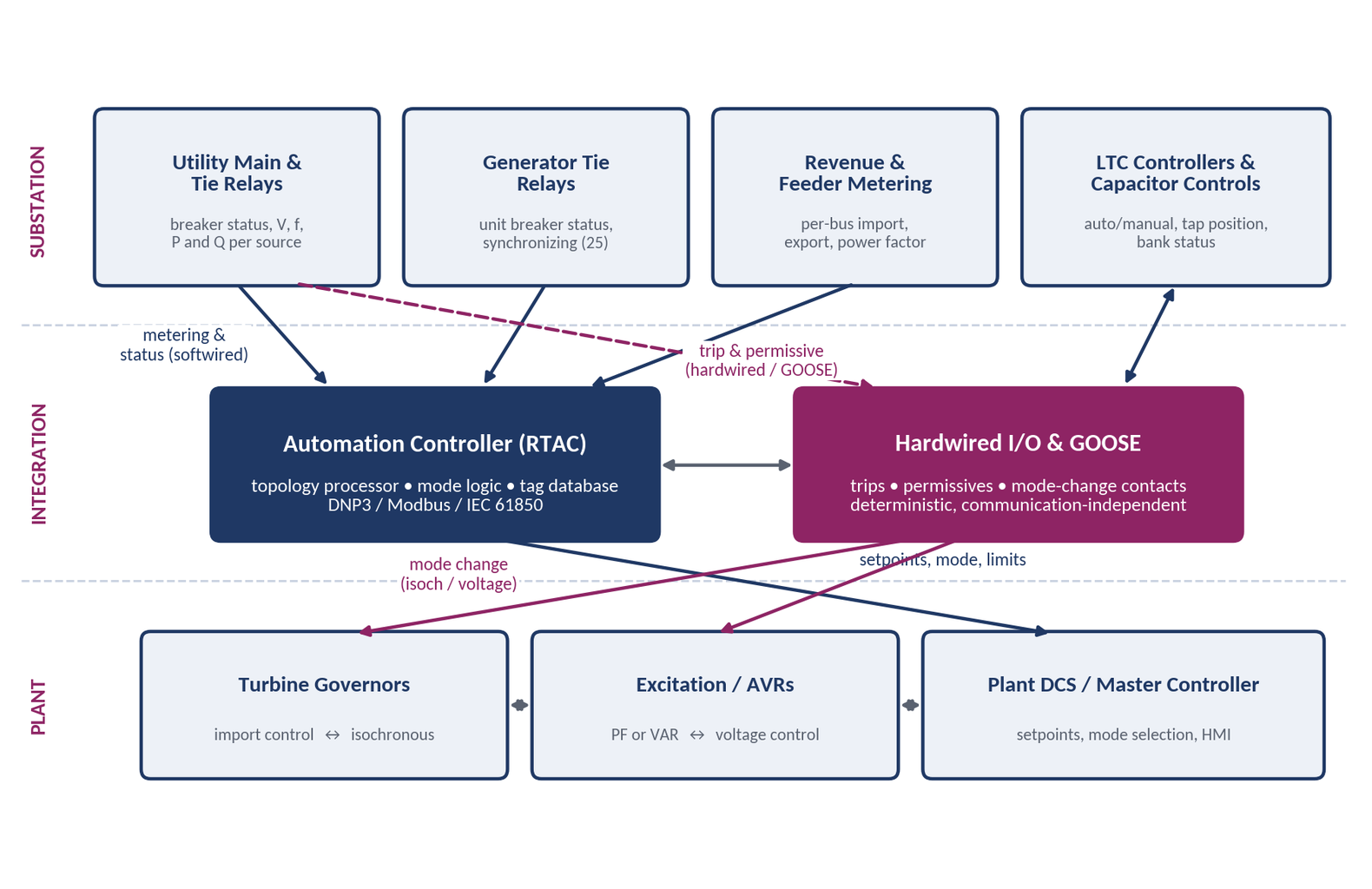
Learn CHP load following and island detection engineering for campus plants, including protection, controls, power studies, and grid transition design.
By SANDIP R PATEL
•
September 20, 2026
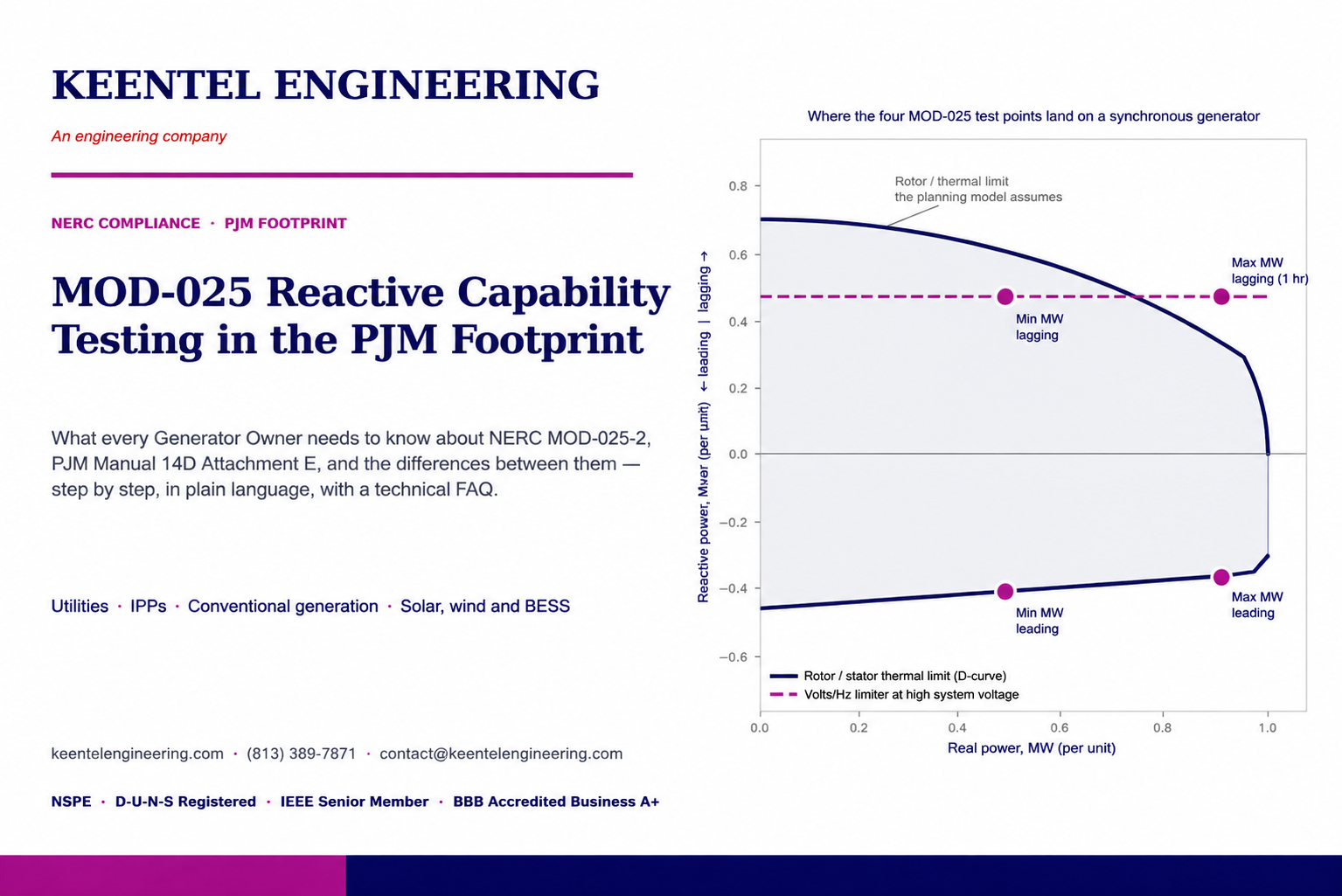
NERC MOD-025-2 Generator Owners, MOD-025-2 reactive power testing, generator capability verification, NERC Attachment 1, MOD-025 compliance testing

By SANDIP R PATEL
•
September 19, 2026
Explore utility scale solar engineering from site assessment to POI interconnection, including PV design, BESS, substation and grid studies.

By SANDIP R PATEL
•
September 18, 2026
Learn how to size rack power distribution, PDU and RPP systems for continuous loads, A/B redundancy, failover capacity, SCCR and high-density AI data centers.
By SANDIP R PATEL
•
September 18, 2026
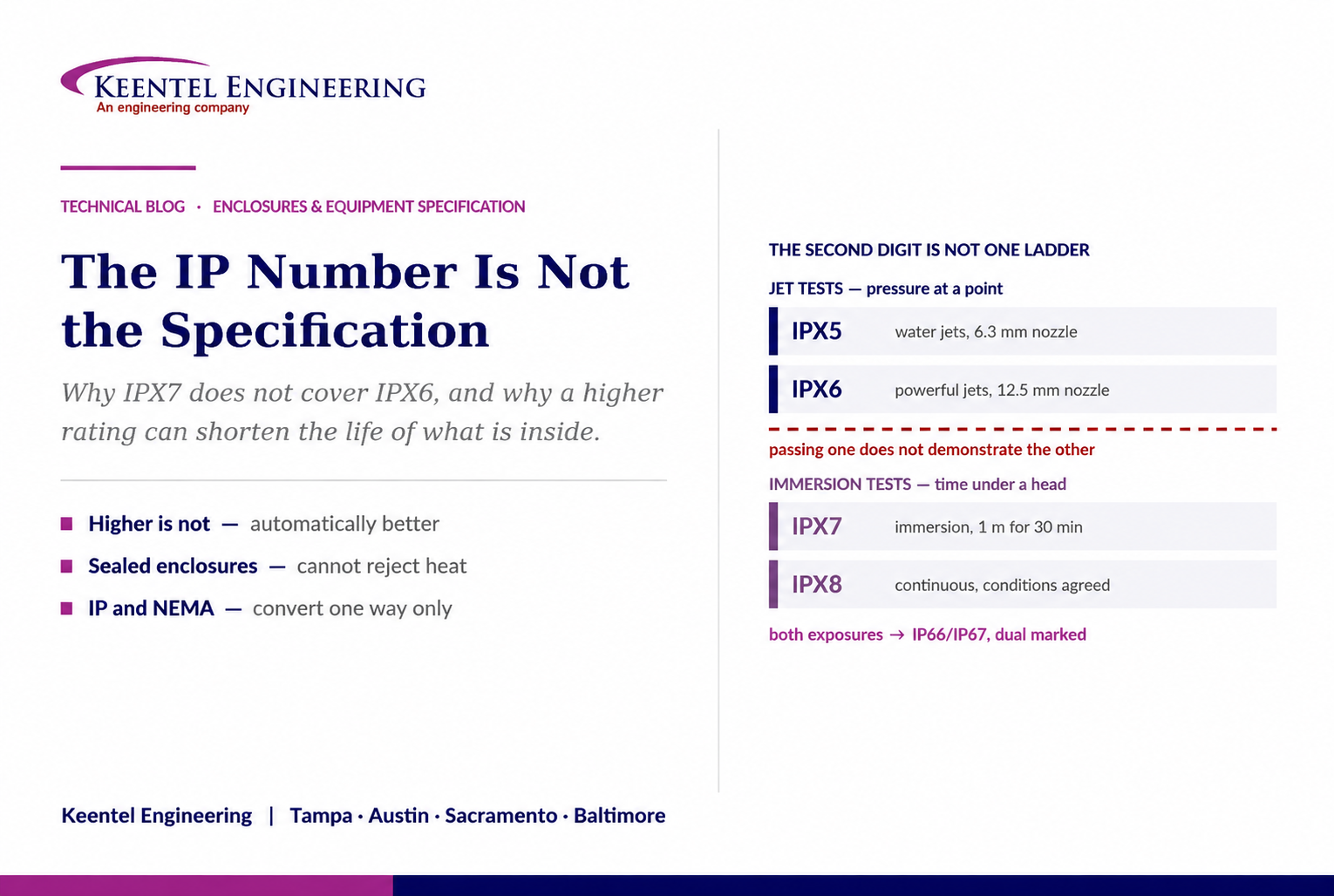
Learn why IP ratings like IP66, IP67, and IP68 do not tell the full story. Understand enclosure selection, NEMA differences, heat, corrosion, and protection.
By SANDIP R PATEL
•
September 9, 2026
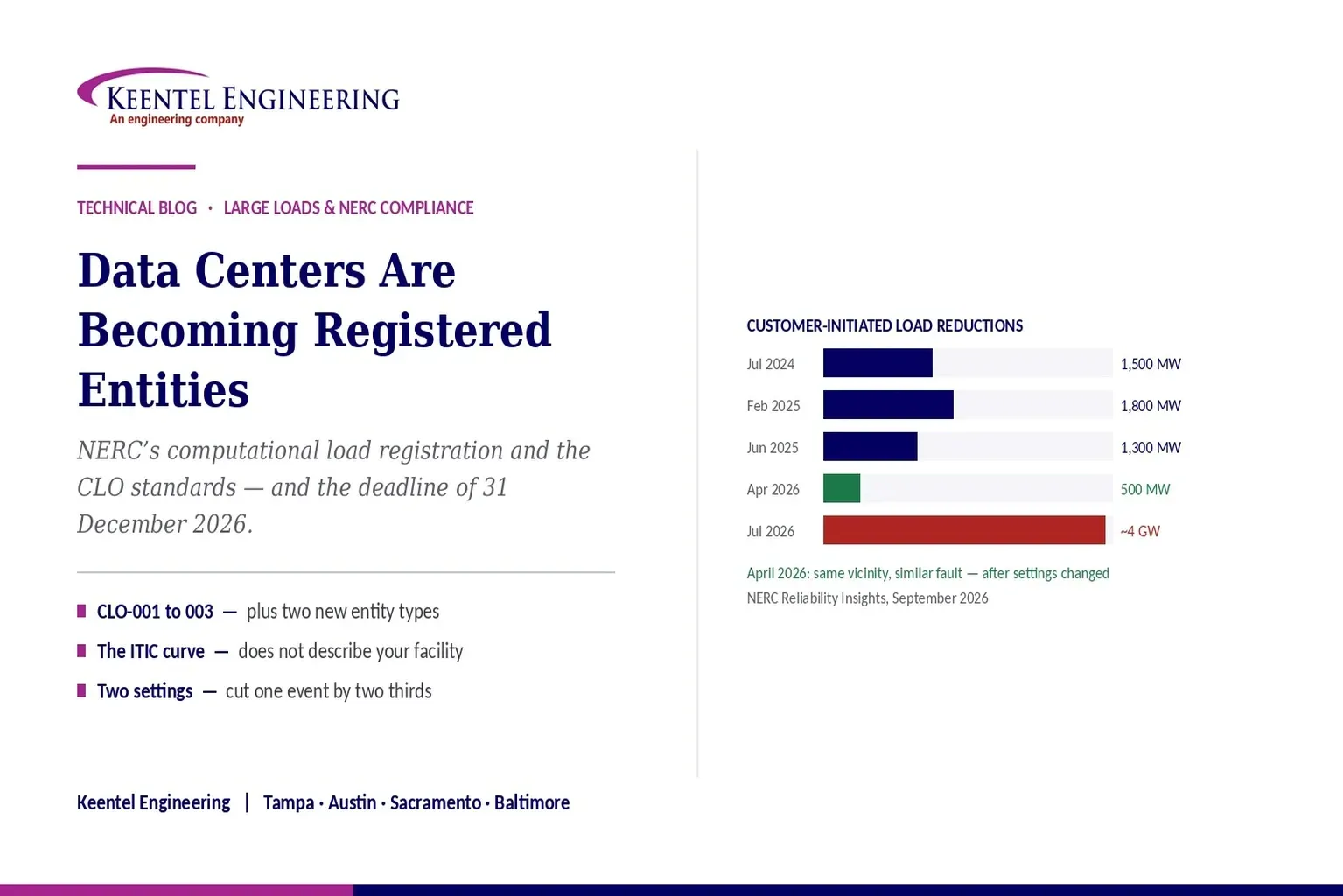
Learn how NERC computational load registration impacts data centers, CLO standards, ride-through requirements, modeling, and grid reliability compliance.
By SANDIP R PATEL
•
September 7, 2026
Learn NEC 2026 load calculations, Article 120 changes, the 2 VA rule, EV charging requirements, service sizing, and dwelling calculation methods.





