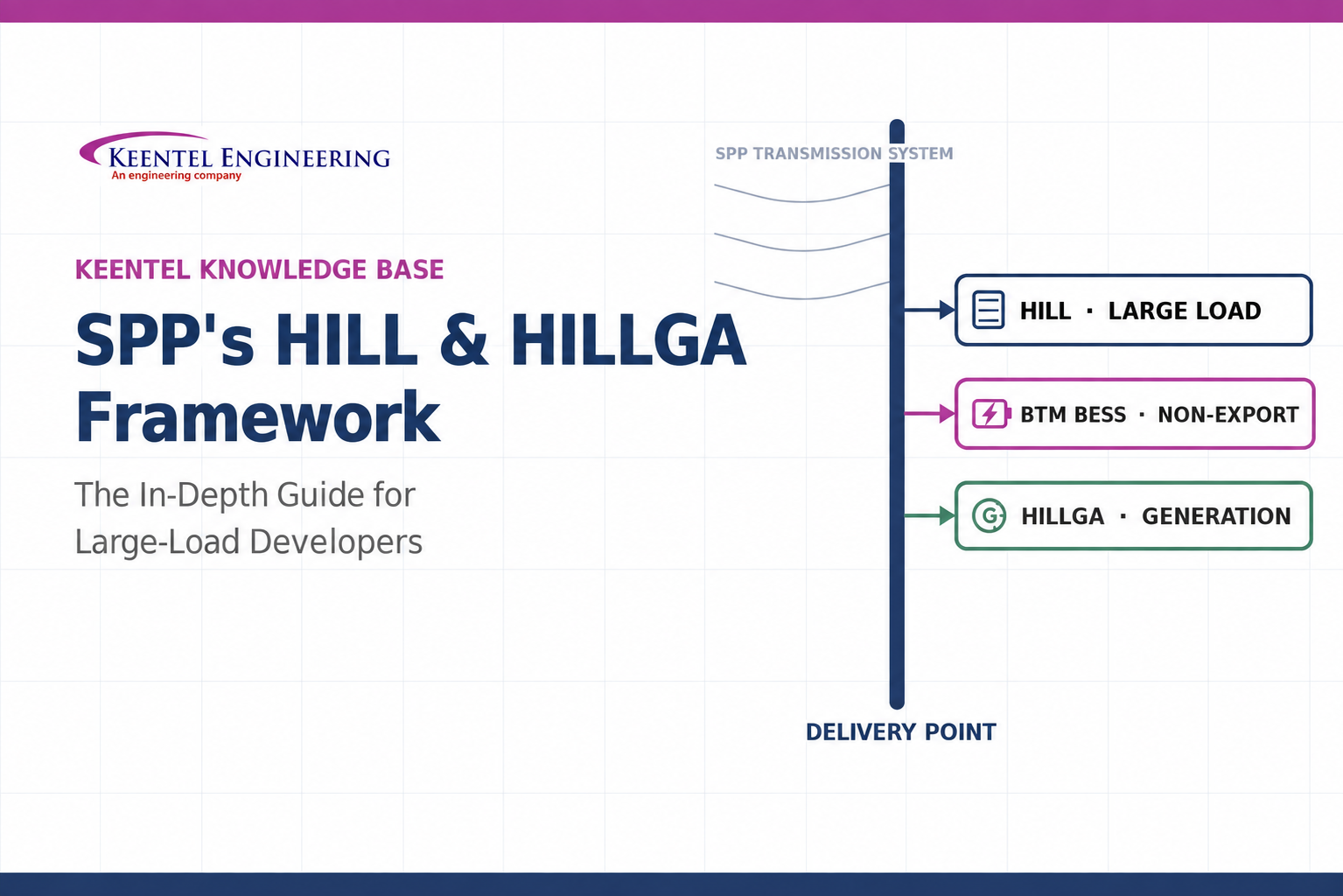

A Coordinated Electric System Interconnection Review—the utility’s deep-dive on technical and cost impacts of your project.

HV & MV Load Flow Studies FAQs

Calendar icon. D

May 9, 2025 | Blog

Electrician in blue jacket and hard hat inspecting wiring in an electrical panel.

Welcome to Keentel Engineering. Here, we answer your most pressing questions about power flow analysis—what it is, why it matters, which software we use (ETAP, PSS®E, PowerWorld), data requirements, deliverables, and how often studies should be refreshed. Dive in to get expert guidance for optimizing your high- and medium-voltage networks.


Frequently Asked Questions (FAQ)

  • Q1: What is a Load Flow Study?

    A Load Flow Study (or power flow analysis) evaluates the steady-state operation of an electrical network, calculating voltages, active/reactive power flows, and system losses to ensure voltage stability and efficient power delivery.

  • Q2: Why are Load Flow Studies essential for HV/MV systems?

    They help you:


    • Verify voltage compliance with ANSI/IEC standards
    • Optimize conductor sizing and transformer tap settings
    • Prevent overloads and voltage drops
    • Support protection coordination, arc-flash, and short-circuit studies
    • Plan for future DER or renewable integrations
  • Q3: Which software platforms do you use?

    We leverage ETAP, Siemens PSS®E, and PowerWorld for scalable, high-fidelity simulations across HV and MV networks.

  • Q4: What data does Keentel need to begin?

    • Single-Line Diagrams (SLDs)
    • Bus & line impedance, length, ampacity
    • Transformer and generator specs
    • Load profiles (kW/kVAR)
    • Renewable resource data (PV, wind, BESS)
    • Contingency and switching scenarios
  • Q5: What are the typical deliverables?

    Our detailed report includes:


    • Bus voltage profiles
    • Branch power flows & losses
    • Transformer loading & recommended tap settings
    • Color-coded one-line diagrams
    • System efficiency metrics
    • Actionable improvement recommendations
  • Q6: How often should studies be refreshed?

    Update whenever you add major loads/generation or reconfigure the network—and at least every 3–5 years for critical or NERC-jurisdictional facilities.


  • Q7: Do you handle renewable interconnection studies?

    Yes. We perform load flow analysis for solar, wind, and utility-scale BESS interconnections, ensuring compliance with ISO and utility requirements.

  • Q8: Are load flow studies required for permitting?

    Often—utilities, ISOs, and permitting bodies typically mandate power flow analysis for grid impact assessments and interconnection approvals.

  • Q9: Can load flow be integrated with other studies?

    Absolutely. We bundle Load Flow with Short-Circuit, Protection Coordination, Arc-Flash, Harmonics, and Stability analyses for turnkey project support.


A smiling man with glasses and a beard wearing a blue blazer stands in front of server racks in a data center.

About the Author:

Sonny Patel P.E. EC

IEEE Senior Member

In 1995, Sandip (Sonny) R. Patel earned his Electrical Engineering degree from the University of Illinois, specializing in Electrical Engineering . But degrees don’t build legacies—action does. For three decades, he’s been shaping the future of engineering, not just as a licensed Professional Engineer across multiple states (Florida, California, New York, West Virginia, and Minnesota), but as a doer. A builder. A leader. Not just an engineer. A Licensed Electrical Contractor in Florida with an Unlimited EC license. Not just an executive. The founder and CEO of KEENTEL LLC—where expertise meets execution. Three decades. Multiple states. Endless impact.

Four workers in safety vests and helmets stand with arms crossed near wind turbines.

Let's Discuss Your Project

Let's book a call to discuss your electrical engineering project that we can help you with.

Man in a blazer and open shirt, looking at the camera, against a blurred background.

About the Author:

Sonny Patel P.E. EC

IEEE Senior Member

In 1995, Sandip (Sonny) R. Patel earned his Electrical Engineering degree from the University of Illinois, specializing in Electrical Engineering . But degrees don’t build legacies—action does. For three decades, he’s been shaping the future of engineering, not just as a licensed Professional Engineer across multiple states (Florida, California, New York, West Virginia, and Minnesota), but as a doer. A builder. A leader. Not just an engineer. A Licensed Electrical Contractor in Florida with an Unlimited EC license. Not just an executive. The founder and CEO of KEENTEL LLC—where expertise meets execution. Three decades. Multiple states. Endless impact.

Leave a Comment

Related Posts

ERCOT Batch Zero large load interconnection guide
By SANDIP R PATEL July 5, 2026
Learn ERCOT Batch Zero requirements, large load interconnection, ride-through standards, dynamic modeling, compliance timelines, and grid approvals.
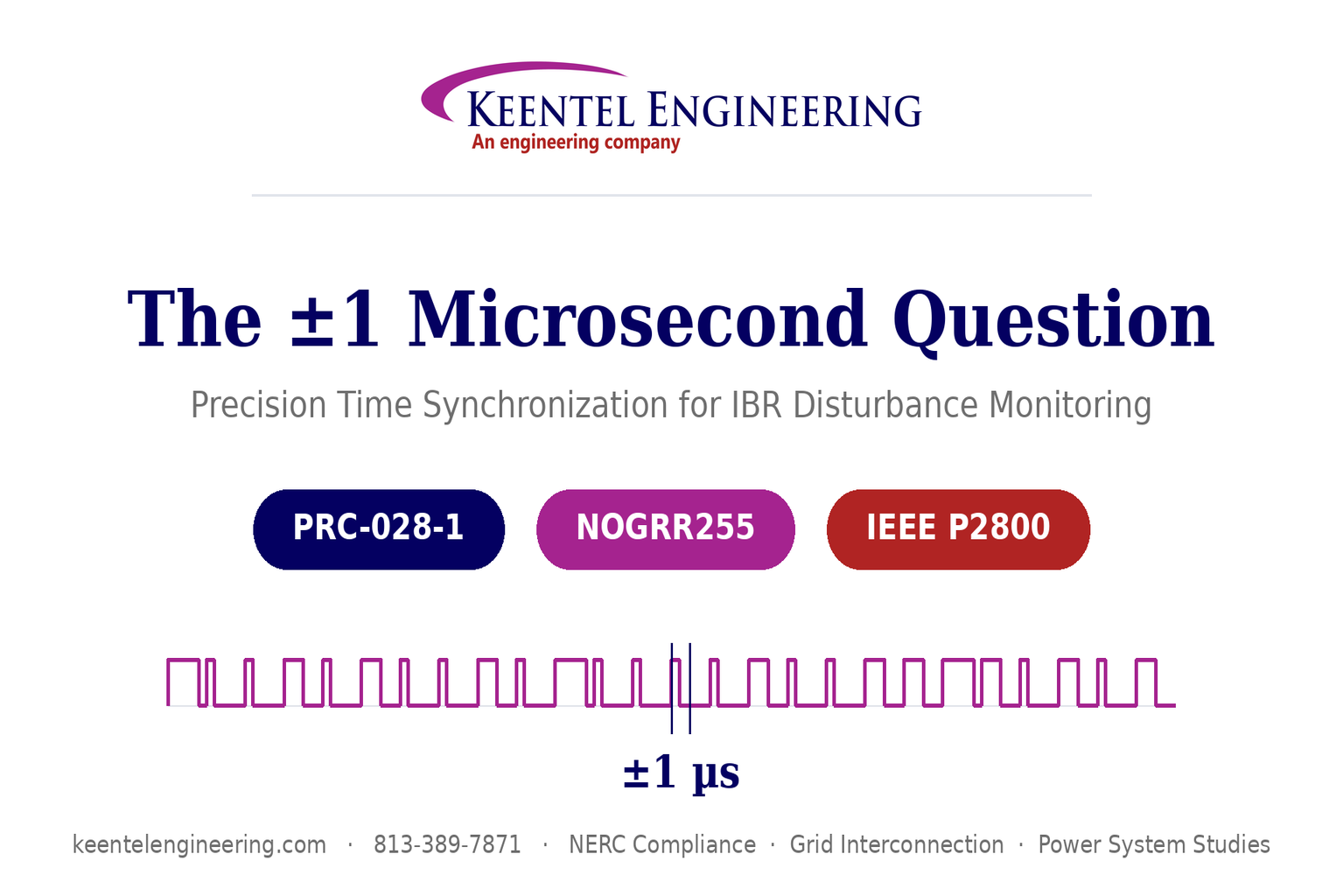
PRC-028-1 and NOGRR255 compliance with SEL-2240 Axion and SEL-3555 RTAC
By SANDIP R PATEL July 5, 2026
Learn how to achieve PRC-028-1 and ERCOT NOGRR255 compliance using the SEL-2240 Axion and SEL RTAC for disturbance monitoring, DFR engineering, and IBR facilities.
PJM EMT modeling guidelines for inverter-based resources
By SANDIP R PATEL July 3, 2026
Learn PJM EMT model development requirements for inverter-based resources, including PSCAD modeling, benchmark testing, EMT studies, and Decision Point II compliance.
Power transformer testing and commissioning
By SANDIP R PATEL July 2, 2026
Master power transformer testing and commissioning with expert guidance on TTR, winding resistance, insulation testing, impedance tests, CT verification, and safe energization.
Fast real-time EMT simulation for low-inertia power systems
By SANDIP R PATEL July 2, 2026
Discover fast real-time EMT simulation for low-inertia power systems, HIL testing, PSCAD modeling, cloud-based EMT, OEM controller integration, and transient stability assessment.
Fundamentals of substation protection and power system relays
By SANDIP R PATEL June 30, 2026
Learn substation protection, protective relaying, relay coordination, fault analysis, and power system protection fundamentals.
Utility-scale solar and battery storage engineering infrastructure
By SANDIP R PATEL June 30, 2026
Learn utility-scale solar engineering, battery storage integration, grid interconnection, power system studies, and commissioning best practices.
Data center design engineering with grid-to-rack power and cooling
By SANDIP R PATEL June 29, 2026
WHITE PAPER |Learn data center design, power infrastructure, cooling systems, redundancy, and grid interconnection to build reliable, efficient facilities.
Transmission line engineering from 30% design to IFC
By SANDIP R PATEL June 29, 2026
Learn how transmission line design progresses from 30% to IFC, covering clearance, sag-tension, structures, foundations, and engineering best practices.