A Coordinated Electric System Interconnection Review—the utility’s deep-dive on technical and cost impacts of your project.
Challenge: Frequent false tripping using conventional electromechanical relays
Solution: SEL-487E integration with multi-terminal differential protection and dynamic inrush restraint
Result: 90% reduction in false trips, saving over $250,000 in downtime
ERCOT enforces all of the above through simulation, which means your model is your compliance case. The bar is now high:
- Whole-facility scope. The model must represent everything the IT load, the UPS and power conversion, the cooling plant, the protection and control systems in formats compatible with ERCOT's study platforms (PSS/E, PSCAD, TSAT).
- Real control loops, not approximations. Generic textbook representations are unacceptable. The model must capture the actual inner control behavior of your power electronics.
- Hardware-validated converter models. For electronic loads, the PSCAD model must be benchmarked against actual hardware testing including voltage ride-through and subsynchronous response. A model assembled from standard PSCAD library blocks fails by definition, because a generic block has never been tested against your vendor's hardware. The good news: validation is a hardware-type test, so results for a given converter product are reusable across every facility that uses it.
- Format migration. Facilities that previously submitted the older composite load model (CMLD) format must transition to EPRI's PERC1 format.
- Three checkpoints. Models are reviewed before the stability study begins (no model, no study), before each quarterly stability assessment, and for electronic loads one final time before energization, when you must submit as-built models with a documented comparison against the previously studied data and a sworn attestation that the model matches actual field settings. ERCOT's review takes 10 business days, extendable by 20 put it on your critical path.
- A living obligation. Change your technology, controls, or relay settings in a way that affects ride-through including converting a crypto mining site to an AI data center — and you've triggered a new interconnection study, even if your megawatts don't change.
| Parameter | Detail |
|---|---|
| System | 230 kV / 138 kV transmission corridors, wind and wet-snow icing exposure |
| Data basis | 15 years of minute-resolution forced-outage records + regional weather observations |
| Core methods | Event grouping, MVA performance curves, time-to-95%-restore, area outage rate curves, fragility modeling, rerun-history benefits, exceedance and log-domain risk metrics |
| Headline result | ≈85% of maximum resilience benefit at 60% of original capital; worst-event restoration window cut from 11 days to 5 in rerun-history terms |
| Decision supported | Capital portfolio selection; resilience plan filing; post-investment verification framework |
| System / Topic | Governing Standard(s) | What It Controls |
|---|---|---|
| Overall plant electrical distribution | IEEE 141 (Red Book); IEEE 666 | Distribution architecture, voltage selection, design of generating station auxiliary service systems |
| Power system studies | IEEE 399 (Brown Book); IEEE 551 | Load flow, symmetrical/asymmetrical short circuit, motor starting methodologies down to the lowest LV panelboard |
| Protection & coordination | IEEE 242 (Buff Book); IEEE 3004.5; IEEE C37 series | Generator relaying (21, 59N, 87G), time-current coordination, selective clearing between LV and MV tiers |
| GSU / UAT / SST transformers | IEEE C57.12.00 and C57 family | Transformer ratings, impedance, testing, loading |
| HV switchyard breakers | IEEE C37.06 | AC high-voltage circuit breaker preferred ratings |
| MV switchgear (13.8 kV) | IEEE C37.20.2; IEEE C37.20.7 | Metal-clad construction, compartmentalization, vacuum breakers; arc-resistant design with plenum venting |
| MV cable | UL 1072; ICEA S-93-639 (NEMA WC 74) | Type MV-105 shielded cable, 133% insulation level for HRG systems |
| LV switchgear (480 V) | IEEE C37.13; UL 1558 | Metal-enclosed LV power circuit breaker switchgear to 635 V, draw-out ACBs with electronic trip units |
| Motor control centers | UL 845; NEMA ICS 18 | LV-MCC construction, MCCB/MCP protection for motors under ~200 HP |
| Motors | NEMA MG-1 | Motor performance, starting characteristics, service factors |
| DC & battery systems | IEEE 485; IEEE 946 | Lead-acid battery sizing (125/250 VDC), DC auxiliary system design |
| Grounding | IEEE 80; IEEE 142 (Green Book) | Ground grid step/touch potential limits; system grounding including high-resistance grounding |
| Lightning protection | IEEE 998 | Direct-stroke shielding of switchyard and outdoor generator structures |
| Arc flash & electrical safety | IEEE 1584; NFPA 70E | Incident energy calculation; worker safety boundaries and PPE |
| Fire protection | NFPA 850 | Fire protection and risk management for combustion turbine generating plants |
| Installation code | NEC (NFPA 70); NESC | Wiring methods inside the plant fence; overhead/outdoor clearances at the switchyard |
| Interconnection & compliance | FERC LGIP; NERC MOD-025/026/027, PRC-019/024/029, FAC-008 | Interconnection process, model validation, protection/ride-through coordination, facility ratings |
| IFC / Construction Deliverable | Purpose |
|---|---|
| Stamped IFC packages | Legal basis for construction; P.E. responsible charge |
| Final relay settings & TCCs | Protection as-installed matches the coordination study |
| Calculation archive | Owner records; NERC audit evidence trail |
| Commissioning procedures | Safe, sequenced energization; MOD field testing |
| Construction support | RFIs, field changes, FAT/SAT witness |
| As-builts & model handoff | Operating baseline; future study currency |
| Metric | Outcome |
|---|---|
| Defects found pre-occupancy | Three topology defects and one settings-mismatch family corrected before load migration; the shared-switchboard defect alone would have invalidated the concurrently-maintainable claim on day one |
| IST findings | Fourteen additional discrepancies surfaced under scenario testing (control logic, alarm mapping, one generator sequencing fault) — all closed before handover instead of during operations |
| Black-building test | Passed on second execution; the first attempt exposed the generator sequencing fault under true block load, exactly the failure the compressed plan would never have found |
| Handover quality | Operations team certified on the actual failure scenarios; corrected EOPs and settings documentation delivered as controlled documents |
| Business outcome | Occupancy proceeded three weeks behind the original date — against an independent estimate that the uncorrected sequencing fault carried a high probability of a full facility outage within the first year |
Part 2 — Frequently Asked Questions: Large Load Interconnection
| Who | Acronym | Plain-English Role |
|---|---|---|
| ERCOT | — | The grid's air traffic controller. It doesn't own power lines or plants; it directs the flow of electricity across most of Texas and referees the admission process for new generators. |
| Interconnecting Entity | IE | You — the developer or owner trying to connect a new plant (or significantly modify an existing one). You file the application and drive the process. |
| Resource Entity | RE | The registered owner/operator of the generator once it becomes an official market participant. Often the same company as the IE, wearing a different hat. |
| Qualified Scheduling Entity | QSE | Your plant's voice on the grid. The QSE handles round-the-clock communications with ERCOT — telemetry, schedules, dispatch instructions. Every generator must have one. |
| Transmission Service Provider | TSP | The utility that owns the wires and substation you'll connect to. The TSP runs your detailed study, builds the connection facilities, and signs your interconnection contract. |
| RIOO-IS | — | ERCOT's online portal where the whole process lives — applications, documents, status tracking, and checklists all flow through it. |
| Who | Acronym | Plain-English Role |
|---|---|---|
| ERCOT | — | The grid's air traffic controller. It doesn't own power lines or plants; it directs the flow of electricity across most of Texas and referees the admission process for new generators. |
| Interconnecting Entity | IE | You — the developer or owner trying to connect a new plant (or significantly modify an existing one). You file the application and drive the process. |
| Resource Entity | RE | The registered owner/operator of the generator once it becomes an official market participant. Often the same company as the IE, wearing a different hat. |
| Qualified Scheduling Entity | QSE | Your plant's voice on the grid. The QSE handles round-the-clock communications with ERCOT — telemetry, schedules, dispatch instructions. Every generator must have one. |
| Transmission Service Provider | TSP | The utility that owns the wires and substation you'll connect to. The TSP runs your detailed study, builds the connection facilities, and signs your interconnection contract. |
| RIOO-IS | — | ERCOT's online portal where the whole process lives — applications, documents, status tracking, and checklists all flow through it. |
| Who | Acronym | Plain-English Role |
|---|---|---|
| ERCOT | — | The grid's air traffic controller. It doesn't own power lines or plants; it directs the flow of electricity across most of Texas and referees the admission process for new generators. |
| Interconnecting Entity | IE | You — the developer or owner trying to connect a new plant (or significantly modify an existing one). You file the application and drive the process. |
| Resource Entity | RE | The registered owner/operator of the generator once it becomes an official market participant. Often the same company as the IE, wearing a different hat. |
| Qualified Scheduling Entity | QSE | Your plant's voice on the grid. The QSE handles round-the-clock communications with ERCOT — telemetry, schedules, dispatch instructions. Every generator must have one. |
| Transmission Service Provider | TSP | The utility that owns the wires and substation you'll connect to. The TSP runs your detailed study, builds the connection facilities, and signs your interconnection contract. |
| RIOO-IS | — | ERCOT's online portal where the whole process lives — applications, documents, status tracking, and checklists all flow through it. |
| Who | Acronym | Plain-English Role |
|---|---|---|
| ERCOT | — | The grid's air traffic controller. It doesn't own power lines or plants; it directs the flow of electricity across most of Texas and referees the admission process for new generators. |
| Interconnecting Entity | IE | You — the developer or owner trying to connect a new plant (or significantly modify an existing one). You file the application and drive the process. |
| Resource Entity | RE | The registered owner/operator of the generator once it becomes an official market participant. Often the same company as the IE, wearing a different hat. |
| Qualified Scheduling Entity | QSE | Your plant's voice on the grid. The QSE handles round-the-clock communications with ERCOT — telemetry, schedules, dispatch instructions. Every generator must have one. |
| Transmission Service Provider | TSP | The utility that owns the wires and substation you'll connect to. The TSP runs your detailed study, builds the connection facilities, and signs your interconnection contract. |
| RIOO-IS | — | ERCOT's online portal where the whole process lives — applications, documents, status tracking, and checklists all flow through it. |
| Who | Acronym | Plain-English Role |
|---|---|---|
| ERCOT | — | The grid's air traffic controller. It doesn't own power lines or plants; it directs the flow of electricity across most of Texas and referees the admission process for new generators. |
| Interconnecting Entity | IE | You — the developer or owner trying to connect a new plant (or significantly modify an existing one). You file the application and drive the process. |
| Resource Entity | RE | The registered owner/operator of the generator once it becomes an official market participant. Often the same company as the IE, wearing a different hat. |
| Qualified Scheduling Entity | QSE | Your plant's voice on the grid. The QSE handles round-the-clock communications with ERCOT — telemetry, schedules, dispatch instructions. Every generator must have one. |
| Transmission Service Provider | TSP | The utility that owns the wires and substation you'll connect to. The TSP runs your detailed study, builds the connection facilities, and signs your interconnection contract. |
| RIOO-IS | — | ERCOT's online portal where the whole process lives — applications, documents, status tracking, and checklists all flow through it. |
| Who | Acronym | Plain-English Role |
|---|---|---|
| ERCOT | — | The grid's air traffic controller. It doesn't own power lines or plants; it directs the flow of electricity across most of Texas and referees the admission process for new generators. |
| Interconnecting Entity | IE | You — the developer or owner trying to connect a new plant (or significantly modify an existing one). You file the application and drive the process. |
| Resource Entity | RE | The registered owner/operator of the generator once it becomes an official market participant. Often the same company as the IE, wearing a different hat. |
| Qualified Scheduling Entity | QSE | Your plant's voice on the grid. The QSE handles round-the-clock communications with ERCOT — telemetry, schedules, dispatch instructions. Every generator must have one. |
| Transmission Service Provider | TSP | The utility that owns the wires and substation you'll connect to. The TSP runs your detailed study, builds the connection facilities, and signs your interconnection contract. |
| RIOO-IS | — | ERCOT's online portal where the whole process lives — applications, documents, status tracking, and checklists all flow through it. |
| Who | Acronym | Plain-English Role |
|---|---|---|
| ERCOT | — | The grid's air traffic controller. It doesn't own power lines or plants; it directs the flow of electricity across most of Texas and referees the admission process for new generators. |
| Interconnecting Entity | IE | You — the developer or owner trying to connect a new plant (or significantly modify an existing one). You file the application and drive the process. |
| Resource Entity | RE | The registered owner/operator of the generator once it becomes an official market participant. Often the same company as the IE, wearing a different hat. |
| Qualified Scheduling Entity | QSE | Your plant's voice on the grid. The QSE handles round-the-clock communications with ERCOT — telemetry, schedules, dispatch instructions. Every generator must have one. |
| Transmission Service Provider | TSP | The utility that owns the wires and substation you'll connect to. The TSP runs your detailed study, builds the connection facilities, and signs your interconnection contract. |
| RIOO-IS | — | ERCOT's online portal where the whole process lives — applications, documents, status tracking, and checklists all flow through it. |
Connecting a Power Plant to the Texas Grid A Plain-Language Guide to ERCOT's Generator Interconnection Process From First Application to Commercial Operation
Jul 15, 2026 | Blog
Part I The Plain-Language Guide
1. Why You Can't Just Plug In a Power Plant
Imagine you've built a brand-new solar farm, wind farm, battery facility, or gas plant somewhere in Texas. It's finished, tested by your contractors, and ready to make electricity. Can you just connect it to the grid and start selling power? No — and for good reason.
The Texas electric grid is one enormous, interconnected machine. Every power plant on it affects every other one, the way every car on a highway affects traffic for everyone else. If a new plant connects without being checked, it could overload power lines, destabilize voltage in its neighborhood, or trip offline at exactly the wrong moment and drag other equipment down with it. So before any generator of 1 megawatt (MW) or larger can join the grid, it must pass through a formal admission process run by ERCOT — the Electric Reliability Council of Texas — working together with the utility that owns the power lines the plant will connect to.
That process is spelled out in ERCOT's Resource Interconnection Handbook, a document written for engineers and grid insiders. This guide translates it into plain English. If you're a landowner, investor, developer, data center operator, executive, or simply curious about how power plants actually get connected in Texas, this is the version written for you. And if you're responsible for getting a real project through this process — that's exactly what Keentel Engineering does for clients every day.
The One-Sentence Version
Connecting a power plant in Texas is a three-stage journey — (1) apply and get studied, (2) register and get modeled into ERCOT's systems, and (3) energize, synchronize, and pass your final tests — and the whole thing is governed by a series of strict deadlines that can cancel your project if you miss them.
2. Meet the Cast of Characters
The interconnection process involves a handful of players with confusing acronyms. Here's who they are in everyday terms:
The interconnection process involves a handful of players with confusing acronyms. Here's who they are in everyday terms:
| Who | Acronym | Plain-English Role |
|---|---|---|
| ERCOT | — | The grid's air traffic controller. It doesn't own power lines or plants; it directs the flow of electricity across most of Texas and referees the admission process for new generators. |
| Interconnecting Entity | IE | You — the developer or owner trying to connect a new plant, or significantly modify an existing one. You file the application and drive the process. |
| Resource Entity | RE | The registered owner/operator of the generator once it becomes an official market participant. Often the same company as the IE, wearing a different hat. |
| Qualified Scheduling Entity | QSE | Your plant's voice on the grid. The QSE handles round-the-clock communications with ERCOT — telemetry, schedules, and dispatch instructions. Every generator must have one. |
| Transmission Service Provider | TSP | The utility that owns the wires and substation you'll connect to. The TSP runs your detailed study, builds the connection facilities, and signs your interconnection contract. |
| RIOO-IS | — | ERCOT's online portal where the whole process lives — applications, documents, status tracking, and checklists all flow through it. |
One important surprise for newcomers: ERCOT does not own the grid, and ERCOT is not a party to your interconnection contract. Your contract — called the Standard Generation Interconnection Agreement, or SGIA — is signed between you and the TSP. ERCOT referees and approves; the TSP owns and builds. You are effectively managing two relationships at once, and projects that neglect the TSP side routinely stall even when their ERCOT paperwork is perfect.
3. The Big Picture: A Three-Stage Journey
Think of the process like getting a new commercial airline into service. First, you apply for routes and prove your plane is airworthy (studies). Then you register the aircraft and connect to the control tower's systems (registration and modeling). Finally, you do supervised test flights before carrying passengers (commissioning). ERCOT's version has three stages:
| Stage | What Happens | Rough Feel |
|---|---|---|
| Stage 1: Application & Studies | You apply through RIOO-IS, ERCOT runs a quick screening study, the TSP runs the deep-dive Full Interconnection Study, you sign the SGIA contract, and you clear stability and compliance reviews. | The permitting phase — months to years; most of the deadlines that can kill a project live here. |
| Stage 2: Registration & Modeling | You register as an official market participant and feed ERCOT every technical detail so your plant appears in the grid's “digital map,” with working meters and communications. | The paperwork-and-plumbing phase — heavy on data, lead times, and coordination. |
| Stage 3: Energize, Sync & Commission | A three-part checklist governs turning on your equipment, connecting your generator to the grid for the first time, and passing performance tests to earn full commercial status. | The supervised test-drive — every step needs ERCOT's sign-off. |
4. Stage 1 Applying and Getting Studied
Everything starts with an application in RIOO-IS, along with the required fee. ERCOT checks the application within 10 business days. If anything's missing, you get 10 business days to fix it — go silent and the application is rejected. Texas-specific homework is also due here, including attestations related to the Lone Star Infrastructure Protection Act (a state security law restricting certain foreign-linked equipment and services) and a Department of Defense notification (letting nearby military installations know about the project).
One physical rule worth knowing early, because it shapes your site plan and budget: your connection point — the Point of Interconnection, or POI — must be at a real substation with circuit breakers. You cannot simply 'tap' into a passing transmission line like splicing into a garden hose. Breakers are what allow a faulted section of the grid to be isolated safely, and ERCOT requires them at every new connection.
Once the application is complete, the studies begin — and it helps to think of them as a medical exam that gets progressively more thorough:
- Security Screening Study (SSS) — ERCOT's quick health check. Within 90 days, ERCOT runs a high-level study of how your plant would affect power flows in your area, and how much your plant could realistically run alongside existing generators before new transmission lines would be needed. Think of it as a screening X-ray: fast, informative, not the final word. The results also flag whether your project needs a special add-on study called SSR (more below).
- Full Interconnection Study (FIS) — The full-body MRI, run by the TSP. This is the deep dive: power-flow studies, short-circuit studies, stability studies, and a facility study that determines exactly what equipment must be built and roughly what it costs. Here's the catch every developer must understand: the FIS has no defined completion deadline. It is typically the longest, least predictable part of the whole process — ERCOT's own timeline table shows 40 to 300 days, and that's after the scope is agreed. Getting a realistic timetable written into the study scope agreement is one of the most valuable things you can do in the entire process.
- Subsynchronous Resonance (SSR) study — A specialty test for projects in certain locations. Subsynchronous resonance is, loosely speaking, a harmful electrical 'vibration' that can occur when generators interact with certain types of transmission equipment — in severe historical cases it has physically damaged machinery. If ERCOT's screening flags the risk, you must complete an SSR study, and any required protective countermeasures must be installed and working before your plant is ever allowed to connect. SSR studies can take 60 to 180 days, so a flag here is a schedule event.
- Reactive Study — Your promise about voltage support. You must submit an engineering analysis showing your plant can supply 'reactive power' — the unglamorous ingredient that keeps grid voltage stable, a bit like keeping tire pressure correct on a truck. ERCOT needs about a month to review it, and any extra voltage-support equipment it identifies must be physically installed before first connection.
The Two 180-Day Tripwires
Two use-it-or-lose-it deadlines cancel more projects than any technical failure. First: after ERCOT sends your Security Screening Study results, you have 180 days to formally request the FIS (with site control proof and project dates) — miss it and your application is automatically withdrawn. Second: after the FIS is complete, you have 180 days to execute the SGIA contract with the TSP — miss it and ERCOT cancels the project (limited exceptions exist if both sides can show work on the agreement is genuinely underway). Starting over means a new application, a new fee, and the back of the line.
Two more gates close out Stage 1. First, ERCOT runs a Compliance with Operational Standards review — a 90-day check of whether your plant's design can actually follow the grid's operating rulebook. Second comes the Quarterly Stability Assessment (QSA), which works like a scheduled boarding window at an airport. Every three months, ERCOT studies all the new plants planning to connect in a given future quarter — together, as a group — to make sure the grid stays stable when they all show up. To board your quarter, your prerequisites (completed FIS, reactive study, any SSR work, mitigation plans, and the compliance review) must be done by a cutoff date roughly five to seven months before you intend to connect:
| Want to Connect In... | Your Prerequisites Must Be Done By | ERCOT Finishes the Assessment |
|---|---|---|
| January – March | August 1 (prior year) | End of October |
| April – June | November 1 (prior year) | End of January |
| July – September | February 1 | End of April |
| October – December | May 1 | End of July |
Miss your window and you don't wait a week — you wait a full quarter. For a financed project paying interest on hundreds of millions of dollars of equipment, a three-month slip is real money. This single table drives more schedule strategy in ERCOT than almost anything else.
5. Stage 2 Getting Into the Grid's Digital Map
ERCOT operates the grid through something called the Network Operations Model — essentially a detailed digital map of every line, transformer, breaker, and generator in its territory. Your plant does not exist, as far as grid operations are concerned, until it's accurately drawn into that map. Stage 2 is about earning your place on it.
The anchor date for everything in Stage 2 is the Production Load Date (PLD) — the day ERCOT's systems formally 'switch on' your plant's existence: your spot in the digital map, your revenue-grade meters, your communication links, and your market settlement identity all go live together. Working backward from the PLD, the handbook lays out a cascade of lead times:
| Milestone | Lead Time | In Plain Terms |
|---|---|---|
| Register as a market participant | Start ~140 days before PLD (registration itself ~60 days) | Becoming an official Resource Entity involves agreements, forms, and Texas-specific attestations — it isn't an afternoon of paperwork. |
| Submit full technical data in RIOO-IS | At least 120 days before PLD | Every electrical detail of your plant, per ERCOT's Resource Registration Glossary — expect revision cycles, so early submission is self-defense. |
| Metering design (EPS meters) | Before your resource data deadline | The TSP designs and installs the revenue-grade meters ERCOT reads every 15 minutes to pay you — the design must be approved before your data deadline. |
| Communications list (ICCP points) | At least 30 days before PLD | The full list of live data signals your plant will stream to ERCOT — breaker positions, voltages, output levels, control-system statuses. |
| PLD → energization gap | 15–30 days (30 typical) | Buffer between appearing in the digital map and actually switching on, so telemetry problems can be found and fixed. |
The telemetry piece deserves emphasis because it's the most common late-stage surprise. Your plant must give ERCOT working 'eyes and ears' — a continuous stream of real-time measurements flowing from your site, through your QSE, to ERCOT's control room. The handbook is blunt: insufficient telemetry data creates a high risk of delay to energization, synchronization, and commissioning. And before ERCOT approves each major switch-on milestone, your telemetry must have been streaming good, believable data for at least 48 continuous hours. Communications and controls engineering isn't a side task in ERCOT — it's on the critical path.
Stage 2 also assigns clear homework to each player: the TSP models its side of the connection and files the metering paperwork; the QSE builds the communications list and manages outage entries; and you (as the RE) submit the plant's technical data and verify the 'GENMAP' package — ERCOT's confirmation of exactly where your generator and meters sit in the digital map. Everyone's submissions are designed to snap together on the PLD; one late party can hold the date for all.
6. Stage 3 Switching On, Step by Careful Step
No one flips one big switch. Stage 3 is a supervised sequence governed by a three-part commissioning checklist, each part requiring ERCOT's explicit approval before the next step can happen:
- Checklist Part 1: Energization — Permission to energize your equipment — to put grid voltage on your substation, transformers, and site wiring for the first time, without the generator running. Submit at least 7 business days before your planned date; ERCOT verifies your digital-map entry and that your telemetry has been clean for 48 hours.
- Checklist Part 2: Synchronization — Permission to synchronize — the genuinely delicate moment when your generator locks onto the grid's rhythm and connects for the first time. Grid electricity alternates 60 times per second, and every generator must match that timing exactly, like a musician joining an orchestra mid-piece without missing a beat. Approval requires passing the same model and telemetry scrutiny again.
- Checklist Part 3: Commissioning — Permission to become a fully commissioned commercial resource — granted only after your plant passes its full battery of performance tests.
At least 30 days before submitting Part 1, you must file a Commissioning Plan — an eight-section document covering how your plant will be described, controlled, shut down, verified, scheduled, and tested throughout the process. ERCOT reviews it within 15 days. Practical details matter here: ERCOT reviews checklists on business days only, submissions after 2 PM Central count as the next business day, and submitting a checklist part before the previous one is approved just resets its clock. Sloppy sequencing quietly costs weeks.
The tests themselves have intimidating acronyms but simple purposes. AVR testing proves your automatic voltage regulator — mandatory on every generator, and required to be on whenever you're generating — actually holds voltage steady; if voltage at your connection point drifts outside its allowed band, your plant must deploy its full voltage-support capability within five minutes. Reactive capability tests prove you can deliver the voltage-support muscle you promised in your Stage 1 study, in both directions (pushing and pulling). PFR testing proves your plant automatically leans against frequency disturbances — grid frequency is like the speed of a treadmill everyone shares, and every machine must help steady it within seconds, without waiting for instructions. PSS applies to conventional spinning generators and damps power oscillations. None of these are formalities: Part 3 approval waits on all of them, and the handbook specifically warns that no extensions are given for incomplete reactive testing.
Renewables and batteries get a 'training wheels' provision worth knowing: plants generally may not exceed 20 MVA of connected equipment until their automatic controls (voltage regulation, frequency response, curtailment response) are proven — via a self-test and formal attestation — after which ERCOT can approve raising the limit. During testing phases, your plant reports its status to ERCOT's dispatch systems as OUT, ONTEST, or ON, and using them correctly has financial teeth: a plant reporting 'ON' is expected to follow ERCOT's dispatch instructions precisely and is exposed to deviation charges if it doesn't.
The 300-Day Rule
Once ERCOT approves initial synchronization for a resource above 20 MVA, the clock starts: you have 300 days to complete construction and testing and reach commercial operations. If you genuinely can't, you must file a Good Cause Exception request with ERCOT — with real detail and a credible new date — before your planned commercial operation date, not after.
7. What This Means Right Now: The Issues Moving Through the Pipeline
- Small generators, rooftop-scale batteries, and distributed resources (DGRs/DESRs) — Projects connecting to local distribution wires (roughly, the smaller lines that serve neighborhoods rather than the giant cross-country lines) follow a streamlined path with its own checklist, simplified modeling, and a System Impact Study run by the local wires utility. Streamlined does not mean casual: ride-through capability, frequency-response settings, and proof that your line won't be cut off by automatic load-shedding schemes are all still required. ERCOT strongly recommends optional review meetings for first-time applicants — free expert feedback that new developers should never skip.
- Data centers and co-located loads — Texas's data center boom has pushed ERCOT to add specific rules for large loads sharing a site with renewable generation. These sites must provide an extra telemetry signal (the Gross Real-time Power Potential, or GRPP) showing what the generation could produce before the on-site load consumes it, and their QSEs must forecast the site's load a full week (168 hours) ahead so ERCOT's renewable forecasts stay honest. If you're planning a co-located data center in ERCOT, these requirements belong in your controls design from day one, not as a retrofit.
- Ride-through rules and the August 2024 dividing line — Ride-through is the requirement that your plant hold on through brief grid disturbances — voltage dips, frequency wobbles — rather than instantly disconnecting, the way a cyclist rides over a pothole instead of falling off. For inverter-based resources (solar, batteries, most wind), which requirements apply depends heavily on whether your SGIA was signed before or after August 1, 2024, and whether the project has been through the interconnection process since. Newer projects face the more demanding modern standards (aligned with the national IEEE 2800-2022 standard), and your declared capabilities must be kept current in ERCOT's systems — mismatches will hold up your Part 2 and Part 3 approvals.
8. Where Projects Actually Go Wrong
Reading the handbook end to end, a pattern emerges: projects rarely die from a single dramatic failure. They bleed schedule at predictable choke points. Here is the danger map:
| Choke Point | The Risk | The Defense |
|---|---|---|
| 180-day FIS request deadline | Application auto-cancelled after SSS results if you don't formally request the FIS in time. | Calendar it the day SSS results arrive; prepare site-control documents in advance. |
| FIS duration (no defined limit) | The open-ended study becomes a black hole — 40 to 300 days in ERCOT's own tables. | Negotiate a written timetable into the FIS scope agreement; ERCOT itself recommends this. |
| 180-day SGIA deadline | Project cancelled if the contract isn't signed within 180 days of FIS completion. | Start commercial negotiation with the TSP during the study, not after it. |
| QSA quarterly windows | Miss a prerequisite cutoff; wait three months to synchronize. | Build the QSA cutoff into the master schedule as a hard milestone with float. |
| Telemetry readiness | 48-hour clean-data requirement plus a 30-day points-list deadline; bad telemetry stalls every checklist. | Treat SCADA/communications as critical-path engineering, tested well before checklist submission. |
| Testing failures | No extensions for incomplete reactive testing; retests can chase seasonal windows. | Verify reactive capability and control tuning during construction, not during commissioning. |
| Stale dates in RIOO-IS | ERCOT teams schedule key internal steps off your posted dates; stale dates cause silent delays. | Assign one owner to keep RIOO-IS dates current at all times. |
9. How Keentel Engineering Helps
Everything in this guide is, at bottom, an engineering-management problem: studies to run and review, models and data to build, deadlines to defend, tests to pass, and two parallel relationships (ERCOT and the TSP) to manage without dropping either. Keentel Engineering is a power systems and grid interconnection consulting firm — headquartered in Tampa with offices in Austin, Sacramento, and Baltimore — and shepherding projects through exactly this process is core to what we do:
| Keentel Service | Where It Carries Your ERCOT Project |
|---|---|
| Grid Interconnection Engineering | Application strategy, RIOO-IS submissions, POI selection, study coordination, SGIA technical support, and deadline management across the full GIM process. |
| Power System Studies | Independent load flow, short circuit, and stability analysis — so you understand your FIS results, can challenge questionable assumptions, and see upgrade costs coming. |
| EMT Modeling & Model Validation | PSCAD/dynamic model development and benchmarking for solar, wind, and battery plants — clean models prevent study delays and restudy cycles. |
| Reactive & Voltage Studies | The reactive study ERCOT requires, plus reactive equipment sizing so voltage-support hardware is specified, procured, and installed on time. |
| Substation & Transmission Design | POI switchyard and collector substation design through IFC — built to satisfy both the TSP's standards and ERCOT's breaker-at-the-POI rules. |
| Commissioning & Testing Support | Commissioning Plan preparation, checklist sequencing, telemetry verification, and AVR/PFR/reactive test planning and execution support. |
| NERC Compliance & Ride-Through | FRT/VRT capability assessment against the applicable post-2024 standards and IEEE 2800 alignment, with registration data kept consistent in ERCOT systems. |
| Owner's Engineer Services | One accountable technical team tracking every deadline, every submission, and every interface — ERCOT, TSP, QSE, EPC — from application to commercial operation. |
10. The Bottom Line
ERCOT's interconnection process is demanding, but it isn't arbitrary. Every study, checklist, and test exists because the grid is a shared machine, and one poorly integrated plant can harm everyone connected to it. The process rewards exactly one thing: preparation. Projects that treat the deadlines as hard engineering constraints, invest early in data quality and telemetry, and manage the TSP relationship as seriously as the ERCOT one get through. Projects that improvise do not.
If you're planning a generation, storage, or co-located load project in Texas, the FAQ below answers the questions we hear most — and Keentel Engineering is ready to put an experienced team behind yours.
Part II Frequently Asked Questions
Q1. Who has to go through this process?
Anyone connecting new generation of 1 MW or larger to the ERCOT grid — or making qualifying modifications to an existing plant (such as significantly changing its capacity or equipment). That covers solar farms, wind farms, battery storage, gas plants, and combinations of these. Smaller distribution-connected resources follow the streamlined Small Generation path, but they still register and still meet performance requirements. If your project is under 1 MW, you're generally dealing with your local utility's rules rather than the full ERCOT process.
Q2. How long does the whole thing take?
There is no single answer, and be skeptical of anyone who gives you one. The screening study alone can take up to 90 days; the Full Interconnection Study has no defined completion deadline and commonly runs 40 to 300 days after its scope is agreed; contract negotiation, registration, modeling, and commissioning add months more; and the quarterly synchronization windows mean slippage happens in three-month increments. Well-run large projects typically measure the journey from application to commercial operation in years, not months. The variables you control — data quality, deadline discipline, telemetry readiness — are what separate the fast projects from the slow ones.
Q3. What does it cost?
There are three distinct buckets. First, ERCOT's fees: an application fee at submission and study-related fees per ERCOT's published Fee Schedule. Second, the TSP's study fees, negotiated in your FIS scope agreement — ERCOT is not a party to that agreement. Third, and by far the largest, the physical interconnection costs: the substation, lines, and any network upgrades the studies identify, which you must financially secure before the TSP builds. Study fees are thousands to hundreds of thousands; interconnection facilities and upgrades can run into the millions — ERCOT even runs a special informational economic review when estimated transmission costs exceed $25 million.
Q4. What exactly is a Point of Interconnection, and why do I keep hearing I can't 'tap a line'?
The Point of Interconnection (POI) is the physical spot where your plant's electricity enters the wider grid. ERCOT requires the POI to be at a station equipped with circuit breakers — devices that can interrupt enormous fault currents and isolate a problem section of the grid within a fraction of a second. A 'hard tap' — splicing directly into a passing line without breakers — would mean any fault at your plant could take down the whole line and everything on it. So your project either connects at an existing breaker station or pays to build one. This is a major cost and siting decision, and it's one of the first things a competent interconnection engineer will analyze.
Q5. What's the difference between the Security Screening Study and the Full Interconnection Study?
Depth, owner, and consequence. The Security Screening Study is ERCOT's quick, high-level look (up to 90 days) at how your plant affects power flows and how much it could operate alongside existing generation before major transmission additions are needed — useful intelligence, not a final verdict. The Full Interconnection Study is the TSP-led deep dive: steady-state, short-circuit, stability, and facility studies that determine what must be built and set up your contract. The SSS tells you whether the neighborhood looks promising; the FIS tells you exactly what living there will require and roughly what it will cost.
Q6. What are the deadlines that can actually kill my project?
Four stand above the rest. (1) After receiving your Security Screening Study results, you have 180 days to formally request the FIS — miss it and your application is automatically withdrawn. (2) After the FIS is complete, you have 180 days to sign the SGIA with the TSP — miss it and ERCOT cancels the project, with only narrow exceptions. (3) The Quarterly Stability Assessment prerequisite cutoffs — miss your quarter's deadline (roughly 5–7 months before your intended synchronization) and you wait three months for the next window. (4) After synchronization approval (above 20 MVA), you have 300 days to reach commercial operations or must file a detailed Good Cause Exception before your planned date. Every one of these belongs on your master schedule with an owner and float.
Q7. What is the Quarterly Stability Assessment in simple terms?
A group stability check with scheduled boarding windows. Every three months, ERCOT studies all the new and modified plants planning to connect in a given future quarter — together — to confirm the grid stays stable when they all arrive, and to identify any fixes needed first. To be included, your homework (completed FIS, reactive study, any SSR work, identified system improvements, and the initial compliance review) must be finished by a cutoff about five to seven months ahead: August 1 for the January–March window, November 1 for April–June, February 1 for July–September, and May 1 for October–December. Not in the assessment for your quarter means not allowed to synchronize that quarter — no exceptions by enthusiasm.
Q8. What is an SSR study and will my project need one?
Subsynchronous resonance is a harmful electrical oscillation — think of it as a resonant vibration in the electrical system — that can arise when generators interact with certain transmission configurations, particularly series-compensated lines common in parts of West Texas. In severe historical cases it has physically damaged generator shafts. ERCOT checks for SSR exposure during the screening study; if your project is flagged, a dedicated SSR study is required, and any needed protection or mitigation must be installed and operational before you're allowed to synchronize. Whether you need one is mostly a function of where you connect — which makes SSR exposure a legitimate factor in POI selection, and another reason location analysis belongs at the very start of a project.
Q9. Who is my contract actually with — ERCOT or the utility?
The utility. Your Standard Generation Interconnection Agreement (SGIA) is between you and the TSP that owns the facilities at your POI. ERCOT is not a party to it, just as ERCOT is not a party to your FIS scope agreement or its fees. ERCOT's role is the referee: it screens, reviews, assesses, and approves — but the entity you negotiate scope, cost, and schedule with is the TSP. This is why experienced developers treat the TSP relationship as a first-class workstream with its own commercial strategy, rather than an afterthought to the ERCOT paperwork.
Q10. What is a QSE and why can't I talk to ERCOT myself?
A Qualified Scheduling Entity is your plant's certified, round-the-clock operational agent — the entity that exchanges real-time data, schedules, and dispatch instructions with ERCOT's control room. Running one requires 24/7 staffing, certified systems, and redundant communications, which is why most generators contract with an established QSE rather than becoming one. You'll still talk with ERCOT plenty during development (through your assigned Resource Integration engineer and account manager), but live grid operations flow exclusively through your QSE — and your QSE has real homework in this process, including building the telemetry points list and managing outage-scheduler entries.
Q11. What is the Production Load Date and why does everything count backward from it?
The PLD is the day your plant officially comes to life inside ERCOT's systems: it appears in the Network Operations Model (the grid's digital map), your revenue meters and settlement identity activate, and your communication links go live — all simultaneously. Because so many parties' submissions must land together on that one day, ERCOT publishes lead times counting backward from it: start market-participant registration about 140 days out, submit complete technical data 120 days out, have your communications points list in 30 days out, and expect roughly 30 more days between the PLD and actually energizing. Miss an upstream deadline and the PLD slides — taking energization, synchronization, and revenue with it.
Q12. What is telemetry, in plain terms, and why does everyone warn me about it?
Telemetry is your plant's continuous live data feed to ERCOT — breaker positions, voltages, power flows, control-system statuses — streamed from your site through your QSE to the control room. It's how ERCOT 'sees' your plant. The warnings exist because telemetry is the most common late-stage schedule killer: your communications points list is due at least 30 days before the PLD, your data must stream clean and believable for at least 48 continuous hours before ERCOT will approve energization or synchronization, and the handbook explicitly flags insufficient telemetry as a high delay risk. The defense is cultural as much as technical: treat controls and communications engineering as critical-path work, tested early — not as commissioning-week cleanup.
Q13. Walk me through the three-part commissioning checklist.
Part 1 asks permission to energize — putting grid voltage on your substation and site equipment for the first time, generator off. Part 2 asks permission to synchronize — connecting your running generator to the grid for the first time, matching its rhythm exactly. Part 3 asks permission to commission — full commercial status, granted only after all performance tests pass. Each part needs ERCOT approval before the next; submit early and the clock simply waits. Practical rules that quietly matter: submit Part 1 at least 7 business days ahead, ERCOT responds within 7 business days, reviews happen business days only, and anything submitted after 2 PM Central counts as the next day. And 30 days before Part 1, your eight-section Commissioning Plan must already be filed.
Q14. What are AVR, VSS, PFR, and PSS — and why so many tests?
They're the grid's shared good-citizenship requirements, and each test proves one of them. AVR (automatic voltage regulator): every generator must automatically hold voltage steady, with the AVR on whenever generating — and if voltage at your connection point leaves its allowed band, your full reactive capability must deploy within five minutes. VSS (voltage support service): plants above 20 MVA must actively help regulate local grid voltage. PFR (primary frequency response): your plant must automatically push back against grid frequency deviations within seconds, without waiting for instructions — everyone shares the same 60-cycles-per-second heartbeat. PSS (power system stabilizer): required on conventional spinning generators to damp power oscillations. The tests exist because ERCOT operates on proof, not promises — and note that no extensions are granted for incomplete reactive testing.
Q15. What is the 20 MVA rule for solar, wind, and batteries?
A training-wheels provision. New renewable and storage plants generally may not operate more than 20 MVA of connected equipment until their automatic controls — voltage regulation, frequency response, and the ability to reduce output instantly when ERCOT commands it — are demonstrated through a curtailment self-test and a formal attestation. Once proven, ERCOT can approve raising the limit toward full capability. Plants building out in phases can keep commissioning new equipment as long as no more than 20 MVA is energized at a time until the controls are cleared. How you'll manage this progression must be written into your Commissioning Plan — and batteries must additionally prove correct telemetry in both charging and discharging before the limit lifts.
Q16. My project is a data center co-located with generation. What's different?
Two ERCOT-specific requirements, both born of the Texas data center boom. First, extra telemetry: your site must provide a Gross Real-time Power Potential (GRPP) signal showing what the on-site renewable generation could produce before your load consumes it — so ERCOT sees the true resource, not just the leftover exported to the grid. Second, forecasting duty: your QSE must estimate the data center's consumption 168 hours (a full week) ahead and adjust the plant's declared availability accordingly. Both belong in the controls and metering design from the start. Beyond these, expect this area of ERCOT's rules to keep evolving quickly — large-load requirements are among the most active topics in Texas grid policy right now.
Q17. What are ride-through requirements, and what's special about August 1, 2024?
Ride-through means your plant must hold on through brief grid disturbances — momentary voltage dips or frequency swings — instead of instantly tripping offline. It matters because if thousands of megawatts of solar and batteries all flinch at the same disturbance, a small event becomes a big one; several real ERCOT and national incidents have proven the point. The rules were significantly tightened for inverter-based resources, and which version applies to you turns largely on whether your SGIA was signed before or after August 1, 2024 (and whether the project has been through the interconnection process since). Newer projects face the modern, more demanding requirements aligned with the national IEEE 2800-2022 standard — and your declared ride-through capabilities must be kept accurate in ERCOT's registration systems, or your Part 2 and Part 3 approvals will wait.
Q18. What happens if my project just isn't ready in time?
It depends which clock is running. Miss the 180-day FIS-request or SGIA deadlines and the project is withdrawn or cancelled — starting over means a new application and the back of the line, though a completed-FIS project may use INACTIVE status to buy time in some circumstances. Miss a QSA window and you slip a quarter. Blow past the 300-day synchronization-to-commercial window and you must file a Good Cause Exception with genuine detail and a credible new date — before your planned commercial date. The honest summary: ERCOT's clocks don't pause for optimism, but most have defined relief valves if you act early. The unforgivable sin isn't slipping; it's slipping silently.
Q19. Do I really need a consultant for this?
For a small distribution-connected project with an experienced team, perhaps not — though ERCOT itself strongly recommends the optional review meetings for first-timers, which says something. For utility-scale projects, consider what the process actually demands: power-flow, short-circuit, stability, and reactive studies; dynamic models clean enough to survive TSP and ERCOT scrutiny; substation design meeting the breaker-at-the-POI rule; telemetry engineering with a 48-hour proof standard; a dozen interlocking deadlines where one miss costs a quarter or the project; and parallel negotiations with a TSP. That's not paperwork — it's a multi-year engineering program. The question isn't whether the work gets done; it's whether it gets done by people who've done it before.
Q20. How does Keentel Engineering support ERCOT projects specifically?
End to end. We handle application strategy and RIOO-IS submissions; POI selection and screening analysis; independent power system studies so you understand and can challenge FIS results; PSCAD/EMT model development and validation for inverter-based plants; the required reactive study and voltage-support equipment engineering; substation and interconnection facility design to TSP standards; commissioning plans, checklist sequencing, telemetry verification, and AVR/PFR/reactive test support; ride-through capability assessment under the post-2024 standards; and owner's engineer services that put one accountable team on every deadline and every interface — ERCOT, TSP, QSE, and EPC. We also work across ERCOT's large-load and co-location rules for data center projects. Reach us at contact@keentelengineering.com or (512)-591-0752
About Keentel Engineering
Keentel Engineering is a power systems and grid interconnection consulting firm headquartered in Tampa, Florida, with offices in Austin, Sacramento, and Baltimore. Our service lines span grid interconnection engineering, substation and transmission design,
power system studies NERC compliance, renewables and BESS engineering, EMT modeling, and
owner's engineer services. We serve developers, independent power producers, utilities, and large-load customers across North American RTO/ISO footprints.
| Contact | Details |
|---|---|
| Headquarters | 400 N Ashley Dr STE 2600, Tampa, FL 33602 |
| Phone | (813) 389-7871 |
| contact@keentelengineering.com | |
| Florida Firm Registration | No. 36853 |
| Additional Offices | Austin, TX • Sacramento, CA • Baltimore, MD |
Disclaimer:
Keentel Engineering is an independent consulting firm and is not affiliated with, endorsed by, or sponsored by PJM Interconnection, L.L.C., the Federal Energy Regulatory Commission (FERC), the North American Electric Reliability Corporation (NERC), the Organization of PJM States (OPSI), Consumer Advocates of the PJM States (CAPS), or any other organization referenced in this document. All product names, standards, and trademarks are the property of their respective owners and are referenced for identification purposes only. This document summarizes publicly available regulatory and market-process information as of the date of preparation; market rules, tariff provisions, fees, and stakeholder procedures change frequently and readers should verify current requirements directly with PJM and FERC. Nothing herein constitutes engineering, legal, financial, or regulatory advice for any specific project or proceeding.

About the Author:
Sandip "Sonny" R. Patel, P.E.
IEEE Senior Member · Founder & CEO, Keentel Engineering
In 1995, Sonny Patel earned his Electrical Engineering degree from the University of Illinois. But degrees don't build legacies — action does.
For three decades, he has worked the power industry from every side of the table: 16 years as a utility engineer at Exelon/Commonwealth Edison; generation leadership across hydroelectric, industrial steam turbine, and a 9 GW renewable fleet; NERC Regional Entity Senior Compliance Engineer and Audit Team Lead, auditing some of the nation's largest utilities; and testing and commissioning lead on equipment up to 765 kV — the very top of the North American grid.Utility. Generator. Regulator. Consultant. Few engineers have seen all four seats. Fewer still have sat in them.
His experience spans nuclear, hydro, conventional generation, renewables, oil and gas, mining — and today's data centers, where he is authoring a three-book series on data center design. He is a Licensed Professional Engineer in six states and a Licensed Electrical Contractor in Florida (Unlimited EC) — he doesn't just design the work; he's qualified to stand behind its execution.Today, as Founder and CEO of Keentel Engineering, Sonny leads a nationwide team of engineers delivering substation design, power system studies, NERC compliance, and commissioning — done right, coast to coast.Three decades. Every side of the table. One standard: accountable engineering.
Services

Let's Discuss Your Project
Let's book a call to discuss your electrical engineering project that we can help you with.
About the Author:
Sandip "Sonny" R. Patel, P.E.
IEEE Senior Member · Founder & CEO, Keentel Engineering
In 1995, Sonny Patel earned his Electrical Engineering degree from the University of Illinois. But degrees don't build legacies — action does.
For three decades, he has worked the power industry from every side of the table: 16 years as a utility engineer at Exelon/Commonwealth Edison; generation leadership across hydroelectric, industrial steam turbine, and a 9 GW renewable fleet; NERC Regional Entity Senior Compliance Engineer and Audit Team Lead, auditing some of the nation's largest utilities; and testing and commissioning lead on equipment up to 765 kV — the very top of the North American grid.
Utility. Generator. Regulator. Consultant. Few engineers have seen all four seats. Fewer still have sat in them.
His experience spans nuclear, hydro, conventional generation, renewables, oil and gas, mining — and today's data centers, where he is authoring a three-book series on data center design. He is a Licensed Professional Engineer in six states and a Licensed Electrical Contractor in Florida (Unlimited EC) — he doesn't just design the work; he's qualified to stand behind its execution.
Today, as Founder and CEO of Keentel Engineering, Sonny leads a nationwide team of engineers delivering substation design, power system studies, NERC compliance, and commissioning — done right, coast to coast.Three decades. Every side of the table. One standard: accountable engineering.
Leave a Comment
Thank you for contacting us.
We will get back to you as soon as possible.
We will get back to you as soon as possible.
Oops, there was an error sending your message.
Please try again later.
Please try again later.
Related Posts
By SANDIP R PATEL
•
October 13, 2026
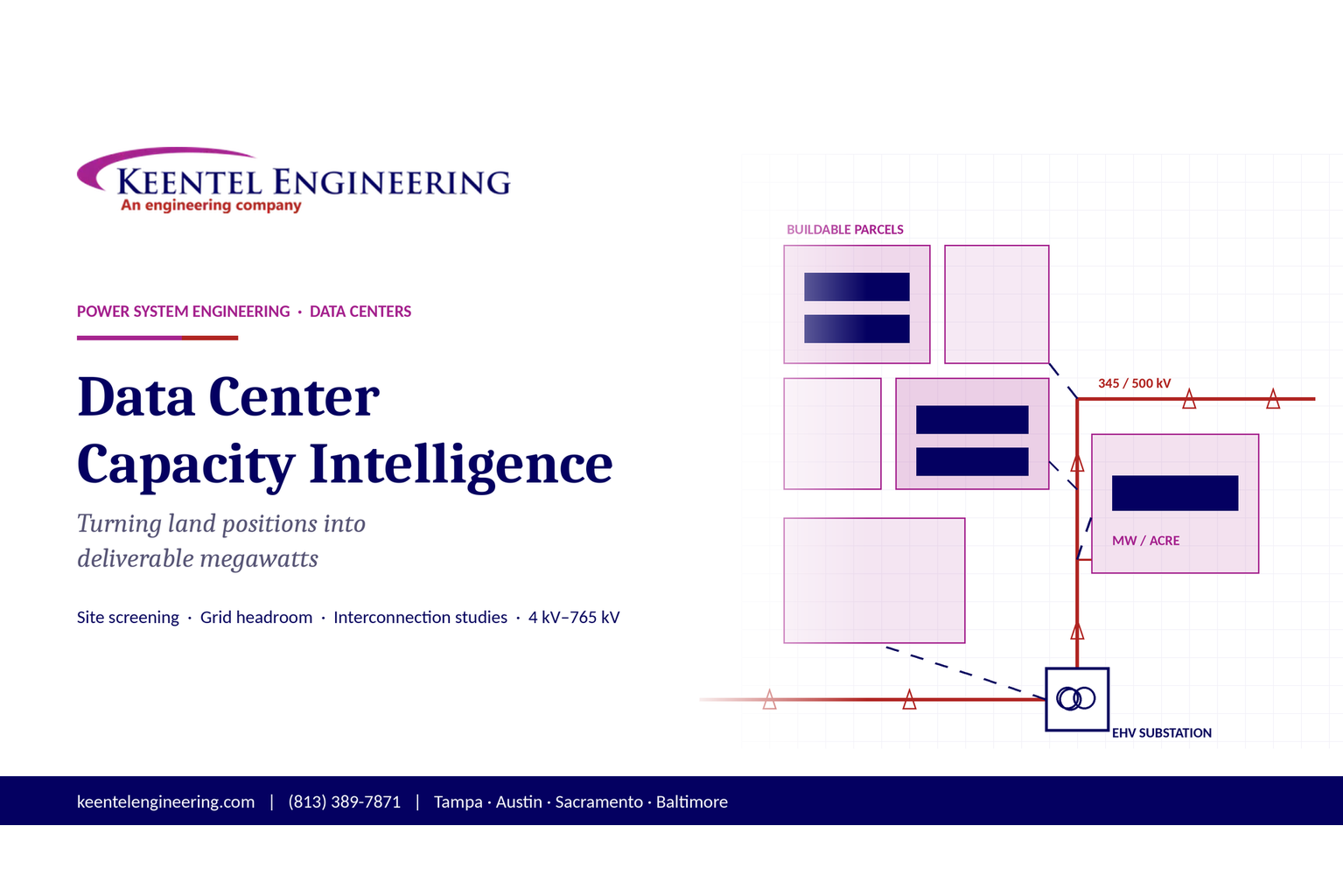
Plan data center capacity with land screening, MW-per-acre estimates, grid power availability and interconnection feasibility studies from Keentel Engineering.
By SANDIP R PATEL
•
October 11, 2026
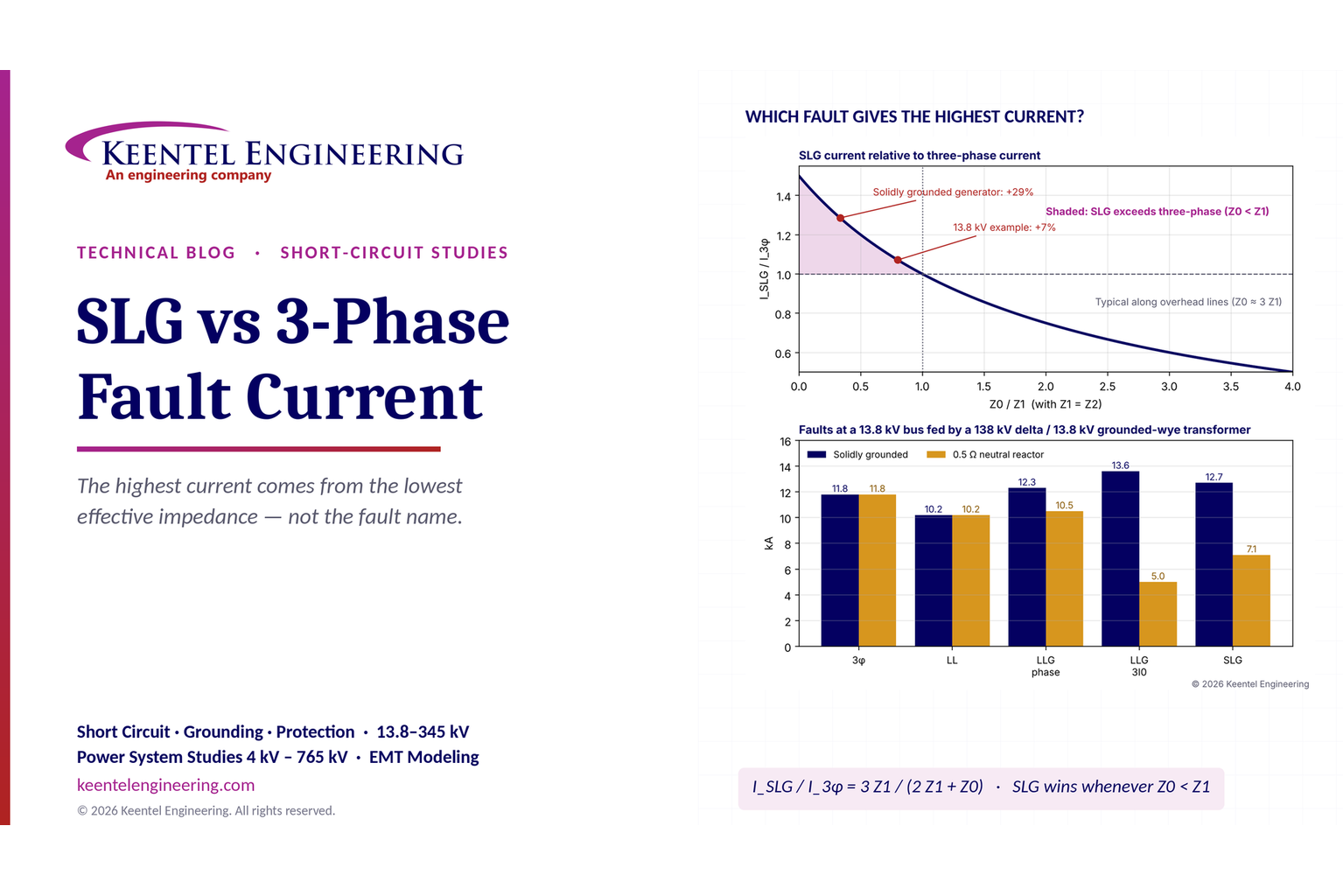
Learn which fault produces the highest current at a bus, why SLG faults can exceed three-phase faults, and how symmetrical components determine fault duty.
By SANDIP R PATEL
•
October 11, 2026
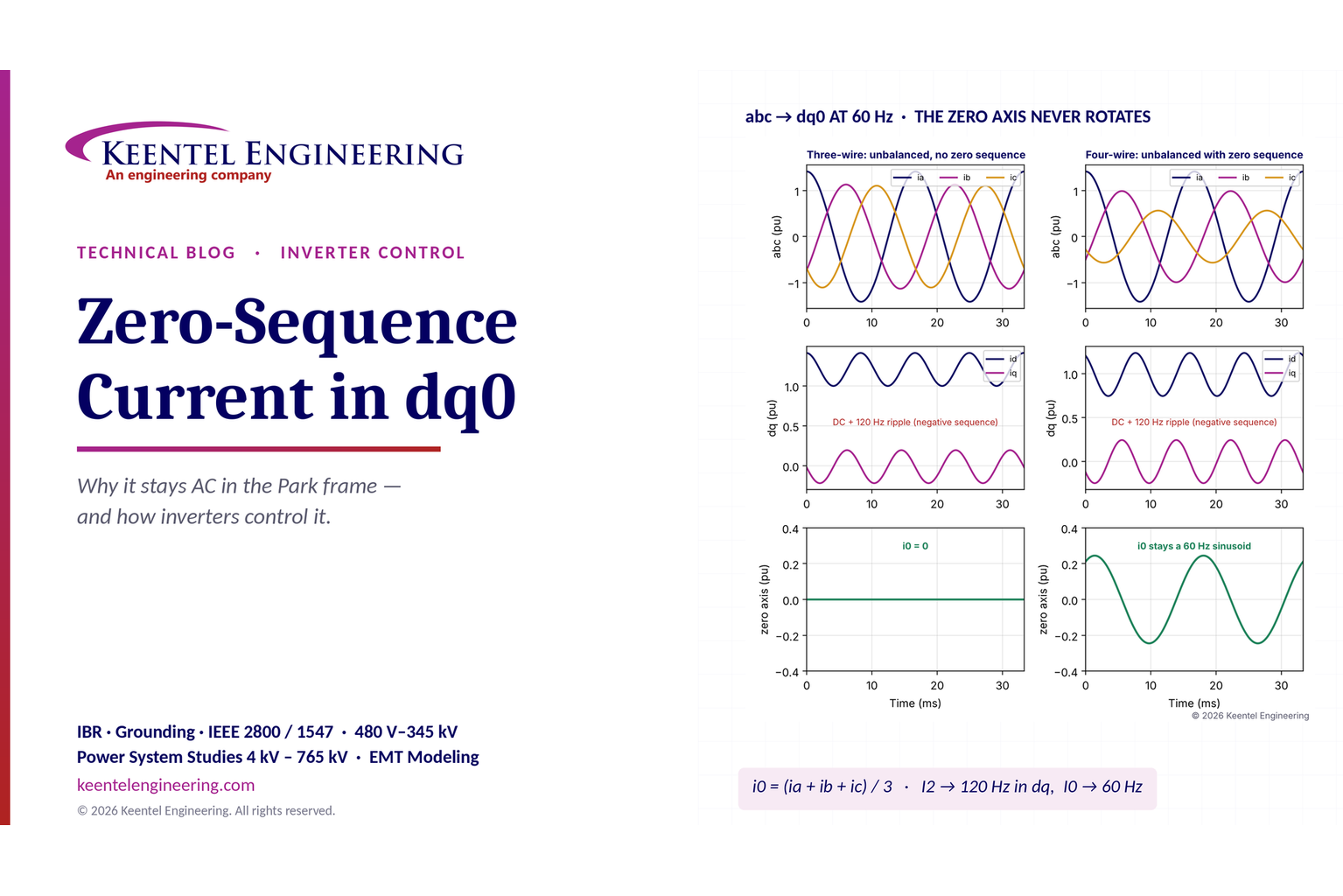
Learn why zero-sequence current pulsates in the dq0 frame, how Park's transformation works, and how inverter controls handle unbalance and ground faults.
By SANDIP R PATEL
•
October 11, 2026
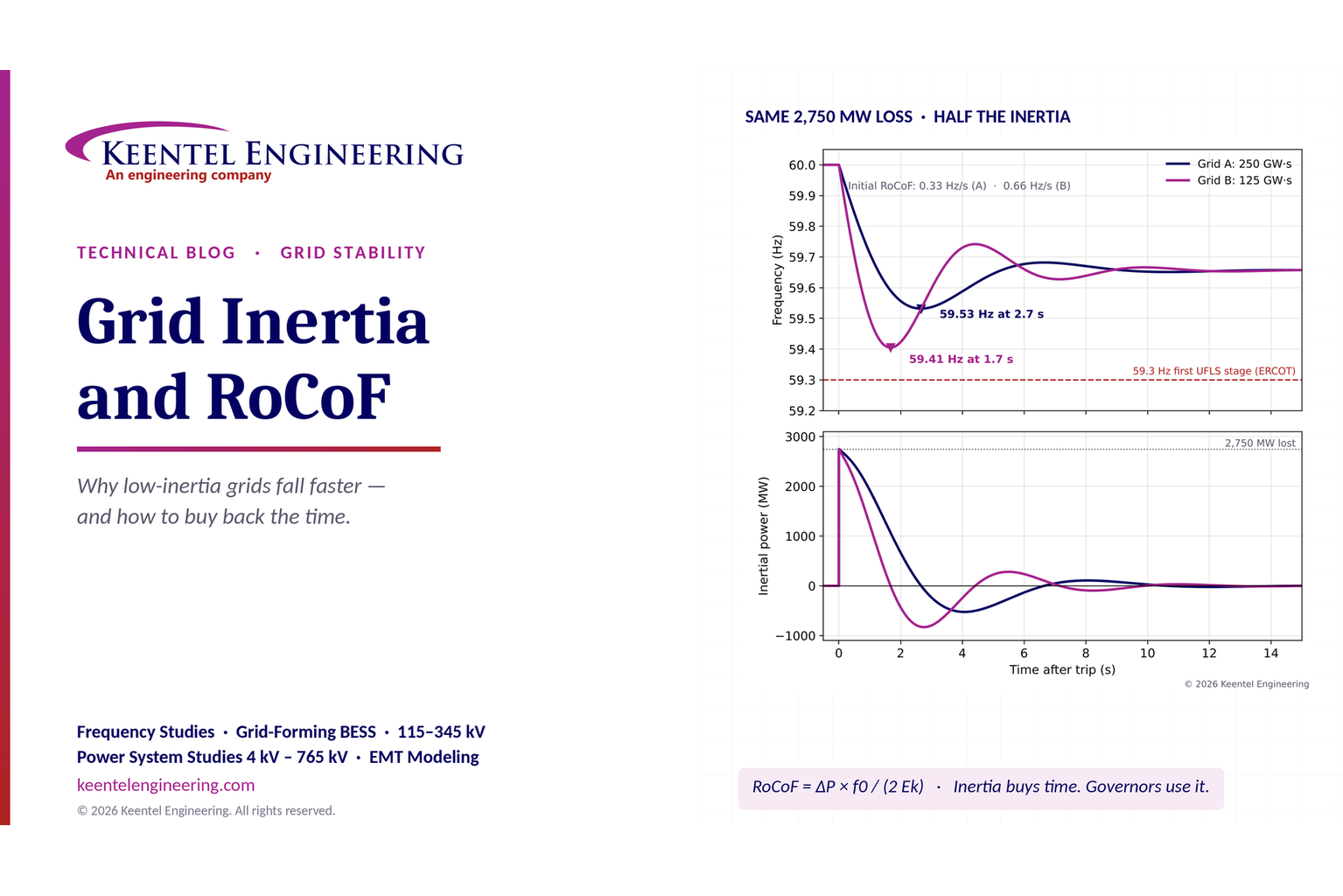
Explore grid inertia, RoCoF and frequency response, with swing equation calculations, frequency nadir analysis and US power system simulation examples.
By SANDIP R PATEL
•
October 11, 2026
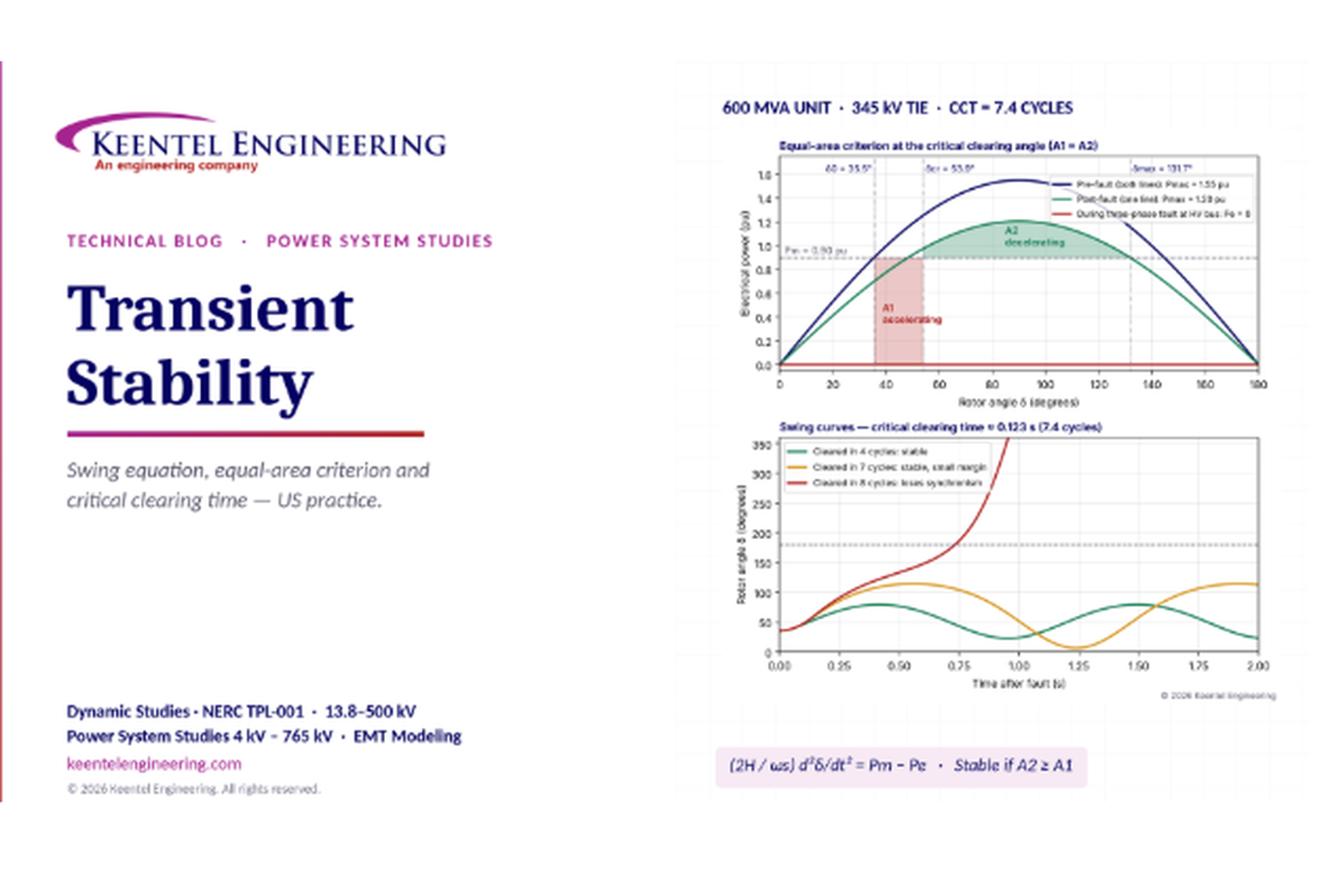
Learn transient stability analysis, swing equation, equal-area criterion and critical clearing time with a 345 kV worked example and NERC TPL-001 guidance.
By SANDIP R PATEL
•
October 11, 2026
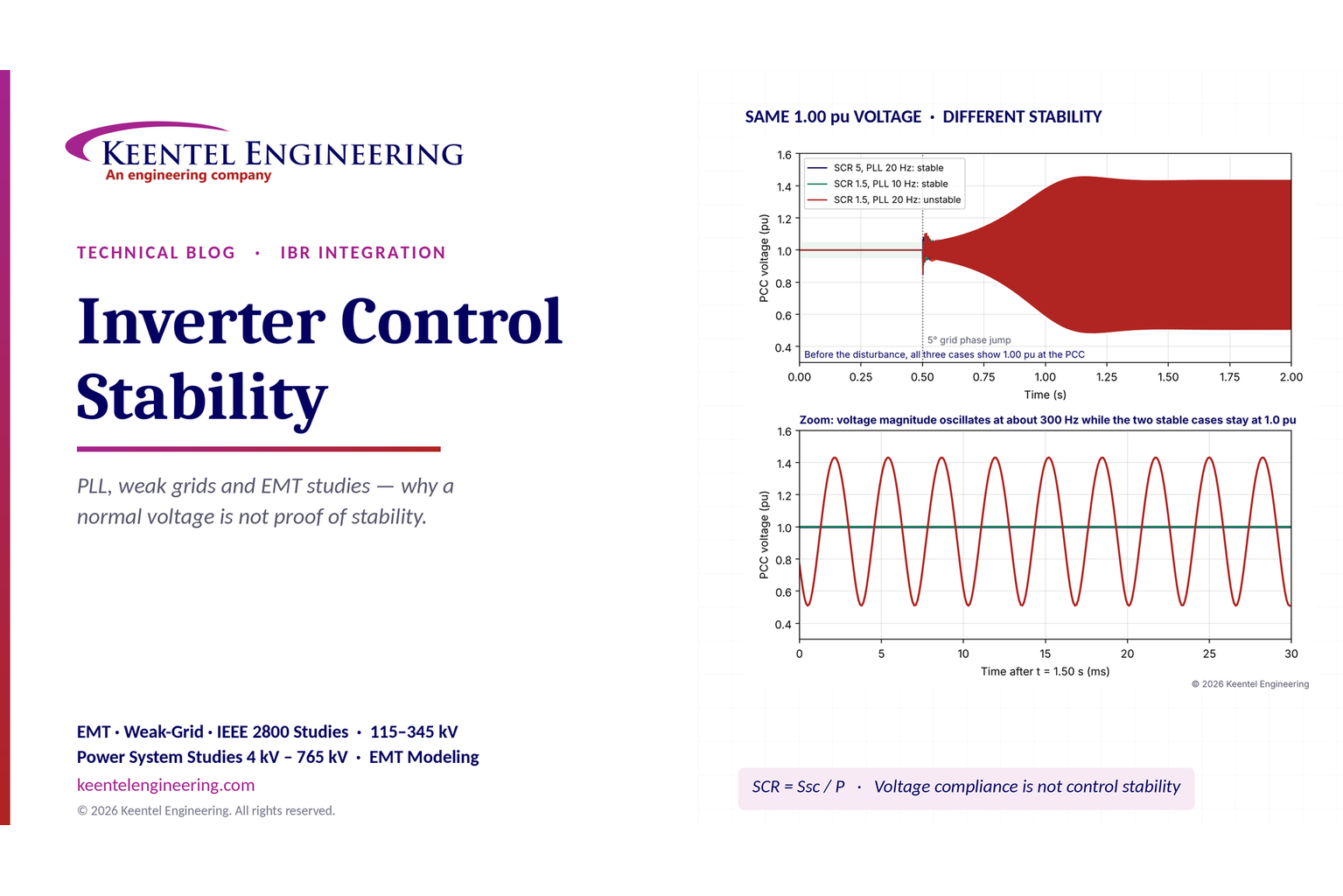
Learn why inverter controls become unstable in weak grids, how PLL bandwidth and SCR affect stability, and how PSCAD EMT studies identify and mitigate oscillations.
By SANDIP R PATEL
•
October 11, 2026
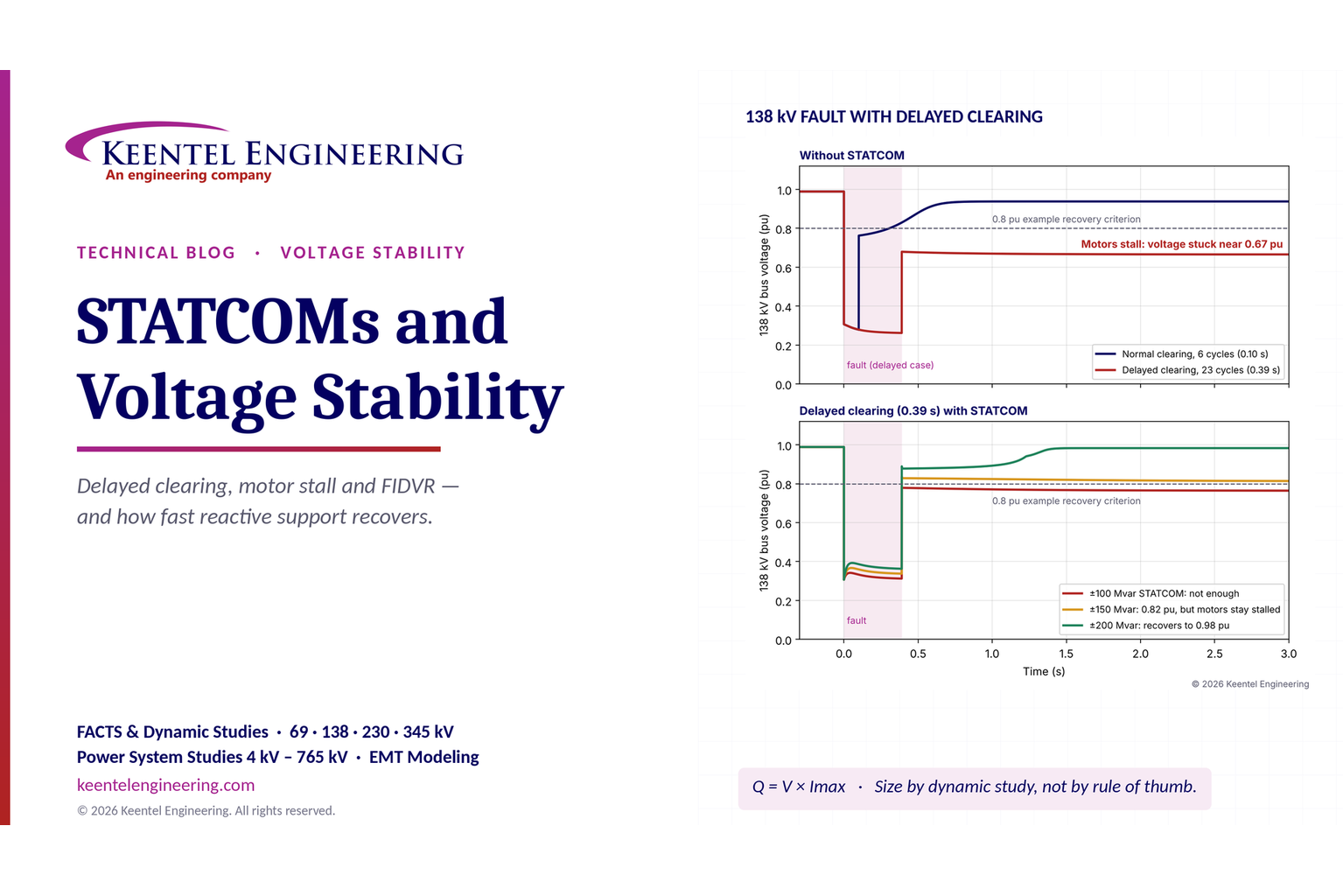
Learn how STATCOMs improve voltage stability and prevent FIDVR. Explore reactive power sizing, delayed fault clearing, NERC criteria and 138 kV simulation results.
By SANDIP R PATEL
•
October 10, 2026
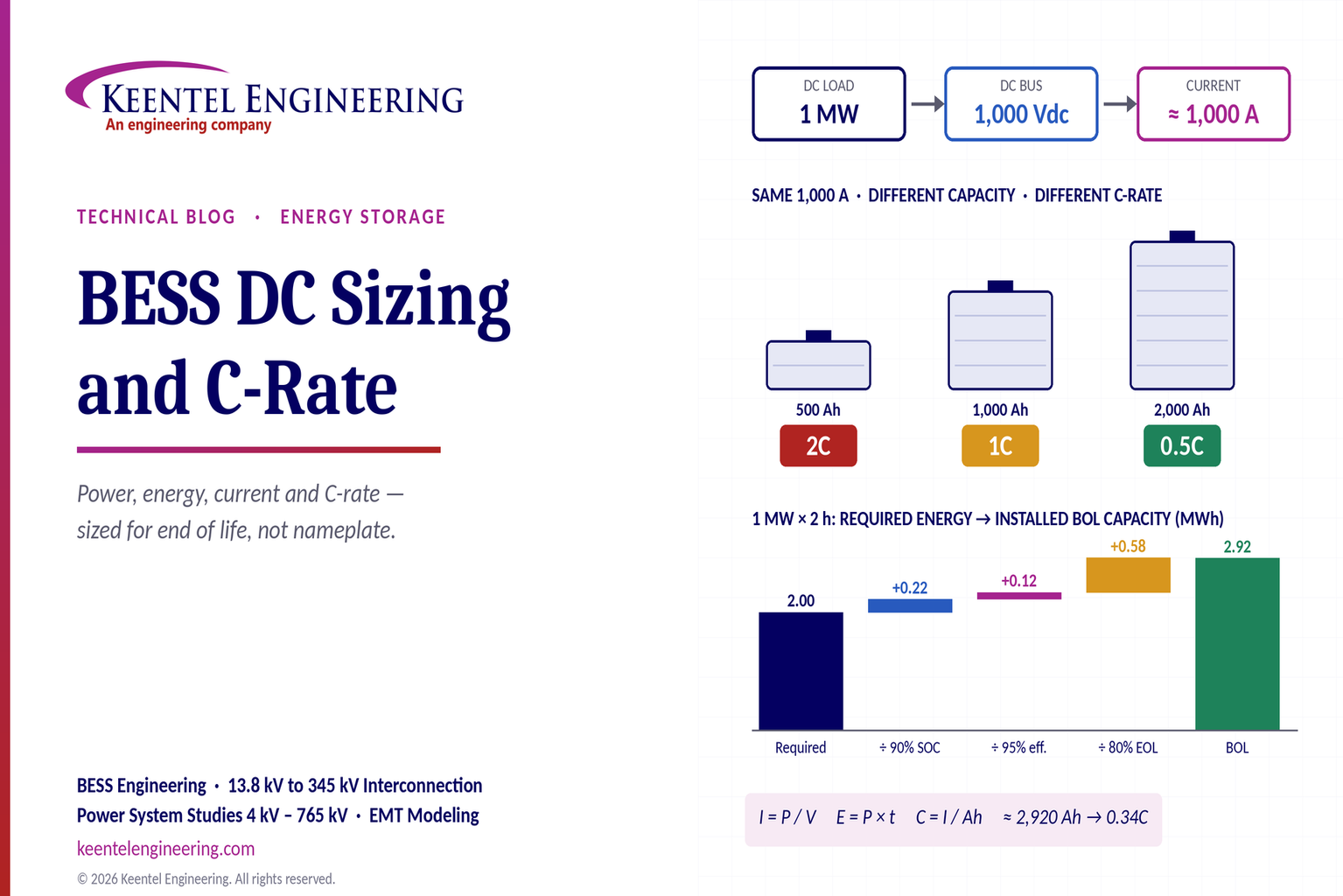
Learn BESS DC sizing with power, energy, current and C-rate calculations, battery losses, degradation and a 100 MW/400 MWh utility-scale example.
By SANDIP R PATEL
•
October 10, 2026
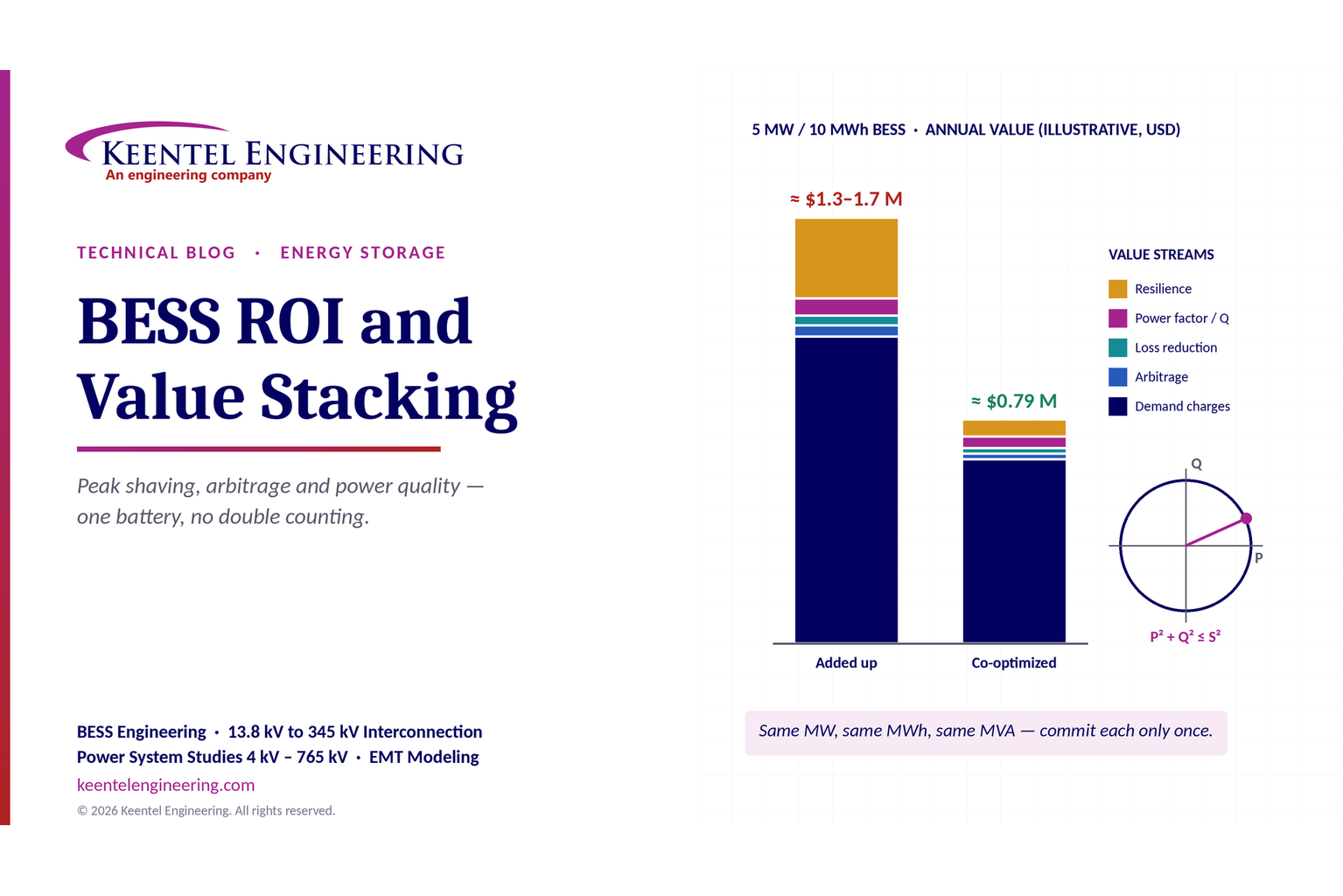
Learn how BESS ROI is calculated using peak shaving, energy arbitrage, power quality and battery storage economics, with a practical 5 MW/10 MWh example.