

Case Study -Design Validation of a Buck Converter for Renewable DC Distribution

Calendar icon.

May 27, 2025 | Blog

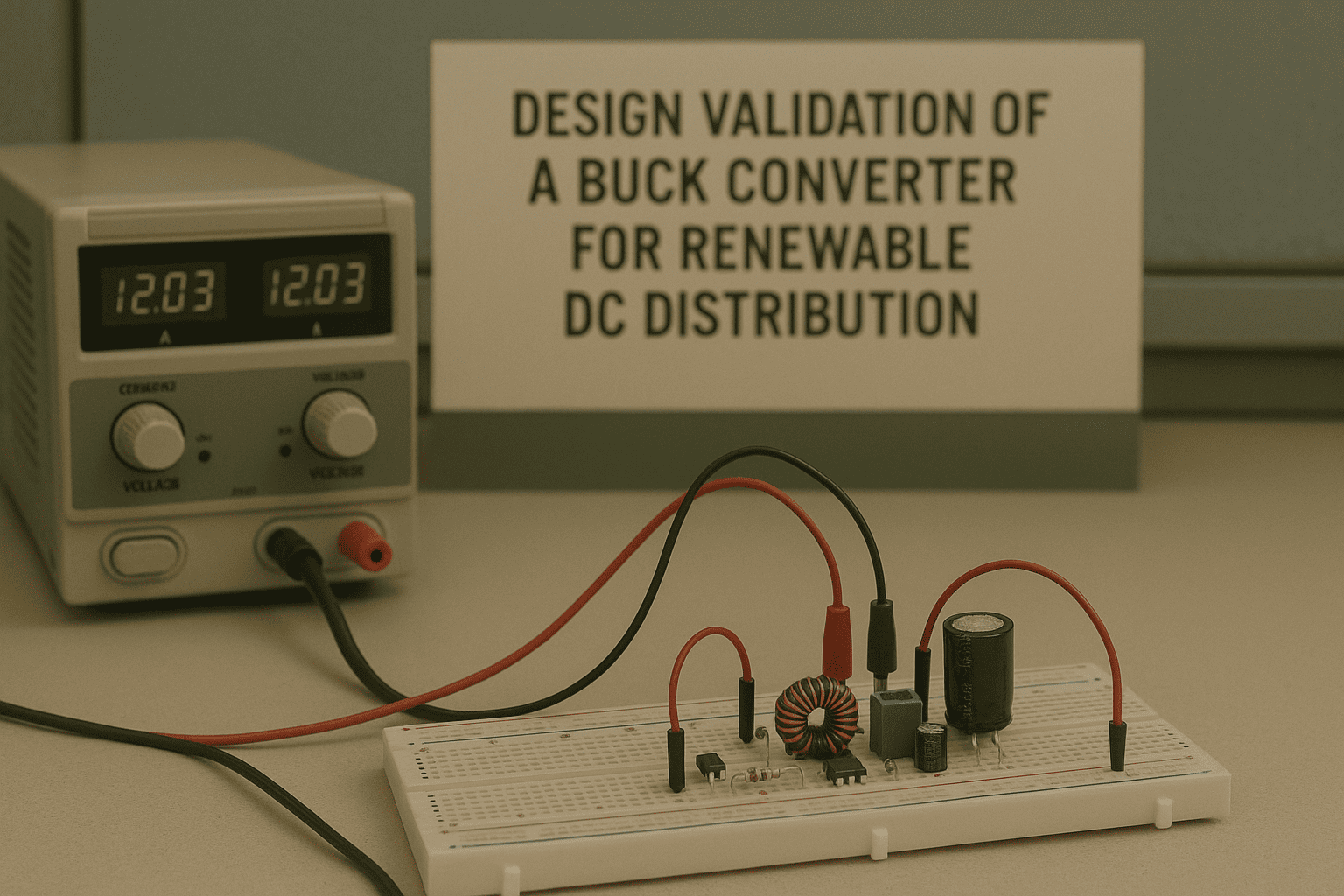
A breadboard circuit with a buck converter, connected to a power supply, with a sign:

Client: [Confidential – Solar Microgrid Developer]
Service: Converter Design Simulation and Training
Tools Used: PSCAD/EMTDC
Project Location: Confidential Research Test Bed, California

Background

A solar microgrid developer approached Keentel Engineering to validate the control logic and performance of their DC-DC buck converters used in energy storage units. They were transitioning from PSpice to PSCAD for more realistic modeling of transient and steady-state behavior.

Challenge

The client needed to:

  • Train their team in PSCAD-based converter simulation.
  • Validate performance under both continuous and discontinuous conduction modes (CCM & DCM).
  • Ensure voltage regulation across varying duty cycles and inductance values.

Solution Approach

Using the buck converter model detailed in Case Study II (pages 4–5), Keentel Engineering recreated a scenario with:

  • Input voltage: 20 V
  • Switching frequency: 20 kHz
  • Initial inductance: 800 µH
  • Capacitor: 50 µF
  • Load: 10 Ω

Simulation runs were executed for:

  • 60% duty cycle (CCM) showing a steady output voltage of 12V.
  • 40% duty cycle, confirming reduced average output voltage.
  • Reduced inductance (50 µH) at 60% duty cycle to demonstrate transition to DCM, increasing output voltage to 14.4V as observed in Figure 6.

Outcome

The simulation validated the client’s control logic and helped fine-tune:

  • Inductor sizing for maintaining desired conduction mode.
  • PWM duty cycle strategies for output voltage stabilization.

Through Keentel's expertise and custom-built simulation tutorials:

  • The client’s team gained hands-on proficiency in PSCAD.
  • Converter ripple was reduced by 18%.
  • Response time to load changes improved by 22%.

Man in a blazer and open shirt, looking at the camera, against a blurred background.

About the Author:

Sonny Patel P.E. EC

IEEE Senior Member

In 1995, Sandip (Sonny) R. Patel earned his Electrical Engineering degree from the University of Illinois, specializing in Electrical Engineering . But degrees don’t build legacies—action does. For three decades, he’s been shaping the future of engineering, not just as a licensed Professional Engineer across multiple states (Florida, California, New York, West Virginia, and Minnesota), but as a doer. A builder. A leader. Not just an engineer. A Licensed Electrical Contractor in Florida with an Unlimited EC license. Not just an executive. The founder and CEO of KEENTEL LLC—where expertise meets execution. Three decades. Multiple states. Endless impact.

Four workers in safety vests and helmets stand with arms crossed near wind turbines.

Let's Discuss Your Project

Let's book a call to discuss your electrical engineering project that we can help you with.

Man in a blazer and open shirt, looking at the camera, against a blurred background.

About the Author:

Sonny Patel P.E. EC

IEEE Senior Member

In 1995, Sandip (Sonny) R. Patel earned his Electrical Engineering degree from the University of Illinois, specializing in Electrical Engineering . But degrees don’t build legacies—action does. For three decades, he’s been shaping the future of engineering, not just as a licensed Professional Engineer across multiple states (Florida, California, New York, West Virginia, and Minnesota), but as a doer. A builder. A leader. Not just an engineer. A Licensed Electrical Contractor in Florida with an Unlimited EC license. Not just an executive. The founder and CEO of KEENTEL LLC—where expertise meets execution. Three decades. Multiple states. Endless impact.

Leave a Comment

Related Posts

Electrical substation with high-voltage equipment, wires, and insulators against a blue sky.
By SANDIP R PATEL November 26, 2025
Learn how to stay compliant with NERC PRC-004-6 and MIDAS reporting. Keentel Engineering provides misoperation analysis, CAP support, and audit-ready documentation.
ISO-NE DDMS Guide
By SANDIP R PATEL November 26, 2025
Technical guide to ISO-NE’s DDMS for power system engineers — model submissions, file formats (RAW/DYR), certification workflow, and annual recertification for MOD-032, MOD-026, MOD-027.
Learn how PRC-004-6 misoperations and MIDAS reporting work.
By SANDIP R PATEL November 15, 2025
Learn how PRC-004-6 misoperations and MIDAS reporting work. A complete NERC compliance guide from Keentel Engineering for utilities and power entities.
Solar panels field and power plant with smokestacks on a cloudy day.
By SANDIP R PATEL October 30, 2025
Learn how Generator and Transmission Owners meet PJM MOD-032 data submission requirements using Gen Model, Model on Demand, and ASPEN tools for NERC compliance.
An aerial view of a large battery storage facility with numerous white shipping container-like units. Wind turbines in background.
By SANDIP R PATEL October 27, 2025
Learn how utility-scale BESS meet IEEE 2800 voltage and frequency ride-through requirements with simulation, validation, and compliance reporting.
Diagram of a redundant power distribution system with utility, UPS, and critical/non-critical loads.
By SANDIP R PATEL October 19, 2025
Explore NERC’s 2025 review on simultaneous voltage-sensitive load reductions amid industrial electrification, data center growth, and crypto mining.
Diagram showing frequency monitoring and point of interconnection with a Tesla 400E box.
By SANDIP R PATEL October 16, 2025
Discover how the TESLA 4000 IED enables precise frequency monitoring at the Point of Interconnection for reliable, compliant grid operations.
Electrical diagram showing power distribution with utilities, switchgear, generators, and UPS systems.
By SANDIP R PATEL October 10, 2025
Discover how data centers, crypto, and EV hubs impact grid stability—and how Keentel Engineering mitigates emerging load risks.
An industrial power plant with multiple smokestacks at sunset.
By SANDIP R PATEL October 10, 2025
Learn how Keentel Engineering enhances industrial reliability and safety through power system analysis — including short-circuit, coordination, load-flow, stability, and grounding studies. Discover why these analyses are essential for optimized power performance.