Add your custom HTML here

Keentel Engineering Newsletter

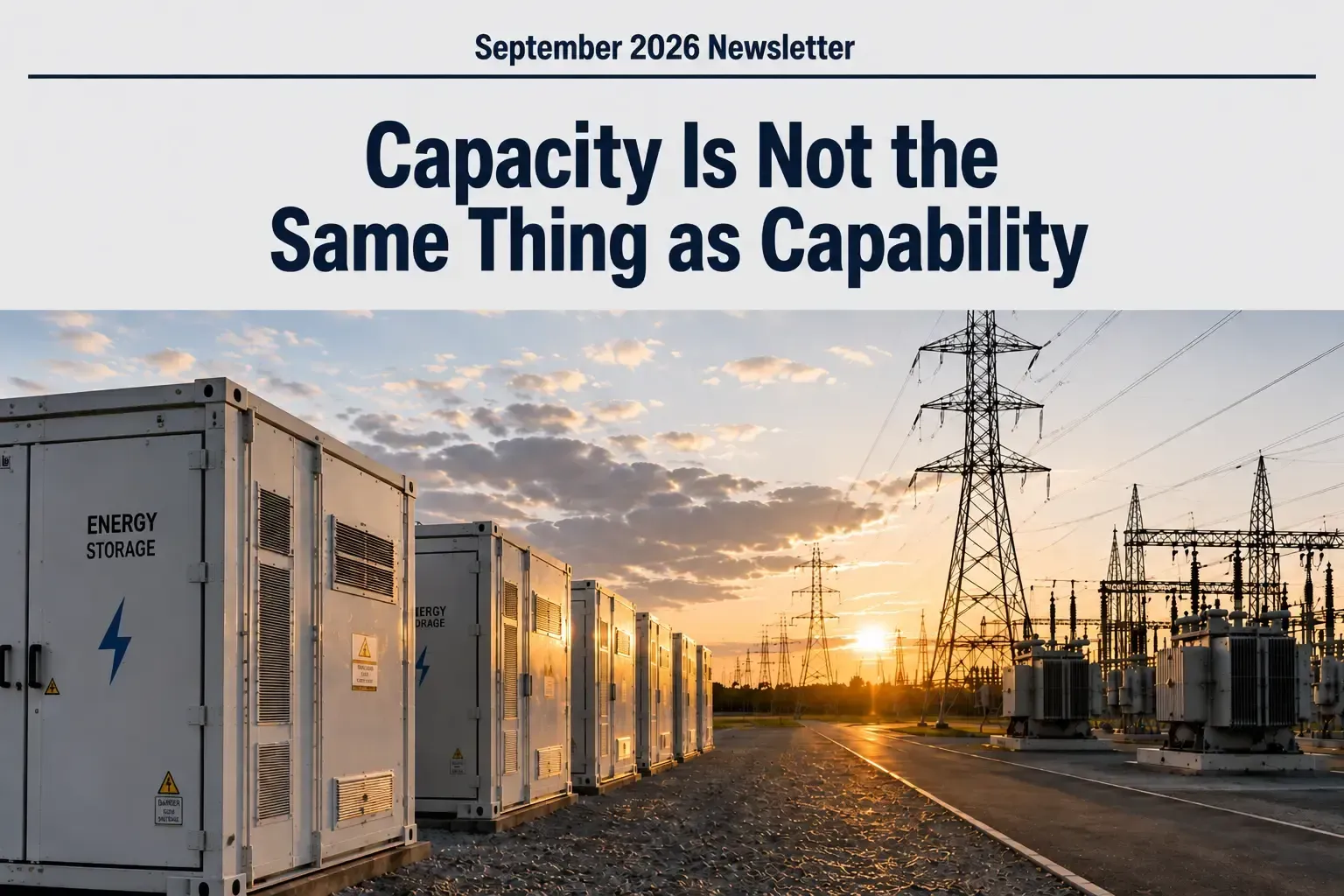
Capacity Is Not the Same Thing as Capability

Modern data center with rows of server racks and electrical switchgear.

Sep 2026 Edition

The month the constraint moved from generation to delivery

Seven developments this month—a new entrant in grid-scale storage, a supply-side earnings recovery, a national demand forecast, an EHV proposal in Texas, a European network acquisition, a trade delegation from Southern Africa, and a laboratory transformer that has no iron core in the conventional sense—point at the same conclusion from seven directions. There is no shortage of electrons or of capital. There is a shortage of delivery capacity, qualified engineering hours, and schedule.

Inside This Issue

01 Storage Hardware — a new entrant at 512 Ah, and why cell capacity is a site‑layout question

02 Supply Chain — H1 2026 cell‑maker results, the end of price deflation, and counterparty risk

03 Demand & Capacity — 55% growth by 2050 and why grid‑enhancing technologies are study work

04 Transmission — 765 kV in ERCOT — what an EHV layer actually changes

05 Technology Watch — megawatt‑class solid‑state transformers, and the honest efficiency case

06 Grid Capital — Iberdrola–Caruna and the pricing of distribution networks

07 International — a Southern African delegation in Austin, and what modernization means there

08 The Keentel Take — what owners, developers and EPCs should do about it this quarter

Principal’s Desk

If you read only the headlines this month, you would conclude that the industry is in excellent shape. Battery manufacturers have returned to profitability. A major automaker has committed a gigafactory to grid storage. A large Texas utility has published an economic case for tens of billions in annual benefit from new transmission. A national trade association has quantified demand growth through 2050. A university laboratory has demonstrated a transformer technology that has been theoretical for two decades.

Read them as an engineer and a different picture emerges. Every one of these items describes capacity —manufacturing capacity, transmission capacity, generating capacity, conversion capacity. None of them describes capability: the ability to place that capacity into a specific network at a specific point of interconnection, with validated models, coordinated protection, a defensible facility rating, and a schedule that survives contact with a cluster study.

That gap is where projects die. It is not usually a technology failure. It is a study that was never run, a model that never matched the as‑built equipment, a fault‑current assumption that stopped being true when the surrounding generation mix changed, or a protection scheme that was coordinated against a synchronous machine and now sits next to a converter that will not produce the current it was expecting. The equipment in this issue is genuinely impressive. The engineering discipline required to install it safely has not become any easier.

The through‑line in this issue: Cell capacity, conductor rating, converter topology and transformer technology are all upstream design inputs. Each one changes the study set required before energization. When the hardware changes faster than the study practice around it, the risk does not disappear — it moves to the commissioning window, where it is most expensive to find.

01 · Storage Hardware

Ford has entered grid‑scale storage through a new energy division, converting Kentucky cell manufacturing capacity from electric‑vehicle LFP production toward stationary storage. The flagship product is a liquid‑cooled 20‑foot DC block built on 512 Ah LFP cells, rated at 5.45 MWh, offered in two‑hour and four‑hour configurations, with a 1040–1500 V DC operating window, IP55 enclosure rating, roughly 43.5 tonnes container weight and operation to 4,000 m altitude without derating. The company has indicated 20 GWh of annual manufacturing capacity, with first customer deliveries expected in late 2027. Because the units are assembled domestically, they are positioned as compliant with foreign entity of concern and prohibited foreign entity restrictions and as eligible for domestic content adders.

Why the cell capacity number matters at the site, not just on the datasheet

Most fielded storage still uses 280 Ah or 314 Ah cells. The industry has been migrating toward a 587–628 Ah class, which is now approaching volume production at several manufacturers. Ford is entering above the old standard but below the emerging one, and at the container level that difference is material: competing blocks in the 587–588 Ah class are rated near 6.25 MWh against Ford’s 5.45 MWh.

For a 400 MWh project that is roughly a dozen additional containers. Additional containers mean additional foundations or piers, additional DC collection runs and combiner terminations, more medium‑voltage transformer positions, a larger fenced footprint, longer AC collection, and a proportional increase in the number of thermal management and fire suppression systems to commission and maintain. Cell capacity is not a procurement detail. It propagates into civil layout, collection design, land acquisition and the commissioning schedule.

Parameter Ford Energy 587–628 Ah class (industry range) Engineering consequence
Cell capacity 512 Ah 587–628 Ah Sets cells per module and module count per rack
Container energy 5.45 MWh ≈ 5.0–6.26 MWh (typically 6.25 MWh at 587–588 Ah) Drives container count, pad count and MV transformer positions
Duration offered 2 h and 4 h 2 h, 4 h and 6 h depending on manufacturer Determines inverter sizing and ancillary service eligibility
Container weight ≈ 43.5 tonnes Generally managed below the 45‑tonne transport ceiling Governs crane selection, road permits and foundation loading
Operating range −35 °C to +55 °C Upper limits commonly +60 °C to +70 °C Ambient derate risk in hot‑climate siting
Round‑trip efficiency Not published Typically stated 94–96.5% Unstated RTE is an unclosed variable in the revenue model
Cycle life Not published; 20‑year calendar life stated Commonly 8,000–12,000 cycles to 70–80% SOH Calendar life without cycle life is not a warranty basis

Comparative positioning based on publicly announced manufacturer specifications. Figures are as published by the respective manufacturers and have not been independently verified by Keentel Engineering.

Three items an owner’s engineer should press on

  • The thermal ceiling. An upper operating limit of +55 °C is below much of the competing field. In West Texas, Arizona, the Central Valley or the Gulf Coast, the governing number is not shade ambient — it is enclosure surface temperature under solar gain with the liquid cooling system already working. Ask for the derate curve, not the operating range.
  • Undisclosed round‑trip efficiency and cycle life. These are the two inputs a storage revenue model is most sensitive to. Where they are not published, they should be contractual: guaranteed RTE at defined conditions, and a capacity maintenance schedule with defined augmentation obligations.
  • No fielded operating history. A first‑deliveries date of late 2027 means no MOD‑026 or MOD‑027 validation record, no established generic model stack in the transmission planning libraries, and no EMT model with a track record of matching field response. For a project inside a cluster study, that is a schedule risk before it is a performance risk. Learn more about NERC compliance services

Domestic assembly is not the same as compliance

Final assembly in the United States supports a domestic content position, but prohibited foreign entity determinations under the 2025 tax legislation turn on material assistance cost ratios and on effective control tests — not on the location of the final assembly line. Cell chemistry sourcing, licensed technology, and the ownership structure behind the manufacturing entity all remain in scope. Treat vendor compliance statements as the beginning of diligence, not the end of it.

02 · Supply Chain

Interim results across the listed Chinese battery manufacturers show the broadest profitability recovery the storage supply chain has seen in several years. After the 2024–2025 price war drove utility‑scale cell pricing to roughly RMB 0.3/Wh, prices recovered quarter over quarter through the first half of 2026. Leading manufacturers used their storage segments to lift gross margins; second‑tier suppliers returned to positive gross margin across the board, helped by a sharp rebound in capacity utilization.

Manufacturer H1 2026 storage signal What it tells a buyer
CATL Storage system revenue up roughly 88% year over year; storage gross margin near 24%, above its power battery segment; capacity utilization near 95% Margin headroom to fund warranty reserves and long‑dated performance guarantees
EVE Energy Storage shipments above 44 GWh; storage gross margin near 12.5% and down year over year Growth bought with price concession — test the balance sheet behind a 20‑year guarantee
CALB Storage shipments above 31 GWh, up roughly 51%; H1 net profit forecast roughly doubled Scaling into storage from an automotive base
Gotion High‑Tech Roughly 4.5% of global stationary storage shipments; sharp net profit growth, partly non‑recurring Read the profit recovery net of one‑time items
Great Power Returned to profit from a prior‑year loss; near‑full capacity with output fully sold; 588 Ah lines entering volume production around year end Confirms 587–588 Ah as the emerging standard cell class
REPT BATTERO H1 net profit already exceeded full‑year 2025; revenue up roughly 57% Scale economics beginning to hold
Desay Battery Storage cell revenue up sharply on a shift from pack assembly to in‑house cell production Vertical integration changing the supplier landscape

Compiled from company interim reports and performance forecasts; shipment shares reflect third‑party market research estimates. Several entries are forecasts rather than filed results and should be confirmed against final filings before use in a commercial decision.

What this changes in a project financial model

The deflation assumption is dead for now. Models built on continued cell price decline through 2027 should be revisited. Quarter‑over‑quarter price recovery with capacity effectively sold out is the opposite condition.

Gross margin is a bankability input. The spread between a manufacturer earning roughly 24% on storage and one earning roughly 12.5% is the difference between a supplier funding twenty years of warranty obligation out of margin and one relying on future volume to cover it. Independent engineers should be reading supplier financials alongside datasheets.

Lead times and configuration flexibility tighten together. When lines run at or near full capacity, the ability to negotiate non‑standard container configurations, custom protection interfaces or accelerated delivery erodes. Procurement decisions need to be sequenced earlier relative to the interconnection study schedule, not later.

The compliance and cost frontiers are diverging. The manufacturers with the deepest cost position and the longest operating record are largely not the ones that resolve prohibited foreign entity exposure. Procurement now has to solve for both constraints at once, and the engineering consequence is that the preferred technical solution and the preferred tax‑credit solution may specify different equipment.

03 · Demand and Grid Capacity

A grid reliability study published this month by the National Electrical Manufacturers Association projects United States electricity demand rising roughly 55% by 2050, driven by artificial intelligence workloads and hyperscale data centers, industrial growth, transportation electrification and shifting consumer patterns. The more useful part of the analysis is the framing: the central challenge is not producing more energy, it is moving existing generation to where it is needed. That reframing turns a generation problem into a transmission, protection and interconnection problem — which is to say, an engineering problem rather than a capital problem.

Grid‑enhancing technologies are study deliverables, not products

The discussion of solutions covers grid‑enhancing technologies, advanced transmission and reconductoring, dynamic line ratings, demand response, storage, vehicle‑to‑grid, data center interconnection, supply chains, permitting reform, and a widening workforce gap. It is worth being precise about what these actually require, because they are frequently described as though they were equipment purchases. See our power system studies capabilities.

Technology What it is presented as What it actually requires before it delivers headroom
Dynamic line ratings Sensors that unlock existing capacity A ratings methodology the operator will accept, revised FAC‑008 facility ratings, protection settings reviewed against the new thermal envelope, and a validated path from measurement to the real‑time model
Advanced conductors and reconductoring A higher‑ampacity replacement conductor Changed line impedance and thermal limits — which propagates into power flow cases, relay coordination, and any distance element set against the original line constants
Demand response and vehicle‑to‑grid Dispatchable load at low capital cost Telemetry, forecast accuracy, aggregation modeling and a defensible basis for counting the resource in a planning case rather than only in an operating hour
Storage as a transmission asset Deferral of a line build Duration adequacy against the actual constraint, state‑of‑charge management rules, and study treatment that reflects an energy‑limited resource
AI‑enabled grid control Optimization of existing assets SCADA and telemetry coverage, data quality, and model accuracy. The algorithm is rarely the binding constraint — the measurement layer beneath it is

Keentel Engineering assessment of the study and commissioning work implied by each technology class.

The point worth carrying: None of these technologies is plug‑in. Each one changes a network parameter that some existing setting, rating or model was derived from. Deployed without the corresponding re‑study, they convert a capacity gain into a protection or ratings exposure. The workforce gap identified in the study is the binding constraint on exactly this work. There is more engineering to be done per megawatt delivered than there was a decade ago, not less.

04 · Transmission

CenterPoint Energy has released a third‑party economic study of proposed resiliency and reliability transmission projects in Southeast Texas built around 765 kV development. The study estimates more than $18 billion annually in statewide economic benefit, over $120 million per year in local property taxes, and roughly 41,000 construction jobs, with joint efforts alongside other ERCOT utilities projected as high as $30 billion in annual economic value and $300 million per year in new tax revenue.

These are claimed benefits from a utility‑commissioned study supporting a capital program that requires regulatory approval. They should be read as advocacy, and cited as such. The engineering content underneath them, however, is real and consequential — and largely absent from the coverage.

An EHV overlay is a different design practice, not a bigger version of the same one

ERCOT’s transmission backbone is built at 345 kV. Introducing a 765 kV layer is a step change in design practice, and the differences are not incremental. Explore our transmission line design services.

Design area What changes at 765 kV
Reactive compensation Line charging current rises steeply with voltage. Shunt reactors become a mandatory part of the design rather than an optimization, and light‑load overvoltage and self‑excitation of nearby machines must be studied explicitly
Insulation coordination Switching surge, rather than lightning, governs air‑gap clearances and tower geometry. Controlled closing resistors or point‑on‑wave switching, and surge arrester energy duty, all move to the front of the design
Right‑of‑way and structures Wider corridors, larger structures, greater conductor bundling, and audible noise and electric field gradient limits that constrain conductor selection independently of ampacity
Protection and relaying Long‑line distance protection with series compensation considerations, single‑pole tripping and reclosing to preserve stability, and secondary arc extinction — practice that has limited precedent in this footprint
System studies A new voltage level means new power flow cases, revised short‑circuit duties at every interconnected bus, transient stability re‑evaluation, and EMT studies for switching transients and for interaction with the inverter‑based resources already interconnected nearby
Interconnection consequences New EHV terminals change point‑of‑interconnection availability and short‑circuit ratio across a wide area, which changes what generation and load can interconnect where, and what grid‑forming or synchronous support is required to do it

Keentel Engineering assessment of the design and study implications of an EHV overlay in a predominantly 345 kV network.

Resiliency and reliability are not synonyms. The coverage uses the two terms interchangeably; the engineering does not. Reliability is steady‑state adequacy — enough capacity and enough network to serve load under credible contingencies. Resiliency is the ability to withstand and recover from low‑probability, high‑consequence events, and it is delivered through different measures: structure class upgrades, storm loading criteria, selective undergrounding, sectionalizing and restoration strategy. A 765 kV overlay is primarily a reliability and deliverability investment. Undergrounding and hardening programs are resiliency investments. Both may be justified; they answer different questions, and the studies that support them are different studies.

05 · Technology Watch

North Carolina State University, working with the New York Power Authority and EPRI, has designed and tested a high‑efficiency solid‑state transformer rated to 1 MW under realistic operating conditions, demonstrated at EPRI’s laboratory facility in Lenox, Massachusetts. The technology is presented as improving efficiency at high‑demand installations including data centers, reducing conversion heat loss, and offering a compact footprint suited to space‑constrained urban sites.

What the technology actually is

A solid‑state transformer replaces the 60 Hz magnetic core with a power electronic conversion chain: medium‑voltage AC is rectified, converted through a high‑frequency isolated DC‑to‑DC stage built around a medium‑frequency transformer, and inverted back to AC or delivered directly as DC. Because transformer core volume scales inversely with operating frequency, moving isolation from 60 Hz to the kilohertz range collapses the magnetics. Megawatt‑class ratings at medium voltage have become practical largely because of silicon carbide devices with the blocking voltage to handle MV directly.

The efficiency claim, stated honestly: A well‑designed conventional medium‑voltage transformer operates above 99% efficiency. A solid‑state transformer is a multi‑stage converter, and stage‑by‑stage it will not beat that. The credible efficiency argument is at the system level: if a data center campus can accept medium‑voltage‑to‑DC conversion directly, the solid‑state transformer displaces a transformer plus a rectifier stage plus part of the uninterruptible power supply chain. Compared against that stack, the case is strong. Compared against a transformer alone, it is not. Any specification that claims otherwise is comparing the wrong boundary.

What you give up, and what you gain

Consideration Conventional MV transformer Solid‑state transformer
Fault current contribution Passive, predictable, set by impedance Electronically limited and controlled — changes short‑circuit study results and downstream relay coordination
Overload behavior Thermal inertia allows short‑term overload Hard‑limited by semiconductor junction temperature; little ride‑through margin
Failure modes Well‑characterized; long mean time between failures Converter failure modes; reliability governed by device and capacitor life
Expected service life Commonly 30–40 years Governed by power electronic component life, not core and winding life
Controllability None beyond taps Voltage regulation, reactive support, harmonic isolation between site and grid, native DC ports
Footprint and weight Large; oil containment where applicable Substantially reduced — the primary advantage in constrained urban sites
Specification maturity Mature standards and utility material specs Demonstration stage; no established utility standard specification

Keentel Engineering comparison of design and operating considerations.

What it would take to actually specify one

A protection philosophy that does not assume a passive fault‑current source, and a short‑circuit study that reflects a current‑limited contribution rather than a transformer impedance.

A defined testing and acceptance regime — the type test basis that exists for conventional transformers does not map cleanly onto a converter.

A spares and service strategy priced against power electronic component life rather than transformer life, and a defined obsolescence path for the control platform.

This is a laboratory demonstration, not a fielded product. Reported as a technology to track and to design around in ten‑year planning — not as an item to place in a specification this year.

06 · Grid Capital Watch

Iberdrola has agreed to acquire 80% of the equity in Caruna, Finland’s largest electricity distribution operator, for approximately $2.3 billion, in a transaction valuing the company including debt at roughly $5.7 billion. Swedish and Finnish pension insurers retain minority positions of 12.5% and 7.5%. Caruna serves more than 1.5 million people — over a fifth of the Finnish population — across roughly 89,000 kilometres of network operating under two regional distribution concessions. Notably, 67% of that network is underground, concentrated around Helsinki and the Joensuu region. Industrial activity and demand growth tied to new data centers and residential development in western and north‑eastern Finland were cited as drivers.

Data center demand is now global

The data center demand story is now global and it is showing up in asset pricing. The same driver behind United States interconnection queue congestion is being underwritten into acquisition multiples in Northern Europe.

Two‑thirds underground at distribution scale is the number engineers should notice. That ratio changes the engineering profile of a network: cable ampacity and thermal environment become the governing rating constraint, fault location practice shifts from visual patrol to injection and travelling‑wave methods, and restoration times move from hours to days when a failure does occur — in exchange for far fewer failures.

It is a useful comparison to the Texas hardening programs. Finland arrived at heavy undergrounding largely through outage‑duration regulation; Houston is arriving at it through storm experience. Same engineering solution, two different regulatory routes to it — and a reminder that undergrounding decisions are ultimately driven by the cost of interruption, not by the cost of cable.

Pension capital in the cap table signals the asset class. Regulated distribution is being priced as long‑duration, inflation‑linked infrastructure. That raises the standard for technical due diligence, condition assessment and asset‑life modelling on both sides of a transaction.

07 · International

The U.S. Trade and Development Agency is hosting a delegation of roughly fifteen government and private‑sector power sector decision‑makers from Angola, Botswana, Mozambique and Zambia, travelling to Denver and Austin from 29 August to 5 September. The programme focuses on securing and modernizing transmission and distribution systems, with demonstrations of network technologies and AI‑enabled grid control, and meetings with utilities and regulators including the Colorado Public Utilities Commission and ERCOT.

Why the engineering problem there is not the engineering problem here

It is easy to read “grid modernization” as the same work described in section 03. It is not. These four countries sit in and around the Southern African Power Pool, a network characterized by very long high‑voltage interties, large hydroelectric resources on the Zambezi system, and mining and industrial loads whose profiles look nothing like a North American distribution feeder. The binding problems are voltage stability over long lines, system integrity protection schemes, inter‑area oscillation, metering and revenue protection, and telemetry coverage — not congestion driven by rapid data center load growth.

The same caution applies to AI‑enabled control as applies domestically, only more sharply: an optimization layer is only as good as the measurement layer beneath it. Where SCADA coverage, time synchronisation and data quality are the constraint, the highest‑value early work is instrumentation, communications architecture and model validation — the unglamorous foundation that makes advanced control meaningful rather than decorative.

Keentel note

Keentel maintains an Austin office and works on transmission and substation design, power system studies and SCADA architecture across all of these problem classes. USTDA reverse trade missions, feasibility studies and technical assistance grants are a recognised route by which US engineering firms enter these markets. Firms interested in Southern African T&D work should be tracking USTDA programme announcements directly.

08 · The Keentel Take

Seven items, one recurring pattern: the hardware is changing faster than the study practice around it. Below is what we would put in front of an owner, developer or EPC on the strength of this month’s developments.

If you are… The question this month raises The study or deliverable that answers it
Developing a storage project Does the container class in your budget still match the container class your layout, collection design and land position assume? Revisit the DC block selection against civil layout and collection design before the next design milestone; confirm RTE, cycle life and derate curves contractually rather than by datasheet
Procuring cells or DC blocks Is your supplier’s twenty‑year obligation supported by margin, and does your compliance position survive a material assistance cost ratio test? Supplier financial and compliance diligence run alongside technical evaluation, with the tax‑credit and technical selections reconciled explicitly
Interconnecting a large load or data center Has the surrounding network changed since your study assumptions were set, and does an EHV overlay change your point‑of‑interconnection options? Short‑circuit ratio and grid strength assessment at the POI; interconnection strategy review against announced transmission projects
Operating or planning transmission Do your facility ratings, protection settings and models reflect the grid‑enhancing technologies you have deployed or plan to? Facility ratings review under FAC‑008, protection coordination review against revised thermal envelopes, and updated steady‑state and dynamic cases
Approaching commercial operation Do your as‑built parameters match the models the interconnection study was run on? As‑built model validation, MOD‑025/026/027 baseline testing, and settings‑control verification before the commissioning window closes
Evaluating new conversion technology What does a current‑limited source do to your protection scheme? EMT study and protection review that treats converter‑interfaced equipment as what it is, rather than as a transformer with different labels

Keentel Engineering recommendations. Project‑specific advice requires project‑specific study.

How Keentel supports this work

Service line Scope
POI interconnection engineering Interconnection strategy, application support, feasibility and system impact study review, facilities study review, and negotiation support across ERCOT, CAISO, PJM, SPP, MISO, NYISO and WECC footprints
Power system studies (EHV / HV / MV) Load flow, short circuit, arc flash, protection coordination, transient stability, harmonic and power quality, grounding, insulation coordination and reactive planning
EMT modelling PSCAD and EMTP model development, benchmarking and validation for inverter‑based resources, storage and grid‑forming applications
Substation and transmission design 30/60/90/IFC packages, physical and electrical design, protection and control, and construction support for AIS and GIS substations
Utility‑scale solar, wind and BESS engineering Owner’s engineer, design engineering and technical due diligence across the project lifecycle
NERC compliance FAC‑008 facility ratings, MOD‑025/026/027 testing and model validation, PRC standards support and audit preparation
MEP engineering and data centers Electrical distribution design, reliability topology, commissioning support and design‑phase engineering for mission‑critical facilities

Keentel Engineering service offerings. For specific engagements, contact our team.

Talk to us about a project

Sandip R. Patel, P.E. — Founder and Principal Engineer

contact@keentelengineering.com  ·  sandip.patel@keentelengineering.com  ·  813‑389‑7871
Florida Firm Registration No. 36853
Contact Keentel
Man in a blazer and open-collared shirt, indoors. He's looking at the camera with a neutral expression.

About the Author:

Sandip "Sonny" R. Patel, P.E.

IEEE Senior Member · Founder & CEO, Keentel Engineering

In 1995, Sonny Patel earned his Electrical Engineering degree from the University of Illinois. But degrees don't build legacies — action does.For three decades, he has worked the power industry from every side of the table: 16 years as a utility engineer at Exelon/Commonwealth Edison; generation leadership across hydroelectric, industrial steam turbine, and a 9 GW renewable fleet; NERC Regional Entity Senior Compliance Engineer and Audit Team Lead, auditing some of the nation's largest utilities; and testing and commissioning lead on equipment up to 765 kV — the very top of the North American grid.Utility. Generator. Regulator. Consultant. Few engineers have seen all four seats. Fewer still have sat in them.His experience spans nuclear, hydro, conventional generation, renewables, oil and gas, mining — and today's data centers, where he is authoring a three-book series on data center design. He is a Licensed Professional Engineer in six states and a Licensed Electrical Contractor in Florida (Unlimited EC) — he doesn't just design the work; he's qualified to stand behind its execution.Today, as Founder and CEO of Keentel Engineering, Sonny leads 51 engineers delivering substation design, power system studies, NERC compliance, and commissioning — done right, coast to coast.Three decades. Every side of the table. One standard: accountable engineering

Four workers in safety vests and helmets stand with arms crossed near wind turbines.

Let's Discuss Your Project

Let's book a call to discuss your electrical engineering project that we can help you with.

Man in a blazer and open-collared shirt, indoors. He's looking at the camera with a neutral expression.

About the Author:

Sandip "Sonny" R. Patel, P.E.

IEEE Senior Member · Founder & CEO, Keentel Engineering

In 1995, Sonny Patel earned his Electrical Engineering degree from the University of Illinois. But degrees don't build legacies — action does.For three decades, he has worked the power industry from every side of the table: 16 years as a utility engineer at Exelon/Commonwealth Edison; generation leadership across hydroelectric, industrial steam turbine, and a 9 GW renewable fleet; NERC Regional Entity Senior Compliance Engineer and Audit Team Lead, auditing some of the nation's largest utilities; and testing and commissioning lead on equipment up to 765 kV — the very top of the North American grid.Utility. Generator. Regulator. Consultant. Few engineers have seen all four seats. Fewer still have sat in them.His experience spans nuclear, hydro, conventional generation, renewables, oil and gas, mining — and today's data centers, where he is authoring a three-book series on data center design. He is a Licensed Professional Engineer in six states and a Licensed Electrical Contractor in Florida (Unlimited EC) — he doesn't just design the work; he's qualified to stand behind its execution.Today, as Founder and CEO of Keentel Engineering, Sonny leads 51 engineers delivering substation design, power system studies, NERC compliance, and commissioning — done right, coast to coast.Three decades. Every side of the table. One standard: accountable engineering