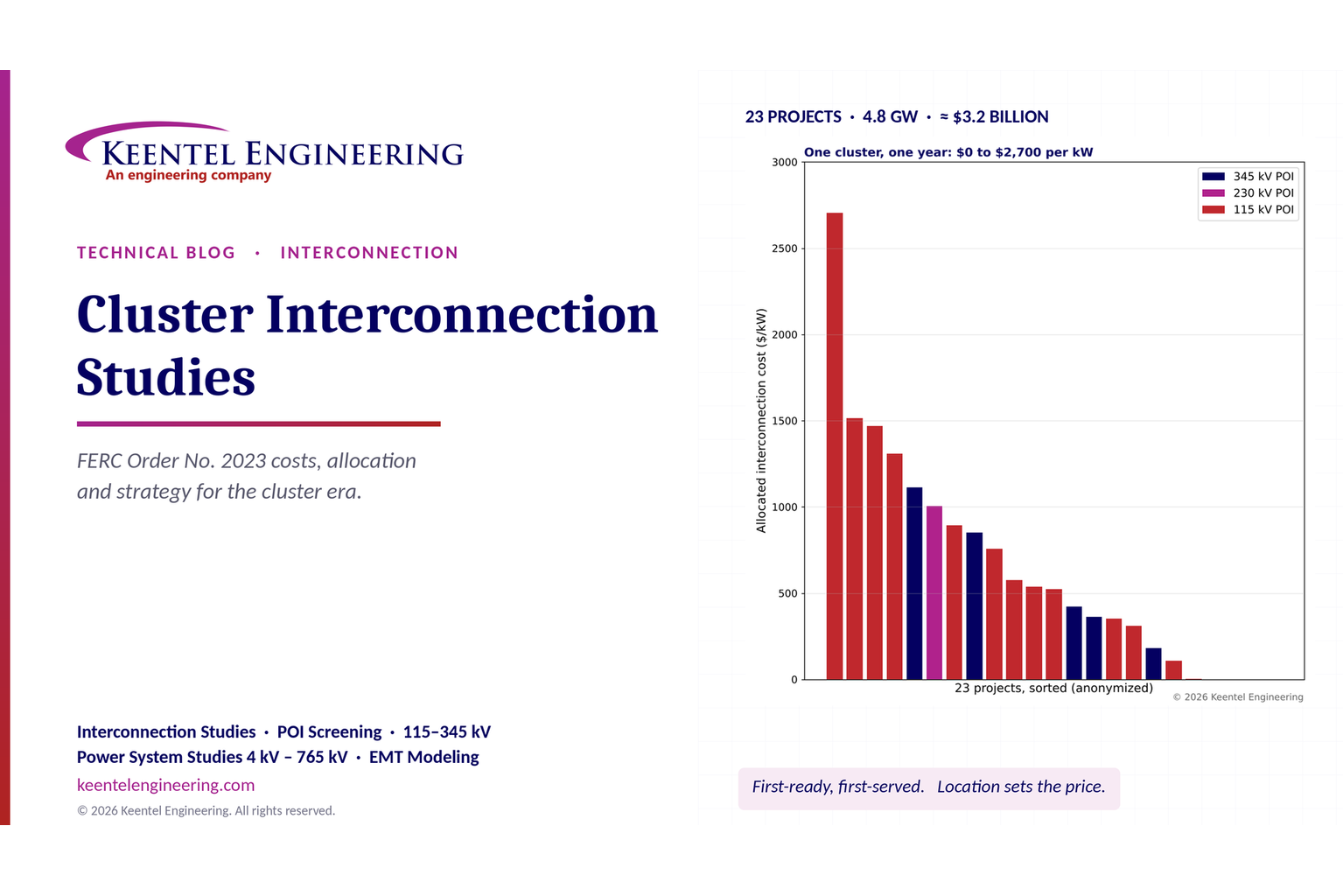


A Coordinated Electric System Interconnection Review—the utility’s deep-dive on technical and cost impacts of your project.

Challenge: Frequent false tripping using conventional electromechanical relays
Solution: SEL-487E integration with multi-terminal differential protection and dynamic inrush restraint
Result: 90% reduction in false trips, saving over $250,000 in downtime

Methods for Identifying the Frequency Response of Voltage Measurement Systems

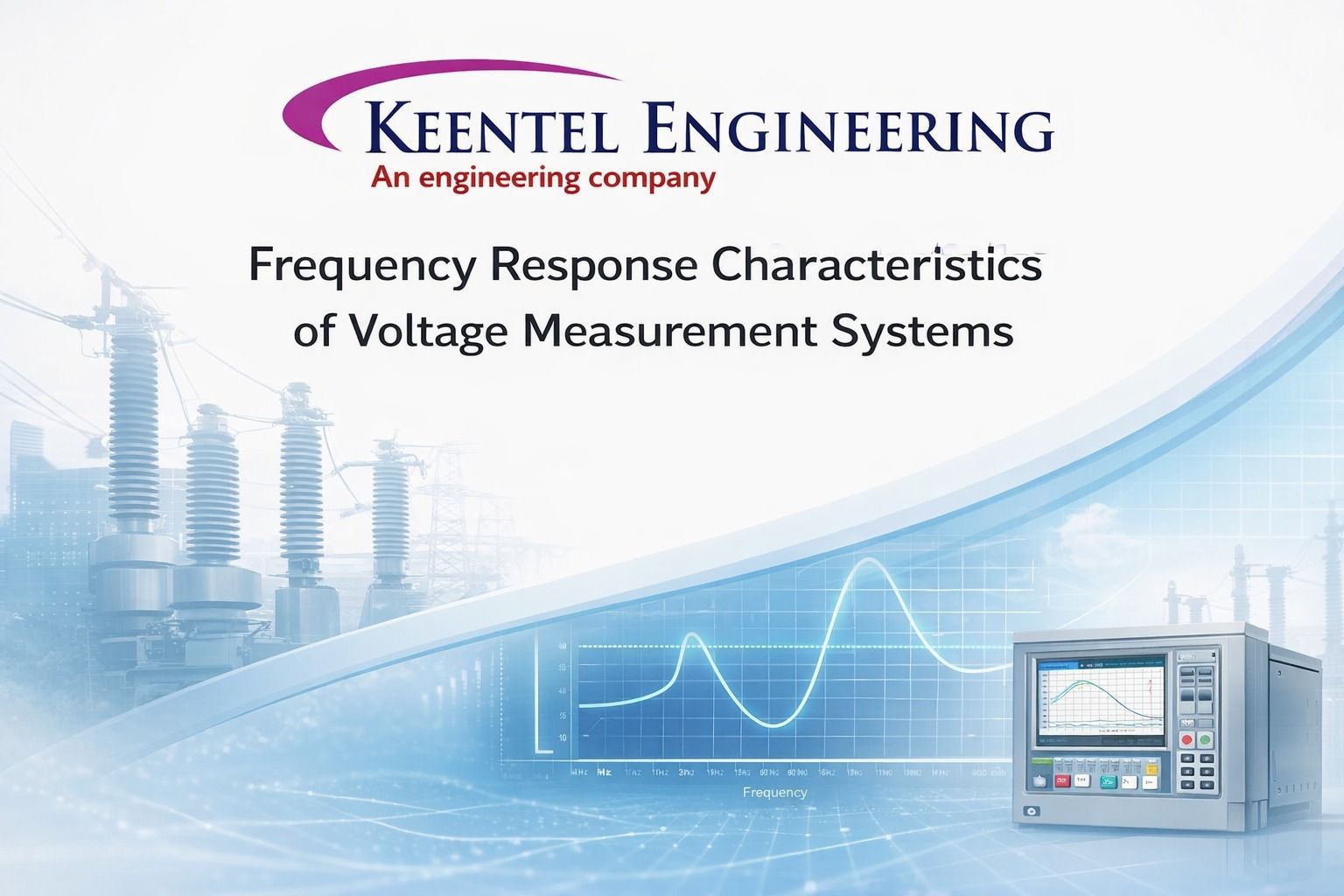
Frequency response characteristics of voltage measurement systems illustrated with substation and waveform analysis
Calendar icon. D

january 22, 2026 | Blog

Why Wideband Voltage Measurement Matters in Modern Power Systems

The global energy transition is fundamentally changing how transmission and distribution systems behave. High penetration of inverter-based resources (IBRs), power electronics, HVDC links, FACTS devices, and increasingly dynamic operating conditions have introduced voltage phenomena far beyond the traditional 50/60 Hz sinusoidal waveform. Harmonics, interharmonics, sub-harmonics, fast transients, and very fast transient overvoltages (VFTOs) are now part of normal grid operation.


At the center of this transformation lies the voltage measurement system the critical interface between the primary power system and secondary applications such as protection, control, metering, power quality monitoring, PMUs, and digital substations. If the frequency response of the voltage measurement system is not properly understood, verified, and documented, even the most advanced protection or monitoring scheme can produce misleading or unsafe results.


What Is a Voltage Measurement System?

A voltage measurement system is not just a voltage transformer. It is the entire measurement chain, which may include:

  • Primary voltage sensor (IVT, CVT, LPVT, optical sensor)
  • Intermediate converters or signal conditioning
  • Cabling and termination
  • Burden and connected secondary equipment
  • Digital interfaces and merging units (IEC 61869-9)

The overall frequency response is determined by the combined behavior of all these components not by the primary sensor alone.


Drivers for Wideband Frequency Response Requirements

1. Changes in the Primary Power System

Modern grids experience:


  • Increased harmonic distortion due to power electronics
  • Bidirectional power flows
  • Frequent switching events in GIS and AIS substations
  • Ferro-resonance and resonant overvoltages
  • Lightning and switching transients with frequency components up to hundreds of kHz


Voltage measurement systems must therefore reproduce signals far beyond rated frequency without unacceptable ratio error or phase displacement.


2. Expansion of Secondary Applications

Voltage signals are now used for:


Each application imposes different bandwidth and accuracy requirements, making frequency response identification essential.


Overview of Voltage Measurement Technologies

1. Inductive Voltage Transformers (IVTs)

Strengths:


  • High accuracy at rated frequency
  • Excellent long-term stability
  • High burden capability


Limitations:


  • Limited bandwidth due to core magnetics
  • Susceptibility to ferro-resonance
  • Resonance behavior at higher frequencies


IVTs are well suited for protection and metering at power frequency but require careful evaluation when used for harmonic or transient measurements.


2. Capacitor Voltage Transformers (CVTs / CCVTs)

Strengths:


  • Lower weight and cost at EHV levels
  • Integrated PLC capability
  • Established technology


Limitations:


  • Frequency-dependent accuracy
  • Significant resonance effects
  • Strong sensitivity to burden and damping systems


CVTs must be treated with caution for power quality and transient applications unless their frequency response is explicitly characterized.


3. Low-Power Instrument Transformers (LPIT / LPVT)

LPITs include resistive dividers, capacitive dividers, and optical voltage sensors.


Key advantages:


  • Wide bandwidth (from DC to tens or hundreds of kHz)
  • Linear response over wide voltage range
  • Ideal for digital substations and power quality


Challenges:


  • Sensitivity to termination and cabling
  • Dependence on secondary electronics
  • System-level testing is essential

Understanding Frequency Response Characteristics

Frequency-Domain Perspective


Frequency response describes how the magnitude and phase of the measured voltage change as a function of frequency. Key parameters include:


  • Ratio error versus frequency
  • Phase displacement versus frequency
  • First resonance frequency
  • Application bandwidth (e.g., 1%, 5%, or 10% error limits)


Time-Domain Perspective


Transient performance is equally important. Relevant parameters include:


  • Step response
  • Settling time
  • Peak overshoot
  • Reproduction of fast-front and very-fast-front transients


Time-domain and frequency-domain responses are mathematically equivalent and must be assessed together.


Identification Methods for Frequency Response

1. Mathematical (Model-Based) Identification

This approach uses equivalent circuit models:


  • White-box models based on physical design
  • Black-box models based on measured input-output behavior


Applications include:


  • Design optimization
  • Sensitivity analysis
  • Simulation of resonance phenomena


Keentel Engineering routinely applies such models to evaluate transformer suitability for power quality and EMT studies.

2. Measurement-Based Identification

Practical testing methods include:


  • Single-frequency sweeps
  • Multi-tone excitation
  • White-noise excitation
  • Impulse and step-response testing


These tests may be performed:


  • In high-voltage laboratories
  • Using low-voltage injection methods
  • On-site with mobile test systems


Measurement-based identification is essential for compliance verification and forensic investigations.


Influence Factors Engineers Must Consider

  • Burden magnitude and power factor
  • Secondary cable length and impedance
  • Temperature variation
  • Stray electric fields and grounding
  • Merging unit sampling and filtering
  • Ferro-resonance damping devices


Ignoring these factors can invalidate otherwise compliant laboratory results.


Technology-to-Application Mapping

Different applications require different measurement technologies:


  • Revenue metering → IVT or LPVT (rated-frequency accuracy)
  • Protection → IVT, LPVT with verified transient response
  • Power quality → LPVT with wideband class
  • PMU / WAMS → LPVT + digital interface
  • Transient studies → Resistive or optical LPVT


There is no universal solution engineering judgment is required.


How Keentel Engineering Supports Clients

Keentel Engineering provides end-to-end support for voltage measurement system performance, including:


Our experience spans HV, EHV, renewable interconnections, HVDC, and complex grid environments.


Frequently Asked Questions (FAQ)

  • 1. Why is rated-frequency accuracy no longer sufficient?

    Because modern grids contain significant harmonic and transient content that can distort measurements outside rated frequency.

  • 2. What is application bandwidth?

    It is the frequency range within which the measurement error remains within defined accuracy limits.

  • 3. Are CVTs suitable for power quality measurements?

    Only if their frequency response is verified and resonance effects are properly mitigated.

  • 4. Do LPVTs always provide better performance?

    They offer wider bandwidth, but system integration and termination are critical.


  • 5. What is the first resonance frequency?

    It is the lowest frequency at which resonance significantly affects measurement accuracy.

  • 6. How does burden affect frequency response?

    Burden impedance can shift resonance points and alter ratio and phase accuracy.

  • 7. Can merging units affect accuracy?

    Yes. Sampling rate, filtering, and synchronization directly influence wideband performance.

  • 8. Are IEC wideband accuracy classes mandatory?

    They are increasingly referenced in specifications and compliance programs.

  • 9. Can frequency response be assessed on-site?

    Yes, with appropriate test equipment and procedures.

  • 10. Is modeling alone sufficient?

    No. Models must be validated by measurement.

  • 11. How high in frequency must voltage be measured?

    Depending on application, from DC up to 150 kHz or higher.

  • 12. What role does ferro-resonance play?

    It can severely distort measurements and damage equipment if not mitigated.

  • 13. Can IVTs be used with digital substations?

    Yes, when paired with compliant merging units.

  • 14. What is white-noise excitation testing?

    A method that excites multiple frequencies simultaneously to extract frequency response.

  • 15. How does temperature affect accuracy?

    Temperature changes alter electrical parameters and resonance behavior.

  • 16. Are optical sensors immune to EMI?

    They are less susceptible but still require system-level validation.

  • 17. Why is phase accuracy important for PMUs?

    PMUs rely on precise phase alignment for synchrophasor calculations.

  • 18. Can CVTs be retrofitted for better performance?

    Adapters and damping solutions exist but must be carefully engineered.

  • 19. How often should frequency response be tested?

    At commissioning and after major system changes.

  • 20. How can Keentel help?

    By providing independent, standards-aligned engineering analysis and testing support.


Man in a blazer and open shirt, looking at the camera, against a blurred background.

About the Author:

Sonny Patel P.E. EC

IEEE Senior Member

In 1995, Sandip (Sonny) R. Patel earned his Electrical Engineering degree from the University of Illinois, specializing in Electrical Engineering . But degrees don’t build legacies—action does. For three decades, he’s been shaping the future of engineering, not just as a licensed Professional Engineer across multiple states (Florida, California, New York, West Virginia, and Minnesota), but as a doer. A builder. A leader. Not just an engineer. A Licensed Electrical Contractor in Florida with an Unlimited EC license. Not just an executive. The founder and CEO of KEENTEL LLC—where expertise meets execution. Three decades. Multiple states. Endless impact.

Four workers in safety vests and helmets stand with arms crossed near wind turbines.

Let's Discuss Your Project

Let's book a call to discuss your electrical engineering project that we can help you with.

Man in a blazer and open shirt, looking at the camera, against a blurred background.

About the Author:

Sonny Patel P.E. EC

IEEE Senior Member

In 1995, Sandip (Sonny) R. Patel earned his Electrical Engineering degree from the University of Illinois, specializing in Electrical Engineering . But degrees don’t build legacies—action does. For three decades, he’s been shaping the future of engineering, not just as a licensed Professional Engineer across multiple states (Florida, California, New York, West Virginia, and Minnesota), but as a doer. A builder. A leader. Not just an engineer. A Licensed Electrical Contractor in Florida with an Unlimited EC license. Not just an executive. The founder and CEO of KEENTEL LLC—where expertise meets execution. Three decades. Multiple states. Endless impact.

Leave a Comment

Related Posts

Keentel Engineering white paper cover on reevaluating IEEE and IEC substation standards for increase
By SANDIP R PATEL January 21, 2026
Professional white paper cover by Keentel Engineering on reevaluating IEEE and IEC substation standards, featuring an electrical substation under fault conditions.
Learn how PJM D-Curve reactive capability testing is performed for wind farms and inverter-based res
By SANDIP R PATEL January 15, 2026
Learn how PJM D-Curve reactive capability testing is performed for wind farms and inverter-based resources, including testing requirements, measurement basis, and eDART submission support.
Energy sector integration showing power grids, wind turbines, solar energy, and multi-energy system
By SANDIP R PATEL January 1, 2026
Explore how energy sector integration reshapes modern power grids, improving decarbonization, resilience, and system planning based on CIGRE TB 973 insights.
Diagram illustrating real-code EMT modeling for HVDC, FACTS, and inverter-based resources in power s
By SANDIP R PATEL January 1, 2026
Learn how IEEE/CIGRE real-code EMT modeling improves HVDC, FACTS, and inverter-based resource studies with higher fidelity, compliance accuracy, and tool-independent simulation.
A practical guide to upcoming NERC Reliability Standards (2026–2028), key effective dates, and compl
By SANDIP R PATEL December 29, 2025
A practical guide to upcoming NERC Reliability Standards (2026–2028), key effective dates, and compliance readiness for inverter-based resource owners.
Cover of a guide on ERCOT Model Quality Tests for IBR owners and developers, wit
By SANDIP R PATEL December 26, 2025
Complete technical guide to ERCOT Model Quality Tests (MQT) for inverter-based resources. Covers PRC-029-1, IEEE 2800-2022, PSCAD, SCR testing, and pass/fail criteria.
Graphic for PRC-030-1, event analysis for inverter-based resources. Solar farm, technicians monitoring data, equipment.
By SANDIP R PATEL December 26, 2025
PRC-030-1 compliance guide for Generator Owners covering IBR event analysis, corrective action plans, audit requirements, and post-disturbance obligations.
Power lines against a twilight sky with digital network lines overlayed, spanning an open field.
By SANDIP R PATEL December 19, 2025
A practical guide to NERC PRC-029-1 for inverter-based resource owners. Learn ride-through requirements, compliance timelines, exemptions, and how Keentel Engineering supports PRC-029-1 readiness.
Electrical substation with high-voltage equipment, wires, and insulators against a blue sky.
By SANDIP R PATEL November 26, 2025
Learn how to stay compliant with NERC PRC-004-6 and MIDAS reporting. Keentel Engineering provides misoperation analysis, CAP support, and audit-ready documentation.